The American lobster (Homarus americanus) is a large crustacean with a hard shell and two big claws. It lives on the sea floor of the cold northwest Atlantic.[1] Its range runs from Labrador in Canada to North Carolina in the USA, and its fishery is the largest lobster fishery in the world.[2] Females carry their eggs under the tail for 9 to 11 months, and the young float in open water before they settle on the bottom.[1][3] The IUCN rated the species Least Concern in a 2009 assessment, but a 2025 US stock assessment found the Southern New England stock significantly depleted.[2][4]
Quick facts
Description
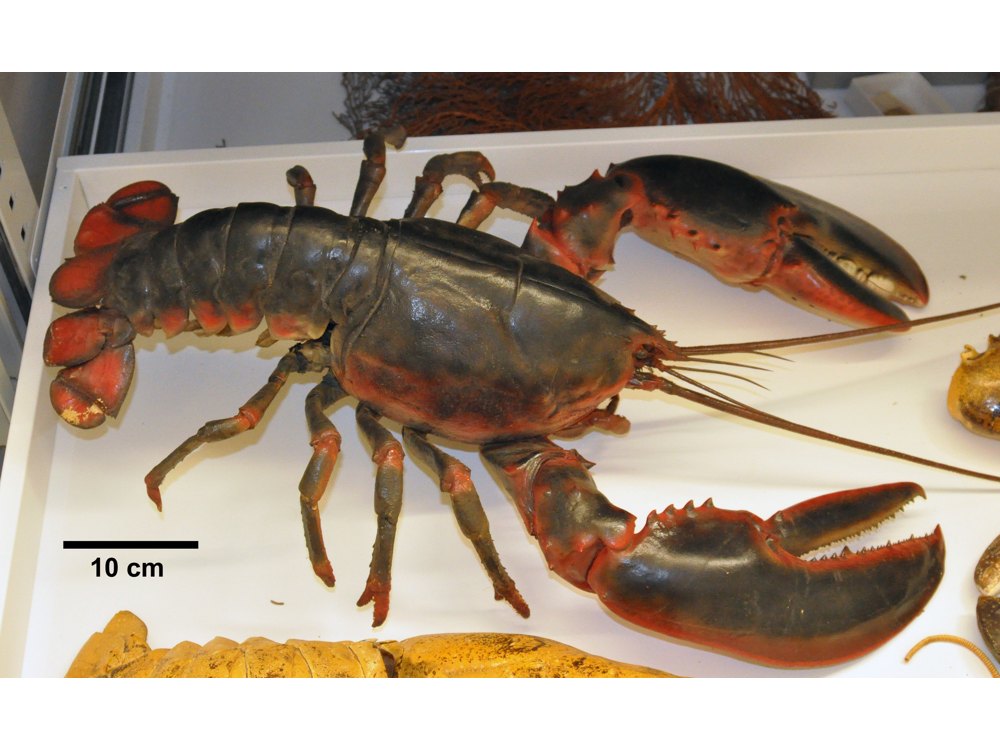
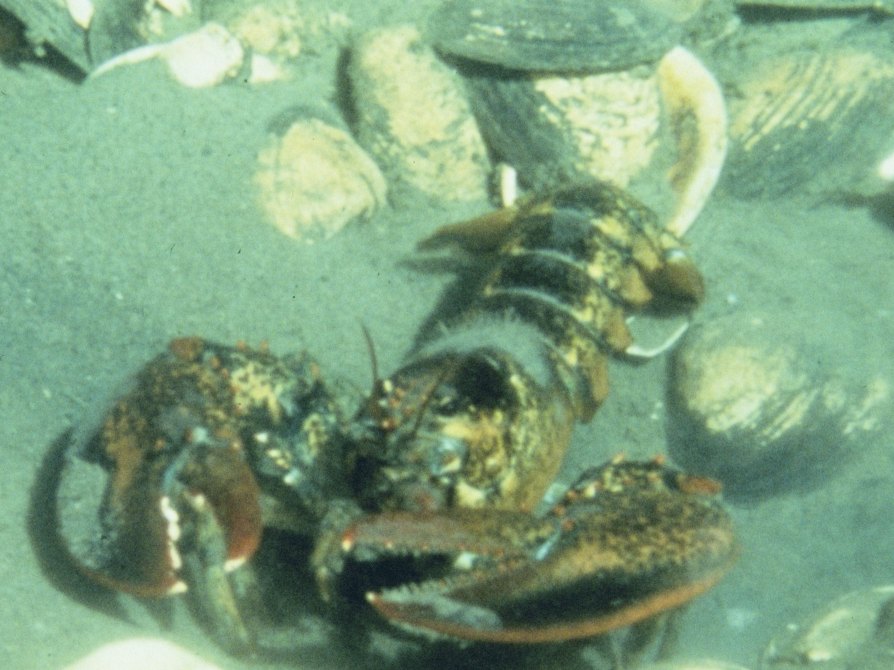
Live American lobsters are not red. Most are olive-green or greenish-brown, some with orange, reddish, dark green or black speckles and with bluish colours in the joints. Red appears only after the animal is cooked.[1][7]
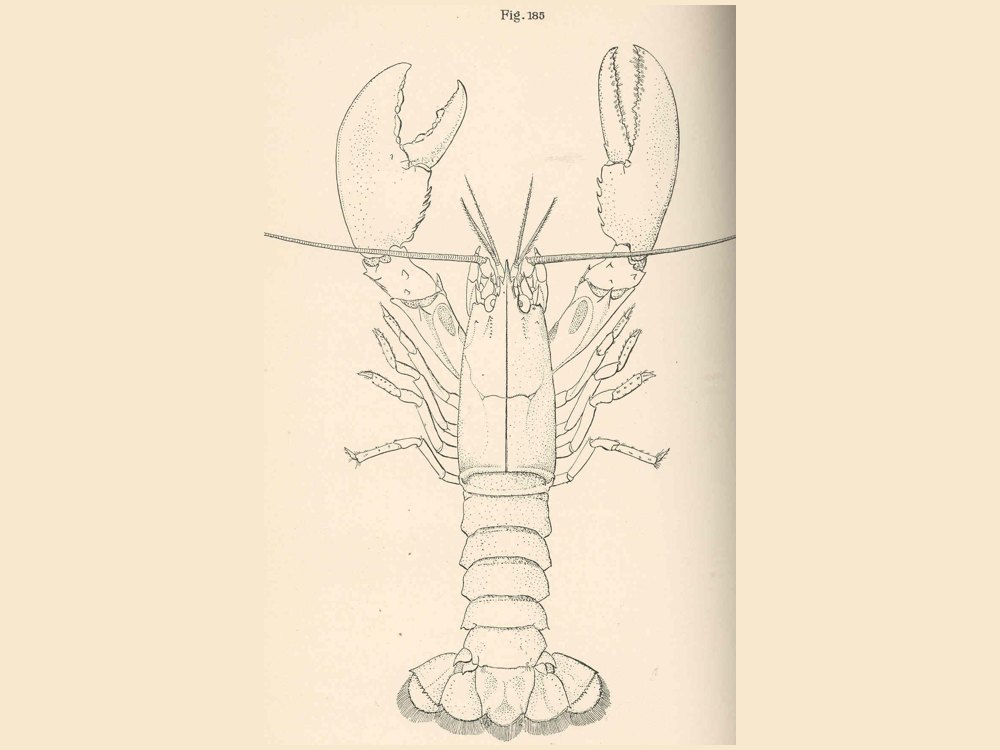
The body is covered by a hard shell, which a lobster sheds in order to grow.[1] The part of the shell over the head and chest is the carapace. Its length, measured from the back of the eye socket to the rear edge, is how lobsters are measured in fishery rules.[1] The two big front claws are different from each other in an adult: one is a slender, fast cutter and the other a stout, slow crusher.[5]

Name
The scientific name Homarus americanus was published by H. Milne Edwards in 1837, in volume 2 of his Histoire naturelle des Crustacés.[8][9] The genus name Homarus goes back to Weber in 1795, and its type species is the European lobster.[10] The type locality is Long Branch on the coast of New Jersey, USA.[11][9] The accepted English name is American lobster. The IUCN also lists Atlantic lobster and true lobster, and GBIF adds Maine lobster, northern lobster and Canadian lobster.[2][8]
In other languages
| Language | Name | Meaning |
|---|---|---|
| Mi’kmaq local | jagej | lobster |
| French | homard d’Amérique; homard américain | lobster of America; American lobster |
| German | Amerikanischer Hummer | American lobster |
| Dutch | Amerikaanse kreeft | American lobster |
| Spanish | bogavante americano | American lobster |
| Norwegian | amerikahummer | American lobster |
| Swedish | amerikansk hummer | American lobster |
| Danish | Amerikansk hummer | American lobster |
Meanings are literal translations of the words. The names come from national checklists listed in GBIF.[12] The Mi’kmaq name is from the Mi’gmaq-Mi’kmaq Online Talking Dictionary.
Body
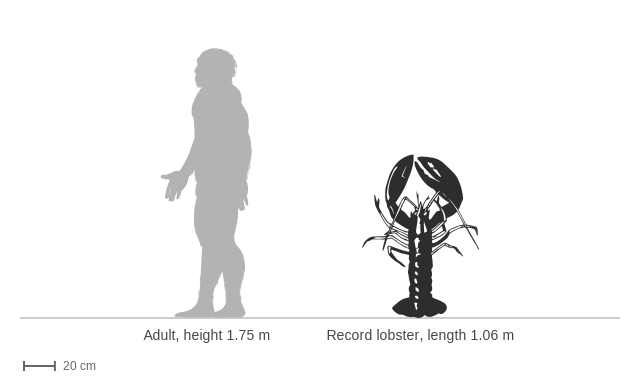
Fishery rules measure lobsters by carapace length. The legal minimum is about 3-1/4 to 3-3/8 inches and the maximum 5 to 6-3/4 inches, depending on the management area.[1] NOAA says American lobsters can weigh up to 44 pounds.[1] Guinness World Records lists the heaviest as a lobster of 20.14 kg (44 lb 6 oz) caught off Nova Scotia, Canada, on 11 February 1977. It measured 1.06 m from the end of the tail fan to the tip of the largest claw.[13] The FAO gives 250 mm as the usual length and says exceptional animals reach over 640 mm.[14] In 1899 Cobb listed some large Maine lobsters from the 1890s, among them a male of slightly over 23 pounds taken in Penobscot Bay on 6 May 1891 and a male of 25 pounds reported from off Criehaven on 7 September 1898, 25 inches from nose to tail tip and 45 inches with the claws.[15]
The record length is measured from the tail fan to the tip of the largest claw. Fishery size limits use carapace length instead.[13][1]
Size ranges
| Weight (heaviest) | 20.14 kg |
| Length (longest) | about 106 cm |
Claws
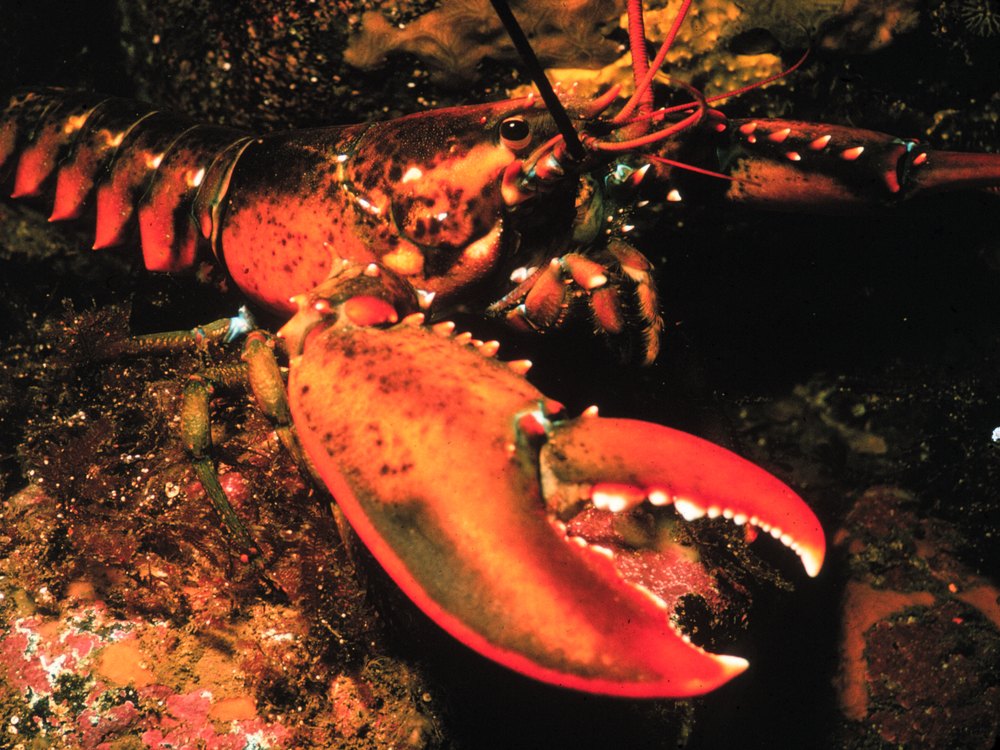
The two big claws start out as a matching pair. In the larval and early juvenile stages they work alike, and in later juvenile and adult stages they turn into a slender, fast-acting cutter and a stout, slow-acting crusher.[5] The muscles that close the claws become fixed as cutter or crusher type during the fourth and fifth juvenile stages. Crusher muscle has only slow fibres, and cutter muscle is mostly made of fast fibres.[6] A lobster can regrow a lost claw. If the claws are lost during the fourth to seventh juvenile stages, the regrown closing muscle is delayed in its development and is sometimes a mosaic of types.[6]
Sexes
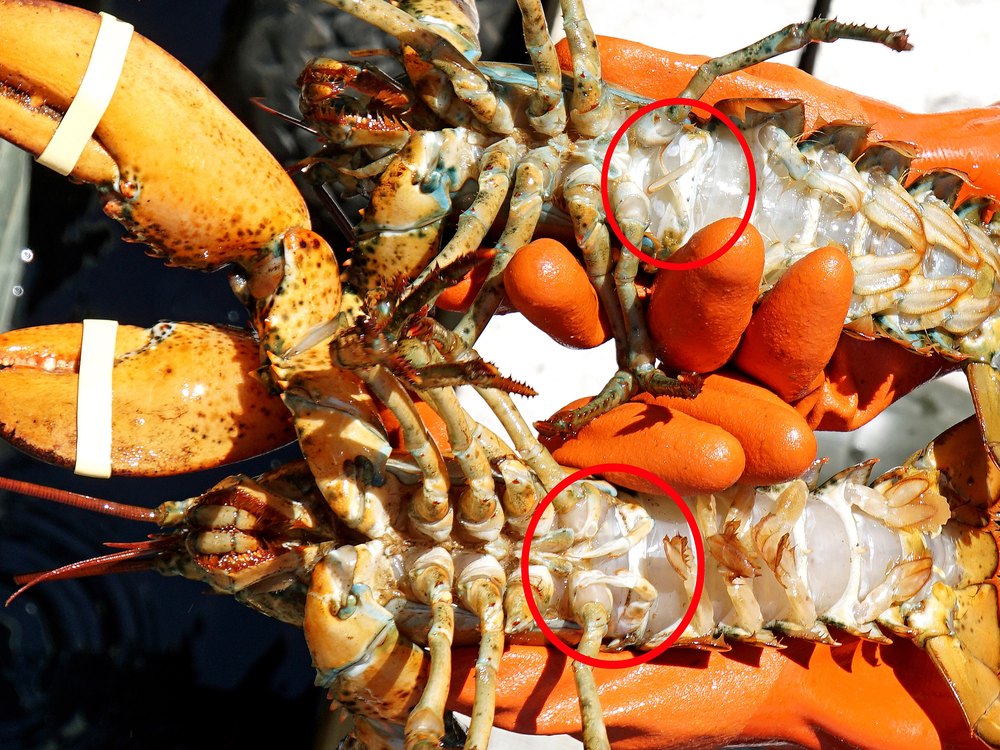
Females carry the eggs, which are glued to the swimmerets, the small paddle-like legs under the tail.[1][3] A female carrying eggs is called berried. In fishery science, a female’s maturity is judged from the width of her abdomen compared with her carapace length, from the cement glands that glue the eggs to the tail, and from the state of the ovaries.[16]


Behavior
Shelter and territory
The American lobster lives alone on the sea floor and defends its territory. It needs a burrow or crevice for cover, and coastal animals prefer rocky ground and sometimes dig burrows in mud.[1] Lobsters are most active at night.[1][3] A lobster usually stays within a home range of about 5 to 10 km².[3] In a field study, lobsters hid under algae, rocks and boulders. Some changed shelter often, while others stayed in one for up to ten weeks.[17][18]
Movement
Whether lobsters migrate depends on the stock. The ASMFC says large, mature offshore lobsters make seasonal moves inshore to reproduce, that in southern inshore areas large lobsters may move to deeper, cooler water for part of the year or for good, and that in winter some move deeper to avoid near-freezing inshore water.[3] NOAA says small coastal lobsters travel little and larger ones may travel far, and that offshore lobsters migrate in spring over 50 to 190 miles.[1] The FAO says migration does not occur, or occurs only on a limited scale.[14]
Temperature
Lobsters of all life stages are found from −1 °C to over 25 °C. In laboratory tests they avoided water below 5 °C and above 18 °C, and preferred 16 °C. Several days above 20 °C cause breathing stress and a weaker immune system, and heart and breathing rates at least double with each rise of 10 °C.[3]
Fights and mating
Studies in laboratory tanks and mesocosms show that lobsters fight and form stable pecking orders, called dominance hierarchies.[18] In a pool of 180 m² holding 30 lobsters, fights were much rarer than in small tanks, large males started most encounters, and dominant lobsters won more often when defending their shelter.[19] Males compete for territory and for mates, and the locally dominant male keeps a shelter and may mate with several females.[18]
Sound
Lobsters can make a low buzz. They tense two muscles at the base of the second antenna at the same time, which shakes the carapace and gives off sound in the water. In a laboratory study the average frequency was 183.1 Hz (range 87 to 261 Hz), and each buzz lasted 68 to 1,720 ms, on average 277.1 ms. Lobsters of all sizes and both sexes buzzed when startled, grasped or threatened. The purpose of the buzz is not known.[20]
Moulting
A lobster grows by shedding its hard shell, a process called moulting. Between hatching and reaching legal size, which takes 5 to 8 years, it moults about 20 to 25 times.[1] After a moult the lobster eats a great deal, often including its own cast-off shell, which gives back calcium and helps the new shell harden.[1] Before a moult, juveniles and adults are more sensitive to low oxygen and to heat.[3]

Diet
The American lobster is an opportunistic feeder, and its diet changes from region to region. Adults eat crabs, molluscs, worms, sea urchins, sea stars, fish and seaweed.[1] The FAO describes the food as mainly bottom-living fishes, crustaceans, molluscs and other invertebrates.[14] Larvae and postlarvae eat zooplankton, the tiny animals that drift in open water, during their first year.[1] In a 2025 study of postlarvae in the Gulf of Maine, most of the prey was arthropods, and copepods, including Calanus finmarchicus, were suspected to be a main part.[21]
A lobster also eats its own moulted shell.[1][7] In captivity lobsters have been recorded eating other lobsters.[7]
Life cycle
| Stage | Age / time | Notes |
|---|---|---|
| Egg | Carried 9 to 11 months | 5,000 to over 100,000 eggs, depending on the size of the female[1][3] |
| Larva | Drifts for 20 to 100 days | Three larval stages and then the postlarva, the fourth stage[3][1] |
| Juvenile | 20 to 25 moults over 5 to 8 years | Until legal size and reproductive age[1] |
| Adult | Females mature at 79 to 92 mm carapace length | Offshore females, by region[16] |
Mating and eggs
Mating usually follows a moult of the female. The male places sperm on the soft-shelled female, who stores it. NOAA gives the storage time as up to a year, and the ASMFC as two years.[1][3] The eggs are fertilised as they leave the body and stick to the swimmerets under the tail, where the female carries them for 9 to 11 months before they hatch.[1][3] A female lays between 5,000 and more than 100,000 eggs, depending on her size.[1] The eggs hatch mostly from mid-May to mid-July, when the water rises above 12.5 °C.[3] In one Newfoundland study, hatching was in July and August.[22] Egg-bearing females move inshore to hatch their eggs in late spring or early summer.[1]
A female normally breeds on a two-year cycle: she moults and mates in summer, lays eggs about a year later, and after the eggs hatch she moults and mates again a year later. Some females, usually ones spawning for the first time, moult and lay eggs in the same year.[22]
Larvae and postlarva
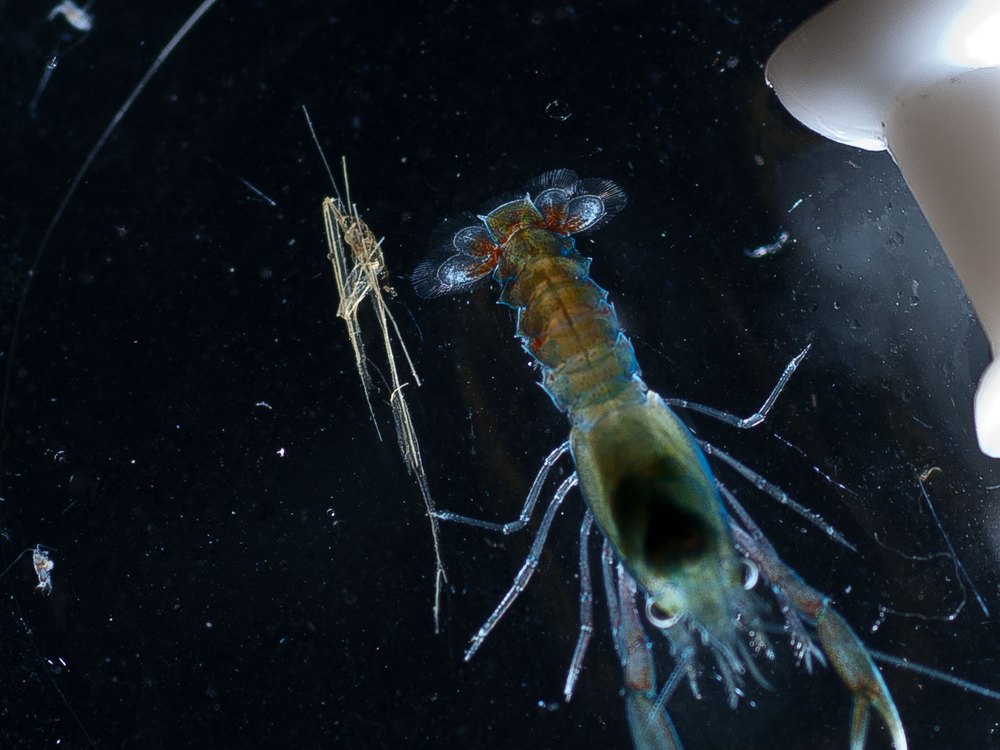
The newly hatched young are larvae. They float in open water, carried by the currents among the plankton, the tiny plants and animals that drift in the sea. They moult four times before they look like small adults and settle on the bottom, which takes 20 to 100 days depending on the water temperature.[3][1] The first three stages are larvae, and the fourth stage is the postlarva, the one that settles.[3] Postlarvae choose places warmer than 12 °C, and settling has been reported as deep as 80 m.[23] They settle mostly in shallow water less than 30 m deep, in cobble and boulder habitats.[2] The settling ground can also be gravel, often with algae, salt-marsh peat, eelgrass, seaweed or firm mud, in any place with enough structure for burrows.[3]

Growing up
A young lobster reaches reproductive age and legal size after 20 to 25 moults over 5 to 8 years, and the age differs with temperature.[1] In a study of 734 offshore females, the size at which half were mature was 79 mm carapace length in the south, 82 mm in the middle region and 92 mm in the north, on Georges Bank and in the offshore Gulf of Maine. Warmer water gave smaller sizes: the three regions had 808, 999 and 234 annual degree-days over 8 °C, a measure of how much warmth the water has in a year.[16] The IUCN gives a generation length of 9 to 10 years.[2]
Lifespan
A lobster sheds its whole shell, so scientists long had no direct way to read its age. A 2012 study found growth bands in the eyestalk and in a part of the stomach called the gastric mill of shrimps, crabs and lobsters. Comparison with independent age estimates strongly suggests that the bands form once a year, and chemical tags placed in the shell lasted through one or two moults.[24]
Ecology
Predators
A variety of bottom-dwelling animals eat lobsters, including fish, sharks, rays, skates, octopuses and crabs. Young lobsters are especially at risk.[1]
Shell disease
Epizootic shell disease is a disease of the shell. It appeared in southern New England near the end of 1996 and was first documented in Rhode Island waters in 1997.[25] Deep, dark lesions start on the back of the carapace just behind the rostrum, the pointed snout, and can spread over the whole back.[25] A lobster can shed a damaged shell when it moults, but if bacteria eat right through the shell the lobster can die.[26] Large lobsters were the first to show signs, especially egg-bearing females, which keep their shells longer between moults. In Narragansett Bay the disease was most common around the moults in late spring and early autumn.[25] A 2012 review put the share of lobsters affected in southern New England at 10 to 40%, depending on the place and the year.[25] In the nearshore Southern New England stock about 30% of lobsters had it in the 2009 IUCN assessment, which says the problem is limited to warmer water.[2] In the 2025 US stock assessment, shell disease was increasing in some areas of the Gulf of Maine and Georges Bank but still low compared with Southern New England.[4]
The cause is not settled. Two kinds of bacteria are common in the lesions, and they also live, in smaller numbers, on lobsters without the disease. The review describes the disease as opportunistic, striking lobsters that are already weakened, for example by injury. In aquarium tests lesions formed at 10, 15 and 20 °C, and were worst at 15 °C, so warm water alone does not explain the disease.[25] The Southern New England stock fell sharply as the disease spread, and the authors treat the disease as one of several linked factors, not as a proven single cause.[25]
The 1999 die-off in Long Island Sound
In late summer and autumn 1999, large numbers of dead and dying lobsters of all sizes were reported in western Long Island Sound, in Connecticut and New York. Commercial landings in the western Sound fell by as much as 99% from the year before. Landings from the whole Sound had peaked at 11.7 million pounds in 1997, dropped to 2 to 4 million pounds a year for the next three years, and reached 1.58 million pounds in 2003.[26] Shell disease was not the cause. Bottom water had been 1 to 2 °C warmer than average for many months in 1998 and 1999, above the 20 °C (68 °F) at which lobsters become stressed. Researchers concluded that lobsters at record numbers were weakened by this heat, and that many died of an infection with an amoeba, Neoparamoeba pemaquidensis.[26][27] Of the dead lobsters examined at the height of the die-off, 94% (29 of 31) were infected.[26] NOAA also links die-offs in Long Island Sound to warmer water, low oxygen (hypoxia) and other stress, and says warming may push lobsters toward cooler offshore water.[1]
Traps and whales
The trap and pot fishery for American lobster in the northeast and mid-Atlantic USA can entangle large whales by accident.[1] Lost traps can keep catching lobsters, and rules require biodegradable escape panels.[1]
Habitat and range
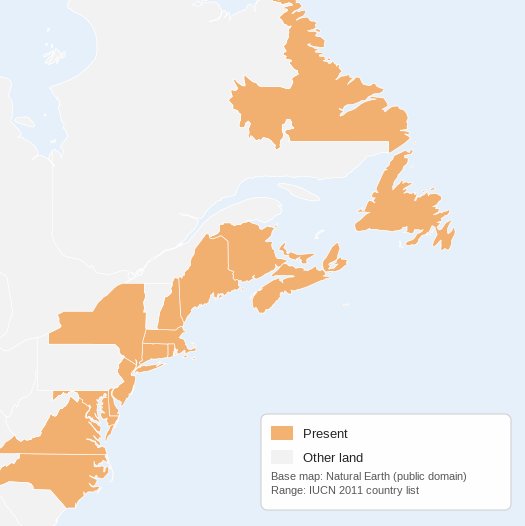
The American lobster lives in the northwest Atlantic Ocean. NOAA gives the range as Labrador to Cape Hatteras, and the IUCN as Labrador, Canada, to North Carolina, USA.[1][2] SeaLifeBase says Newfoundland to North Carolina.[28] It is most abundant in coastal waters from Maine through New Jersey.[1] The IUCN lists it as native in Canada (Labrador, New Brunswick, Newfoundland, Nova Scotia and Prince Edward Island) and in many US states, including Connecticut, Delaware, Maryland, Maine and Massachusetts.[2]
It lives in many kinds of seabed as long as there is a burrow or crevice for cover.[1] The IUCN says it is found most often on rocky reefs, and also on gravel, sand, sandy mud, mud, seaweed beds and seagrass. It is most common between 0 and 50 m deep, and at 700 m it lives in burrows in the walls of submarine canyons.[2] NOAA says offshore lobsters live as deep as 2,300 feet, and SeaLifeBase gives a depth range of 0 to 480 m.[1][28] The usual temperature range is 5 to 20 °C, and the species tolerates 1 to 30.5 °C.[2]
Outside its native range, the IUCN lists Norway, where specimens found since 2005 are thought to come from imported animals, as introduced. Records from Iceland in the 1960s were not confirmed by genetic tests.[2]

Evolution
Decapods, the order that holds lobsters, crabs, shrimps and crayfish, are old. A 2019 study of 94 species put the root of the order in the Late Ordovician, about 455 million years ago (range 412 to 512), and found that most living branches split in the Triassic and Jurassic. In the same study the branch that holds clawed lobsters and crayfish split in the Pennsylvanian, and the clawed lobster family split in the Early Jurassic.[29] The lobster-like decapods do not form a single evolutionary group.[30]
The American lobster and the European lobster, Homarus gammarus, share a genus. A 2026 genome study dated their split to about 26 million years ago (range 22 to 30), near the end of the Oligocene and start of the Miocene. The same paper quotes earlier estimates of 18 million years and 100.9 million years.[31]
A 2018 review counted two living species of Homarus and six fossil ones. The oldest fossil species comes from the Early Cretaceous, and the genus is then not known again until the Paleogene. A new species from the late Oligocene of Hungary is the fourth Oligocene nephropid lobster known, and all four are Homarus from western Europe. Clawed lobsters living on continental shelves were most diverse in the Late Cretaceous.[32]
Forms and variants
No subspecies is listed for the American lobster, and the IUCN gives only synonyms.[2]
Colour forms
Blue, yellow and very pale lobsters are sometimes seen, and some end up in aquariums.[33] They are colour variants of the same species as the usual olive-green lobster.
Conservation
The IUCN lists the American lobster as Least Concern. The assessment was made on 3 December 2009 and published in 2011, and the Red List marks it as needing an update. It gives these reasons: a broad geographic range, many habitat types and no significant overall decline. The slight declines seen near shore in Southern New England seem to be linked to warm water, low oxygen and shell disease, which may relate to climate change. The population trend in that assessment was stable.[2]
The 2025 benchmark assessment for the USA, accepted by the ASMFC, found a different picture in each stock. The Gulf of Maine and Georges Bank stock is not depleted, but it has fallen 34% since the peak in 2018, and overfishing is occurring. Its average abundance in 2021–2023 was 202 million lobsters.[4] The Southern New England stock is significantly depleted, with record low numbers at all life stages. Its average abundance in 2021–2023 was 6 million lobsters, against a threshold of 18 million, the lowest on record.[4] Landings in Southern New England peaked at 21.8 million pounds in 1997 and fell to 1.7 million pounds in 2023.[4] The assessment names temperature as the main influence, and its review panel warned against placing too much weight on environmental effects and ignoring the effects of fishing.[4]
Threats
Climate changeDiseaseFishing gear[2][4][1]Climate change. The range is shifting with warming water at some of the fastest rates in the world.[4]
Fishing gear. The IUCN lists fishing for food as an ongoing threat with unknown scope and severity.[2]
Management
In the USA the ASMFC manages the three stocks, Gulf of Maine, Georges Bank and Southern New England. In Canada, according to the IUCN assessment, the fishery is managed through 28 inshore lobster fishing areas and one offshore area.[2] Rules vary by area and include closed seasons and areas, a ban on removing berried females, minimum legal sizes, limits on gear and the number of vessels, and annual quotas.[2] In US waters a berried female may not be kept, and in most areas she must be notched with a V shape in the tail fin before release, so that she can be recognised later. Traps must have escape vents and biodegradable panels.[1] In the Gaspé lobster areas 19 to 21 in Canada the minimum carapace length is 83 mm in area 19 and 82 mm in areas 20 and 21, and the fishing season lasts about ten weeks.[34]
History and culture
Fishery
The American lobster supports the largest commercial lobster fishery in the world.[2] The IUCN assessment lists it as a food species used nationally and internationally.[2] The Gulf of Maine fishery has made up 82% of US landings since 1982, and Georges Bank 5%.[4]
In Maine, the lobster trade by boat began early. In 1841 Captain E. M. Oakes began carrying lobsters from Harpswell to Boston in a 41-ton well-smack, the Swampscott, and carried 35,000 lobsters in ten trips that season.[15] Canning was first tried at Eastport shortly after 1840 and made to work in 1843.[15] Fishermen first used hoop-net pots, then lath pots, and from about 1865 they set pots on trawls.[15] The average Maine fisherman used 56 pots in 1880 and 50 in 1898.[15] The Maine catch in 1898 was 11,183,294 pounds, valued at $992,855. The catch rose until 1889 and then fell until it was lower in 1898 than in 1880, while the number of fishermen and pots kept rising. The average price per pound rose from 1.9 cents in 1880 to 8.9 cents in 1898.[15] The last canneries closed in 1895 after a minimum length of 10½ inches was fixed.[15]
The US Fish Commission also hatched lobsters. By Cobb’s account, it planted 36,925,000 fry in Maine waters in 1899, hatched from the eggs of berried females bought from fishermen.[15]
Folklore
The story that servants or prisoners were fed lobster only a few times a week has no documents behind it. Food writer Sandy Oliver found that the earliest telling of the tale in her sources, from 1893, was about salmon, and that it moved to lobster only in the 1900s.[35]
Taxonomy
| Rank | Name |
|---|---|
| Kingdom | Animalia |
| Phylum | Arthropoda |
| Subphylum | Crustacea[9][36][37] |
| Class | Malacostraca |
| Order | Decapoda |
| Family | Nephropidae (clawed lobsters) |
| Genus | Homarus Weber, 1795[10] |
| Species | Homarus americanus (H. Milne Edwards, 1837)[8][9][36][37] |
Synonyms (3)
| Name |
|---|
| Astacus marinus (Say, 1817) |
| Astacus americanus (Stebbing, 1893) |
| Homarus mainensis (Berrill, 1956) |
From the GBIF backbone.[12]
Higher classification
The American lobster belongs to the family Nephropidae, the clawed lobsters, in the order Decapoda, which also holds crabs, shrimps and crayfish.[9] The genus Homarus has two living species, this one and the European lobster, Homarus gammarus (Linnaeus, 1758), which is also the type species of the genus.[11][32] Crustacea is a subphylum in WoRMS, ITIS and the Catalogue of Life, but genetic studies place the insects inside the crustacean family tree, so the group is a traditional one.[9][36][37][38][39] Above the order, WoRMS and ITIS use the group Eucarida, which a 2023 genetic study rejected.[9][36][38]
Hybrids with the European lobster
The two Homarus species can be crossed in captivity. A 2020 study reports that one earlier report found the sperm packets of captive-reared hybrid males held no sperm, while another reported that both sexes of hybrid offspring were fertile.[40] The same study described a case in the wild: an American lobster female carrying eggs, caught in the Gullmar fjord in Sweden in October 2016, whose clutch gave 30 larvae.[40] The American lobster has reached European waters through introductions, so the two species can meet there.[9] For the age of the split between the two species, see Evolution.
Sources
- NOAA Fisheries, American lobster species page
- Wahle, Butler, Cockcroft & MacDiarmid 2011, IUCN Red List assessment of Homarus americanus
- Atlantic States Marine Fisheries Commission, American Lobster Life History and Habitat Needs (2017)
- Atlantic States Marine Fisheries Commission, news release on the 2025 American lobster benchmark stock assessment (30 October 2025)
- Govind 1984, Biological Bulletin 167: 94–119
- Govind, Gee & Pearce 1991, Biological Bulletin 180: 28–33
- Animal Diversity Web, Homarus americanus
- GBIF backbone, Homarus americanus
- WoRMS / DecaNet, Homarus americanus
- Naturalis, marine lobsters database, genus Homarus
- Naturalis, marine lobsters database, Homarus americanus
- Names in other languages: GBIF vernacular names, which draw on national checklists (France, Norway, Sweden, Denmark) and on the Catalogue of Life and WoRMS
- Guinness World Records, heaviest marine crustacean
- Virginia Institute of Marine Science, American lobster page (quoting FAO)
- Cobb 1899, The Lobster Fishery of Maine, Project Gutenberg
- Size at maturity of offshore female lobsters, Journal of Crustacean Biology 2005
- Karnofsky, Atema & Elgin 1989, Biological Bulletin 176: 239–246
- Review of lobster biology and welfare, Animals 2025
- Karnofsky & Price 1989, Marine Behaviour and Physiology
- Henninger & Watson 2005, Journal of Experimental Biology 208: 3421–3429
- Diet of lobster postlarvae in the Gulf of Maine, PLOS ONE 2025
- Ennis 1984, “Incidence of molting and spawning in the same season in female lobsters”, Fishery Bulletin 82(3) (NOAA)
- Oppenheim et al. 2019, “The cresting wave”
- Kilada et al. 2012, Canadian Journal of Fisheries and Aquatic Sciences 69
- Castro, Cobb, Gomez-Chiarri & Tlusty 2012, “Epizootic shell disease in American lobsters Homarus americanus in southern New England: past, present and future”, Diseases of Aquatic Organisms 100:149–158
- Balcom & Howell 2006, Responding to a Resource Disaster: American Lobsters in Long Island Sound, 1999–2004, Connecticut Sea Grant
- Pearce & Balcom 2005, “The 1999 Long Island Sound lobster mortality event: findings of the comprehensive research initiative”, Journal of Shellfish Research 24:691–697
- SeaLifeBase, Homarus americanus
- Wolfe et al. 2019, Proceedings of the Royal Society B 286: 20190079
- Bracken-Grissom et al. 2014, Systematic Biology 63: 457–479
- Paris et al. 2026, Genome Biology and Evolution
- Tshudy, Hyzny, Dulai & Jagt 2018, Journal of Paleontology 92: 170–182
- Wikimedia Commons files Blue Lobster.jpg, Yellow-lobster.jpg and Light blue Homarus americanus at Osaka aquarium 01.jpg
- Fisheries and Oceans Canada, integrated fisheries management plan for lobster, Gaspé (LFAs 19–21)
- Sandy Oliver 2015, The Working Waterfront, Island Institute
- ITIS, Homarus americanus (TSN 97314)
- Catalogue of Life (ChecklistBank), Homarus americanus
- Bernot et al. 2023, Molecular Biology and Evolution
- Lozano-Fernández et al. 2019, Genome Biology and Evolution
- Ellis et al. 2020, “Crossing the pond: genetic assignment detects lobster hybridisation”


