The Atlantic Horseshoe Crab (Limulus polyphemus) is a hard-shelled sea animal of the Atlantic and Gulf coasts of North America. It is not a crab. It is a chelicerate, in the same subphylum as spiders and scorpions.[1][2][3][4] Every spring, adults come onto sandy beaches at high tide to spawn, and the female buries her eggs in the sand.[5][6] Its blue blood is the source of LAL, a test for bacterial endotoxin used on injectable drugs.[7] A 2017 status review by the IUCN assessors concluded that the species is vulnerable, with a higher risk in some regions.[8]
Quick facts
Description
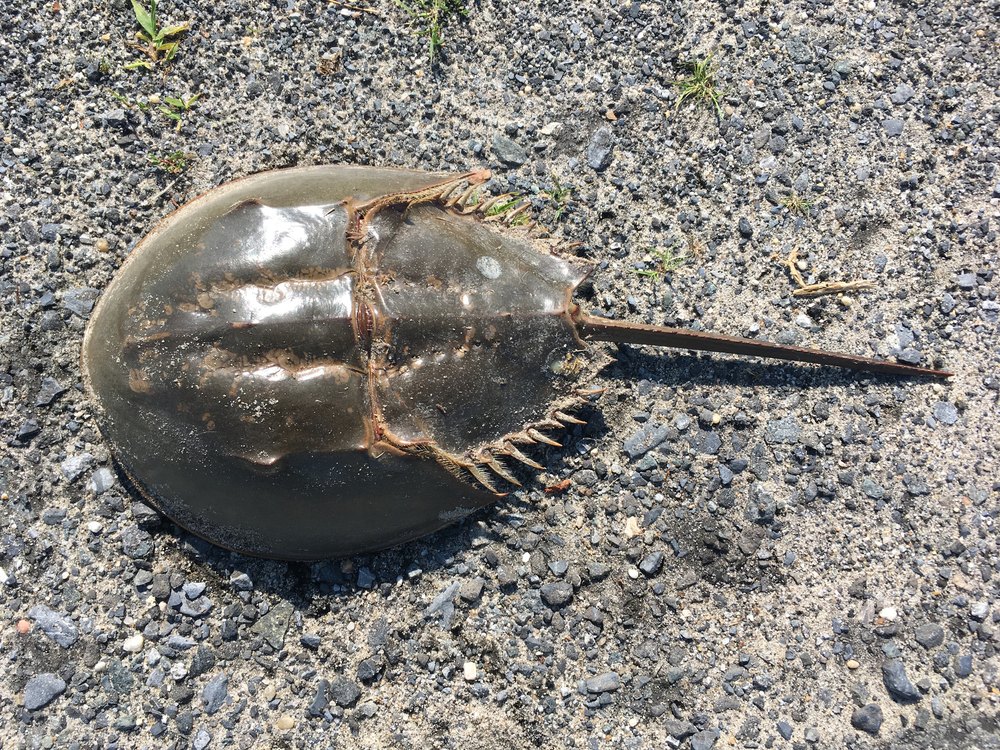
The body has three parts: a horseshoe-shaped front shield called the prosoma, a hinged rear part called the opisthosoma, and a long tail spine called the telson. The rear part can flex up to 90 degrees at the hinge.[10] The shell is hard and brown.[11] A pair of large compound eyes sits on the sides of the front shield, and two small median eyes sit near the front (see Body).[10][12]
The underside has five pairs of walking legs. The last pair is called the pusher legs. They are used for digging and pushing off, and in females also for shaping eggs into clusters. In adult males, the claws on the first pair of legs are modified into clasps that hold a female during spawning. In front of the mouth is a pair of small feeding claws, the chelicerae, and the mouth lies between the leg bases. A pair of paddle-shaped structures, the chilaria, pushes food to the mouth.[10][13] Behind the legs are five pairs of plate-like book gills.[10]
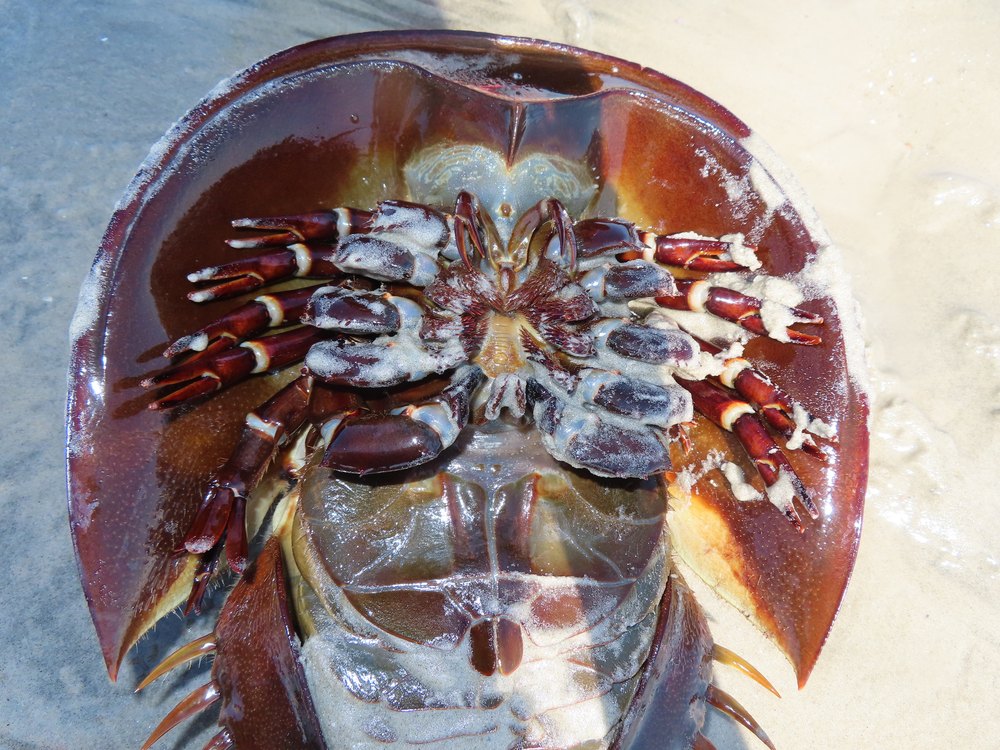
Females are larger than males, and the size differs between regions (see Body).[14]
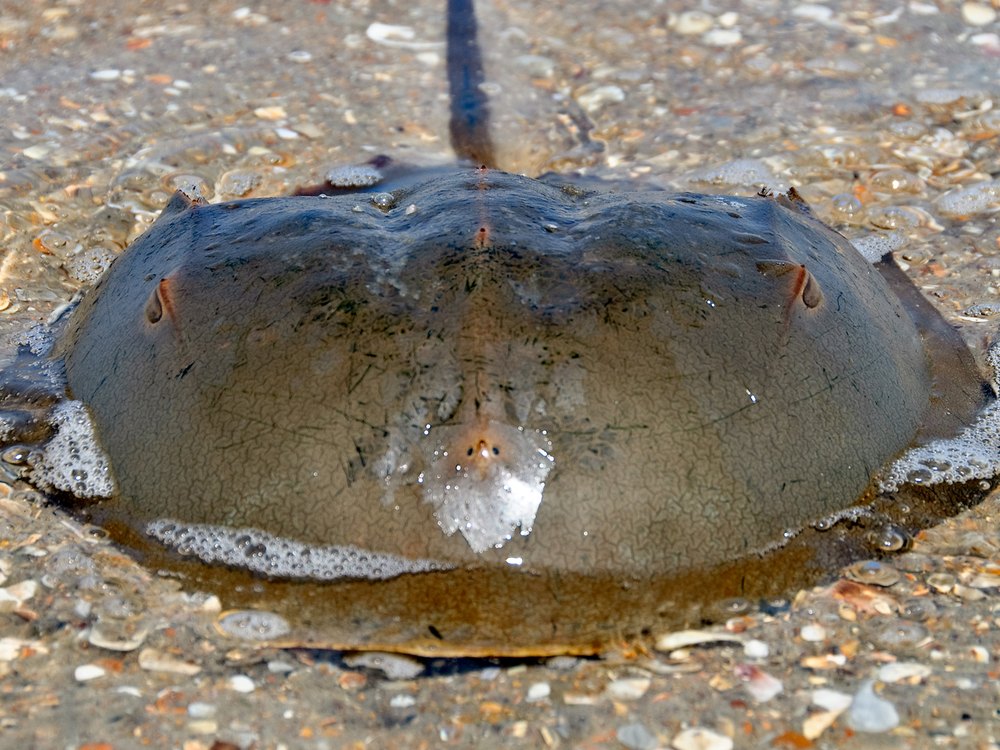
Name
“Atlantic Horseshoe Crab” is the common name used on this page. The species is also called the American horseshoe crab, a name used in the scientific literature, ITIS and the Catalogue of Life, and the Catalogue of Life also lists “king crab”.[8][1][3]
A horseshoe crab is not a crab. Crabs are crustaceans. Horseshoe crabs are chelicerates, in the same subphylum as spiders and scorpions, and Lankester showed in 1881 that they are closer to arachnids than to crustaceans.[1][9]
The scientific name is Limulus polyphemus (Linnaeus, 1758). Linnaeus first published it as Monoculus polyphemus, and the genus Monoculus was later suppressed.[2] The genus name Limulus was given by O.F. Müller in 1785.[1][3] Limulus is Latin for “somewhat askance”.[15] Wikipedia says that polyphemus refers to Polyphemus, the one-eyed giant of Greek myth, and that the name rests on the mistaken idea that the animal has one eye. The reason Linnaeus gave was not found.[16]
In other languages
| Language | Name | Meaning |
|---|---|---|
| French | limule atlantique | Atlantic limulus |
| Spanish | cangrejo herradura del Atlántico | Atlantic horseshoe crab |
| Dutch | Atlantische degenkrab | Atlantic sword crab |
| Swedish | dolksvans | dagger tail |
| Chinese | 美洲鱟 | American horseshoe crab |
| Japanese | アメリカカブトガニ | American horseshoe crab |
| Korean | 대서양투구게 | Atlantic horseshoe crab |
These names come from the Catalogue of Life, through the GBIF list of vernacular names. It is one aggregated database, and native speakers have not checked the names.[3][4] Some of them are also used for horseshoe crabs in general.
Body
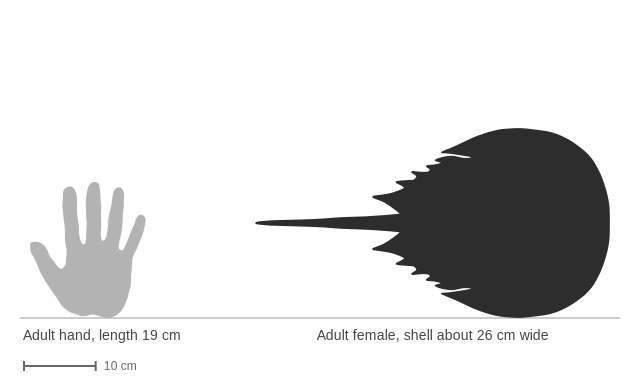
Size
Size is given as the width of the prosoma, the horseshoe-shaped front shield, and not as total length with the tail. No measured total length was found. Females are larger than males. In Delaware Bay, the average width of mature females is 264 to 267 mm, and that of mature males is 207 mm. Females are about 1.26 to 1.29 times as wide as males.[14][17] In Pleasant Bay on Cape Cod, adult males averaged 17 ± 1% smaller than females.[5]
| Place | Male width, mm | Female width, mm | Male weight, kg | Female weight, kg |
|---|---|---|---|---|
| New Jersey, Delaware Bay | 207 (160–254) | 264 (220–314) | 1.12 (0.51–2.04) | 2.66 (1.02–4.25) |
| Delaware, Delaware Bay | 207 (175–245) | 267 (225–325) | 1.03 (0.61–1.53) | 2.42 (1.48–4.40) |
| Mid-Atlantic shelf, New York to Virginia | 209 (172–292) | 264 (181–321) | 1.02 | 2.55 |
| Connecticut | 195 (100–300) | 249 (150–370) | 1.06 | 2.56 |
| Massachusetts, Pleasant Bay | 179 (120–235) | 229 (170–295) | not measured | not measured |
| Massachusetts, Plum Island Sound | 118 (97–140) | 155 (126–199) | not measured | not measured |
| New Hampshire, Great Bay | 127 (108–159) | 154 (140–178), 12 animals | 0.23 (0.14–0.44) | 0.61 (0.33–0.88) |
| Maine, Medomak River | 158 (139–182) | 201 (180–219) | not measured | not measured |
| Florida, Gulf coast (Bald Point and Ochlockonee) | 174 (154–201) | 231 (208–272) | not measured | not measured |
Averages for mature animals, with the range in brackets. The table in the paper gathers spawning surveys, a fishery sample, a trawl survey and older studies, so each row is only as good as its original. The Connecticut weights are from about 70 animals of each sex, and no range was given. The Florida rows are from the Gulf coast.[14]
The authors conclude that crabs between Rhode Island and South Carolina are larger and heavier than crabs from Maine, New Hampshire, Massachusetts and Florida.[14]
| Female | Male | |
|---|---|---|
| Weight | 2.4–2.7 kg | 1.0–1.1 kg |


Weight
Mature females in Delaware Bay weigh about 2.4 to 2.7 kg on average, and mature males about 1.0 to 1.1 kg. The female averages include the weight of the eggs she carries.[14] The heaviest values in that paper were 4.40 kg and 4.25 kg for females in Delaware Bay.[14]
Why females are bigger is not settled. In Delaware Bay, male and female juveniles had similar molt increments and sizes, and the authors found that differential maturity is the most parsimonious explanation.[17] In Pleasant Bay, the study found no sign that males mature at a smaller size: all juveniles larger than 150 mm were males.[5] The explanation may differ between populations.
Blood
The blood carries oxygen with hemocyanin, a protein that holds copper.[18] Hemocyanin that has bound oxygen is blue, and Wikipedia gives its concentration as about 50 g per litre.[16] The blood cells, called amebocytes, are the source of LAL, the test described under Conservation.[7]
Eyes
The adult has a pair of large lateral compound eyes. Each has over 1,000 well-organised ommatidia, the units of a compound eye, and each lateral ommatidium holds five to 12 photoreceptors under a conical lens.[12] The adult also has a pair of median eyes. These are loose clusters of five to 11 photoreceptors under a single lens, and they sit on each side of the front-most spine.[12][10]
Larvae have three pairs of simple, larval eyes: lateral, median and ventral. These persist in the adult.[12] The ventral eyes lie just under the shell on the underside, and light receptors in the tail can reset the animal’s body clock.[19] Popular accounts differ on the total number of eyes, and the research papers describe types of eyes and not a total.
Telson
The telson, the long tail spine, serves as a rudder when the animal swims and as a lever for righting itself when it is flipped onto its back.[10] It leaves a groove in the sand when it is dragged.[20] Trilobite larvae do not have the long telson.[11] The Delaware agency sheet says that animals should not be lifted by the telson.[10]
Behavior
Moving and seasons
A horseshoe crab walks on the bottom, and it can also swim upside down using its book gills.[20] Juveniles spend their first two years on sand and mud flats just off the spawning beaches.[8] Adults stay in local bays or move offshore to overwinter on the continental shelf, and about one third of the adults in Delaware Bay overwintered in the bay.[8] In Delaware Bay, adults are active above 15 °C, and in Great Bay, New Hampshire, above 10.5 °C.[8] Wikipedia reports that their movement follows the tides, and that light and dark matter less.[16]
No study was found that describes a sound made by this species.
Spawning
Spawning in Delaware Bay runs from April to at least July, with a peak in May and June.[8] In Pleasant Bay it ran from late March to mid-July.[5] In Florida it is longer: in the Indian River Lagoon it goes on all year, with peaks in April, May and August, and on the Gulf coast it runs from February to October. On the Yucatán Peninsula it goes on all year, with a winter and spring peak reported from one site.[8]
Peak spawning is usually at the night-time high tides around full and new moons in May and June.[5] In Delaware Bay in 1999, volunteers counted spawning crabs on 16 beaches. Spawning was concentrated within three days of new and full moons, and wave height moderated the pattern.[6] In New Hampshire, the crabs do not follow the lunar cycle.[21]
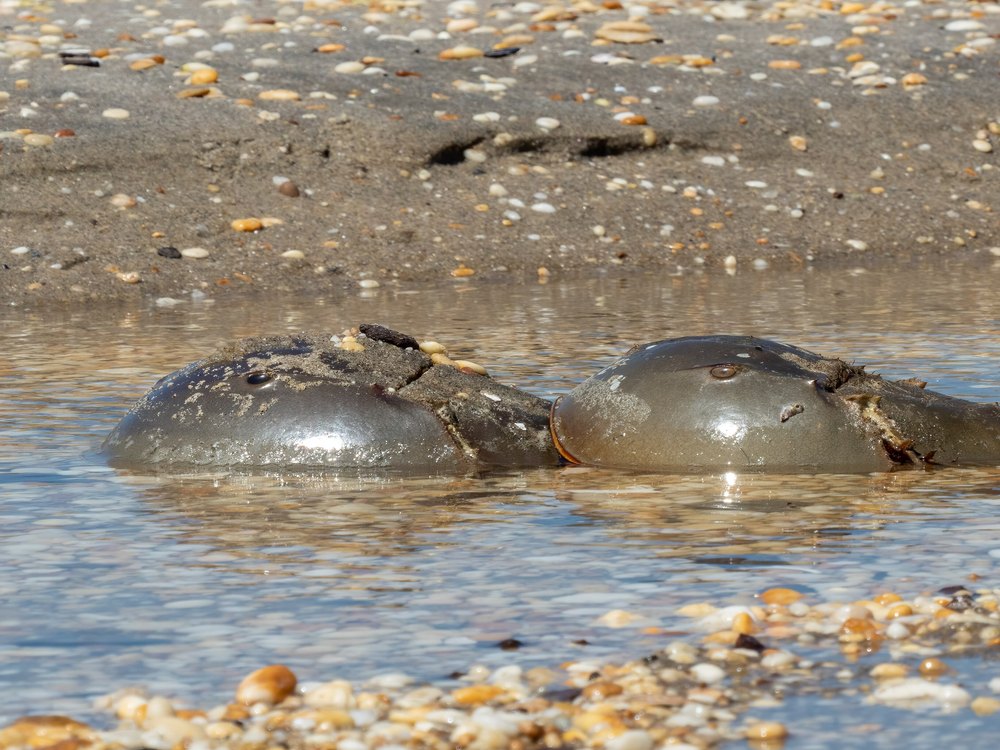

The female digs a nest in the upper part of the beach and lays eggs in it. Nests are 5 to 20 cm deep, and eggs are laid in clutches of 3,000 to 8,000. A female may lay at least 88,000 eggs a year.[5] In western Delaware Bay, 85% of nests were on the shore between the tidal flat and the night-time high-tide line of seaweed and debris, and the eggs go into two to five separate clusters.[8] The eggs are fertilized outside the body, and the parents do not brood them.[22]
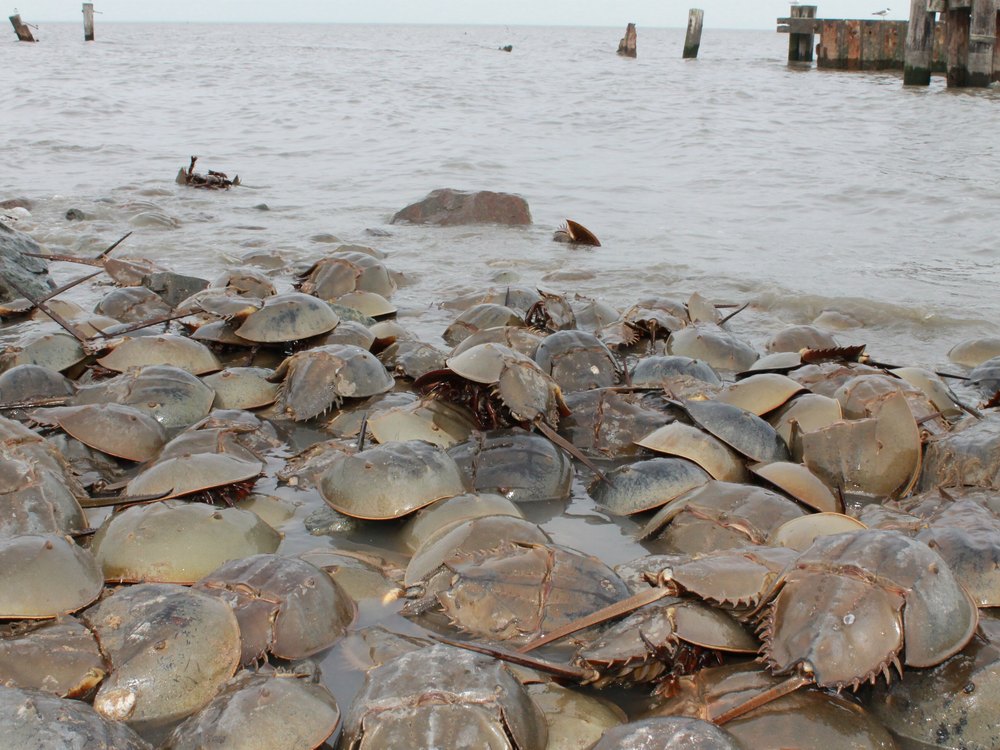

The male clasps the female from behind with his modified front claws.[10] In dense populations, extra “satellite” males wait beside a pair. In Delaware Bay, between 30 and 60% of spawning females have more than one mate. Male competition leaves 30 to 60% of pairs with at least one satellite male, and a satellite may fertilize on average 40% of the eggs when it has one or two rivals. These percentages are quoted from Brockmann’s work.[22] In Connecticut, where spawning density is about 400 times lower, 90 to 95% of spawning females were paired with only one male.[22] In Pleasant Bay there were 2.3 adult males for each adult female.[5]
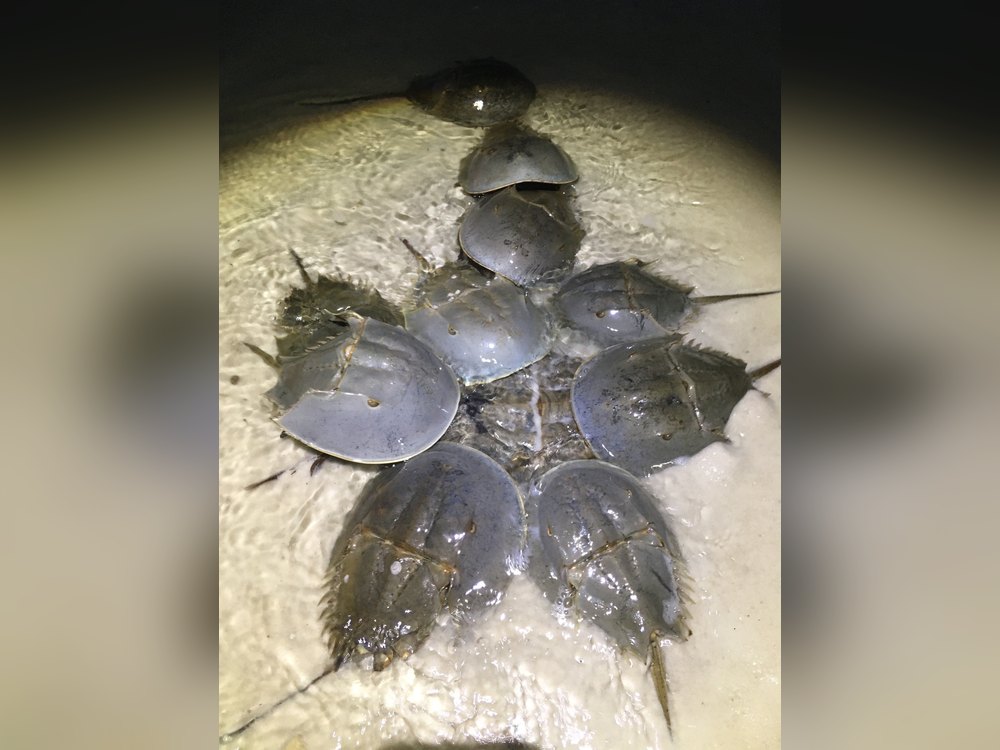

Righting itself
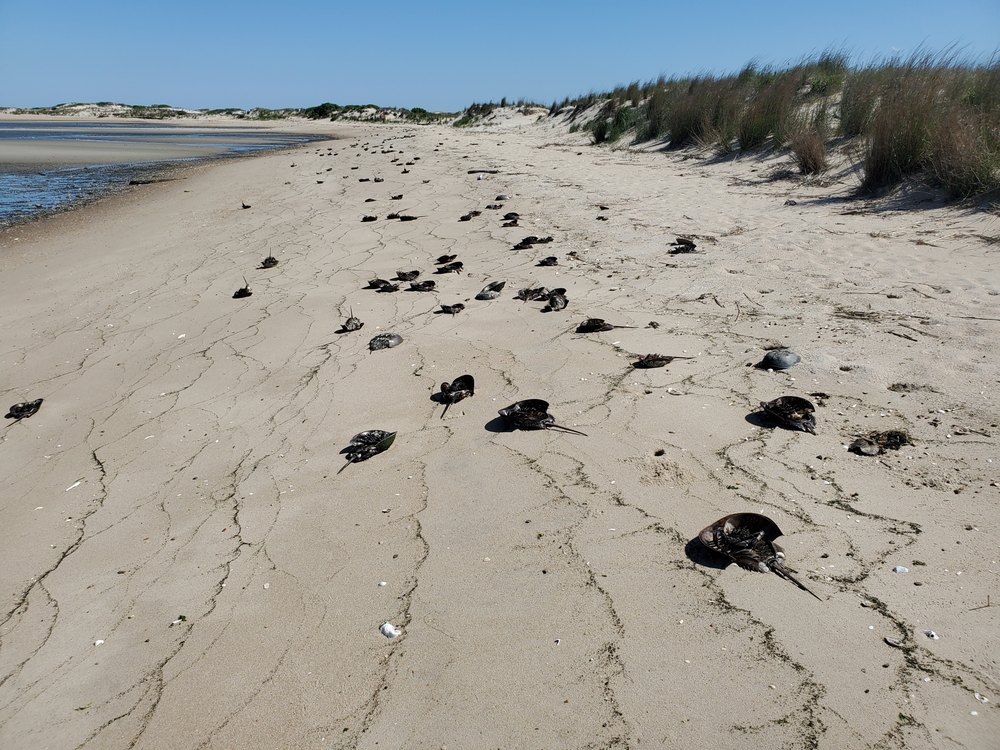
A horseshoe crab on its back can turn over by using its telson as a lever.[10] Crabs that end up stranded on a beach are the main natural cause of adult death. Stranding accounted for about 10% of the adult population of Delaware Bay in the mid-1980s.[8] Wikipedia reports a campaign called “Just Flip ’Em” that asks people to turn stranded crabs over.[16]
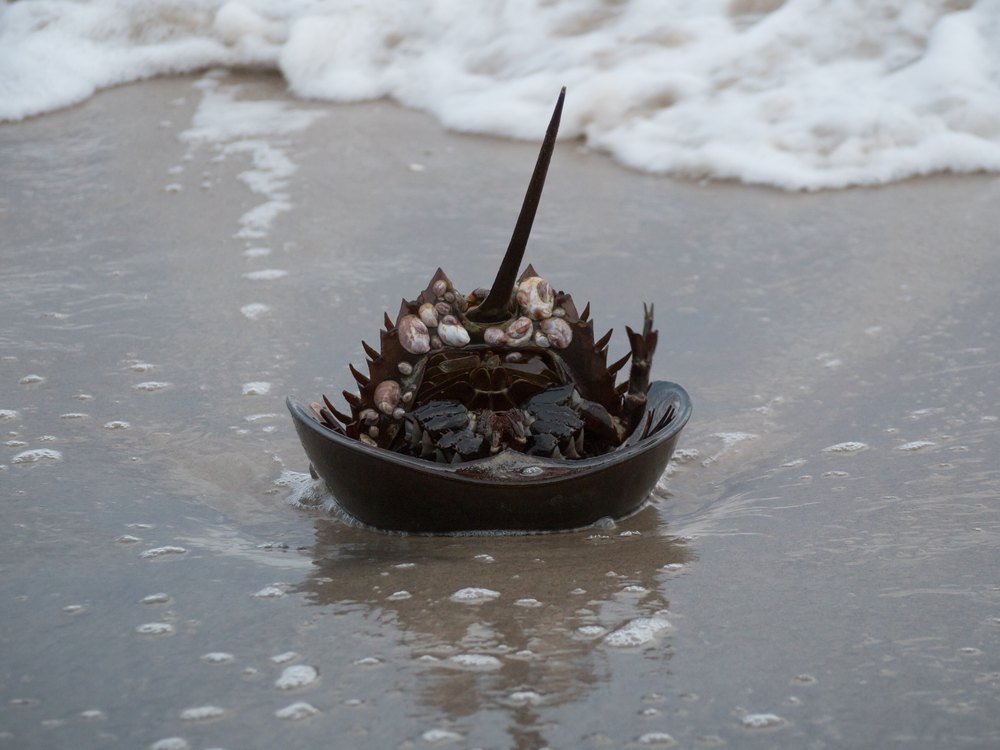

Digging and tracks
Horseshoe crabs bury themselves in sand and mud. In Pleasant Bay, about 20% of adults were buried shallowly in the sediment.[5] The pusher legs do the digging.[10]
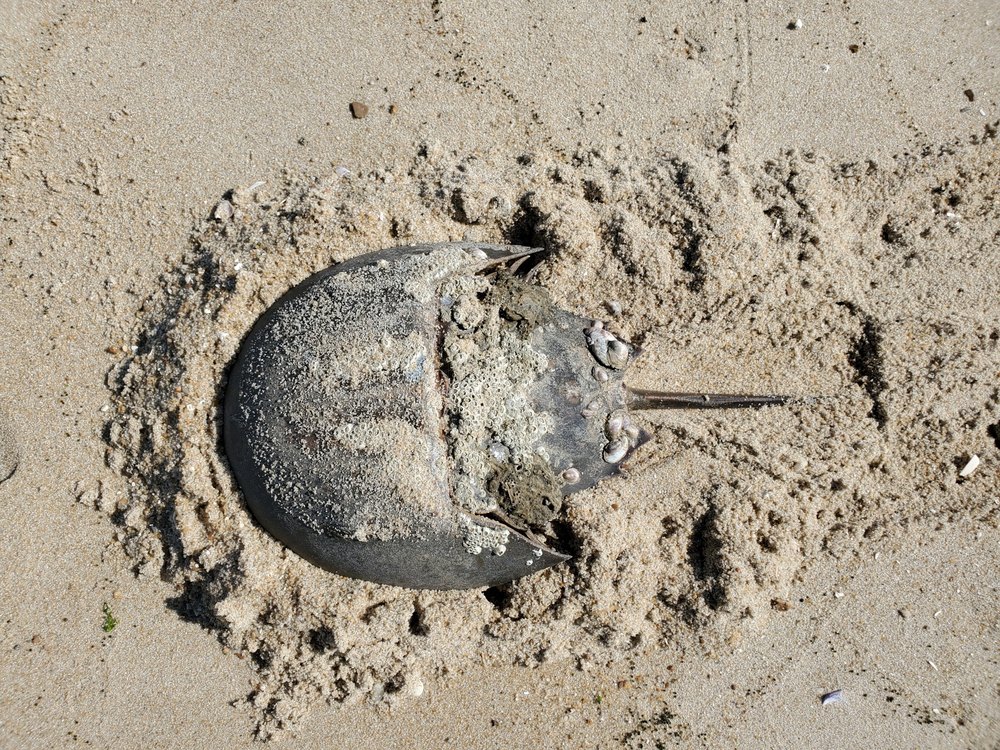

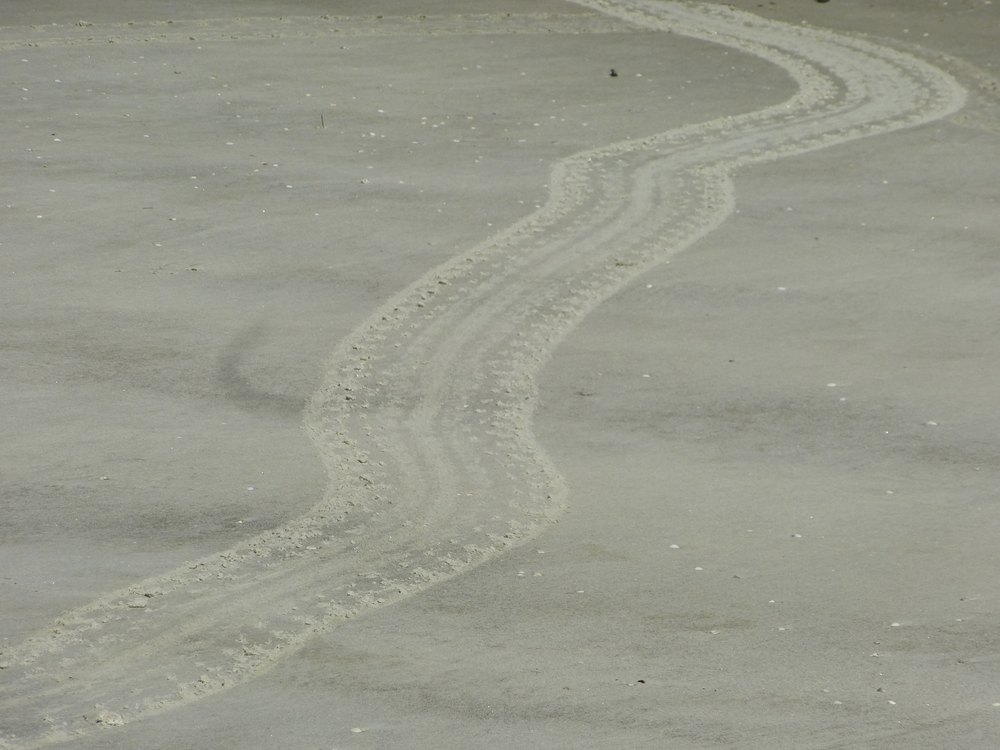
A paper on a fossil trackway describes the ideal trackway of a horseshoe crab, which is well established from fossil and living animals. It has two main side prints from the pusher legs, eight small prints from the other legs, and one median print from the telson. A crab that plows through sand makes deep prints of the front shield, and the living Atlantic Horseshoe Crab commonly does this.[20]

Diet
The Atlantic Horseshoe Crab is a carnivore that eats animals living on the sea floor. In a study of 36 adults caught on the continental shelf off New Jersey in July and August 1978, the crabs had eaten mostly bivalves, arthropods and polychaete worms.[23] Surf clams were the most frequent item in the 24 crabs from Atlantic City: 48 clams in 14 crabs. Other food included the clam Tellina, the razor clam Siliqua costata, Nereis worms and young rock crabs (Cancer irroratus).[23] The guts of a group collected near Stone Harbor were packed with blue mussels, an average of 383 per crab.[23]
The authors call the horseshoe crab a dietary generalist that feeds opportunistically. Foraminifera in the guts were probably swallowed by accident while digging for prey. In tanks, the crabs ate only the soft parts of surf clams, so counts of shells in the gut may undercount clams.[23] Another review gives blue mussels and surf clams as the main food of adults.[8] The sample was small, from one summer and one stretch of coast.
Feeding
The mouth lies between the leg bases, and the chilaria push food toward it.[10] Trilobite larvae do not feed. They live on yolk stored in the egg.[24]
Life cycle
| Stage | Time | Notes |
|---|---|---|
| Egg | About 2 weeks to hatching in the field; up to about 5 weeks, depending on warmth | Buried 5 to 20 cm deep in a beach nest[5][25] |
| Trilobite larva | Days to about 3 weeks | A swimming larva with no long tail spine. It lives on yolk and does not feed. Then it settles and molts into the first tailed stage[24][26][27] |
| Juvenile | About 9 to 11 years, with 16 to 17 molts | The first two years are spent on flats just off the spawning beaches. Ages are inferred, not measured[8][5][13] |
| Adult | From maturity at about 9 to 11 years | Females are larger than males. Wild lifespan is estimated at about 14 to 19 years[14][5] |
The swimming time of the larva is given as about 6 days by the Maryland DNR and as about 3 weeks by the South Carolina DNR.[27][26]
Eggs and hatching
In a laboratory study with eggs from the Gulf coast of Florida, the time from the egg to the first tailed stage depended strongly on temperature. It was about 20 days at 30 °C, 41 to 51 days at 25 °C and 89 to 176 days at 20 °C. At 35 °C it took almost a week longer than at 30 °C.[24] Eggs from Indian River Lagoon, Florida, developed and molted at salinities below 60 ppt, but they failed to develop at 35 °C or higher.[28] On northern beaches, the sand was much cooler than the laboratory setting, and temperature was the main driver of development speed.[21] In the field, eggs hatch about two weeks after spawning.[5]
Few young survive. In the Pleasant Bay model, only 0.001% of the young survived to the end of their first year, and about 78% of those reached adulthood.[5]
Molting
A horseshoe crab grows by molting, shedding its old shell. In Pleasant Bay, the young crabs likely molted five times in the first year and reached about 16.6 mm in width. In the next four years they molted four more times, to about 49.2 mm, and they likely molted another five to seven times before maturity. The study estimated that juveniles took up to 11 years and 17 instars, which are growth stages, to reach maturity at a width of about 160 mm.[5]
In a nine-year laboratory study in Japan, the animals reached the 14th instar. The authors concluded that males generally molt 16 times to reach maturity in the ninth year, and females 17 times in the tenth year. No lab animal reached the adult stage, so the maturity ages are extrapolated.[13] Earlier work quoted in that paper gave 9 to 11 years and 19 or fewer molts.[13] In the first year in the lab, the first tailed stage lasted 11 to 24 days, depending on salinity.[13]
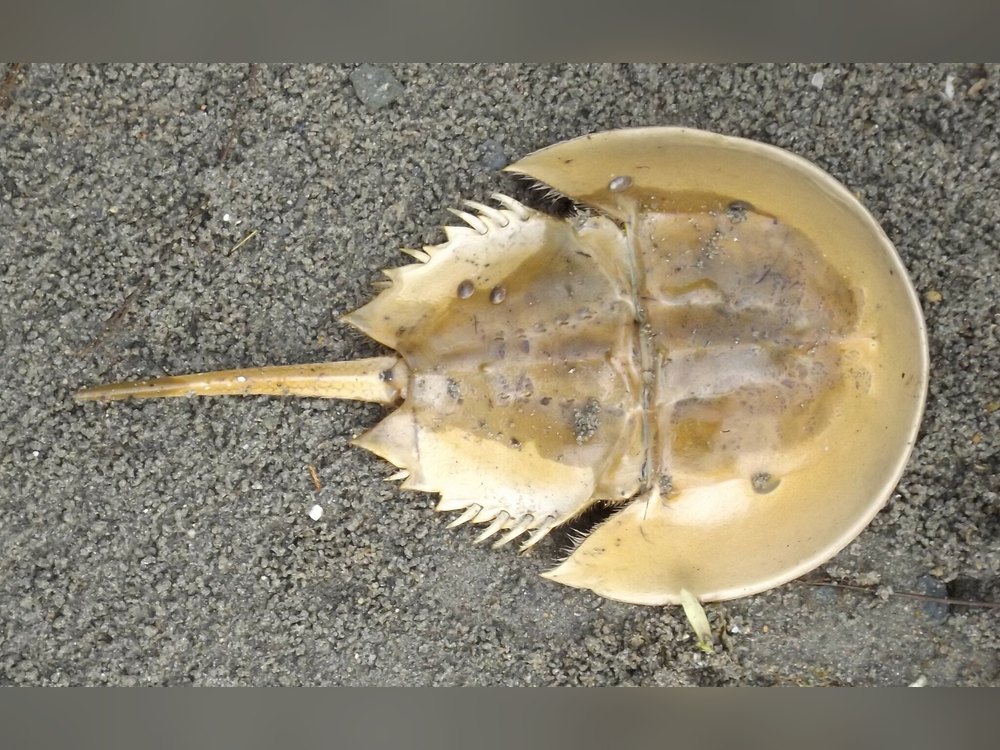

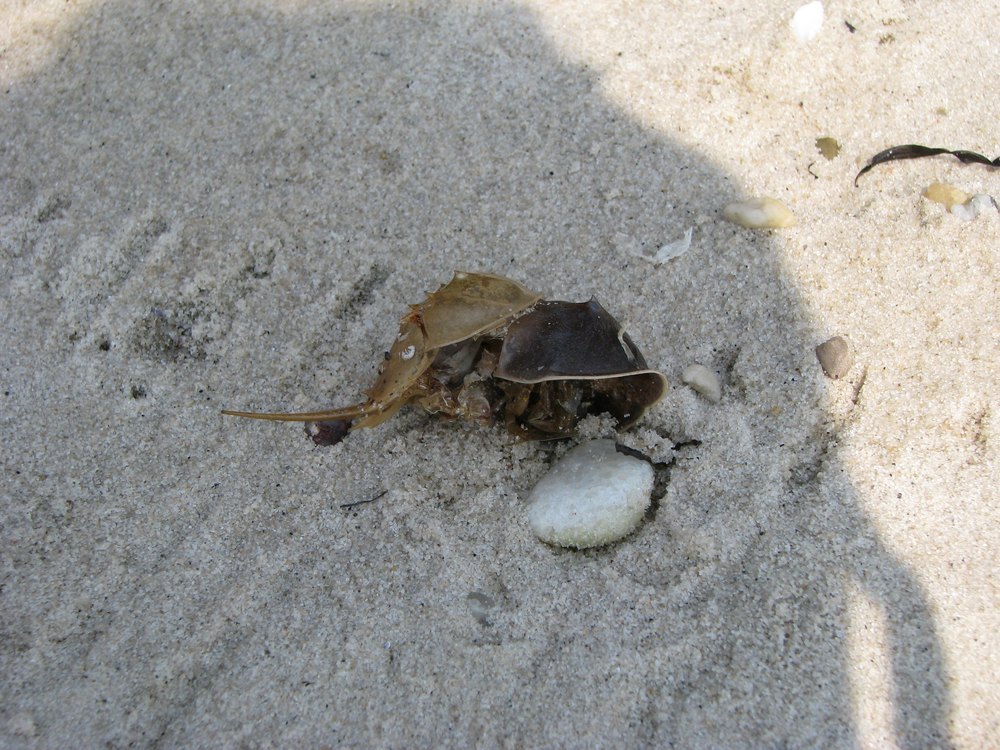
Horseshoe crabs have been thought to stop molting at maturity. The evidence is only one report of a cast-off shell from a mature male, and no one has reported a mature crab molting. The Pleasant Bay study argues that adults may plausibly molt about once a year, but this is a hypothesis in one paper and not settled.[5]

Lifespan
No method of ageing a horseshoe crab is known. From growth in Pleasant Bay, the study estimated that males may live up to 16 years and females up to 18 years, consistent with earlier estimates of 14 to 19 years. If adults molt only once in three years, the figures would be up to 26 years for males and 29 for females.[5] No reliable record of the longest wild age or of captive lifespan was found. In Delaware Bay, annual adult survival has been estimated at 77% for males and 65% for females.[8]
Ecology
Shorebirds and eggs
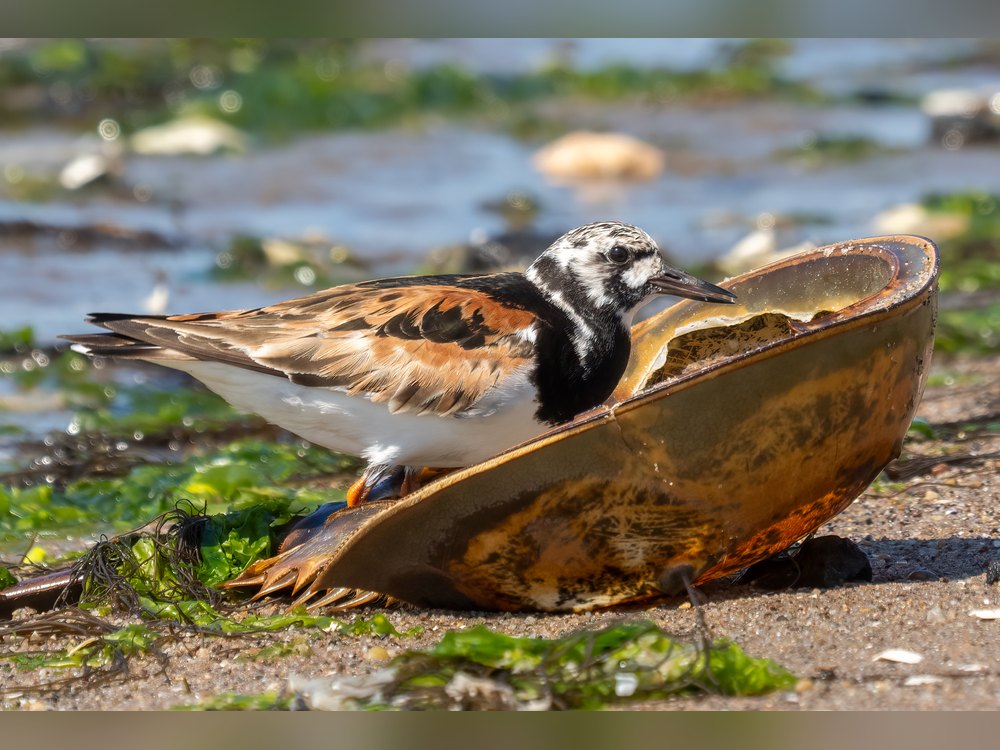
Delaware Bay is the second largest migratory staging area for shorebirds in North America.[8] In spring, red knots and other shorebirds feed on horseshoe crab eggs there. The findings below are from separate studies, and they do not agree on how strongly the knots depend on the eggs.
Pen trials fed captive red knots and ruddy turnstones only crab eggs. The birds gained 3 to 11 g a day, comparable to wild birds, and isotope values showed that the diet of wild knots matched crab eggs.[29] In the 1990s, the bait harvest in Delaware Bay rose tenfold, and egg availability for knots fell by more than 90%. The number of knots stopping in the bay fell by more than 75%, partly because adult survival in Tierra del Fuego dropped.[30] The Tierra del Fuego wintering population fell from 51,000 to 27,000 in 2000 to 2002, and the authors suggested late arrival and less food from heavy crab harvest as causes.[31]
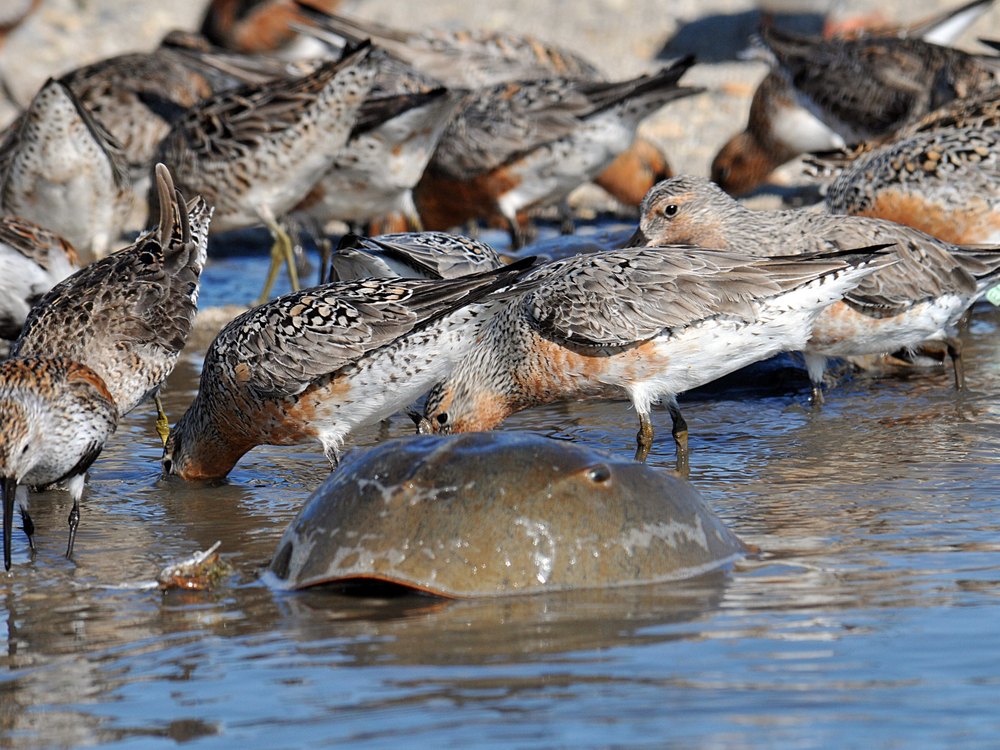

A study of 2004 and 2005 found that eggs were enough to support the refuelling of the then-current stopover population of knots.[32] A study of 1997 to 2008 found a positive link between crab spawning numbers and the chance of knots gaining weight, but the survival of heavier and lighter birds differed only slightly.[33] Average egg density was 156,600 per square meter in the 1980s and 10,243 per square meter in 2015 to 2021. Red knot counts have stabilized at about 30% of the earlier level, and ruddy turnstones at about 40%.[34] The 2024 stopover estimate was 54,044 red knots, up from 39,361 in 2023, and numbers were relatively stable from 2020 to 2024.[35] The management plan treats the link between crabs and knots as real.[8][36]
The reverse effect is judged small. Eggs are laid 5 to 25 cm deep, out of reach of most short-billed shorebirds, and a 1994 study concluded that shorebird predation probably has little effect on the crab population.[8]

Other predators
Eggs and larvae are a seasonal food for many invertebrates and fishes. Adults and juveniles are part of the diet of loggerhead sea turtles in Chesapeake Bay, and how much mortality turtles and other predators cause is unknown. Raccoons have been reported preying on spawning pairs in Yucatán, from a personal communication.[8] No reliable data were found for gulls or eels as predators.
Hitchhikers on the shell
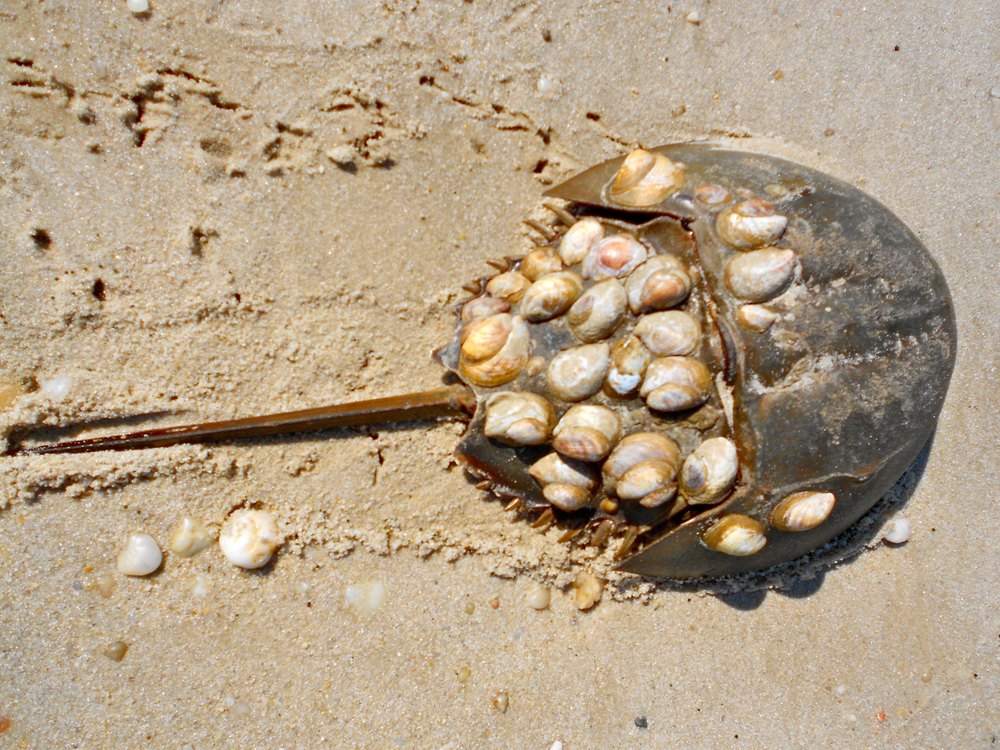
Slipper shells and worm tubes are concentrated near the movable spines on the rear part of the shell, and are rare on the front shield and the telson, according to a paper on crabs stranded at Reeds Beach, New Jersey. A 1996 paper reports that the species is fouled by green algae, diatoms, flatworms, mussels, oysters, barnacles, tunicates and other animals.[37] Among 10,094 iNaturalist observations from 2008 to 2022, some photos showed molluscs or barnacles attached to the crabs.[38]
A flatworm, Bdelloura candida, lives on the book gills. In crabs from Long Island waters in 2019 and 2022, it was found on 100% of adults and subadults and on 6.2% of juveniles. The authors call it parasitic, but older sources call it a commensal, and its effect on the crab has not been studied.[39]

Habitat and range
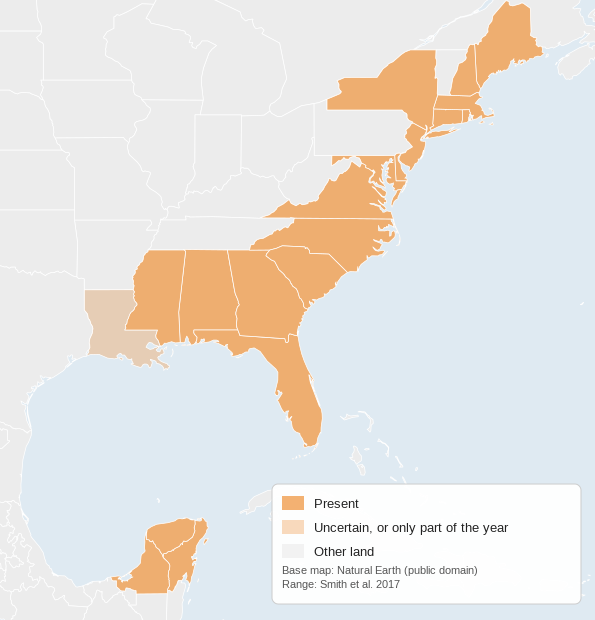
The species lives on the Atlantic coast of North America from the Yucatán Peninsula, Mexico (18° N) to Maine (42° N). A distinct population lives on the coasts of Campeche, Yucatán and Quintana Roo. The species is absent from the western and southern Gulf of Mexico, from Texas to Tabasco.[8] The northern limit today is Frenchman Bay, east of Mt. Desert Island in Maine.[8] GBIF holds about 39,000 records, almost all from the United States.[40]
| Place | Status | Notes |
|---|---|---|
| Maine to Georgia | Native | Maine, New Hampshire, Massachusetts, Rhode Island, Connecticut, New York, New Jersey, Delaware, Maryland, Virginia, North Carolina, South Carolina and Georgia. In Maine spawning is sparse, and the northern limit is Frenchman Bay |
| Florida | Native | Both coasts. Nests are found in all coastal counties, and there are no records as far west as the Dry Tortugas |
| Alabama and Mississippi | Native, rarer | Few records. Spawning has been seen at Fort Morgan, Gulf Shores and Dauphin Island in Alabama, and on three islands in Mississippi |
| Louisiana | Fringe or historical | The Chandeleur Islands are the western historical spawning record. No crabs were caught in the state’s trawl surveys |
| Mexico: Campeche, Yucatán, Quintana Roo | Native, a distinct population | Mangrove coastal lagoons. Rare reports from Veracruz, and none from Tabasco or Tamaulipas |
| Canada | Historic record only | A 1977 report of one live animal from Nova Scotia. No breeding population is known now |
| Texas and the western Gulf | Absent | No trawl records. A small introduced population in Galveston Bay did not persist |
| Bahamas, Jamaica, Cuba | Unverified | A few unpublished sightings in the Bahamas. No published account of horseshoe crabs anywhere in the Caribbean |
| Europe, San Francisco Bay | Introduced, not established | Old records from Europe, and a large release in San Francisco Bay, which did not establish |
Status and notes are from a 2017 range-wide review. Many local records in it are personal communications.[8]
Habitat
Spawning beaches are sandy beaches in bays and coves that are protected from waves. On beaches in Massachusetts, New Jersey and Delaware the sand is typically coarse and well drained, and on Florida beaches it is typically fine and poorly drained. Crabs avoid beaches with oxygen-poor, eroded sediment.[8] Eggs develop best at a salinity of 20 to 30 ppt.[8]
Adults have been found as far as 35 miles offshore at depths of more than 200 m, yet 74% of the crabs caught in NOAA bottom trawls were in water shallower than 20 m.[8] On the continental shelf they were caught from North Carolina to southern New England, with the most between Virginia and New Jersey. New York is the northern limit on the shelf.[41] The species lives at salinities from under 10 ppt in the upper Chesapeake to over 50 ppt in the Indian River Lagoon.[8]

Evolution
Horseshoe crabs belong to an old lineage. Xiphosuran fossils from the Early Ordovician of Morocco, about 480 million years ago, have not yet been formally described. Garwood and Dunlop say the oldest clear horseshoe crabs are Ordovician, about 480 million years old.[9] Lunataspis aurora, from the Late Ordovician of Manitoba about 445 million years ago, closely resembles living (crown-group) limuline horseshoe crabs.[42] Xiphosurida in the narrow sense first appears in the Late Devonian.[9]
Is it a living fossil?
The phrase “living fossil” needs care. The broad body plan is old, but the evidence for the genus Limulus is more limited.
Fossil horseshoe crabs were more varied than the living ones. A 2020 study counted 88 described xiphosuran species, of which four are alive,[43] and another study finds that the living species are only a fraction of the group’s past variety of form and habitat. It also finds that horseshoe crabs invaded fresh water independently at least five times.[44] The genus Limulus is much younger than the Ordovician. Kin and Blazejowski dated the oldest Limulus to about 148 million years ago, in the Late Jurassic of Poland,[45] but Bicknell and colleagues moved that fossil to another genus and found that the Limulus record begins in the Late Cretaceous.[46] Kin and Blazejowski prefer the word “stabilomorph” for genera whose structure is nearly unchanged for more than 65 million years.[45]
Genetic change is only moderately slow. A study of two mitochondrial genes found a moderate slowdown in sequence change in horseshoe crabs,[47] and the genome went through three rounds of whole-genome duplication.[48][49]
When the living species split
The dates for the last common ancestor of the four living horseshoe crabs conflict. One paper gives about 135 million years ago, quoting an earlier study,[48] while a genome study of an Asian species gives the Silurian, about 436 million years ago, for the split between the American and Asian lines.[49] The authors of an earlier genetic study said the dates remain uncertain, mainly because of doubts about molecular-clock calibration.[47] The American species is the sister of a group of the three Asian species,[47] and the Asian species diversified in the Paleogene.[50]
Forms and variants
No subspecies are recognised. WoRMS, ITIS, the Catalogue of Life and GBIF list none.[2][1][3][4] Genetic studies do find structure along the coast. A 2017 range-wide review used six regions: the Gulf of Maine, the Mid-Atlantic, the Southeast, Florida Atlantic, the Northeast Gulf of Mexico and the Yucatán Peninsula.[8]
The Yucatán population is described as a distinct population. It has conservation protection because its habitat is limited and fragmented and it is isolated from the other regions.[8] A genetic study of crabs from Maine to the Yucatán found that the southernmost population in Mexico, which is isolated, showed a strong increase, while all other populations declined.[51]
Mitochondrial DNA from New Hampshire to the Gulf coast of Florida shows a break of about 2% sequence difference between all animals north and all animals south of northeastern Florida.[52] A 2005 study of 21 sites proposed four management units for the United States: the Gulf of Maine, the Mid-Atlantic, Atlantic Florida and Gulf Florida.[53] A 2015 study found two more zones of genetic difference on the southeast Atlantic coast and structure along the Florida Gulf coast.[54]
Conservation
A 2017 status review by the IUCN assessors (Smith, Beekey, Brockmann, King, Millard and Zaldivar-Rae) concluded that the species is vulnerable at the species level, with a higher risk in some regions: the Yucatán Peninsula, parts of New England and Great Bay.[8] A US federal notice of 18 February 2026 says that the IUCN Red List entry is the assessment published as Smith et al. 2017.[55] A 2023 study under the IUCN Green Status process found that harvest regulation is central, and that conservation efforts are not expected to offset habitat loss at the scale needed for range-wide functionality. The notice quotes it as rating the Gulf of Maine unit “most likely” functional and the Yucatán unit viable, which means not threatened with extinction but not fully recovered.[56][55]
Numbers and trends
In the 2017 review, trends in 40 surveys fell in the Gulf of Maine (Great Bay) and New England, were flat in New York, Delaware Bay and the northeast Gulf, and rose in the Southeast.[8] The 2024 ASMFC update, with data to 2022, rated Delaware Bay and the Southeast as good, the Northeast as neutral and New York as poor, with the coast as a whole in good condition.[57] One model run estimated about 30.1 million mature males and 19.4 million mature females in the Delaware Bay region in 2024.[35] The federal notice says the Gulf of Maine, the northeast Gulf and Yucatán populations have been described only in words, because there are no numbers.[55]
Threats
Bait harvestBycatchHabitat lossClimate change[8][58]Bait harvest. The bait harvest grew in the 1990s, mainly for whelk bait. Coastwide landings were over 6 million pounds, or about 3 million animals, in 1998.[8] Bait landings peaked in 1999 at 2.6 million crabs and have been under 1 million since 2003.[58] Whelk and American eel pots are the main users.[8]
Bycatch. Crabs that are caught and discarded in dredge, trawl and gillnet fisheries are likely a larger source of removals than the blood industry in Delaware Bay, with much uncertainty.[58]
Habitat loss. Only 10.6% of the New Jersey shore of Delaware Bay was optimal spawning habitat, and 40% of the shoreline of five New Jersey spawning beaches was broken up by bulkheads.[8]
Climate change. The main climate risk is the loss of spawning habitat to sea-level rise and storms.[8]
Mass deaths. In 1999, about 100,000 adults died in the Indian River Lagoon area of Florida, and the cause was not established.[8]
Law
In Mexico, the species has been classed as “en peligro de extinción” (in danger of extinction), the highest category of the national list NOM-059, since 1994, and harvest is forbidden unless strict conditions are met.[8] In the United States, petitions to list the species under the Endangered Species Act were received in December 2023 and February 2024. NMFS found on 18 February 2026 that they did not present substantial information indicating that listing may be warranted (91 FR 7448). NMFS says that quotas were never exceeded over the previous 26 years.[55]
Management
The Atlantic States Marine Fisheries Commission (ASMFC) adopted a fishery plan in 1998. Addendum VII in 2012 started the Adaptive Resource Management (ARM) framework for New Jersey, Delaware, Maryland and Virginia, used first for the 2013 season.[36] The revised framework allows up to 500,000 males and 210,000 females,[35] and female harvest counts only if red knots reach 81,900 birds or female crabs reach 80% of carrying capacity, 11.2 million assuming a capacity of 14 million.[58] For 2026 and 2027, the ASMFC set a harvest of 500,000 males and no females from Delaware Bay, with 173,014 males each for Delaware and New Jersey. The model would have allowed 175,000 females for 2026 alone, but the board kept females at zero while a process to revise the framework runs.[59][35] Addendum IX in 2025 allows male-only harvest limits for several years, through 2031.[36]
A federal no-take zone of about 3,885 km², the Carl N. Shuster Jr. Horseshoe Crab Reserve, lies off the mouth of Delaware Bay. It was established on 7 March 2001.[8][60] Since 1999, bait bags have used smaller pieces of crab per pot.[8]
The blood test
LAL (Limulus amebocyte lysate) is made from horseshoe crab blood cells and detects bacterial endotoxin in injectable drugs.[7] Adults are collected, up to 40% of their blood is taken, and they are released alive.[8] Six companies bleed crabs in Massachusetts, New Jersey, Maryland, Virginia and South Carolina.[36] The FDA estimated 130,000 crabs used in 1989 and 260,000 in 1997, and over 500,000 in 2014.[8] In 2017, 444,115 crabs collected only for biomedical use were bled, and the estimated deaths at the 15% rate were 72,674.[58] The estimated biomedical mortality in 2022 was the highest in the time series.[57]
How many bled crabs die is uncertain. The ASMFC uses 15%, with a range of 4% to 30%, from an analysis of earlier studies.[58][57] Single studies differ. Bled crabs in Massachusetts had a mortality of 22.5% and 29.8%, against 3% for controls, and a study of 28 females found an average of 17.9%. Laboratory studies never exceeded 20%, and 8 of 11 were under 15%.[55] Bled crabs mated less after release in a small study of 14 bled and 14 control crabs.[58] Spawning was lower in areas open only to blood harvest.[8] The ASMFC has a threshold of 57,500 crabs for biomedical deaths, which was exceeded every year from 2007 except 2016.[58]
A test without animal blood exists. Recombinant Factor C uses a gene sequence from a horseshoe crab, but the reagent is made in cell culture. The European Pharmacopoeia chapter 2.6.32 on recombinant Factor C was available from 1 July 2020.[61] The Japanese Pharmacopoeia accepted these assays from 1 April 2021.[7] USP chapter <86>, on tests using recombinant reagents, became official on 1 May 2025, and USP says it adds methods and does not replace LAL.[62]
History and culture
First description
Linnaeus described the species in 1758 as Monoculus polyphemus, but the name covered two species, the American one and the Moluccan one. In 1764 he described an American specimen as polyphemus. O.F. Müller named the genus Limulus in 1785, and he also mixed the American and Moluccan species.[63]
Fertilizer and bait
In the 1800s, horseshoe crabs were taken in Delaware Bay in large numbers for fertilizer and animal feed, and the trade ended by the 1960s.[8][64] In the 1880s and 1890s, writers warned that constant capture was making the crabs scarcer.[65] Chemical fertilizers, complaints about the smell and falling numbers ended the factories.[65] Use as bait for eel and whelk pots picked up sharply in the 1990s.[64]
Finding the blood test
Bang studied blood clotting in the early 1950s at the Marine Biological Laboratory at Woods Hole and published in 1956, then set his observations aside for nearly ten years.[66][67] In 1964, Levin and Bang published “The role of endotoxin in the extracellular coagulation of Limulus blood”.[7][67] In 1977, the US FDA approved the first gel-clot LAL reagent, launched by Associates of Cape Cod.[7]
Taxonomy
| Rank | Name |
|---|---|
| Kingdom | Animalia[2][3] |
| Phylum | Arthropoda[2][1] |
| Subphylum | Chelicerata[2][1][3] |
| Class | Merostomata[2][1][3][4] |
| Order | Xiphosurida[2][3][4] |
| Family | Limulidae[2][3] |
| Genus | Limulus Müller, 1785[1][3] |
| Species | Limulus polyphemus (Linnaeus, 1758)[2][1][3][4] |
Synonyms (6)
| Name | |
|---|---|
| Monoculus polyphemus (Linnaeus, 1758) | Original name |
| Limulus albus (Bosc, 1802) | |
| Limulus americanus (Leach, 1819) | |
| Limulus cyclops (Fabricius, 1793) | |
| Limulus occidentalis (Lamarck, 1801) | |
| Limulus sowerbii (Leach, 1815) |
WoRMS and GBIF agree on these six names, and GBIF also lists Xiphosura polyphemus (Linnaeus, 1758).[2][4] Gronovius proposed the genus name Xiphosura in 1764.[63]
All four databases put the species in the class Merostomata. The order is Xiphosurida in WoRMS, the Catalogue of Life and GBIF, and Xiphosura in ITIS.[2][1][3][4] Recent papers use the name Xiphosura for the group and do not treat Merostomata as a natural group. The old split of marine Merostomata from land-living Arachnida was an ecological division and not a family tree.[43][9] This page uses the database names.
| Source | Class | Order |
|---|---|---|
| WoRMS | Merostomata | Xiphosurida[2] |
| ITIS | Merostomata | Xiphosura, suborder Limulina[1] |
| Catalogue of Life | Merostomata | Xiphosurida[3] |
| GBIF | Merostomata | Xiphosurida[4] |
| Lamsdell 2016, 2020; Garwood and Dunlop 2023 | Merostomata not used as a formal group | Xiphosura for the whole group; Xiphosurida for the narrower group with the living species[44][43][9] |
Four horseshoe crab species are alive today, and the genus Limulus has only one. The other three live in Asia.[3][43]
Where horseshoe crabs sit among the chelicerates is unresolved. Lozano-Fernández and colleagues (2019) put them as the sister of a single group of all arachnids, and their analyses rejected a place inside the arachnids.[68] Ballesteros and Sharma (2019) found them inside the arachnids, as the sister of the hooded tick spiders (Ricinulei),[69] and Ballesteros and colleagues (2022) again found them nested inside a group of arachnids that is not a natural group.[70] Another study (Noah and colleagues, 2020) placed them as the sister of the spiders, scorpions and relatives, as reported by Garwood and Dunlop.[9] A 2025 review says that the unity of the arachnids and a single move onto land have come into contention.[71]
Sources
- ITIS, Limulus polyphemus (TSN 82703)
- WoRMS, Limulus polyphemus (Linnaeus, 1758), AphiaID 150514, classification and synonyms
- Catalogue of Life (ChecklistBank dataset 3LR), Limulus polyphemus, Tachypleus gigas and Carcinoscorpius rotundicauda
- GBIF backbone, Limulus polyphemus (usage key 1010610), synonyms and vernacular names
- Carmichael, Rutecki & Valiela 2003, Marine Ecology Progress Series 246: 225–239, abundance and population structure in Pleasant Bay, Cape Cod
- Smith, Pooler, Swan, Michels, Hall, Himchak & Millard 2002, Estuaries 25(1): 115–125, spawning in Delaware Bay
- Biomedicines 2021, 9(5): 536, review of endotoxin and glucan assays
- Smith, Brockmann, Beekey, King, Millard & Zaldivar-Rae 2017, “Conservation status of the American horseshoe crab, Limulus polyphemus: a regional assessment”, Reviews in Fish Biology and Fisheries 27: 135–175
- Garwood & Dunlop 2023, Arachnologische Mitteilungen 66(1): 2–16, consensus and conflict in studies of chelicerate fossils and phylogeny
- Delaware DNREC Aquatic Resources Education Program 2014, Limulus polyphemus anatomy guide, dorsal and ventral features
- University of Florida IFAS Extension, publication FA254, horseshoe crab culture
- Battelle et al. 2014, Journal of Experimental Biology, UV opsin in the eyes of Limulus
- Sekiguchi, Seshimo & Sugita 1988, “Post-embryonic development of the horseshoe crab”, Biological Bulletin 174: 337–345
- Graham, Botton, Hata, Loveland & Murphy 2009, Fishery Bulletin 107(2): 235–243, “Prosomal-width-to-weight relationships in American horseshoe crabs”
- Etymonline and Dictionary.com, entries for “limulus”
- Wikipedia, Atlantic horseshoe crab
- Smith, Mandt & Macdonald 2009, Journal of Shellfish Research 28(2): 405–417
- Hazes et al. 1993, Protein Science (PMC2142367) and Magnus et al. 1994, Proteins, on the structure of horseshoe crab hemocyanin
- Battelle 2013, “What the clock tells the eye: lessons from an ancient arthropod”, Integrative and Comparative Biology
- Gaillard 2010, Swiss Journal of Geosciences, a giant fossil limulid trackway
- Sasson et al. 2025, Ecology and Evolution 15(12): e72732
- Mattei, Beekey, Rudman & Woronik 2010, Current Zoology 56(5): 634–642
- Botton & Haskin 1984, Fishery Bulletin 82(2), distribution and feeding of the horseshoe crab on the continental shelf off New Jersey
- Laughlin 1983, Biological Bulletin 164: 93–103, effects of temperature and salinity on larval growth
- ASMFC, Horseshoe Crab Stock Assessment Overview, 2019
- South Carolina DNR, species gallery, horseshoe crab
- Maryland DNR, horseshoe crab fact sheet (hsc0404.pdf)
- Ehlinger & Tankersley 2004, Biological Bulletin 206: 87–94, embryos and larvae in hypersaline conditions
- Haramis et al. 2007, stable isotope and pen feeding trial studies of the value of horseshoe crab eggs to spring migrant shorebirds in Delaware Bay, Journal of Avian Biology 38
- Niles et al. 2009, “Effects of horseshoe crab harvest in Delaware Bay on red knots: are harvest restrictions working?”, BioScience 59: 153–164
- Baker et al. 2004, “Rapid population decline in red knots”, Proceedings of the Royal Society B 271: 875–882
- Karpanty, Cohen, Fraser & Berkson 2011, “Sufficiency of horseshoe crab eggs for red knots during spring migration stopover in Delaware Bay USA”, Journal of Wildlife Management 75: 984–994
- McGowan et al. 2011, Ecosphere 2(6): 69, linking red knot survival to horseshoe crab spawning abundance
- Smith, Dey, Williams, Diehl, Feigin & Niles 2022, Aquatic Conservation 32: 1913–1925, horseshoe crab egg availability for shorebirds in Delaware Bay
- ASMFC, Horseshoe Crab ARM Subcommittee and Delaware Bay Ecosystem Technical Committee call summary, 23 September 2025
- ASMFC, Horseshoe Crab Species Management Overview, Commissioner Manual, May 2026
- Search-result summaries of a paper in Estuaries on epizoans of crabs stranded at Reeds Beach, New Jersey, and of a 1996 paper on epizoic bryozoans, Bulletin of Marine Science 58: 368–384
- Unger et al. 2023, Bulletin of Marine Science, iNaturalist observations of horseshoe crabs
- Brianik et al. 2023, Hydrobiologia 850: 3655–3669, the flatworm Bdelloura candida on the American horseshoe crab
- GBIF occurrence search, Limulus polyphemus (taxon key 1010610), counts by country and state, queried 24 October 2026
- Botton & Ropes 1987, Fishery Bulletin, populations of horseshoe crabs on the northwestern Atlantic continental shelf
- Rudkin, Young & Nowlan 2008, “The oldest horseshoe crab”, Palaeontology 51(1): 1–9
- Lamsdell 2020, “The phylogeny and systematics of Xiphosura”, PeerJ 8: e10431
- Lamsdell 2016, “Horseshoe crab phylogeny and independent colonizations of fresh water”, Palaeontology 59(2): 181–194
- Kin & Blazejowski 2014, “The horseshoe crab of the genus Limulus: living fossil or stabilomorph?”, PLoS ONE 9(10): e108036
- Bicknell, Blazejowski, Wings, Hitij & Botton 2021, Papers in Palaeontology 7(3): 1525–1556, critical re-evaluation of Limulidae
- Avise, Nelson & Sugita 1994, “A speciational history of ‘living fossils’”, Evolution 48(6): 1986–2001
- Nong et al. 2021, Communications Biology 4: 83, horseshoe crab genomes and three rounds of whole genome duplication
- Shingate et al. 2020, chromosome-level genome of the coastal horseshoe crab (Tachypleus gigas), Molecular Ecology Resources
- Obst, Faurby, Bussarawit & Funch 2012, Molecular Phylogenetics and Evolution 62(1): 21–26, molecular phylogeny of extant horseshoe crabs
- Faurby, King, Obst, Hallerman, Pertoldi & Funch 2010, Molecular Ecology 19(15): 3088–3100, population genetics of the American horseshoe crab
- Saunders, Kessler & Avise 1986, Genetics 112(3): 613–627, mitochondrial DNA variation in Limulus polyphemus
- King, Eackles, Spidle & Brockmann 2005, Transactions of the American Fisheries Society 134(2): 441–465, regional differentiation and sex-biased dispersal
- King et al. 2015, “Conservation genetics of the American horseshoe crab”, in Changing Global Perspectives on Horseshoe Crab Biology, Conservation and Management, Springer, pp. 65–96
- NMFS 2026, “Endangered and Threatened Wildlife; 90-Day Finding on Petitions To List the Atlantic Horseshoe Crab (Limulus polyphemus) Under the Endangered Species Act”, Federal Register 91(32): 7448 ff., 18 February 2026
- Smith, Brockmann, Carmichael, Hallerman, Watson & Zaldivar-Rae 2023, “Assessment of recovery potential for the American horseshoe crab: an application of the IUCN Green Status process”, Aquatic Conservation 33: 1175–1199
- ASMFC, Stock Assessment Overview: Horseshoe Crab, May 2024
- ASMFC, 2019 Horseshoe Crab Benchmark Stock Assessment, non-confidential peer review report
- ASMFC press releases on horseshoe crab specifications, October 2023 and October 2025
- Federal Register notice of 22 June 2005 (05-12353), on the Carl N. Shuster Jr. Horseshoe Crab Reserve
- EDQM news, “Recombinant factor C: new Ph. Eur. chapter available as of 1 July 2020”
- USP notices on General Chapter <86>, Bacterial Endotoxins Test Using Recombinant Reagents
- Pocock, R. I., “The taxonomy of recent species of Limulus”, Annals and Magazine of Natural History
- Delaware DNREC, “Careful management ensures the Delaware Bay remains a horseshoe crab haven”
- Farrell & Martin (eds) 1997, Proceedings of the Horseshoe Crab Forum: Status of the Resource, 23 February 1997, University of Delaware Sea Grant (DEL-SG-05-97) (scanned text, partly garbled)
- Golden Goose Award, horseshoe crab blood
- Zhang, Baek & Koch 1988, Journal of Clinical Microbiology 26: 1464–1470
- Lozano-Fernández et al. 2019, Nature Communications 10: 2295, increasing species sampling in chelicerate genomic-scale datasets
- Ballesteros & Sharma 2019, Systematic Biology 68(6): 896–917, a critical appraisal of the placement of Xiphosura
- Ballesteros et al. 2022, Molecular Biology and Evolution 39(2): msac021, comprehensive species sampling refutes the monophyly of Arachnida
- Sharma & Gavish-Regev 2025, Annual Review of Entomology 70: 143–163, the evolutionary biology of Chelicerata