The northern Bald Eagle (Haliaeetus leucocephalus washingtoniensis) is the subspecies of Alaska, Canada and the northern United States.[1] It is the larger of the two forms that most checklists recognise.[2]
Names and classification
The name washingtoniensis was published by Audubon in 1827, as Falco washingtoniensis.[3] An older name for the same form, alascanus Townsend, 1897, is a synonym.[3] Some texts spell the epithet washingtoni, but the IOC list, ITIS and GBIF all use washingtoniensis.[1][3][4]
Range
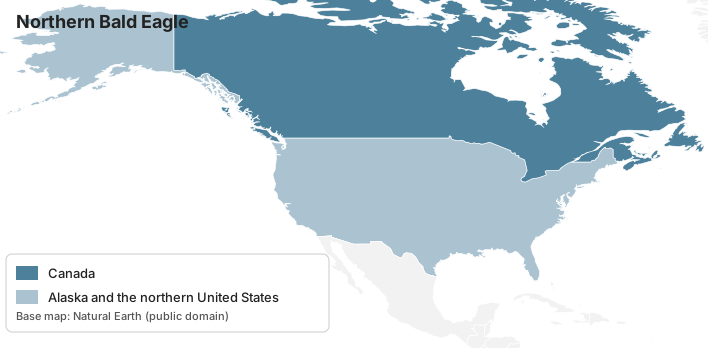
The IOC list gives its range as Alaska, Canada and the northern United States.[1] Eagles in the north are larger than those in the south.[2] A sample of adults trapped in Montana on migration, probably from breeding grounds in northern Canada, averaged 4.3 kg for males and 5.1 kg for females.[5]
Classification evidence
Not everyone agrees. A study of enzyme genes in eagles from Alaska, Washington, Oregon and Arizona found a smooth change from north to south, with no break that matched the northern and southern subspecies.[6] Some authorities therefore treat the Bald Eagle as having no subspecies.[6]
Sources
- IOC World Bird List, version 15.2
- U.S. Fish and Wildlife Service, Bald Eagle species page
- ITIS, Haliaeetus leucocephalus (TSN 175420)
- GBIF backbone, Haliaeetus leucocephalus
- McClelland et al. 1998, Journal of Raptor Research 32: 120–125 (adults trapped in Montana)
- Morizot et al. 1985, Biochemical Genetics 23: 337–345 (genetic variation)