The Desert Locust (Schistocerca gregaria) is a short-horned grasshopper of the deserts of Africa, the Middle East and South-West Asia. It can change from a lone, shy insect into one that gathers in huge swarms.[1] A single square kilometre of swarm can hold 40–80 million adults, which eat as much food in a day as about 35,000 people.[1]
Quick facts
Description
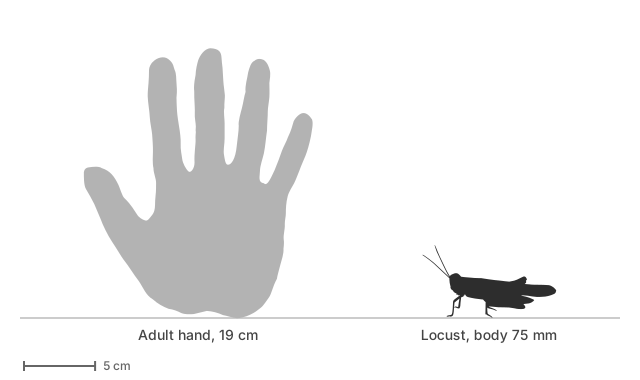
The Desert Locust is a large, lightly built grasshopper with a strong, darting flight.[2] Males are 60–75 mm long and females 70–90 mm, and the difference between the sexes is larger in solitary locusts than in swarming ones.[3] An adult weighs about 2 g.[1] Its hind legs are big and built for jumping,[1] and its ears sit on the sides of the first segment of the abdomen.[4]
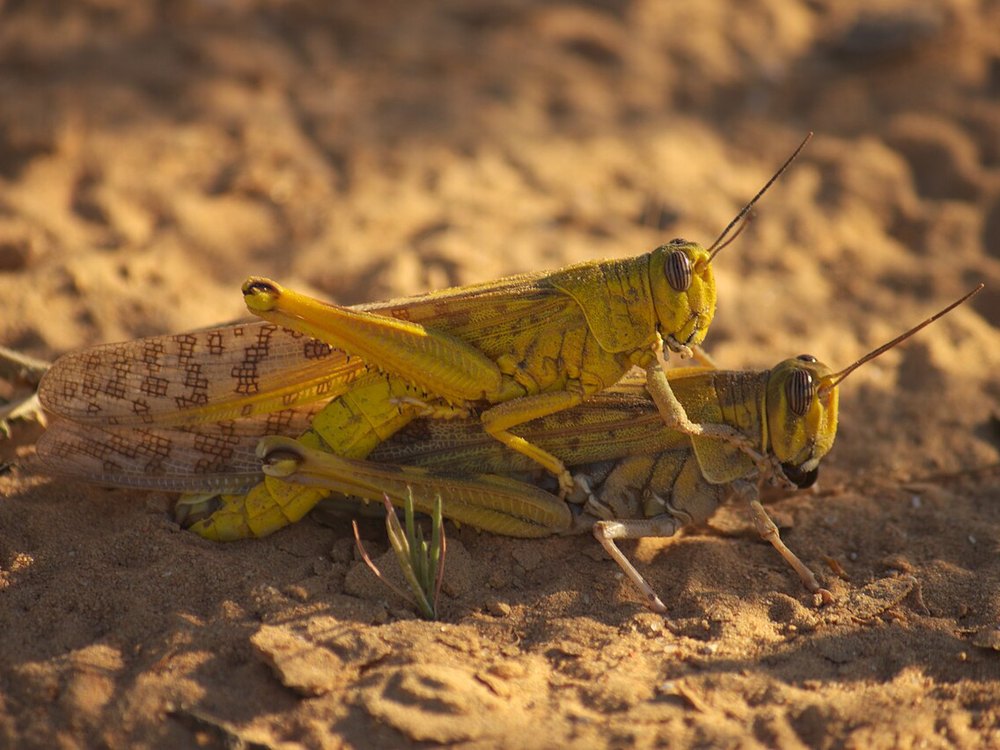
Colour depends on the form. Solitary adults are brown, while swarming adults are pink when young and yellow when mature.[1]
A locust is a grasshopper that changes its behaviour and body in response to crowding. Adult locusts can form swarms, and the young, wingless hoppers can form bands. Grasshoppers form neither, but the line between the two is not clear-cut.[5] The Desert Locust is one of about a dozen species of short-horned grasshoppers that do this.[1]
Name
“Locust” entered English around 1150–1200 from Latin locusta, “grasshopper”.[6] The species name gregaria comes from the Latin gregarius, built on grex, “flock”.[7] Peter Forsskål named the species Gryllus gregarius in 1775.[8][9]
In other languages
| Language | Name | Meaning |
|---|---|---|
| German | Wüstenheuschrecke | desert grasshopper |
| French | criquet pèlerin | pilgrim locust |
| Spanish | langosta del desierto | desert locust |
| Arabic | جراد الصحراء | locusts of the desert |
| Hebrew | ארבה המדבר | locust of the desert |
| Japanese | サバクトビバッタ | desert flying grasshopper |
Meanings are literal translations of the words.[10][11][12] Names in other languages are not listed because no reliable dictionary source was found.
Body
The adult has a body 60–90 mm long and weighs about 2 g.[3][1] Adults do not moult: after the last moult they only gain weight.[2] The young hopper of a swarming locust starts at about 7 mm and weighs 30–40 mg. By the fifth stage it is about 50 mm long and weighs 1,000–1,200 mg.[2]
Size ranges
Behavior
Swarms and bands
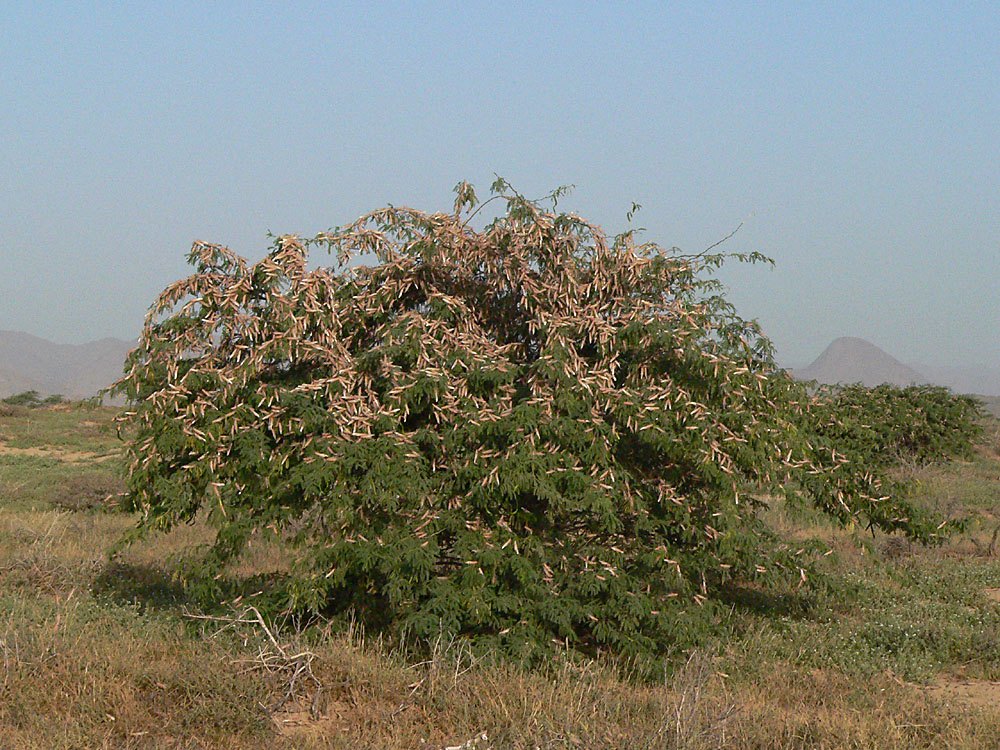
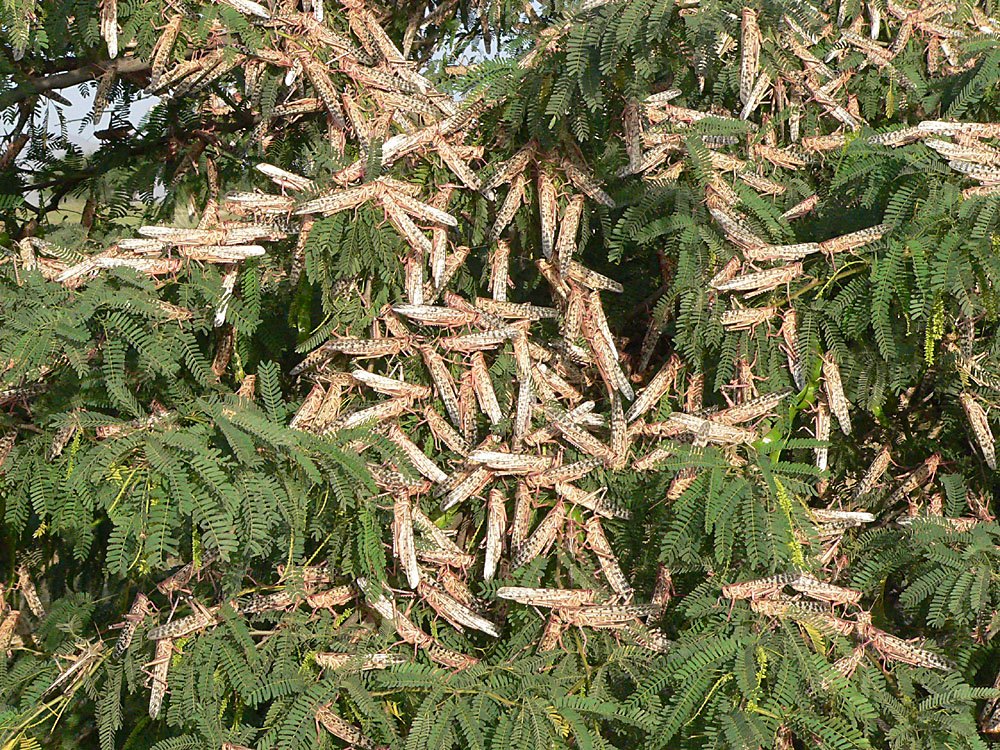
Swarming locusts fly by day. A swarm roosts in vegetation overnight, basks on the ground at sunrise, takes off by mid-morning and often flies until just before sunset.[2] It flies with the wind at about 16–19 km/h and can travel 5–130 km or more in a day.[1] Swarms range from under 1 km² to several hundred km².[1] Swarms regularly cross the Red Sea, a distance of 300 km.[1] In 1954 a swarm flew from North-West Africa to the British Isles.[1]
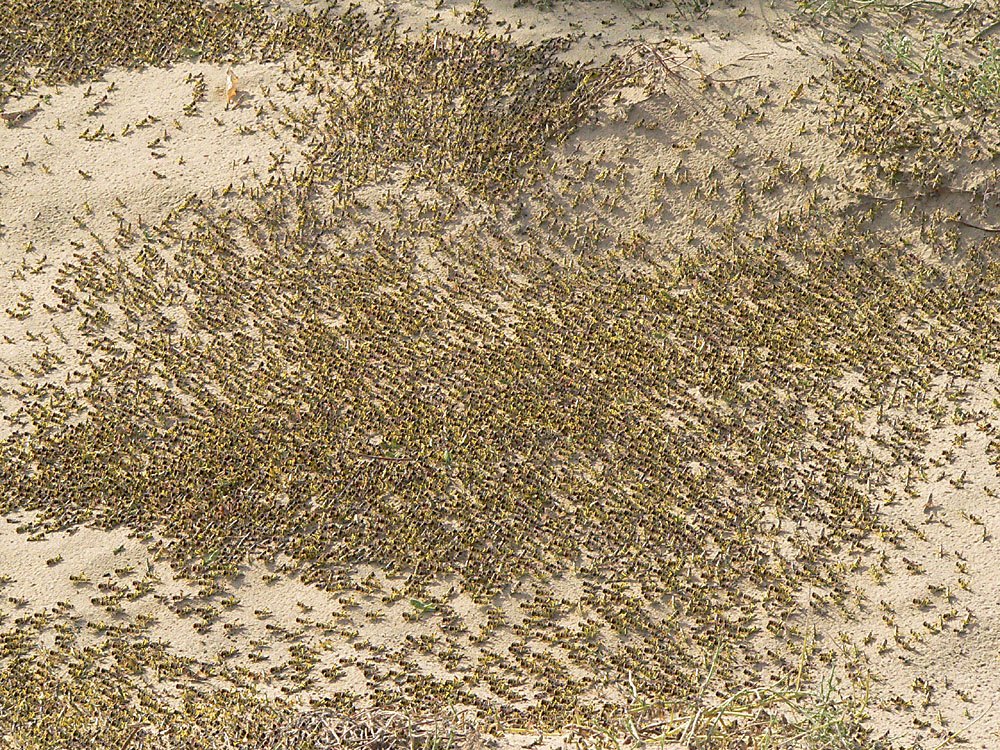
Young hoppers move in bands. A band marches by day, from two to three hours after dawn until about an hour before sunset, and roosts in vegetation at midday and at night. Fourth-stage bands move about 200–1,700 m a day.[2]



Lone locusts
Solitary adults fly at night. They take off about 20 minutes after sunset, usually fly for a few hours, and move 1–400 km in a night, sometimes as high as 1,800 m. They are attracted to lights.[2]
Diet
The Desert Locust eats a wide range of plants, and swarms target the crops and vegetation that feed people and animals.[13] FAO says that an adult can eat roughly its own weight in fresh food a day, about 2 g, and that a swarm of 1 km² with about 40 million locusts eats as much in a day as about 35,000 people.[1] Locusts do not attack people or animals, and there is no evidence that they carry diseases that harm humans.[1]

Life cycle
| Stage | Time | Notes |
|---|---|---|
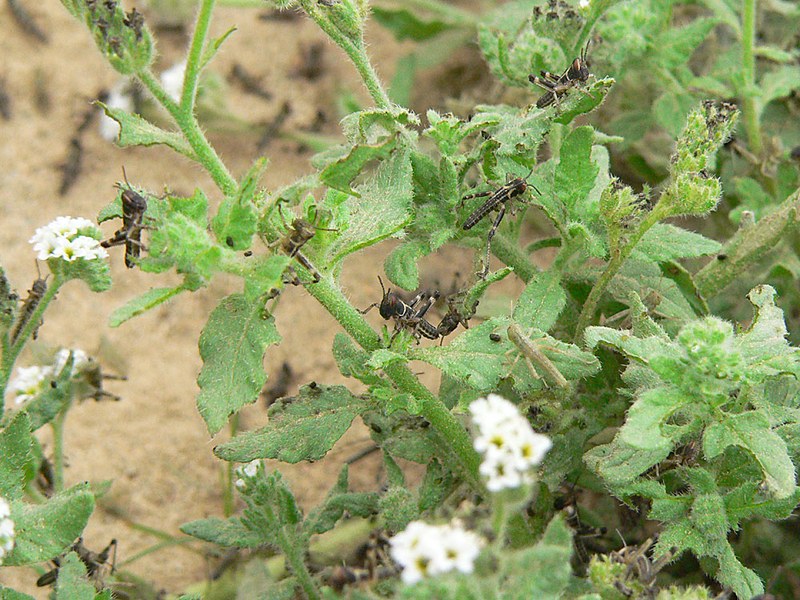
| Egg | About 2 weeks (10–65 days) | Laid in a pod 3–4 cm long, with its top 5–10 cm below the surface of bare, moist sand. A pod holds fewer than 80 eggs in swarming locusts and 90–160 in solitary ones[2][1] |
| Incubation | 50 days at 19.7 °C, 11–12 days at 35–41 °C | Development stops below 15.1 °C. This is from a laboratory study[14] |
| Hopper | About 30–40 days (24–95) | Five stages in swarming locusts, five or sometimes six in solitary ones[1][2] |
| Adult | Matures in 3 weeks to 9 months | The wings harden about ten days after the last moult. Rain triggers maturing, and most adults mature in 2–4 months[2][1] |
A female usually lays two or three pods, about 6–11 days apart.[2][1] Many eggs and hoppers die. Up to 70–80% of first-stage hoppers can die from lack of water, cannibalism and ants.[2] Under the best conditions a single female can produce up to 16–20 locusts in one generation.[2]

Lifespan
A locust’s whole life lasts about 3–5 months. It is extremely variable and set mostly by weather, with two to three generations a year.[1][3]
Ecology
Natural enemies
Predators and parasites do little to hold locusts down, because locusts migrate away from most of them. People and birds eat locusts, but usually not enough to cut numbers over large areas.[1] In a study in Niger, common kestrels and lanner falcons were the main predators, and about 90% of the kestrels’ prey remains were adult Desert Locusts.[15]
Pesticides
Chemical pesticides also kill or weaken the locust’s natural enemies, which can lower the control gained and risk outbreaks of other pests.[15]
As food
People in several countries collect locusts for food, then stir-fry, roast or boil them. Locusts killed by pesticides must never be eaten.[1]
Habitat and range
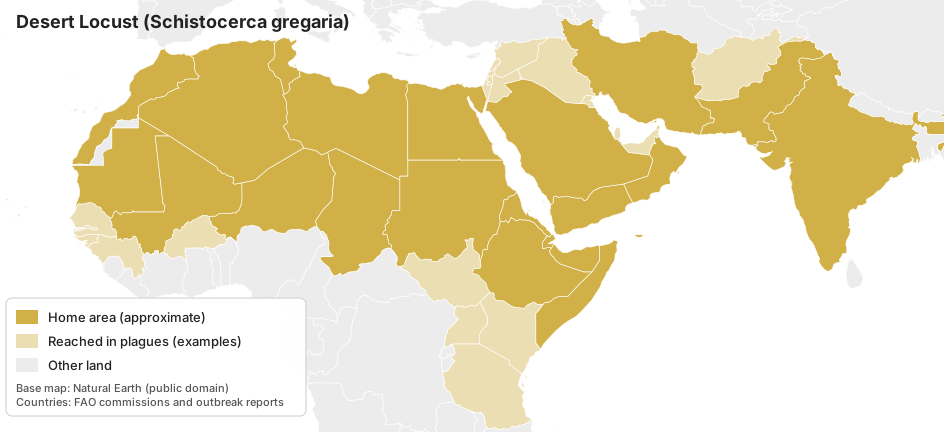
Between plagues, the Desert Locust lives in the semi-arid and arid deserts of Africa, the Near East and South-West Asia that get less than 200 mm of rain a year. This area is about 16 million km² and covers about 30 countries.[1] During plagues, swarms can spread over some 29 million km², reaching up to about 60 countries.[1]
To breed it needs moist sandy or sand-and-clay soil to a depth of 10–15 cm, some bare ground to lay on, and green plants for the hoppers.[1] Hoppers are found on plants such as Heliotropium, Panicum and Pennisetum.[2] Within its home area, the locusts move with the winds: in summer into the Sahel and the Indo-Pakistan desert, and in winter and spring to north-west Africa, the Red Sea coasts and Baluchistan.[2] A second subspecies lives in a limited area of southern Africa.[16]
Evolution
The Desert Locust belongs to Schistocerca, a genus of about 40 to 50 species, depending on the count, that arose about 7.9 million years ago. It is the only member in the Old World, and the first branch of the genus.[17][9][18] Its relatives live in the Americas. The ancestor of the American species flew across the Atlantic from Africa to South America about 6 million years ago, then spread to Central and North America.[17][18]
Two American species, the Central American and the South American locusts, also swarm. The three swarming Schistocerca species do not form a single group on the family tree, so swarming evolved or was lost more than once in the genus.[17] The grasshopper family Acrididae arose about 59 million years ago.[19]
Forms and variants
Forms
A Desert Locust can live in two main forms, called phases, that look and act very differently: the solitarious form lives alone, and the gregarious form gathers in bands and swarms. They are not separate species or subspecies. One locust can change into the other, and the change is set by how crowded the locusts are.[20]
| Solitarious | Gregarious | |
|---|---|---|
| Hoppers | Green | Black, or yellow and black[21] |
| Adults | Brown | Pink when young, yellow when mature[1] |
| Behaviour | Slow, avoids other locusts | Active, attracted to other locusts; hopper bands and swarms[20] |
| Adult flight | At night | By day[1] |
| Eggs per pod | 90–160 | Fewer than 80[2] |
| Hopper stages | 5, sometimes 6 | 5[2][22] |
| Brain | Smaller | About 30% larger[23] |
FAO also uses a third category in the field, transiens, for locusts changing from one form to the other.[21][5] Colour is only a hint: FAO notes that colour and shape show how the locusts have been behaving, not how they will behave.[5]
How the change happens
Crowding is the trigger. Repeatedly touching a hind leg for about 4 hours is enough to switch a solitary locust to gregarious behaviour, and serotonin is both needed for the switch and enough to cause it.[20][24] Behaviour changes within hours. Colour takes one crowded generation, and body shape takes two or more.[5][20] Going back is slower: after isolation a gregarious locust loses some gregarious behaviour within hours, then stays semi-gregarious for at least a week.[20] Every swarm comes from gregarious locusts, so the change is what turns a quiet population into a plague.[5]
Subspecies
Two subspecies are accepted: S. g. gregaria in the north, and S. g. flaviventris in southern Africa.[8][9] They can be told apart by their DNA and by the shape of the male’s tail parts.[25] Some older authors treated flaviventris as part of the main form.[9]
Conservation
The Desert Locust is a crop pest, not a species of conservation concern. It has not been evaluated by the IUCN, according to GBIF.[8] Between plagues it is monitored, not protected.
Outbreaks and plagues
FAO uses set terms. In a recession, most locusts are at low density. A plague is made up of many bands and many swarms, and the build-up to one is an upsurge, over a number of generations. Most upsurges die out without leading to a major plague.[5] FAO lists plagues in 1926–34, 1940–48, 1949–63, 1967–69 and 1986–89, and says there is no evidence that they come at fixed intervals.[1]
Monitoring and control
FAO runs a Desert Locust Information Service that collects data from affected countries and publishes monthly bulletins and forecasts up to six weeks ahead.[1][26] Control teams mainly spray organophosphate pesticides in tiny doses from vehicles and aircraft. Newer tools include insect growth regulators and a fungus, Metarhizium acridum, sold as Green Muscle, which works slowly: in a field test in Niger locusts began dying five days after spraying, and the effect reached 80% by day 21.[1][15] Finding locusts is hard: the home area is huge and remote, and ordinary environmental satellites cannot see individual locusts or swarms.[1]
History and culture
Ancient records
FAO says plagues of locusts have been reported since Pharaonic times in ancient Egypt.[1] The Bible’s eighth plague of Egypt tells of locusts brought by an east wind that “covered the face of the whole earth”.[27] The text does not name the species. The Roman writer Pliny wrote that in Cyrenaica a law forced people to fight locusts three times a year: first crushing the eggs, then killing the young, and last the full-grown insects.[28]
Food
Locusts are eaten in many places. The Bible lists the locust among the flying creatures that may be eaten, and says John the Baptist’s food was locusts and wild honey.[29][30] The texts do not say which species.
Understanding the two forms
In 1921 Boris Uvarov proposed the idea of phases, from his study of another species, the Migratory Locust. He suggested that the Desert Locust also changed phase in 1923, and in 1926 locusts were seen changing in Sudan.[31][32] Uvarov became the first director of the Anti-Locust Research Centre in London in 1945.[33]
Modern plagues
The 1986–89 plague drew about US$300 million of aid for fighting locusts and grasshoppers. Swarms were blown across the Atlantic in October and November 1988. Some reached the Cape Verde Islands, others south-west England, and Desert Locusts were recorded in the Caribbean and South America for the first time.[32] The 2003–05 upsurge began in the Sahel in June 2004. About 12.9 million hectares were sprayed, and the total cost of the campaign was about US$400 million.[34]
The 2019–21 upsurge began with two cyclones in 2018 that brought heavy rain to the Empty Quarter of the Arabian Peninsula, where locusts bred for three generations and grew about 8,000-fold before anyone could survey them.[35] FAO’s response in the Greater Horn of Africa and Yemen controlled nearly 2.3 million hectares, and FAO says it averted 4.5 million tonnes of crop losses and secured food for 41.5 million people.[36]
Taxonomy
| Rank | Name |
|---|---|
| Kingdom | Animalia |
| Phylum | Arthropoda |
| Class | Insecta |
| Order | Orthoptera |
| Suborder | Caelifera (grasshoppers) |
| Family | Acrididae (short-horned grasshoppers)[9] |
| Subfamily | Cyrtacanthacridinae[9] |
| Genus | Schistocerca Stål, 1873[9] |
| Species | Schistocerca gregaria (Forsskål, 1775)[8][9] |
The Orthoptera Species File gives the holotype locality as Cairo, Egypt.[9] The old name Schistocerca peregrina is now a synonym.[8] “Locust” is not a group on the family tree. Locusts are found in several subfamilies of Acrididae, and the habit of swarming arose more than once.[17]
Sources
- FAO Locust Watch, frequently asked questions about locusts
- Symmons & Cressman 2001, FAO Desert Locust Guidelines 1: Biology and behaviour (archived copy)
- CIRAD (Lecoq), Schistocerca gregaria species sheet
- Hearing in the desert locust, Journal of Comparative Physiology A 2025
- Symmons 1994, FAO The Desert Locust Guidelines I: Biology and behaviour
- Dictionary.com, locust
- Wiktionary, gregarius (secondary)
- GBIF backbone, Schistocerca gregaria
- Orthoptera Species File, Schistocerca gregaria
- FAO, le criquet pèlerin (in French)
- FAO, la langosta del desierto (in Spanish)
- GBIF vernacular names (Catalogue of Life)
- FAO, “A threat from the desert”
- Hunter-Jones 1970, Bulletin of Entomological Research 59: 707–718 (egg development and temperature)
- Mullié et al. 2021, PLOS ONE 16: e0244733 (Green Muscle and kestrels in Niger)
- Meynard et al. 2017, Global Change Biology (the southern African subspecies)
- Song et al. 2017, Scientific Reports 7: 6606 (phylogeny of locusts and grasshoppers)
- Lovejoy et al. 2006, Proceedings of the Royal Society B 273: 767 (Schistocerca and the Atlantic crossing)
- Song et al. 2018, Insect Systematics and Diversity 2 (Acrididae phylogeny)
- Rogers et al. 2014, Journal of Insect Physiology 65: 9–26 (rapid gregarization)
- FAO, instructions for the Desert Locust survey form (archived copy)
- Pelissie et al. 2016, PLOS ONE 11: e0155736 (extra moult in solitarious hoppers)
- Ott & Rogers 2010, Proceedings of the Royal Society B 277: 3087–3096 (brains of the two forms)
- Anstey et al. 2009, Science 323: 627–630 (serotonin and gregarization)
- Chapuis et al. 2016, Systematic Entomology (the two subspecies)
- FAO Locust Watch, Desert Locust Bulletin
- Exodus 10:12–15 (King James Version)
- Pliny the Elder, Natural History 11.35 (Bostock and Riley translation), Perseus
- Leviticus 11:21–22 (King James Version)
- Matthew 3:4 (King James Version)
- Uvarov 1921, Bulletin of Entomological Research 12: 135–163
- Magor et al. 2007, FAO Technical Series 35, history of locust control
- AIM25, Anti-Locust Research Centre
- FAO 2006, Multilateral evaluation of the 2003–05 Desert Locust campaign
- FAO, Desert Locust situation in Pakistan
- FAO 2022, Desert Locust crisis, final progress report