The Green Sea Turtle (Chelonia mydas) is a large sea turtle with an adult shell about a metre long. It lives in tropical and subtropical seas around the world and comes ashore only to nest. Young turtles eat a mix of animal and plant food, while adults graze mainly on seagrass and algae. The IUCN Red List (2025) lists the species as Least Concern.[1][2][3]
Quick facts
Description
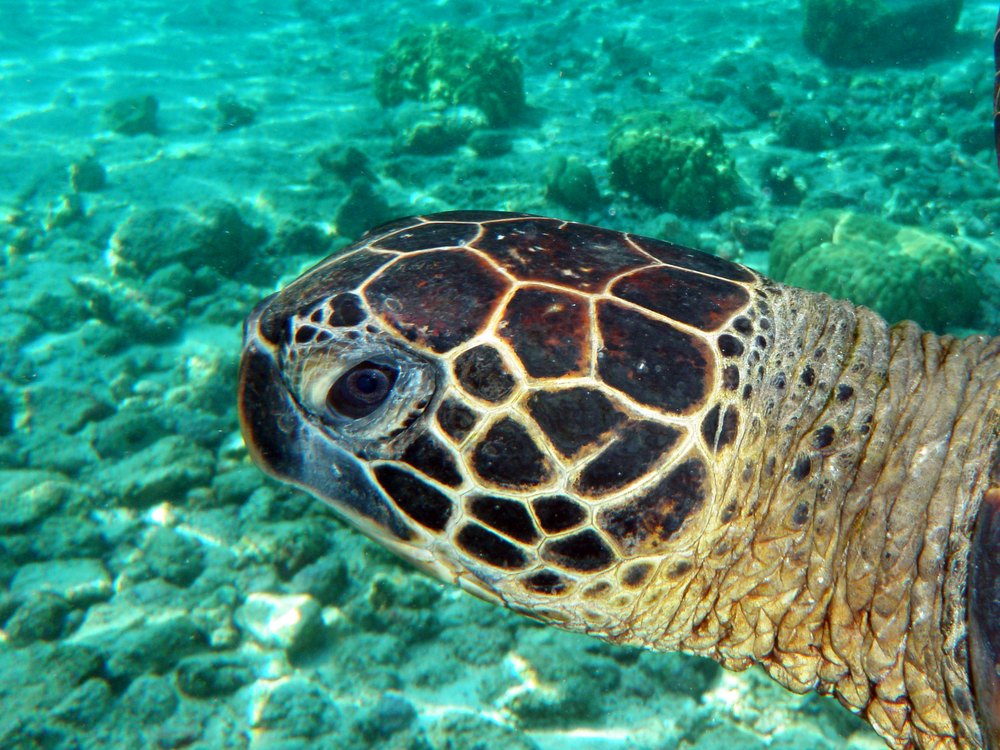
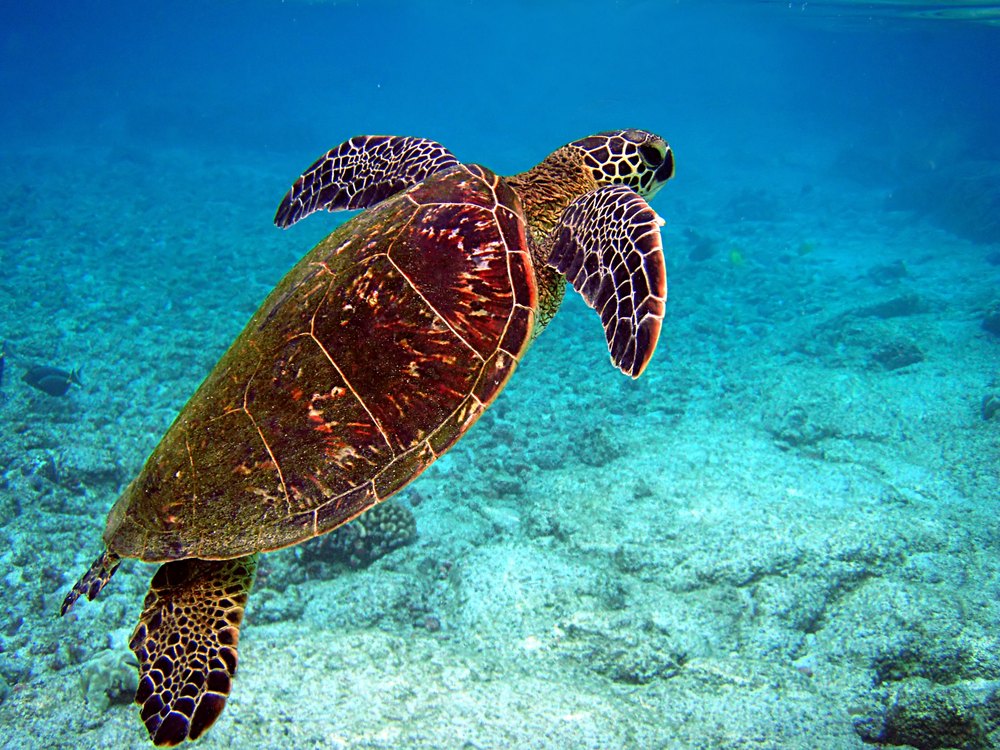
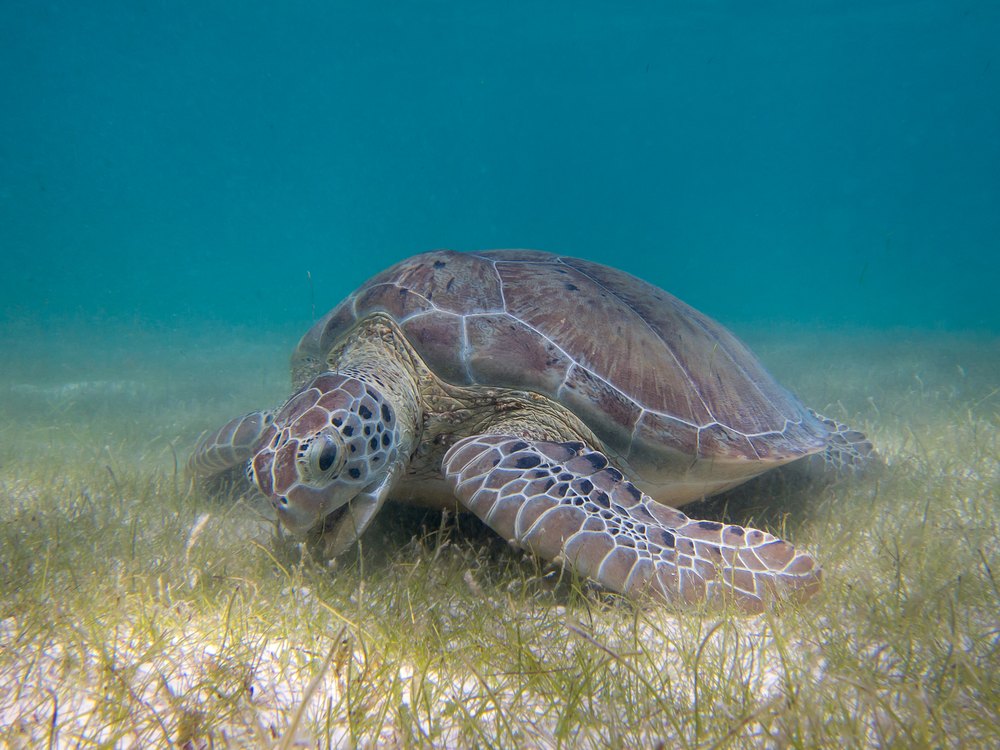
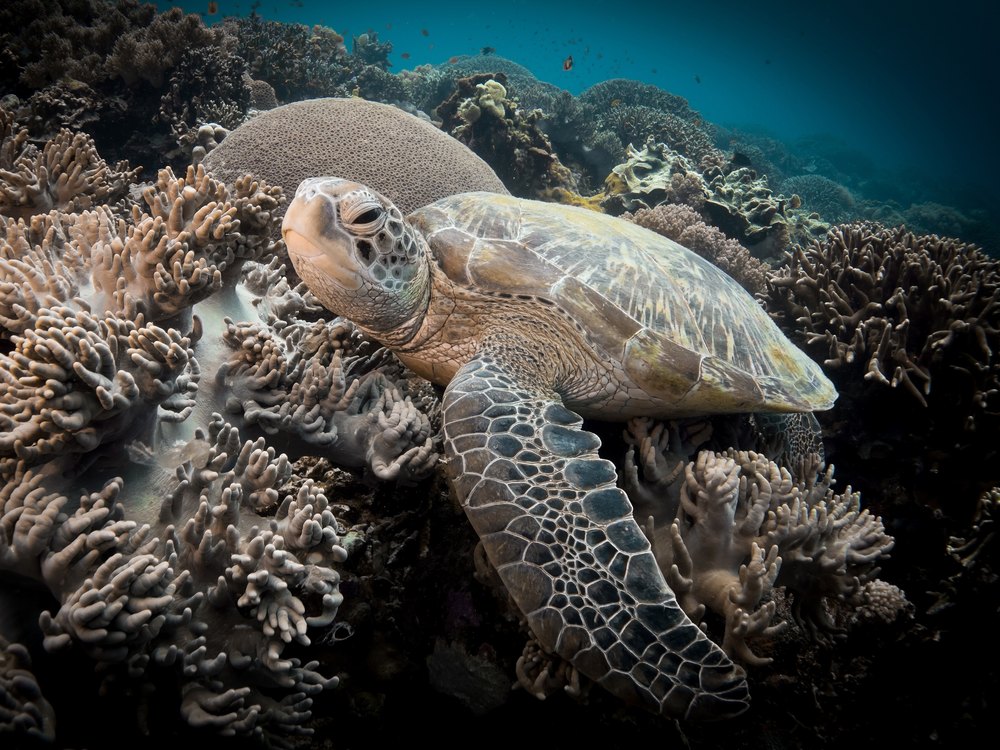
The Green Sea Turtle has a shell that ranges from olive to brown to black, not green.[5] NOAA describes the shell as dark brown, grey or olive, with five plates (scutes) down the middle and four on each side. Young turtles have dappled or sunburst-like patterns on the shell.[2] The upper shell is called the carapace and the lower shell the plastron.
The head is small, with a short snout and a strong, serrated beak that covers the jaw bones.[3][2] The turtle has a single pair of scales in front of the eyes (prefrontal scales), while other sea turtles have two or more.[3] Hatchlings have a dark grey to black upper shell, a white lower shell and white edges on the shell and flippers.[2] Males have longer claws and longer tails than females.[3] In the eastern Pacific, a mostly black form is known as the black turtle; whether it is a separate species is discussed under Forms and variants.[6]

Name
The turtle is called “green” because of its greenish fat, not the colour of its shell, which is olive to black. NOAA Ocean Service says the fat is thought to get its tint from the turtle’s diet of seagrass and algae.[5] The Red List also gives the English names Green Turtle and Black Turtle.[1] The Reptile Database gives the Greek chelónē, “tortoise” or “turtle”, as the source of the genus name Chelonia.[7] The scientific name dates from Linnaeus in 1758 (see History and culture).[7][8]
In other languages
| Language | Name | Meaning |
|---|---|---|
| Malagasy local | Fano Omby; Fano Zaty | — |
| Sinhala local | Gal Kasbawa; Kola Kasbawa; Weli Kasbawa | — |
| Tamil local | Pachchai Amai; Pera Amai | — |
| Samoan local | Laumei | — |
| Fijian local | Vonu Dina | — |
| Chamorro local | Haggan | — |
| Xhosa local | ufudo lelwandle | sea tortoise |
| Papiamento local | Tortuga blanku | — |
| French | Tortue verte | Green turtle |
| Spanish | Tortuga verde | Green turtle |
| Portuguese | Tartaruga-verde | Green turtle |
| Italian | Tartaruga verde | Green turtle |
| Indonesian | Penyu hijau | Green sea turtle |
| Japanese | Ao umigame | Blue-green sea turtle |
| Swahili | Nyamba | — |
| Hawaiian | Honu | — |
Names are those listed on the IUCN Red List page for the species; the Hawaiian name honu is the one used by the Hawai‘i Division of Aquatic Resources.[1][9] These names are from the IUCN Red List list of common names and the Dutch Caribbean species register, as listed by GBIF.
Body
Size
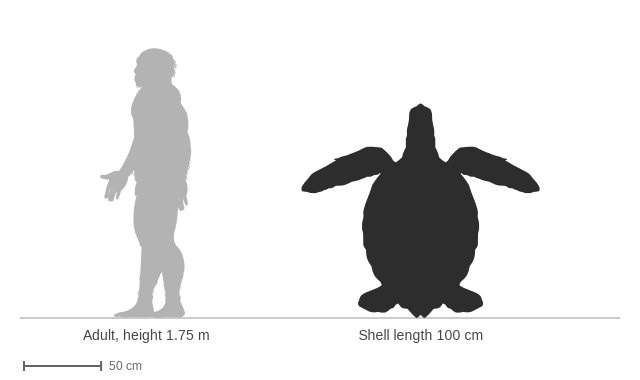
A hatchling of the Green Sea Turtle (Chelonia mydas) is about 5 cm long and weighs about 25 g.[3] Juveniles reach about 40 cm, and subadults measure 70 to 100 cm.[3] Adults have a carapace (the upper shell) of 100 to 120 cm and weigh 150 to 200 kg, according to Animal Diversity Web.[3] NOAA Fisheries describes adults as about 0.9 to 1.2 m long.[2]
The size at which turtles mature differs between places. In Hawai‘i it ranges from 75 to 106 cm straight carapace length (the length in a straight line, without following the curve of the shell).[10] Curved carapace length is measured over the curve of the shell and is longer than the straight length of the same turtle.
| Weight (adult) | 150–200 kg |
| Length (adult) | 100–120 cm |
Salt glands
Sea turtles get rid of the extra salt they take in through glands near the eyes. The “tears” of a turtle are salty fluid. In a test on Green Sea Turtles that were given a salt load, the fluid from the gland rose from 300–400 to a plateau of 1,680–2,000 milliosmoles per kilogram (a measure of saltiness). It is mostly sodium and chloride in much the same proportions as in sea water, and its top rate of secretion matched that of the mammalian kidney.[11]
Senses
Vision is the main sense that the turtle uses for finding food and for communicating with others of its kind.[3] The inner ear picks up the direction of waves, which helps the turtle find its way.[3]
Diving and breathing
The Green Sea Turtle breathes air and makes dives of very different lengths. Resting dives of nesting females at Ascension Island routinely reached 18 to 20 m, and dives deeper than 20 m were extremely rare.[12] On the open-ocean swim to and from Ascension, most dives lasted less than 5 minutes, but some, mostly at night, lasted more than 20 minutes: dives were either short (2 to 4 minutes, about 0.9 to 1.5 m deep) or long (typically 20 to 30 minutes, 10 to 20 m deep).[13] Two turtles off Cyprus dived no deeper than about 25 m but stayed under water for up to about 40 minutes.[14]

Navigation
A 2004 experiment showed that the Green Sea Turtle has a map that is at least partly based on the Earth’s magnetic field.[15] Winds may help too. Ascension Island lies more than 2,200 km from the Brazilian coast where its females feed, and in tests with six females that were moved 50 km from the island, the three taken downwind found it again within 1 to 4 days, while of the three taken upwind two took 10 and 27 days and one headed back towards Brazil. The authors concluded that this strongly supports wind-borne cues helping turtles find the island.[16] The long swim itself is described under Behavior.
Behavior
Adult home ranges at feeding grounds measured 3.8 to 642.2 hectares in radio-tagged turtles.[3]
Mating
During mating, a female signals that she accepts a male by staying still while he mounts. When she refuses, she swims away with her hind flippers closed, bites, or floats with her lower shell turned towards him.[3]
Migration
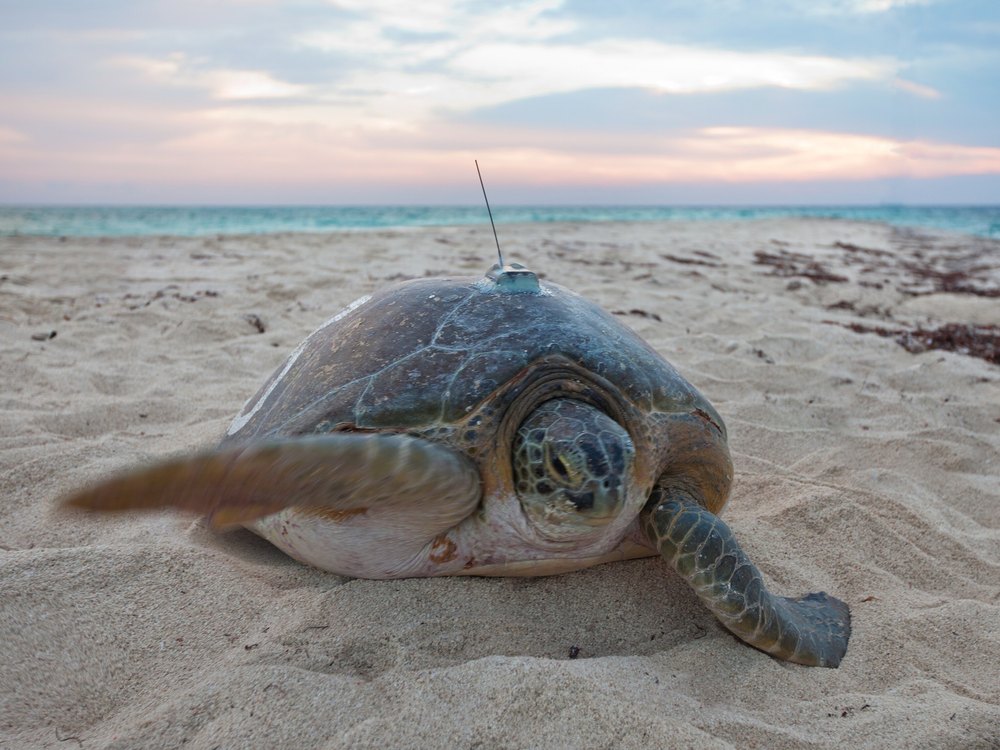
Adults travel between feeding grounds and nesting beaches every 2 to 4 years.[1] Radio-tagged turtles swim about 20 to 90 km a day.[3] Satellite tracking of females leaving Ascension Island showed five of six reaching the coast of Brazil, a distance of 1,777 to 2,342 km covered in 33 to 47 days.[17] The tagging work that first showed these long crossings is described in History and culture.
Basking
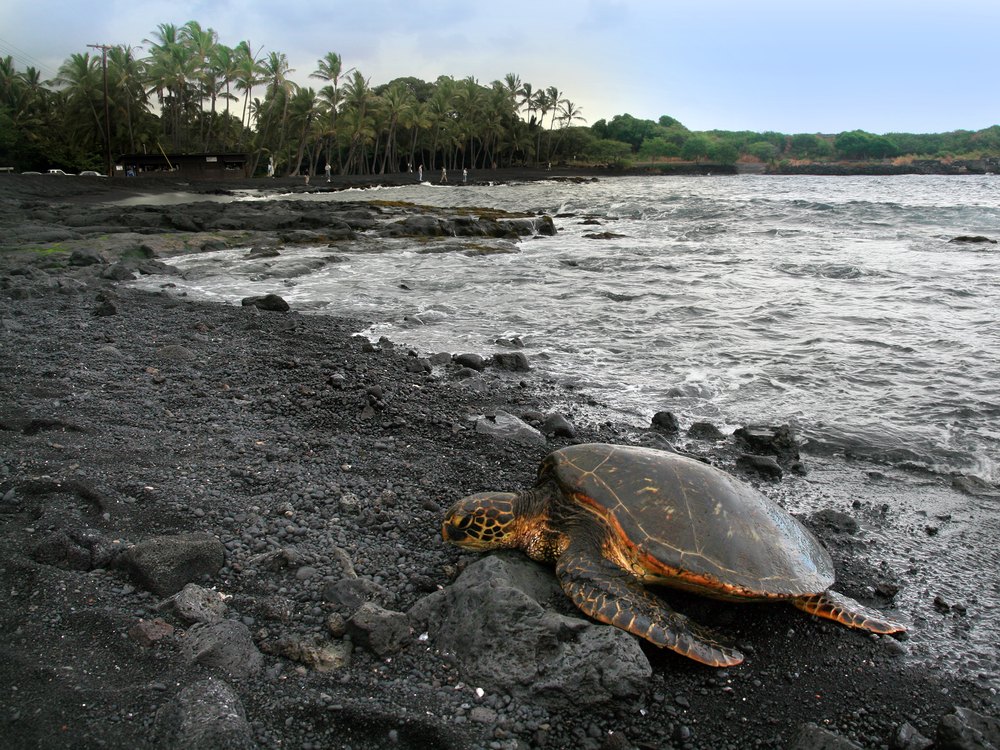
Green Sea Turtles sometimes leave the water to bask. At French Frigate Shoals in Hawai‘i, basking turtles flipped sand onto their shells; the shell surface reached 42.8 °C, while the highest body temperature measured was 31.3 °C, and turtles spent 0.3 to 7.5% of the time under observation basking.[18] In the Galápagos, basking on Fernandina Island was linked to low tides, higher air temperatures and clear skies, and the researchers suggested that it helps with warming or digestion.[19]

Sounds
Young turtles make sounds. Hatchlings recorded at Ascension Island produced 70 sounds that fell into four categories, and the authors compared them with the contact calls of other aquatic turtles.[20] Underwater recorders attached to 11 free-ranging juveniles off Martinique gave the first evidence of underwater calls in this species, including pulses, low-amplitude calls, frequency-modulated sounds and squeaks.[21]
Diet
Young turtles
Hatchlings spend their first years in the open ocean before moving to coastal waters and a diet that includes plants.[1] In the open ocean, young Chelonia mydas feed on drifting communities such as floating Sargassum seaweed.[2] The eastern Pacific population eats more animal prey than other populations.[2] In the south-western Pacific, juveniles feed on floating material in the open ocean and, at about 44 cm curved carapace length, move to feeding grounds near the shore, where they become mainly plant eaters.[22] The change is not the same everywhere. In the north-western Gulf of Mexico, turtles as small as 16.2 cm straight carapace length already fed in nearshore waters, mostly on algae, with seagrass dominating above 30 cm, and animal food stayed a common part of the diet.[23]
Adults
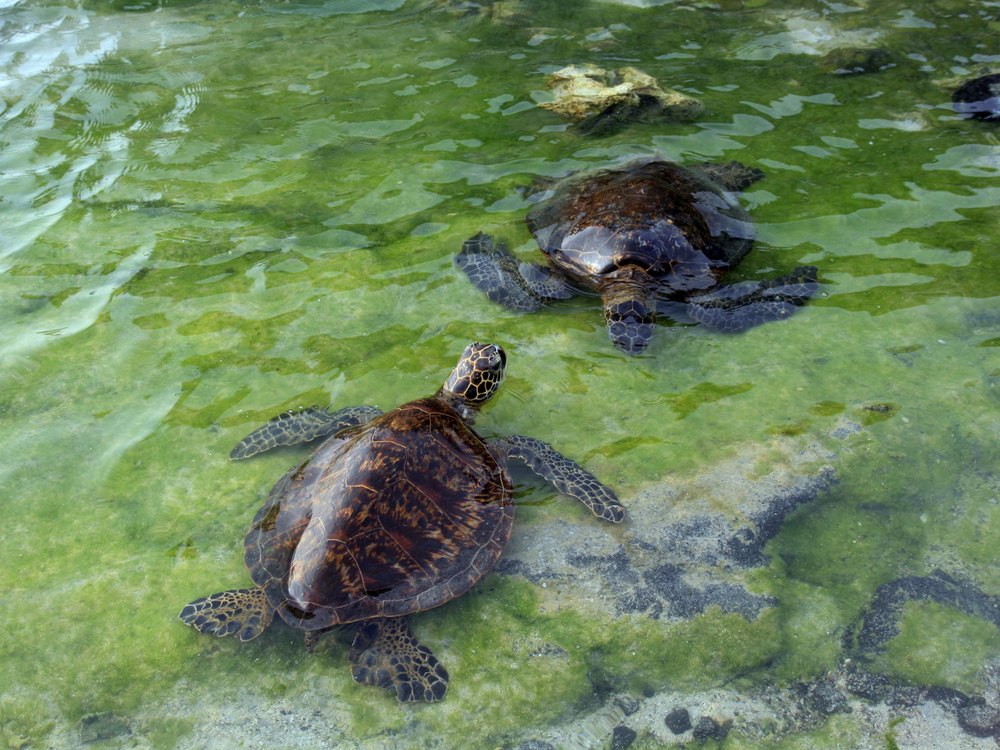
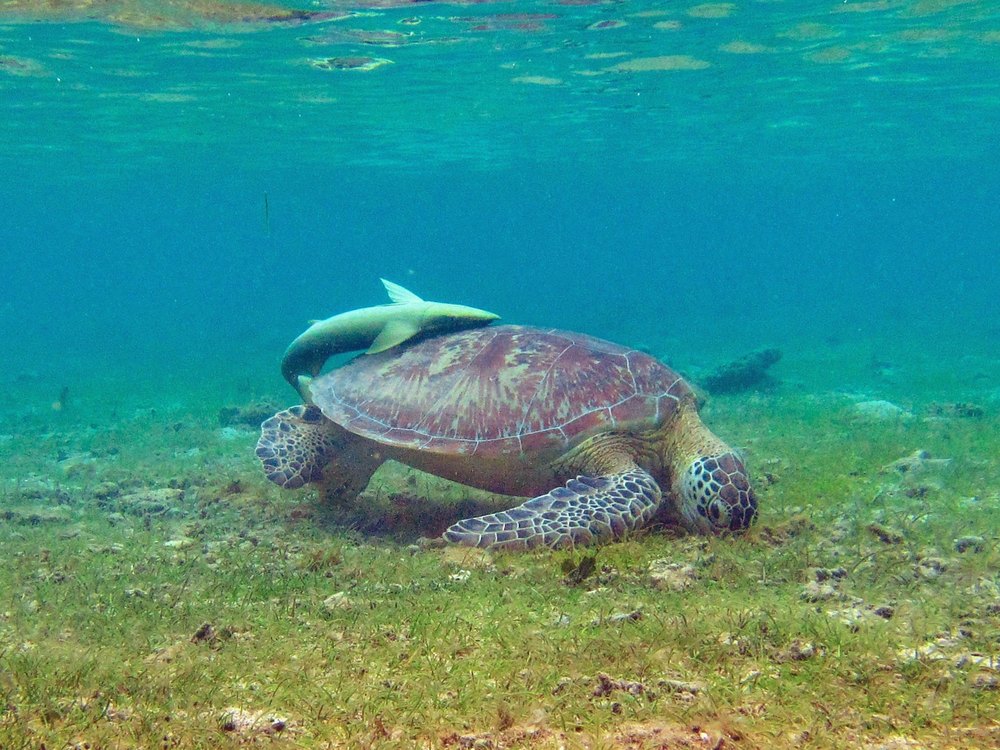
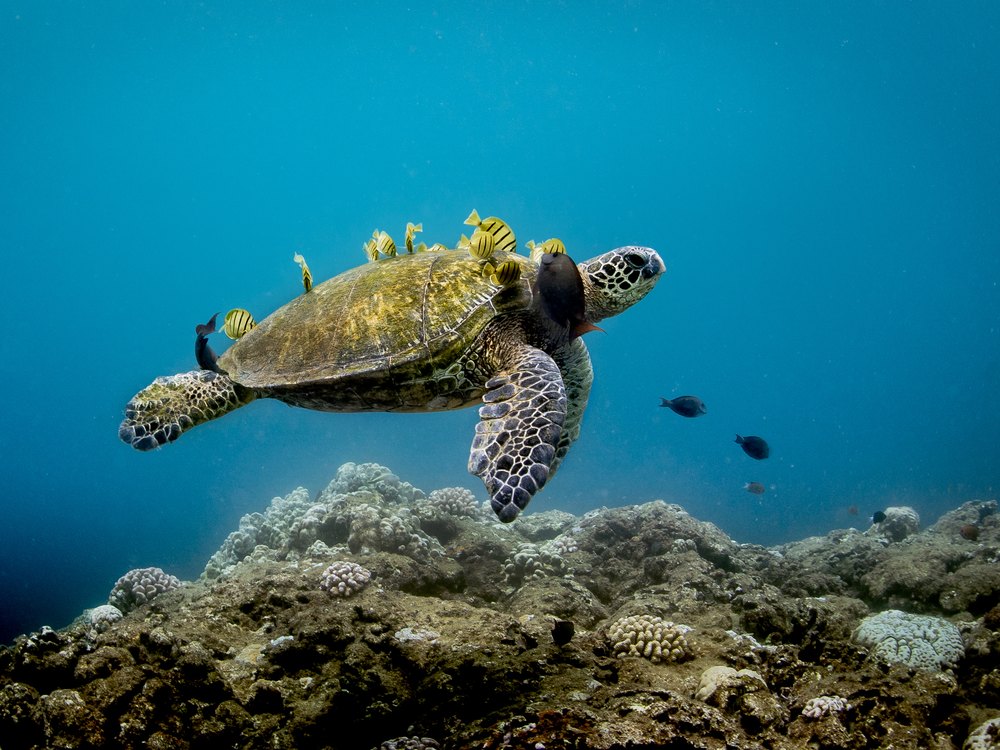
Adults and older coastal juveniles feed mainly on seagrass (flowering plants that grow on the sea floor) and algae.[3][2] They also eat sponges and other invertebrates.[2] A global review of 177 studies found that at warm sites (above 25 °C for at least six months a year) plants made up on average about 93% of the diet, while at cooler sites (below 20 °C) animal matter averaged about 51%.[24] Immature turtles in Moreton Bay, Queensland, ate both seagrass and algae, but most fed selectively on algae, mainly Gracilaria.[25] In Shark Bay, Western Australia, turtles got most of their energy from algae and from gelatinous plankton (jellyfish and comb jellies), and video suggested that the plankton might be the most commonly eaten food.[26] The turtle’s gut bacteria help with the plant diet: in young turtles from Brazil, bacteria that break down plant fibre became common soon after the turtles settled in coastal waters.[27] The greenish colour of their fat, which gave the species its name, is explained in Name.


Life cycle
| Stage | What it looks like / size |
|---|---|
| Egg | About 100 eggs a nest[1] |
| Hatchling | About 5 cm long and about 25 g[3] |
| Juvenile | About 40 cm when it settles in coastal waters[3] |
| Adult | 100 to 120 cm and 150 to 200 kg[3] |
Stages
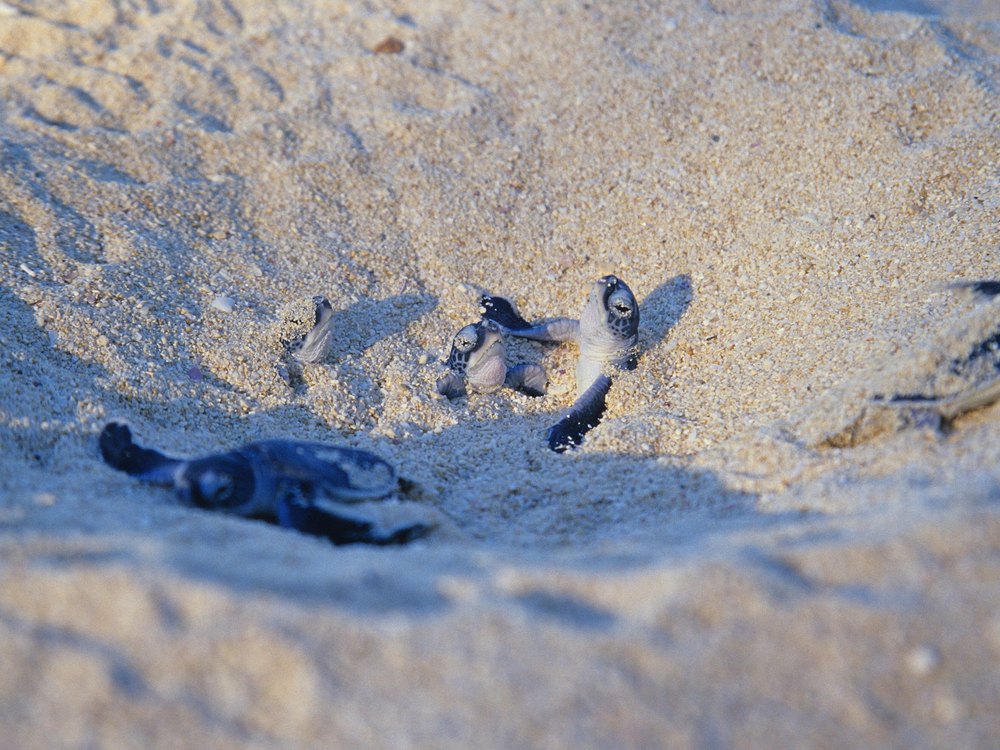
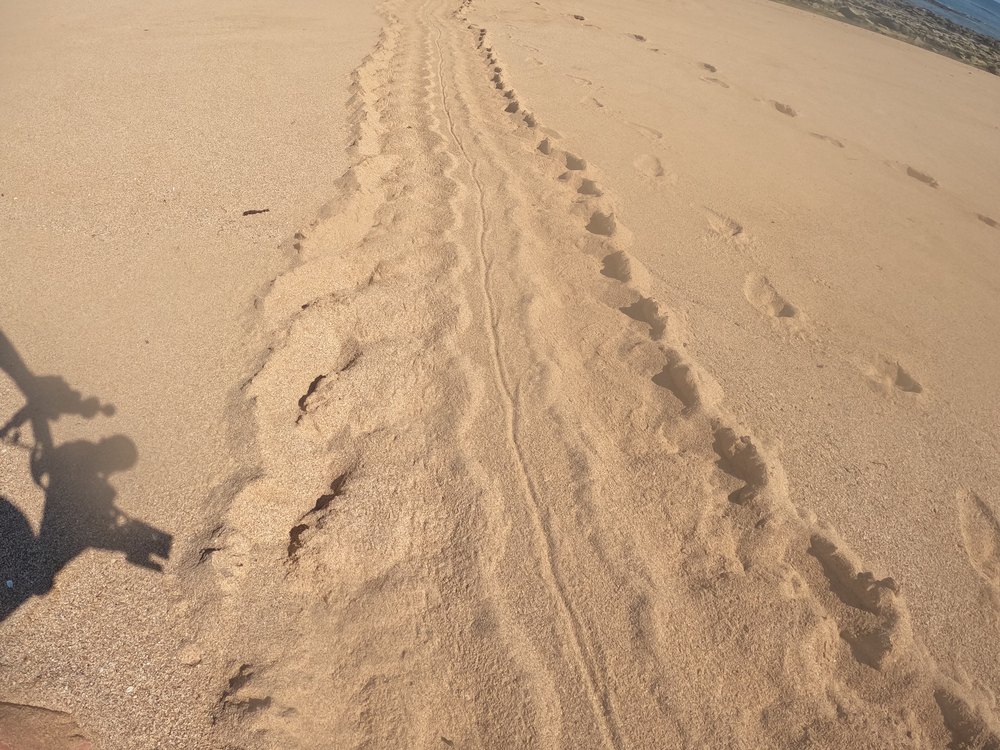
A female Chelonia mydas lays her eggs in a hole she digs in the sand of a beach. The hatchlings are about 5 cm long and weigh about 25 g.[3] They crawl to the sea and swim out to the open ocean, where young turtles drift and feed in the open water far from land for their first years.[28][1]
The length of this open-ocean stage is only roughly known. A study in the north-western Atlantic gave 1 to 7 years, with an average of 3, and stable-isotope work in the Bahamas pointed to about 3 to 5 years.[28] On the northern Great Barrier Reef the young turtles were 5 to 6 years old when they moved to coastal waters.[28] There the juveniles switch to feeding in shallow water near the coast, mostly on algae and seagrass, and some regions have more omnivorous turtles (see Diet).[28][3]

Nesting
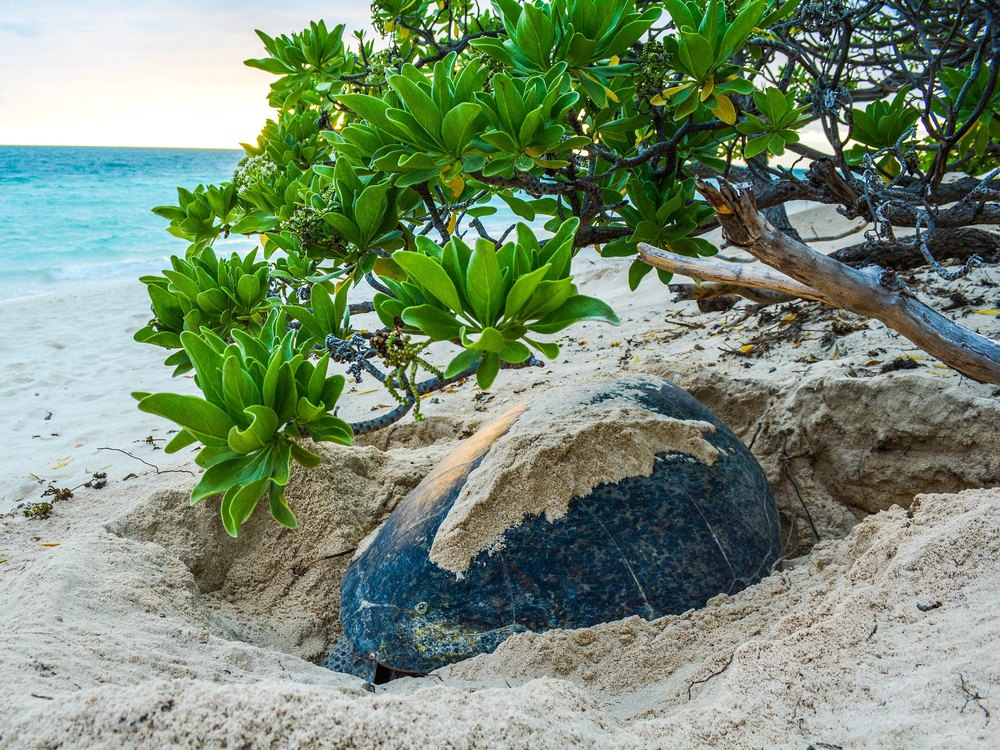
The IUCN gives about 100 eggs a clutch, and NOAA about 110.[1][2] A female lays several clutches in one season, about 2 weeks apart.[2] Eggs take 6 to 8 weeks to hatch.[1] Females do not nest every year: at Tortuguero, Costa Rica, a 3-year gap is the most common.[3] Turtles often return to the region where they hatched to nest.[1] Tagged females have kept nesting for more than 40 years at Heron Island and Mon Repos in Australia.[1]


Sex and temperature
The sex of a hatchling is set by the temperature of the nest: cooler sand gives more males and warmer sand gives more females.[28][3] Animal Diversity Web puts the change at about 28.5 °C (more males below) and 30.3 °C (more females above).[3] The temperature that gives equal numbers of each sex differs between populations. It was 28.8 °C for 39 nests at Ascension Island,[29] and 29.4 °C in Guinea-Bissau, where both sexes were produced between 27.6 and 31.4 °C.[30]
Warm nests have shifted the balance on the northern Great Barrier Reef. Among the sampled turtles there, 99.1% of juveniles and 99.8% of subadults were female, as were 86.8% of adult-sized turtles. On the cooler southern reef, 65 to 69% of the sampled turtles were female. The study linked this to sand there staying above about 29.3 °C since around 1980.[4]
Lifespan
The Green Sea Turtle matures slowly. In the wild the IUCN gives 15 to 50 years to reach maturity, which differs by population and by how age is measured.[1] NOAA gives 25 to 35 years for females.[2] NOAA estimates the lifespan at 70 years or more, while the IUCN notes that longevity data are scarce, partly because tags are lost.[2][1]
Ecology
Role in the sea
The IUCN calls the Green Sea Turtle (Chelonia mydas) a keystone species in tropical marine ecosystems, including seagrass meadows and coral reefs.[31] A keystone species is one whose presence shapes the whole community around it. As a large herbivore, the turtle affects how much seagrass grows and how productive the meadows are, and it is an essential link in the food chain of these habitats.[32] Females also move nutrients from the sea to the land, because the eggs they bury in beach sand carry food energy that was gathered offshore.[32]


Predators
Eggs and hatchlings face the most predators. Nests are dug up by ghost crabs, raccoons, feral pigs, foxes, coyotes, armadillos and red fire ants in the south-eastern United States, by dogs and pigs on islands in the Caribbean and Pacific, and by jackals, foxes and dogs around the Mediterranean.[28] At Akyatan in Turkey, canids destroyed 63.8% of the nests in 1992.[28] At Rose Atoll in American Samoa, hatchlings are eaten by crabs and blacktip reef sharks.[28] On Diego Garcia in the Chagos Archipelago, coconut crabs, ghost crabs and introduced black rats ate green turtle eggs, but only 3.1% of eggs in the nests studied were eaten.[33]
Few animals attack adults. Jaguars kill nesting females on the beach at Tortuguero, Costa Rica, where 57 turtles were found killed in 2011, and the number has risen since 1997.[28] Sharks take turtles in some areas, such as Puerto Rico and Panama, and tiger sharks off north-eastern Brazil eat green turtles often enough that turtles seem to be an important part of their diet.[28] At Shark Bay, Western Australia, tiger sharks are a major cause of turtle deaths, although green turtles had fewer shark injuries than loggerheads.[34] People are the main adult predator: see Conservation.
Disease
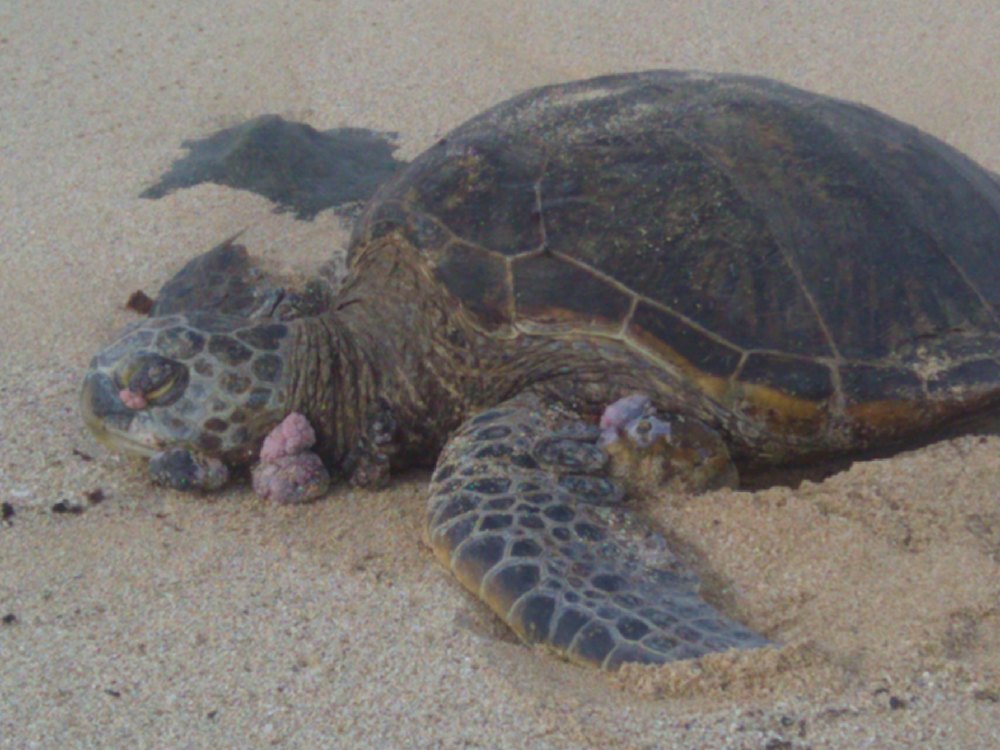
Fibropapillomatosis is a disease that causes tumours on the skin, eyes and organs. The tumours can grow large enough to hamper swimming, seeing, feeding and escape from predators.[28] It is found mainly in Hawai‘i and the south-eastern United States. In Florida it was first recorded in 1938, and 22% of 6,027 stranded green turtles examined from 1980 to 2005 had tumours on the outside of the body.[28] It is rare at some sites: none of 274 nesting females at Poilao, Guinea-Bissau, in 2007 had it.[28] A link with polluted or nutrient-rich coastal water has been suggested, but no direct link has been shown, and the effect of the disease on turtle populations is not established.[28] The IUCN calls it common but not a major current threat.[1]

Habitat and range
Habitat
The Green Sea Turtle uses three kinds of place during its life. Females nest on sandy beaches with dunes, native plants, natural temperatures and no artificial light.[28] Hatchlings go to the open ocean, where they drift in convergence zones, places where currents meet and gather floating Sargassum seaweed. They feed on the seaweed and the small animals living in it.[28] The length of this stage is described under Life cycle.
Older juveniles and adults live in shallow coastal water, where they graze on seagrass and algae.[28] Feeding grounds can lie hundreds to thousands of kilometres from the nesting beach.[28] Turtles in cool feeding areas can be cold-stunned or poisoned by red tide, a bloom of toxic algae.[28] Cold-stunning happens when cold water makes turtles too weak to swim: in January 2010, 1,648 green turtles were cold-stunned in St Joseph Bay, Florida,[28] and thousands were cold-stunned in Texas in the winter of 2020 to 2021.[1]

Range
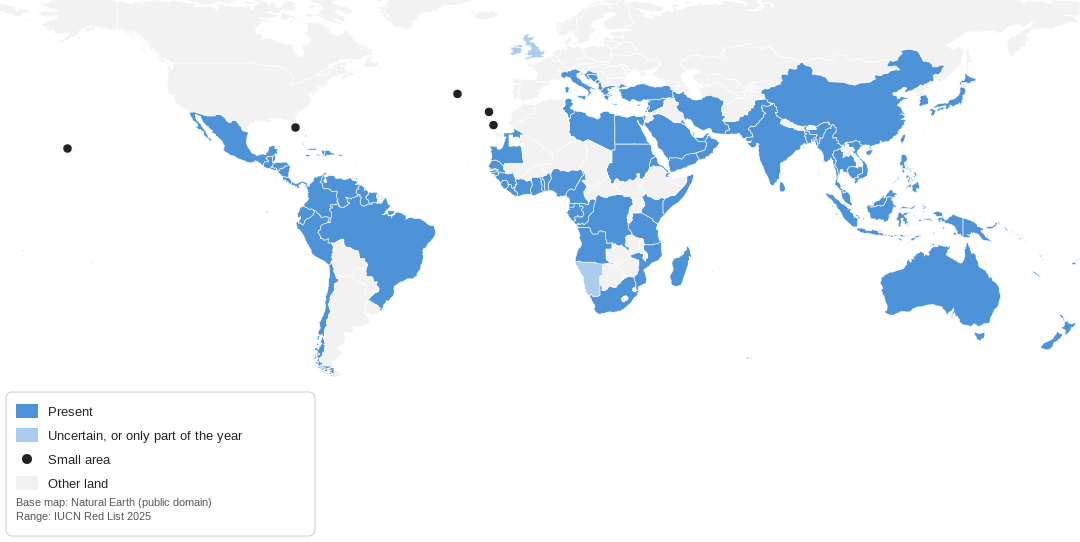
The IUCN describes the range as circumglobal between 40° N and 40° S, mainly in tropical waters and, to a lesser extent, subtropical ones.[1] The turtle is a resident in about 150 countries and territories.[1] It is a vagrant (an animal that wanders far outside its range) in Ireland, Namibia and the United Kingdom, and it may be present in a few places such as the Azores, Madeira and the Canary Islands.[1]
The IUCN divides the species into 11 subpopulations: North Atlantic, Mediterranean, South Atlantic, Southwest Indian Ocean, North Indian Ocean, East Indian-West Pacific, Southwest Pacific, Central West Pacific, Central South Pacific, Hawaiian (North Central Pacific) and East Pacific.[1] The Southwest Pacific is the largest subpopulation and the North Atlantic the second largest.[1]
Nesting sites
At Tortuguero, Costa Rica, 79% of all nesters in the North Atlantic subpopulation use the beach.[28] Raine Island, on the northern Great Barrier Reef, is probably the largest nesting site of the species. Estimates of nesting females there range from 4,000 to 89,000 a year, with about 25,000 in a typical season.[28] On Heron Island, further south, the average number of nesting females a year varied between 26 and 1,801 from 1999 to 2004.[28]
At Ras al Hadd in Oman, about 6,000 females nested a year in 1977 to 1979.[28] On Ascension Island, in the South Atlantic, the number of adult females was estimated at 13,417 in 2010 to 2012.[28] In Hawai‘i, about 3,710 breeding females were estimated, and almost all nest at French Frigate Shoals.[28]
Evolution
The Green Sea Turtle belongs to the sea turtles (superfamily Chelonioidea), which have seven living species in two families. The leatherback is the only living member of its own family, and the other six are the hard-shelled sea turtles (Cheloniidae), which include the Green Sea Turtle, the flatback, the hawksbill, the loggerhead and the two ridleys.[6]
Dates for these branches depend on the DNA used and on the calibration. A 2021 study of whole mitochondrial genomes (the small DNA ring passed on by the mother) puts the split between the leatherback and the hard-shelled turtles at about 52 to 68 million years ago and the start of the hard-shelled family at about 34 to 44 million years ago.[35] The same study found higher values when it used nuclear DNA.[35]
In that study the Green Sea Turtle came out as the sister of a group made of the hawksbill, the loggerhead and the olive ridley. The flatback and Kemp's ridley were not sampled, so the closest relative of the Green Sea Turtle is not settled.[35] Nuclear DNA from earlier work also places the genus Chelonia apart from the loggerhead and the hawksbill.[36]
Within the species, DNA studies find two main ocean lineages: one in the Atlantic and Mediterranean, and one in the Indian and Pacific oceans.[36] A study of 11 lineages of mitochondrial DNA in nesting turtles from 127 nesting sites concluded that the species appears to have originated in the Indo-Pacific and later spread into the central and eastern Pacific and the Atlantic.[37]
Forms and variants
Subspecies
No subspecies of the Green Sea Turtle are accepted today. The Integrated Taxonomic Information System (ITIS), GBIF and the Reptile Database each treat Chelonia mydas as one species without subspecies, and the IUCN Red List lists none.[8][7][38][1] The Reptile Database and ITIS list the old subspecies names japonica (Thunberg, 1787) and carrinegra (Caldwell, 1962) as synonyms of the species.[7][8]
The one open question is the black turtle, a dark form of the eastern Pacific that has been described as its own species, Chelonia agassizii. In waters around Japan, two colour types of the Green Sea Turtle live side by side, one with a light, yellowish plastron and one with a black plastron.[39] A 1999 genetic study found no separate lineage: black turtles share their mitochondrial DNA type with green turtles of Hawaii and the Indian Ocean.[36] The same year, Pritchard and Mortimer weighed arguments for and against and supported species status.[6] The manual in which they wrote, from the IUCN/SSC Marine Turtle Specialist Group, listed the black turtle under Chelonia mydas without taking a formal position on the debate.[6] In 2014 Okamoto and Kamezaki measured 127 turtles from the coastal waters of Japan, sorted by plastron (lower shell) colour, and reported shell differences that in their view support the black type as a separate species.[39]
Conservation
Status
The IUCN Red List moved the Green Sea Turtle (Chelonia mydas) from Endangered to Least Concern in 2025 (assessed in December 2024). It had been listed as Endangered since at least 1982; the 2004 assessment gave an estimated decline of 48% to 67% over three generations.[1] The new listing rests on clutch counts at monitored nesting beaches with at least ten years of data, which rose by about 28%, from about 419,000 clutches a year to about 526,000. This is a nesting index, not a head count of turtles.[1]
The numbers are still far below historic levels. The assessment notes that the Southwest Pacific, the largest subpopulation, has low hatchling output, and that the North Atlantic has declined at Tortuguero since 2008. Several of the 11 subpopulations remain threatened or Near Threatened.[1]

Threats
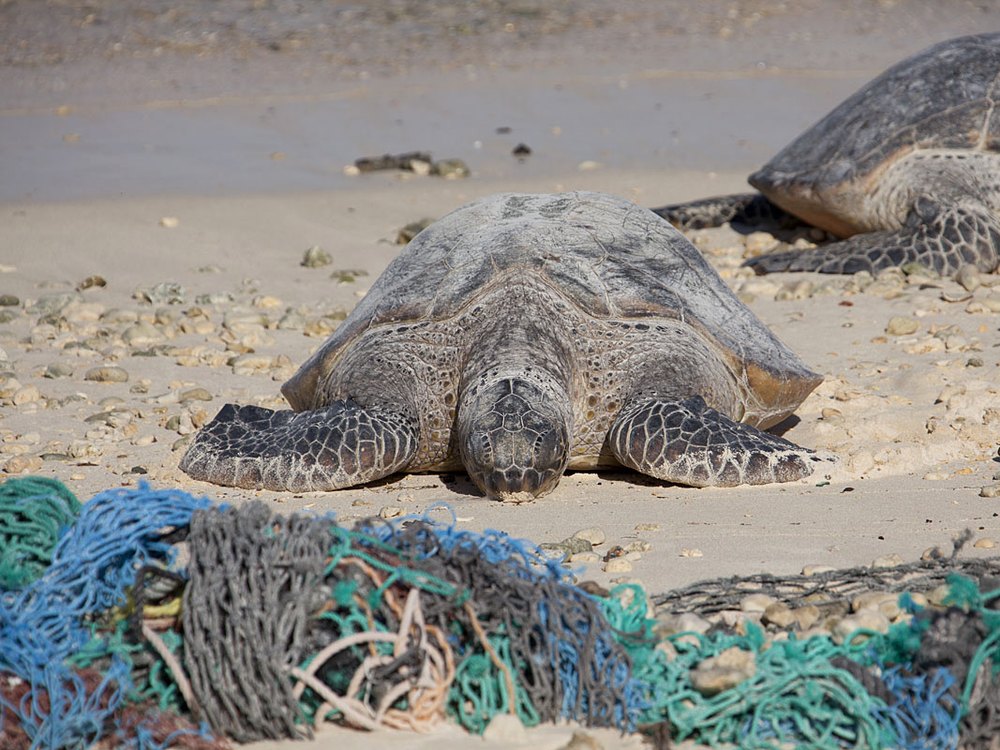
HuntingIllegal killingBycatchFishing gearHabitat lossPollutionDiseaseClimate change[1]Hunting and illegal take. The IUCN says that direct take of turtles and eggs has been the most important source of death for centuries. At least 42 countries and territories allowed some legal take, according to a 2014 review quoted by the IUCN, and green turtles made up over 80% of it.[1] Illegal take across all sea turtle species is about 44,000 turtles a year, most of them green turtles.[1] Because the turtles mature slowly, the effects of egg harvest at nesting beaches can take decades to show.[32]
Bycatch and fishing gear. Bycatch, the accidental catch of animals in fishing gear, happens in gillnets, longlines and trawls.[1][2]
Habitat loss. Coastal development removes nesting beach, and artificial light confuses hatchlings and nesting females.[1][28]
Pollution. Plastic and other marine debris are a further threat.[1][2]
Disease. Disease is described under Ecology.
Climate change. Climate change works in two ways: warm sand produces more female hatchlings (see Life cycle), and cold snaps can stun turtles in the water (see Habitat and range).[1]

Protection
The Green Sea Turtle is in Appendix I of CITES, the treaty on international trade in endangered species, which bans trade, and in Appendices I and II of the Convention on Migratory Species. It is also in Annex II of the SPAW Protocol, a Caribbean treaty on protected areas and wildlife.[1][28] In the United States the species has been protected by the Endangered Species Act since 1978. Since 2016 the listing covers 11 distinct population segments: 3 are endangered (Mediterranean, Central West Pacific and Central South Pacific) and 8 are threatened.[40][28]
Turtle excluder devices, trapdoors in shrimp trawl nets that let turtles escape, cut bycatch in trawl fisheries. The IUCN also names protection of nesting females and eggs, community programmes and trade restrictions as measures behind the recovery, which has been strongest at Ascension Island, Brazil, Mexico and Hawai‘i.[31][28]
History and culture
The first description
Carl Linnaeus described the turtle in 1758 in the tenth edition of Systema Naturae, under the name Testudo mydas. His text named the Pelagie Islands and Ascension Island as the home; in 1928 Mertens and Müller restricted the type locality to Ascension Island.[7]
Hunting and trade
People have eaten the meat and eggs of the Green Sea Turtle for centuries.[1] In Hawai‘i, ships from Europe, Asia and North America harvested turtles in the Northwestern Hawaiian Islands in the 1800s, and by the 1900s green turtles were sold in Honolulu markets and restaurants. Hunting there was banned in 1978, after the species was listed under the Endangered Species Act.[9] Overharvest of turtles and eggs was one of the main reasons for the 1978 listing.[40]
The Cayman Turtle Centre on Grand Cayman began in 1968 as Mariculture Ltd., a company set up to raise green turtles commercially. The company went bankrupt in 1975, a German group bought it, and the Cayman Islands Government took it over in 1983. The farm reports that its first adults, taken from the wild, nested in 1973, that the last wild eggs were collected in 1976, and that the first second-generation hatchlings were bred in captivity in 1989.[41]
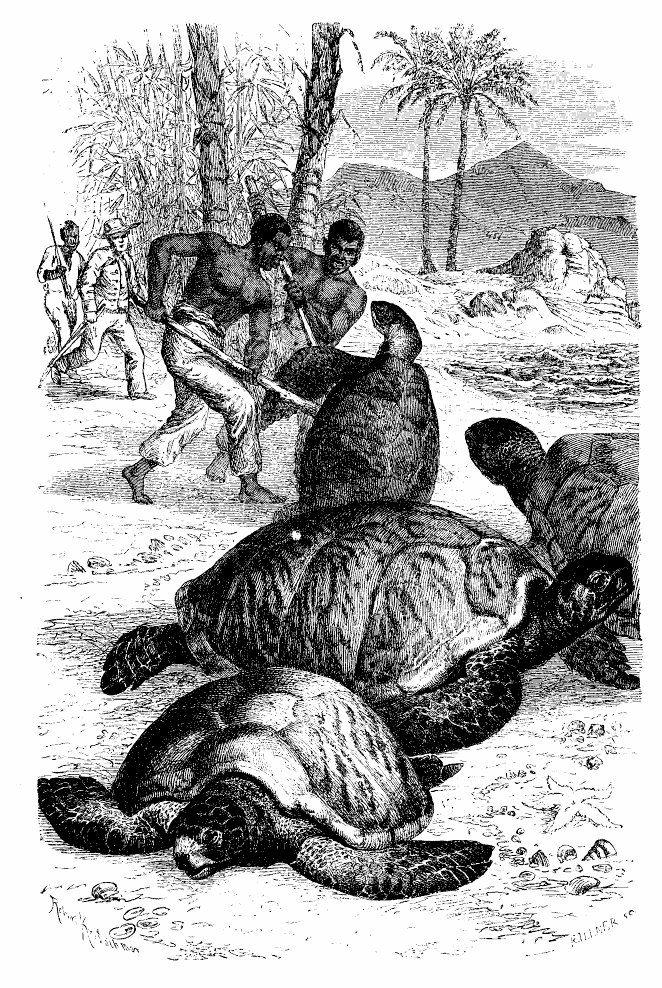

Tagging and migration
The zoologist Archie Carr ran a tagging programme at Tortuguero, Costa Rica. By 1964 his team had tagged 3,000 green turtles there, and 120 tags had come back from other countries. Carr concluded that the turtle is a periodic long-distance migrant.[42] In 1960, 206 turtles were tagged on the nesting beaches of Ascension Island, in the middle of the South Atlantic. By 1964 eight had been recovered on the coast of Brazil. Carr wrote that these returns strengthened his belief that Brazilian turtles go to Ascension to nest, but that they “still do not prove it”.[42]
Hawaiian meaning
The Hawaiian name of the turtle is honu. In old Hawai‘i, some people regarded green sea turtles as an ‘aumakua, an ancestral guardian, and many Hawaiians still do.[9]
Taxonomy
| Rank | Name |
|---|---|
| Kingdom | Animalia |
| Phylum | Chordata |
| Subphylum | Vertebrata |
| Superclass | Tetrapoda[44] |
| Class | Reptilia |
| Order | Testudines (turtles and tortoises)[8] |
| Suborder | Cryptodira[44] |
| Superfamily | Chelonioidea[44] |
| Family | Cheloniidae (hard-shelled sea turtles)[6][8] |
| Subfamily | Cheloniinae[44] |
| Genus | Chelonia[8][7] |
| Species | Chelonia mydas (Linnaeus, 1758)[38][8][7] |
Synonyms (10)
| Name |
|---|
| Euchelonia midas (Linnaeus, 1758) |
| Mydasea mydas (Linnaeus, 1758) |
| Testudo mydas (Linnaeus, 1758) |
| Chelonia viridis (Schneider, 1783) |
| Testudo viridis (Schneider, 1783) |
| Testudo japonica (Thunberg, 1787) |
| Testudo macropus (Gmelin, 1789) |
| Testudo chloronotus (Bechstein, 1800) |
| Testudo rugosa (Daudin, 1801) |
| Testudo cepediana (Daudin, 1802) |
A selection of the oldest names. The GBIF backbone lists 30 species-level synonyms.[43]
Higher classification
The Green Sea Turtle belongs to the hard-shelled sea turtles, the family Cheloniidae, in the order Testudines, which also holds the freshwater turtles and the tortoises.[8] In the databases read, the genus Chelonia holds only this one species, and the black turtle of the eastern Pacific is listed as a synonym (see Forms and variants).[7][8][38] Which hard-shelled turtle is its closest relative is not settled (see Evolution).
Old subspecies names
Older books split the Green Sea Turtle into subspecies by ocean, Chelonia mydas mydas for the Atlantic and Chelonia mydas japonica for the Indian and Pacific oceans.[7] The Reptile Database does not accept subspecies today, because the species is very variable, and it lists japonica as a synonym of the species.[7]
Sources
- Wallace and Broderick 2025, IUCN Red List assessment of Chelonia mydas (global)
- NOAA Fisheries, green turtle species page
- Animal Diversity Web, Chelonia mydas
- Jensen et al. 2018, “Environmental warming and feminization of one of the largest sea turtle populations in the world”, Current Biology 28: 154–159
- NOAA National Ocean Service, “Why is it called a green turtle?”
- Pritchard and Mortimer 1999, “Taxonomy, external morphology, and species identification”, in Eckert et al. (eds), Research and Management Techniques for the Conservation of Sea Turtles, IUCN/SSC Marine Turtle Specialist Group Publication 4
- The Reptile Database, Chelonia mydas (Linnaeus, 1758)
- ITIS, Chelonia mydas (Linnaeus, 1758), TSN 173833
- Hawai‘i Department of Land and Natural Resources, Division of Aquatic Resources, sea turtles page
- Goshe, Snover, Hohn and Balazs 2016, Ecology and Evolution 6(10): 3208–3215, Hawaiian green turtles
- Nicolson and Lutz 1989, “Salt gland function in the green sea turtle Chelonia mydas”, Journal of Experimental Biology 144: 171–184
- Hays et al. 2000, “The diving behaviour of green turtles at Ascension Island”, Animal Behaviour 59: 577–586
- Hays et al. 2001, “The diving behaviour of green turtles undertaking oceanic migration to and from Ascension Island”, Journal of Experimental Biology 204: 4093–4098
- Hochscheid, Godley, Broderick and Wilson 1999, “Reptilian diving: highly variable dive patterns in the green turtle Chelonia mydas”, Marine Ecology Progress Series 185: 101–112
- Lohmann et al. 2004, “Geomagnetic map used in sea-turtle navigation”, Nature 428: 909–910
- Hays et al. 2003, “Island-finding ability of marine turtles”, Proceedings of the Royal Society B 270 (Supplement): S5–S7
- Luschi, Hays, Del Seppia, Marsh and Papi 1998, satellite tracking of green turtles migrating from Ascension Island, Proceedings of the Royal Society B 265
- Whittow and Balazs 1982, “Basking behavior of the Hawaiian green turtle (Chelonia mydas)”, Pacific Science 36: 129–139
- Maxwell et al. 2014, “The influence of weather and tides on the land basking behavior of green sea turtles (Chelonia mydas) in the Galápagos Islands”, Chelonian Conservation and Biology 13: 247–251
- Ferrara, Mortimer and Vogt 2014, sounds of green turtle hatchlings at Ascension Island, Copeia 2014(2): 245–247
- Charrier et al. 2022, “First evidence of underwater vocalizations in green sea turtles Chelonia mydas”, Endangered Species Research 48: 31–41 (excerpts)
- Arthur, Boyle and Limpus 2008, “Ontogenetic changes in diet and habitat use in green sea turtle (Chelonia mydas) life history”, Marine Ecology Progress Series 362: 303–311
- Howell and Shaver 2021, “Foraging habits of green sea turtles (Chelonia mydas) in the northwestern Gulf of Mexico”, Frontiers in Marine Science 8: 658368
- Esteban et al. 2020, “A global review of green turtle diet: sea surface temperature as a potential driver of omnivory levels”, Marine Biology 167
- Brand-Gardner, Lanyon and Limpus 1999, “Diet selection by immature green turtles, Chelonia mydas, in subtropical Moreton Bay, south-east Queensland”, Australian Journal of Zoology 47: 181–191
- Burkholder, Heithaus, Thomson and Fourqurean 2011, “Diversity in trophic interactions of green sea turtles Chelonia mydas on a relatively pristine coastal foraging ground”, Marine Ecology Progress Series 439: 277–293
- Campos, Guivernau, Prenafeta-Boldú and Cardona 2018, “Fast acquisition of a polysaccharide fermenting gut microbiome by juvenile green turtles Chelonia mydas after settlement in coastal habitats”, Microbiome 6: 69
- Seminoff et al. 2015, Status Review of the Green Turtle (Chelonia mydas) under the U.S. Endangered Species Act, NOAA Technical Memorandum NMFS-SWFSC-539
- Godley, Broderick, Glen and Hays 2002, “Temperature-dependent sex determination of Ascension Island green turtles”, Marine Ecology Progress Series 226: 115–124
- Patrício et al. 2017, “Balanced primary sex ratios and resilience to climate change in a major sea turtle population”, Marine Ecology Progress Series 577: 189–203
- IUCN press release, 10 October 2025, on the Red List update
- Seminoff 2002, IUCN/SSC Marine Turtle Specialist Group review, 2002 global status assessment of the green turtle
- Stokes, Esteban and Hays 2023, “Predation of sea turtle eggs by rats and crabs”, Marine Biology
- Heithaus, Frid, Wirsing, Bejder and Dill 2005, “Biology of sea turtles under risk from tiger sharks at a foraging ground”, Marine Ecology Progress Series 288: 285–294
- Vilça et al. 2021, Molecular Ecology 30(23): 6178–6192, sea turtle family tree and divergence times
- Karl and Bowen 1999, “Evolutionary significant units versus geopolitical taxonomy: molecular systematics of an endangered sea turtle (genus Chelonia)”, Conservation Biology 13(5): 990–999
- Jensen et al. 2019, Journal of Biogeography 46(5): 860–870, global phylogeography of the green turtle
- GBIF Backbone Taxonomy, Chelonia mydas (Linnaeus, 1758)
- Okamoto and Kamezaki 2014, “Morphological variation in Chelonia mydas from the coastal waters of Japan, with a taxonomic discussion on the turtles allied to Chelonia mydas agassizii”, Current Herpetology 33(1): 46–56
- NOAA Fisheries and U.S. Fish and Wildlife Service 2016, final rule listing eleven distinct population segments of the green sea turtle, Federal Register 81: 20058
- Cayman Turtle Centre, history page (archived)
- Carr 1964, “Transoceanic migrations of the green turtle”, BioScience 14(8): 49–52
- GBIF backbone, Chelonia mydas, synonyms
- ITIS, Chelonia mydas, classification