The Komodo Dragon (Varanus komodoensis) is the largest living lizard.[1] It lives only on a few islands of Indonesia, including Komodo, Rinca and parts of Flores, in dry savanna and forest.[2] Adults hunt deer, wild pigs and water buffalo from ambush.[2] The IUCN assessment rates the species Endangered, with 1,383 adults.[2]
Quick facts
Description
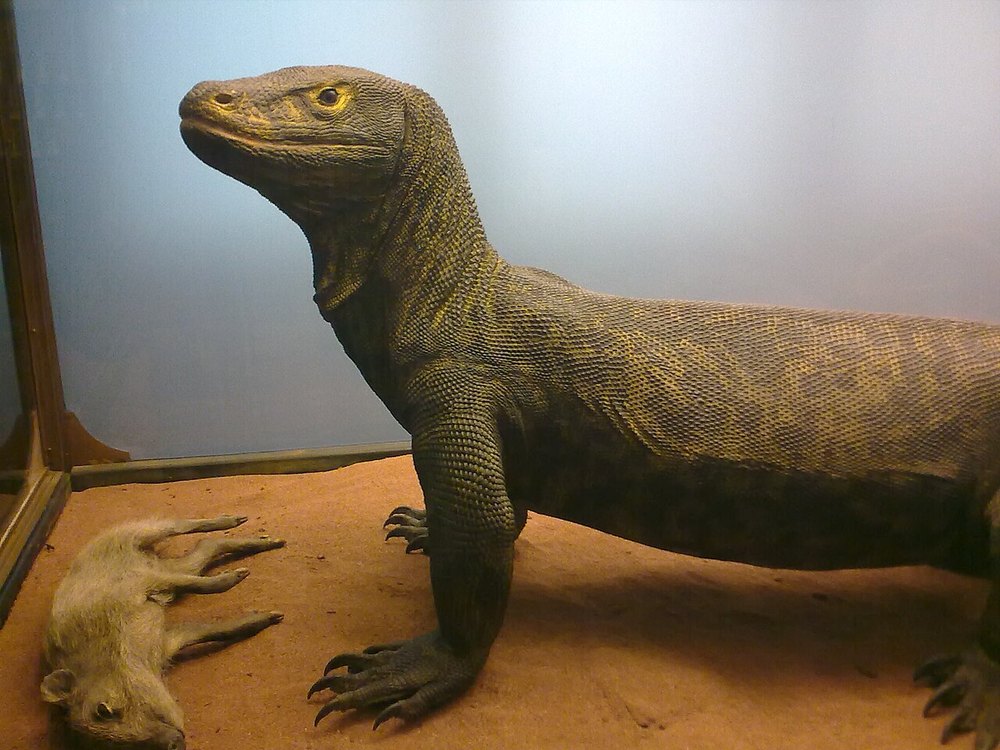
The Komodo Dragon is a heavy, long-bodied lizard with a long tail, strong limbs and a broad head. The skin is covered in small scales set in regular rows, and the original 1912 description calls it dark brown above.[5] The tongue is long, forked and yellow.[5][6][7] Adults have bony plates inside the skin (see Body).
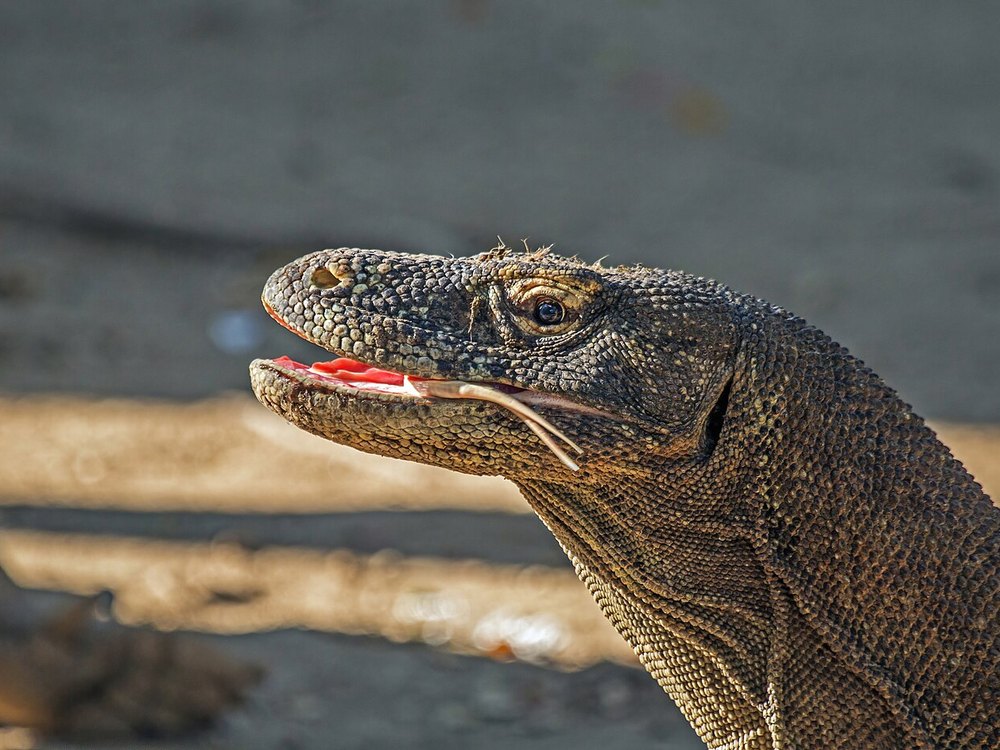
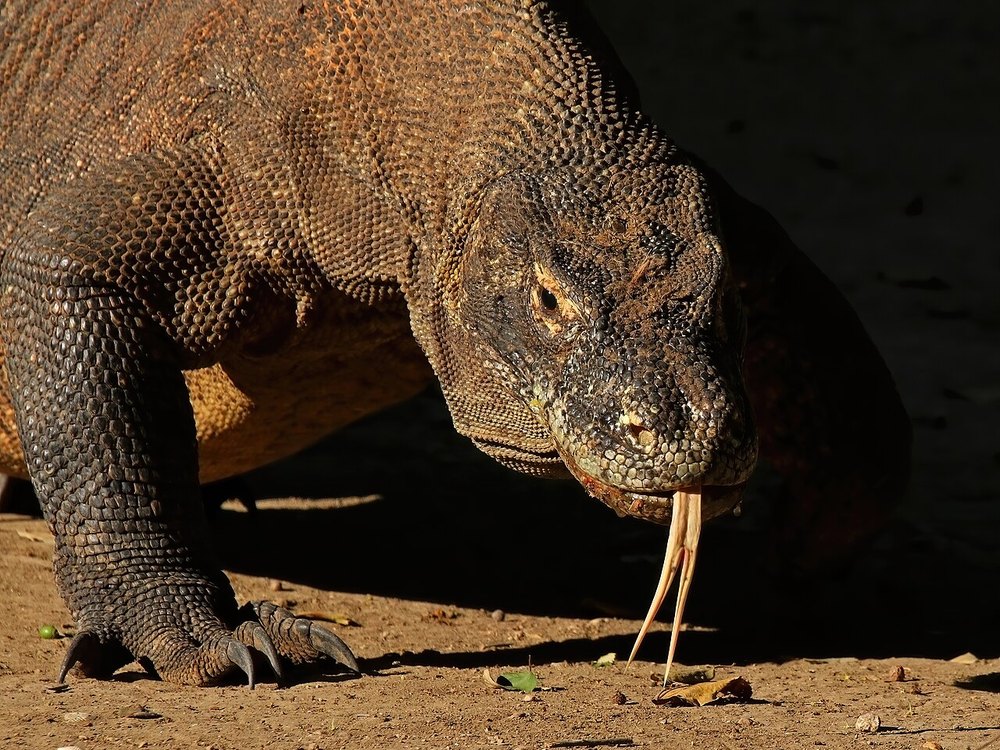
Name
The scientific name is Varanus komodoensis Ouwens, 1912. P. A. Ouwens described the animal in a three-page paper in 1912 and wrote that, if it was indeed a species not yet described, he proposed to call it Varanus Komodoensis.[5] The species name means “from Komodo”: the Reptile Database says it is named after the type locality, the island of Komodo, and the ending -ensis is Latin for “from a place”.[8] The first skin Ouwens studied actually came from Flores (see History and culture).[5] The genus name Varanus comes from an Arabic word for a lizard (waral, also waran).[9]
English names listed by the IUCN are Komodo Dragon, Komodo Monitor and Ora.[2] PBS says that “ora” and biawak raksasa (“giant monitor”) are local names, and that the word “dragon” began when the American W. Douglas Burden called the animals dragons on his expedition of 1926.[10] Ouwens recorded another local name in 1912, boeaja darat (modern spelling buaya darat), meaning “land crocodile”.[5]
In other languages
| Language | Name | Meaning |
|---|---|---|
| Manggarai local | ora | also hora, lawora |
| Indonesian local | buaya darat; biawak raksasa | land crocodile; giant monitor |
| French | Dragon des Komodos; Varan de Komodo | — |
| Spanish | Varano de Komodo | — |
| German | Komodowaran; Komododrache | Komodo monitor; Komodo dragon |
| Italian | Varano di Komodo; Drago di Komodo | Komodo monitor; Komodo dragon |
| Portuguese | Dragão-de-komodo; crocodilo-da-terra | Komodo dragon; land crocodile |
| Dutch | Komodovaraan | — |
| Danish | Komodovaran | — |
| Finnish | Komodonvaraani | — |
| Polish | Waran z Komodo | — |
| Czech | varan komodsky | — |
| Hungarian | komodoi varanusz | — |
| Turkish | Komodo ejderi | Komodo dragon |
| Russian | Komodskij varan | — |
| Javanese | Komodho | — |
| Japanese | コモドオオトカゲ (komodo-oo-tokage) | Komodo big lizard |
| Chinese | 科摩多龍; 科莫多龍 | Komodo dragon |
The French and Spanish names come from the IUCN assessment.[2] The other names are listed by GBIF and the Catalogue of Life and are unverified.[11] The local names are from the list collected by Walter Auffenberg in 1981, as quoted on a web page about the lizard’s legends.
Body
Size and weight
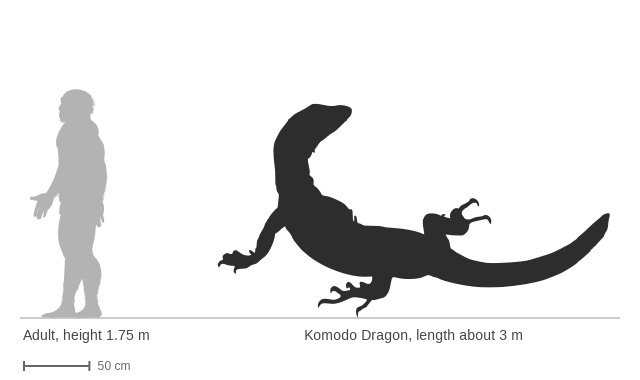
The Komodo Dragon is the largest living lizard. In a study that caught, marked and released wild animals on four islands, males reached about 157 cm and about 70 kg, and females were not caught above 117 cm and weigh about 25 kg.[1] These lengths are snout-vent lengths: the distance from the nose to the base of the tail.
The largest wild animals reach about 3 m in total length and 87 kg in that study, and 3.04 m and 87.4 kg in a 2007 survey (Jessop et al.).[1][12] Size differs between islands: a 2006 study is reported to find a 33% difference in snout-vent length between Komodo and Gili Motang, in line with deer numbers.[13] The tail is about half the total length, 46% to 54% depending on the specimen.[14] Hatchlings are far smaller (see Life cycle).
| Female | Male | |
|---|---|---|
| Weight (wild) | about 25 kg | about 70 kg |
| Length (wild, snout to vent) | up to 117 cm | about 157 cm |
Senses
Animal Diversity Web says smell is the main sense for finding food, the forked tongue tip is the main scent detector, and hearing covers only a restricted range of sounds.[6] A zoo fact sheet adds that smell helps to follow wounded prey.[7]
Teeth and tail
The teeth of adults are flattened, curved backwards and serrated along the rear edge, like small saw blades. Young animals lack this form.[15][16] Each tooth position can hold up to five replacement teeth, and a new tooth forms about every 40 days.[15]
Adult skin is reinforced by osteoderms, small bony plates in the skin, which the tail also carries.[14] The tail cannot be dropped to escape a predator. It stores fat, helps with steering and lets the animal lose heat.[14]
Venom and the mouth bacteria debate
Scientists disagree on how the bite harms prey, and no single answer is accepted. The old idea, credited to Walter Auffenberg's 1981 book, was that mouth germs cause deadly infections. Ed Yong's 2013 report says it rested on bitten water buffalo that later died, not on tests.[17]
Fry et al. (2009) found two venom glands in the lower jaw using body scans. They report toxic effects such as stopping blood clotting and causing shock, and reject the bacteria idea.[18][17]
Goldstein et al. (2013) tested 16 captive animals from three US zoos and found no dangerous bacteria. They conclude that the mouth bacteria reflect recent meals and are unlikely to cause rapid fatal infection. The animals were captive, and a co-author notes that bacteria that cannot be grown in a laboratory could still play a part.[19][17]
Bull et al. (2010) propose a lizard-to-lizard epidemic: prey that escape carry bacteria to other dragons that feed on the carcass later. They say their life-history data fit this idea, which is a proposal, not a test.[20] For how the dragon eats, see Diet.
Behavior
Daily rhythm
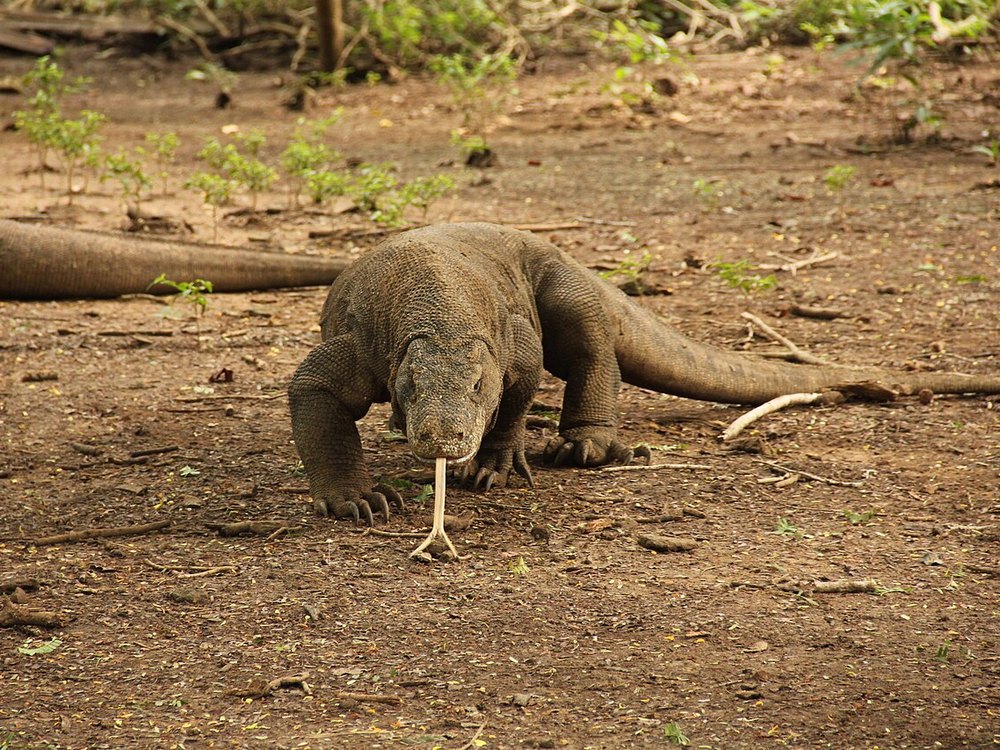
A zoo fact sheet says the Komodo Dragon is mainly active by day, that activity peaks at about 09:30 and 15:30, that the animals sleep about 12 hours a day, and that they shelter in burrows and under plants.[7] Animal Diversity Web likewise calls the species diurnal (active by day) and says it shelters in burrows at night and in extreme heat.[6]
Living alone and together
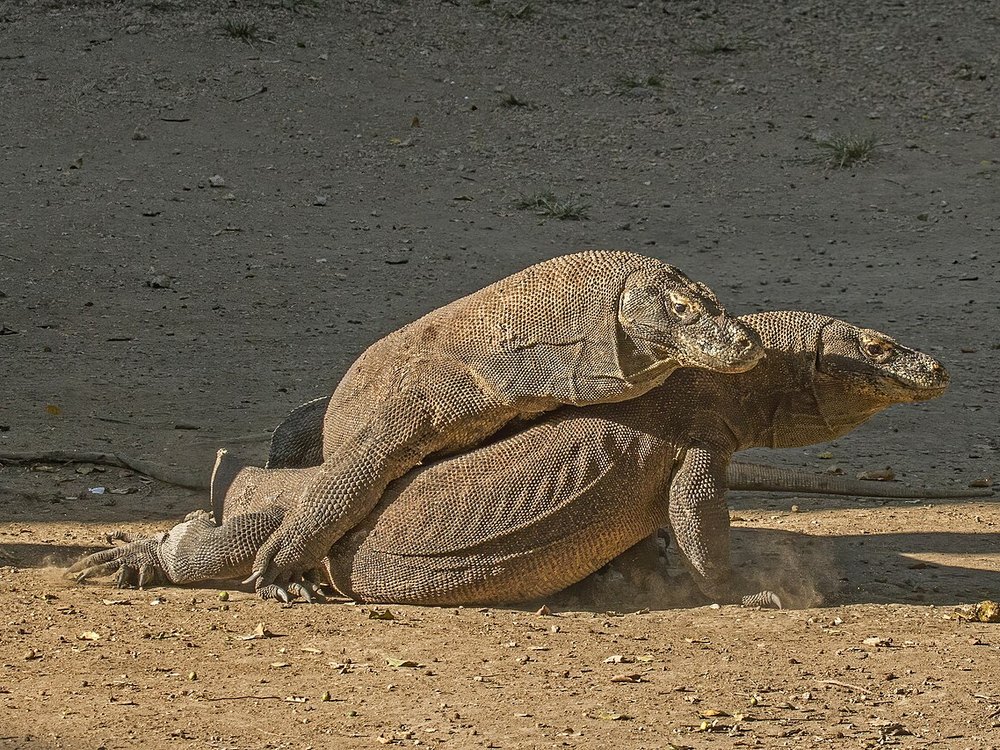
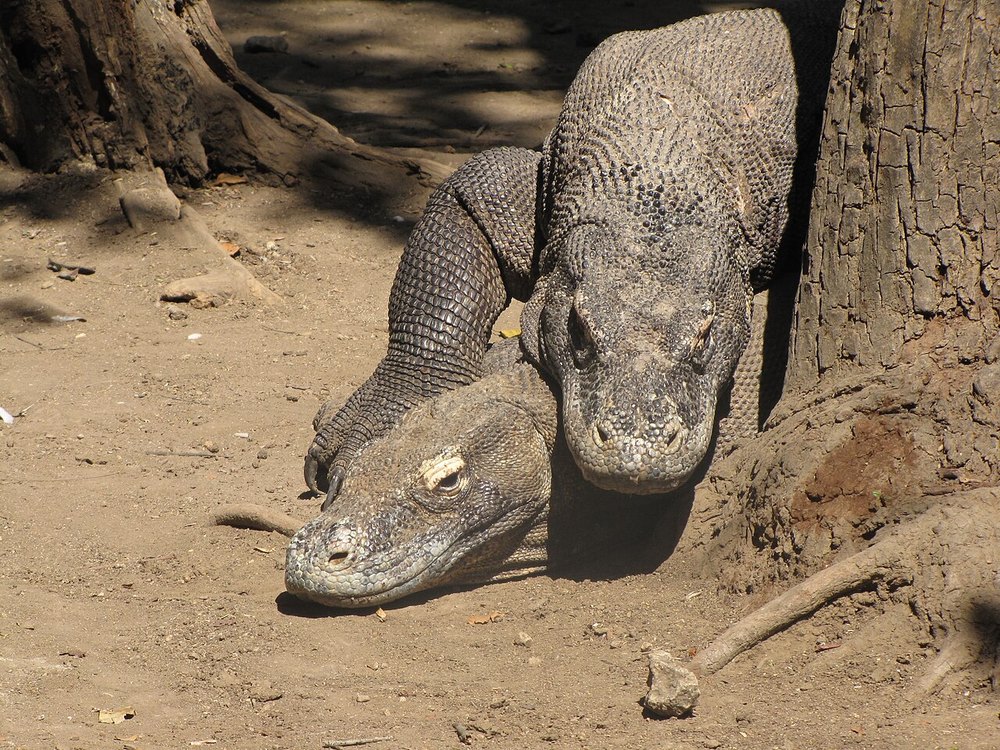
According to a zoo fact sheet and Animal Diversity Web, adults live mainly alone and meet at carcasses and to breed.[7][6] The same sources say feeding follows body size and sex: the largest males eat first, and smaller animals show they give way through body language and hissing.[7][6] The zoo sheet describes territories as minimal to none, with the feeding area depending on where a carcass lies.[7]
Hissing is one of the few sounds the species makes. The zoo sheet says it is used when an animal is defending itself, feeding or attacking, and by females during mating.[7] Young animals live in trees for a time (see Life cycle).
Fighting and courtship
Animal Diversity Web says rival males wrestle upright.[6] For the mating season and nests, see Life cycle.
Diet
Adults
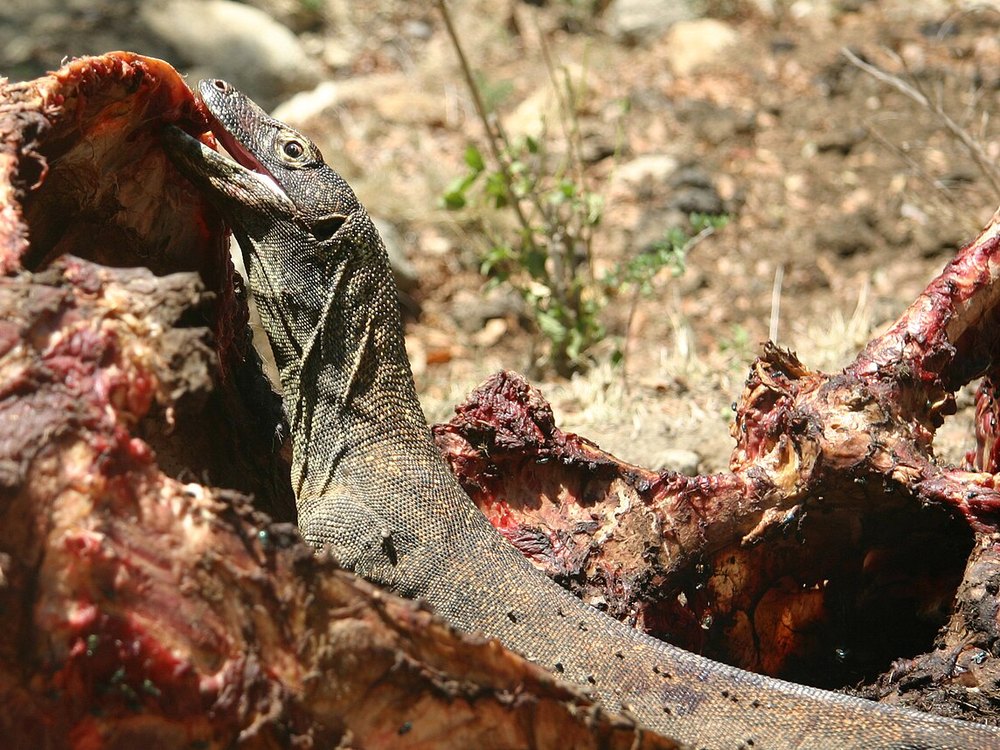
In the wild, three large mammals dominate the adult diet in Komodo National Park: Rusa deer (Rusa timorensis), wild pigs and water buffalo.[1] The IUCN assessment also names deer, wild pigs and water buffalo as the main prey.[2] A study of prey on the park islands found Rusa deer at 2.5 to 165.5 per km2 across 11 sites and wild pigs at 0.0 to 25.2 per km2, with too few buffalo to count.[21] Animal Diversity Web adds goats, horses and smaller dragons to the list, and notes that carrion (the flesh of animals found dead) is a large part of the diet.[6] It also says dragons feed on carcasses from many causes and gather at them.[7][6]
Young animals
A 2024 study of skulls and teeth says young dragons live in trees and feed mostly on insects.[15] Animal Diversity Web also lists geckos, beetles, grasshoppers, eggs, birds and small mammals.[6] Adults, by contrast, hunt on the ground.[2]
How it hunts and eats
Adults are ambush hunters that wait for prey on the ground.[2] A study of the park animals found that dragons heavier than 20 kg switch from small prey (10 kg or less) to large prey (50 kg or more), and move from active searching to a less active sit-and-wait style.[22] For the bite and the venom debate, see Body.
A zoo fact sheet gives an average of 10 to 20 minutes spent eating, followed by 3 to 6 days of digestion.[7]
Life cycle
| Stage | Age / time | Notes |
|---|---|---|
| Egg | About 220 days to 8 months | About 220 days (IUCN assessment, zoo fact sheet) or about 8 months (Animal Diversity Web)[2][7][6] |
| Hatchling | First year or longer | About 37–47 cm and 80–105 g, depending on the source; lives in trees[7][6][9][2] |
| Juvenile | Up to about 7 years | Males and females similar in size (wild)[1] |
| Adult | Females 6–7 or 8–11 years | First breeding at 6–7 years (IUCN assessment) or 8–11 years (growth study)[2][1] |
Mating and nests
A zoo fact sheet says females nest from June to August and the young hatch from February to May, while Animal Diversity Web gives mating in July and August.[7][6] In a study of nest sites, 61% of nests were in mounds, 19.5% on open hillsides and 19.5% in ground nests.[23] The mounds are built by the orange-footed scrubfowl, a ground-living bird, and dragons often use them.[24] The IUCN assessment says nests can also be dug in the soil.[2] Females fast while they guard a nest.[1]
Eggs and hatchlings
A clutch holds up to 30 eggs. The IUCN assessment gives an average of 18 eggs and incubation of about 220 days at about 28 °C.[2][25] A zoo fact sheet gives 2.5 to 8 months, and about 220 days in zoos.[7] In Komodo National Park an average of 21.0 hatchlings (± 3.6) came out of each wild nest,[26] and the IUCN assessment gives 20 (± 2.5) from nine fenced nests;[2] these come from different studies and are not directly comparable.
A zoo fact sheet gives a hatchling weight of about 80 g, Animal Diversity Web a length of about 37 cm, and a 2015 news report an average of 46.5 cm and 105.1 g for 16 young from one nest.[7][6][9] The IUCN assessment says hatchlings are strictly tree-living and juveniles stay in trees for the first year; Animal Diversity Web says about eight months.[2][6] About 10% of viable hatchlings survive to maturity, according to the IUCN assessment.[2] For what the young eat, see Diet.
Growth and maturity
In a study that caught, marked and released wild animals again and again, males and females were similar in size until about 7 years. After that, female growth levelled off.[1] The IUCN assessment says wild females mature at 6 to 7 years and males at a weight of 17 kg, with a generation (the average age of parents) of 15 years.[2] The growth study estimates 8 to 11 years for females, from the smallest females seen nesting.[1] A zoo fact sheet gives 5 to 7 years for both sexes.[7] For adult sizes, see Body.
Virgin births
In 2006, two female dragons in British zoos, Flora at Chester and Sungai in London, laid eggs after no contact with a male. DNA tests showed the young had no father.[3][4] This is called parthenogenesis: a female produces young without a male. All the young that hatched were male.[3][4] The reason lies in the sex chromosomes. Females carry two different ones (ZW) and males two alike (ZZ), so an unfertilised egg can only become ZZ, a male, and WW eggs do not survive.[4] Sungai later bred normally with a male.[3]
Lifespan
Wild lifespan has not been measured directly. In the growth study, no female older than about 31 years was caught, and the authors think males can live considerably longer.[1] A zoo fact sheet quotes a 2023 median of 19.5 years for males and 12.9 years for females in zoos.[7]
Ecology
Top predator
A study of wild populations found that Komodo Dragons reach far higher body-mass densities (kilograms of animal per square kilometre), and use more energy as a population, than apex mammal predators in Africa, Asia and North America.[27] But large changes in the energy the dragons used, over time and between places, did not control how fast their main prey, the rusa deer and the wild pig, grew in number. The authors conclude that dragons do not play the same role as apex mammal predators elsewhere, because they hunt rarely and are inactive for much of the time, scavenging included.[27] For what the dragons eat, see Diet.
Predators and competitors
Animal Diversity Web says that adult dragons have no natural predators except humans and that young dragons are eaten by adults, which is why the young live in trees.[6] Dragons also compete with one another: in a long study of marked wild animals, growth was fastest at middle population densities.[1]
Parasites and disease
In a survey of 33 wild dragons in Komodo National Park, blood samples were positive for hemogregarines (single-celled parasites that live in blood cells), while 44 zoo animals were all negative. The authors found no notable medical, nutritional or toxic problems in the wild animals.[28] The tapeworm Kapsulotaenia sandgroundi is a known parasite of the species, described from Komodo[29]; a university press release gives 6.67% of wild dragons infected.[30] The tick Amblyomma helvolum is described as a specialist parasite of the dragon and was found on dragons on Rinca.[31] In April 2025 a wild adult male in the park had a shoulder wound with fly larvae (Chrysomya rufifacies), the first such case recorded in a wild dragon; the wound was cleaned and the animal released.[31]
Habitat and range
Where it lives
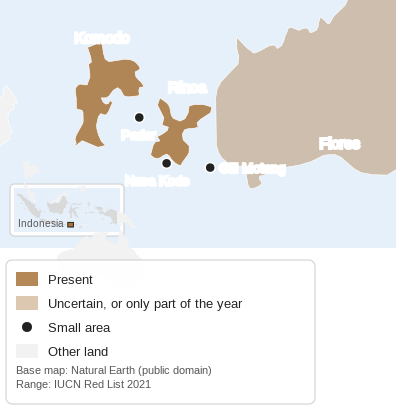
The Komodo Dragon lives only in Indonesia, on a few islands of the Lesser Sunda chain. The IUCN assessment says there are eight separate subpopulations: five in Komodo National Park (Komodo, Rinca, Padar, Nusa Kode and Gili Motang) and three on Flores, including the small outlying islands of Longos and Ontoloe.[2] On Flores, a camera survey found dragons in three isolated coastal areas in the west, north-west and north.[32] Padar lost its dragons in the late 1970s; a small subpopulation exists again after recolonisation in 2004 and at least one later deliberate release of animals.[2] The IUCN assessment gives the area occupied as about 809 km².[2]
Habitat
The IUCN habitat list names dry savanna, moist lowland forest and mangrove above the high-tide line as major habitats, and rocky and sandy shores as minor. Its text says the dragon is most abundant in savanna and monsoon forest (forest that loses its leaves in the dry season) and seems to prefer forest vegetation within a savanna-grassland mix.[2] Jones et al. 2020 say instead that moist forest and land above 600 m limit the species, so dragons are rarely found more than 5 to 6 km from the shore. They describe flat, drier lowland savanna woodland and lowland deciduous forest below 300 m as the main habitat, with the forest the most preferred.[33]
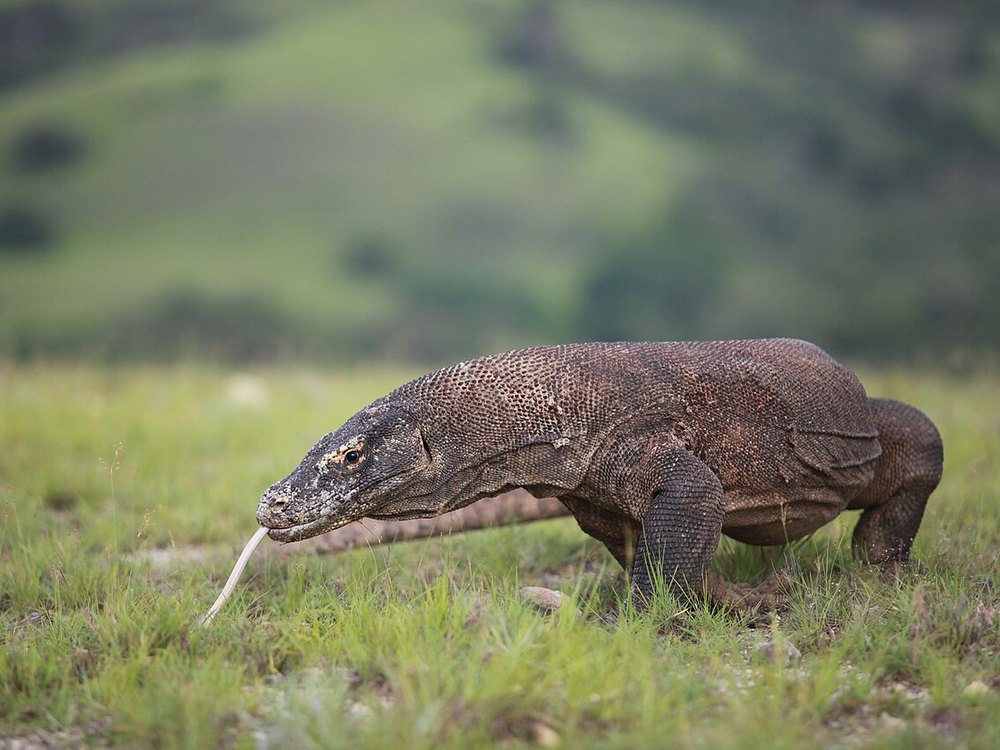
Numbers
The IUCN assessment counts 1,383 adults, or about 3,458 animals with juveniles (tree-living hatchlings not included). About 68% live on Komodo and Rinca together. Rinca has the most, 1,119 to 1,493 animals, about 474 of them adults; Komodo is slightly lower.[2] Padar and north-west Flores each hold only 3 adults, and Gili Motang and Nusa Kode fewer than 100 animals each, juveniles included.[2] Earlier, a capture-mark-recapture study (catching, marking and releasing animals to count them) estimated 2,448 dragons in the park (range 2,067 to 2,922), and found Gili Motang declining.[34] On Flores, the IUCN assessment says the occupied area fell about 12% over three generations (45 years), mostly in the north-west, with no change on Komodo.[2]
Evolution
Monitor lizards (genus Varanus) have no agreed birthplace. Dong et al. 2022 conclude that the step from earlier monitor-like lizards to Varanus happened in East Asia, citing a new early Eocene fossil (52 to 56 million years old), Archaeovaranus, that they place next to the genus.[35] Hocknull et al. 2009 say monitors most likely spread east from Asia to Australia.[36] Arida and Boehme 2010 call the origin still open to debate.[37]
The Komodo Dragon genome, published in 2019, has about 1.51 billion base pairs (DNA letters) in 20 pairs of chromosomes. The closest relative with a sequenced genome is the Chinese crocodile lizard.[38]
Fossils
In Queensland, Australia, fossils of the Komodo Dragon run from the early Pliocene to the middle Pleistocene, and Hocknull et al. put its origin on mainland Australia more than 3.8 million years ago.[36] On Flores the fossils date from about 900,000 to about 2,000 years ago.[36] The same study says the species spread west to Flores by 900,000 years ago and to Java by 800,000 to 700,000 years ago, based on one tentatively identified vertebra there.[36] Turvey et al. 2017 report a tooth from Sumba that may be close to 1 million years old.[39]
The extinct giant monitor Varanus priscus lived alongside it in Australia and was gone from there by the end of the Pleistocene.[36] A skull-shape study, as reported by Arida and Boehme, also calls it a sister species (closest relative) of the Komodo Dragon.[37]
Why so big
The Komodo Dragon was long taken as a classic case of island gigantism (animals growing larger on islands), linked to hunting dwarf elephants.[36] Hocknull et al. reject this. They argue that it arrived on Flores already large and that its size stayed stable for about 900,000 years.[36]
Forms and variants
GBIF, the Catalogue of Life, ITIS and the Reptile Database list no subspecies and no colour forms of the Komodo Dragon.[40][41][42][8] A study of 24 genomes from six places finds three main genomic groups (animals whose DNA sets them apart), with Komodo island and the north coast of Flores standing out as separate units for conservation.[43] Ciofi et al. 1999 had already found the Komodo island population the most genetically distinct.[44]
Conservation
Status
The IUCN assessment lists the Komodo Dragon as Endangered under criterion C1, which is used for small populations that are declining or expected to decline. It was published in 2021 and assessed in 2019. The species was earlier listed as Vulnerable (1996).[2] The population trend is given as Stable.[2]
The assessment says no subpopulation holds more than 500 adults, the area where the species lives is badly broken up, and climate modelling suggests a fall of more than 30% over 40 years from 2010 (for the numbers, see Habitat and range).[2] The assessment adds that the whole population may be broadly stable, but may be falling in all the Flores areas.[2]
Threats
Habitat lossHuntingClimate change[2]Habitat loss. On Flores, the IUCN assessment describes habitat loss as ongoing and growing, mostly on the north coast. Forest is lost at about 1% a year, caused by subsistence farming and changed fire patterns (people burn land, and fires come more often than before). No more than 10% of the occupied area of any Flores subpopulation is protected.[2] Ariefiandy et al. 2021 report that the range on Flores shrank by about 44%, based on camera traps in 2015 to 2020 compared with older records from 1970 to 2000.[32]
Hunting. Hunting of deer and pigs by people also removes the dragon's natural prey on Flores (see Diet).[2] Jones et al. 2020 name illegal hunting of prey and forest clearing for farms as pressures.[33]
Climate change. Climate change is the threat that reaches the whole population. The IUCN assessment gives modelled falls in suitable habitat between 2010 and 2040 of 8.4%, 30.2% or 71%, depending on the climate scenario used.[2] Jones et al. 2020 model the range-wide habitat loss by 2050 at 8% to 87%, depending on the scenario. Rising seas flood the low valleys, and a warmer, drier climate brings more fire.[33] In that study Komodo and Rinca have the lowest risk of losing the species.[33]
Smuggling. The assessment also reports the smuggling of live animals for the pet trade and for zoos, and calls illegal collection on Flores a medium risk. It names a market seller in Bangkok in 2011 who said he could supply a half-grown animal, and seizures in 2014.[2][45]
Inside Komodo National Park. The assessment calls the area fairly well protected, with no habitat loss and a low risk from human activity, though some deer are poached.[2]
Protection and trade
The species lives in at least one protected area, including Komodo National Park, where five of the eight subpopulations live.[2] Animal Diversity Web lists the Komodo Dragon in Appendix I of CITES, the international agreement that controls trade in wild animals and plants.[6] The IUCN assessment says the species is covered by international trade controls, is kept in zoos, and has been reintroduced or introduced successfully.[2]
The assessment lists these actions as needed: managing sites and areas, controlling invasive species such as dogs and cats, managing harvest, and enforcing the rules at national and international level.[2] It also says the genetically distinct north Flores and Komodo National Park populations should be managed as separate units.[2]
History and culture
Discovery
Barnard writes that the Komodo Dragon was unknown to the world before 1912, and that the Buitenzorg botanical garden and museum on Java first heard of it in 1910.[46] In December 1910 P. A. Ouwens, who worked at the museum there, began writing to Lieutenant J. K. H. van Steyn van Hensbroek, the civil administrator at Reo on Flores. The lieutenant had been told that a very large Varanus lived on Komodo and near Labuan Bajo. Local people had their own name for it (see Name).[5]
Two hunters from the pearling fleet stationed at Komodo told the lieutenant that the animals could reach 6 to 7 m. This was false. The lieutenant obtained a specimen of 2.20 m, and sent Ouwens a photograph and the skin.[5] Ouwens then sent a collector from the museum, who brought back animals of 2.90 m and 2.80 m and two young ones of about 1 m.[5] In 1912 Ouwens proposed the name Varanus komodoensis for the species, after the island.[5]
From the island to the zoo
In September 1926 an expedition led by W. Douglas Burden for the American Museum of Natural History came back from the Dutch East Indies with two live dragons, the first to leave the islands. They were shown at the Bronx Zoo in New York and died on 19 October and 14 November 1926.[46] In 1927 five more reached Europe: two to London, and one each to Amsterdam, Rotterdam and Berlin.[46] Burden wrote a book on the trip in 1927.[47] Barnard argues that Burden created the world's image of the animal, turning large lizards into “dragons”.[46]
Female dragons in zoos later laid eggs without a male (see Life cycle).


The park and tourism
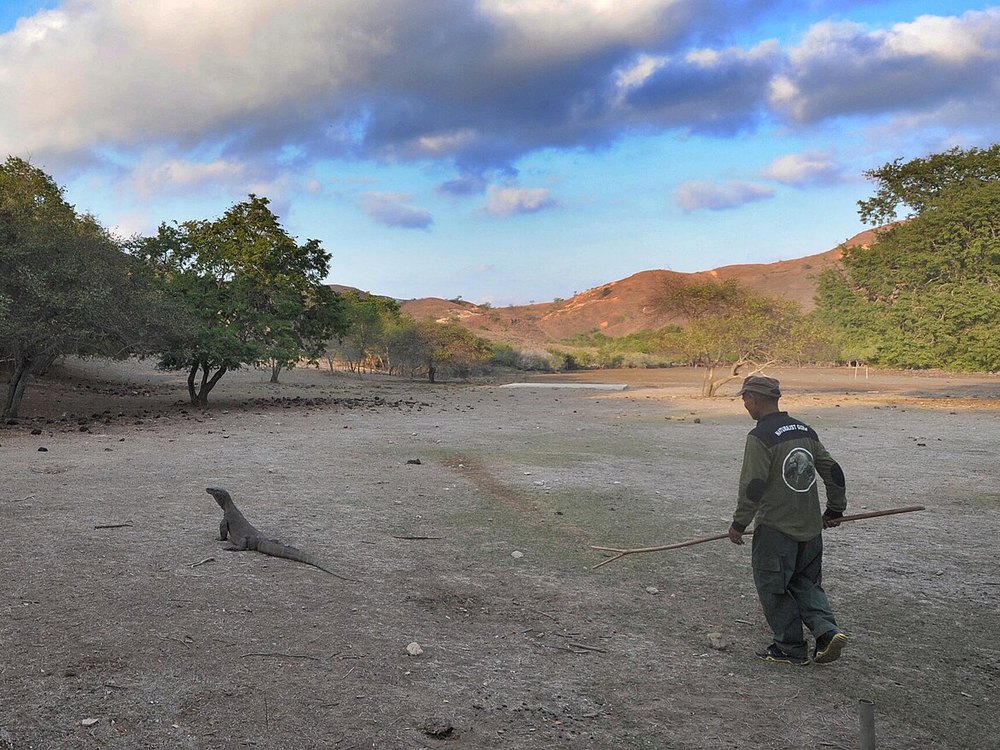
Protection began under Dutch colonial rule. After 1926 the authorities on Flores banned capturing or killing the animals, keeping skins or body parts, and taking eggs. The Komodo Dragon was the only reptile on the colonial protection list.[46] From 1927 permits had to go through Buitenzorg, and by the mid-1930s foreign expeditions had to be joined by a scientist from there.[46] In 1938 areas of Komodo and Rinca were made wildlife preserves.[46]
On tourism, the IUCN assessment says the effect on the dragons is limited, with no decline over 50 years where visits are greatest.[2] Ardiantiono et al. 2018 found that dragons used to tourists were less wary, heavier and in better condition, and survived better, probably because of food scraps. The authors also warn of changed behaviour and recommend removing the food supply.[48]

Taxonomy
| Rank | Name |
|---|---|
| Kingdom | Animalia |
| Phylum | Chordata |
| Subphylum | Vertebrata |
| Superclass | Tetrapoda[52] |
| Class | Reptilia |
| Order | Squamata |
| Suborder | Autarchoglossa[52] |
| Family | Varanidae (monitor lizards)[8] |
| Genus | Varanus[8] |
| Species | Varanus komodoensis (Ouwens, 1912)[40][42][41][8] |
Higher classification
The Komodo Dragon belongs to the family Varanidae, the monitor lizards, in the order Squamata.[8] Its genus Varanus is large: the Reptile Database lists 93 species.[51] The Reptile Database places the Komodo Dragon in the subgenus Varanus, the group named after the genus itself.[8] A study of mitochondrial DNA found the lace monitor, Varanus varius of eastern Australia, to be the closest relative.[37]
Relatives and old hybrids
Not every study agrees on how the monitors are related, and the Komodo Dragon shows why. Pavón-Vázquez and colleagues (2021) read more than 300 stretches of nuclear DNA. They found that four Australian sand monitors share more DNA with the Komodo Dragon than a simple family tree allows. They suggest an ancient cross between the Komodo Dragon and the ancestor of the sand monitors, in northern Australia, and the sand monitors have body features between those of their nearest relatives and the Komodo Dragon.[50] A different old idea concerned fossils: in 1972 Hooijer took some vertebrae from Timor for a subspecies of the Komodo Dragon, but Hocknull and colleagues (2009) assign the Timor bones to an unnamed species.[36][37]
Sources
- Laver et al. 2012, PLoS ONE 7: e45398
- Jessop et al. 2021, IUCN Red List assessment of Varanus komodoensis
- Watts et al. 2006, Nature 444: 1021–1022
- Nature news, 20 December 2006
- Ouwens 1912, Bulletin du Jardin Botanique de Buitenzorg (2) 6: 1–3
- Animal Diversity Web, Varanus komodoensis
- San Diego Zoo Wildlife Alliance, Komodo dragon fact sheet
- The Reptile Database, Varanus komodoensis
- Wikipedia, Komodo dragon
- PBS, Wild Indonesia: Komodo dragon
- GBIF, vernacular names of Varanus komodoensis
- Jessop et al. 2007, Biological Conservation 135: 247–255 (largest wild animal; known only through a later citation)
- Jessop et al. 2006, Oikos 112: 422–429 (body size on different islands)
- “Biological significance of the Komodo dragon’s tail”, Animals 14: 2142 (2024)
- Maho & Reisz 2024, PLoS ONE 19: e0295002
- “Macroanatomical, histological and microtomographic study of the teeth of the Komodo dragon”, Biology 12: 247 (2023)
- Yong 2013, “The myth of the Komodo dragon’s dirty mouth”, National Geographic Phenomena, 27 June 2013 (journalism)
- Fry et al. 2009, PNAS 106: 8969–8974
- Goldstein et al. 2013, Journal of Zoo and Wildlife Medicine
- Bull, Jessop & Whiteley 2010, PLoS ONE (“Deathly drool”)
- Ariefiandy et al. 2013, Wildlife Biology
- Purwandana et al. 2016, The Science of Nature
- Jessop et al. 2004, Biological Conservation 117: 463–470 (nest sites)
- Imansyah et al. 2009, Journal of Field Ornithology (scrubfowl mounds)
- Auliya & Koch 2020, BfN-Skripten 552 (clutch size and incubation, as given by the IUCN assessment)
- Purwandana et al. 2020, Copeia 108: 855–860
- Jessop et al. 2020, Ecology 101: e02970
- Gillespie et al. 2000, Zoo Biology 19: 495–509
- de Chambrier 2006, Systematic Parasitology
- Universitas Gadjah Mada, news page, 3 July 2026
- Winarso et al. 2026, Veterinary Research Communications
- Ariefiandy et al. 2021, Biodiversity and Conservation
- Jones et al. 2020, Ecology and Evolution 10: “Identifying island safe havens to prevent the extinction of the world’s largest lizard from global warming”
- Purwandana et al. 2014, Biological Conservation
- Dong et al. 2022, Philosophical Transactions of the Royal Society B 377: 20210041
- Hocknull et al. 2009, PLoS ONE 4: e7241
- Arida & Boehme 2010, Biawak 4: 117–124
- Lind et al. 2019, Nature Ecology & Evolution 3: 1241–1252
- Turvey et al. 2017, Proceedings of the Royal Society B 284: 20171278
- GBIF, Varanus komodoensis
- Catalogue of Life, Varanus komodoensis
- ITIS, Varanus komodoensis
- Iannucci et al. 2021, Molecular Ecology
- Ciofi et al. 1999, Proceedings of the Royal Society B 266: 2269–2274
- Koch et al. 2013, Pressing problems: distribution, threats, and conservation status of the monitor lizards of Southeast Asia (as cited by the IUCN assessment)
- Barnard 2011, “Protecting the dragon”, Indonesia 92: 97–123
- Burden 1927, Dragon Lizards of Komodo (as cited by Barnard 2011)
- Ardiantiono et al. 2018, Biodiversity and Conservation
- Ast 2001, Cladistics 17: 211–226
- Pavón-Vázquez, Brennan & Keogh 2021, Systematic Biology 70: 877–890
- The Reptile Database, species of the genus Varanus (advanced search)
- ITIS, Varanus komodoensis, classification