The Asiatic Lion (Panthera leo persica) is the lion of India. It is the only wild lion outside Africa, and it survives only in and around the Gir Forest in Gujarat.[1] It was named in 1826 from Persia, but whether it deserves its own subspecies name is disputed.[2]
Names and classification
Before 2017, lion classifications usually split an African subspecies from the Asiatic one. The IUCN Cat Specialist Group’s 2017 checklist recognises only two lion subspecies and puts India under Panthera leo leo, which also covers West and Central Africa.[2] It argues that Asian lions have colonised south-west Asia only within the last 20,000 years.[2] One 2024 study goes further and calls the Asiatic Lion a branch of the northern lineage that left Africa at least 31,000 years ago.[3]
Range
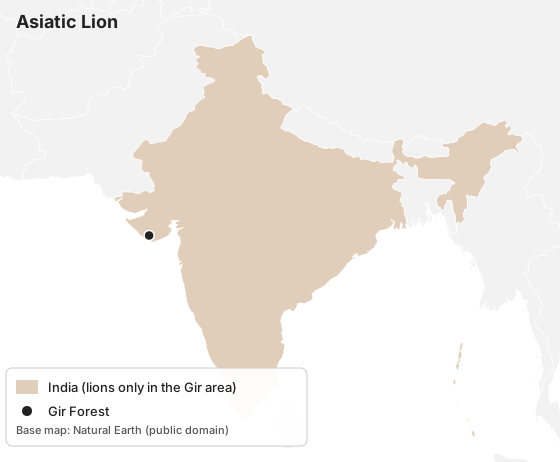
The Asiatic Lion lives in dry deciduous forest. In the Gir area it prefers the wettest, thickest cover available.[1] Gir National Park and Wildlife Sanctuary covers about 1,400 km², and it is surrounded by farmland that is shared with herders and their livestock.[1] In a camera-trap study, lions used both dense and open habitat, while leopards preferred dense cover.[4] Lions once lived from Persia to India. Outside Gir they are extinct in Asia.[1]
The commonest wild prey in Gir is the chital deer, and livestock have long been a large part of the diet.[1]
Classification evidence
DNA shows that lions of West and Central Africa are closer to the Asiatic Lion than to the lions of East and Southern Africa.[5] An analysis of the northern lineage dates the first move from North Africa into India to about 21,000 years ago, with a later move into the Middle East.[6] Indian lions have almost no genetic variety.[7]
History
By the end of the 1800s only a small population remained in the Junagadh area. The Nawab of Junagadh protected the Gir Forest, and a census in 2015 counted 523 lions, 27% more than in 2010, with up to 40% living outside the park.[8] The Gujarat Forest Department’s 2020 survey is cited by the IUCN as about 670 adult and subadult lions, though the same IUCN text also gives 537 for that survey.[1] Inside the reserve the population levelled off, while the lions in the surrounding countryside grew by about 400% in 21 years.[9]
Status
The IUCN assessed the Asiatic Lion as Endangered in 2008.[9] The Indian population is in Appendix I of CITES, the strictest level of trade control.[1] Having one main population is a risk. In September 2018 canine distemper reached the Gir lions, and the virus was found in 68 lions and 6 leopards.[10]
Sources
- Nicholson et al. 2025, IUCN Red List assessment of Panthera leo
- Kitchener et al. 2017, A revised taxonomy of the Felidae, IUCN Cat Specialist Group
- Broggini et al. 2024, International Journal of Molecular Sciences
- Gir camera-trap study, PLOS ONE 2020 (lions and leopards in Gir)
- Bertola et al. 2011, Journal of Biogeography 38
- Barnett et al. 2014, BMC Evolutionary Biology 14: 70
- de Manuel et al. 2020, PNAS (lion and cave lion genomes)
- PBS Nature, Asiatic lion fact sheet
- Bauer et al. 2016, IUCN Red List assessment of Panthera leo
- Emerging Infectious Diseases 2019, canine distemper in Gir lions