Giraffa tippelskirchi thornicrofti, the Luangwa or Thornicroft’s giraffe, is a giraffe of the Luangwa Valley in eastern Zambia. The IUCN giraffe task force lists it as a subspecies of the Masai Giraffe, but authorities disagree about its rank.[1][2]
Names and classification
The Catalogue of Life lists it as Giraffa tippelskirchi thornicrofti Lydekker, 1911.[2] The Mammal Diversity Database also calls it the Rhodesian giraffe, and shows the name as a synonym within the species.[3]
Range
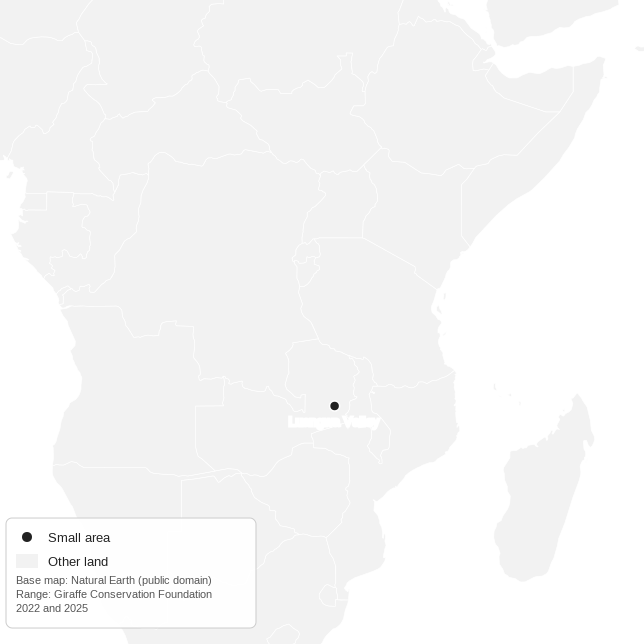
In Zambia the Masai giraffe lives only in the Luangwa Valley. It occurs in South Luangwa National Park, Luambe National Park and nearby management areas and ranches.[4][5][6] It lives more than 400 km south of the nearest nominate population.[1] The 2025 count was 764 animals (range 654 to 895), and a 2023 survey extended the known range 120 km southward.[5]
Classification evidence
Groves and Grubb (2011) treated it as a species, G. thornicrofti, but the IUCN giraffe task force found no support for that rank and counts it within the Masai species.[1] Fennessy and colleagues (2016) suggested folding it into the Masai giraffe.[7] Coimbra and colleagues (2021) say it should be recognised as a distinct subspecies, but note that animals from the areas between are missing from their samples.[1][8] Its mitochondrial DNA falls inside a western Masai group.[9] The Mammal Diversity Database does not list subspecies and merges the name into the species.[3]
History
A well-studied population
Much of what is measured about giraffe life comes from this population, which has been followed for more than 40 years. The longest-lived females reached about 28 years.[10] Females had a calf on average about every 678 days.[11]
Sources
- IUCN SSC Giraffe and Okapi Specialist Group, Giraffe Taxonomy Task Force 2025 (August), “An Evaluation of the Taxonomic Status of Giraffe (Giraffa spp.)”
- Catalogue of Life, monthly release 26.10 (14 October 2026), Giraffa tippelskirchi
- Mammal Diversity Database, Giraffa tippelskirchi
- CMS COP15 document UNEP/CMS/COP15/Doc.31.3.5, “Concerted action for the Masai giraffe, northern giraffe, reticulated giraffe and southern giraffe” (2025)
- Giraffe Conservation Foundation, State of Giraffe 2025 (Marneweck et al., eds)
- Giraffe Conservation Foundation, Country profile, Republic of Zambia (February 2022)
- Fennessy et al. 2016, Current Biology 26: 2543–2549
- Coimbra et al. 2021, Current Biology 31: 2929–2938
- Lohay et al. 2023, Ecology and Evolution 13: e10160
- Bercovitch & Berry 2017, African Journal of Ecology
- Bercovitch & Berry 2010, African Journal of Ecology