The Monarch Butterfly (Danaus plexippus) is a large orange-and-black butterfly of the Americas. Its caterpillars eat milkweed, and the adults drink flower nectar.[1][2] In North America, one population flies south each autumn to spend the winter in the fir forests of central Mexico, and a western group winters on the California coast.[3] Monarchs have also settled in parts of the Pacific, Australia and some Atlantic islands.[4] The IUCN rates the species Least Concern, counting only its Americas populations.[4]
Quick facts
Description
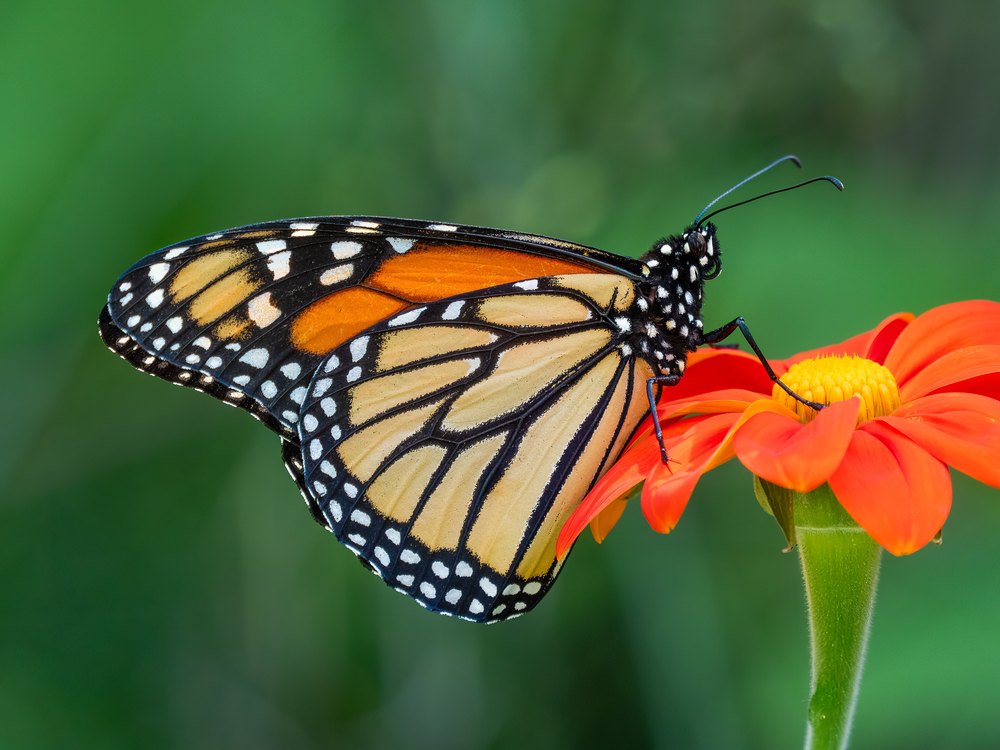
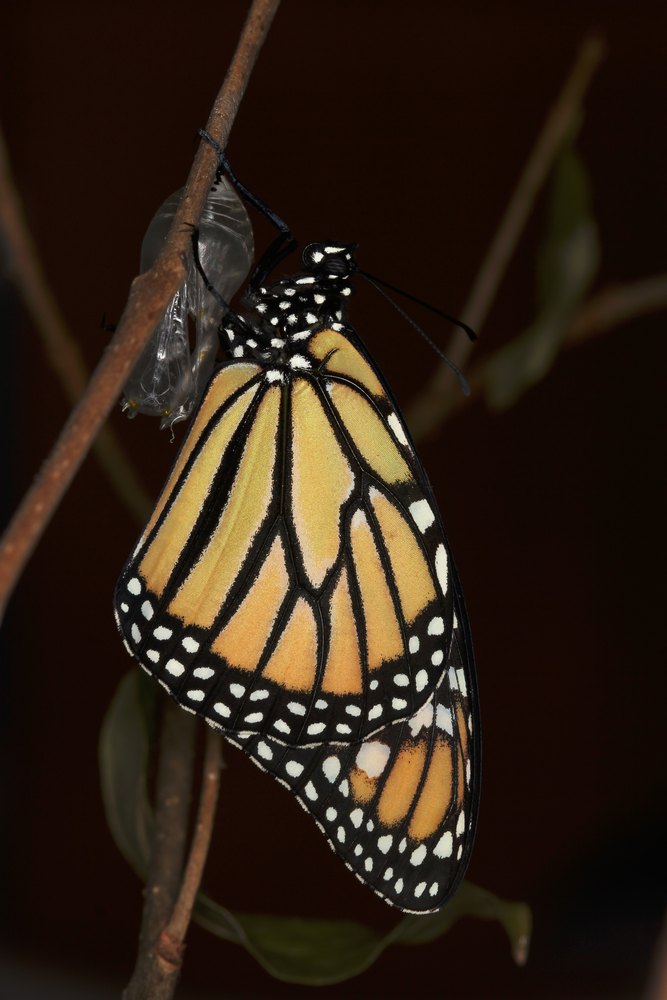
The adult Monarch Butterfly is bright orange, with a black border and black veins across the wings.[1][6] The male has a black spot on a vein of each hindwing, and a swollen pouch there; the female lacks the spot, looks darker and has thicker veins.[2][1]
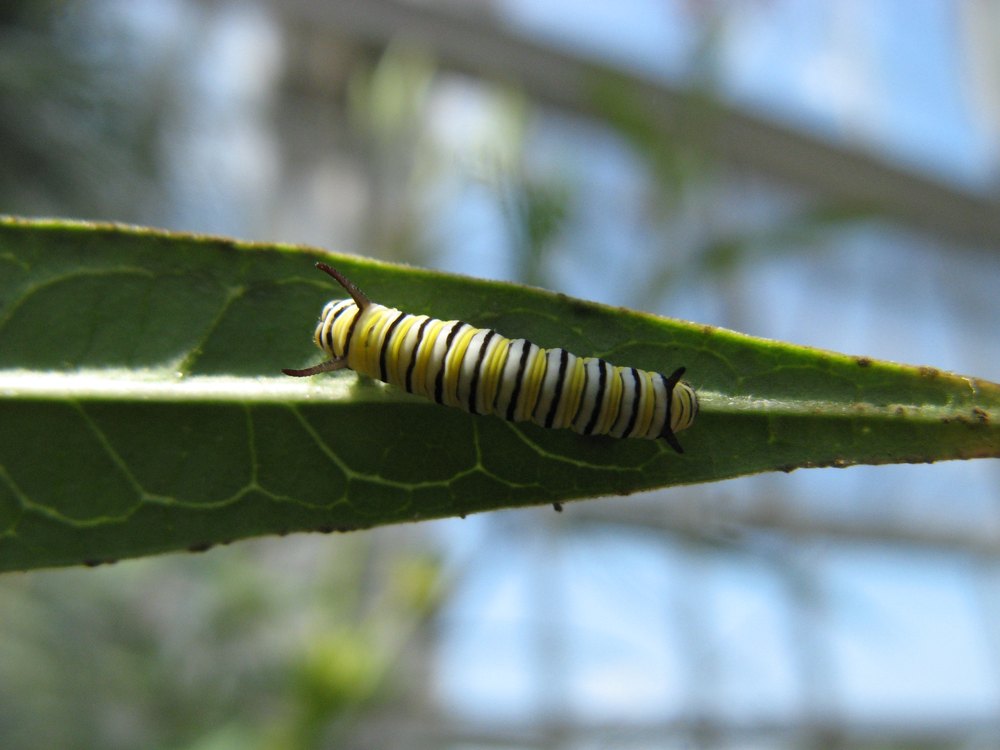
The caterpillar is pale green or greyish-white, shiny and almost see-through when it hatches. From its second instar (growth stage between moults) it shows clear bands of black (or dark brown), yellow and white.[2][6] The fleshy tentacles at its front and rear ends are not antennae but sense organs, and the monarch has only two pairs, one at each end.[7]
The chrysalis (the pupa) is green with gold dots.[6][8][2] The gold dots have no agreed function: camouflage and warning colour are among the ideas.[7] The egg is off-white or yellow, with ridges running from top to bottom.[2]

Name
The scientific name Danaus plexippus comes from the species Papilio plexippus, described by Carl Linnaeus in 1758.[9][10] The type specimen is a replacement male (a neotype) collected at Kendall, New York State.[11][12] The common name in English is Monarch Butterfly, or simply the monarch; the milkweed butterfly is another English name.[10]
In other languages
| Language | Name | Meaning |
|---|---|---|
| Papiamento local | Monarka | — |
| Spanish | mariposa monarca | monarch butterfly |
| French | Monarque; Monarque américain | Monarch; American Monarch |
| German | Monarch | monarch |
| Dutch | Monarchvlinder; Amerikaanse monarch | monarch butterfly; American monarch |
| Danish | Monark | monarch |
| Swedish | monarkfjäril; monark | monarch butterfly; monarch |
| Norwegian | monark | monarch |
| Finnish | monarkki | monarch |
| Icelandic | kóngafiðrildi | king butterfly |
| Welsh | Gloynod y Llaethlys | milkweed butterfly |
Names are taken from national and regional species lists collected by GBIF. Meanings are literal translations of the words.[9] The Papiamento name is from the Dutch Caribbean species register, as listed by GBIF.
Body
Size
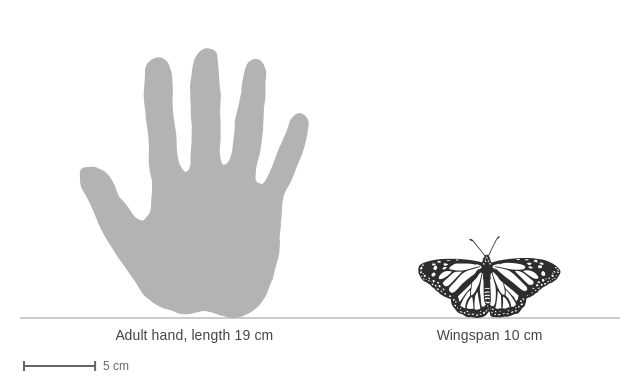
The wingspan is 8.6 to 12.4 cm according to Animal Diversity Web, and 7 to 10 cm according to the U.S. Fish and Wildlife Service.[1][6] The forewing (the front wing) averages about 50 mm long.[13] Migratory monarchs have longer forewings than non-migratory ones, a difference that follows migratory habit rather than latitude.[14]
| Weight (adult) | about 0.5 g |
| Forewing length | about 50 mm |
Weight
An adult monarch weighs about half a gram on average.[6][13] The Center for Biological Diversity says the body mass of fifth-instar caterpillars has increased about 2,000-fold.[8]
Behavior
Migration
North American monarchs migrate in two populations. East of the Rocky Mountains they fly up to 3,000 miles (about 4,800 km) to central Mexico; west of the mountains they make a shorter flight to the California coast.[3] The IUCN gives journeys of up to 4,000 km for the migratory subspecies, D. p. plexippus.[15]
The eastern monarchs begin flying south after about mid-August and reach central Mexico from early November; the western ones reach the California coast around late October. The western monarchs leave California again in February and March.[3] The eastern trip may take more than two months,[6] with about 25 to 30 miles (40 to 48 km) flown a day, and Monarch Joint Venture reports monarchs flying as high as 1,250 m above the ground.[7]
The round trip takes about four generations, and it is generally the fourth generation that flies south.[3] These migrants do not reproduce on the way: they enter reproductive diapause, a pause in which their reproductive organs stay undeveloped.[3] For how long they live, see Life cycle.
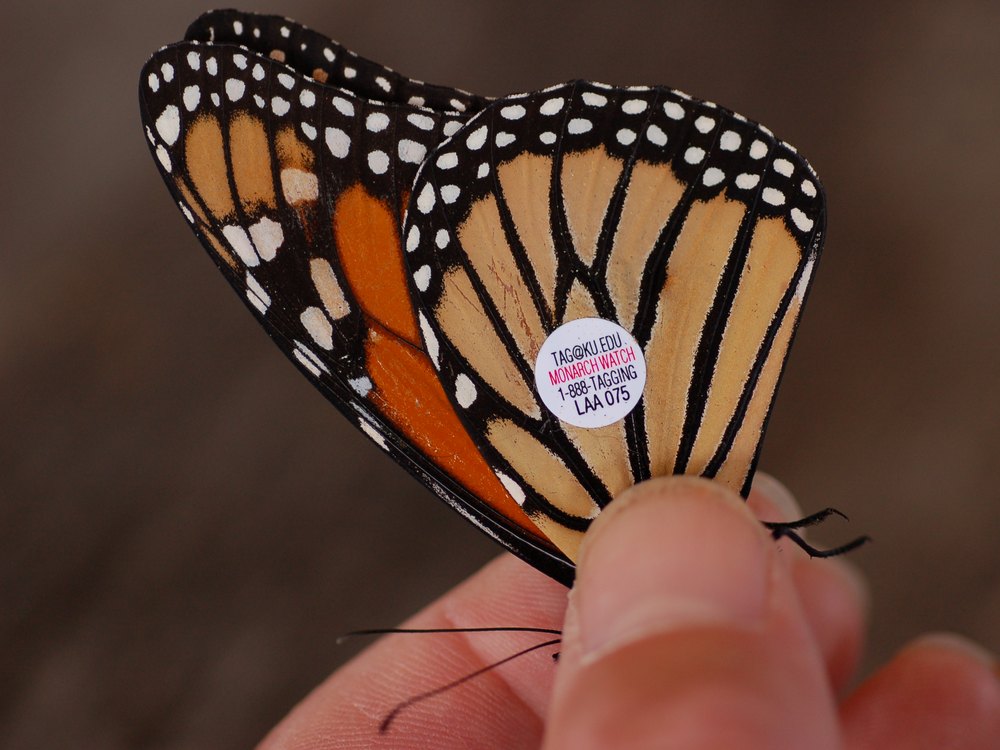
The longest tagged flight on record is a male released by Donald A. Davis at Presqu'ile Provincial Park, near Brighton, Ontario, on 10 September 1988. It was recaptured in Austin, Texas, on 8 April 1989, after a journey of at least 4,635 km.[5]
Not every monarch migrates. D. p. megalippe, which lives in the Caribbean, Central America and northern South America, does not.[4][16]

Navigation
Monarchs may steer by the position of the sun on the horizon, together with an internal body clock.[3] A 2014 study from the Reppert laboratory found that migratory monarchs also have a magnetic compass, which needs short-wave ultraviolet light to work.[3]
Roosting
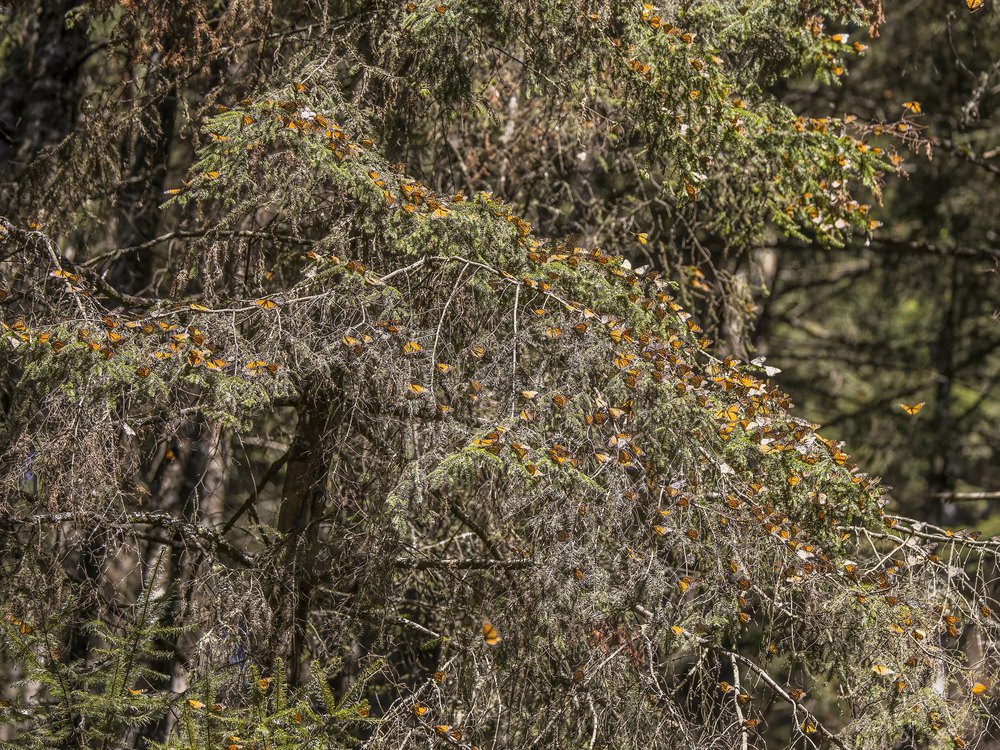
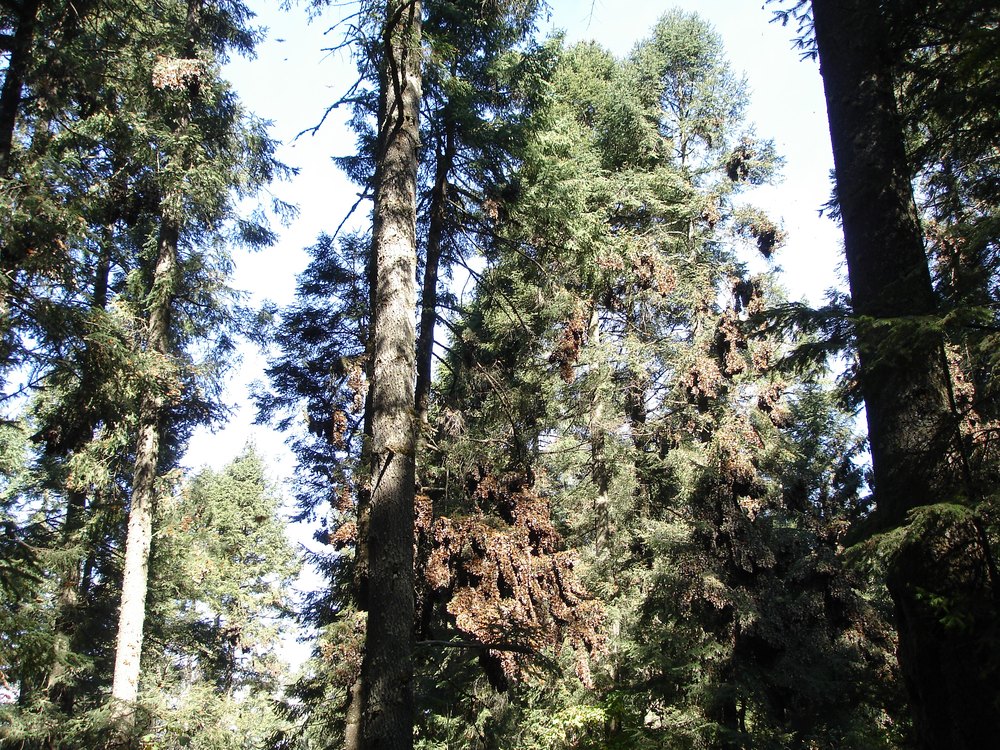
In winter the migratory monarchs cluster together, covering whole tree trunks and branches, in spots that stay close to, but not quite at, freezing.[3] For the forests and the numbers, see Habitat and range.

Courtship and mating
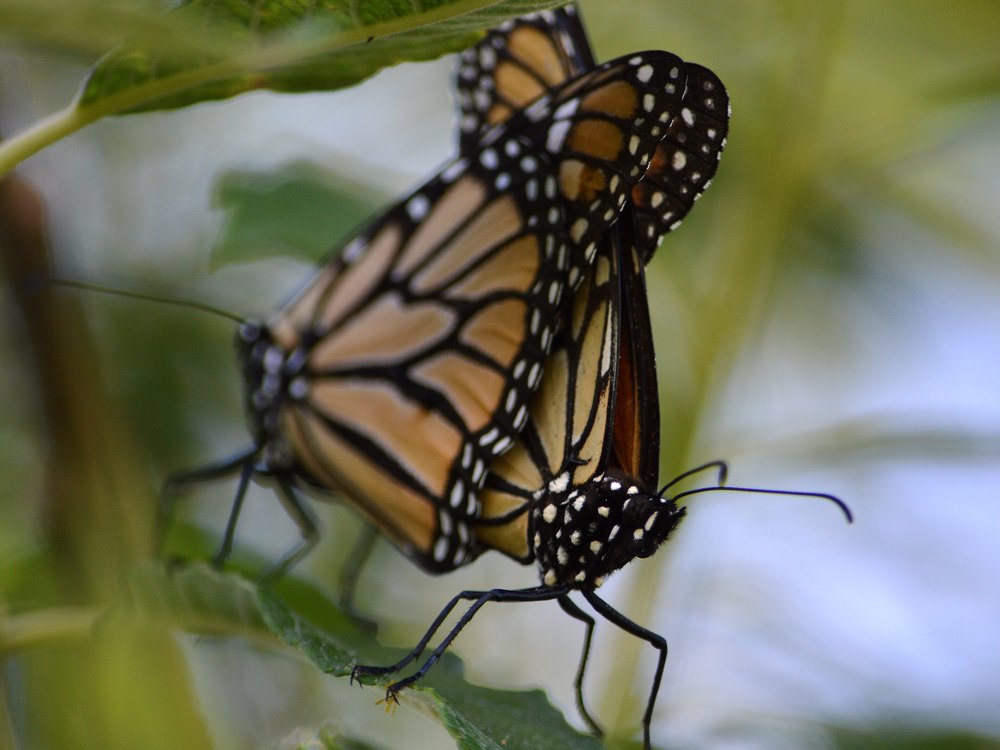
Courtship has an aerial phase and a ground phase. In the air the male pursues the female and often forces her to the ground. On the ground the pair mate, and the male passes the female a sperm packet, called a spermatophore.[1] Monarchs do not mate before they are three to eight days old, and a pairing can last from one afternoon until early the next morning, often up to 16 hours.[2] The migrants mate in spring, just before they leave the overwintering sites.[1]

Diet
Caterpillars
Monarch caterpillars eat milkweeds, plants of the genus Asclepias. They have been recorded on 27 North American species of the milkweed family, among them Asclepias viridis, A. syriaca and A. speciosa, and they rely on milkweed and a few closely related genera. The females lay their eggs only on milkweeds.[17][7] Milkweed leaks a sticky latex. A small caterpillar chews a circular trench so the latex cannot flow into the part it eats, and a larger one cuts the main vein of the leaf.[17]
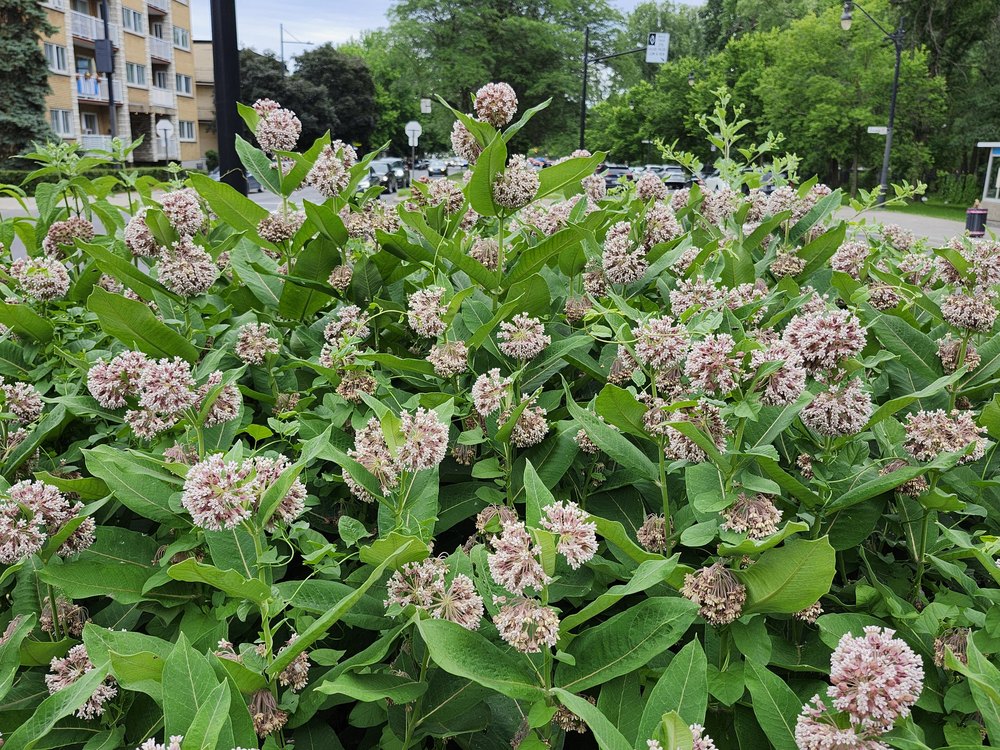

Milkweed contains cardenolides, heart poisons that the caterpillars store; see Ecology.[17]

Adults
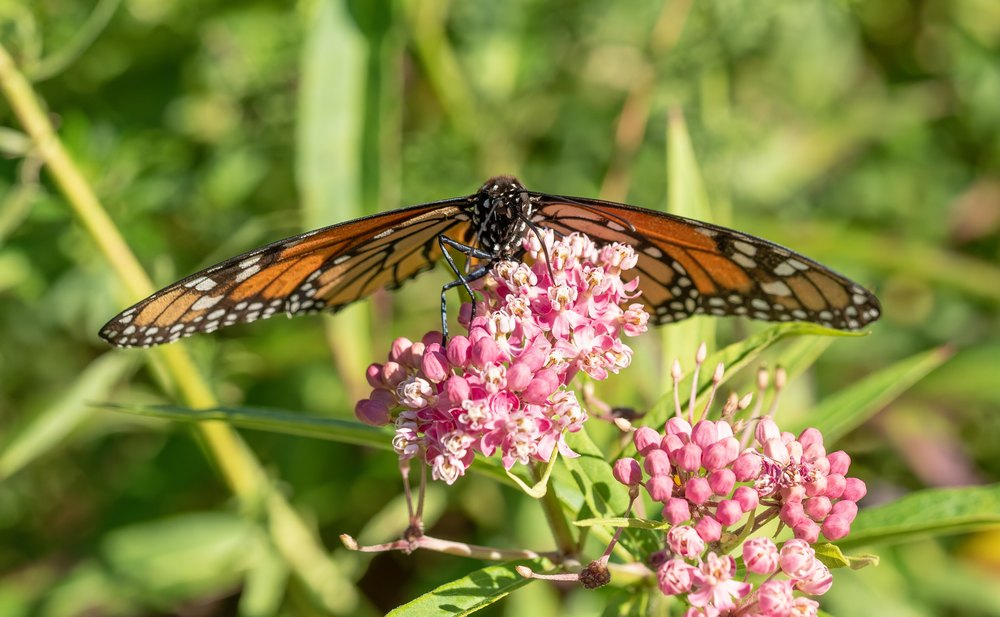
Adult monarchs feed on flower nectar, which is about 20% sugar and gives most of their food. They find nectar with taste receptors on their feet.[18]

Life cycle
| Stage | Age / time | Notes |
|---|---|---|
| Egg | 3 to 5 days | About 1.2 mm high and 0.9 mm wide.[18][2] The time depends on temperature.[2] |
| Larva (caterpillar) | 9 to 14 days | Five instars (growth stages between moults). The first four last 1 to 3 days each and the fifth 3 to 5 days.[2] The fifth instar is 25 to 45 mm long.[2][18] |
| Pupa (chrysalis) | 8 to 15 days | The adult butterfly comes out of the chrysalis at the end.[2] |
| Adult | 2 to 5 weeks in summer; up to 9 months in the migratory generation | Forewing about 50 mm and weight about 0.5 g.[13] |
Stages
The times above are for normal summer weather, and the first generation of the year can take much longer in cool weather.[2] A female usually lays one egg at a time, often on the underside of a leaf near the top of the plant. Monarch Joint Venture gives 300 to 500 eggs over two to five weeks, with a record of 1,179 in captivity.[2]

Generations
The monarch has four generations a year, and the fourth is generally the one that flies south (see Behavior).[2][3] Adults that hatch in late summer enter reproductive diapause, triggered by falling temperature and shorter days.[2]
Lifespan
Adults of the summer generations live 2 to 5 weeks.[2] Adults of the migratory generation live up to 9 months according to Monarch Joint Venture, 8 or 9 months according to Monarch Watch, and 6 to 9 months according to the U.S. Fish and Wildlife Service.[2][18][6]
Ecology
Predators
Monarchs are eaten by birds such as blue jays, by mice, and by invertebrates: mites, spiders, ants, wasps and bugs. The larva of the green lacewing is a voracious predator of monarch eggs.[17] Monarch Watch states that in most natural populations invertebrates kill many more butterflies than frogs, lizards, birds, toads or mice do.[18]
At the overwintering sites in Mexico, two birds eat large numbers of monarchs: the black-backed oriole and the black-headed grosbeak. Both can feed on a butterfly that is toxic to most birds. Of the five mouse species near the roosts, only the black-eared mouse, Peromyscus melanotis, eats monarchs.[18]
Defences
Caterpillars eat milkweed and store its cardenolides (heart poisons). The poison stays in the adult, which is bitter and toxic, and the bright orange wings with black borders and veins act as a warning signal to predators.[1][17] Captive birds vomited after eating monarchs with higher levels of cardenolides.[17] The amount stored depends on the milkweed species the caterpillar ate, so protection varies from one butterfly to the next.[18]
Habitat and range
Habitat
Eastern monarchs spend the winter in oyamel fir forests on steep, south-west-facing slopes of the mountains of central Mexico, about 3,000 m above sea level. Western monarchs winter on the California coast, in eucalyptus, Monterey pine and Monterey cypress.[3] In the 2022 count, all 11 colonies in Mexico were in the states of Michoacan (3) and Mexico (8).[19] In winter 2020 to 2021 the IUCN counted 102 overwintering sites in California and nine in Mexico.[15]

Range
The IUCN counts the monarch as native in the Americas and the Caribbean. Its assessment leaves out the populations in Europe, Australia, New Zealand, the Pacific islands, Taiwan and the Philippines, because the plants the caterpillars feed on there are not native. The extent of occurrence in the Americas is at least 17 million km².[4]
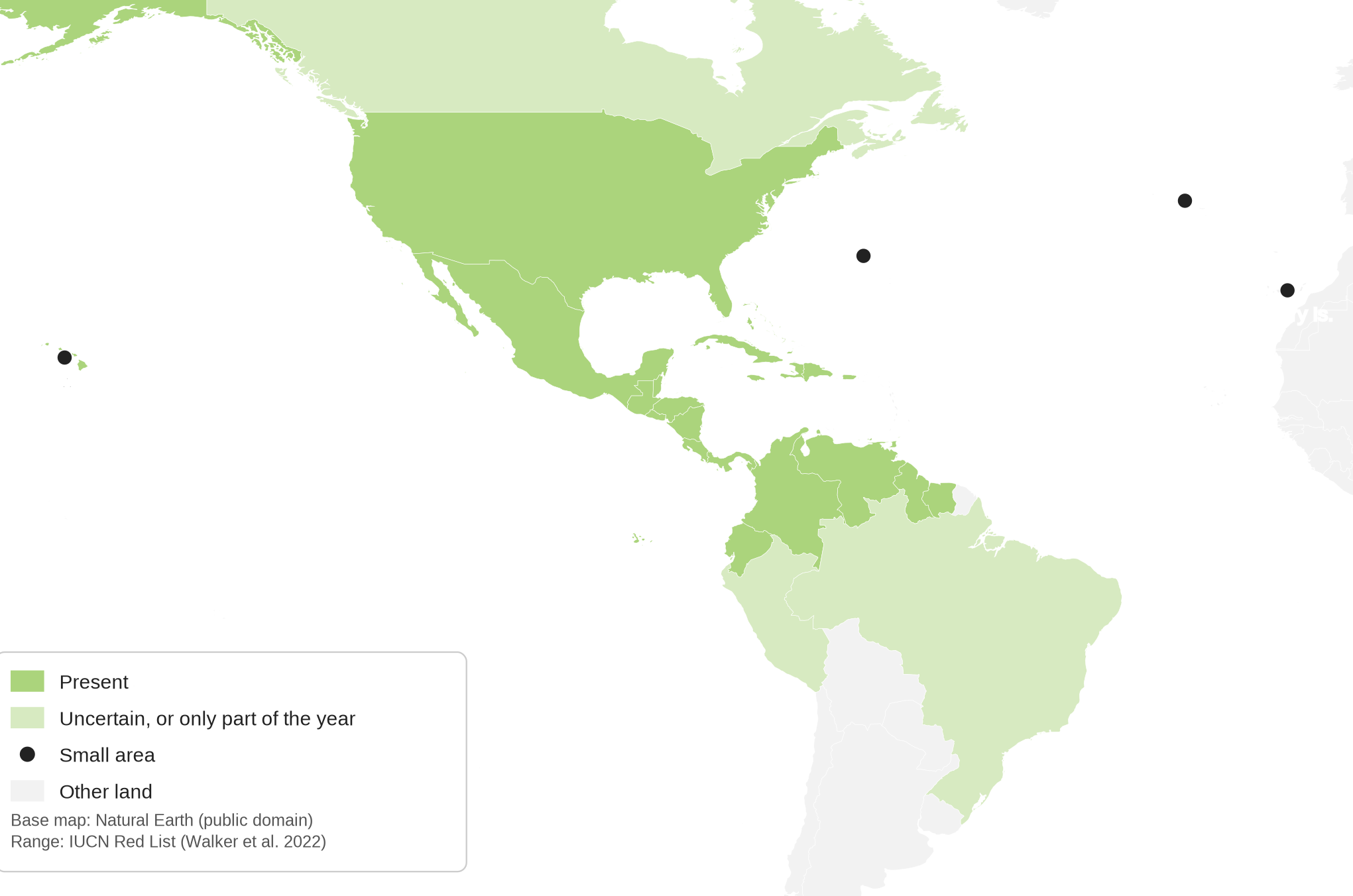
The migratory subspecies breeds from southern Canada through the United States and winters in central Mexico and on the California coast. The extent of occurrence of its winter grounds is almost 450,000 km².[15] The subspecies and their ranges are described in Forms and variants.
Population
Counts of the eastern migratory population measure the forest area the winter colonies occupy in Mexico, not the butterflies themselves. Teams map the colonies in December, and the area is the sum of all colonies.[19] In winter 2020 to 2021 the monarchs occupied 2.1 ha. At 6.9 to 60.9 million butterflies per hectare, with 21.1 million used as the best estimate, the IUCN put the total at 14.5 to 127.9 million, best estimate 44.3 million.[15]
The eastern population fell by 84% from 1996 to 2014.[15] In the ten years up to 2020, the IUCN says, it appeared to have stabilised at about 55 million butterflies, an average of 2.59 ha.[15] WWF-Mexico measured 2.84 ha in December 2021 and 2.21 ha in December 2022, a fall of 22%.[19] The next count was 0.9 ha in December 2023, then 1.79 ha in 2024, a rise of 99%.[20] In 2025 to 2026 the colonies covered 2.93 ha in nine colonies, up 64% on the year before, against a ten-year average of 2.81 ha.[21]
The western population is counted on the California coast. The 2020 to 2021 count found 1,914 butterflies, against about 30,000 in each of the two years before.[15]
Evolution
A genome study (Zhan et al. 2014) speculates that the monarch (Danaus plexippus) began in the southern United States or northern Mexico and was probably migratory from the start. The same study found that North American monarchs are the oldest branches of the family tree, and that three separate spreads left North America: one to Central and South America and the Caribbean, one across the Pacific, and one across the Atlantic to Portugal, Spain and Morocco.[22]
The genus Danaus split from its sister genus Tirumala (the blue and common tigers) about 4.9 million years ago, plus or minus 0.3, by an older mitochondrial clock.[23] That clock was calibrated on geological events, because no fossil of Danaus is known.[23]
The monarch’s closest relative is the Southern Monarch (Danaus erippus) of South America, which Zhan et al. call a probable closest relative.[22] The two differ by about 4.8% in their mitochondrial DNA (DNA passed down from the mother; one Southern Monarch specimen compared), which at a rate of 1.2% per million years in each lineage gives a split about 2 million years ago.[16] Crossing experiments showed that the two do not breed freely, and the authors concluded that they are separate species.[24]
Forms and variants
Subspecies
The number of monarch subspecies depends on the list. The IUCN assessment of 2022 says that at least two are recognised, D. p. plexippus and D. p. megalippe, and adds that Pelham (2008) recognises several colour varieties of megalippe, including portoricensis, leucogyne and tobagi, as additional subspecies.[4] Smith et al. (2005) accept only the two, and treat leucogyne, portoricensis and tobagi as colour varieties of megalippe and not as geographical groups.[16] ITIS lists only the nominate subspecies, Butterflies of America and Funet list six, and GBIF lists ten, while also treating many of those names as synonyms of the species.[10][12][11][9]
Colour forms
A white form, nivosus, lives on Oahu in Hawaii, where it has been recorded since the mid-1890s. It is a colour form of the monarch and not a subspecies.[22]
Conservation
Status
The Monarch Butterfly (Danaus plexippus) is listed as Least Concern on the IUCN Red List (assessed in 2021, published in 2022). The assessment covers only the Americas; the introduced populations elsewhere are left out. It judges the species widespread with a large overall population, but says the migratory phenomenon itself is at risk.[4]
The migratory subspecies, D. p. plexippus, is listed as Vulnerable (criterion A2b, published in 2023): a population decline estimated from an index of abundance, here the area of forest the butterflies occupy. This replaced the earlier Endangered listing (assessed in 2021, published in 2022) after a petition against it. The IUCN Standards and Petitions Committee named both Vulnerable and Near Threatened as plausible categories.[15][25] For the numbers of butterflies and the area they occupy, see Habitat and range.
In the United States, the U.S. Fish and Wildlife Service proposed on 12 December 2024 to list the monarch as threatened under the Endangered Species Act. The final decision is still pending.[6]
Threats
Habitat loss and herbicides. The WWF-Mexico report names three main threats. The first is the decline of milkweed at the breeding sites in the United States, caused by herbicide use. The second is land-use change in North America and the degradation of the forests in Mexico where the butterflies spend the winter.[19]
Climate change. The third main threat is climate change.[19]
Protection
The main overwintering colonies in Mexico lie in and around the Monarch Butterfly Biosphere Reserve. In the winter of 2022, more than two-thirds of the area the butterflies occupied lay inside the reserve.[19] The reserve collected yearly data from 1993 to 2003, and since 2004 the WWF-Telmex Telcel Foundation Alliance and Mexico’s national protected-areas commission (CONANP) have monitored the colonies each December.[19]
The proposed U.S. rule would also set which protections apply to the monarch and would name critical habitat for it.[6]
History and culture
The Mexican sites
For many years the winter home of the eastern monarchs was unknown. The zoologist Fred Urquhart of Toronto and his wife Norah began tagging monarchs with volunteers in 1950.[26] In 1973, after a newspaper article, Kenneth Brugger, who lived in Mexico, wrote to the Urquharts and then searched Mexico for two winters, travelling in a motor home. In January 1975 he phoned them to report millions of monarchs in evergreen trees beside a mountain clearing.[26] The Urquharts visited the site in January 1976, and Fred Urquhart announced the find in National Geographic in August 1976.[26]
For the longest tagged flight on record, see Behavior.
Taxonomy
| Rank | Name |
|---|---|
| Kingdom | Animalia |
| Phylum | Arthropoda |
| Class | Insecta (insects) |
| Subclass | Pterygota[29] |
| Infraclass | Neoptera[29] |
| Superorder | Holometabola[29] |
| Order | Lepidoptera (butterflies and moths) |
| Superfamily | Papilionoidea[29] |
| Family | Nymphalidae (brush-footed butterflies)[9] |
| Subfamily | Danainae (milkweed butterflies)[27] |
| Tribe | Danaini[29] |
| Genus | Danaus[10] |
| Species | Danaus plexippus (Linnaeus, 1758)[9][10] |
Synonyms (10)
| Name |
|---|
| Papilio plexippus (Linnaeus, 1758) |
| Danaus misippiformis (Meuschen, 1781) |
| Danaus archippus (Fabricius, 1793) |
| Papilio archippus (Fabricius, 1793) |
| Danaus curassavicae (Fabricius, 1807) |
| Danaus menippe (Hübner, 1816) |
| Danaus megalippe (Hübner, 1826) |
| Danaus leucogyne (Butler, 1884) |
| Danaus fumosus (Hulst, 1886) |
| Danaus pulchra (Strecker, 1900) |
A selection of the oldest names. The GBIF backbone lists 15 species-level synonyms.[28]
Higher classification
The monarch is a brush-footed butterfly (family Nymphalidae), and sits in the subfamily Danainae, the milkweed butterflies.[9][10] ITIS places it in the tribe Danaini, inside the true butterflies (Papilionoidea). The order Lepidoptera also holds all the moths.[10] Its genus Danaus also holds the Southern Monarch (Danaus erippus), D. eresimus, D. genutia, D. affinis and several others.[11]
The Southern Monarch and the old subgenera
The Southern Monarch (Danaus erippus) was once treated as a subspecies of the monarch. Smith et al. (2005) and Hay-Roe et al. (2007) treat it as a separate species, and Funet follows that.[11][16][24] The databases are not fully in step on the old names. Funet lists Anosia menippe Hübner, 1816 under the Southern Monarch, while GBIF lists Danaus menippe Hübner, 1816 as a synonym of the monarch.[9][11] Smith et al. also dropped the old subgenera of Danaus, but ITIS still shows the monarch in the subgenus Danaus (Danaus).[10][16]
Sources
- Animal Diversity Web, Danaus plexippus
- Monarch Joint Venture, life cycle
- Monarch Joint Venture, monarch migration
- Walker et al. 2022, IUCN Red List assessment of Danaus plexippus
- Guinness World Records, longest journey by a butterfly
- U.S. Fish and Wildlife Service, monarch butterfly species page
- Monarch Joint Venture, monarch biology FAQ
- Center for Biological Diversity, monarch butterfly natural history
- GBIF Backbone Taxonomy, Danaus plexippus (Linnaeus, 1758)
- ITIS, Danaus plexippus
- Savela, Funet Lepidoptera and some other life forms, Danaus
- Butterflies of America, Danaus plexippus
- Monarch Joint Venture, vital statistics
- Li, Pierce & de Roode 2016, Animal Migration
- IUCN Red List assessment of Danaus plexippus plexippus, 2023
- Smith, Lushai & Allen 2005, Zoological Journal of the Linnean Society 144: 191–212
- Monarch Joint Venture, why milkweed
- Monarch Watch, monarch biology
- WWF-Mexico, Monarch Butterfly Report 2022–2023
- University of Wisconsin Arboretum, monarch winter 2024–25 population numbers
- Monarch Conservation, 2025–2026 population numbers
- Zhan et al. 2014, Nature 514: 317–321, “The genetics of monarch butterfly migration and warning colouration”
- Lushai et al. 2003, Insect Science and its Application 23: 309–316
- Hay-Roe, Lamas & Nation 2007, Biological Journal of the Linnean Society 91: 445–453
- Monarch Joint Venture, “IUCN changes migratory monarch status from Endangered to Vulnerable”
- National Geographic Education, “How a scientist solved the case of the disappearing butterflies”
- Wahlberg et al. 2009, Proceedings of the Royal Society B 276: 4295–4302
- GBIF backbone, Danaus plexippus, synonyms
- ITIS, Danaus plexippus, classification