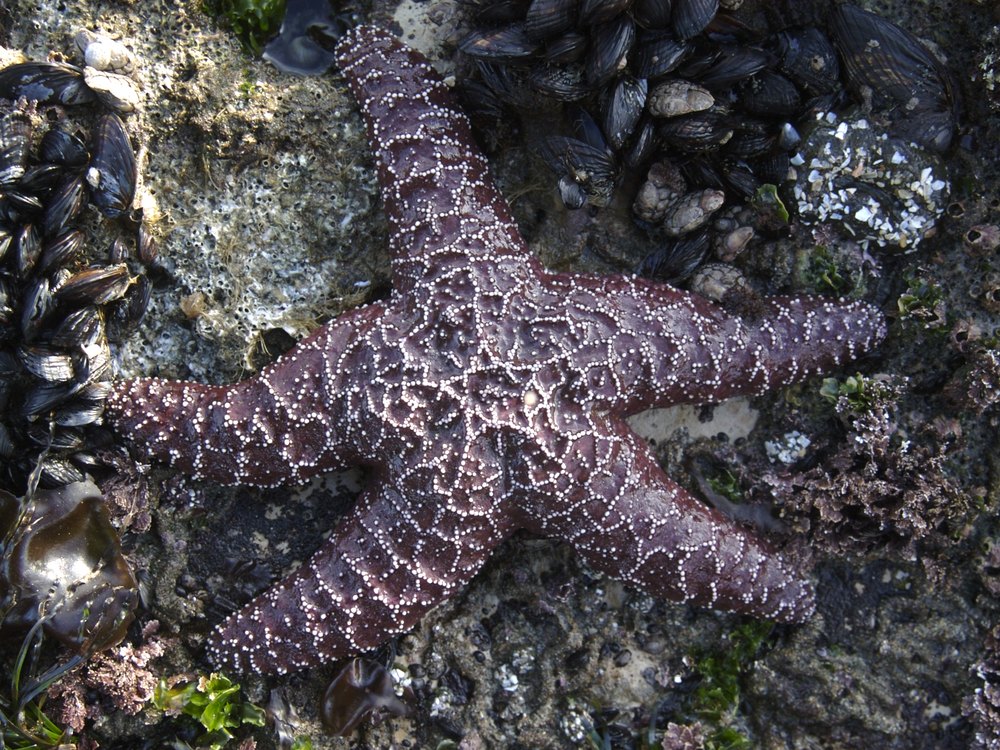
The ochre sea star (Pisaster ochraceus) is a sea star of the rocky shores of western North America, from Alaska to California. Most are purple, but orange, yellow, reddish and brown ones live beside them.[1] It eats mainly mussels and other shellfish.[1][2] Ecologists built the idea of the keystone predator on experiments with this species: when it was removed from a stretch of shore, mussels took over and other species disappeared.[3][4] From 2013 a wasting disease killed large numbers of adults along much of the coast.[5][6]
Quick facts
Description
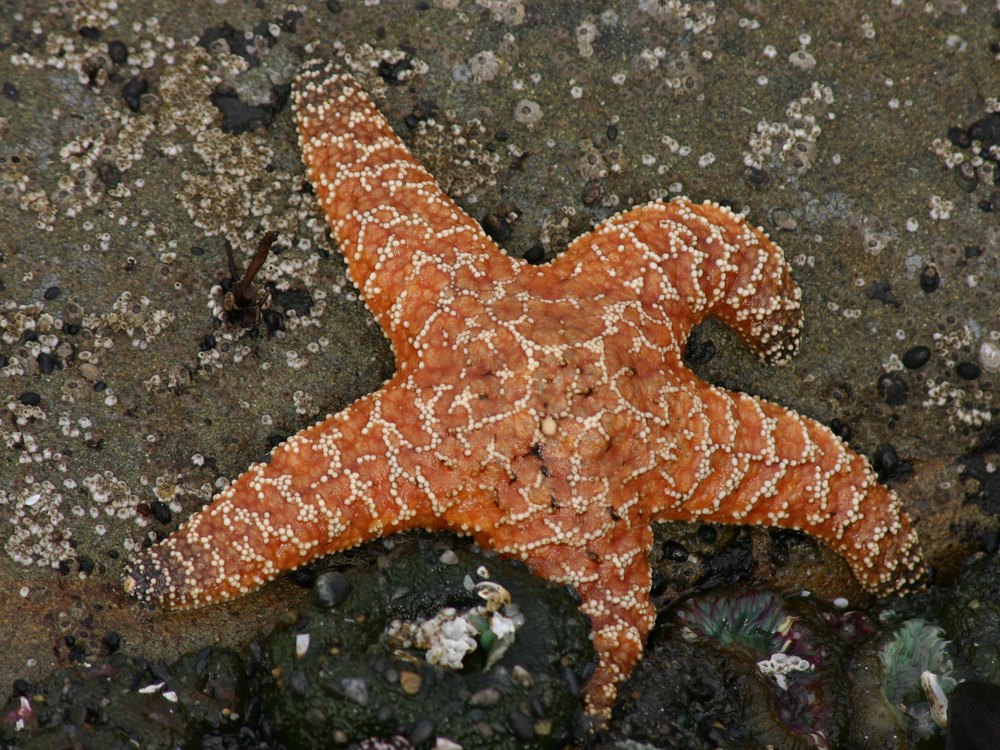
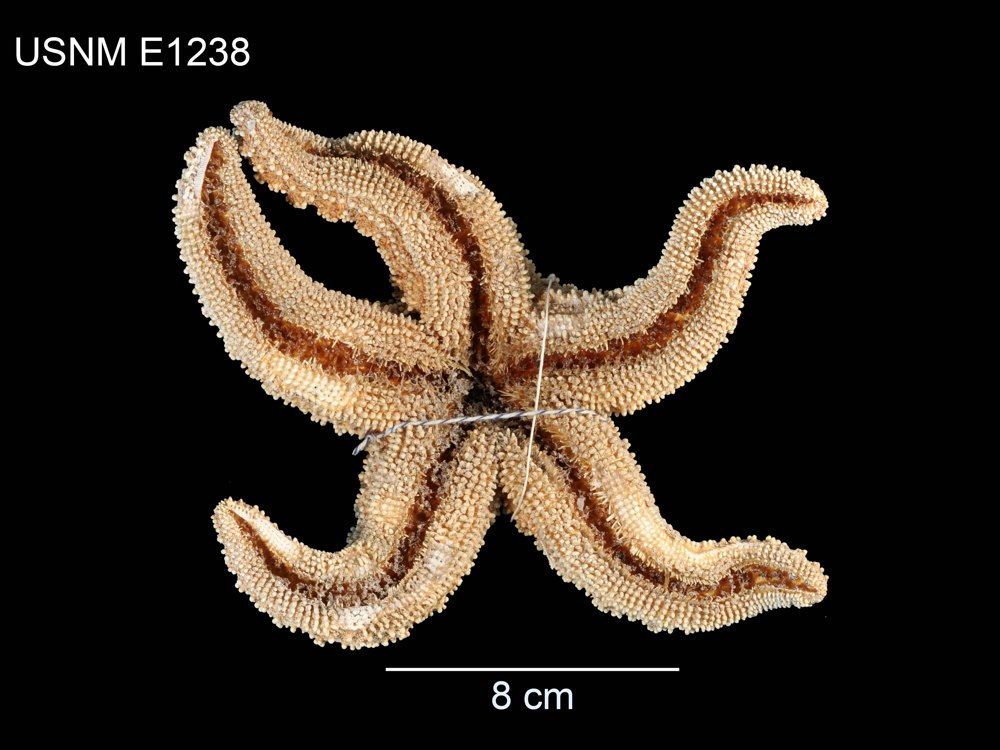
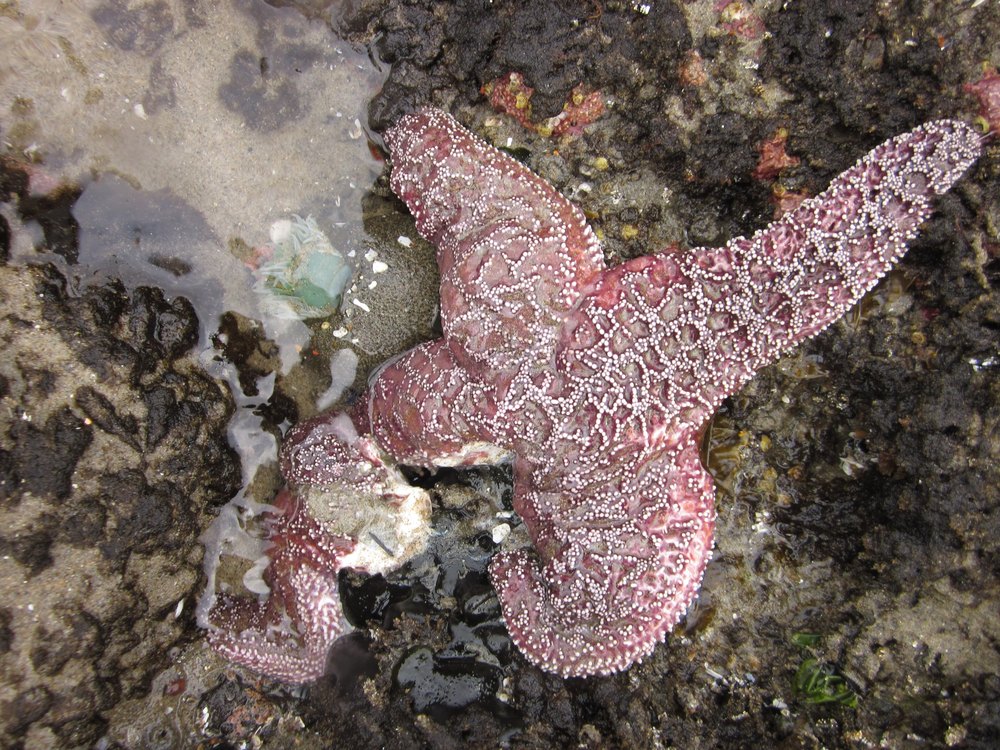
The ochre sea star usually has five arms, though four to seven occur.[1][7] The central disc and arms are covered above by a net-like pattern of small skeletal plates called ossicles.[7] It moves and holds on to the rock with tube feet, and the suckers on the tube feet keep it attached on shores where the surf is strong.[1][7] Seawater enters the body through the madreporite.[7] The animal has light-sensitive cells grouped in an “optic cushion” that contains several simple eyes (ocelli).[8]


Name
The species was first described as Asterias ochracea by Brandt in 1835, in the account of animals collected on the round-the-world voyage that H. Mertens joined, published in St Petersburg.[9] The genus Pisaster was named by Müller and Troschel in 1840, and the brackets around Brandt’s name in the modern name Pisaster ochraceus (Brandt, 1835) show that the species was moved to this genus later.[9] English names are ochre star, ochre sea star, purple sea star and purple star.[10] The World Asteroidea Database lists 12 other names that are not accepted today.[9][10]
Synonyms (12)
| Name | Authority | Note |
|---|---|---|
| Asterias ochracea | (Brandt, 1835) | The original name |
| Asterias ianthina | (Brandt, 1835) | A synonym according to Fisher (1930) |
| Asterias janthina | (Brandt, 1835) | A misspelling |
| Asterias margaritifera | (Brandt in Fisher, 1930) | A synonym according to Fisher (1930) |
| Asteracanthion margaritifer | (Müller & Troschel, 1842) | A synonym according to Fisher (1930) |
| Asterias conferta | (Stimpson, 1862) | — |
| Pisaster confertus | (Stimpson, 1862) | — |
| Asterias fissispina | (Stimpson, 1862) | A synonym according to Fisher (1926, 1930) |
| Pisaster fissispinus | (Stimpson, 1862) | A synonym according to Fisher (1926, 1930) |
| Pisaster ochraceus ochraceus | (Brandt, 1835) | A subspecies, no longer accepted |
| Pisaster ochraceus segnis | (Fisher, 1926) | A subspecies, no longer accepted |
| Pisaster ochraceus var. nodiferus | (Verrill, 1914) | No longer accepted |
Names and notes follow the World Asteroidea Database.[9]
Body
Size ranges
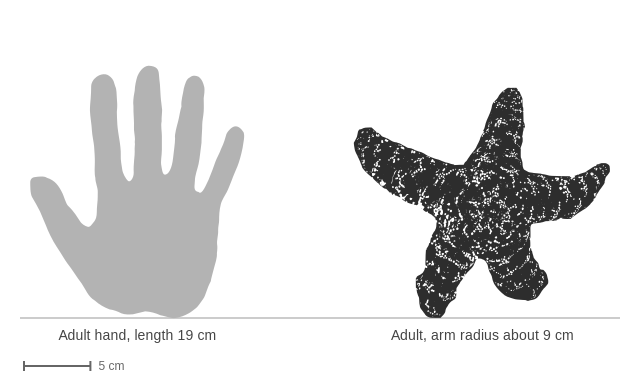
In Oregon and California the arm radius averages about 9 cm, and it can reach about three times that.[1] Researchers measure arm length in different ways: from the madreporite to the tip of the opposite arm in Oregon, and from the centre of the disc to the arm tip in California.[11] By weight, an adult is a star heavier than 80 g, and the heaviest recorded individual weighed 1,200 g wet. A star is about 70 g when it reaches maturity.[11][12]
| Weight (largest recorded) | 1,200 g |
| Arm radius (average) | about 9 cm |
Regeneration
The ochre sea star can regrow lost arms.[1] Photographs show individuals regrowing one, two or five arms.[7]
Heat, cold and salt
Stars on the middle and lower shore are out of the water at low tide. Field measurements at Bodega Bay, California, in 2006 and 2007 showed that repeated exposure to peak body temperatures of 23 °C or more reduced both feeding and growth, while a single brief exposure raised feeding and did not change growth.[13] Cold water also matters: when upwelling dropped the water temperature by 3 to 5 °C, predation on mussels fell.[14] The star does not control the salt content of its body fluids, and it tolerates salinities from 15 to 30 practical salinity units.[7] It lives from the intertidal zone down to about 90 m.[1]
Diet
The ochre sea star is a carnivore. On the open coast its main prey is mussels, and in inland waters it favours barnacles and whelks.[1] In Oregon its prey includes the California mussel (Mytilus californianus), chitons, limpets, snails, barnacles, sea urchins and crabs.[2] The bay mussel (Mytilus trossulus) is also eaten.[7]
| Food | Where | Notes |
|---|---|---|
| California mussel, bay mussel | Open coast | The main prey[1][7] |
| Barnacles, whelks | Inland waters | Favoured there[1] |
| Chitons, limpets, snails | Rocky shores | [1][2] |
| Sea urchins, crabs | Oregon | [2] |
Feeding
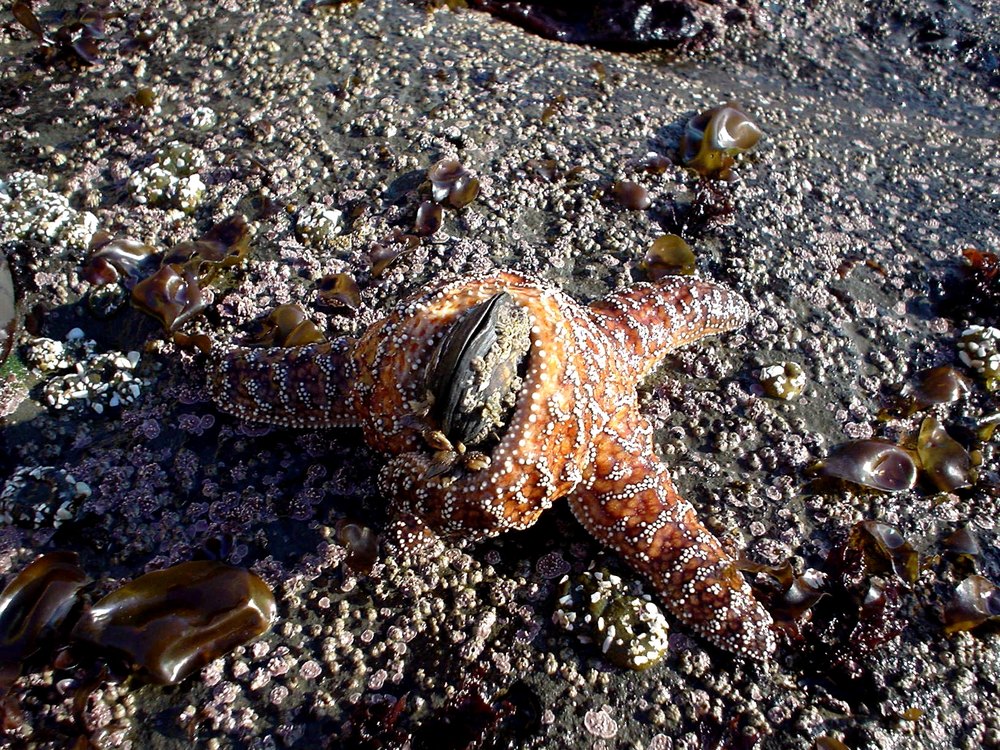
A star pulls the two halves of a mussel shell slightly apart with its tube feet and pushes its stomach out between the shells, digesting the mussel outside its body.[1] At Mukkaw Bay, near Neah Bay in Washington, Paine recorded what the stars ate from November 1963 to November 1964: 1,049 food items seen eaten. They included chitons, limpets, bivalves and barnacles. Measured in calories, barnacles were about a third as important to the stars as the California mussel or the chiton Katharina tunicata.[4]
Temperature changes how much the star eats. In Bodega Bay, repeated exposure to peak body temperatures of 23 °C or more cut both feeding and growth.[13] Predation on mussels dropped when upwelling cooled the water by 3 to 5 °C.[14]

Life cycle
| Stage | Size / weight / age | Notes |
|---|---|---|
| Larva | About 0.2 mm at hatching; up to about 2.2 mm | Hatches after about 4.5 days and drifts in the plankton for about 2.5 to 8 months[12][8][2] |
| Settled young | About 0.5 mm after settling | The young star shrinks when it settles[12] |
| Juvenile | 5 to 80 g; arm length about 2.6 to 7.7 cm | Roughly 2 to 6 years old; first-year recruits weigh 0.01 to 1 g[11] |
| Adult | More than 80 g; arm length more than 7.7 cm | Arm radius averages about 9 cm[11][1] |
Sexes are mostly separate. Eggs and sperm are released into the sea, where fertilisation happens, and the parents give no care.[8] Spawning happens in spring[8] and, in Puget Sound, from late spring to early summer, about May to July.[7] The larva passes through two feeding stages, the bipinnaria and then the brachiolaria, before it settles on the shore.[8] Young stars hide in crevices, under rocks and within mussel beds.[1]
Growth and lifespan
Adults keep growing, and their growth rate depends on how much food they get.[8] The ages in the table are the estimates of the researchers who measured the stars, taken from histograms of star sizes, not from counts of growth rings.[11] A wild ochre sea star is thought to live up to 20 years.[1][8]
Ecology
A keystone predator
The best-known study of the ochre sea star is the experiment Robert Paine began in June 1963 at Mukkaw Bay, near Neah Bay, Washington. He removed the stars from a typical piece of shoreline and left an adjacent stretch alone as a control.[4] By September the barnacle Balanus glandula covered 60 to 80% of the space. By the next June small, fast-growing mussels (Mytilus) and goose barnacles (Mitella) were crowding the Balanus out. Algae growing on the rock disappeared, and chitons and larger limpets left because they had lost space and food. A food chain of sponges and nudibranchs was displaced, and anemones became fewer. The removal area became simpler, with a “pronounced decrease in diversity”, while the control area did not change.[4]
A later paper followed the mussels. At Mukkaw Bay the lower edge of the mussel bed moved down by up to 0.85 m in five years where the stars were removed, and it did not move at two control sites. On steeper Tatoosh Island, the greatest shift was 1.93 m in three years. Mussels kept more than 25 kinds of invertebrates and algae off the rock at Mukkaw Bay, and in photographs taken up to nine years apart the lower limit of the mussel band stayed at the same height.[15]
The experiments are the basis of the idea that one predator can hold a whole community in shape.[3] In 2016 two ecologists called Paine’s 1966 paper the most-cited empirical article in the American Naturalist. They argued that the California mussel, which makes a bed that shelters over 300 other species, matters more than the star’s effect on diversity, and that removing the sea star raises the total diversity of the community.[16] In Oregon, predation on caged mussels has been measured at some sites since 1990.[3]
Predators
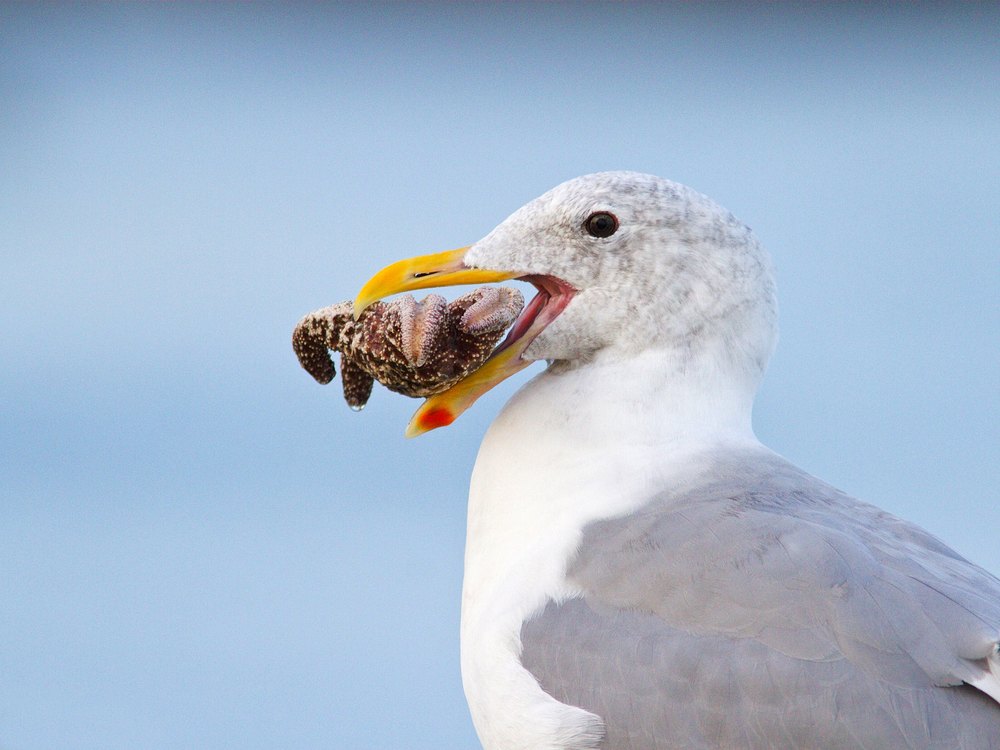
Few animals eat adult ochre stars. Gulls are the main predators in Oregon, and sea otters eat them on the Washington and California coasts.[2] A study of free-living Glaucous-winged Gulls found moderate to high occurrences (32.5 to 91.6%) of Pisaster in their diets.[17]

Habitat and range
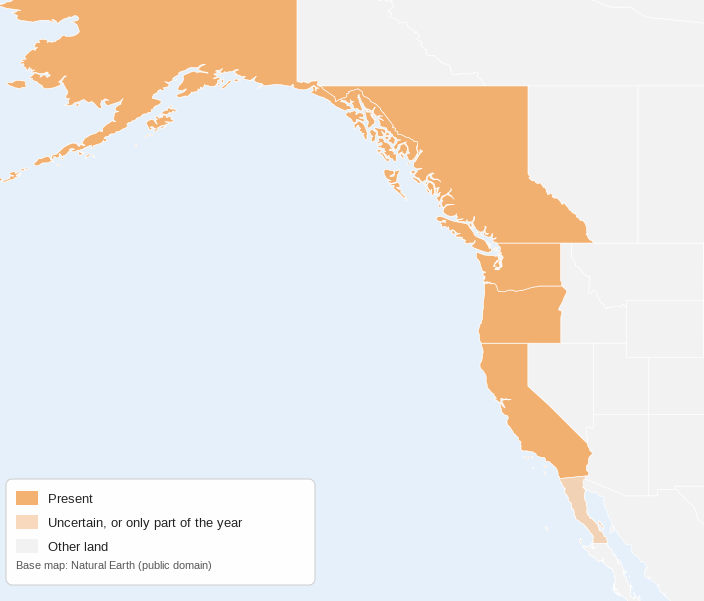
The ochre sea star lives on rocky shores from Prince William Sound in Alaska south through British Columbia, Washington, Oregon and California.[1][2][7] Sources differ on the southern end: one gives Point Sal in Santa Barbara County, California, another Santa Barbara, and the MARINe species page gives Baja California in Mexico.[7][2][1] Genetic samples have been taken from Vancouver to Punta San Carlos, Baja California.[18] Disease surveys in 2013 to 2023 recorded the species at sites in Alaska (Sitka, Kayak Island, Kasaan Bay), British Columbia, Washington (the Olympic Coast and the Salish Sea), Oregon and northern, central and southern California.[19]
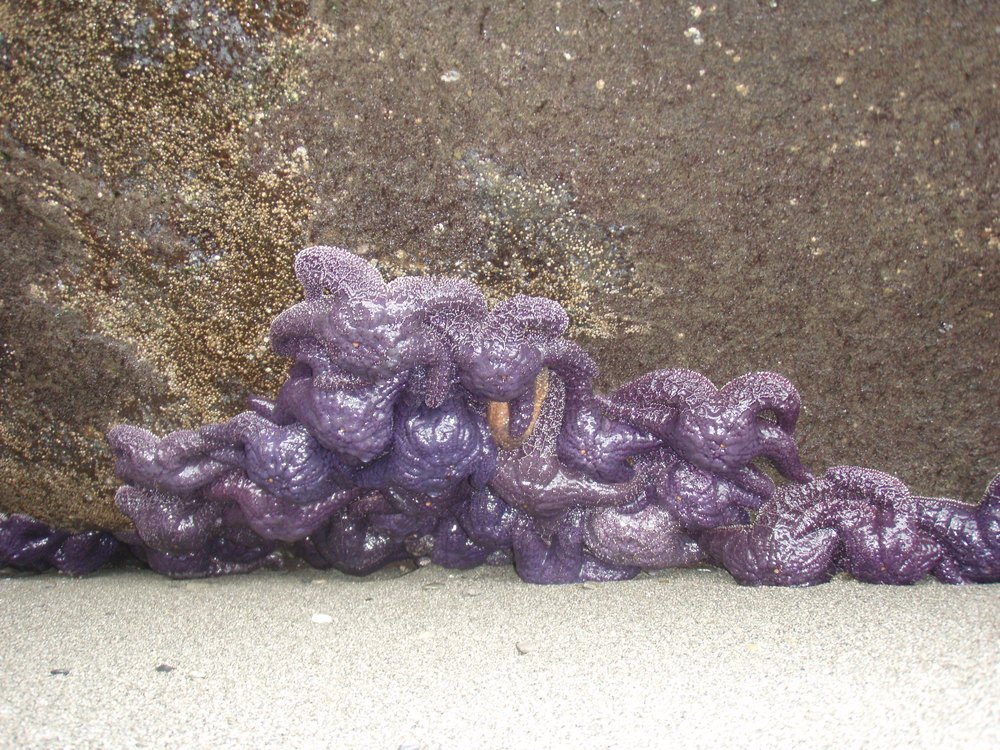
The star lives in the middle and lower intertidal zone of wave-swept rocky shores, and also below the tide line on rock down to about 90 m.[1] In Oregon it lives on rocky shores and in the shallow sea just offshore, in nearshore and estuarine waters, on shelves, in surge channels, on cliffs and platforms and in tide pools, often on wave-washed mussel beds.[2] Young stars hide in crevices, under rocks and in mussel beds.[1]

The MARINe network watches the species at many sites. One analysis used almost two decades of data from a coordinated monitoring effort at 88 sites from southern British Columbia to San Diego, plus two sites near Sitka, Alaska.[6] In Oregon, 12 long-term sites cover about 360 km of coast.[3] In southern California the number of stars has fallen since 1978, with the largest losses in the 1982–84 and 1997–98 El Niño events.[1]

Evolution
Sea stars (class Asteroidea) and brittle stars form a group called Asterozoa, and a study of the genes expressed in 23 newly sampled echinoderms found it to be the sister group of the sea urchins and sea cucumbers (Echinozoa). Other analyses place the groups differently.[20] The molecular clock of a study of sea star mitochondrial genomes puts the origin of living sea stars at 351.1 million years ago, at the Devonian–Carboniferous boundary, with a 95% range of 275.9 to 454.9 million years.[21] The oldest sea star body fossil known comes from the Early Ordovician of Utah (Eriaster ibexensis), so fossils reach back further than the molecular age.[22]
The same mitochondrial study dates the group that holds the forcipulatid sea stars, the deep-sea Paulasteriidae and the brittle-armed Brisingida to 270.2 million years ago (range 208.2 to 347.1).[21] Studies disagree on where the Brisingida belong: the mitochondrial study nests them inside the forcipulatid sea stars, while two other studies place them beside the Asteriidae or beside the Forcipulatida.[23][24] The infraclass Neoasteroidea, which holds most living sea stars, is believed to have diversified after the end-Permian mass extinction. The earliest clear fossils of the forcipulatacean sea stars are from the Lower Jurassic, and the earliest members of the living branch date to the Hettangian, about 201.4 million years ago.[25]
The date of the ochre sea star’s own family, the Asteriidae, is disputed. An older view held that the family was known from the start of the Jurassic. A 2024 revision argued that the Jurassic fossils placed in the family do not belong to it, and that the Asteriidae most likely arose in the late Cretaceous.[25] A molecular study of four main groups of forcipulatacean sea stars found that the Asteriidae, as it defined them, are a much smaller group than older classifications held.[23]
Within the genus Pisaster, which has three living species, the ochre sea star is one of two possible sister species of the giant pink sea star (Pisaster brevispinus). The genome of the ochre sea star is 401.9 megabases long, against 505.3 in the giant pink sea star.[26]
Forms and variants
Two subspecies were once used: P. o. ochraceus north of Point Conception, California, and P. o. segnis south of it.[9][18] A study of 126 stars from Vancouver to Punta San Carlos, Baja California, used two mitochondrial genes and found no genetic structure along the coast. The authors concluded that P. ochraceus is a single species.[18] The World Asteroidea Database and GBIF accept no subspecies; ITIS still lists both.[9][10][27]
Colour forms
Purple is the commonest colour, but individuals can also be orange, orange-ochre, yellow, reddish or brown.[1] Long-term monitoring on the exposed coast has found about 20% of the stars to be orange.[1] Along the open Pacific coast, between 6 and 28% of the stars in a population were orange, with few brilliant purple ones and many reddish-brown to dull purple ones. In the San Juan Islands (Washington) and the southern Strait of Georgia (British Columbia), nearly all stars were brilliant purple.[28] The colours come from carotenoid pigments held in the upper surface of the body.[28] The colour forms are not separate species or subspecies: the same study found very little genetic structure among populations.[28]
Conservation
The ochre sea star is Not evaluated on the IUCN Red List.
Threats
Disease[5]Disease. The main recent threat is sea star wasting disease. Earlier die-offs were recorded in the 1970s, 1980s and 1990s, but none was as large as the one that began in 2013.[5]
Sea star wasting disease
The disease was first noticed in ochre stars in June 2013, on the Washington coast, during monitoring by researchers from Olympic National Park.[5] The worst die-off came in 2013 and 2014 and ran from Alaska to California.[5] At least 20 species of sea star were affected.[5] In Oregon the disease was first seen in April 2014, and up to 90% of the stars showed signs between June and August 2014. By September 2014 the number of stars at the nine core sites had fallen by 59 to 84% and their weight by 60 to 90%.[3]
In central California, at 16 sites, the median adult density fell from 0.028 to 0.005 stars per square metre between 2012 and 2015, a drop of 81%.[29] Along the whole coast the losses were larger in the south. Among adults over 30 mm at the 39 southern sites, numbers fell by more than 75% at all but one site and by 99% or more at over half. At the northern sites about 80% of the stars declined by at least 75%.[6] The disease came back in places later: in the Salish Sea in November 2017, in Kasaan Bay, Alaska, in August 2018, and in September 2021, when about 30% of the stars counted at a site on the Olympic Coast showed mild to severe signs.[19]

The cause
The cause of the disease in the ochre sea star is still debated. In 2014 a team reported that filtered, virus-sized material from sick tissue made healthy stars ill, while heat-killed controls stayed healthy. They named a densovirus as the most likely candidate, found more of it in sicker stars, and also found it in museum specimens from 1942.[30] A later study found that these viruses tracked the disease only in the sunflower sea star, a different species, and that they also turned up in stars with no signs. Its authors suggested that wasting may be a syndrome with different causes in different places and species.[31] A laboratory study produced lesions in ochre stars by enriching the water with organic matter and lowering its oxygen by about 39%. Bacteria that thrive on rich food increased before the disease appeared, and bacteria that live without oxygen increased at the lesions.[32] Warm water was not the trigger in Oregon: the frequency of wasting was lower after warmer weeks (p = 0.0004), and 2014 was cooler there than most earlier years.[3]
Recovery
After the die-off, young stars settled in unusual numbers. In Oregon, from autumn 2014 to spring 2015, recruitment was about 7 to 300 times higher than in 2014.[3] In central California, recruitment rose 74-fold from late 2013.[29] Later, young stars survived less well than they had before the disease, and low levels of wasting remained across the range.[6] In adults before and after the outbreak, the frequencies of gene variants changed at three places in the genome, and the same changes appeared in the new recruits. The authors read this as a sign of selection that may persist.[29]
Recovery differs by region. By November 2020, Alaska and Washington were mostly below their levels from before the disease, while Oregon and northern California looked best and central California showed little sign of recovery. In September 2023, Oregon and northern California “hold the most promise”, central California had a boom of young stars but most of them died, and southern California had a “poor outlook” with no successful recruitment since 2013–14.[19] At Cape Arago, Oregon, 9 stars were counted in September 2017, against an average of 73 before the disease.[19] The Oregon state plan describes the species there as largely recovered, sometimes to its densities from before the die-off.[2]
Protection
Oregon has not allowed commercial harvest of sea stars since 2014. On 18 March 2022 the Oregon Fish and Wildlife Commission banned recreational harvest, with immediate effect. Before then, the limit was 10 marine invertebrates in total, including sea stars.[33][34] The state’s conservation plan lists keeping the ban on all taking of sea stars as an action.[2]
History and culture
Description and naming
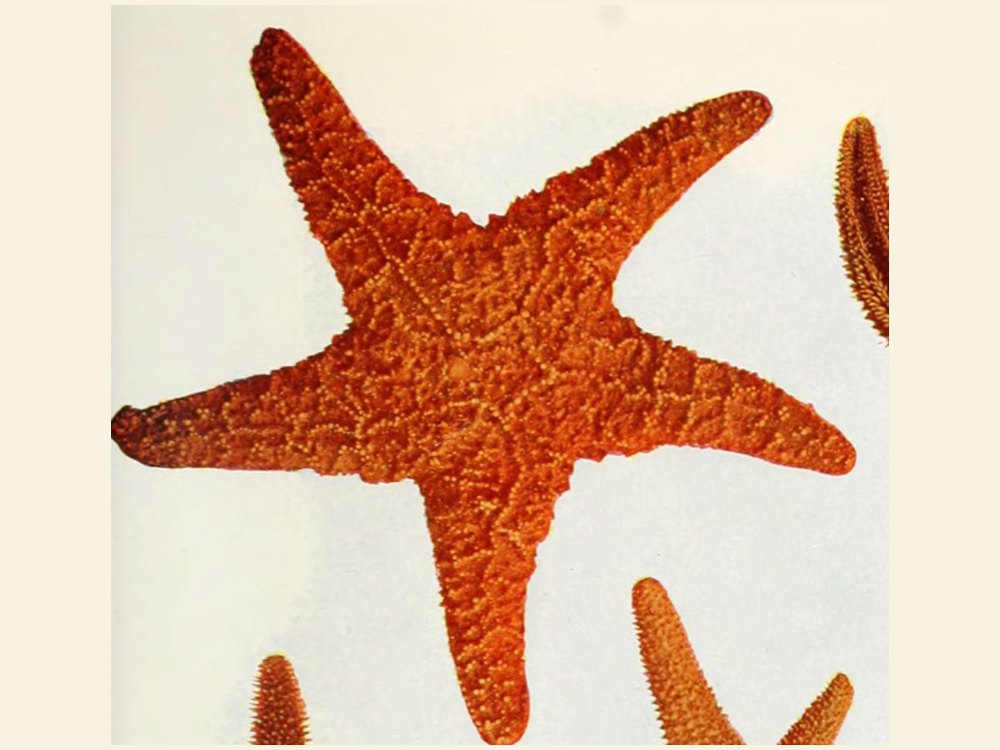
The species was described by Brandt in 1835 as Asterias ochracea.[9]

Paine and the keystone idea
Robert T. Paine (1933–2016) carried out the removal experiments on the Washington coast.[35] His 1966 paper reported them.[4] A separate paper from 1969 in the journal Ecology described how the ochre sea star feeds on the snail Tegula, and how it affects the shape of intertidal communities.[35]
Wasting disease and the public
MARINe worked with community-science groups to document the wasting disease from Alaska to California. Members of the public can submit sighting logs, including logs that report only healthy stars or no stars at all.[5] The ochre sea star has little commercial value. It is used in research and teaching, and in bay areas tourists admire it.[8]
Taxonomy
| Rank | Name |
|---|---|
| Kingdom | Animalia |
| Phylum | Echinodermata |
| Class | Asteroidea (sea stars) |
| Order | Forcipulatida[9] |
| Family | Asteriidae[9] |
| Genus | Pisaster Müller & Troschel, 1840[9] |
| Species | Pisaster ochraceus (Brandt, 1835)[9][10][27] |
Higher classification
The ochre sea star is a sea star of the class Asteroidea, in the family Asteriidae and the order Forcipulatida. The World Asteroidea Database places the order in the superorder Forcipulatacea.[9] The genus Pisaster has three accepted species: this one, the giant pink sea star (P. brevispinus) and the giant sea star (P. giganteus), both described by Stimpson in 1857.[9]
Sources
- MARINe (Multi-Agency Rocky Intertidal Network), species page “Pisaster (Ochre Star)”
- Oregon Wildlife Action Plan, ochre sea star species page
- Menge et al. 2016, PLOS ONE 11: e0153994
- Paine 1966, “Food web complexity and species diversity”, American Naturalist 100: 65–75
- MARINe, “Sea Star Wasting Syndrome”
- Miner et al. 2018, PLOS ONE 13: e0192870
- Walla Walla University invertebrate pages, Pisaster ochraceus
- Animal Diversity Web, Pisaster ochraceus
- WoRMS (World Asteroidea Database), Pisaster ochraceus (Brandt, 1835), AphiaID 240755
- GBIF Backbone Taxonomy, Pisaster ochraceus
- BCO-DMO dataset 990975, Menge and Gravem, sea star size structure, Oregon and northern California, 2000–2024
- Add-my-pet database entry, Pisaster ochraceus
- Pincebourde, Sanford & Helmuth 2008, body temperature during low tide and feeding
- Sanford 1999, Science 283: 2095–2097
- Paine 1974, Oecologia 15: 93–120
- Lafferty & Suchanek 2016, American Naturalist (doi 10.1086/688045), USGS record
- Glaucous-winged Gull diet study, The Auk 128(4), 2011
- Frontana-Uribe et al. 2008, Journal of the Marine Biological Association of the UK 88: 395–400
- MARINe, “SSWS Updates”
- Reich et al. 2015, PLOS ONE, phylogenomics of Echinodermata
- Sun, Xiao & Sha 2022, Scientific Reports, mitogenomics of sea stars
- Blake & Guensburg 2005, Journal of Paleontology 79(2) (Eriaster ibexensis, Early Ordovician, Utah)
- Mah & Foltz 2011, Zoological Journal of the Linnean Society 162: 646–660
- Linchangco et al. 2017, Molecular Phylogenetics and Evolution 115: 161–170
- Fau et al. 2024, PeerJ 12: e18169
- DeBiasse et al. 2022, Journal of Heredity 113: 689–698
- ITIS, Pisaster ochraceus (TSN 157253)
- Harley et al. 2006, Biological Bulletin 211: 248–262
- Schiebelhut et al. 2018, PNAS 115: 7069–7074
- Hewson et al. 2014, PNAS 111: 17278–17283
- Hewson et al. 2018, Frontiers in Marine Science 5: 77
- Aquino et al. 2021, Frontiers in Microbiology 11: 610009
- Oregon Department of Fish and Wildlife, news release, 18 March 2022
- Oregon Public Broadcasting, 21 March 2022
- Ecological Society of America, history page on Robert T. Paine