The Peregrine Falcon (Falco peregrinus) is a large falcon that lives on every continent except Antarctica.[1] It nests on cliffs and, in many places, on tall buildings and bridges, and it eats mostly birds.[2][3] It is best known for the stoop, a steep dive with the wings folded in.[4] Numbers crashed in the mid-1900s because of the pesticide DDT and have since recovered, and the IUCN rates the species Least Concern.[5]
Quick facts
Description
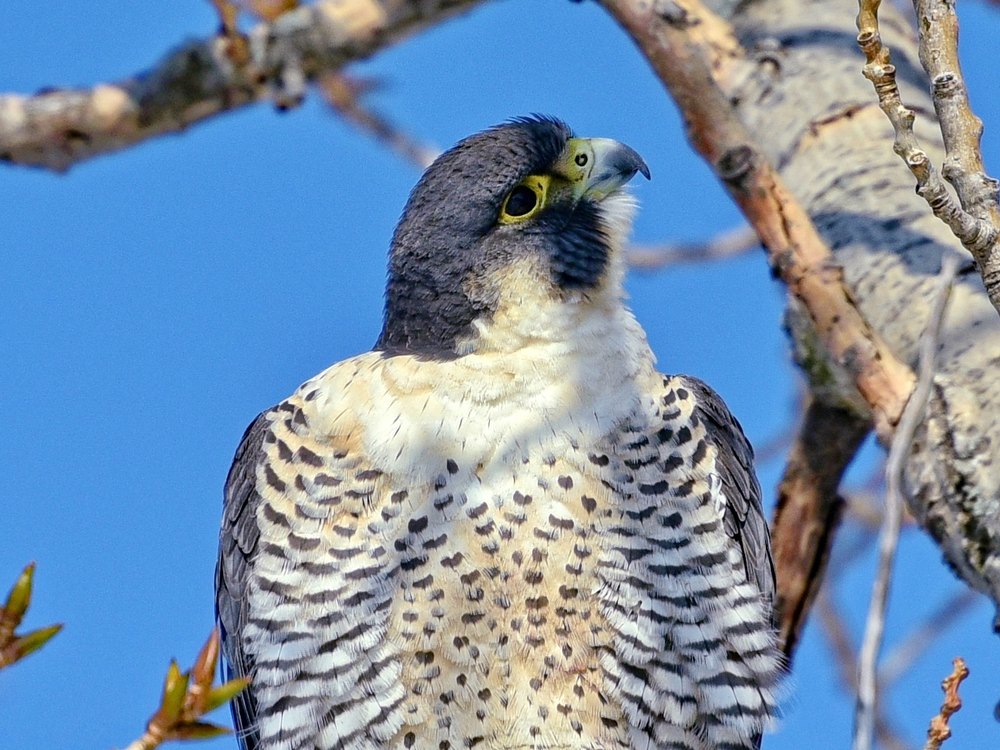
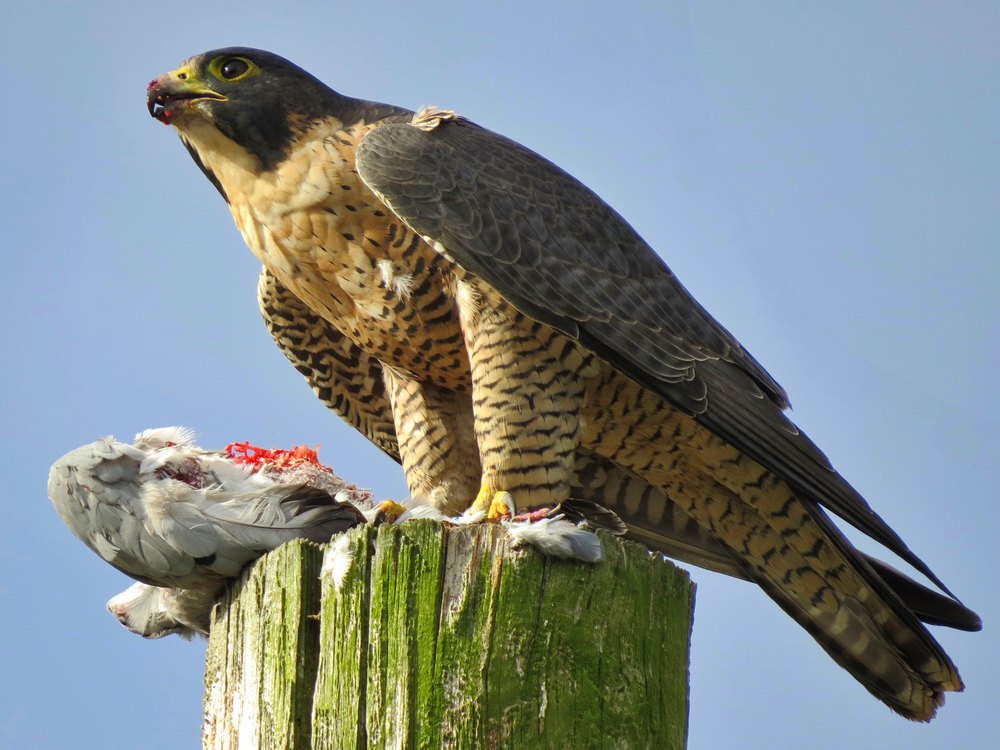
The adult Peregrine has blue-grey to slate upperparts with faint darker barring, black wingtips, and a black head with a dark stripe down each cheek, often called a moustache. The underparts are white to rusty and barred with dark. The cere (the bare skin at the base of the beak), the ring around the eye and the feet are yellow, and the beak and claws are black.[7] The plumage does not change with the season.[2]
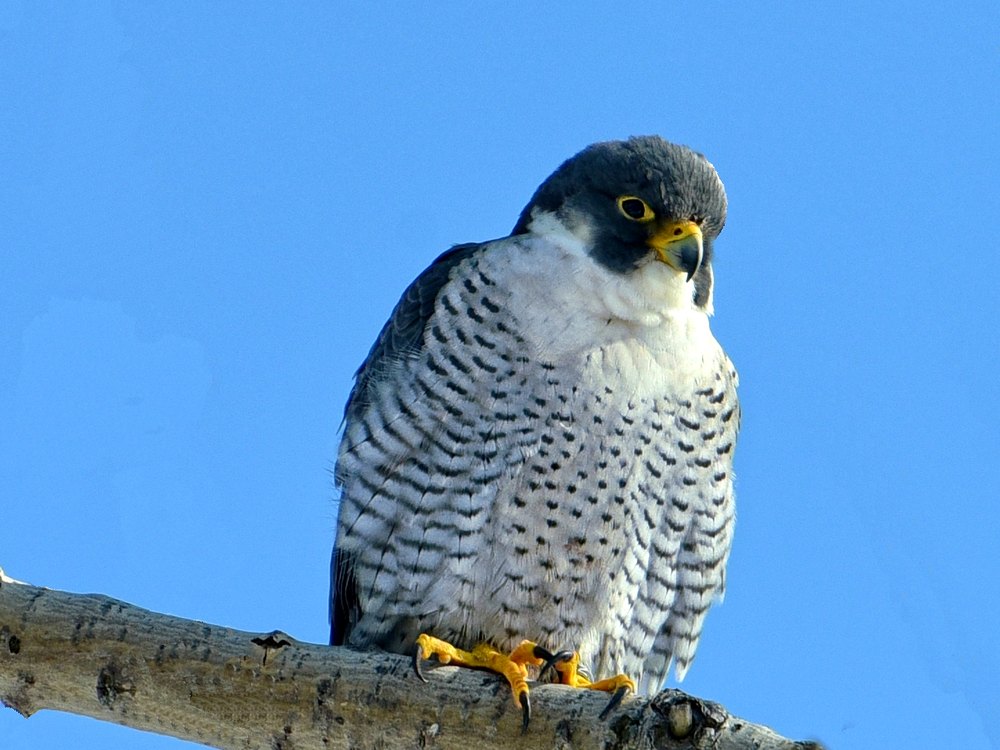

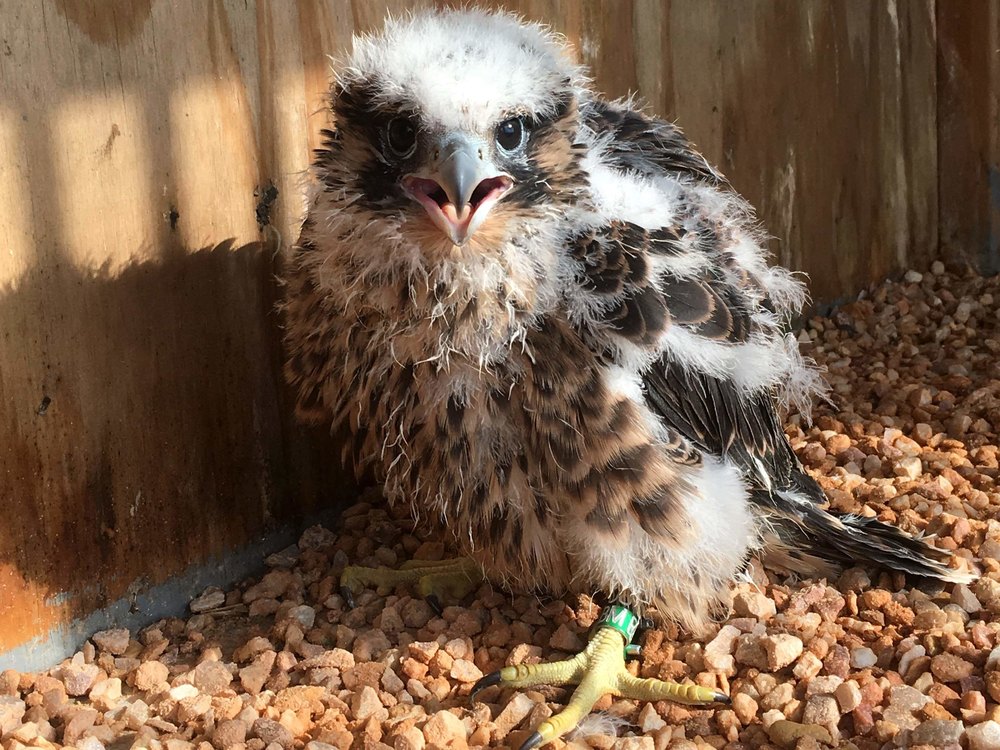
Young birds are darker and browner than adults. Their underparts are streaked instead of barred, and the cere and eye-ring are pale bluish.[2][7] The hooked beak has a notch along its upper edge, which the bird uses to cut through the neck bones of its prey.[2]

Name
The English name comes from the Latin word peregrinus, which means “foreign” or “wanderer”.[8] Older English names used in North America include Duck Hawk and Great-footed Hawk.[9]
The scientific name Falco peregrinus dates from 1771, when it appeared in Ornithologia Britannica, a short list of British birds printed without an author’s name and later credited to Marmaduke Tunstall.[10][11] Because the book was anonymous, the body that rules on animal names rejected it for naming purposes in 1956.[12] In 1969 the same body used its special powers to confirm peregrinus as a valid name and put it on the Official List of Specific Names in Zoology.[11] The genus name Falco is Late Latin for falcon. The Key to Scientific Names links it to a Latin verb meaning “to curve”, probably for the curved talons.[8]
In other languages
| Language | Name | Meaning |
|---|---|---|
| Tswana local | lekgotlhwé | — |
| Welsh local | Hebog Tramor | — |
| Scottish Gaelic local | seabhag ghorm | blue falcon |
| Faroese local | Ferðafalkur | — |
| Icelandic local | förufálki | — |
| Finnish local | Muuttohaukka | migrating hawk |
| Arabic local | الشاهين (shaheen) | — |
| French | Faucon pèlerin | “pilgrim falcon” |
| German | Wanderfalke | “wandering falcon” |
| Spanish | Halcón peregrino | “pilgrim falcon” |
| Portuguese | Falcão-peregrino | “pilgrim falcon” |
| Dutch | Slechtvalk | — |
| Swedish | Pilgrimsfalk | “pilgrim falcon” |
| Danish | Vandrefalk | “wandering falcon” |
| Norwegian | Vandrefalk | “wandering falcon” |
Names come from national checklists listed in GBIF: French (TAXREF), German, Spanish, Dutch (Dutch Species Register), Swedish (Dyntaxa) and Danish (national checklist). The Norwegian name comes from Catalogue of Life, and the Portuguese name from Brazil’s national catalogue.[13] These names are from Tsammalex, the UK species inventory, Dyntaxa, EUNIS and the IUCN Red List, as listed by GBIF.
Body
Size
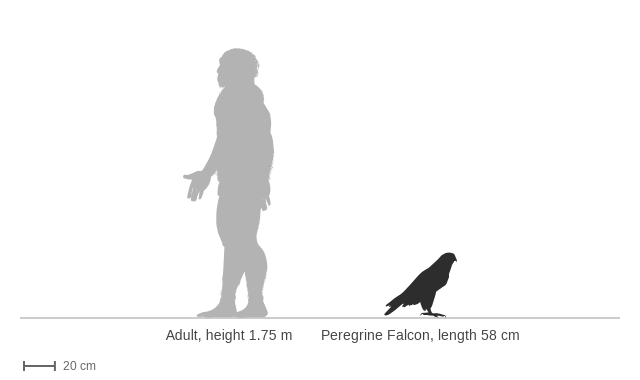
In North America, males are 36–49 cm long and females 45–58 cm. The wingspan is 91–112 cm.[2] Females are about 15–20% longer and 40–50% heavier than males.[3][2] The average weight is 907 g.[2] In the UK, live birds of both sexes averaged 889.3 g.[14]
| Female | Male | |
|---|---|---|
| Weight (average) | 907 g | |
| Length | 45–58 cm | 36–49 cm |
Senses and feathers
The Peregrine is very keen-sighted.[2] From airflow tests and photographs, Ponitz and colleagues suggested that body feathers lifting in small patches of disturbed airflow may act as passive flow control. This is the authors’ suggestion, not a proven function.[4]
Behavior
Territory and pairs
Pairs defend a territory around the nest and are mostly solitary at other times.[2] In dense northern populations, nests were 3.3–5.6 km apart, home ranges covered 177–1,508 km², and birds hunted up to 5 km from the nest.[2] In courtship the pair circle and dive together, and the male passes food to the female in the air, while she rolls onto her back to take it.[7] Peregrines are mostly active around dawn and dusk.[7]
Migration
Peregrines are highly migratory in the temperate and Arctic parts of the range, moving south for the winter, while birds breeding at lower latitudes or in the Southern Hemisphere tend to be resident.[5] The northernmost breeders travel as far as South America.[2] Migrating birds leave their breeding sites between August and November and return between March and May. They readily fly across open sea and mostly travel alone or in pairs.[5] Adult males often stay near their territory through the winter.[2][7]
Flight and the stoop
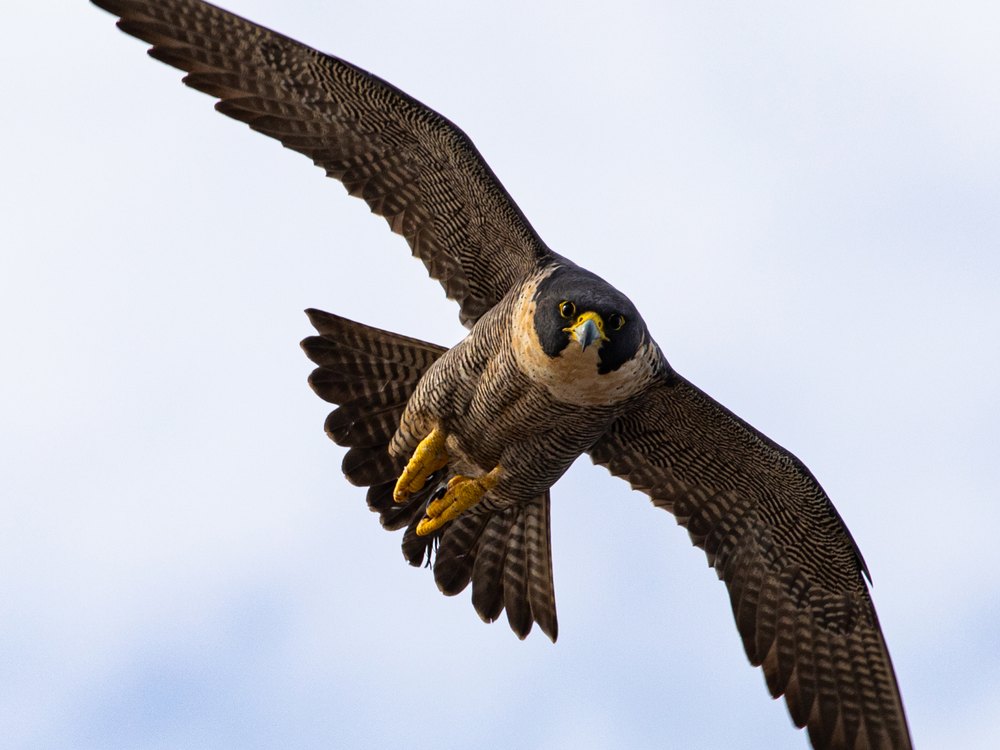
The stoop is a steep dive with the wings folded in, used to strike prey in the air. Its speed is often overstated. A 2014 study says Peregrines reach “more than 320 km/h” in dives, but that line is a statement from earlier literature and was not measured in the study.[4] A 2018 paper notes that no peer-reviewed article measures the peak speed of a falcon’s stoop.[6]
Trained Peregrines filmed with high-speed cameras diving beside a 60 m dam reached 22.5 m/s, about 81 km/h. The authors say the dam’s limited height held the speed down.[4] A computer model gives a terminal speed of about 123 m/s (about 443 km/h) for a falcon diving straight down, but that is a calculation, not a measurement.[6] The fastest dives measured with known accuracy in any animal were by a trained Gyrfalcon, a larger relative of the Peregrine: 52–58 m/s (about 187–209 km/h) in its seven fastest dives.[15] In level flight, the top speed quoted is 27.6 m/s (about 99 km/h).[6] The same model suggests that a high-speed stoop helps catch agile prey only if the falcon’s vision and steering are very precise.[6]

Voice
The alarm and nest-defence call is a harsh “cack”, and individual birds can be recognised from their calls in 72–90% of cases. Young birds beg with a “screea”, and a sharp “kee” is given in quick series as a territorial call while hunting.[2]
Diet
What it eats
Birds make up 77–99% of the Peregrine’s prey, and pigeons and doves are the most important by weight.[2][5] Bats are the commonest mammal prey, followed by voles, squirrels and rats.[2] In North America, about 450 prey species have been identified.[16]

How it hunts
The Peregrine hunts from a high perch or from the air over open ground.[2] In a stoop it strikes with a clenched foot and hits one wing of the prey, which stuns or kills it. It can also catch a bird and kill it with a bite that cuts the neck bones.[2][7] The prey is plucked before it is eaten.[2]
Life cycle
| Stage | Age / time | Notes |
|---|---|---|
| Egg laying | One egg every 48 hours | One clutch a year; a clutch lost early can be replaced about 2 weeks later[2] |
| Clutch | 3–4 eggs | UK average 3.28, range 2–5; 2–6 with an average of 3 in another source[14][2] |
| Incubation | About 30–35 days | UK average 31.1 days, range 29.5–33.5; 33–35 days in another source[14][2] |
| In the nest | About 5–6 weeks | UK average 39.4 days, range 35–44; 35–42 days in another source[14][2] |
| First breeding | Usually from 2 years | Females 1–5 years and males 2–8 years in North America[14][2] |
Nest
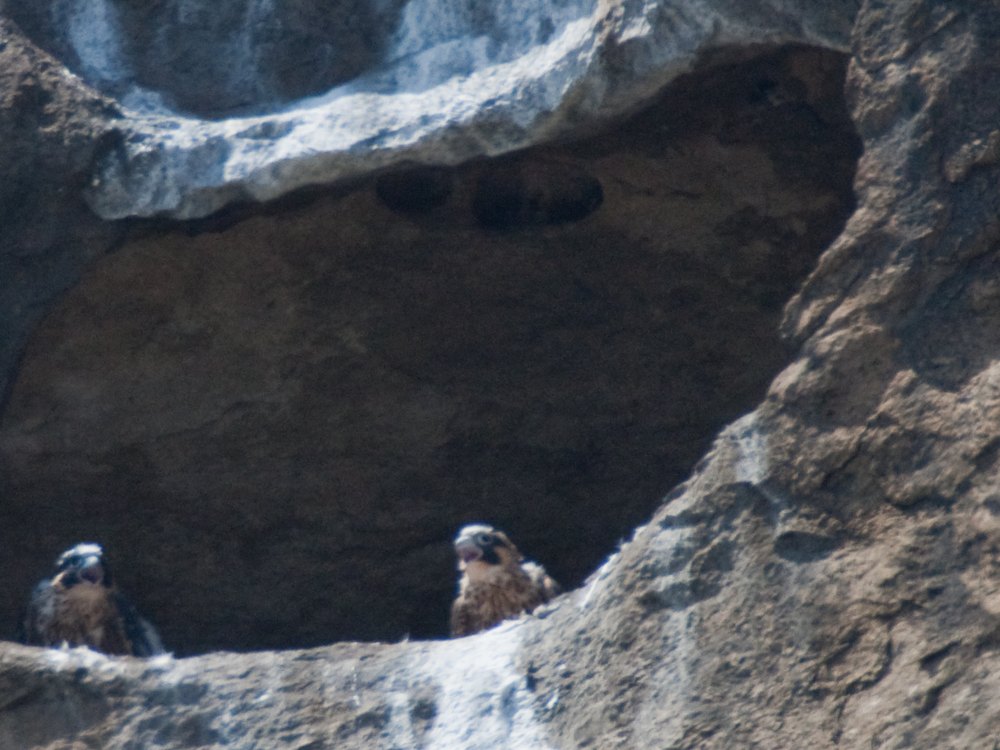
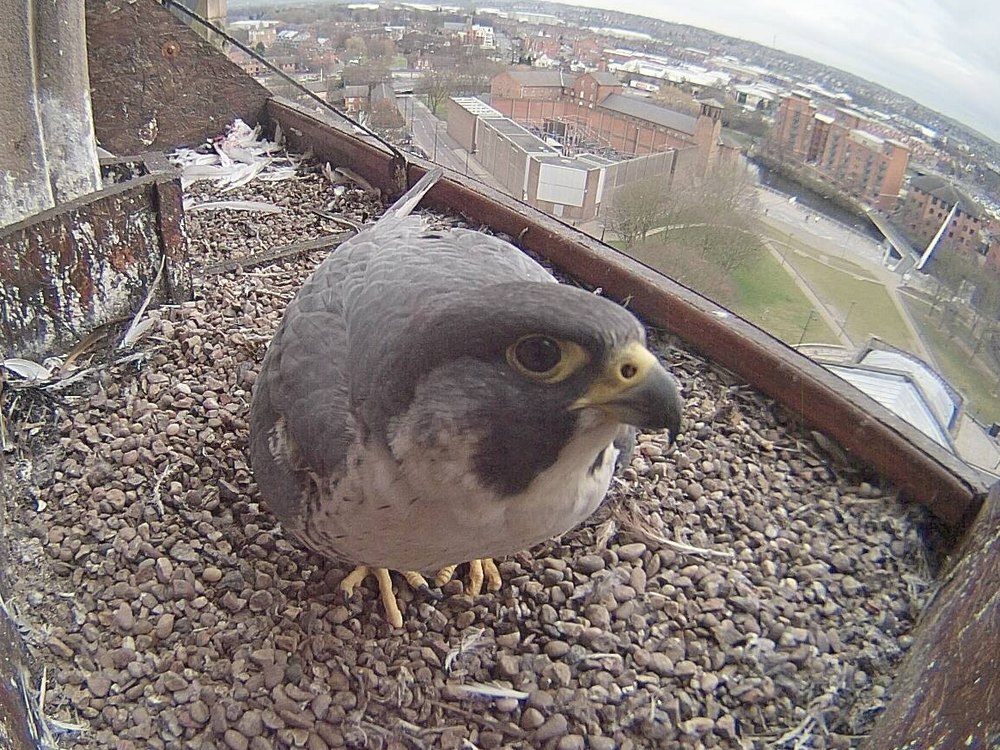
The Peregrine builds no nest. The eggs are laid in a scrape, a shallow dip in a rock ledge or other bare surface.[5] The usual sites are natural cliffs and bluffs. Some pairs use old stick nests of other birds in trees, and more and more pairs nest on buildings and other man-made structures.[1] At Derby Cathedral in England, a young pair first nested on a small wooden ledge in 2006 and raised three chicks, then two in 2007.[17]


Eggs and young
The eggs are white to buff with red or brown markings. The female does most of the incubating, with the male taking over by day.[7] A young falcon in the nest is called an eyas. It is covered in creamy-white down.[7] In North America, each occupied territory fledged on average 1.37 young in the northern population and 1.73 in the southern one. First-year survival was 0.51 in the north and 0.44 in the south, and adult survival was 0.78 and 0.81.[16] Another source gives about 40% survival in the first year and about 70% in adults.[2]
Lifespan
Captive Peregrines have lived up to 25 years.[2] The UK ringing record is 21 years 10 months, set in 2016.[14]
Ecology
Role
The Peregrine is a top predator of birds and can change how its prey behave. Wintering shorebirds in Mauritania changed how they flocked and fed when Peregrines hunted them. In British Columbia, recovering Peregrines were linked to falls in the numbers and body condition of shorebirds.[1]
Predators
Adults are killed by large raptors such as the Great Horned Owl, the Gyrfalcon and the Golden Eagle. Nestlings and fledglings are taken by mammals such as cats, bears, wolverines and foxes, especially from low nests.[2] Predation is not measured for any Canadian population but can be locally important.[3] The United States’ 1999 delisting rule states that owl predation was not documented as a significant cause of the population crash.[18]
Disease
Bird flu (avian influenza H5) is the newest disease threat. In the Netherlands, 28 of 32 dead Peregrines tested in 2023 carried the virus.[19] On the US mid-Atlantic coast, adult survival fell from 0.82 to 0.25 in the two years after the virus arrived, and the share of occupied territories fell by more than half.[20] The authors of a 2025 review say drops in breeding pairs in other regions, such as Sweden, are possibly linked to the flu, but this is not proven.[21]
In wildlife-centre records from Virginia for 1993–2003, West Nile virus was the commonest infectious disease in Peregrines and Bald Eagles.[22] In Kentucky, 21 of 266 nestlings swabbed between 2005 and 2023 carried the parasite Trichomonas, which may hinder nestling survival in some areas, especially cities, where the birds eat many pigeons and doves.[23]
Habitat and range
Cliffs, coasts and mountains
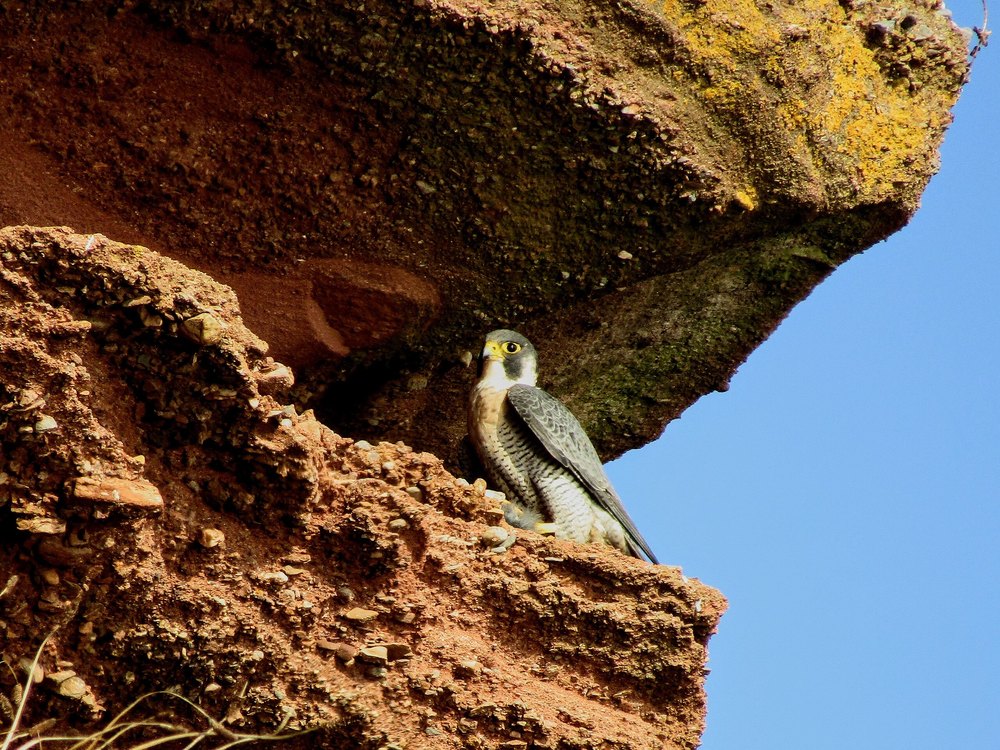
The Peregrine lives in open country and is absent only from rainforest and the cold, dry Arctic. It is commonest on tundra and coasts and rare in subtropical and tropical habitats.[2] The Red List counts rocky areas as the major habitat for breeding, and also lists temperate forest, savanna, desert, tundra, wetlands, rocky and sandy shores, and urban areas as suitable.[5] In Canada, nesting needs cliffs or buildings, open ground to hunt over, and large rivers or lakes nearby. The Peale’s Peregrine nests mainly on island cliffs along the coast and depends heavily on seabirds.[3] It is found from sea level up to 3,300 m in the Red List elevation record, and the same assessment gives about 4,000 m in its text.[5]

Cities
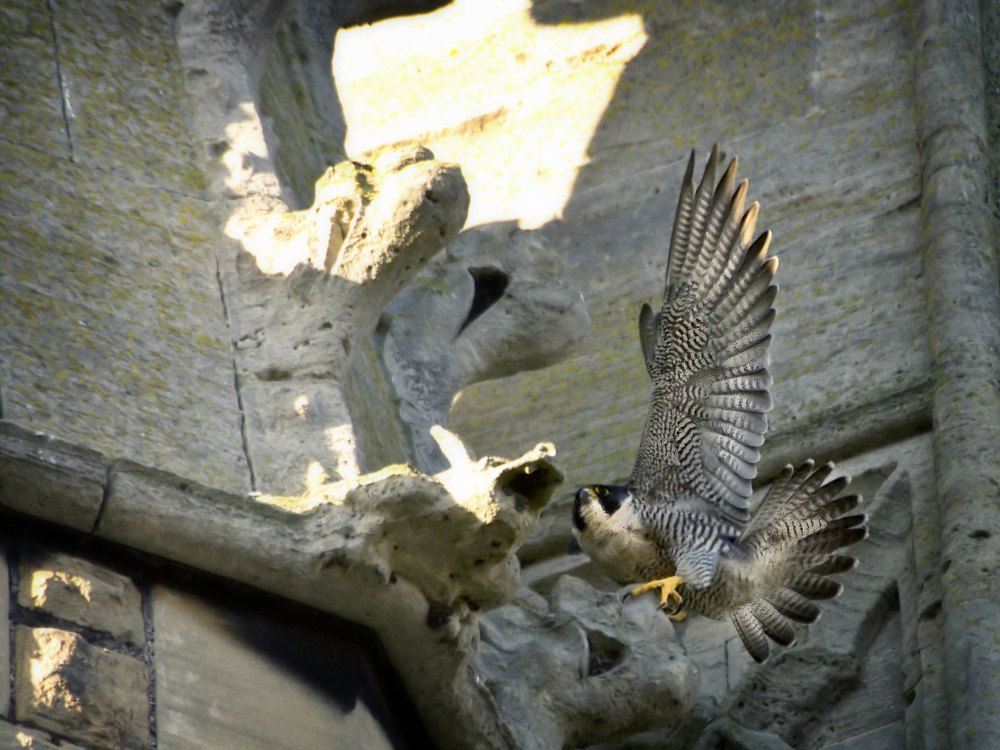
Cities with tall buildings and bridges now host many pairs. In California, urban Peregrines raised more young and had higher juvenile survival than rural ones. In Cape Town, the number of breeding pairs rose from 3 in 1997 to 18 in 2010.[1] Young birds in cities are at risk from collisions with cars, windows and other man-made objects.[5]

Range
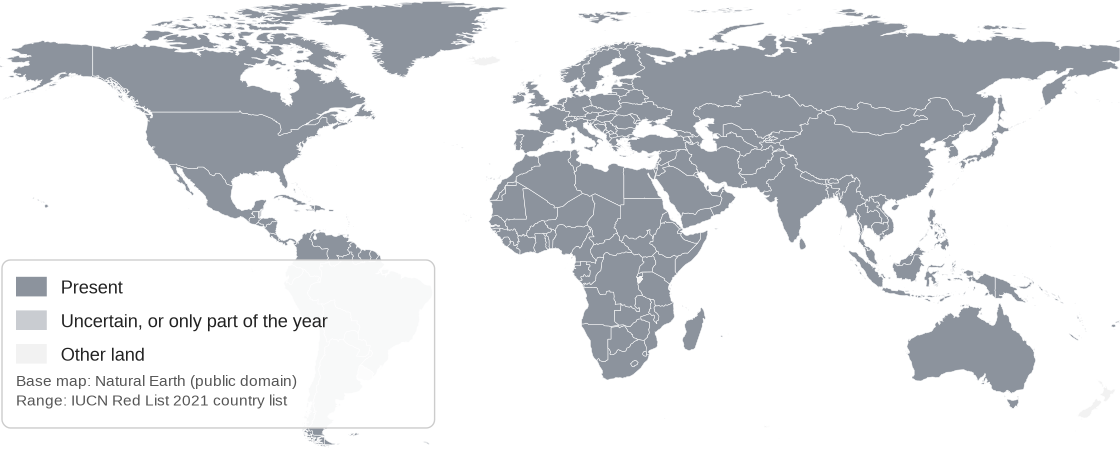
The Peregrine breeds on every continent except Antarctica.[1] The Red List puts its range at about 413 million km².[5] The Red List shows resident birds across most of Europe, Africa, the Middle East, South Asia and the Americas, including Canada, Mexico, India and Brazil, and breeding birds in the United States, Russia, China, Pakistan, the Philippines and Australia. Non-breeding visitors include Belize, Jamaica, Palau and Uruguay, and birds on passage are recorded on Saint Pierre and Miquelon. Rare strays, such as those recorded in Iceland, the Faroe Islands, the Maldives and Mauritius, are not counted in the range.[5] The country list also covers the birds some lists call the Barbary Falcon, as explained under Forms and variants.[5]
Evolution
Place among the birds
Falcons are not close relatives of hawks and eagles. Genome studies place the falcons in a group called Australaves, together with seriemas (long-legged birds of South America), parrots and songbirds. The seriemas branch off first, and the group is a sister to Afroaves, which holds the hawks, eagles, owls and woodpeckers.[24] The IOC World Bird List makes the same point: falcons and caracaras are a separate lineage and order from the hawk order.[25]
Age of the group
A study of 64 species of the falcon family found that its three subfamilies arose at similar times in the Early to Middle Miocene. Splits within the falcon subfamily, Falconinae, began about 16 million years ago, and splits within the genus Falco began about 7.5 million years ago.[26] Falco holds about 60% of all falcon species. A faster rate of new species at the base of the genus lines up roughly with the spread of C4 grasslands around the boundary of the Miocene and Pliocene.[26]
Close relatives
The Prairie Falcon is an outgroup to the branch that holds the Peregrine and the hierofalcons, the group of large falcons that includes the Gyrfalcon and the Saker Falcon. Older studies had put the Prairie Falcon closer to the Peregrine.[27] The Peregrine is a young species: it split from the Taita Falcon within the past million years, and its subspecies share common ancestry within that same time.[28]
Forms and variants
Subspecies
Lists count 18 or 19 subspecies of the Peregrine. The IOC World Bird List, Clements, AviList, Howard and Moore, GBIF and Catalogue of Life count 18. BirdLife International and the Handbook of the Birds of the World count 19, adding submelanogenys, a form that Howard and Moore fold into macropus of Australia.[25][29][30][9] Subspecies are named for differences in plumage colour, size and range.[28]
The Barbary Falcon (pelegrinoides and babylonicus) was long kept as a separate species. The IOC list merged it into the Peregrine in June 2019, saying it is genetically similar to the other Peregrine subspecies. Clements, AviList, BirdLife and the Handbook, Howard and Moore, GBIF and Catalogue of Life also treat it as a Peregrine subspecies, while older lists, such as Sibley and Monroe (1993), keep it separate.[31][29][30][9] The Red List names the Barbary Falcon as a synonym of the Peregrine and says the species was previously split in two.[5]
Genetic studies show weak boundaries. In Alaska, the coastal pealei is genetically distinct from Arctic and forest birds, but tundrius and anatum cannot be told apart.[32] A whole-genome study of all 19 named forms found geographic clustering, with low resolution at the base of the tree and a network-like pattern in the centre.[28]
See all 18 named subspeciesConservation
The Peregrine is listed as Least Concern on the IUCN Red List (version 3.1, assessed on 10 August 2021 and published in 2021 by BirdLife International). The listing rests on a very large range and a population trend that is suspected to be increasing following the ban on DDT. Earlier assessments from 2014 to 2019 were also Least Concern.[5] It is on Appendix I of CITES, which controls international trade, and on Appendix II of the Convention on Migratory Species.[1][33]
Threats
PollutionIllegal killingDisease[5][20]Pesticides. The Red List scores pesticides as affecting the majority of the population, with only negligible declines now.[5]
Persecution and falconry. Persecution, the use of the species in falconry, wind energy, power lines, roads and an oil spill in northern Spain are scored as affecting a minority of the population. The effect of falconry on populations is uncertain.[5] In North Africa, the main threat is illegal trapping of nestlings for falconry.[5] Eggs and young are also stolen from nests in Europe and passed off as captive-bred.[21]
Other pressures. Rock climbing may disturb nest sites, and urban fledglings can be killed by cars and windows. In West Africa, the species may be vulnerable to loss of habitat through wood harvesting, overgrazing and burning.[5]
The DDT crash
After the Second World War, the pesticide DDT and its breakdown product DDE made eggshells thin, and eggs broke. Eggshell thinning began in 1947 and reached 19% or more in the United States.[34] The Peregrine was essentially gone from the eastern United States by the mid-1960s, and by 1965 only 33% of historic nest sites in the Rocky Mountains were still occupied.[18] By 1975, the North American population had fallen to an all-time low of 324 nesting pairs.[35] The Peregrine was listed as endangered in the United States in 1970. DDT was banned in Canada in 1970 and in the United States in 1972.[18] The US Environmental Protection Agency announced final cancellation of remaining crop uses on 14 June 1972, effective 31 December 1972.[36]
Recovery
Captive breeding and releases began in the 1970s. By 1998, nearly 7,000 Peregrines had been released in North America.[5] Many were raised by hacking: young birds are placed in a release box on a tower or cliff and fed until they can fly and hunt, then left free.[37][18] In 1998, the known breeding population was 1,650 pairs in the United States and Canada.[18] The Arctic form tundrius was removed from the US endangered list on 5 October 1994, and the American form anatum on 25 August 1999. The Eurasian form peregrinus stayed listed.[18] The Migratory Bird Treaty Act still protects the bird.[18] Limited falconry take of wild first-year birds resumed in the western United States in 2001 and the eastern United States in 2008, and use has averaged under half of the 309 birds allowed.[16] In Canada, anatum and tundrius were reassessed as Not at Risk in 2017, while pealei stayed Special Concern.[3]
In central and eastern Europe, the tree-nesting population fell from about 4,000 pairs to none. Restoration work in Germany and Poland has returned it to about 20 pairs.[5] CITES records show an average of 1,551 live Peregrines exported a year from 51 countries in 2015–2024, and 96% were captive-bred.[1]
Numbers today
The Red List puts the world population in the band of 100,000–499,999 mature individuals. This comes from a very preliminary estimate of 248,000–478,000, scaled up from Europe, which holds about 13% of the range.[5] The inputs are about 72,000 individuals in the USA and Canada, 2,290–2,900 pairs in North Africa, and 16,100–31,100 pairs in Europe, equal to 32,200–62,100 mature individuals. Overall the population is increasing, but it is stable in the Arctic and in North Africa.[5]
The UK had 1,769 breeding pairs in 2014, 22% more than in 2002.[38] In the United States, a population model gives 94,366 birds in 2020 in the northern population (range 69,991–122,299), including first-year birds, up from 70,880 in 2000, and 9,583 birds in the southern population in 2019, up from 5,788 in 2009.[16] In Canada, the pealei subspecies has 250–1,000 mature individuals, and anatum and tundrius together have 36,000–40,000.[3]
Conservation actions
The Red List records a systematic monitoring scheme, conservation sites identified over the whole range, at least one protected area, successful reintroductions and captive breeding, but no recovery plan. It calls for protection of nesting habitats, monitoring of population trends and breeding success, and a sustainable level of falconry take.[5]
History and culture
Falconry
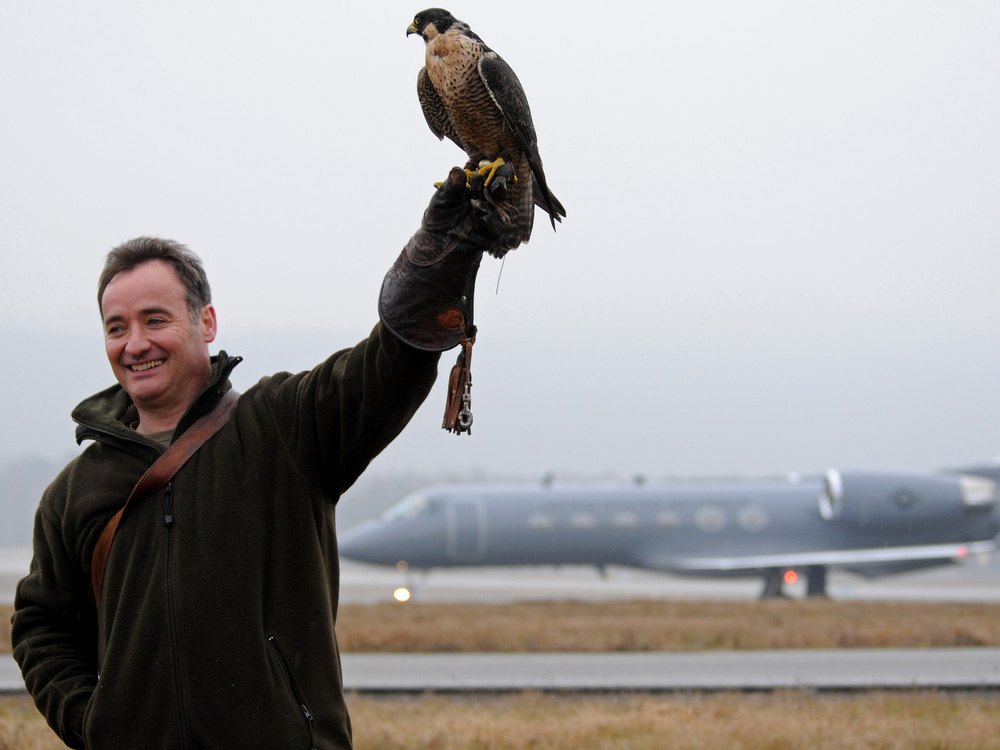
Falconry is the traditional art of training falcons and other birds of prey to hunt. UNESCO lists it as a living human heritage practised for over 4,000 years, first for food and later for sport and contact with nature.[39] It was added to the Representative List of the Intangible Cultural Heritage of Humanity in 2010 on the nomination of 11 states.[40] The listing was extended in 2012, 2016 and 2021, and now covers 24 states.[41][39] The listing covers falconry as a whole, not the Peregrine alone. Hacking, the release technique used in the recovery programmes, has been used by falconers since medieval times.[37]

War and pesticides in Britain
In the Second World War, the British government ordered the destruction of Peregrines to protect carrier pigeons. The National Archives hold the file on the National Pigeon Service order of 1941.[42] The result was a virtual extermination of the breeding birds in the southern counties of England, less so further north, and the large population in the Republic of Ireland was not affected.[43]
A survey in 1961–62 found that the breeding population of 1930–39 had averaged about 650 pairs. About 60% of the territories checked were occupied in 1961 and about 50% in 1962, and breeding success was 19% in 1961 and 13% in 1962. In southern England, 69% of pre-war territories were deserted by 1961 and 92% by 1962. Of the explanations weighed, secondary poisoning from farm chemicals fitted best.[43]
Peregrines in cities
In 1978, workers at a Baltimore office tower noticed a young female Peregrine on a ledge on the 33rd floor. A wild male arrived in 1983, and the pair raised four young the next year, the first wild Peregrine births in an eastern US city in about 30 years.[44] Derby Cathedral in England has had breeding Peregrines since 2006 and runs webcams and viewing events in late May to early July.[17]
The recovery programme
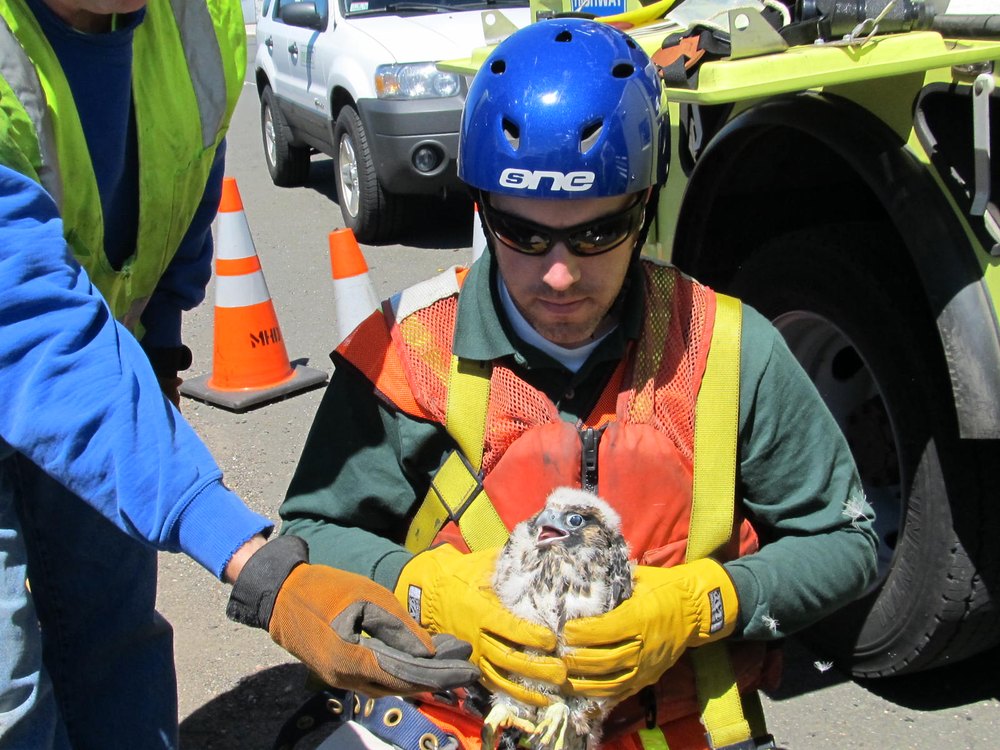
Tom Cade founded The Peregrine Fund, launched in 1970, and used hack towers and a gentle “soft release” of young birds. In 1980, three captive-bred pairs nested in the wild and raised six young, the first natural nesting east of the Mississippi in over 20 years.[37]


Taxonomy
| Rank | Name |
|---|---|
| Kingdom | Animalia |
| Phylum | Chordata |
| Subphylum | Vertebrata |
| Superclass | Tetrapoda[45] |
| Class | Aves (birds) |
| Order | Falconiformes |
| Family | Falconidae (falcons and caracaras)[25] |
| Subfamily | Falconinae[45] |
| Genus | Falco Linnaeus, 1758[8] |
| Species | Falco peregrinus (Tunstall, 1771)[30][9][25] |
Higher classification
The Peregrine belongs to the family Falconidae, the falcons and caracaras and the genus Falco.[26] GBIF, the Catalogue of Life and the IOC list place the family in the order Falconiformes.[9][25][30]
Falcons and the hawk order
Older lists put the falcons in one order with the hawks, eagles and vultures. In the genome study by Jarvis and colleagues the eagles and New World vultures were taken out of Falconiformes, and the name now covers the falcons only.[24] The IOC list, Clements, AviList, GBIF and the Catalogue of Life use the name in this narrower way.[9][25][29][30] The IUCN Red List follows the 2014 Handbook of the Birds of the World and BirdLife checklist.[5]
Sources
- CITES CoP20 Proposal 17 (Canada and the United States), 2025
- Animal Diversity Web, Falco peregrinus
- COSEWIC 2017, assessment of the Peregrine Falcon in Canada
- Ponitz et al. 2014, PLOS ONE 9(2): e86506
- BirdLife International 2021, IUCN Red List assessment of Falco peregrinus
- Mills et al. 2018, PLOS Computational Biology
- Wikipedia, Peregrine falcon
- Jobling, The Key to Scientific Names, Birds of the World (entries Falco and peregrinus)
- Catalogue of Life, release 2026-10-14 (COL26.10), Falco peregrinus
- Tunstall 1771, Ornithologia Britannica, Internet Archive
- International Commission on Zoological Nomenclature, Opinion 882 (1969)
- International Commission on Zoological Nomenclature, Direction 38 (1956)
- GBIF vernacular names for Falco peregrinus
- British Trust for Ornithology, BirdFacts: Peregrine
- Tucker et al. 1998, Journal of Experimental Biology 201: 2061–2070
- US Fish and Wildlife Service 2023, Peregrine Falcon status assessment, sustainable take rate and take limits
- Derby Cathedral, the Peregrines
- US Fish and Wildlife Service, final rule, Federal Register 64 FR 46542, 25 August 1999
- Caliendo et al. 2024, Viruses
- Watts et al. 2026, Scientific Reports
- Saggese et al. 2025, Animal Conservation
- Harris & Sleeman 2007, Journal of Zoo and Wildlife Medicine
- Slankard et al. 2026, Journal of Wildlife Diseases
- Jarvis et al. 2014, Science 346: 1320–1331
- IOC World Bird List 15.2 (Gill, Donsker & Rasmussen 2026)
- Fuchs, Johnson & Mindell 2015, Molecular Phylogenetics and Evolution 82: 166–182
- Doyle et al. 2018, BMC Genomics 19: 233
- Johnson et al. 2023, Ecology and Evolution
- IOC 15.2 compared with other lists (AviList, Clements, BirdLife/HBW, Howard and Moore and others)
- GBIF backbone, Falco peregrinus
- IOC World Bird List, updates and proposed splits
- Talbot et al. 2017, PLOS ONE
- Convention on Migratory Species, Raptors MOU species page
- Hickey & Anderson 1968, Science 162: 271–273
- US Fish and Wildlife Service press release, August 1999
- US Environmental Protection Agency, DDT: a regulatory history
- Audubon, Remembering Tom Cade
- Wilson et al. 2018, Bird Study, 2014 UK Peregrine survey
- UNESCO, Falconry, a living human heritage
- UNESCO, decision 5.COM 6.45 (2010)
- UNESCO, decision 16.COM 8.B.14 (2021)
- The National Archives (UK), TS 28/466, National Pigeon Service: Destruction of Peregrine Falcons (No 2) Order 1941
- British Trust for Ornithology, summary of the 1961–62 Peregrine survey
- Audubon 2015, A Highrise for Peregrines
- ITIS, Falco peregrinus, classification