Falco peregrinus cassini is the Peregrine of western South America, from Colombia to Tierra del Fuego, and of the Falkland Islands.[1]
Names and classification
Sharpe named it in 1873.[1] IOC World Bird List 15.2 counts 18 subspecies of the Peregrine Falcon. GBIF and Catalogue of Life list the same 18 names.[1][2][3] A 2025 conservation letter calls it the Austral Peregrine Falcon, and the Clements checklist lists it as Peregrine Falcon (South American).[4][5] The pale colour form known as the pallid falcon belongs to this subspecies.[4][6]
Range
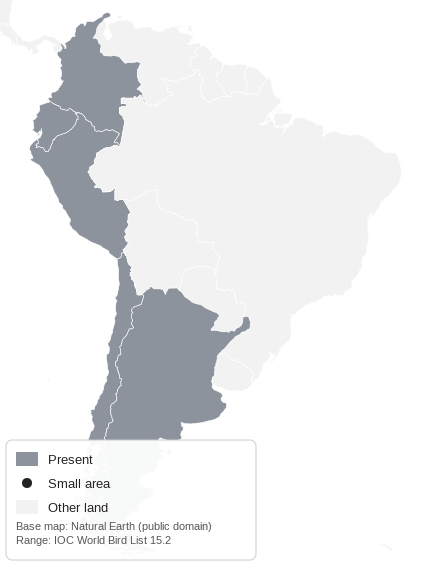
The IOC gives its range as western South America, from Colombia to Tierra del Fuego, and the Falkland Islands.[1] In a genome study of birds from Chile and the Falkland Islands, the Chilean birds had the highest inbreeding and the lowest genetic variety of any mainland population sampled, and the authors conclude that both groups have stayed small for many generations.[7]
Status
A 2025 letter in Animal Conservation lists it among the subspecies whose range and numbers are poorly known.[4] It warns that nest robbing is a concern for the pale form in southern Argentina and Chile, and that the effect of bird flu, which spread through South America after 2022, is unknown.[4]
Sources
- IOC World Bird List 15.2 (Gill, Donsker & Rasmussen 2026)
- GBIF backbone, Falco peregrinus
- Catalogue of Life, release 2026-10-14 (COL26.10), Falco peregrinus
- Saggese et al. 2025, Animal Conservation
- GBIF vernacular names for Falco peregrinus cassini
- Wikipedia, Peregrine falcon
- Johnson et al. 2023, Ecology and Evolution