Falco peregrinus tundrius is the Arctic Peregrine, the Peregrine of the far north, which breeds from Alaska to Greenland.[1][2]
Names and classification
White named it in 1968.[1] The IOC World Bird List counts 18 subspecies of the Peregrine Falcon. GBIF and Catalogue of Life list the same 18 names.[1][3][4] The US Fish and Wildlife Service calls it the Arctic peregrine falcon.[2] In Alaska, a genetic study could not tell tundrius apart from anatum.[5]
Range
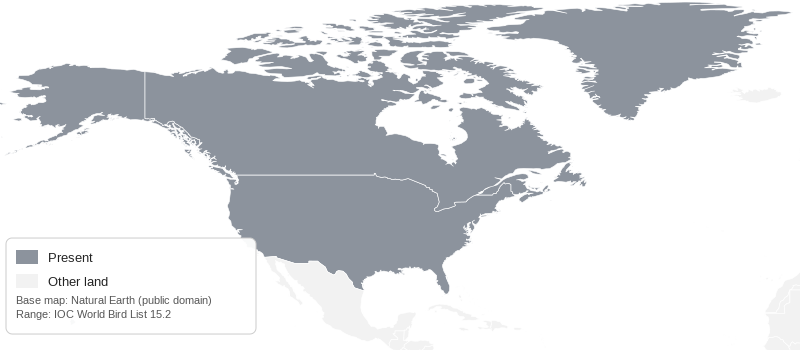
The IOC gives its breeding range as Alaska to Greenland.[1] Peregrines of the far north migrate long distances, to South America.[6]
Status
The Arctic and American peregrines were listed as endangered in the United States in 1970, and the Arctic form was taken off the list on 5 October 1994.[2] In Canada, the 2017 assessment treated tundrius and anatum together as Not at Risk, with an estimated 36,000 to 40,000 mature individuals.[7]
Sources
- IOC World Bird List 15.2 (Gill, Donsker & Rasmussen 2026)
- US Fish and Wildlife Service, final rule, Federal Register 64 FR 46542, 25 August 1999
- GBIF backbone, Falco peregrinus
- Catalogue of Life, release 2026-10-14 (COL26.10), Falco peregrinus
- Talbot et al. 2017, PLOS ONE
- Animal Diversity Web, Falco peregrinus
- COSEWIC 2017, assessment of the Peregrine Falcon in Canada