The Southern Sea Otter (Enhydra lutris nereis) is the Sea Otter of California. It lives on the central coast and at San Nicolas Island.[1][2] It has been listed as threatened under the United States Endangered Species Act since 1977.[1][3]
Names and classification
The name nereis dates from C. H. Merriam, 1904, and is now used for a subspecies.[4] The Mammal Diversity Database, ITIS and GBIF all list three subspecies of the Sea Otter.[4][5][6] The IUCN Red List text names the same three, first described by Wilson and colleagues in 1991 and confirmed by Cronin and colleagues in 1996.[7] It is usually called the southern Sea Otter.[8]
Description
The U.S. Fish and Wildlife Service gives average adult weights of 46 pounds (about 21 kg) for females and 64 pounds (about 29 kg) for males.[8] In a study of 761 stranded animals measured over 34 years, adult males were 118.3 to 138.0 cm long and adult females 105.0 to 128.0 cm. The paper does not say whether the tail is counted.[9] Northern Sea Otters reach larger adult sizes than southern ones.[10]
Range
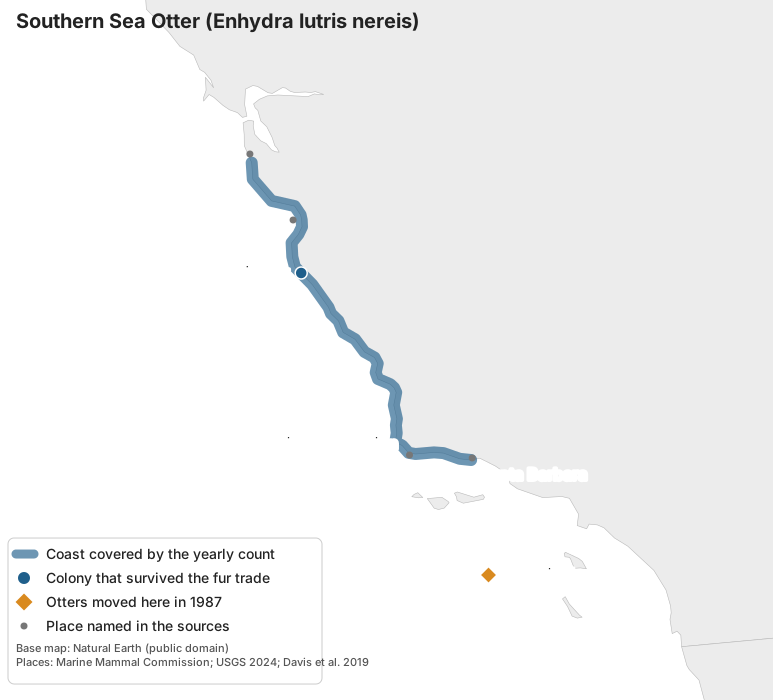
The Southern Sea Otter lives on the central California coast, from Monterey Bay to Point Conception.[1] The yearly count covers the coast from Half Moon Bay south to Santa Barbara, and San Nicolas Island.[2] Today’s range is about 13% of the historical one, which ran from Oregon to Baja California.[1]
The count is a three-year running average of the annual counts, called the population index. It was 3,272 in 2016, 3,186 in 2017 and 2,962 in 2019.[1] A census was carried out in 2024, and a new statistical model to allow for animals that are missed was being developed; the USGS page of September 2024 gave no totals.[2] About 146 otters lived at San Nicolas Island in 2023.[1] A 2021 model projected that California could eventually support 17,226 otters (95% credible interval 9,739 to 30,087).[11]
Classification evidence
The three subspecies were described from skull measurements and mitochondrial DNA.[12] A 2023 study read about 50 million bases of DNA in 107 Sea Otters from five populations, plus three historical samples from California. It found five broad geographic groups: the Kuril Islands, the Commander Islands, the western Aleutians, south-central Alaska and California. Otters from Baja California fell in the California group.[13]
The authors call the California otters the last survivors of a divergent lineage that was isolated for thousands of years. They date the split between California and Alaska to about 4,000 generations ago (about 28,000 years), with little gene flow since. They suggest it may relate to the Last Glacial Maximum, about 20,000 to 27,000 years ago, but they cannot rule out isolation by distance.[13] The study does not propose changing the subspecies or the management units; it says that defining management units remains a challenge.[13]
Genetic variety is low. The genomes of a southern and a northern Sea Otter each have 0.0003 heterozygous sites per base, half the figure for the Giant Otter.[14] Samples from before the fur trade, from California to Russia, held twice the genetic diversity of modern populations, and the historical population structure was kept.[15]
History
Before the fur trade the Sea Otter lived around the North Pacific from Hokkaido, Japan, to Baja California.[7] When the 1911 fur seal treaty protected the species, fewer than 2,000 animals are thought to have remained in 13 remnant colonies. They included one in central California; another, off Mexico’s San Benito Islands, has presumably died out.[7][1] About 50 otters were in the California colony.[1] In 1977 the Fish and Wildlife Service said that the range had shrunk by 90 percent and that fewer than 2,000 otters, possibly as few as 1,000, remained.[3] In 1987, 139 otters were moved from the mainland to San Nicolas Island.[16]
Status
The Southern Sea Otter was listed as threatened under the Endangered Species Act in 1977, and it is classed as depleted under the Marine Mammal Protection Act.[1] The 1977 rule named the shrinking of the range, the small numbers and the risk from oil spills.[3] The recovery plan sets a delisting benchmark of a three-year average above 3,090. The index first passed 3,090 in 2016 but not for three years in a row, and it fell to 2,962 in 2019.[1][2] The Fish and Wildlife Service kept the threatened status in 2023, after a petition to delist it in 2021.[1]
In necropsies of 560 southern Sea Otters from 1998 to 2012, death from a white shark bite rose sharply and was the most common primary cause of death. Infectious disease was a primary or contributing cause in 63% of the otters examined.[17] The IUCN assessment covers the whole species, which it lists as Endangered (A2abe), not this subspecies alone.[7]
Sources
- Marine Mammal Commission, southern sea otter
- USGS Western Ecological Research Center, “2024 southern sea otter census and statistical model development”
- U.S. Fish and Wildlife Service, news release, 10 January 1977 (southern sea otter listed as threatened)
- Mammal Diversity Database, version 2.5 (2026), Enhydra lutris
- ITIS, Enhydra lutris (TSN 180547)
- GBIF backbone, Enhydra lutris
- IUCN Red List, Enhydra lutris (Doroff, Burdin & Larson 2021), taxonomy notes and geographic range
- U.S. Fish and Wildlife Service, southern sea otter species page
- Nicholson et al. 2020, Ecology and Evolution 10: 8592–8609 (southern sea otter measurements)
- Griffen et al. 2024, Conservation Physiology 12: coae067 (review of sea otter bioenergetics data)
- Tinker et al. 2021, Journal of Wildlife Management (carrying capacity of California)
- COSEWIC 2007, status report on the Sea Otter, chapter 5 (species information)
- Beichman et al. 2023, Molecular Ecology 32: 281–298 (genomes of five sea otter populations)
- Beichman et al. 2019, Molecular Biology and Evolution 36: 2631–2655 (sea otter and giant otter genomes)
- Larson et al. 2012, PLoS ONE 7: e32205 (genetic diversity before the fur trade)
- Davis et al. 2019, Frontiers in Marine Science 5: 510 (future directions in sea otter research)
- Miller et al. 2020, Frontiers in Marine Science 7: 582 (deaths of southern sea otters, 1998–2012)