The snow leopard (Panthera uncia) is a pale grey, spotted big cat of the high mountains of Central Asia. It lives alone, hunts mainly at dawn and dusk, and has a very long tail.[1][2] It is found in 12 countries, from Afghanistan to Mongolia and Russia, and the IUCN rates it Vulnerable, with an estimated 2,500 to 10,000 mature individuals.[3]
Quick facts
Description
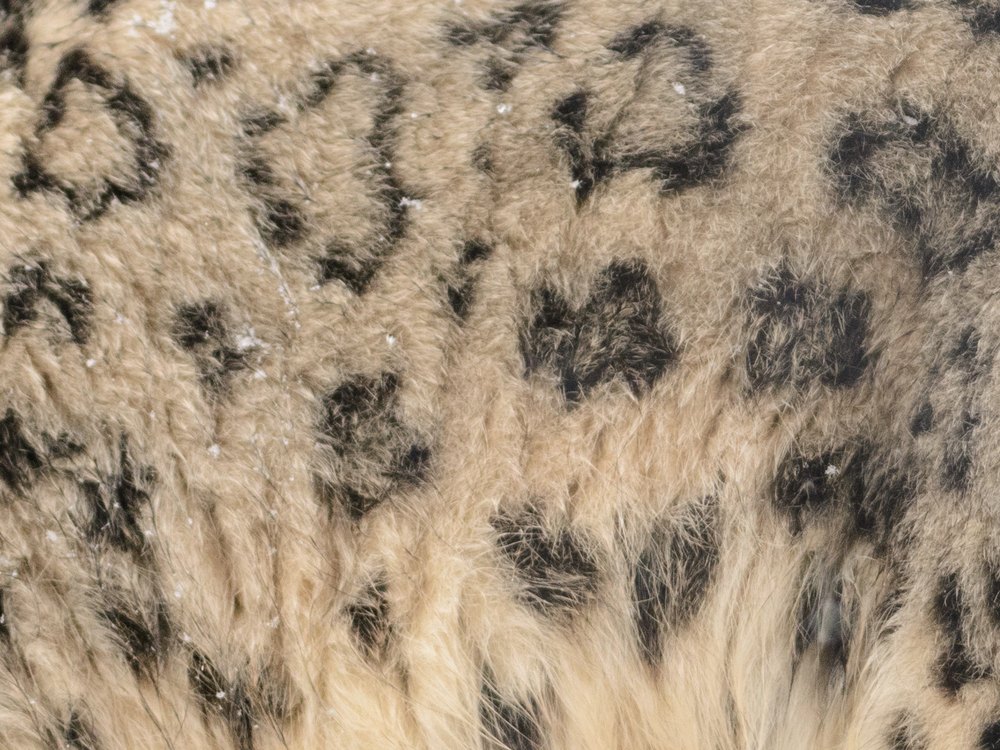
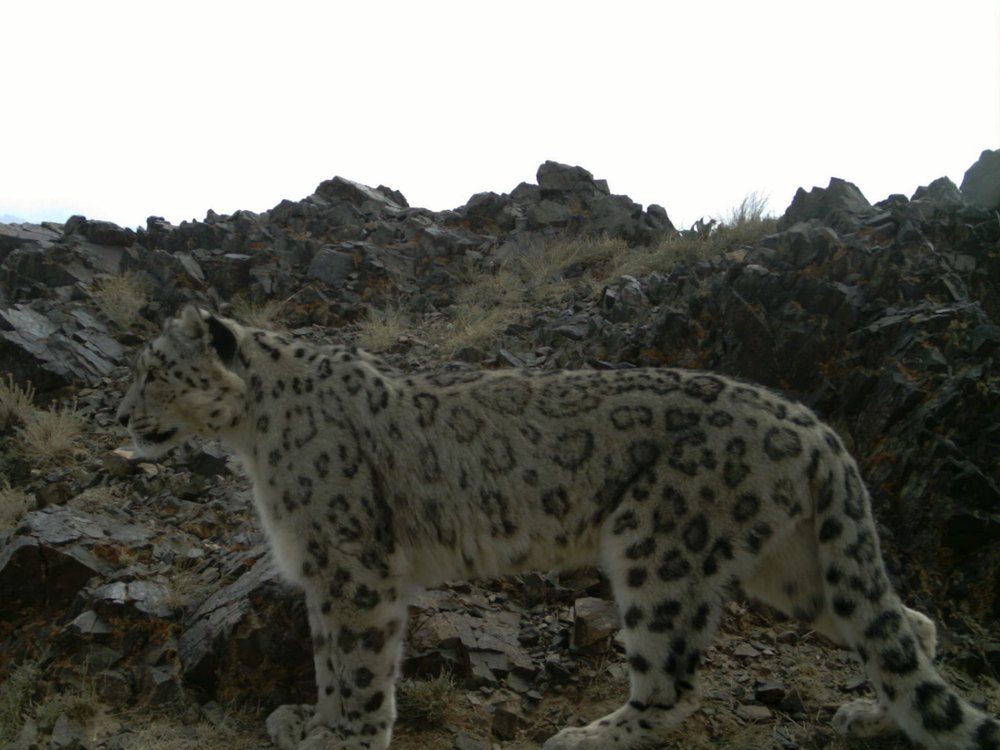
The snow leopard’s fur is white-grey or grey-brown, patterned with dark grey or black spots and rosettes that have pale centres.[1] The head, neck and limbs are marked with smaller black spots, and two dark lines run from the neck to the tail.[1]
The tail is bushy and exceptionally long.[1] The ears are short and rounded, set wide apart, with black backs and a pale centre.[1] The eyes are light green or grey.[1]

Name
The English name is “snow leopard”, and an older English name, “ounce”, is still listed beside it.[3][5] The scientific name Panthera uncia began as Felis uncia. For the authority and the change of genus, see Taxonomy.[6][7][8]
In other languages
| Language | Name | Meaning |
|---|---|---|
| French | Léopard des neiges, panthère des neiges, once | leopard (or panther) of the snows |
| Spanish | Pantera de las nieves | panther of the snows |
| German | Schneeleopard | snow leopard |
| Russian | Irbis | – |
| Kazakh | Irbis | – |
| Kyrgyz | Ilbirs, Akilbirs | – |
| Mongolian | Irvis | – |
| Tibetan | Sah | – |
| Chinese | Xue bao | snow leopard |
| Tajik | Babri barfi | – |
| Urdu | Barfani chita | – |
| Nepali | Hiun chituwa | snow leopard |
The names come from the list of common names in the IUCN Red List assessment.[3]
Body
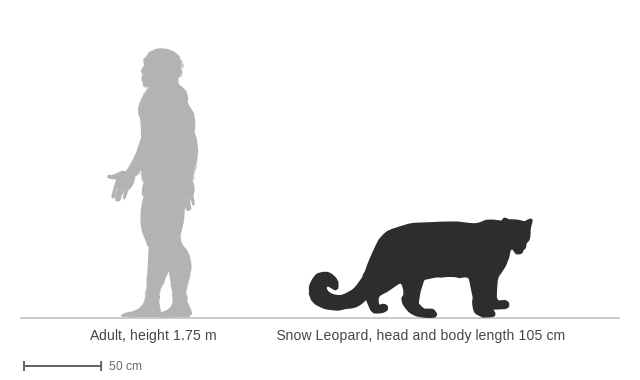
A study of 55 free-ranging snow leopards caught in five mountain ranges (Altai, Hindu Kush, Himalaya, Pamir and Tien Shan) found that wild adult females weighed about 36 kg on average and adult males about 42 kg. Adult males were on average about 5% longer and about 15% heavier than adult females, and the cats were similar in size across the ranges.[9] Other references give wider ranges: 30–50 kg,[1] and an adult average of 35–45 kg with males slightly larger.[2]
The head and body measure 90–120 cm and the tail 80–100 cm, which is 75–90% of the body length.[1] Another reference gives 100–130 cm for the head and body and the same 80–100 cm for the tail.[2]
Size ranges
| Female | Male | |
|---|---|---|
| Weight | about 36 kg | about 42 kg |
| Length (head and body) | 90–120 cm | |
Paws and tail
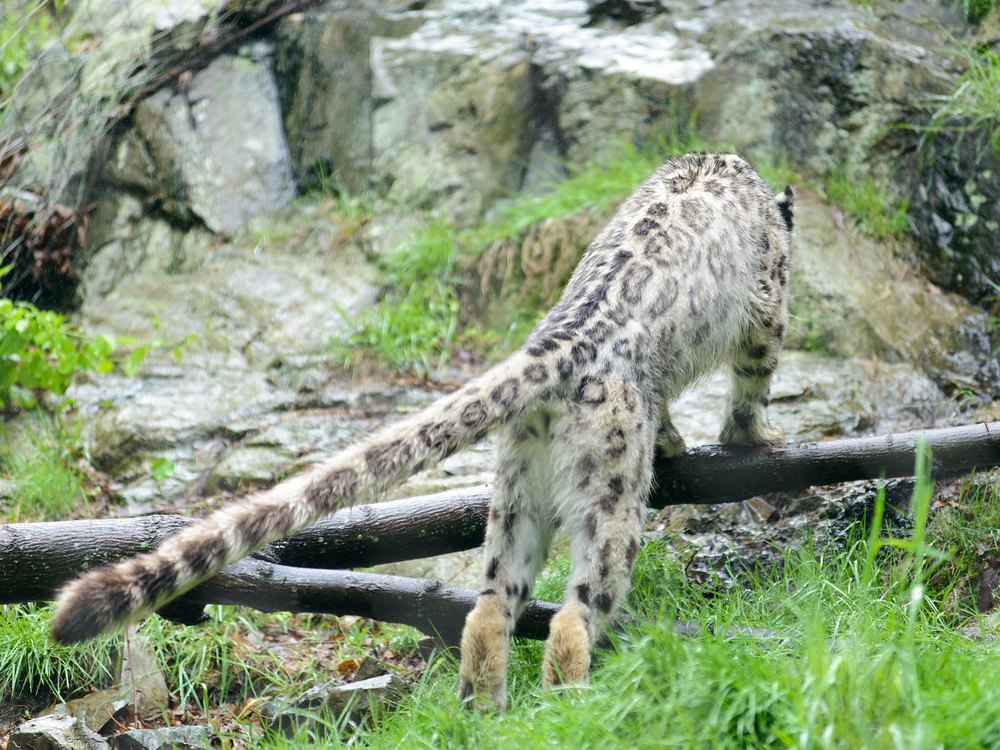
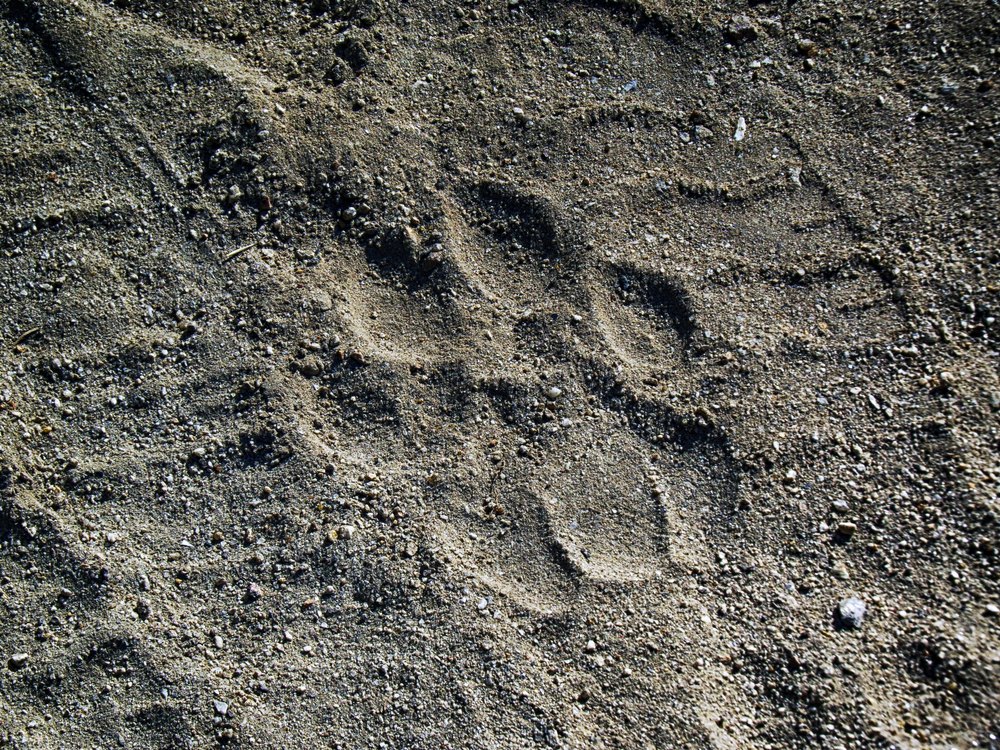
The paws are extremely large for a cat, which helps on snow. The front footpads are 9–10 cm long and 7–8 cm wide.[2] The long tail is used for balance on steep, rocky ground and can be wrapped around the body in the cold.[2]

Fur
The coat is long and thick and is moulted twice a year. The winter fur on the belly grows up to 12 cm long.[2]
Senses and voice
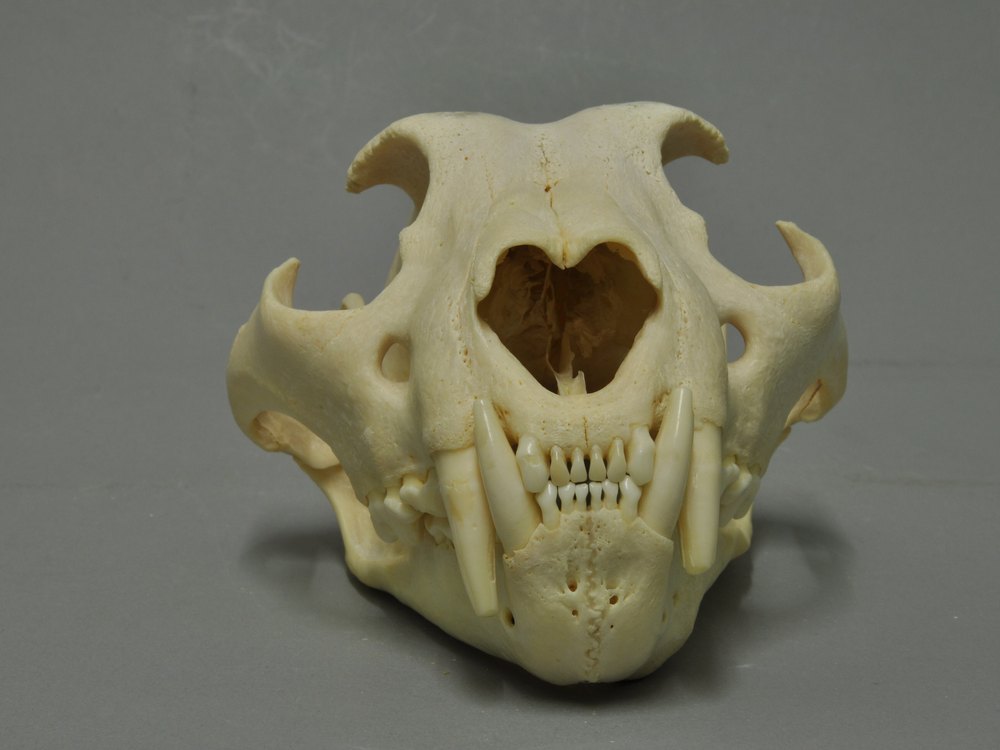
The snow leopard has much larger nasal cavities than its close relatives among the cats.[2]
It does not roar. An anatomical study of the big cats found that the snow leopard’s vocal folds have an intermediate shape.[10] For its calls, see Behavior.

Behavior
The snow leopard lives and hunts alone.[2][1]
Home range
Home ranges vary a great deal between places and between studies. In western Nepal, five radio-collared animals used 12–39 km², and one animal followed by satellite collar used more than 400 km². In Mongolia, early radio-tracking gave ranges of 13–141 km², while GPS collars from 2008 to 2014 gave about 100 to more than 1,000 km².[3] In the Mongolian Altai, five GPS-collared snow leopards at four sites (2013 to 2019) had ranges of 26–395 km² between sites, measured as a minimum convex polygon (the smallest area that holds all the tracking points). The monthly ranges of males were larger than those of females. Female ranges shrank in summer, while male ranges stayed about the same.[11]
Marking and communication
Snow leopards mark their ground with scrapes, sprayed urine, rubbing of the head and raking with the claws.[2] A seven-year camera-trap study in Baltistan, Pakistan (2015 to 2022, 32 cameras), recorded 103 events of nine kinds of communication. The 2024 preprint reports scraping and urine marking mostly in snow-free areas, urine spraying or sniffing in snow, and marks linked to cliffs and boulders.[12]
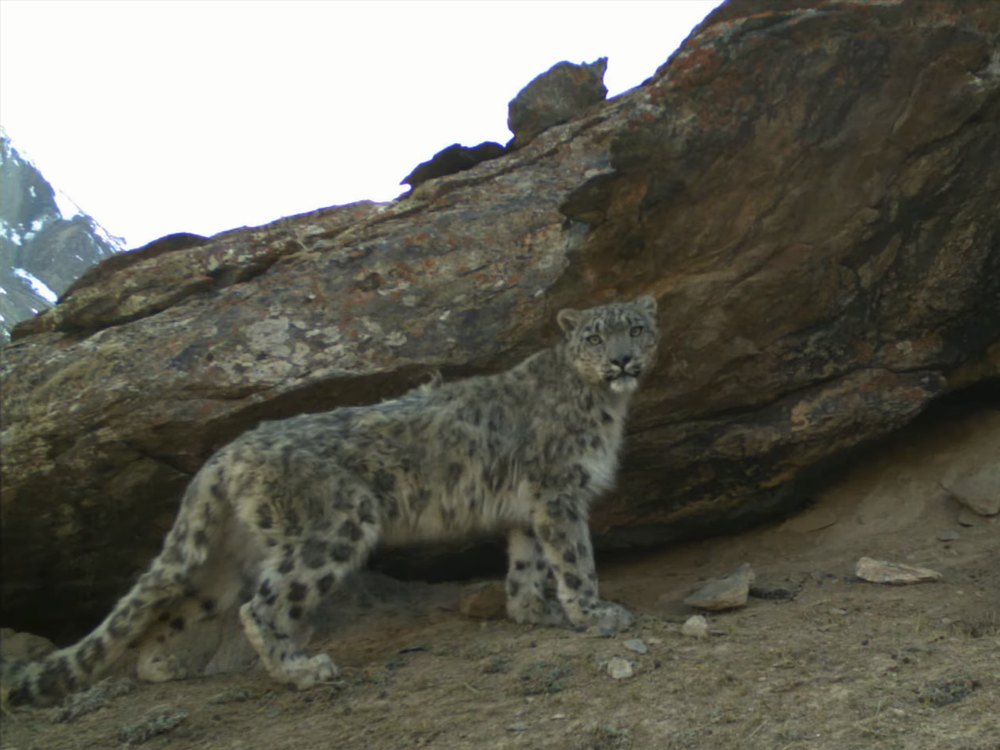

It makes a high-pitched yowl, most often when females are in heat, and a soft, non-aggressive “chuff” through the nostrils as a greeting.[2][1]

Movement and activity
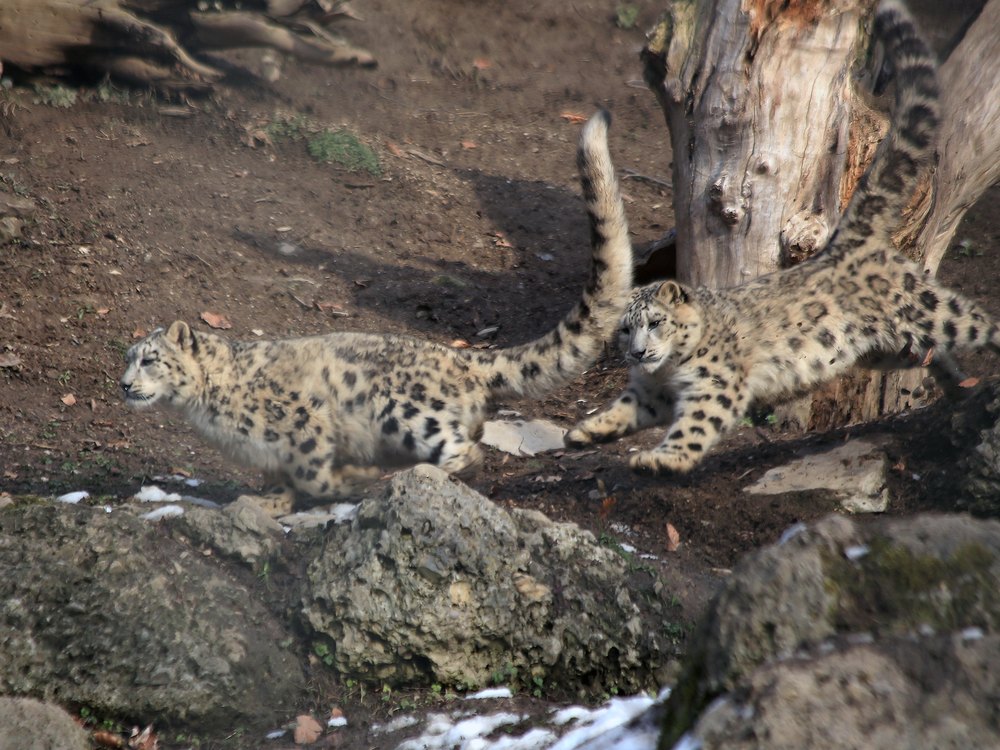
The snow leopard is mainly active at dawn and dusk.[2][1] A study with GPS collars on snow leopards in Mongolia (2009 to 2020) found that they are sometimes active at night. Their activity changed with the seasons, and their prey was mostly active by day.[13] Steep, broken ground is their usual terrain; see Habitat and range.[3]

Diet
The snow leopard is a carnivore. Wild caprids, the wild sheep and goats of the mountains, make up 45–98% of its diet in the studies reviewed by the IUCN, and small prey such as marmots, pikas, hares, rodents and birds make up 2–8% in studies that checked the scats by DNA.[3]
Prey
A review of 1,696 scats from 25 studies named the Siberian ibex, blue sheep, Himalayan tahr, argali and marmots as the main prey. Preferred prey weighs 36–76 kg.[14] The diet changes with the season. In the Lapchi Valley of Nepal, a study from November 2021 to March 2023 found 11 prey species in the scats, with the mix shifting between seasons.[15] The snow leopard can kill animals three to four times its own weight.[2]
Hunting and feeding
In the Tost Mountains of Mongolia, 19 snow leopards followed by GPS collar killed one large hoofed animal about every 8 days on average, and 73% of the kills were wild prey. Males took larger prey than females or young males, and killed 2–6 times more livestock than they did.[4]

Life cycle
| Stage | Age / time | Notes |
|---|---|---|
| Newborn | Birth in May and June | A newborn weighs about 300–600 g; the eyes open at about 7 days[2][16] |
| Cub | Solid food from 2 months | Weaned at about 5 months and independent at about 18–26 months[2][1][16][3] |
| Young adult | Females 2–3 years, males 3–4 years | Age at which the animal can breed[2][16] |
| Adult | Breeding age reached | About 36 kg (female) and 42 kg (male) in the wild; up to 22 years in captivity[9][16] |
Mating and birth
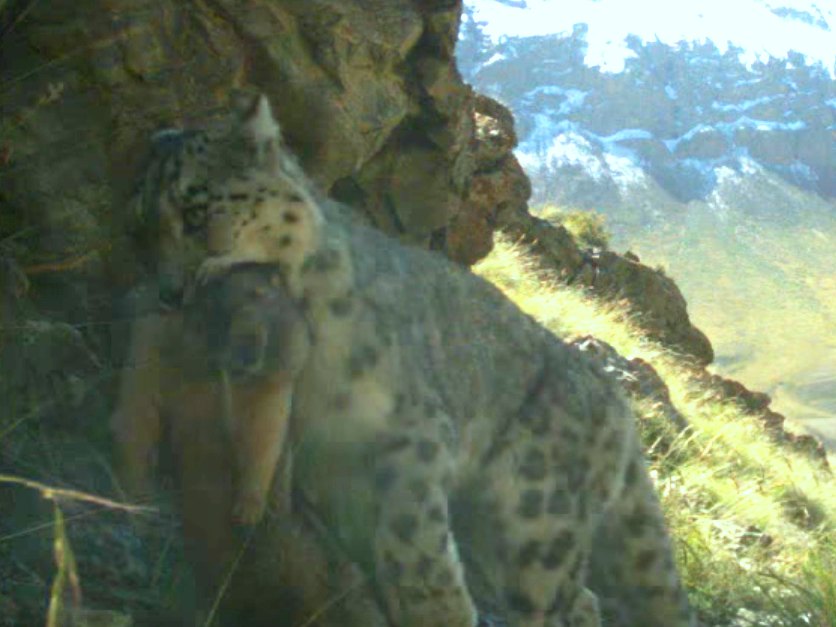
The snow leopard breeds once a year. Mating runs from January to March, and most cubs are born in May and June.[1][3] Pregnancy lasts about 90–110 days.[1][2][16] A litter has 1 to 5 cubs, usually 2 or 3.[2][1]
Cubs
The cubs start on solid food at about 2 months and are weaned at about 5 months.[2][16] They stay with the mother until they are about 18–26 months old.[1][16][3]
Females reach breeding age at 2 to 3 years and males at 3 to 4 years.[2][16] The IUCN assessment says a snow leopard can breed from the age of 2.[3]
Lifespan
Captive snow leopards live about 18 years on average and up to 22 years.[2][16] For wild snow leopards, 10–12 years is an estimate.[16]
Ecology
Competitors
The wolf is the main large predator that shares the snow leopard’s range, and the two overlap strongly in what they eat. In the Everest region of Nepal, a study of the two predators’ diets gave an overlap score of 0.95 (1 would be identical), and their daily activity overlapped by 0.87.[17] In the Central Himalaya of Nepal, DNA-checked scats from 182 snow leopards and 57 wolves showed that blue sheep made up 57% of the snow leopard’s scat material. Wolves relied more on Tibetan gazelle, kiang and argali (31%). Livestock made up about a quarter of both predators’ scat material (27% for the snow leopard and 24% for the wolf).[18]
Camera traps run from June 2014 to April 2024 took 3,312 photos of snow leopards, 352 of wolves, 240 of brown bears and 79 of Eurasian lynx. Over the whole year the species overlapped moderately to highly in time. In the cold season the overlap was high (0.8 to just under 1) for snow leopard and wolf, snow leopard and lynx, and wolf and lynx.[19] At waterholes in the Gobi, the snow leopard and the lynx were the only pair whose use of the water overlapped in both season and time of day.[20]
The snow leopard and the wolf also differ in how they use land shared with herders. In the Mongolian Altai, snow leopards and Siberian ibex avoided places used by livestock, while wolves tended to be found with livestock.[21]
Scat studies of diet and numbers can mislead, because scats are easy to misidentify. In a field study in Xinjiang, more than half of the scats identified in the field as snow leopard turned out to be fox.[22]
Habitat and range
Habitat
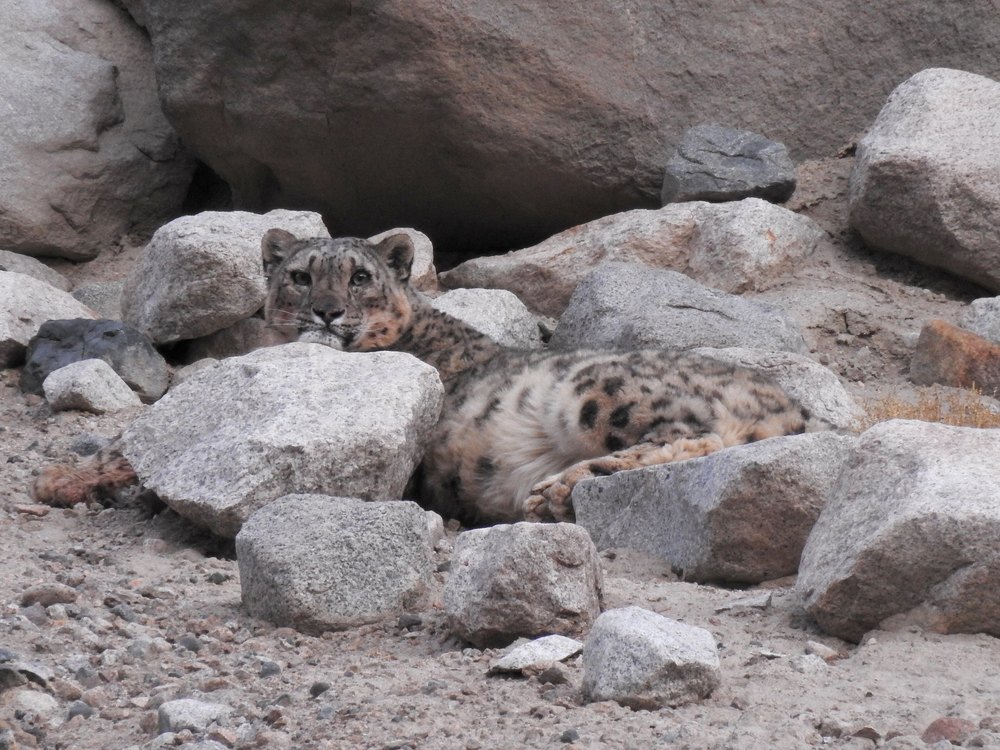
The snow leopard lives in high, cold mountains. In the Himalaya and on the Tibetan Plateau it is found at 3,000 m to over 5,000 m, and in the Altai it lives as low as 500 m. It prefers steep, rugged, broken ground, and it uses ridgelines and the bases of cliffs as travel routes and places to leave signs.[3]


Range
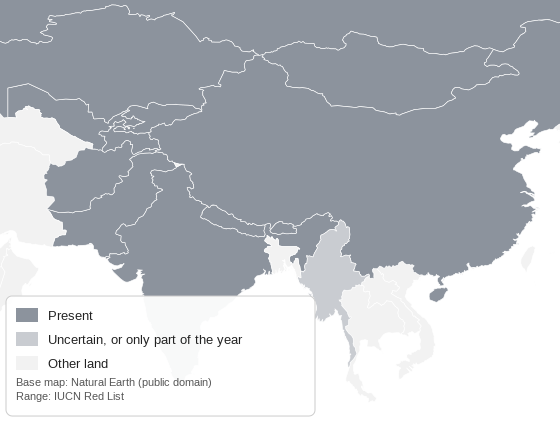
Snow leopards are native residents of 12 countries: Afghanistan, Bhutan, China, India, Kazakhstan, Kyrgyzstan, Mongolia, Nepal, Pakistan, Russia, Tajikistan and Uzbekistan. A small area of possible range in northern Myanmar has not been confirmed as occupied.[3] The occupied range covers about 2.8 million km² and follows the great mountain chains of Central Asia: the Altai, Sayan, Tien Shan, Kunlun, Pamir, Hindu Kush, Karakoram and the outer Himalaya, plus small isolated mountains in the Gobi.[3]
Population
There is no reliable count of snow leopards worldwide. The IUCN assessment says the published global figures are best regarded as guesses: 4,080 to 6,500 (2003), 4,500 to 7,500 (2010) and 3,920 to 6,390 (2013).[3] An expert mapping published in 2016 covered 69 conservation units, 56 of them with data. It gave 4,678 to 8,745 adults and large young animals on 875,818 km², about 31.5% of the occupied range.[3] National estimates from 2016 add up to 7,367 to 7,884 without Bhutan. The IUCN states that this reflects better knowledge and not necessarily an increase.[3]
Local surveys with camera traps and DNA give firmer numbers for small areas. In Ladakh, India, a 2025 camera-trap study identified 126 individual snow leopards and estimated a population of 477 (range 380 to 598), about 1 per 100 km².[23] A 2025 survey of 360,000 km² of China, also with camera traps, estimated 1,002 snow leopards (range 755 to 1,341) at 0.90 per 100 km².[24] The IUCN notes that recent best-practice estimates of density are mostly 1 to over 3 per 100 km². China is thought to hold about 60% of the range, and the assessment cites at least 4,500 snow leopards there (a 2016 estimate).[3]
Only a small part of the range has been surveyed with these methods, so totals remain uncertain.[25][26] The IUCN lists the population trend as decreasing; see Conservation for the status and its reasons.[3]
Evolution
The snow leopard belongs to Panthera, the genus of the big cats. Its age is given as a range, because studies disagree. A study that combined fossils and DNA dated the first split in the genus to about 10.7 million years ago (likely range 5.6 to 19.3 million).[27] Studies that used DNA alone put the start of the genus at 7 million years ago or later.[28][29]
The oldest fossil in this lineage is Panthera blytheae, a partial skull from the Zanda Basin in Tibet. Its fossil beds are 5.95 to 4.10 million years old, and the skull itself is about 4.4 million years old. The authors placed it as the closest relative of the snow leopard.[27] The pairing rests on the shape of a single skull, so it is a proposal and not a settled fact.[27] A 2025 study lists five fossil records of this lineage outside Tibet from the last 2.5 million years, among them Longdan in China (2.5 to 2.2 million years ago), Arago Cave in France (0.5 to 0.6 million years ago) and Manga Larga in Portugal (Late Pleistocene). It finds that the skeleton’s fit to steep ground, and to a lesser degree to cold and altitude, grew stronger after about 0.8 million years ago.[30]
Where the snow leopard sits among its relatives is disputed. Most studies of nuclear DNA place its closest relative as the tiger,[31][29] and the Cat Specialist Group follows this.[5] The mitochondrial genome instead puts it next to the lion and leopard.[28] The IUCN says the snow leopard and the tiger diverged more than two million years ago.[3] The big cats branched quickly, and ancient interbreeding between lineages blurs the tree: the X chromosomes of the lion and the snow leopard split only about 2.1 million years ago, and the genomes show signs of mixing between the two.[31][28][29]
A 2025 study of the whole genomes of 41 snow leopards found the lowest genetic diversity of any big cat. The authors link this to a long-term small population and not to recent inbreeding.[32]
Forms and variants
Subspecies
Snow leopard subspecies are not settled. The IUCN Cat Specialist Group treats the species as monotypic, with no subspecies.[5] The IUCN Red List says two subspecies were named from small differences in shape, and that genetics has not confirmed them.[3] The Integrated Taxonomic Information System has records for P. u. uncia, P. u. uncioides and P. u. schneideri, but marks all three as invalid names of the single species.[7] A 2017 genetic study of 70 snow leopards found three groups, northern (Altai), central (Himalaya and Tibetan Plateau) and western (Tien Shan, Pamir and trans-Himalaya), and proposed a subspecies for each: irbis, uncioides and uncia.[33] A 2025 genome study of 52 wild snow leopards found two main lineages, northern and southern, which it links to the Last Glacial Maximum.[34]
Conservation
Status
The IUCN Red List lists the snow leopard as Vulnerable under criterion C1. The assessment was made on 8 November 2016 and published in 2017, and the population trend is decreasing.[3] The listing rests on a population of more than 2,500 but fewer than 10,000 mature individuals, with an estimated and projected decline of at least 10% over three generations (22.62 years).[3]
The species was listed as Endangered from 1986 to 2008. The 2008 Endangered listing, based on fewer than 2,500 mature individuals, was judged to be an error, so the 2017 change to Vulnerable is called “non-genuine”.[3] The conservation group Panthera and the authors of a commentary in the journal Oryx describe it the same way, and stress that the cat is still threatened.[26][35] The higher population estimates behind the change were disputed. A 2016 statement from the Snow Leopard Trust said that only about 1.5% of the possible range had been surveyed rigorously for abundance.[25]
Threats
Habitat lossKilling in conflict with peopleLoss of preyTrade in bones and body partsClimate change[3]
Habitat loss and loss of prey. The IUCN names three main threats. The first is competition with livestock, which degrades habitat and reduces the wild prey.[3]
Killing in conflict with people. The second main threat is killing in retaliation for livestock losses.[3]
Illegal trade. The third main threat is the illegal trade in furs, bones and other body parts.[3] A 2016 estimate by Nowell and colleagues, cited in the assessment, puts poaching at 221–450 snow leopards a year since 2008, roughly 2 to 10% of the population. Fewer than 38% of cases are thought to be detected. More than 90% of the killing happens in five countries: China (103–236 a year), Mongolia (34–53), Pakistan (23–53), India (21–45) and Tajikistan (20–25).[3]
Climate change and new threats. New threats identified since 2003 include climate change, mining, roads and fenced railways.[3] Models for the Qinghai-Tibet Plateau project a loss of 13.0% of snow leopard habitat under a moderate emissions pathway and 23.4% under a high one, with the blue sheep falling by 38.3% and 49.7%.[36] In western Nepal, 42.5% of the habitat that is suitable now could face severe decline under high emissions.[37]
Trophy hunting. In Khunjerab National Park in Pakistan, trophy hunting reduced the number of prey animals. This was followed by more livestock predation and more retaliatory killing. A total of 170 Siberian ibex and 12 blue sheep were hunted there over three decades.[38]
Protection and actions
On 22–23 October 2013 the governments of the 12 range countries adopted the Bishkek Declaration at the Global Snow Leopard Conservation Forum. It backed the Global Snow Leopard and Ecosystem Protection Program (GSLEP) and named 23 October as International Snow Leopard Day.[39]
China banned guns in 1989. The whole Wakhan District of Afghanistan, over 10,000 km², became the country’s second national park.[3] Herders in Afghanistan, India, Pakistan and Tajikistan strengthened more than 260 livestock corrals, and none of them was attacked again. In western Tyva, Russia, 46 herder camps took part in a scheme that cut livestock losses by 50 to 60%.[3] More than 65 local governance groups are active in Pakistan, and the Snow Leopard Trust runs a handicraft programme for herding families in Mongolia and Kyrgyzstan.[3]
History and culture
In culture
Kyrgyzstan has declared the snow leopard a national symbol.[40] The IUCN assessment notes that conservation groups have highlighted customary beliefs that treat the snow leopard as an important totem animal for some traditional communities across its range. It also notes that Buddhist monasteries have given effective protection to the animals around them.[3]

In the fur trade
The snow leopard has long been hunted for its fur, bones and other body parts. After the Soviet Union broke up around 1991, poaching for skins and body parts rose sharply in the countries of Central Asia, and numbers there fell by 40–75% during the 1990s.[3] Poaching appears to have declined since the late 1990s, but it has not stopped. Demand for rugs, luxury décor and taxidermy, especially from China and Eastern Europe, appears to be driving it now. The use of bones in traditional medicine, once limited to the provinces where the animal lives, has also been reported in the wealthier coastal cities of China since 2010.[3] For the numbers, see Conservation.
Taxonomy
| Rank | Name |
|---|---|
| Kingdom | Animalia |
| Phylum | Chordata |
| Subphylum | Vertebrata |
| Superclass | Tetrapoda[7] |
| Class | Mammalia |
| Subclass | Theria[7] |
| Infraclass | Eutheria[7] |
| Order | Carnivora |
| Suborder | Feliformia[7] |
| Family | Felidae (cats)[5] |
| Subfamily | Pantherinae[7] |
| Genus | Panthera Oken, 1816[8][7] |
| Species | Panthera uncia (Schreber, 1775)[5][7][8] |
Synonyms (2)
| Name |
|---|
| Felis uncia (Schreber, 1775) |
| Panthera unica (Schreber, 1775) |
From the GBIF backbone.[6]
Higher classification
The snow leopard is a member of the cat family, Felidae, in the order Carnivora, which also holds dogs, bears and weasels.[5] It sits in the subfamily Pantherinae, the big cats.[8] The genus Panthera has five living species: the lion, tiger, leopard, jaguar and snow leopard.[5]
Panthera or Uncia
The snow leopard was long kept in a genus of its own, Uncia. The Mammal Diversity Database records its move into Panthera on the strength of the genetic work of Davis and colleagues (2010), and the IUCN credits a 2006 study.[31][41][42] The Cat Specialist Group notes that the tiger and the snow leopard are sister species, so either these two should be split from the other Panthera species or all should stay in Panthera. It supports keeping all five in one genus.[5] GBIF still treats Uncia as the accepted genus and Panthera uncia as a synonym.[6]
Sources
- IUCN SSC Cat Specialist Group, snow leopard species page
- Animal Diversity Web, Uncia uncia
- McCarthy et al. 2017, IUCN Red List assessment of Panthera uncia
- Johansson et al. 2015, Biological Conservation 184
- Kitchener et al. 2017, A revised taxonomy of the Felidae, Cat News Special Issue 11
- GBIF Backbone Taxonomy, Uncia uncia
- Integrated Taxonomic Information System, Panthera uncia
- Catalogue of Life, Panthera uncia
- Johansson et al. 2022, Snow Leopard Reports 1, body measurements of free-ranging snow leopards
- Weissengruber et al. 2002, Journal of Anatomy 201, the hyoid apparatus and pharynx in big cats
- Rosenbaum et al. 2023, PLOS ONE, home ranges in the Mongolian Altai
- Camera-trap study of snow leopard marking in Baltistan, 2024 preprint
- Johansson et al. 2022, Scientific Reports, activity of snow leopards in Mongolia
- Lyngdoh et al. 2014, PLOS ONE 9: e88349
- Koju et al. 2023, Animals 13, snow leopard diet in Lapchi Valley, Nepal
- Snow Leopard Trust, life cycle page
- Zhong et al. 2022, Ecology and Evolution, snow leopard and wolf in the Everest region
- Chetri et al. 2017, PLOS ONE 12: e0170549
- Wang et al. 2025, Animals 15, camera traps of snow leopard, wolf, brown bear and lynx
- Nasanbat et al. 2021, Frontiers in Zoology 18
- Salvatori et al. 2021, Biological Conservation 261
- Laguardia et al. 2015, Zoological Research, scat identification in Xinjiang
- Raina et al. 2025, PLOS ONE, snow leopards in Ladakh
- Li et al. 2025, Biodiversity and Conservation, snow leopards in China
- Snow Leopard Trust, statement of concern on snow leopard population estimates
- Panthera, “Snow leopards shift from Endangered to Vulnerable, explained”
- Tseng et al. 2014, Proceedings of the Royal Society B 281: 20132686
- Li et al. 2016, Genome Research 26
- Figueiró et al. 2017, Science Advances 3: e1700299
- Jiangzuo et al. 2025, Science Advances 11
- Davis, Li & Murphy 2010, Molecular Phylogenetics and Evolution 56: 64–76
- Solari et al. 2025, PNAS, snow leopard genomes
- Janecka et al. 2017, Journal of Heredity 108
- Yang et al. 2025, Genome Biology 26: 94
- “A downlist is not a demotion”, Oryx 2017
- Zhang et al. 2025, Ecology and Evolution, habitat change on the Qinghai-Tibet Plateau
- Budha et al. 2025, Ecology and Evolution, snow leopard habitat in Nepal
- Rashid et al. 2020, Animals 10: 597
- Bishkek Declaration on the Conservation of Snow Leopards, 23 October 2013
- 24.kg, “Snow leopard officially declared national symbol of Kyrgyzstan”
- Mammal Diversity Database, Panthera uncia
- Johnson et al. 2006, Science 311: 73–77