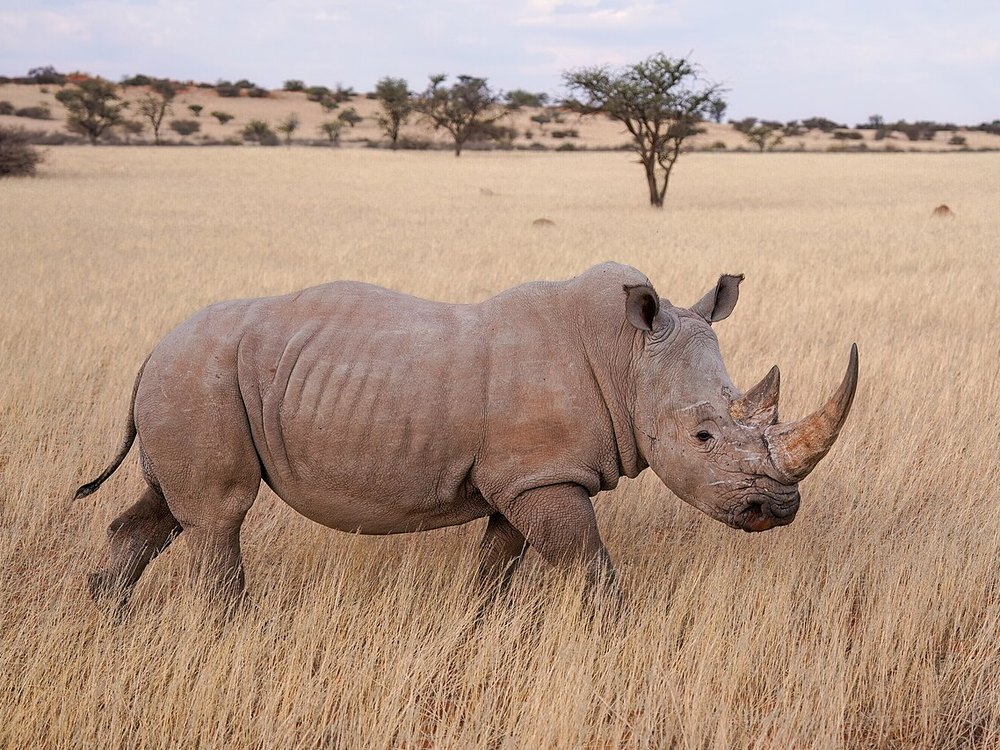
The white rhinoceros (Ceratotherium simum) is a large, grey grazer of southern Africa. It has two horns and a wide, square mouth.[1] Most of the remaining animals live in fenced reserves, conservancies and private game farms.[2] The IUCN rates the species Near Threatened because of continued poaching for horn, and counted 15,752 white rhinos at the end of 2024.[2][3]
Quick facts
Description
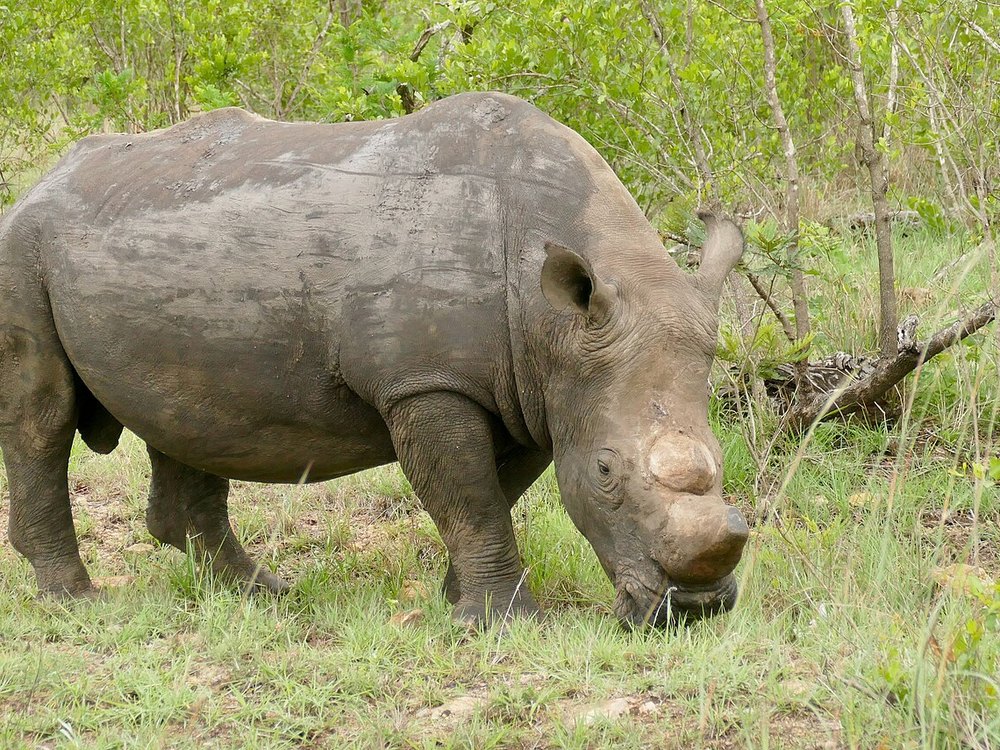
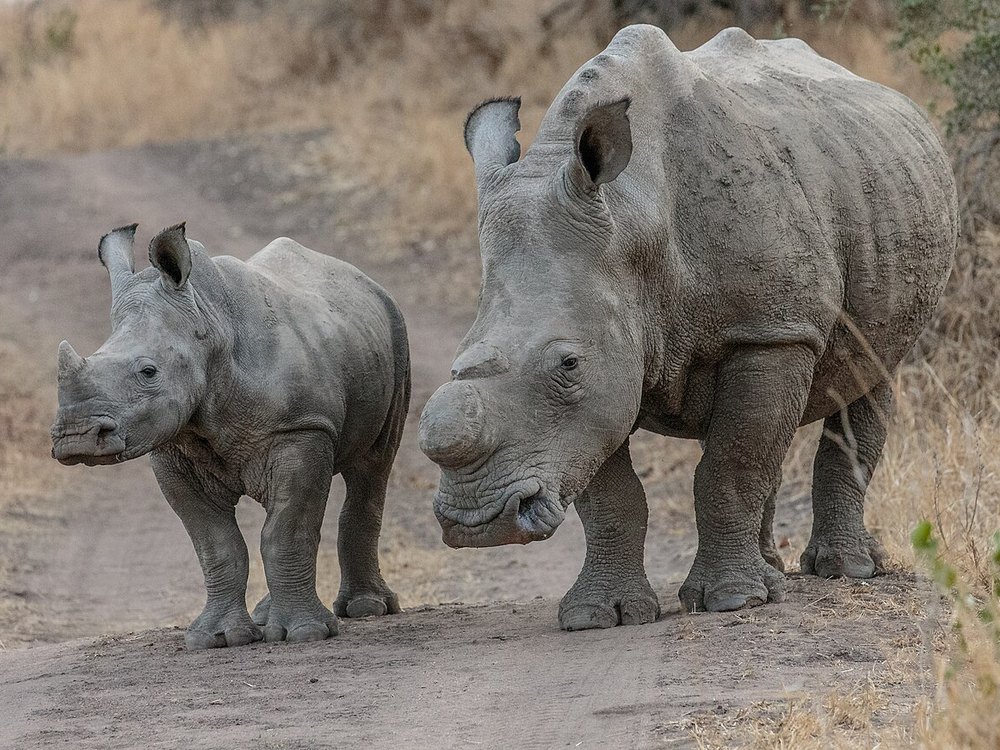
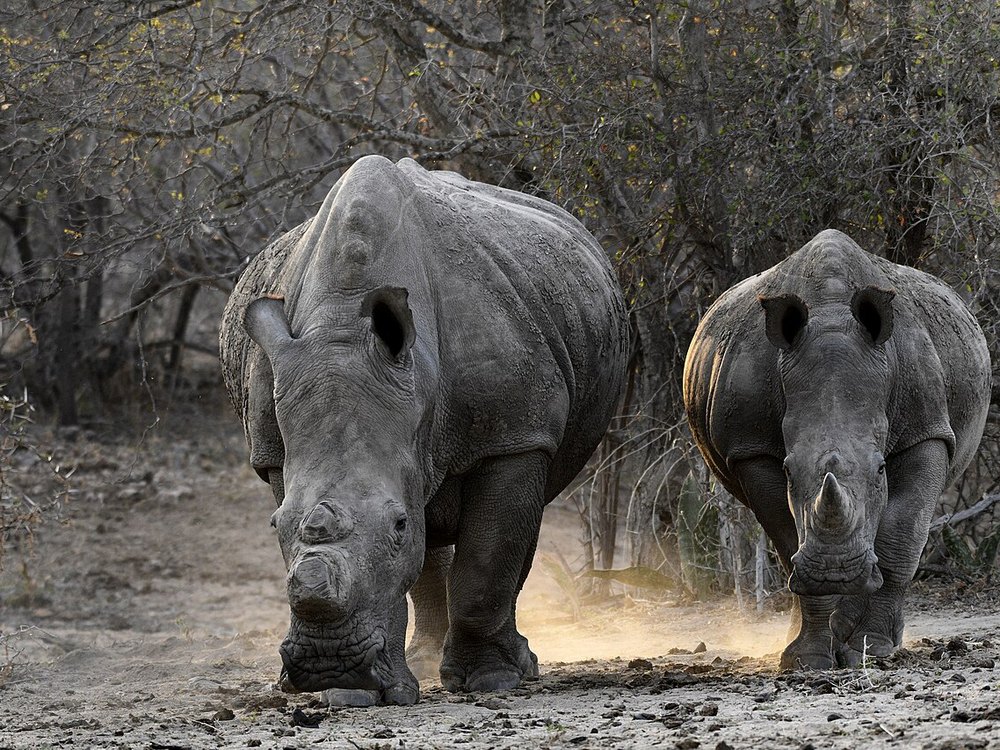
The white rhino has thick, smoke-grey skin, a little lighter than that of the black rhino, with almost no hair apart from fringes on the ears and a tuft at the tail tip.[1][6] A rounded hump of muscle rises on the nape of the neck just in front of the shoulders. The skin folds over the elbow, on the nape and on the throat, but the sides are smooth.[6]
The head is long and carries two horns. The front horn of a female is longer and thinner than that of a male.[7] The mouth is wide and square.[6]

Name
The origin of the English name “white” is not known. A popular story says English speakers misheard Afrikaans or Dutch wyd, “wide”, for the wide mouth. The historian Kees Rookmaaker found no Dutch or Afrikaans use of such a word for this animal and called the story unsubstantiated and historically incorrect; he listed ten other ideas, among them colour, albinism and mud.[8][9] The earliest records are John Barrow (published 1801), who heard a chief call them “white”, Petrus Borcherds (1802), who described one as paler ash-grey than the black rhino, and Andrew Bain (1826), who wrote that the Griquas called it white and noted its broad flat nose. The name was in general use after the accounts of Alexander and Harris, both published in 1838.[8][10]
Other English names are square-lipped (or square-mouthed) rhinoceros, grass rhinoceros, flat-nosed rhinoceros (Jardine, 1836) and Burchell’s rhinoceros (Lesson, 1827).[8] William Burchell gave the animal no English name. The species name simus is Latin for “flat-nosed”; in his own words, he chose it from the flattened form of the animal’s nose and mouth.[11]
In other languages
| Language | Name | Meaning |
|---|---|---|
| Afrikaans local | witrenoster | “white rhinoceros”; probably copied from the English name |
| Zulu local | mKombe | — |
| Tswana local | tshukudu e tshweu | “white rhinoceros”; the early record magooe (Borcherds, 1801) is another name |
| Dutch | witte neushoorn | “white rhinoceros”; early colonial records use wit renoster |
| German | Breitmaulnashorn | “broad-mouth rhinoceros” |
| French | rhinocéros blanc | “white rhinoceros” |
| Spanish | rinoceronte blanco | “white rhinoceros” |
| Chinese | 白犀 (bái xī) | “white rhinoceros”; also 方唇犀牛, “square-lip rhinoceros” |
| Japanese | シロサイ (shirosai) | “white rhinoceros” |
Names from national and international checklists listed in GBIF; early Dutch and Tswana records from Feely.[10][12]
Body
Size and weight
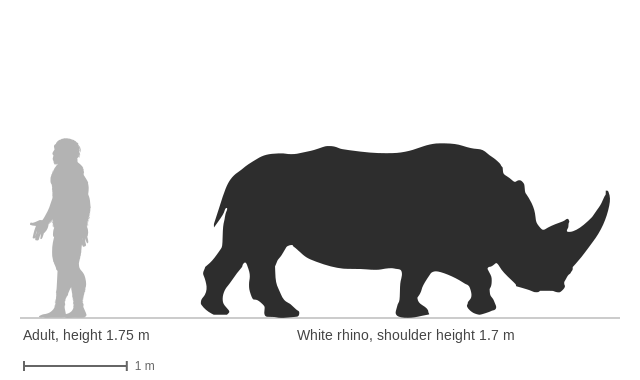
In free-ranging southern animals aged by their teeth (Hillman-Smith and colleagues, 1986), adult males weigh 2,000 to 2,400 kg and females 1,500 to 1,700 kg. Males reach full weight at 10 to 15 years.[13][14] Captive adults in zoo records level off at about 2,066 kg in males and 1,839 kg in females.[15]
Shoulder height is 165 to 188 cm in southern males (11 measured) and 155.6 to 185 cm in southern females (8 measured). The length from the back of the head to the base of the tail is 259 to 284 cm in southern males and 248 to 273 cm in southern females.[14]
| Female | Male | |
|---|---|---|
| Weight (southern) | 1,500–1,700 kg | 2,000–2,400 kg |
| Shoulder height (southern) | 156–185 cm | 165–188 cm |
Horns
The front horn is the longer one. Heller (1913) gave its usual length as about 61 cm and the record for a South African animal as 159 cm, a length reached only by females.[6] The rear horn is a low, sharply pointed cone that seldom stands more than a few centimetres high and is sometimes missing.[6] A horn is made of keratin, the same protein as fingernails, with no bone inside. It is not attached to the skull and keeps growing through life.[1][16][17]
Senses
Eyesight is poor. The eyes sit on the sides of the head and the two fields of view barely overlap, and a moving object is noticed more easily than a still one. Smell and hearing are good.[1] Both senses play a large part in marking and reading territory.[7]
Skin and feet
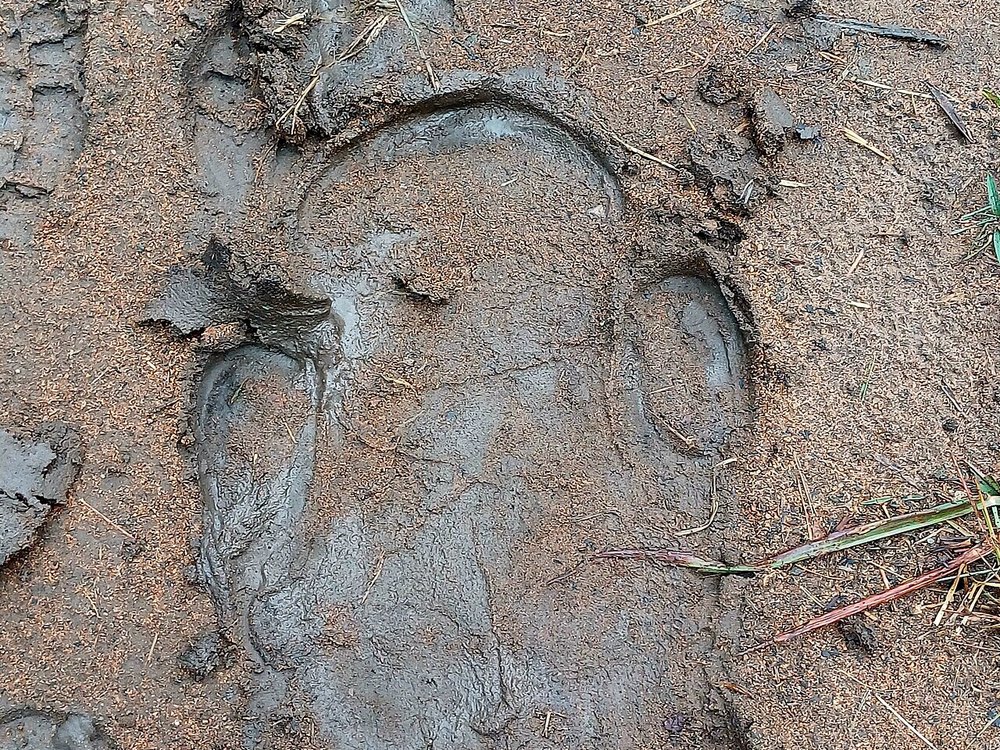
The skin is thick and folded.[1] Each foot has three hoofed toes, and the middle toe is the largest.[1]

Behavior
Social life and territory
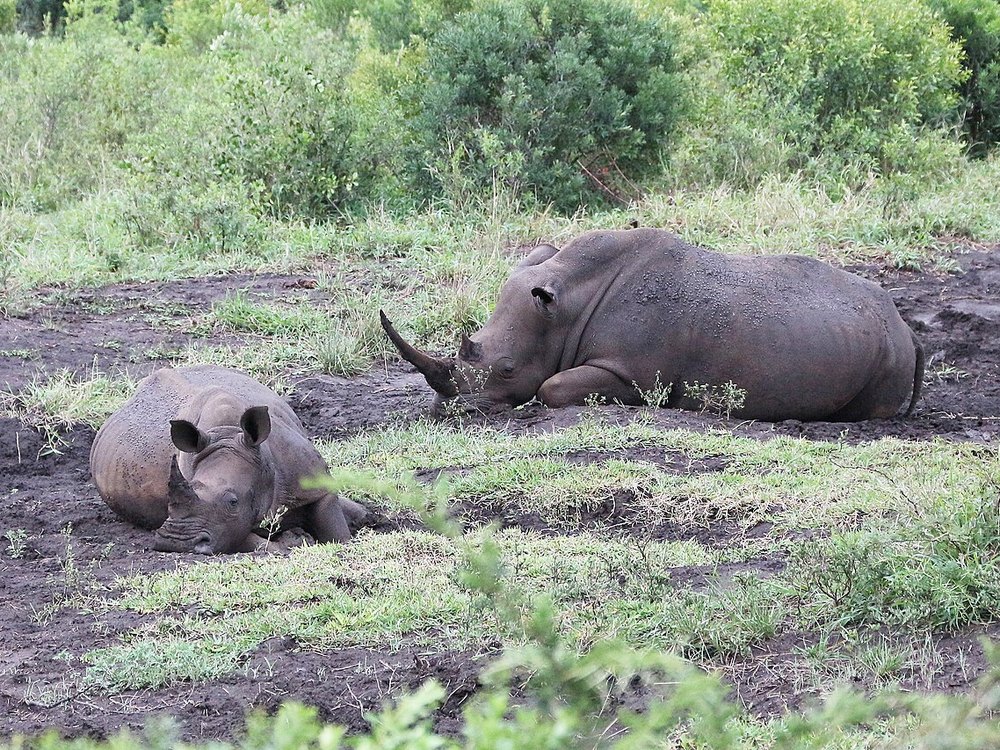
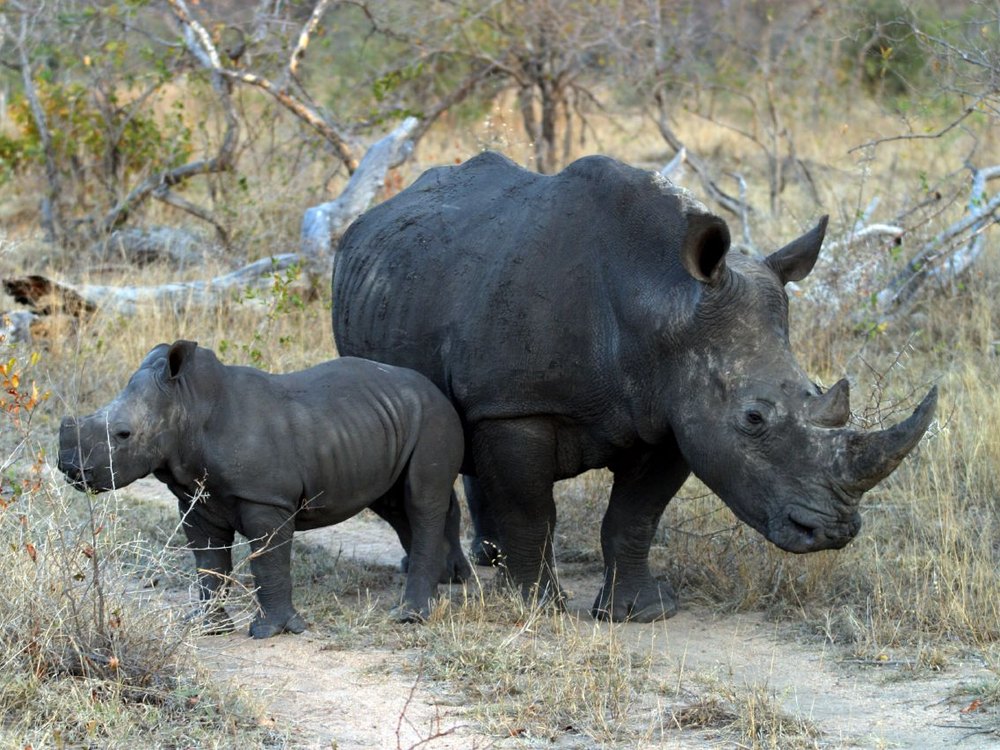
White rhinos are semi-social. Groups are mostly a mother with her offspring, or a small group of subadults, and adult bulls are generally solitary.[18] In Owen-Smith’s study at Umfolozi, South Africa, territorial bulls held ranges that did not overlap, of about 0.7 to 2.6 km², and a territory might be shared with 0 to 3 subordinate adult bulls.[19] Cows ranged much more widely, over 10 to 15 km², with most movement in a core of 6 to 8 km² where the grazing was good.[19] In crowded areas (3 to 5.7 rhinos per km²) bull ranges were 0.75 to 2.6 km² and cow ranges 8.9 to 20.5 km².[19] Territorial bulls get most of the matings, and subordinate bulls seldom mate.[1][7]


Dung middens and scent marking
A territorial bull may keep more than 30 dung middens, which are communal dung heaps. They lie along the territory boundary, on well-used paths and near water. The bull defecates in the centre of a midden, while cows and subadults use the edges.[19] Bulls also spray urine to mark their boundaries, and the dung heaps help rhinos tell individuals apart and signal when a female is in season.[7] In one study, cows cut their visits to middens by 70% when human voices were played, while bulls did not change.[18]
Voice
All the call studies so far were made on southern white rhinos in zoos, not in the wild. Four calls are the most common in adults: hiss, grunt, pant and snort. The hiss and the grunt are made only in aggressive encounters. The pant is a series of short breaths used as a contact call and a mating call, and it carries the caller’s identity, species and sex and age class.[20][21] In a study of 25 adults in six zoos, the grunt, hiss and snort each differed from one animal to the next, and the grunt was the most individual of the three. The snort is heard mainly at rest and while feeding.[20][22]
Calves make a high, tonal whine, mostly while suckling or close to the mother. In eight zoo calves, the whine rate fell from about 21 calls an hour before 18 months to about 3 an hour after that age.[23]
Diet
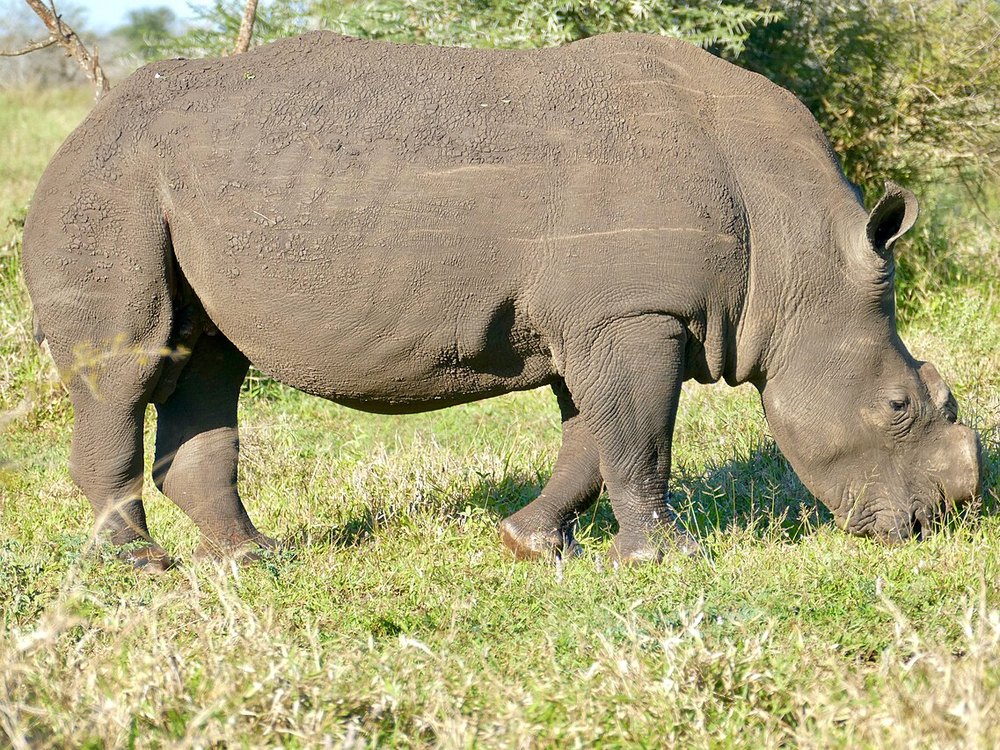
The white rhino is a pure grazer: it feeds on grass and prefers short grass.[1][2] The upper lip is wide, flat and square-edged, which suits cropping grass close to the ground. The black rhino, by contrast, has a pointed lip for browsing.[1]
A field study of the dry season followed what the rhinos ate as the grass dried out. They fed mainly on short, high-quality grassland and on woodland grassland. Late in the dry season they moved to the green regrowth on burnt red oat grass (Themeda) grassland. Bite size grew with the height of the grass while the bite rate fell, and the biggest bites and the fastest intake came in grass taller than 20 cm. The rhinos did not make up for the poorer food of the dry season by eating faster or by widening their diet. The authors suggested that they lived on body fat instead.[24]

Life cycle
| Stage | Age / time | Notes |
|---|---|---|
| Calf | Birth to about 12 months | One calf is born after about 16 months of pregnancy; it starts to graze at about 2 months and is weaned at about 12 months[1][7][25] |
| Juvenile | About 1 to 3 years | The young animal stays with its mother for about 2 to 3 years[1][7] |
| Subadult | About 3 to 6 years | Females on a game ranch had their first calf at a median age of 83.2 months, about 7 years[25] |
| Adult | From about 7 years (cows); 10 to 15 years (bulls) | Cows calve about every 29 months; bulls reach maturity later[1][25][26] |
Mating and birth
White rhinos breed all year.[7] On a South African game ranch, pregnancy lasted around 16 months, and older records give about 16 to 20 months. In US zoos it lasted a median of about 16.6 months.[25][27][28] A cow bears one calf at a time.[7]
Calves
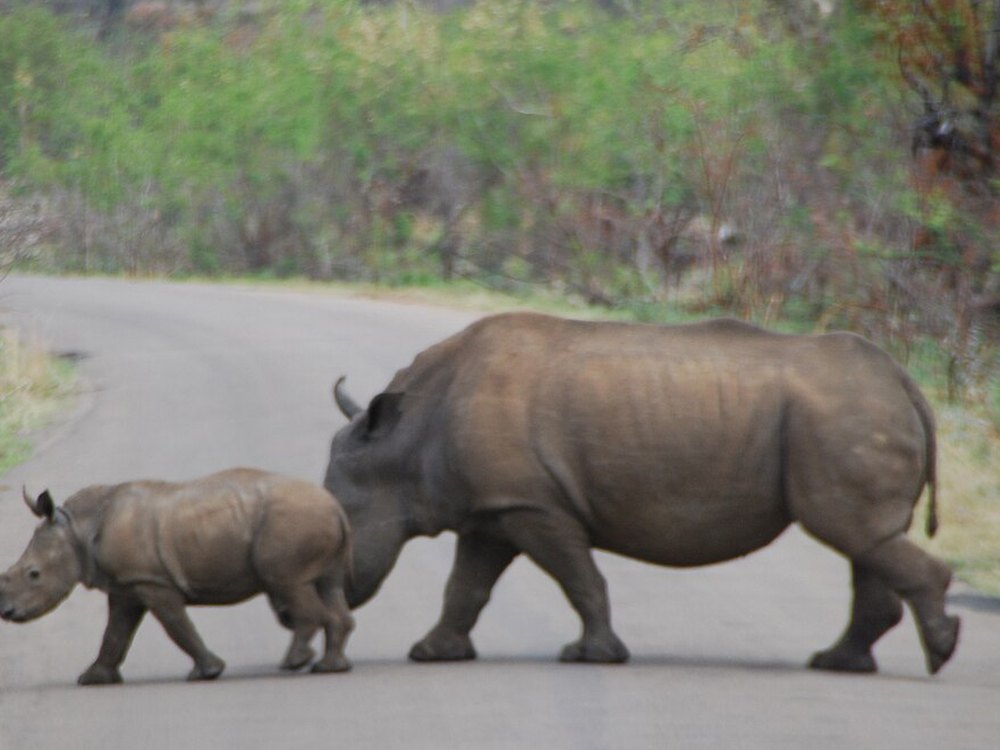
A calf may nurse for up to 18 months, although it is usually weaned earlier.[1][7] In US zoos, southern white calves stood a median 30 minutes after birth and first nursed a median 124 minutes after birth (22 births).[28]

Growing up
On the game ranch, the middle half of cows had 24.6 to 34.8 months between calvings.[25] The interval was 30.8 months before the second calf, 25.6 months before the third and 28.0 months from the fourth on.[25] In Kruger, calving every 2 to 3 years has been recorded, and at Loskop Dam about 4.3 years.[27] In the wild, females first give birth at 6 to 8 years.[13] On the ranch, births peaked from December to April.[25]
Lifespan
A 36-year-old wild cow was still bearing calves.[27] Tooth rings in wild-shot animals show a longevity of at least 40 years.[13] A male aged 40 years and a female aged 37 years lived in one zoo.[14]
Ecology
Grazing lawns
The white rhino can help to create and keep grazing lawns, which are patches of short grass that stay short and regrow because they are grazed. In Kruger National Park, areas that rhinos recolonised long ago had more short-grass cover (17.5% against 10.7%) than areas they returned to only in the 1960s, and about 20 times more grazing-lawn cover.[29] In Hluhluwe-iMfolozi Park, grazer exclosures (fenced plots that keep grazers out) showed that in the wetter Hluhluwe section the white rhino had a large effect on grass height and that smaller grazers could not replace it. In the drier iMfolozi section other grazers could.[30] The effect also reached fire: burnt patches were larger and less patchy where rhinos had been removed.[30]
Oxpeckers and other animals
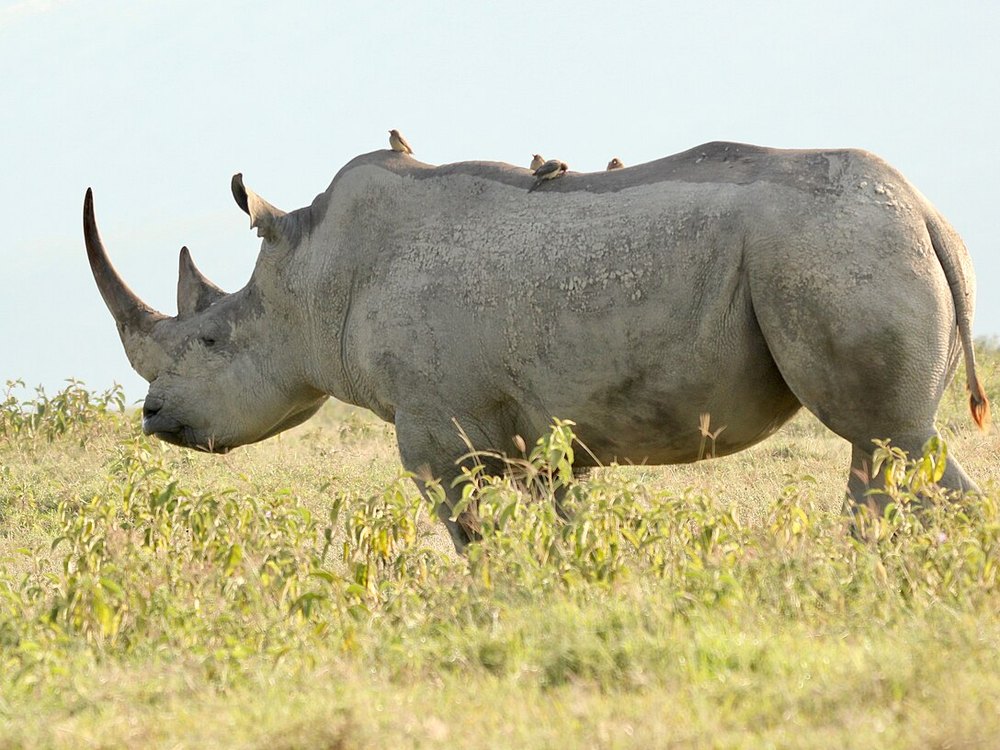
Oxpeckers also ride on white rhinos. The best-known study of oxpeckers and rhinos is on the black rhino: rhinos without oxpeckers noticed a person approaching on foot 23% of the time, while rhinos with oxpeckers noticed every time, because the birds gave alarm calls.[31]

Predators
Adult white rhinos have no regular natural predator, and people are the main danger.[2][7] In one account a young lion was seen jumping onto a calf’s hindquarters; it lost its grip and the calf escaped, and the observer had seen adults chase lions away.[32] In Ithala Game Reserve, South Africa, calf survival from 1999 to 2019 was better after more dry-season rain, and more so where woodland covered much of the mother’s home range.[33]
Parasites and disease
Ticks are the best-recorded parasites. A study of 465 white rhinos (447 in South Africa, 18 in Zimbabwe) found Amblyomma hebraeum on 82.2% of them and Dermacentor rhinocerinus, a tick that prefers rhinos, on 32.9%.[34] Bovine tuberculosis has also been found. In Kruger carcass checks from June 2016 to October 2017, six of 35 white rhinos were infected, with no case that had spread through the body.[35]
Habitat and range
Where it lives
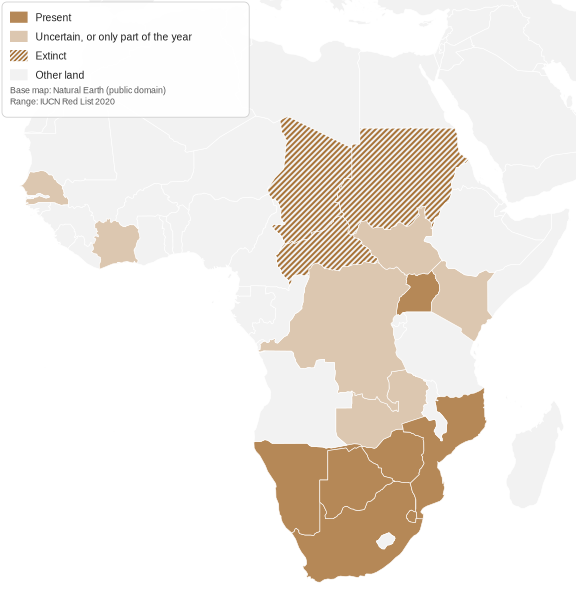
The white rhino lives in grassland within bushveld savanna and is a grazer. The Red List lists dry savanna, dry subtropical and tropical shrubland, and dry subtropical and tropical grassland as suitable habitat.[2] Its southern range was the bushveld south of the Zambezi River, and its northern range covered north-western Uganda, southern Chad, south-western South Sudan, eastern Central African Republic and north-eastern DR Congo.[2] South Africa is the only country where it is native and still present. It has been reintroduced to Botswana, Eswatini, Mozambique, Namibia, Uganda and Zimbabwe. Animals have also been brought to Kenya and Zambia; an old subfossil, about 3,500 years old, shows that the species once lived in Kenya.[2] The species is extinct in the Central African Republic, Chad and Sudan, and possibly extinct in the DR Congo and South Sudan.[2] Today it lives almost only in fenced reserves, conservancies and private game farms, and almost half of all white rhinos are managed by the private sector.[2] The Red List counts 422 subpopulations (separate groups) and 10,080 mature individuals (adults able to breed), says the species occupies about 85,705 km², and puts 91 to 100% of the population in protected areas.[2]

Population
By the end of the 1800s only a small remnant survived, in what is now KwaZulu-Natal, South Africa.[2] After protection and many translocations the wild count reached 21,316 at the end of 2012, then fell about 15% to 18,064 at the end of 2017 (90% confidence range 17,212 to 18,915).[2] These are Africa-wide estimates from the African Rhino Specialist Group. At the end of 2017 South Africa held 15,625, Namibia 975, Kenya 513, Botswana 452 and Zimbabwe 367; Eswatini, Mozambique, Uganda and Zambia together held 131.[2] The count rose 5.6% to about 16,803 at the end of 2022, from about 15,940 at the end of 2021.[18][36] A separate count of southern white rhinos only gave 17,464 at the end of 2023, 13,991 of them in South Africa.[18] The IUCN count for the end of 2024 was 15,752 white rhinos, down 11.2% in one year; the IUCN attributes the fall to drought, limits to management, corrections to earlier counts and, to a lesser extent, poaching.[3][37] In South Africa at the end of 2023, 5,406 (39%) lived on state land and 8,585 (61%) on private land. Kruger National Park held an estimated 1,812 and Hluhluwe-iMfolozi Park 2,117.[18]
Evolution
Fossil record
The genus Ceratotherium goes back at least to the early Pliocene. Groves and colleagues (2010) put its split from the black rhino’s genus, Diceros, at about 7 million years ago from the fossil record. Geraads thinks only a date near the Miocene to Pliocene boundary (about 5.3 million years ago) is supported.[14] Liu and colleagues (2021) used 5.3 to 7.3 million years for the same split, a fossil calibration based on black rhino remains older than 5.3 million years from Lothagam in Kenya and Albertine in Uganda.[38] A study of whole mitochondrial genomes (DNA passed on only through the mother) gave a much older 15.3 million years (95% range 13.5 to 17.4).[39]
Borrani and colleagues (2025) place the fossil species Ceratotherium neumayri, C. mauritanicum and C. advenientis in the genus. They treat C. neumayri as a valid species close to the white rhino, and C. mauritanicum as an early member of the genus.[40] They also describe a well-documented trend towards more grazing within Ceratotherium, seen in tooth shape and in the chemistry of the teeth, while Diceros stayed a browser.[40]
The African rhinos
The black and white rhinos are each other’s closest relatives in all the studies.[38][39][40] Liu and colleagues (2021) date the split of the rhino family from the tapirs to 55 to 60 million years ago, and the split between the Elasmotheriinae, an extinct group of rhinos that includes the giant Siberian unicorn, and the living rhino line to about 36 million years ago.[38] Paterson and colleagues (2025), using proteins from Early Miocene enamel, put the Elasmotheriinae split at 34 to 22 million years ago, younger than earlier DNA clocks.[41] Liu and colleagues find three living rhino lines that separated about 16 million years ago: the African pair, the Sumatran rhino with the extinct woolly and Merck’s rhinos, and the genus Rhinoceros (Indian and Javan).[38] All rhinos, the white rhino among them, have low genetic diversity.[38]
The date of the split between the northern and southern white rhino is disputed. Groves and colleagues (2010) say the two have been separate for over a million years, and calibrate it at 1 to 1.4 million years or 0.75 to 1 million, depending on the fossil date used for the genus.[14] Harley and colleagues (2016) give 0.46 to 0.97 million years for the two mitochondrial lineages.[42] Tunstall and colleagues (2018) find that the DNA in the cell nucleus differs by about 0.1% and put the split at under 80,000 years ago.[43] Moodley and colleagues (2018) found an old split followed by renewed contact, possibly as recent as the peak of the last ice age, and Wang and colleagues (2025) describe the two as separated for tens of thousands of years.[44][45]
Forms and variants
Subspecies
The IUCN and ITIS list the white rhino as one species with two subspecies: the southern white rhino, Ceratotherium simum simum, and the northern white rhino, C. s. cottoni (Lydekker, 1908).[2][46][47] The northern white rhino is down to two females; see its own page. Whether the northern form is a separate species is discussed under Taxonomy. Three other names, oswellii (Elliot, 1847) and the varieties camptoceros and prostheceros (Brandt, 1878), appear only as synonyms.[48]
No colour form of the white rhino has been described. Both African rhinos are grey.[1][6]
Conservation
Status
The white rhino is listed as Near Threatened on the IUCN Red List (assessed 6 January 2020), and the population trend is decreasing. It has been Near Threatened since 2002. The reason given is the continued, high poaching threat and the illegal demand for horn in South-East Asia, especially Viet Nam and China.[2] The northern white rhino (C. s. cottoni) is assessed on its own as Critically Endangered (Possibly Extinct in the Wild), also on 6 January 2020; see its own page.[49][50]
Threats
Illegal killingDiseaseClimate change[2]Poaching. The Red List names poaching (illegal killing for horn) as the main ongoing threat, causing rapid declines.[2] Most white rhinos live in South Africa, and poaching there rose steeply after 2010. The estimated number of white rhinos poached in South Africa was 321 in 2010, peaked at 1,151 in 2014, and then fell: 963 in 2017, 562 in 2019 and 375 in 2020, then 423 in 2021 and 463 in 2023. The 2022 figure of 448 includes some black rhinos.[18] The African Rhino Specialist Group puts the tipping point at a poaching rate of 3.5% of the population a year, the rate above which deaths exceed births. The rate was 3.5% in 2012, 6.4% in 2015, 3.0% in 2020 and 3.3% in each of 2021 to 2023.[18]
For 2024 and 2025 the South African government gives only totals for white and black rhinos together: 420 poached in 2024 and 352 in 2025, a fall of 16%. Poaching of all rhinos in Kruger National Park rose from 88 in 2024 to 175 in 2025, while in Hluhluwe-iMfolozi Park it dropped from 198 to 63.[51] Across Africa, a minimum of 1,349 rhinos of all species were poached in 2015, 892 in 2018 and at least 561 in 2022.[36][50]
Disease and climate change. Two lesser threats are disease, including diseases brought by non-native species, and, in the future, climate change shifting habitat. Droughts have hit the species before and are likely to return.[2] A veterinary moratorium in South Africa has limited the movement of white rhinos out of Kruger National Park, because they may carry bovine tuberculosis (see Ecology).[18]
Other pressures. Poaching is not the only reason for decline; drought and limits to management also played a part (see Habitat and range). Falling live-sale prices and rising security costs have also led some private owners to give up their rhinos.[2][18]
Protection and trade
The species depends on conservation: almost all white rhinos live in fenced reserves, game farms and conservancies (see Habitat and range).[2][18]
Trade is controlled by CITES. Appendix I bans commercial trade, and Appendix II allows controlled trade. South Africa’s white rhinos were moved from Appendix I to Appendix II in 1994, and Eswatini’s white rhinos in 2004. Appendix II applies only to live animals sent to approved destinations and to hunting trophies; all other specimens, including horn, are treated as Appendix I.[2][18] Legal trophy hunting in South Africa has averaged 68 white rhinos a year since 2012, under 0.5% of the population, and 1,053 were hunted from 2010 to 2022.[18] In the same years South Africa exported 1,034 live white rhinos, most of them for reintroduction (54%) or to zoos (29%).[18] In late November 2025 a proposal by Namibia to ease the Appendix II rules was rejected at the CITES meeting in Samarkand.[52] About 95% of the horn reaching illegal markets in 2016 and 2017 came from poached wild animals.[2]
Conservation actions
The Red List credits fenced sanctuaries and protection zones, close monitoring of fast-growing populations, and the moving of surplus animals to start new groups. Regional specialist groups and national rhino plans coordinate the work, and demand-reduction campaigns run in Viet Nam.[2] Dehorning, which removes the reason to poach, has been used mainly in small populations and in Kruger; the stress to the animal fades within 72 hours, but poaching still rose in some other areas after dehorning.[18] The South African government credits a strategic dehorning programme begun in 2024 for part of the later fall in poaching.[51] In 2023 the conservation organisation African Parks bought the largest captive breeding operation in South Africa, with a plan to return the animals to the wild over about ten years.[18] The northern white rhino’s embryo programme is described on its own page.[53]


History and culture
First description
The Englishman William Burchell camped at Chue Spring, north of Kuruman in South Africa, on 16 October 1812, and recorded and collected the white rhino there. He made drawings, shot one or two animals and kept the horns and some teeth; it took four men to lift a skull from the ground.[5][54] In 1817 a letter of his naming the animal Rhinoceros simus was printed in the Bulletin des Sciences of the Société philomathique de Paris.[4][5] A single molar tooth that he brought home became the reference specimen for the species (see Taxonomy).[5]
Near extinction and rescue
Cornwallis Harris, who travelled in 1836 to 1837 and published his account in 1838, reported seeing 22 white rhinos within about 800 m of travel. Hunters, traders and explorers found them easy targets, and in 1893 Frederick Selous predicted that they would vanish before the end of the century.[5] By the end of the 1800s the species had been wiped out almost everywhere except a small area of Zululand in South Africa.[55] There it recovered.[55]
Operation Rhino began in 1960 as a Natal Parks Board programme, with Ian Player playing a major part. New drugs and a dart gun made it possible to capture the animals and move them to other reserves, national parks and zoos.[55] The southern white rhino page gives the detail.
Famous rhinos
Nola, a northern white female, died on 22 November 2015 at the San Diego Zoo Safari Park.[56] The northern white rhino is now down to two females; see its own page.
Horn and belief
Horn is keratin (see Body). A 2024 study of horn from captive white and black rhinos found essential minerals at levels lower than in a daily vitamin, and judged that health benefits are implausible.[57]
In art and symbols
Rhinos appear in the rock art of southern Africa, more often engraved than painted. Engravings on the South African Highveld include white rhinos, and a painting near Chibi in Zimbabwe is thought to show one.[58][59]
Taxonomy
| Rank | Name |
|---|---|
| Kingdom | Animalia |
| Phylum | Chordata |
| Subphylum | Vertebrata |
| Superclass | Tetrapoda[46] |
| Class | Mammalia |
| Subclass | Theria[46] |
| Infraclass | Eutheria[46] |
| Order | Perissodactyla (odd-toed hoofed mammals) |
| Family | Rhinocerotidae (rhinoceroses)[48] |
| Subfamily | Dicerotinae[46] |
| Genus | Ceratotherium Gray, 1868[60] |
| Species | Ceratotherium simum (Burchell, 1817)[46][48][60] |
Synonyms (3)
| Name |
|---|
| Rhinoceros simus (Burchell, 1817) |
| Rhinoceros burchellii (Lesson, 1827) |
| Rhinoceros camus (Griffith, 1827) |
From the GBIF backbone.[12]
Higher classification
The white rhino is one of five living rhinoceroses, in the family Rhinocerotidae.[38] The family belongs to the order Perissodactyla, which also holds the horses and tapirs.[38] The genus Ceratotherium has this one living species. The black rhino belongs to Diceros, and the two genera together are the African rhinos.[40][48]
One species or two
Groves and colleagues (2010) ranked the northern white rhino as a species because the two forms differ in teeth, skull and genes, and Groves and Grubb (2011) kept that rank.[14][48] Harley and colleagues (2016) compared whole mitochondrial genomes of northern and southern animals and judged that subspecies status is the better fit.[42] Moodley and colleagues (2018) suggested that breeding the two forms together could be considered.[44] Sanchez-Barreiro and colleagues (2021) and Wang and colleagues (2025) treat the two as subspecies.[45][61] The split dates these studies give are in Evolution.
Sources
- San Diego Zoo Wildlife Alliance, white rhino fact sheet, Characteristics page
- IUCN Red List assessment of Ceratotherium simum (Emslie 2020; version 3.1, assessed 6 January 2020)
- IUCN press release, August 2025 (African rhino numbers at the end of 2024; IUCN/TRAFFIC report for CITES CoP20)
- Burchell 1817, Bulletin des Sciences, par la Société philomatique de Paris 1817: 96–97 (original description of Rhinoceros simus)
- Rookmaaker 2025, Burchell, teeth, rhinoceros, exhibition text, Langerman Rhino Exhibition (Rhino Resource Center)
- Heller 1913, The white rhinoceros, Smithsonian Miscellaneous Collections 61(1): 1–77
- Animal Diversity Web, Ceratotherium simum
- Rookmaaker 2003, Why the name of the white rhinoceros is not appropriate, Pachyderm 34: 88–95
- Tetrapod Zoology (ScienceBlogs), 15 January 2009, “How did the White rhino get its name?”
- Feely 2007, Black rhino, white rhino: what’s in a name?, Pachyderm 43: 111–115
- Burchell 1824, Travels in the Interior of Southern Africa, vol. 2, p. 75 (footnote)
- GBIF vernacular names of Ceratotherium simum
- Hillman-Smith et al. 1986, Age estimation of the white rhinoceros, Journal of Zoology 210: 355–377
- Groves, Fernando & Robovský 2010, The sixth rhino: a taxonomic re-assessment of the critically endangered northern white rhinoceros, PLoS ONE 5(4): e9703
- Body mass records of zoo-managed rhinoceros compared with field data of free-ranging specimens (PMC12884244)
- Witmer, rhino horn page, Ohio University
- Mongabay, 2006, rhino horn is keratin, calcium and melanin
- South African Scientific Authority, Non-detriment finding for Ceratotherium simum simum, Cer_sim_Oct2024, 1 October 2024 (sanbi.org)
- Owen-Smith 1973, white rhinoceros territoriality at Umfolozi, as quoted in Marneweck et al. 2017 and 2018
- Jenikejew, Chaignon, Linn & Scheumann 2020, vocal networks of white rhinoceros, Scientific Reports 10: 15104
- Cinková & Policht 2014, Contact calls of the northern and southern white rhinoceros allow for individual and species identification, PLoS ONE
- Linn, Schmidt & Scheumann 2021, Journal of Mammalogy 102(2): 440–456
- Linn, Boeer & Scheumann 2018, vocal repertoire of infant and juvenile white rhinoceros, PLoS ONE 13(3): e0192166
- Shrader et al. 2006, How a mega-grazer copes with the dry season, Functional Ecology 20: 376–384
- Reproductive performance of game-ranched white rhinos (C. s. simum), South Africa, 2008–2015 (PMC5728479)
- Save the Rhino, white rhino species page
- Mentis 1972, A review of some life history features of the large herbivores of Africa, Lammergeyer 16: 1–89
- Brenner et al. 2023, Parturition and neonatal parameters of three species of rhinoceros under managed care in the United States, Animals 13: 3653
- Cromsigt & te Beest 2014, Journal of Ecology 102: 566–575 (grazing lawns and white rhino, Kruger)
- Waldram 2005, MSc thesis, University of Cape Town, white rhino and grass in Hluhluwe-iMfolozi Park
- Plotz & Linklater 2020, Current Biology 30 (oxpeckers and black rhinos)
- Woronin 2001, CCA Ecological Journal 3: 65 (a lion and a white rhino calf, Rhino Resource Center note)
- de Lange, Bonnet & Shrader 2024, Journal of Mammalogy 105(3): 502–511 (calf survival)
- Horak et al. 2017, ticks of white and black rhinos, Onderstepoort Journal of Veterinary Research 84(1): a1301
- Miller et al. 2018, bovine tuberculosis in white rhinos, Emerging Infectious Diseases 24(12)
- IUCN press release, 21 September 2023 (African rhino numbers at the end of 2022)
- Daily Maverick, 8 September 2025, report on the 2025 IUCN/TRAFFIC rhino report (secondary)
- Liu et al. 2021, Ancient and modern genomes unravel the evolutionary history of the rhinoceros family, Cell 184: 4874–4885
- Willerslev et al. 2009, Analysis of complete mitochondrial genomes from extinct and extant rhinoceroses reveals lack of phylogenetic resolution, BMC Evolutionary Biology 9: 95
- Borrani et al. 2025, The evolutionary history of Rhinocerotidae: phylogenetic insights and climate influences, Cladistics
- Paterson et al. 2025, Phylogenetically informative proteins from an Early Miocene rhinocerotid, Nature 643: 719–724
- Harley et al. 2016, Comparison of whole mitochondrial genome sequences of northern and southern white rhinoceroses, Conservation Genetics 17: 1285–1291
- Tunstall et al. 2018, Genome Research 28: 780–788
- Moodley et al. 2018, Proceedings of the Royal Society B 285: 20181567
- Wang et al. 2025, Proceedings of the National Academy of Sciences
- Integrated Taxonomic Information System, Ceratotherium simum (TSN 625001)
- Lydekker 1908, The white rhinoceros, The Field 111 (2878): 319, 22 February 1908 (description of Rhinoceros simus cottoni; Rhino Resource Center record)
- Mammal Diversity Database, Ceratotherium simum
- IUCN Red List assessment of Ceratotherium simum ssp. cottoni, northern white rhinoceros (Emslie 2020; assessed 6 January 2020)
- IUCN news, March 2020, “Conservation efforts bring cautious hope for African rhinos”
- Government of South Africa, statement by Minister Aucamp on rhino poaching in 2025, 10 February 2026 (gov.za)
- Earth Negotiations Bulletin, daily report, 29 November 2025, and IFAW release (CITES CoP20 vote on white rhino proposal)
- Ol Pejeta Conservancy, news release, 22 April 2026 (northern white rhino embryos and transfers)
- International Rhino Foundation, Facing down a crisis: how we almost lost the white rhino (rhinos.org)
- Player, Translocation of white rhinoceros in South Africa, Oryx
- Scientific American, Extinction Countdown, 22 November 2015, Northern white rhino dies, leaving just three
- Roth et al. 2024, Scientific Reports 14
- Woodhouse 1990, Rhinoceros on the rocks, REF Journal 3: 24–28 (library record)
- University of Pretoria thesis on rock engravings at Site K, Highveld (figures K2 and K4)
- GBIF Backbone Taxonomy, Ceratotherium simum
- Sanchez-Barreiro et al. 2021, Molecular Ecology 30: 6355