The aardvark (Orycteropus afer) is a nocturnal, burrowing mammal of sub-Saharan Africa. It lives alone, digs fast, and feeds mostly on ants and termites, which it licks up with a long sticky tongue.[1]
Quick facts
Description
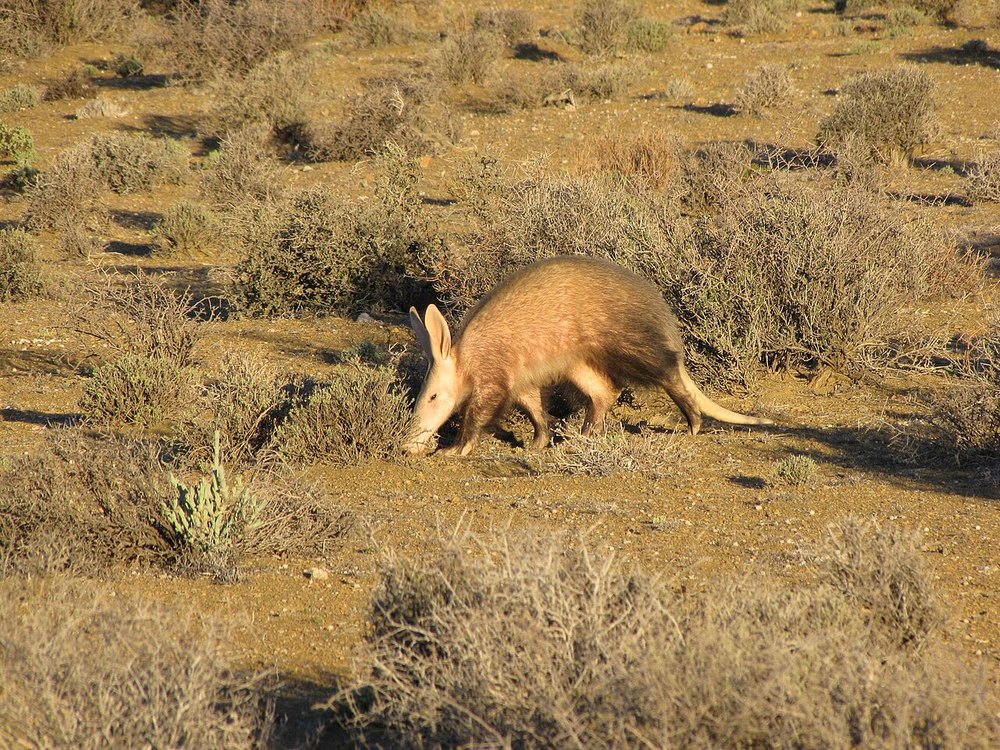
The aardvark is a stocky, medium-sized mammal with a long, tapering snout, tall upright ears and a thick tail. Its coat is pale grey-brown, with darker legs. Its forefeet have four toes and its hind feet have five, and it uses its front claws to dig.[1] Its eyesight is poor, but its hearing and sense of smell are sharp, which it uses to find food in the dark.[1]
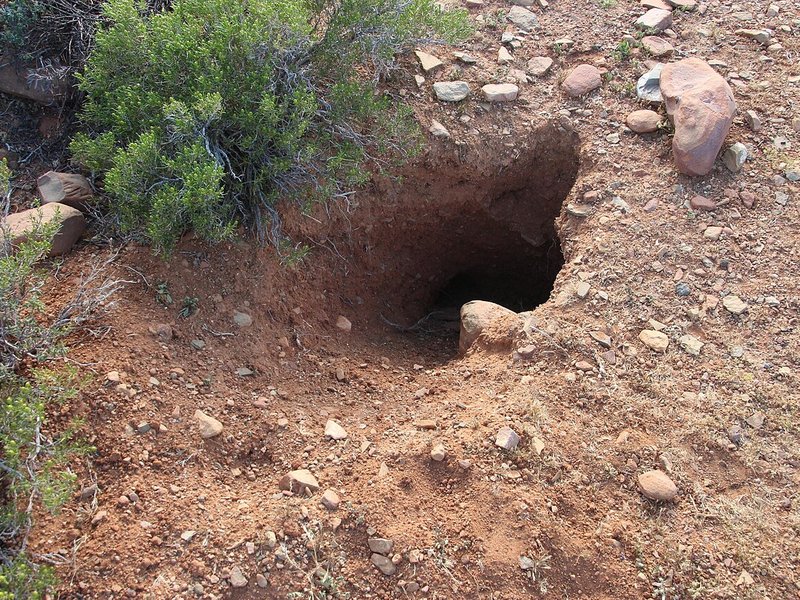
It is nocturnal and solitary. At night it forages alone, covering 2–5 km in search of ants and termites, which it digs out and licks up with a long, sticky tongue.[1] It digs quickly and can bury itself in about 10 minutes, and if it is cornered it defends itself with its front claws.[1] Burrows can reach about 6 m deep, and complex ones have 8 or more entrances.[1] It is shy and territorial. Young become independent at about 6 months.[1]
Name
"Aardvark" comes from Afrikaans and South African Dutch, from aard ("earth") and vark ("pig"), because the animal digs.[12] The word appears in English by the 1780s.[12] The animal was first described scientifically by Peter Simon Pallas in 1766, as Myrmecophaga afra, in the genus of the giant anteaters. His specimen was a foetus sent from the Cape of Good Hope the year before, already labelled with the Dutch name aardvarken, which he credited to an earlier account of the Cape by Peter Kolb.[13] Its genus name, Orycteropus, comes from Greek words for "digger" and "foot". It was published by Geoffroy Saint-Hilaire in 1796, and its authorship was later disputed.[14][32]
Other English names include antbear, earth-hog, earth-pig and, in older texts, Cape ant-bear.[12][16]
In other languages
| Language | Name | Meaning |
|---|---|---|
| Afrikaans | erdvark | earth pig |
| Dutch | aardvarken | earth pig |
| German | Erdferkel | earth piglet |
| French | oryctérope; cochon de terre | from Greek words for “digger” and “foot”; “earth pig” |
| Portuguese | porco-da-terra; porco-formigueiro | earth pig; ant pig |
| Italian | oritteropo | from Greek words for “digger” and “foot” |
| Chinese | 土豚 (tǔtún) | earth pig |
| Japanese | ツチブタ, 土豚 (tsuchibuta) | earth pig |
| Korean | 땅돼지 (ttangdwaeji) | ground pig |
| Swahili | muhanga | — |
| Zulu | isambane | also used of a restlessly industrious person |
| Xhosa | ibhenxa | — |
| Setswana | thakadu | — |
| Hausa | dabgi | — |
Meanings are given only where the name is clearly a compound or a dictionary states one. No source gives a meaning for the Swahili, Xhosa, Setswana or Hausa names.[32]
Body
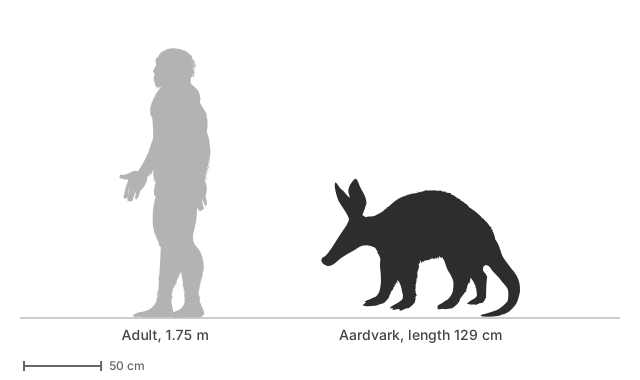
Adults weigh 40–82 kg, and males are larger than females.[1] Total length is 100–158 cm.[1] Another source gives a head-body length of 105–130 cm, a tail up to 70 cm, and a shoulder height of about 60 cm.[2] The forefeet have 4 toes and the hind feet have 5.[1] Sight is poor, but hearing and smell are sharp.[1]
Size ranges
Behavior
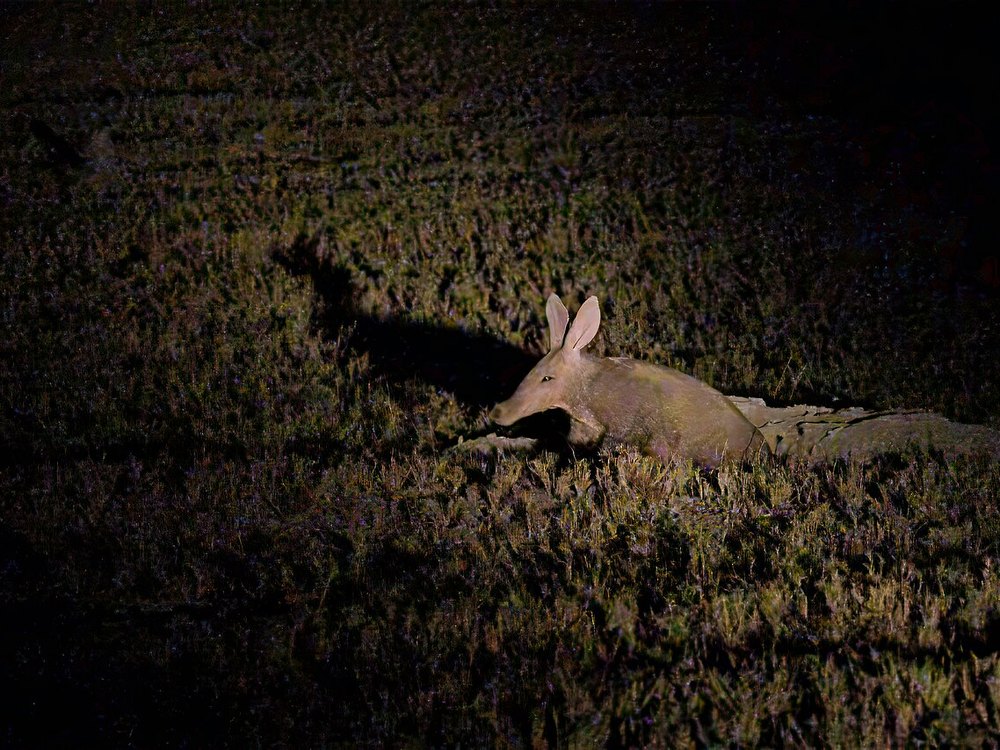
The aardvark is nocturnal, solitary, territorial and shy. It forages 2–5 km a night and holds a territory of about 1–5 km².[1] It digs burrows up to about 6 m deep, and complex ones have 8 or more entrances.[1] If cornered, it defends itself with its front claws. Its predators include lions, hyenas and leopards, and humans.[1]

Diet
The aardvark is a specialist insect eater. It swallows its food with little chewing.[1]
| Food | Type | How important |
|---|---|---|
| Ants | Insect | Most of the diet[1] |
| Termites | Insect | Also a staple; one source puts them first[3] |

Life cycle
| Stage | Age / time | Notes |
|---|---|---|
| Pregnancy | About 7 months (225 days) | Usually 1 young, sometimes 2[1] |
| Birth | Oct–Nov (north), May–Jul (South Africa) | Once a year. Newborn weighs about 1.7–1.9 kg[2] |
| Weaning | About 3 months | Another source gives 3–16 weeks[2] |
| Independence | About 6 months | [1] |
| Maturity | About 2 years | [1] |
Ecology
Predators
Lions, leopards and spotted hyenas kill aardvarks, and pythons, wild dogs and cheetahs have been recorded as predators too.[1][23] A study of photos and videos posted on social media found leopards in 84% of the recorded predation. The authors warn that this is a sample of public posts, and that leopards are more likely to be photographed because they hoist their kills into trees.[23]
Burrows shared with other animals
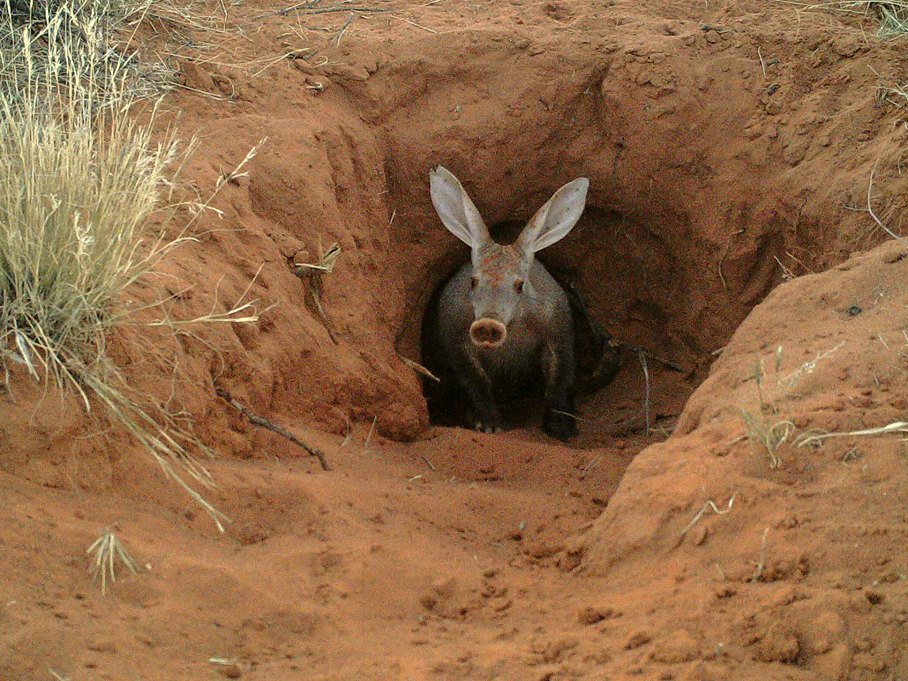
Other animals use aardvark burrows for shelter. A study at three sites in South Africa recorded 27 vertebrate species in them: 21 mammals, 2 birds, 3 reptiles and 1 amphibian. Inside the burrows the maximum temperatures were lower, and the minimum temperatures and humidity higher, than outside.[24] A camera-trap study at 36 burrows on two South African sites recorded 37 species, 13 of them at both sites.[25] Hyenas, warthogs, squirrels, hedgehogs, mongooses, bats, birds and reptiles are among the users.[1]


The aardvark cucumber
The aardvark cucumber (Cucumis humifructus) is a plant of southern African semi-deserts that buries its fruit about 20 cm underground. In a study in central Namibia, the buried fruits were dug up only by aardvarks, and every plant examined had grown from seeds in aardvark droppings. Porcupines destroy the seeds of fruits left near the surface.[26] The 2011 handbook still listed the relationship as needing confirmation.[5]
Ants, termites and drought
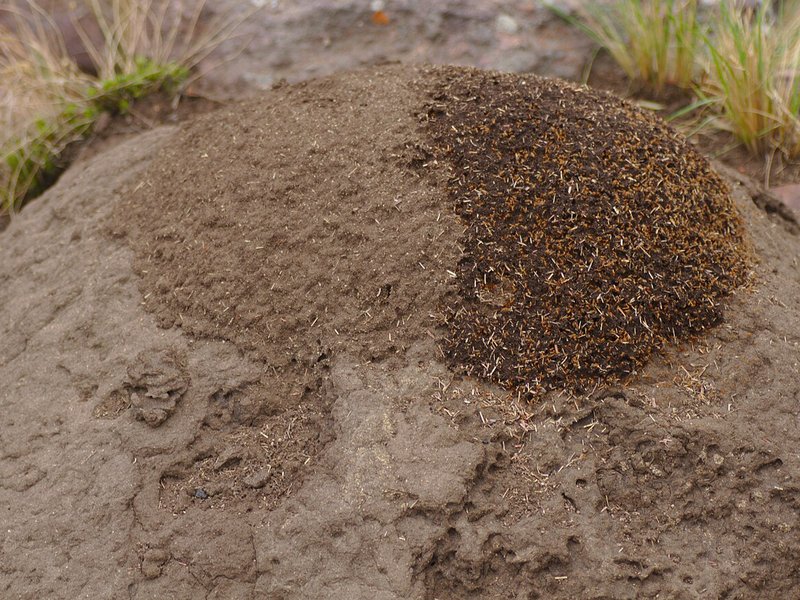
In the Karoo of South Africa, a study of 13 radio-tracked aardvarks found that the diet was entirely ants and termites. Ants dominated in every season, led by the ant Anoplolepis custodiens, followed by the termite Trinervitermes trinervoides. Termites were eaten more in winter, when ants are scarce.[27] Termite colonies are rarely destroyed after an aardvark feeds, and can be built up again.[1]
Food shortages can be deadly. In a three-year study of 12 aardvarks in the Kalahari, a drought and a food-poor winter killed seven of them, presumably from starvation. Hungry animals were often active by day, and their body temperatures varied more.[28]

Habitat and range
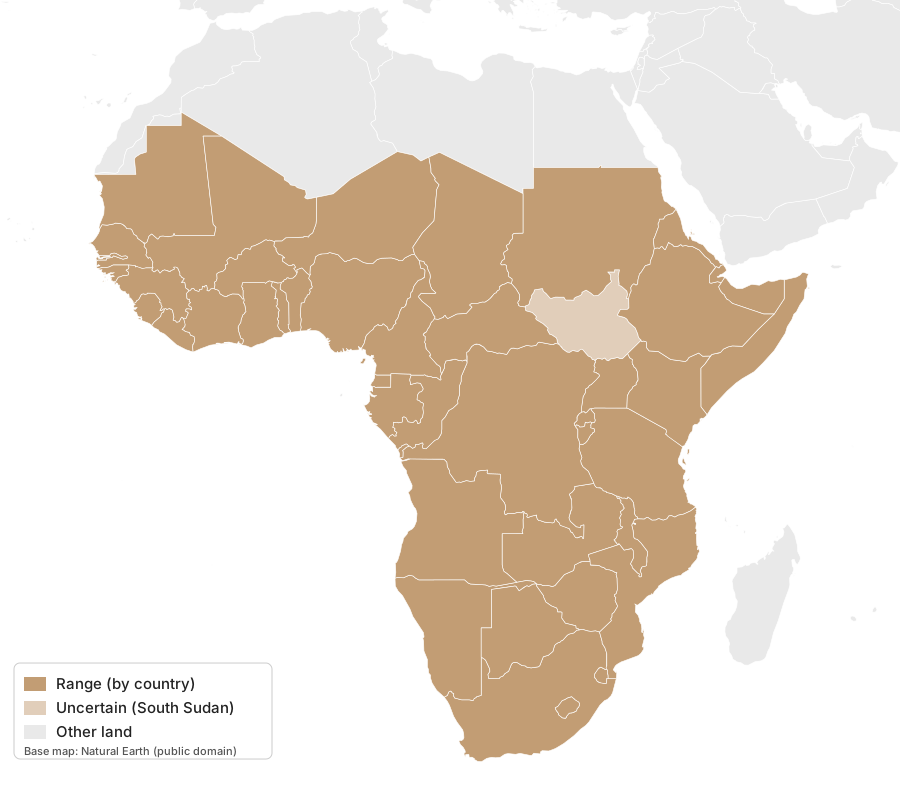
It lives across sub-Saharan Africa, except the West and Central rainforests. It prefers savanna and grassland, where ants and termites are available all year.[1] It avoids hard, compacted or rocky ground and ground that floods often.[1] Another source also lists woodland and rainforest among its habitats.[3]
Evolution
The earliest known aardvark fossils are about 20 million years old and come from Africa. Eurasian fossils date from about 15 million years ago, and aardvarks have since disappeared there. About 14 species in three or four genera are known, with the most diversity in the late Miocene. In recent times only a single genus has survived, and it lives only in Africa.[29] A fossil from Chad was closer to a Eurasian species than to other African ones, the first evidence linking African and Eurasian aardvarks.[30] The living species is known from fossils only from about 3 million years ago, although an older record in South Africa has been proposed.[29]
The aardvark's ant-eating body evolved separately from that of the anteaters and pangolins. It has a tongue up to 30 cm long, saliva that sticks to insects, weak jaw muscles and teeth without enamel.[31] Its adult mouth has 20 teeth and no incisors or canines.[5] DNA shows that its closest relatives are elephants, hyraxes and sea cows, not the anteaters it resembles.[10][18]
Forms and variants
Subspecies
Around 17 to 18 subspecies have been named since 1766, but scientists do not agree that they are real. A 2005 species list recognises 17,[4] a 2011 handbook lists 18,[5] and the Mammal Diversity Database treats every one as a synonym of the single species.[6] A 2014 study noted that none has ever been merged and that no modern revision exists.[7]
Most names were based on colour, hair, ear and tail length, and the shape of the skull and teeth, and many rest on a single animal or skull.[9] Forest forms were described as larger, with shorter ears (erikssoni, leptodon), and a savanna form as smaller with longer ears (faradjius).[9] Colour is a weak clue: the authors themselves note that red soil stains the hair.[9] The South African regional assessment says only the nominate subspecies, O. a. afer, probably lives in southern Africa.[8]
See all 18 named subspeciesThe full list gives each name, who named it, where it was described and what the original author said. It follows the 2005 and 2011 lists, and other names may have been published, so there may be more.
Conservation
The aardvark is listed as Least Concern worldwide.[1] The global assessment dates from 2015.[2] Populations are described as stable overall, with possible declines in eastern, northern and western Africa.[2]
Threats
Farmland expansionPesticidesPersecution by farmersHunting for meat and medicineLogging, roads, urban growth[1][3]History and culture
First aardvarks in Europe
The first live aardvark known to have reached Europe arrived at London Zoo in 1869. A male, bought at Port Elizabeth for £150 on 18 June, was described by the Zoological Society as "believed to be the first specimen of this singular Edentate ever brought to Europe alive". A female followed in October.[16]
Beliefs and uses in Africa
Many African peoples have given the aardvark a place in their beliefs. According to ethnographers cited by the archaeologist Pierre de Maret, the Bambara of Mali link it with agriculture. Young initiates in their tyiwara ceremonies may stay in an aardvark burrow to gain its endurance, and its tail tip is worn for energy at work. The Tabwa of the Democratic Republic of the Congo see it as an animal that links opposites, such as light and dark. Among the Luba, killing one is as serious as killing a person, because it is thought to be a reincarnation. The Tshokwe of Angola put an aardvark claw in their divination baskets, and the Nyanga tell of an aardvark that traps the sun in its burrow. In Rwanda its name also means "courageous farmer". Across Central and East Africa its teeth, claws and skin have been made into amulets and bracelets.[15]
Ancient Egypt
Some scholars have suggested that the animal of the Egyptian god Set, with its long snout and tall ears, was first modelled on an aardvark. Pierre de Maret argued this in 2005, and the idea has been revived in recent books and articles.[15][17] It remains a minority view. The Set animal is generally regarded as a fabulous creature that existed only in the Egyptian imagination, and the identification is not accepted as fact.[17]
In science
Early naturalists grouped the aardvark with the anteaters: Pallas placed it in an anteater genus, and the Zoological Society still called it an "Edentate" in 1869.[13][16] In 1998 a study of DNA placed it instead in a group of mammals of African origin, with elephants, hyraxes, sea cows, tenrecs and elephant shrews. That group was later named Afrotheria.[18]
In popular culture
The best-known fictional aardvark is Arthur, from Marc Brown's picture book Arthur's Nose (1976). A television series based on the books premiered on PBS on 7 October 1996 and ran for 25 seasons. Brown has said he chose an aardvark because he "must have been thinking alphabetically".[19] Dave Sim's comic Cerebus the Aardvark ran from December 1977 to March 2004, for 300 issues.[20] Google bought a social search company called Aardvark in February 2010, reportedly for $50 million.[21] Airmen nicknamed the F-111 jet "Aardvark" because of its oddly shaped nose, and the name was made official when the aircraft retired.[22]
Taxonomy
| Rank | Name |
|---|---|
| Kingdom | Animalia |
| Phylum | Chordata |
| Class | Mammalia |
| Order | Tubulidentata |
| Family | Orycteropodidae |
| Genus | Orycteropus |
| Species | Orycteropus afer |
Sources
- Animal Diversity Web, Orycteropus afer
- Wikipedia, Aardvark (secondary)
- African Wildlife Foundation, Aardvark (secondary)
- Schlitter 2005, Order Tubulidentata, in Mammal Species of the World, 3rd ed.
- Taylor 2011, in Handbook of the Mammals of the World, vol. 2
- Mammal Diversity Database, Orycteropus afer
- Pohlová et al. 2014, Zoo Biology 33: 433–439
- Taylor et al. 2016, South African regional Red List assessment (not the global assessment)
- Original descriptions (scans on archive.org): Matschie 1898, Matschie 1900, Lesson 1840, Lönnberg 1906, Hirst 1906, Rothschild 1907, Lydekker 1908, Grote 1921, Rothschild 1927, Hatt 1932.
- Open Tree of Life, synthetic tree (relationships and the studies behind them)
- Tarver et al. 2016, Genome Biology and Evolution (divergence ages)
- Dictionary of South African English, "aardvark"
- Pallas, P. S. 1766. Miscellanea zoologica (the original description, in Latin)
- Woodman 2021, "Whence Orycteropus?", Bionomina
- de Maret, P. 2005, Bulletin de l'Institut français d'archéologie orientale 105: 107–128 (in French)
- Proceedings of the Zoological Society of London, 1869
- de Maret 2024, "Reconsidering the Seth animal conundrum"
- Stanhope et al. 1998, PNAS 95: 9967–9972
- NPR, on the end of Arthur, 2022
- The A.V. Club, interview with Dave Sim
- TechCrunch, 12 February 2010
- Wings Over the Rockies Air & Space Museum, F-111 “Aardvark”
- Phakoago et al. 2024, Journal of Mammalogy 105: 206–214
- Whittington-Jones, Bernard & Parker 2011, “Aardvark burrows”, African Zoology 46(2)
- Netherlands 2022, MSc dissertation, University of Pretoria (camera traps at aardvark burrows)
- Johnson, Eichhoff & Midgley 2025, Plants, People, Planet 7: 1225–1234
- Taylor, Lindsey & Skinner 2002, Journal of Arid Environments 50: 135–152
- Weyer et al. 2020, Frontiers in Physiology 11: 637
- Lehmann 2008, Fossil Record 11: 67–81
- Lehmann et al. 2005, Zoological Journal of the Linnean Society
- Emerling et al. 2026, Molecular Biology and Evolution
- Names in other languages: woorden.org (Dutch), Duden (German), OQLF (French), Priberam (Portuguese), Treccani (Italian, and the Greek origin of the genus name), CC-CEDICT (Chinese), Jisho (Japanese), Standard Korean Dictionary, Princeton field guide (Swahili), Bryant 1905 (Zulu), Kropf 1915 (Xhosa), Robinson 1913 (Hausa), Tsammalex (Setswana).