The Atlantic Salmon (Salmo salar) is a fish that hatches in rivers on both sides of the North Atlantic, spends one to several years feeding at sea, and returns to its home river to spawn.[1][2] Unlike most Pacific salmon, it can spawn more than once, though few do.[2] Wild numbers have fallen a great deal: the total recorded wild catch in the North Atlantic was 364 tonnes in 2024, the lowest since records began in 1960.[3] Farmed Atlantic Salmon are far more numerous, at about 2.7 million tonnes in 2023.[4]
Quick facts
Description
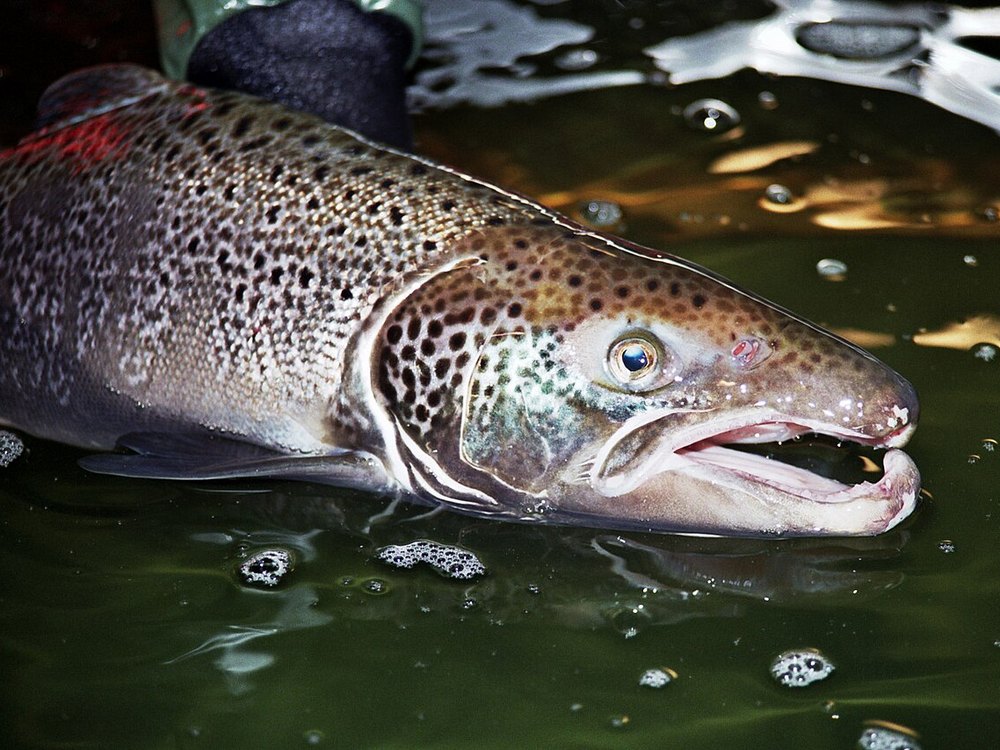
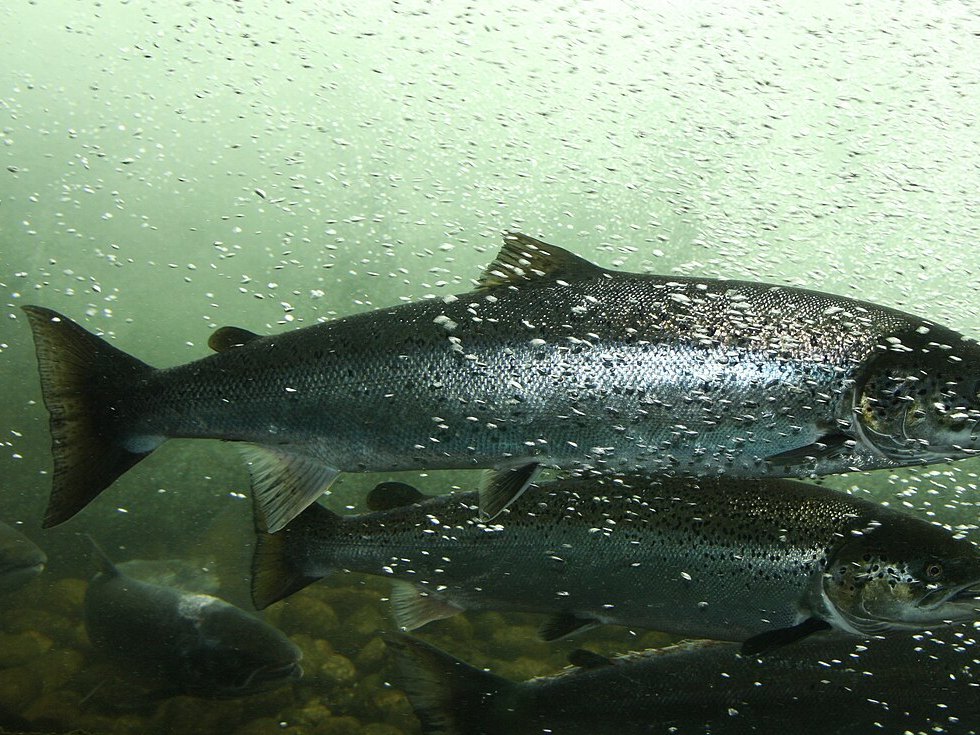
An adult Atlantic Salmon at sea is bluish-green on the back, silvery on the sides and white underneath, with a few black spots, none of them below the lateral line.[6] Young fish in rivers look quite different: they are marked with dark vertical bars called parr marks, which help them hide.[7] Before they go to sea they turn silver.[8] When they come back to spawn, they lose the silver, and turn dull brown or yellowish, a colour often called bronze.[6][7]
Spawning males grow a hooked lower jaw called a kype.[9] Males with a bigger kype tend to rank higher in the mating order.[10] After spawning, the hook of the survivors shrinks.[9]

Name
The English word “salmon” came through Old French from Latin salmo.[11][12] The Roman writer Pliny the Elder used salmo for a river fish of Aquitaine, in about AD 77.[13] Where the Latin word itself came from is unclear. The Germanic and Slavic languages use a different word, as in German Lachs and Norwegian laks.[14][15]
Linnaeus named the species Salmo salar in 1758.[16][17][18][19] The names parr, smolt, grilse and kelt are not other species: they are names for stages of one fish.[20]
In other languages
| Language | Name | Meaning |
|---|---|---|
| Norwegian | laks | Salmon (from Old Norse lax) |
| German | Lachs | Salmon (a Germanic word) |
| French | saumon atlantique | Atlantic salmon |
| Portuguese | salmão | Salmon |
| Irish | bradán | Salmon |
Names are from the dictionaries listed in the sources.[15][14][19][21][22] Names in other languages are not listed because no reliable dictionary source was found.
Body
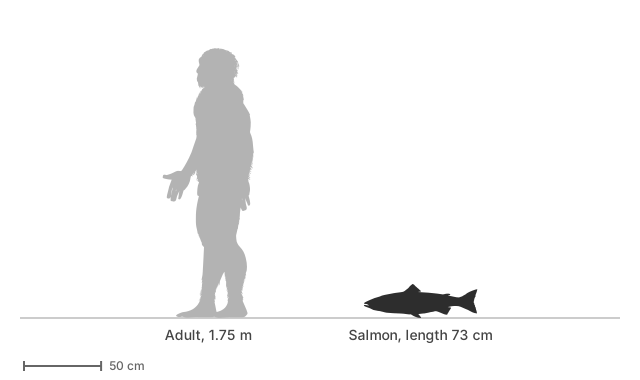
Size depends on the stage and the river. A newly hatched fish is about 28–29 mm long when it starts to feed.[23] A smolt is usually 12–13 cm long in Norway and southern Europe, but more than 20 cm in cold rivers such as those of Ungava Bay in Quebec.[2][24] In one Norwegian river, fish that had spent one winter at sea were 48–50 cm long and weighed 0.8–1 kg in summer.[24] Fish that return after two winters at sea in the USA are about 71–76 cm long and weigh 3.6–5.4 kg.[7] Fish that have spawned are not smaller: tagged ones leaving the River Alta in Norway averaged about 98–102 cm and 7–8 kg.[5]
The heaviest salmon taken by rod in Britain weighed 64 lb (about 29 kg). Georgina Ballantine caught it on the River Tay on 7 October 1922.[25][26] In Eastern Canada, the body length of one-sea-winter salmon has changed over five decades, and it was longer when fewer fish were being caught.[27]
Size ranges
Senses
Smell is essential for finding the home river.[28] At the smolt stage the fish’s sensitivity to smell and the pigments in its eyes change.[8] Young salmon can also respond to the Earth’s magnetic field in experiments.[29]
Genome
The genome is 2.97 billion base pairs long, with 46,598 genes, packed into 29 pairs of chromosomes in European fish. North American fish have 27 pairs, because two chromosomes have joined.[30][31] About 80 million years ago, the ancestor of all salmonids copied its entire genome.[30]
Behavior
Parr and smolts
Young salmon in rivers defend feeding territories. In winter they seek refuge in small spaces or under stones by day.[8][6] When they become smolts, they lose their territorial behaviour and begin to school.[8] Smolts leave in spring, when the sea is about 8 °C in Europe.[2]
At sea
Atlantic Salmon move to the open ocean very quickly after leaving fresh water.[32] Fish from both sides of the Atlantic feed off West Greenland, and fish from Europe also feed in the Norwegian Sea.[3][32] In a tagging study, post-spawned fish from Norway and Denmark swam quickly north or north-west, while fish from Ireland, Spain and Iceland mostly headed west towards East Greenland. North American fish caught at West Greenland went south into the Labrador Sea. The longest distance from release to the tag’s pop-up point was 2,940 km.[5] Six fish tagged leaving the River Alta spent 375–414 days at sea and used Arctic waters from the Barents Sea to Jan Mayen and Svalbard.[33] These were mostly fish that had already spawned, not first-time migrants.
Coming home
Salmon return to their home rivers with high precision.[32] In one Norwegian river, wild fish strayed to other rivers at a rate of about 6% and hatchery fish at about 15%.[34] In Norway most salmon enter the rivers between May and October, and large fish that spent several winters at sea tend to enter earlier.[2]

Leaping and swimming
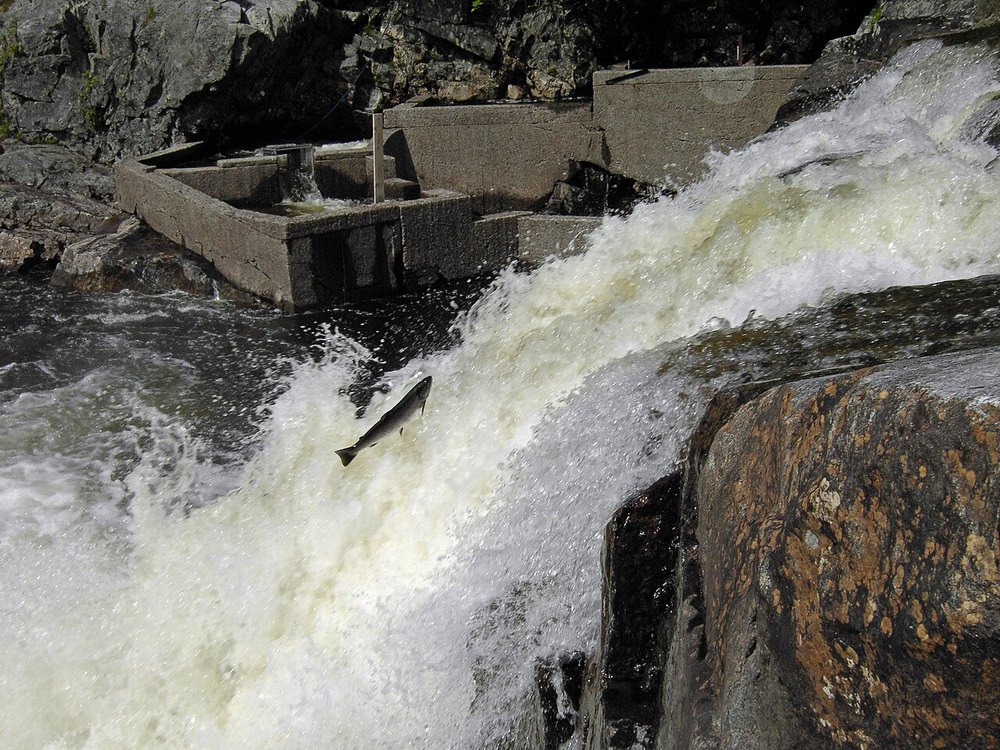
Young salmon in a test stream could jump waterfalls at least five body lengths high.[35] Farmed post-smolts could swim for hours at 2.2–2.7 body lengths a second.[36] No measured jump height for adult wild salmon is known.

Diet
Diet changes with age and place. Young fish in rivers feed mainly on aquatic insects, mollusks, crustaceans and small fish.[6] A newly hatched fish lives on its yolk sac for about 38 days at 7.5 °C before it starts to feed.[37] Post-smolts in Norwegian fjords eat mainly crustaceans and the larvae of fish such as sand eels, herring and cod relatives.[38] In the open Northeast Atlantic they feed largely on young fish, and a kind of small crustacean called an amphipod is also important.[39] Adult salmon at sea eat large crustaceans, fish and squid, and are opportunistic feeders.[32] North of the Faroe Islands, salmon in autumn ate mainly amphipods, krill and shrimps, and in late winter they took deep-sea fish such as lanternfishes.[40]
Life cycle
| Stage | Time | Notes |
|---|---|---|
| Egg | About 50–100 days | Laid in autumn in gravel. Hatching takes about 100 days at 5 °C and 50 days at 10 °C, which is about 500 degree-days. In a Norwegian hatchery study the mean was 556–563 degree-days, with single eggs from 489 to 677[37][23] |
| Alevin | About 38 days at 7.5 °C | Lives in the gravel on its yolk sac[37][20] |
| Parr | 1 to about 8 years | Marked with vertical bars. Shorter in the south and longer in the north[2][41] |
| Smolt | Spring, in the year it leaves | Silver. Usually 12–13 cm in Norway[8][24] |
| Adult at sea | 1 to 4 years | Most first spawn after 1 to 3 winters at sea[2] |
Spawning
The female picks gravel of the right size and digs a hollow called a redd by turning on her side and flexing her body up and down. She spawns with a male, and the fertilised eggs sink into the gravel and are covered.[6] The best spawning gravel is cobbles and pebbles with few fine particles, less than 20% by weight, in water about 17–76 cm deep that flows at 25–90 cm a second.[1] A female carries about 1,100 eggs for every kilogram of her weight.[1] In wild Irish fish a female averaged about 3,400 eggs after one winter at sea and about 6,000 after several, and in one river on the Kola Peninsula a fish carried as many as 17,892.[42][2] Spawning costs a one-sea-winter male or female about half of its energy.[43]
Sea age and the grilse
A fish that returns to spawn after one winter at sea is called a grilse. One that spends two or more winters at sea is a multi-sea-winter salmon.[20] In Eastern Canada, fish under 63 cm are counted as small salmon, and nearly all are one-sea-winter fish. Among returning fish of known age, 64.7% were one-sea-winter and 26.5% two-sea-winter.[27] One gene, vgll3, affects the age at which a salmon matures, and it acts differently in males and females.[44]
Young males that spawn early
Some males mature while they are still small parr, and in most rivers all mature parr are males.[2] In an experiment, mature parr fertilised a similar share of the eggs as adult males that had been to sea.[45]
Survival and spawning again
Few eggs become adults. In studied rivers, between about 0.2% and 2.6% of eggs became smolts.[2] In the Conne River, Newfoundland, an average of 4.77% of smolts came back after one sea winter.[2] The salmon is iteroparous, which means it can spawn more than once.[2] In the USA, fewer than 5% of spawners return to spawn again.[7] In a Norwegian river only 2% of older fish did.[2]
Lifespan
An Atlantic Salmon usually lives 4–6 years, and rarely 10 years or more.[6]
Ecology
In the open North Atlantic, the Atlantic Salmon is a minor part of the pelagic ecosystem, the community of the open water, both by number and by weight.[46] Its role is better known in the rivers. A review of salmon and other diadromous fish, which move between salt and fresh water, says that they bring nutrients from the sea to fresh water, and that predators such as salmon help biodiversity by cycling nutrients and controlling food webs.[47][48] These are general statements from the summaries of those papers, not measurements for Atlantic Salmon in one river.
Some Atlantic Salmon survive spawning: 10–40% of females survive, and most males die.[6] In the River Conon in Scotland, 20–36% of the spent fish, called kelts, survived, and 3–6% came back as previous spawners.[1]
Habitat and range
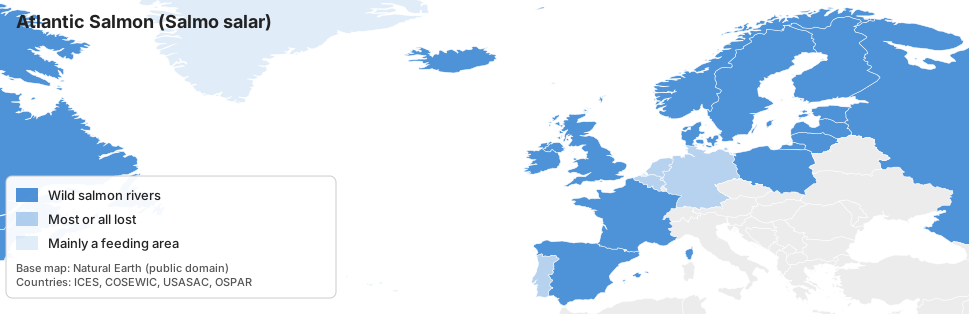
Atlantic Salmon were once found in most rivers that flow into the North Atlantic and the Baltic Sea.[49][50] In Europe they range from northern Portugal, France and Spain to northern Norway and Russia, and they live in Iceland, Ireland and Britain.[49][50] In the north-west Atlantic they now live from the Connecticut River in the United States to the rivers of Ungava Bay in Quebec.[3] Many populations have disappeared. The Rhine, once Europe’s largest salmon river, had no salmon by the end of the 1950s, and rivers in Belgium, Germany and the Netherlands had lost their salmon by the 1960s.[50] The Lake Ontario population is extinct.[49][51]
In the river
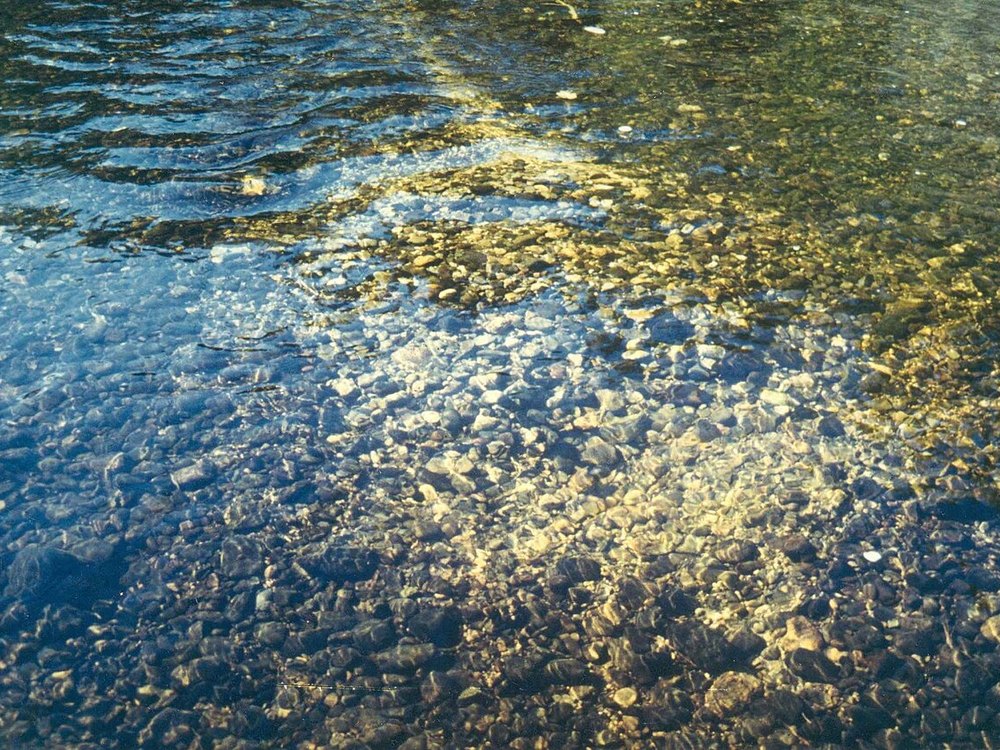
Salmon need clean, cool water with plenty of oxygen. Parr can grow between 6 and 22.5 °C, fastest at about 16 °C.[37] Eggs survive at about 0–16 °C, and deformities rise above 12 °C.[37] Above 22.5 °C, parr are under stress, and a temperature of 28 °C over seven days is lethal for warm-acclimated parr.[37] Lakes make good nurseries, and parr that live in them grow faster than those in flowing water.[2]

At sea
Tagged salmon used water of about 0–16 °C, and Norwegian fish mostly stayed in the cold.[5] Most of the time they were close to the surface, and they used the top 10 m for about 80–83% of the time.[5][33]
Evolution
The Atlantic Salmon belongs to the salmonids, the family that includes trout, charrs and the Pacific salmons. About 80–100 million years ago, the ancestor of all salmonids duplicated its whole genome, 40–50 million years before the living groups split.[30][52][53] The family’s living members shared an ancestor about 52–59 million years ago.[52][54] The oldest fossil salmonid, Sivulliusalmo, comes from Alaska and is about 73 million years old, but it may be a stem relative, not part of the living group.[55]
Within its genus, Salmo salar is the sister of all the other species, including the brown trout.[54] It split from the brown trout about 10 million years ago, but studies give anything from 2.6 to 16 million years.[56] Salmon and pike are sister groups among the ray-finned fishes.[57]
The Atlantic Salmon of North America and Europe separated more than 600,000 years ago.[58] Salmon in Norway come from two main lineages, one from the Barents and White Seas and one from the eastern Atlantic.[59]
Forms and variants
No subspecies of the Atlantic Salmon is accepted by the Catalog of Fishes, FishBase, WoRMS or ITIS.[16][18][19] GBIF lists two, which the Catalog of Fishes calls unnecessary names.[17][16] Instead, the species has several life-history forms. There may be more than this list shows.
Forms
| Form | Description | Location | Notes |
|---|---|---|---|
| Sea-run salmon | The usual form: born in a river, feeds at sea, returns to spawn | Both sides of the North Atlantic | Sea age varies from one winter to several[2] |
| Landlocked salmon | Spends its whole life in fresh water, usually feeding in a lake | Sebago Lake in Maine, the ouananiche of Quebec and Labrador, Lake Vänern in Sweden, Lake Saimaa in Finland | Smaller on average. Adults at maturity range from 10 to 85 cm and 17 to 7,200 g[41][60][61] |
| River-resident salmon | Lives its whole life in a river | The upper River Namsen, Norway (the småblank) | The only European salmon that completes its life cycle in a river. Cut off for about 9,500 years[60] |
| Grilse and multi-sea-winter salmon | Age classes: one winter at sea, or two or more | Everywhere | Not separate forms; influenced by a gene[20][44] |
| Mature male parr | Small males that mature before going to sea | Most rivers | Fertilise eggs by sneaking[2][45] |
| Farmed salmon | Strains bred since the early 1970s | Norway, Chile, the UK, Canada and others | About 12 generations of breeding; they escape and breed with wild fish[62] |
| Hybrids with brown trout | Cross between two species of Salmo | Southern Europe and elsewhere | Mostly a salmon mother; hybrids are less fertile[63] |
Names for lake salmon
Names such as Salmo salar m. sebago and “ouananiche” are used for landlocked salmon, but the Catalog of Fishes lists them as synonyms of the species, not as subspecies.[16] In the old Sebago case, no difference in shape could tell landlocked salmon from sea-run fish.[41]
Farmed salmon
Farmed fish are about two to two and a half times the size of wild fish raised together with them in the same conditions, after seven or eight generations of breeding. They also differ in shape, in when they become smolts, and in how often the males mature as parr.[62] Tens of millions have escaped since the 1970s. Introgression, the spread of farmed genes into wild populations, has been found in about half of 150 Norwegian populations, with an average of 6.4% across 109 of them. The offspring of farmed fish do less well in the wild.[62]
Conservation
The Atlantic Salmon is Near Threatened on the IUCN Red List. It was assessed in 2022 and the result was published in December 2023, when it moved up from Least Concern.[17][64] Some populations are in much worse trouble. In Canada, a 2010 assessment recognised 16 populations: 5 Endangered, 1 Threatened, 4 of Special Concern, 4 Not at Risk, 1 Data Deficient and 1 Extinct (Lake Ontario).[49] In the USA, the Gulf of Maine population is Endangered under the Endangered Species Act.[7]
Decline
The number of wild salmon alive before any fishing, called the pre-fishery abundance, fell by more than half between 1983 and 2016, from about 7 million to about 3.4 million fish.[65] In North America, the yearly average since 1993 is about half that of 1971–1992.[3] The total wild catch in the North Atlantic was 364 tonnes in 2024, the lowest since 1960, with Russia missing from the figure.[3] In 2024 only 1,520 adults returned to all US rivers, 99.8% of them to Maine.[66] Survival at sea has been low and has fallen since the late 1980s, especially for fish that stay several winters at sea and in the south of the range.[46]
Threats
Dams and other barriers have been a leading cause of loss: in France, 75% of the spawning sites were out of reach by 1900.[50] Other threats are poor habitat, climate change and changes at sea, escaped farmed fish, and parasites.[67][3] Escaped farmed salmon are the largest current threat in Norway.[68] Salmon lice from farms harm wild fish, though how much is debated.[69] A skin parasite, Gyrodactylus salaris, has been found in 53 Norwegian rivers, and the mean mortality of young fish in affected rivers is about 86%.[70]
Action
The international body NASCO was set up by a convention that came into force on 1 October 1983. The convention created a large protected zone beyond 12 nautical miles from the coast, where in most areas no targeted salmon fishing takes place.[71] There has been no salmon fishery at the Faroe Islands since 2000.[72] The commercial export fishery at West Greenland has been closed in all but two years since 1998.[73] Drift-net fishing for salmon in Scotland was banned in 1962.[74]
History and culture
Ancient records
A life-size fish is carved in relief on the roof of the Abri du Poisson in the Dordogne, France. The French national museum of prehistory dates it to about 25,000 BC and reads it as a male salmon worn out from spawning.[75] Izaak Walton, in The Compleat Angler, called the salmon “the King of freshwater fish”.[76] Clause 33 of Magna Carta (1215) ordered the removal of fish-weirs from the Thames, the Medway and the whole of England, except on the sea coast. The clause does not mention salmon.[77]
Folklore
In the Irish tale of the boyish exploits of Finn, the poet Finnéces spent seven years watching for the salmon of Fec’s Pool. It was prophesied that when he ate it, nothing would remain unknown to him. Young Finn burned his thumb while cooking it, and whenever he put the thumb in his mouth afterwards, he knew what he had not known.[78] In the Welsh story of Culhwch and Olwen, the Salmon of Llyn Llyw carries two men on his shoulders to find the prisoner Mabon.[79]
First Nations
The Mi’kmaw conservation plan for Atlantic Salmon, Plamu, says that the Mi’kmaq “developed an intimate and sacred relationship with the salmon” and guides harvest by Netukulimk: taking what is needed and not wasting it.[80] The Wolastoqey Nation in New Brunswick says that the Wolastoqiyik “are salmon people”, and that they have been unable to harvest salmon from their own river since 1998.[81]
Rivers that lost their salmon
The last record of a salmon in the Thames was in 1833. A single fish was caught downstream of London in 1974 after the water improved, and hundreds returned each year in the late 1980s. Numbers later fell, and the returning fish were mostly strays from other rivers.[82][83] The Lake Ontario population was declared extirpated in 1896.[51] The Rhine’s salmon were gone by the end of the 1950s.[50]
Fisheries
The commercial fishery for salmon at sea reached its peak in 1973, with about 3.5 million fish caught.[65] Since then, limits on fishing at sea, closures of net fisheries and the end of the Faroese fishery have cut the catch, along with a fall in salmon numbers.[3][72]
Farming
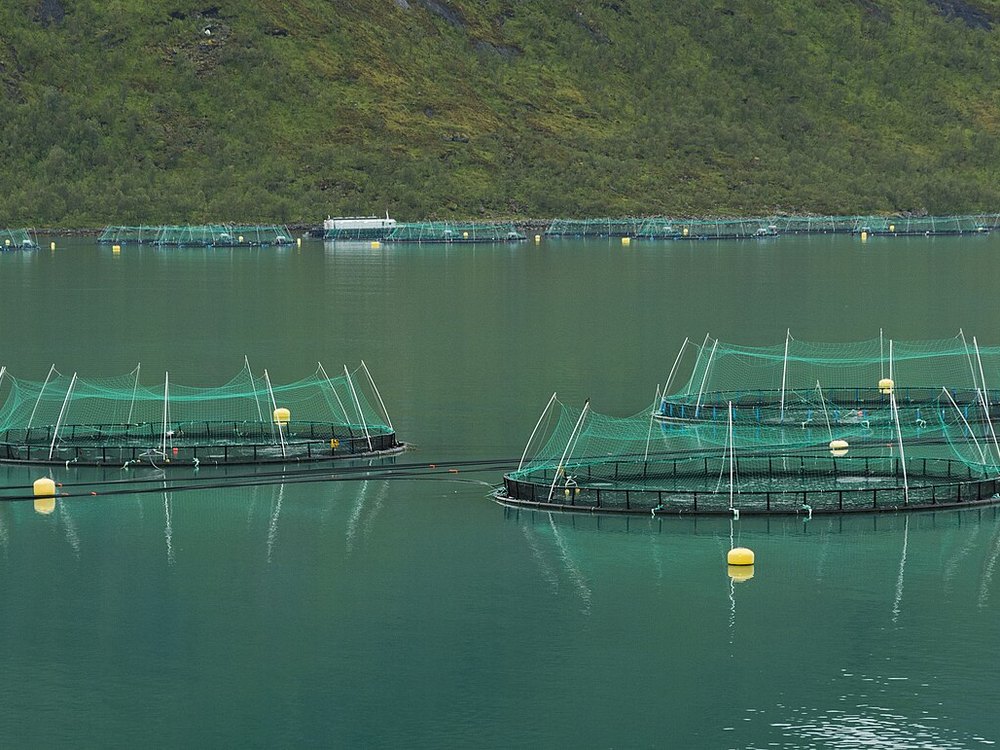
The Norwegian Seafood Council marks 28 May 1970, when the brothers Ove and Sivert Grøntvedt put the first successful generation of farmed salmon into a floating net pen on Hitra, as the start of modern salmon farming. This is the industry’s own account.[84] By 2023 farmed Atlantic Salmon production was about 2.7 million tonnes. Norway produced 1.54 million tonnes, Chile 0.77 million and the UK 0.15 million.[4] The farms have brought escapes, lice and disease, which are covered under Conservation.

Genetically modified salmon
In November 2015 the US Food and Drug Administration approved the AquAdvantage Salmon, an Atlantic Salmon with a growth-hormone gene from a Chinook salmon. The fish are all female and sterile, and they are grown in tanks on land.[85] Health Canada and the Canadian Food Inspection Agency approved it on 19 May 2016.[86]
Science
The Atlantic Salmon genome was published in 2016.[30] Georgina Ballantine’s 64 lb salmon of 1922 is still the heaviest salmon caught by rod in Britain.[25]
Taxonomy
| Rank | Name |
|---|---|
| Kingdom | Animalia |
| Phylum | Chordata |
| Class | Actinopterygii (ray-finned fishes)[19][18] |
| Order | Salmoniformes[19][17] |
| Family | Salmonidae[19][17] |
| Genus | Salmo Linnaeus, 1758[16] |
| Species | Salmo salar Linnaeus, 1758[16][17][18][19] |
The Atlantic Salmon is the type species of Salmo.[16] ITIS and WoRMS put the ray-finned fishes above the class Teleostei.[19][18] The species is a different animal from the Pacific salmons, which belong to the genus Oncorhynchus. The number of species in Salmo is not settled, and databases disagree. The original description gives the type locality as the European seas and rivers, and no type specimens are known.[16]
Sources
- Hendry & Cragg-Hine 2003, Ecology of the Atlantic salmon, English Nature
- Klemetsen et al. 2003, Ecology of Freshwater Fish 12: 1–59 (life histories of salmon, trout and charr)
- ICES 2025, advice on North Atlantic salmon stocks (NASCO copy)
- FAO, global aquaculture production data (to 2023)
- Rikardsen et al. 2021, Scientific Reports 11: 12266 (satellite-tagged salmon at sea)
- FishBase, Salmo salar
- NOAA Fisheries, Atlantic salmon
- McCormick et al. 1998, Canadian Journal of Fisheries and Aquatic Sciences 55 (Suppl. 1): smolt physiology
- Witten & Hall 2003, Journal of Anatomy 203: 435–450 (the kype)
- Perry et al. 2019, Royal Society Open Science 6: 190021 (kype size)
- Dictionary.com, salmon
- Lewis & Short, Latin Dictionary, salmo
- Pliny the Elder, Natural History 9 (Latin text)
- DWDS, Lachs (in German)
- Bokmålsordboka, laks (in Norwegian)
- Eschmeyer’s Catalog of Fishes, Salmo salar
- GBIF backbone, Salmo salar
- World Register of Marine Species, Salmo salar
- ITIS, Salmo salar
- Ritter & Harger 1974, ICES, Atlantic salmon life-stage terms
- Priberam dictionary, salmão (in Portuguese)
- Fóclóir Gaeilge–Béarla, bradán (in Irish)
- Solberg et al. 2014, PLOS ONE 9: e113697 (hatching and alevin growth)
- Power et al. 2023, Ecology and Evolution 13: e10656 (River Namsen salmon)
- Perth Museum, Miss Ballantine’s salmon
- Scone Palace, Georgina Ballantine
- Imlay et al. 2024, Ecology and Evolution 14: e11538 (body length in Eastern Canada)
- Stabell 1984, Biological Reviews 59: 333–388 (smell and homing)
- Scanlan et al. 2018, PNAS 115: 10995–10999 (magnetic orientation of young salmon)
- Lien et al. 2016, Nature 533: 200–205 (the Atlantic salmon genome)
- Brenna-Hansen et al. 2012, BMC Genomics 13: 432 (chromosomes)
- Hansen & Quinn 1998, Canadian Journal of Fisheries and Aquatic Sciences 55 (Suppl. 1): the sea phase
- Strøm et al. 2018, Animal Biotelemetry 6: 3 (tagged salmon in the Arctic)
- Jonsson et al. 2003, Journal of Fish Biology 62: 641–657 (straying in the River Imsa)
- Symons & Heland 1978, Journal of the Fisheries Research Board of Canada 35 (leaping)
- Hvas et al. 2021, Aquaculture Environment Interactions 13 (swimming of farmed fish)
- Environment Agency 2008, thermal biology of brown trout and Atlantic salmon
- Rikardsen et al. 2004, Journal of Fish Biology 64: 1655–1679 (post-smolts in fjords)
- Haugland et al. 2006, ICES Journal of Marine Science 63: 1488–1500 (post-smolt diet)
- Jacobsen & Hansen 2001, ICES Journal of Marine Science 58: 916–933 (salmon diet at sea)
- Power 1958, Arctic 11: 86–92 (freshwater forms in eastern North America)
- de Eyto et al. 2015, Fisheries Research 164: 159–169 (eggs per female)
- Jonsson et al. 1991, Journal of Fish Biology 39 (energy cost of spawning)
- Barson et al. 2015, Nature 528: 405–408 (a gene for age at maturity)
- Myers & Hutchings 1987, Journal of Fish Biology 31 (mature male parr)
- Chaput 2012, ICES Journal of Marine Science 69: 1538–1548 (abundance and survival)
- Watz et al. 2021, Fish and Fisheries 23: 478–491 (Atlantic Salmon in regulated rivers and ecosystem services)
- Ouellet et al. 2022, Frontiers in Ecology and Evolution 10: 1007599 (diadromous fish and ecosystem resilience)
- COSEWIC 2010, assessment of Atlantic Salmon in Canada
- OSPAR Commission 2008, case report for Atlantic salmon
- Bring Back the Salmon, history of salmon in Lake Ontario
- Macqueen & Johnston 2014, Proceedings of the Royal Society B 281: 20132881 (genome duplication and the salmonid tree)
- Robertson et al. 2017, Genome Biology 18: 111 (genome duplication)
- Crête-Lafrenière et al. 2012, PLOS ONE 7: e46662 (salmonid family tree)
- Brinkman et al. 2025, Papers in Palaeontology 11 (the oldest salmonid fossil)
- TimeTree, Atlantic Salmon and brown trout (summary of 11 studies)
- Betancur-R et al. 2017, BMC Evolutionary Biology 17: 162 (the fish tree of life)
- Lehnert et al. 2019, Molecular Ecology 28 (North American and European salmon)
- Norwegian salmon lineages, Ecology and Evolution 2019
- Sandlund et al. 2014, Ecology and Evolution 4: 1538–1554 (a river-resident population)
- Hutchings et al. 2019, Canadian Journal of Fisheries and Aquatic Sciences (landlocked salmon)
- Glover et al. 2017, Fish and Fisheries 18: 890–927 (farmed and wild salmon)
- Hybrids of salmon and brown trout in southern Europe, Journal of Heredity 2010
- Institute of Fisheries Management, news of the IUCN reassessment (December 2023)
- NASCO, state of North Atlantic salmon
- U.S. Atlantic Salmon Assessment Committee, report no. 37 (2024)
- Thorstad et al. 2021, Aquatic Conservation 31: 2654 (threats to Atlantic salmon)
- Forseth et al. 2017, ICES Journal of Marine Science 74: 1496 (threats in Norway)
- Torrissen et al. 2013, Journal of Fish Diseases 36 (salmon lice)
- The parasite Gyrodactylus salaris in Norway, Journal of Fish Diseases 2024
- NASCO, about the organisation
- NASCO, Faroese salmon fishery measures
- NASCO, West Greenland salmon fisheries
- NASCO 2001, EU measures to protect salmon
- Musée national de Préhistoire, the Abri du Poisson
- Izaak Walton, The Compleat Angler (Project Gutenberg)
- Magna Carta Project, clause 33 of Magna Carta (1215)
- “The Boyish Exploits of Finn”, translated by Kuno Meyer (CELT)
- Lady Charlotte Guest, The Mabinogion (Project Gutenberg)
- Mi’kmaw Conservation Harvesting Plan for Atlantic Salmon (Plamu), 2025–26
- Wolastoqey Nation in New Brunswick, “Save Wolastoq’s salmon”
- University of Exeter 2011, salmon in the River Thames
- Griffiths et al. 2011, Biological Conservation 144 (salmon in the Thames)
- Norwegian Seafood Council, “Celebrating 50 years of modern aquaculture”
- U.S. Food and Drug Administration, AquAdvantage Salmon fact sheet
- Health Canada and CFIA, news release, 19 May 2016