Farmed Atlantic Salmon are strains bred for fish farming. About 2.7 million tonnes were farmed in 2023, far more than the wild catch.[1][2]
Habitat and range
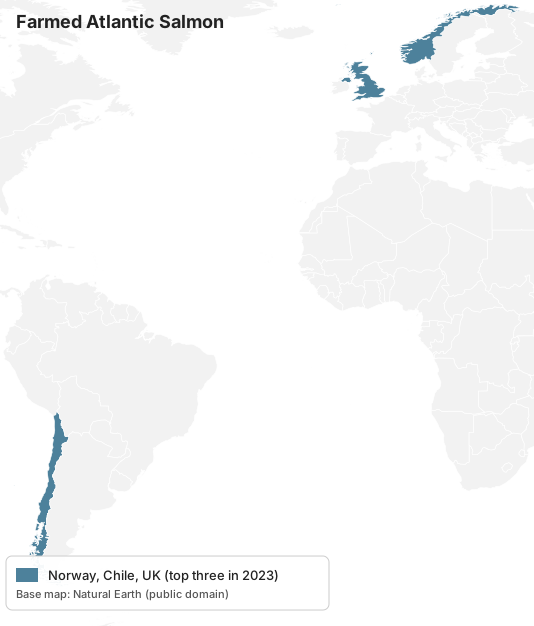
The three largest producers in 2023 were Norway, Chile and the UK.[1]
Origin and change
Commercial salmon farming began in Norway in the late 1960s. The first family-based breeding programme collected eggs and milt from 40 Norwegian rivers and one Swedish river in 1971–74.[3] Three Norwegian strains dominate world production, and by 2017 farmed fish had been bred for about 12 generations.[3] In a trial with fish raised in the same conditions after seven or eight generations, farmed fish were about two to two and a half times the size of wild ones. They also differ in shape, in when they become smolts, in how often males mature as parr, and in behaviour.[3] The kype of a farmed male is smaller on average.[4]
Status and use
World production was 2.71 million tonnes in 2023. Norway produced 1.54 million tonnes, Chile 0.77 million and the UK 0.15 million.[1] In 2024 the wild catch in the whole North Atlantic was 364 tonnes.[2]
Escapes and wild fish
Tens of millions of farmed salmon have escaped since the 1970s, and they breed with wild fish.[3] Farmed genes were found in about half of 150 Norwegian populations, with an average of 6.4% across 109 of them, and the offspring of farmed fish did less well in the wild.[3] Escaped farmed salmon are the largest current threat to wild salmon in Norway.[5] Salmon lice from farms also harm wild fish, though how much is debated.[6]
Sources
- FAO, global aquaculture production data (to 2023)
- ICES 2025, advice on North Atlantic salmon stocks (NASCO copy)
- Glover et al. 2017, Fish and Fisheries 18: 890–927 (farmed and wild salmon)
- Perry et al. 2019, Royal Society Open Science 6: 190021 (kype size)
- Forseth et al. 2017, ICES Journal of Marine Science 74: 1496 (threats in Norway)
- Torrissen et al. 2013, Journal of Fish Diseases 36 (salmon lice)