Landlocked salmon are Atlantic Salmon that spend their whole lives in fresh water. They usually feed in a lake and spawn in the rivers that flow into it. They are the same species as the sea-run salmon.[1][2]
Habitat and range
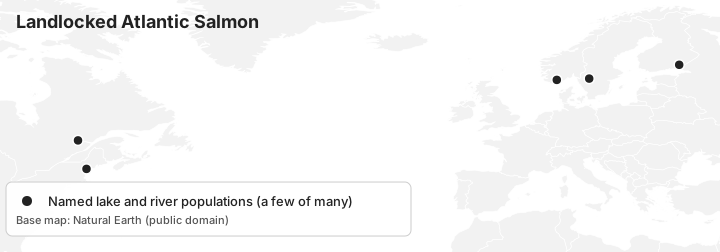
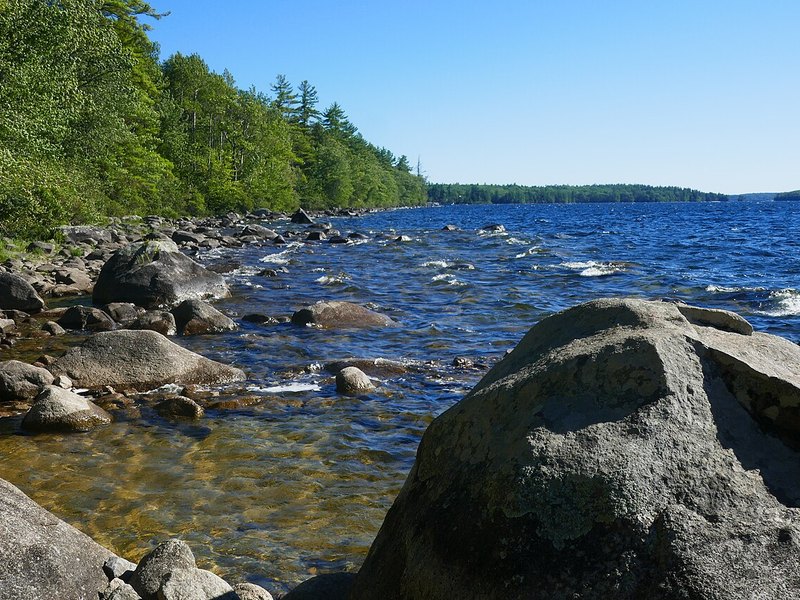
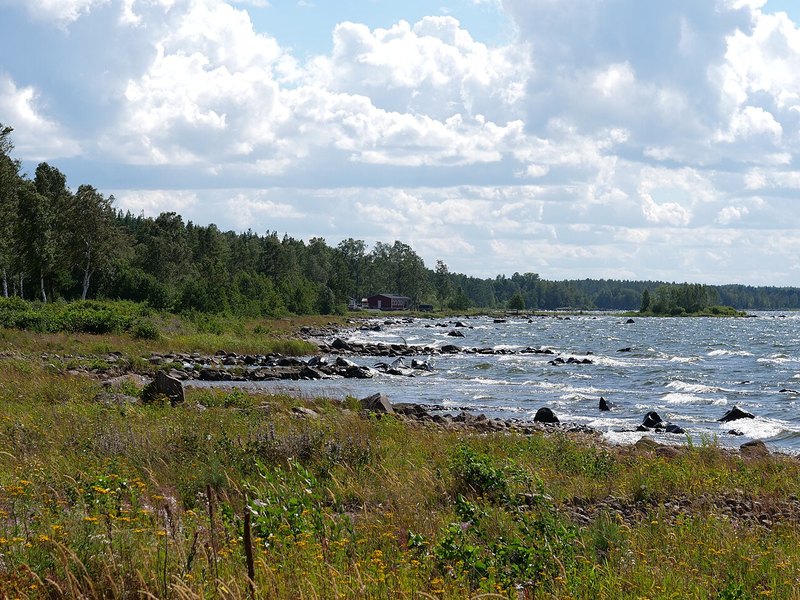
Landlocked salmon live in eastern North America and northern Europe, in habitats from a few hundred metres of river to the largest lakes of Europe.[3] In eastern North America, the best known are the Sebago salmon of the north-eastern United States and the ouananiche of Quebec and Labrador, which is centred on Lake Saint-Jean.[1] In Europe, there are populations in Lake Vänern in Sweden and in Lake Saimaa in Finland, and in Norway in the Otra river and Byglandsfjord lake.[2][4]


Life cycle
Landlocked salmon tend to be smaller than sea-run fish. Across populations, they mature at lengths from 10 to 85 cm and at weights from 17 to 7,200 g, and they live from 3 to 14 years.[3][1] A famous example is the ouananiche, whose adults average 2–3 lb and rarely reach 6 lb.[1]
Status and use
Names such as Salmo salar m. sebago and “ouananiche” are used for these fish, but the Catalog of Fishes lists them as synonyms of the species, not as subspecies.[5] In an old study of the Sebago salmon, no difference in shape could tell it from sea-run fish.[1] Some populations are in trouble. The Lake Saimaa salmon is critically endangered and has depended on hatchery broodstock for about half a century, since hydropower dams were built.[4] The Lake Ontario population is extinct.[6]
Sources
- Power 1958, Arctic 11: 86–92 (freshwater forms in eastern North America)
- Sandlund et al. 2014, Ecology and Evolution 4: 1538–1554 (a river-resident population)
- Hutchings et al. 2019, Canadian Journal of Fisheries and Aquatic Sciences (landlocked salmon)
- Leinonen et al. 2020, PLOS ONE 15: e0232723 (Lake Saimaa salmon)
- Eschmeyer’s Catalog of Fishes, Salmo salar
- COSEWIC 2010, assessment of Atlantic Salmon in Canada