The Bald Eagle (Haliaeetus leucocephalus) is a large sea eagle that lives only in North America.[1] Adults have a dark brown body, a white head and tail, and a yellow bill.[2][3] It usually eats fish, but it also takes birds and mammals and feeds on carrion.[3] It has been the eagle on the Great Seal of the United States since 1782, and in December 2024 Congress named it the national bird.[3][1]
Quick facts
Description
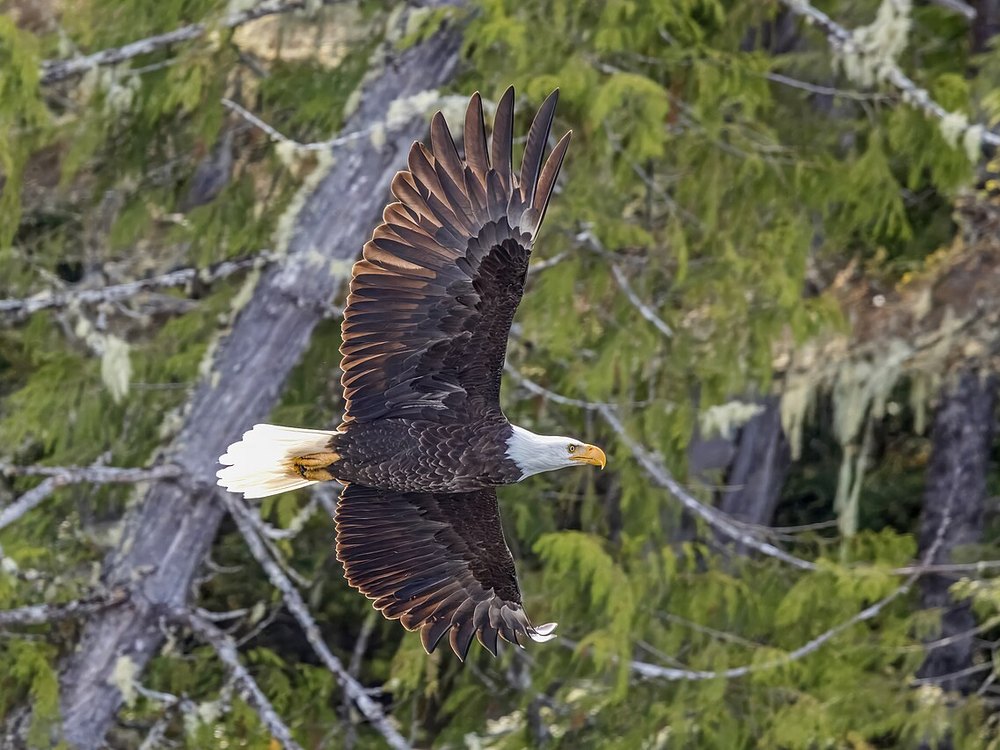
The adult Bald Eagle has a dark brown body that can look almost black, a white head and tail, and yellow eyes, bill and feet.[2][3] Males and females look alike, but the female is larger.[2] The feet are large and carry sharp talons.[2] A young eagle is brown with white blotches. It gets its white head and tail at 4 to 5 years old.[3]
Females are the larger sex, as in most birds of prey. Size alone can tell the sexes apart: one museum study of skins sexed 98.1% of eagles correctly from body measurements.[7]
Name
The word “bald” in the name does not mean hairless. It is an older sense, “having white on the head”.[8] Dictionary.com traces it to Middle English balled, from a word for a white spot, while Wiktionary says the origin is uncertain.[8][9] “Bald eagle” is an Americanism that dates from about 1680–90.[10] The species name leucocephalus means “white-headed”, and the genus name Haliaeetus means “sea eagle”.[4] US law also calls it the “American eagle”.[11]
Linnaeus named it Falco leucocephalus in 1766.[12][13]
In other languages
| Language | Name | Meaning |
|---|---|---|
| French | pygargue à tête blanche | white-headed sea eagle |
| Spanish | pigargo americano | American sea eagle |
| Portuguese | pigargo-americano | American sea eagle |
| German | Weißkopf-Seeadler | white-head sea eagle |
| Italian | aquila di mare testabianca | white-headed sea eagle |
| Russian | белоголовый орлан | white-headed sea eagle |
| Japanese | ハクトウワシ | white-head eagle |
| Chinese | 白头海雙 | white-headed sea eagle |
| Ojibwe | migizi | bald eagle |
| Plains Cree | mikisiw | eagle, bald eagle |
Most of the names are from the IOC list of bird names.[14] Ojibwe and Plains Cree names come from the two community dictionaries.[15][16] Meanings are literal translations. Pigargo is an old word for a sea eagle with a white tail.[17] Names in other languages are not listed because no reliable dictionary source was found.
Body
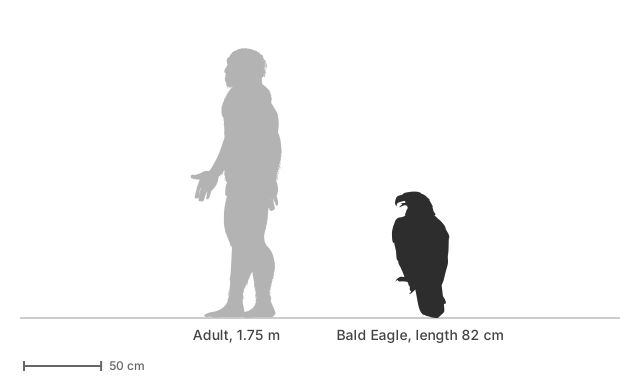
Adults are about 70–95 cm long, with a wingspan of about 1.8–2.3 m, and weigh about 3–6.5 kg.[18][2][19] Large females can reach a wingspan of about 2.4 m, and the biggest females, in Alaska, about 7 kg. Eagles in the north are larger than those in the south.[20]
In one study, adult eagles trapped in Montana on their way south, probably from breeding grounds in northern Canada, weighed 4.3 kg for males (6 birds) and 5.1 kg for females (12 birds), so females were about a fifth heavier. Their wingspans averaged 1.95 m for males and 2.05 m for females. The hind talon, the largest, was 40 mm long in males and 45 mm in females.[21] The samples were small.
Size ranges
Behavior
Daily life
The Bald Eagle is active by day.[2] Northern eagles migrate south for the winter, alone and by day.[20][18] After catching a fish too heavy to lift, an eagle may swim to shore, pulling itself along with its wings.[4]
_in_flight_Tofino.jpg)
Voice
Its voice is weak and high: thin chirps, whistles and harsh chattering.[2][18] Film and television commonly give eagles the call of a Red-tailed Hawk instead.[4][5][6]
Pairs and territory
Pairs usually stay together until one of them dies, and a bird that loses its mate will take a new one.[18][2] In courtship, two eagles may fly high, lock talons and cartwheel towards the ground, letting go just before they hit it.[18][2] Breeding eagles defend a territory by calling and chasing other eagles.[2] Nests are reused year after year.[22]
Winter gatherings
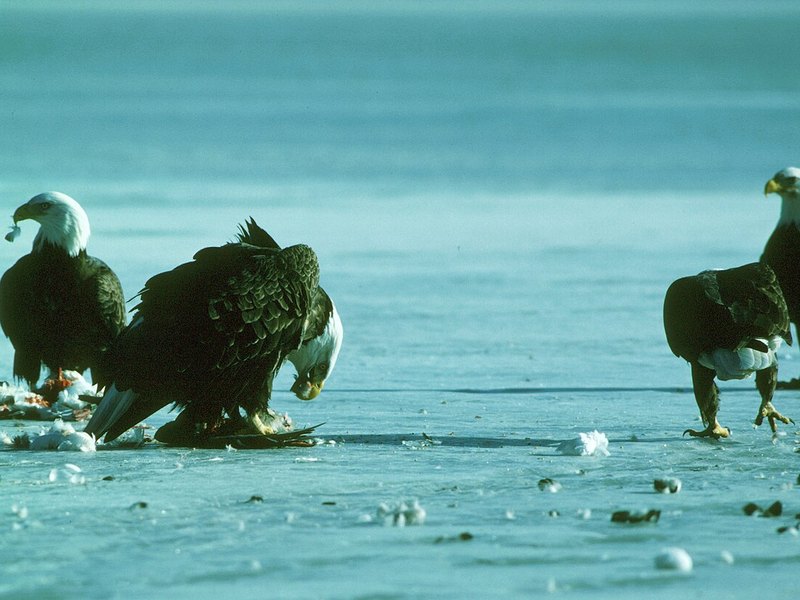
Outside the breeding season, eagles can gather in groups where food is plentiful. In winter in the Klamath Basin, on the border of Oregon and California, five roosts and three feeding areas were studied, and the count peaked at about 500 eagles.[23] Roosts of up to 400 birds are reported elsewhere.[2]
.jpg)
Stealing food
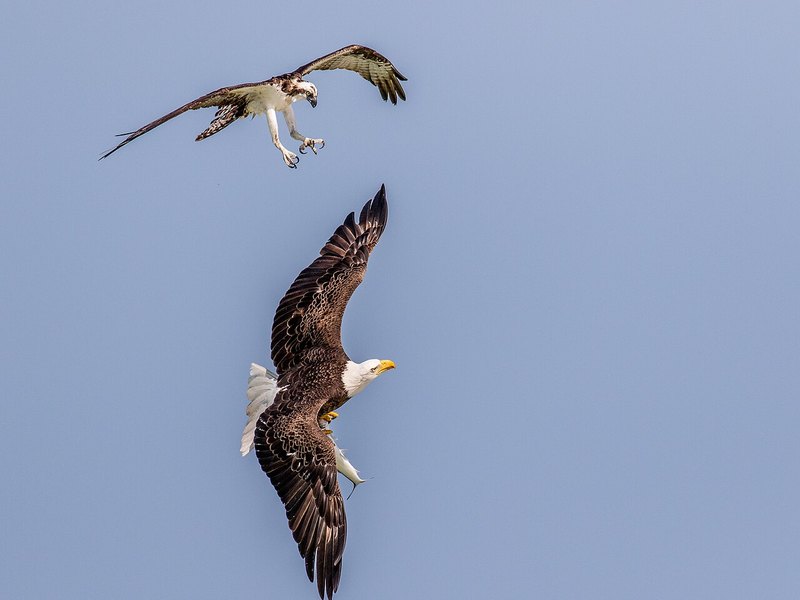
The Bald Eagle often steals fish from other birds, including the Osprey.[18][4][6] On the Mississippi River in winter, eagles robbed other kinds of birds successfully in 55% of 65 attempts, but robbed other eagles successfully in only 8% of 273 attempts.[24]
.jpg)
Diet
The Bald Eagle is an opportunist: it scavenges, steals food from other species, and catches its own prey when it has to. It eats many kinds of vertebrates, but generally prefers fish.[3] It hunts from a perch or by flying low over water or land, and takes prey in its talons. It does not dive under the surface, and lifts fish from near the top of the water.[18][2] Eagles also feed on carrion.[20] Fish are not always the main food:
| Place and time | What the eagles ate |
|---|---|
| Western Washington, nests | 53% birds, 34% fish, 9% mammals[25] |
| Florida Bay, nests, 2009–10 | Fish 70%, birds 29%[26] |
| New Brunswick, winter | 43% white-tailed deer, 30% offal, 16% birds, 3% fish[27] |
Percentages count items found at nests or seen being eaten, not weight of food. Remains at nests can over-represent birds.
In winter trials with four captive eagles, an eagle ate about 92 g of chum salmon, 75 g of jack rabbit or 65 g of mallard for every kilogram of its own weight each day.[28]
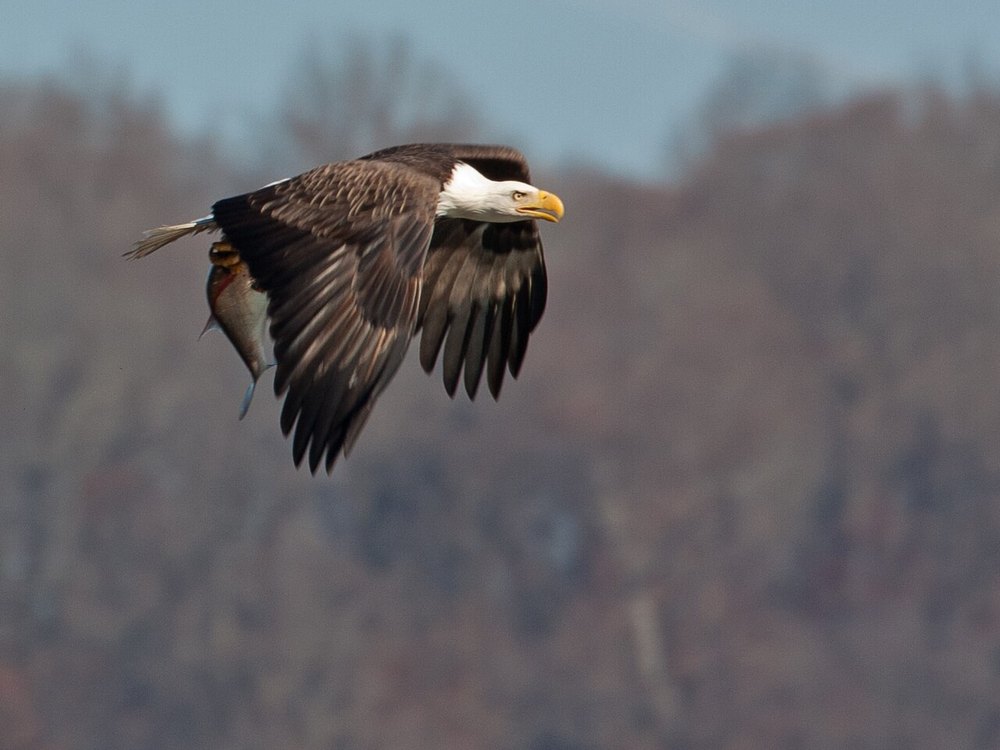
.jpg)
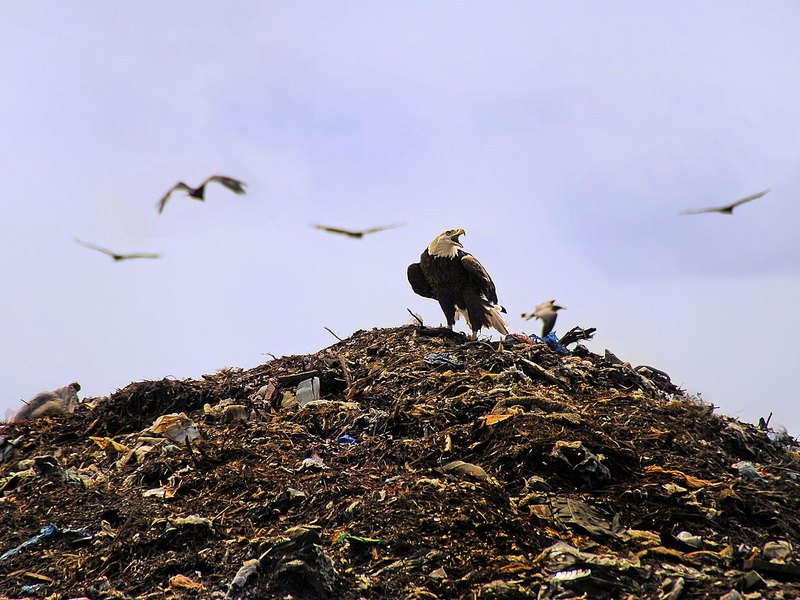

Life cycle
| Stage | Time | Notes |
|---|---|---|
| Egg | About 35 days | 1–3 whitish eggs, usually 2. Both parents incubate, the female far more than the male[18][2][20] |
| Nestling | About 10–12 weeks (8–14) | Hatchlings have pink skin and light beige-grey down. A darker grey second coat of down comes through at 9–11 days, and the first feathers show at 3–4 weeks[29][18][2] |
| Juvenile | Up to the next spring | All dark brown with a dark bill and eye. The first full set of feathers is complete at 11–14 weeks[30] |
| Immature | About 4–5 years | One yearly moult, never a full one, so each year the bird looks a little more like an adult[30] |
| Adult | Breeds from about 4–5 years | Breeding as young as 3 is recorded[18][31] |
Growing up
The moults of a young eagle are named by age: the first coat of true feathers is the juvenal plumage, and the yearly moults after it give the first, second, third basic plumage and so on. The first basic plumage, at about 1.5 years, can have a belly anywhere from dark brown to nearly white. The third, at about 3.5 years, looks nearly adult, with a white head flecked with brown, a mostly yellow bill and a pale yellow eye. Of 17 eagles at 4.5 years, only 4 were fully adult.[30] Body colour alone is not a reliable way to tell a young eagle’s age.[30] A white head is not a sign of readiness to breed: in 1993, a 4-year-old male and a 3-year-old female in young plumage raised an eaglet in Kansas.[31]
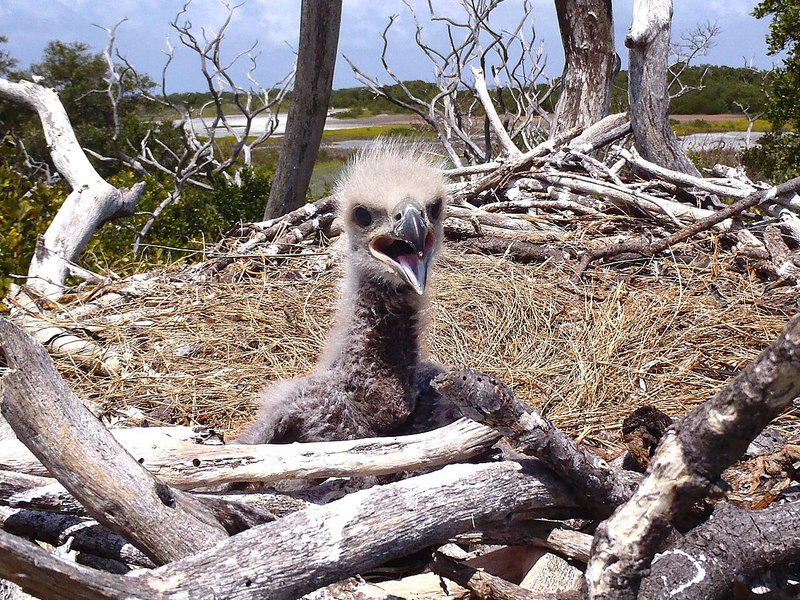
.jpg)
Nest
The nest is a pile of sticks lined with finer material, built by both parents. It is usually in a large tree near water, but eagles use cliffs in the south-west United States and Alaska, and on the ground in Alaska.[22][18] A usual nest is 1.5–2 m across. Nests are added to year after year, and some grow very big.[18] The largest bird’s nest on record belonged to Bald Eagles near St Petersburg, Florida. Examined in 1963, it was 2.9 m wide, 6 m deep and estimated to weigh more than two tonnes.[32]
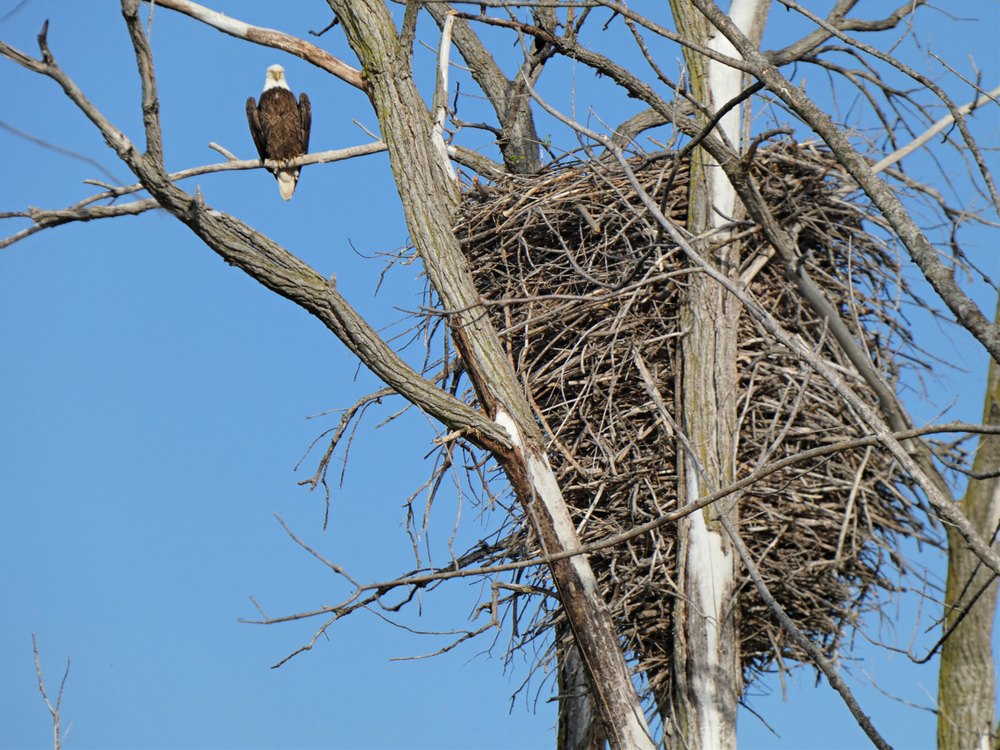

Lifespan
Most Bald Eagles live 15–20 years in the wild.[2] The oldest known wild eagle was banded as a nestling in New York in 1977 and was found dead in 2015, aged 38 years, after it was hit by a vehicle.[33]
Ecology
The Bald Eagle is both an apex predator and an efficient scavenger.[34] Its main food is fish, with waterfowl, gulls, cormorants and carrion as other common foods.[22][20]
Habitat and range
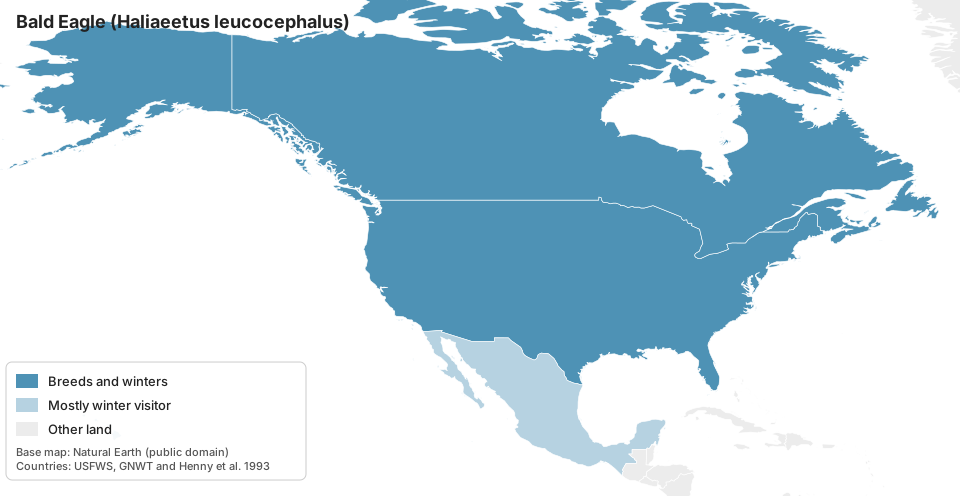
Bald Eagles live near water for their whole lives, but they are not fussy about which kind: reservoirs, lakes, rivers, estuaries and coasts all do.[22] The eagle needs a good food supply, perches and nest sites.[20] Nests are usually in big trees along shorelines, sometimes half a mile or more from the water.[22] In the north, wintering eagles sometimes feed far from water, on carrion.[27]
Range
The Bald Eagle breeds across Alaska, Canada and the United States, and northern birds move south in winter.[20] Alaska has the largest breeding population, about 8,250 pairs in 1997.[22] In the Northwest Territories it is a common migrant and breeder north to the Arctic coast of the mainland.[35] In Mexico it mostly winters. Its nesting there shrank to a remnant at Magdalena Bay in Baja California, where no more than three pairs were found a year in 1983–93.[36]
Cities
Some eagles nest in cities. More than 150 pairs breed in Greater Vancouver, and three-quarters of their nests are within 230 m of buildings and roads.[37]
Evolution
The Bald Eagle belongs to a small group of northern sea eagles, Haliaeetus. Its closest living relative is the White-tailed Eagle of Europe and Asia, and the two are sister species.[38][39] They split about 2 million years ago, but studies disagree: the four dates summarised by TimeTree range from 0.5 to 6 million years.[40] Their nearest relatives are the kites Milvus and Haliastur, which share an ancestor with the sea eagles about 22 million years ago.[39][40]
The sea eagles are found in the family Accipitridae, together with hawks, kites, buzzards and Old World vultures, and the family split from the Osprey about 46 million years ago.[41][42] A distinct lineage of sea eagle once lived on the Hawaiian Islands. DNA from a 3,500-year-old Maui skeleton shows that it was most closely related to White-tailed Eagles.[43]
The oldest fossils assigned to the Bald Eagle itself are from the Middle Pleistocene, in Florida and California.[44][45]
Forms and variants
Subspecies
Most checklists list two subspecies. The northern Bald Eagle, H. l. washingtoniensis, lives in Alaska, Canada and the northern United States, and the southern Bald Eagle, H. l. leucocephalus, in the southern United States and north-west Mexico.[46][13][12] Northern birds are larger.[20] However, a study of enzyme genes found a smooth gradient from north to south, with no break that matched the two subspecies, so some authorities treat the species as having no subspecies.[47]
| Subspecies | Range |
|---|---|
| Haliaeetus leucocephalus washingtoniensis (Audubon, 1827) | Alaska, Canada and the northern United States[46] |
| Haliaeetus leucocephalus leucocephalus (Linnaeus, 1766) | The southern United States and north-west Mexico[46] |
Conservation
The Bald Eagle is listed as Least Concern on the IUCN Red List.[48] In the lower 48 states of the United States, a count of 2018–19 found about 316,700 eagles, and 71,467 occupied nests.[49] That count does not cover Alaska or Canada.[49]
Decline and recovery
Early in the last century, unregulated shooting killed large numbers, and poisoned carrion also killed eagles.[22] After the Second World War, the pesticide DDT built up in eagles and thinned their eggshells, and eagle breeding was poor from the 1950s to the mid-1970s.[22] By 1963 the lower 48 had only about 417 known nesting pairs (USFWS), or about 487 (an Audubon estimate cited in 2007).[49][22] By 2007 there were about 9,789 pairs.[22]
| Year | Event |
|---|---|
| 1940 | Congress protects the Bald Eagle[22] |
| 1967 | Listed as endangered south of 40° N[22] |
| 1972 | The EPA bans general use of DDT[22] |
| 1978 | Listed as endangered in 43 states and threatened in five (Michigan, Minnesota, Wisconsin, Oregon, Washington)[22] |
| 1995 | Reclassified as threatened[22] |
| 2007 | Removed from the endangered species list in the lower 48, effective 8 August[22] |
The eagle is still protected by the Bald and Golden Eagle Protection Act and the Migratory Bird Treaty Act.[22]
Threats
Lead poisoning is a major problem. A study of 1,210 Bald and Golden Eagles from 38 states found signs of long-term lead exposure in 46–47% of them, and it estimated that lead slows the growth of the Bald Eagle population by 3.8% a year.[50] Eagles are also hit by vehicles and structures, and some are still shot.[22] In 2022, bird flu (H5N1) killed 136 eagles in 24 US states by 10 June, and cut the success of some nests.[34]
History and culture
The national bird
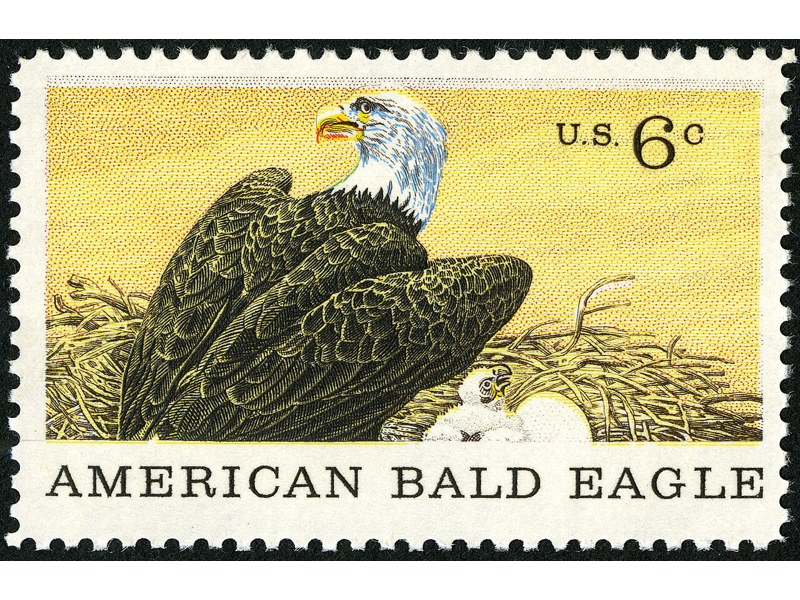
On 20 June 1782 the Continental Congress adopted the design of the Great Seal of the United States, with an eagle at its centre. Its designer, Charles Thomson, wrote only of “an American Eagle”, but he replaced an earlier design’s crested eagle with the native Bald Eagle.[51][52] The 13 arrows, 13 stars and 13 stripes stand for the 13 original states.[51] In 2024 Congress passed a law naming the Bald Eagle the national bird. It was approved on 23 December 2024.[1]

Franklin and the turkey
On 26 January 1784, Benjamin Franklin wrote to his daughter that he wished the Bald Eagle “had not been chosen as the Representative of our Country”. He called it “a Bird of bad moral Character” because it steals fish from the fishing hawk, which is the Osprey. The letter was about the badge of the Society of the Cincinnati, not the Great Seal, and Franklin never proposed the turkey as a national bird. He wrote that the turkey was “a much more respectable Bird”.[53][54]
Sacred feathers
In its 2024 law, Congress said that Bald Eagles are “integral to the spiritual lives and sacred belief systems of most Indigenous peoples and Tribal communities”.[1] A 1994 presidential memorandum states that “Eagle feathers hold a sacred place in Native American culture and religious practices”, and tells agencies to send eagles found dead to the National Eagle Repository.[55] The Repository gives remains, parts and feathers to enrolled members of federally recognised tribes for spiritual and religious use.[56]
Bounties
The Territory of Alaska paid a bounty on eagles from 1917, starting at fifty cents.[57] Records of the territorial treasurer show that 128,273 Bald Eagles were presented for bounty from 1917 to 1952.[58]
Famous eagles
Old Abe was taken from a nest in Wisconsin in 1861, and went to war with the 8th Wisconsin Infantry. He was carried on a perch beside the regiment’s flag and survived the war.[59][60] He died in 1881.[59] Challenger, hatched in 1989, was blown from a nest in Louisiana, was raised by people, and now flies at sports events. The American Eagle Foundation, which cares for him, says he was the first Bald Eagle trained to fly into stadiums during the national anthem.[61]
Taxonomy
| Rank | Name |
|---|---|
| Kingdom | Animalia |
| Phylum | Chordata |
| Class | Aves (birds) |
| Order | Accipitriformes (hawks, eagles and relatives)[12] |
| Family | Accipitridae[12][46] |
| Genus | Haliaeetus Savigny, 1809[46] |
| Species | Haliaeetus leucocephalus (Linnaeus, 1766)[12][13] |
The IOC list, used here, puts four species in Haliaeetus: the Bald, White-tailed, Steller’s and Pallas’s eagles. It moved the six tropical sea and fish eagles to the genus Icthyophaga, while GBIF still lists them in Haliaeetus.[46][12] The way the four northern species are related to each other is not settled.[39]
Sources
- Public Law 118-206 (2024), designating the Bald Eagle as the national bird
- Animal Diversity Web, Haliaeetus leucocephalus
- Buehler 2022, Birds of the World, Bald Eagle (introduction)
- Audubon, “10 Fun Facts About the Bald Eagle” (2025)
- Audubon, “Birdist Rule #50” (2016)
- Smithsonian National Zoo, “9 Fascinating Facts About the Bald Eagle” (2026)
- Bortolotti 1984, Journal of Wildlife Management 48: 72–81 (sexing by size)
- Dictionary.com, bald
- Wiktionary, bald (secondary)
- Dictionary.com, bald eagle
- Bald and Golden Eagle Protection Act, 16 U.S.C. 668
- GBIF backbone, Haliaeetus leucocephalus
- ITIS, Haliaeetus leucocephalus (TSN 175420)
- IOC World Bird List, multilingual names, version 10.2
- The Ojibwe People’s Dictionary, migizi
- nehiyawewin itwewina, mikisiw (Plains Cree dictionary)
- Priberam dictionary, pigargo (in Portuguese)
- Audubon Guide to North American Birds, Bald Eagle
- Alaska Department of Fish and Game, Bald Eagle
- U.S. Fish and Wildlife Service, Bald Eagle species page
- McClelland et al. 1998, Journal of Raptor Research 32: 120–125 (adults trapped in Montana)
- U.S. Fish and Wildlife Service 2007, final rule removing the Bald Eagle from the endangered species list, Federal Register 72: 37346
- Keister et al. 1987, Journal of Wildlife Management 51: 415–420 (winter roosts, Klamath Basin)
- Fischer 1985, The Condor 87: 246–251 (piracy by wintering eagles)
- Knight et al. 1990, Canadian Field-Naturalist 104: 545–551 (western Washington)
- Hanson & Baldwin 2017, Journal of Raptor Research 51: 1–14 (Florida Bay)
- Stocek 2000, Canadian Field-Naturalist 114: 605 (winter diet in New Brunswick)
- Stalmaster & Gessaman 1982, Journal of Wildlife Management 46: 646–654 (food needs of captive eagles)
- Bortolotti 1984, Wilson Bulletin 96: 524–542 (growth of nestlings)
- McCollough 1989, Wilson Bulletin 101: 1–10 (moult and ageing)
- Mulhern et al. 1994, Journal of Raptor Research 28: 113–114 (nesting at ages 3 and 4)
- Guinness World Records, largest bird’s nest
- USGS Bird Banding Laboratory, historical longevity records
- Nemeth et al. 2023, Scientific Reports 13: 191 (H5N1 influenza)
- Government of the Northwest Territories, Haliaeetus leucocephalus
- Henny et al. 1993, Journal of Raptor Research 27 (Baja California)
- Goulet et al. 2021, Journal of Raptor Research 55: 65 (urban nests in British Columbia)
- Hailer et al. 2007, Journal of Biogeography 34: 1193–1206 (white-tailed eagle)
- Open Tree of Life, Haliaeetus leucocephalus (synthetic tree, release 16.1)
- TimeTree, divergence of the Bald Eagle and White-tailed Eagle (summary of four studies)
- Lerner & Mindell 2005, Molecular Phylogenetics and Evolution 37: 327–346 (Accipitridae)
- TimeTree, divergence of the Bald Eagle and the Osprey (summary of 17 studies)
- Hailer et al. 2015, Molecular Phylogenetics and Evolution 83: 40–43 (extinct Hawaiian eagle)
- Paleobiology Database, Haliaeetus leucocephalus records
- Kilmer & Steadman 2016, Bulletin of the Florida Museum of Natural History 55: 1–38 (Pleistocene birds of Florida)
- IOC World Bird List, version 15.2
- Morizot et al. 1985, Biochemical Genetics 23: 337–345 (genetic variation)
- Audubon Bird Guide, Bald Eagle (IUCN category)
- U.S. Fish and Wildlife Service 2021, “America’s bald eagle population continues to soar”
- Slabe et al. 2022, Science 375: 779–782 (lead poisoning)
- U.S. Department of State, The Great Seal of the United States
- National Archives, original design of the Great Seal
- National Archives, “Talking Turkey” (Franklin’s letter of 26 January 1784)
- Franklin’s letter to Sarah Bache, 26 January 1784 (reprint)
- Presidential memorandum on eagle feathers for Native American religious purposes, Federal Register 59: 22953 (1994)
- U.S. Fish and Wildlife Service, National Eagle Repository
- Territory of Alaska 1917, Chapter 12, “Placing a bounty on eagles”
- U.S. Fish and Wildlife Service news release, 14 November 1968
- Wisconsin Veterans Museum, “Old Abe, the war eagle”
- National Park Service, 8th Wisconsin Infantry
- American Eagle Foundation, Challenger