Willan’s Chromodoris (Chromodoris willani) is a small sea slug of the tropical western Pacific.[1] It is bluish white with dark blue to black stripes, and white speckles on its gills and rhinophores set it apart from similar species.[1] It feeds on sponges.[2] It was described by Rudman in 1982 and named after R. C. Willan, who collected the first specimens.[3][4] The IUCN has not evaluated it.[1][5]
Quick facts
Description
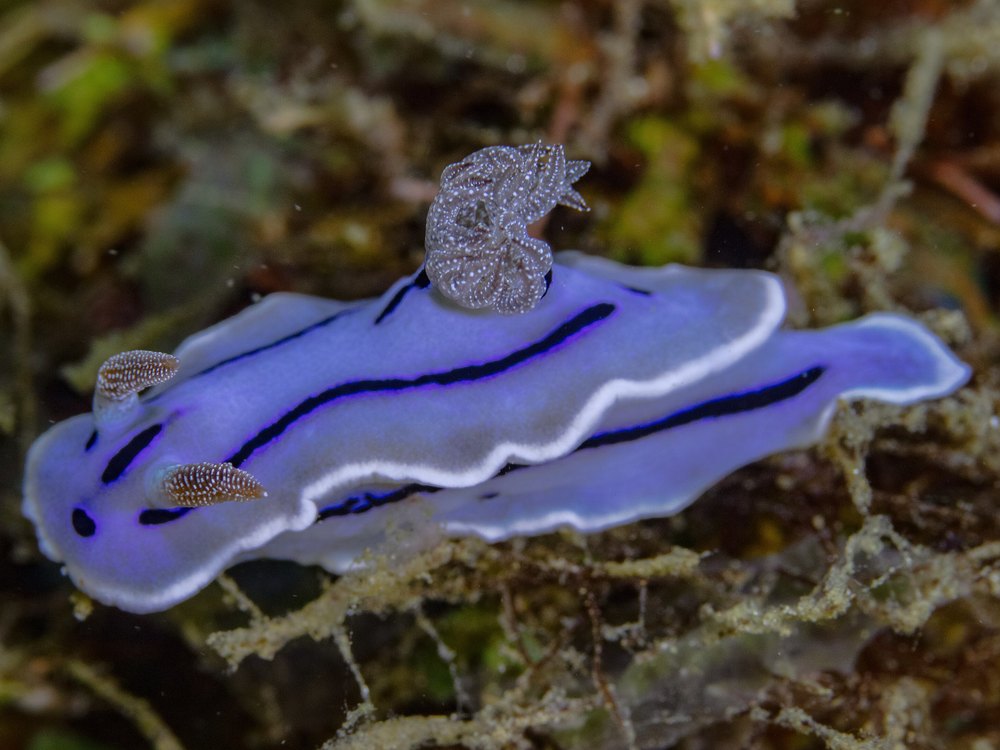
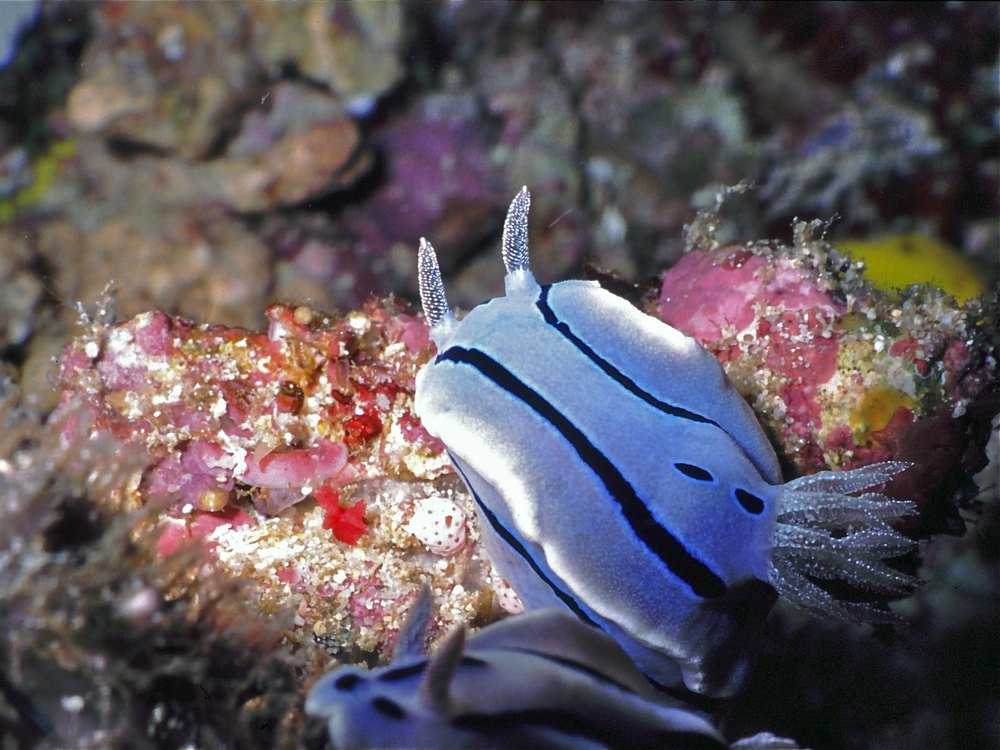
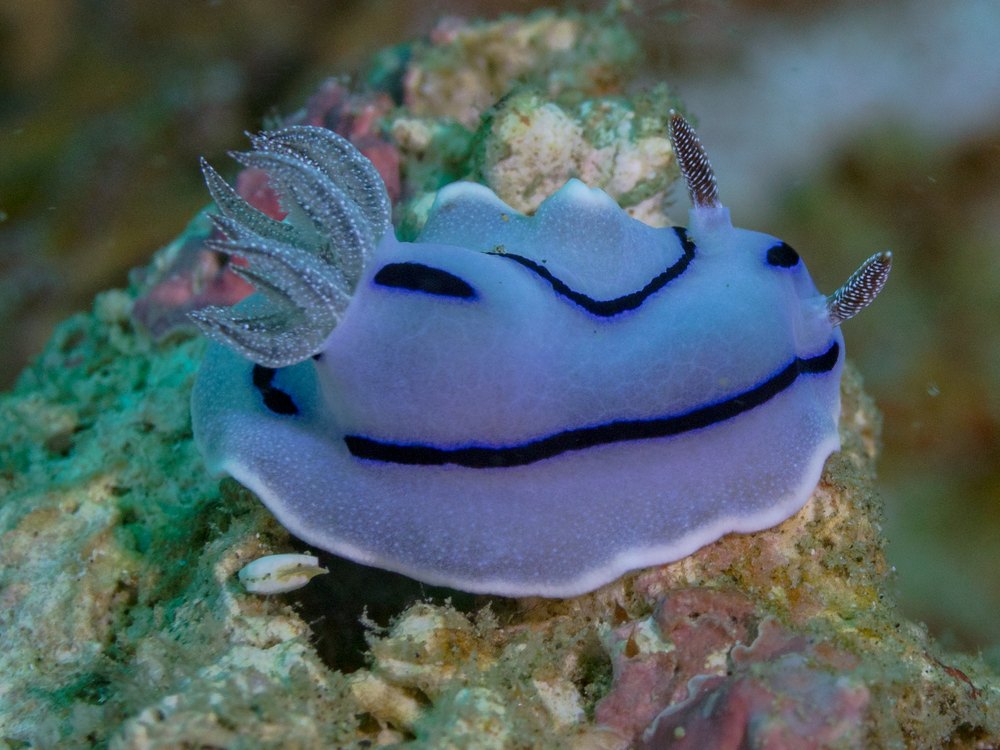
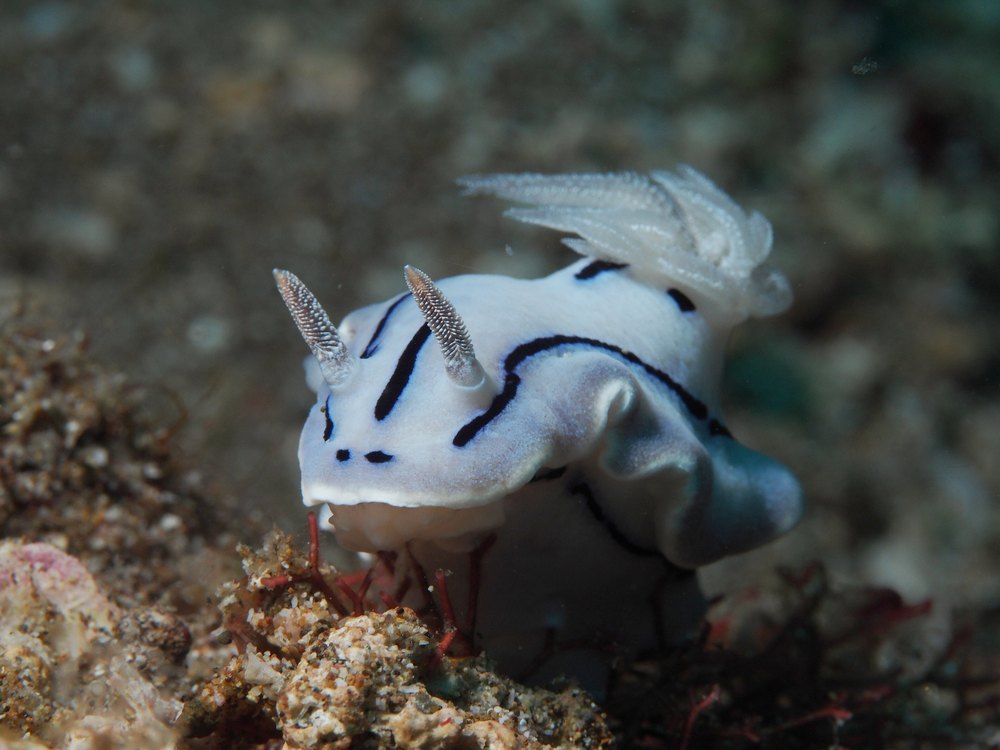
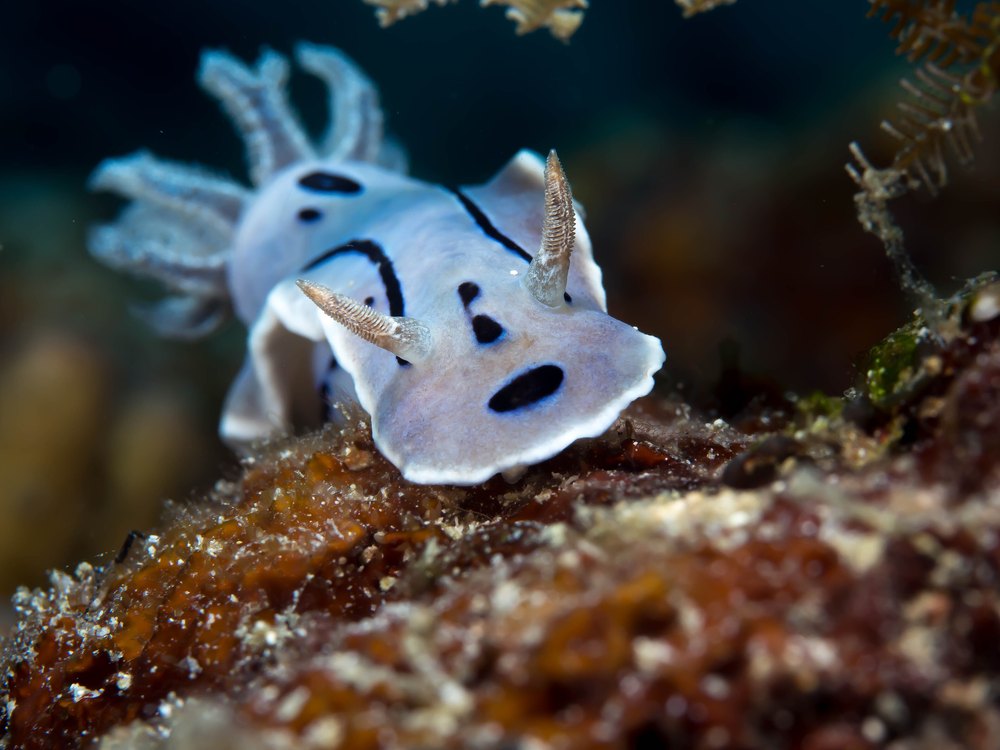
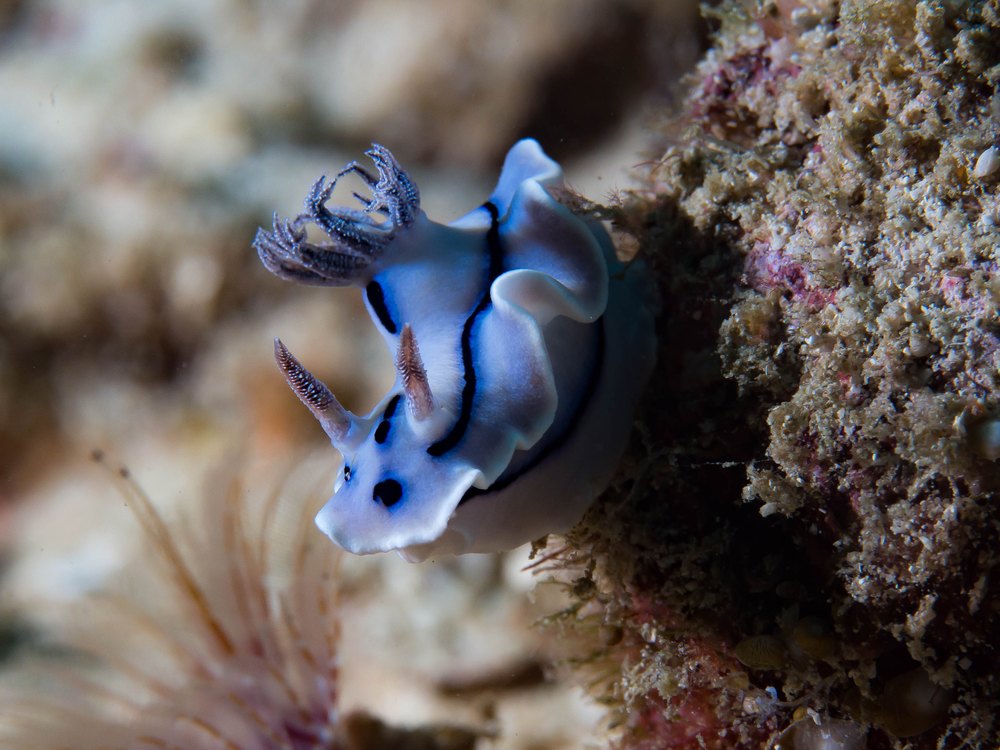
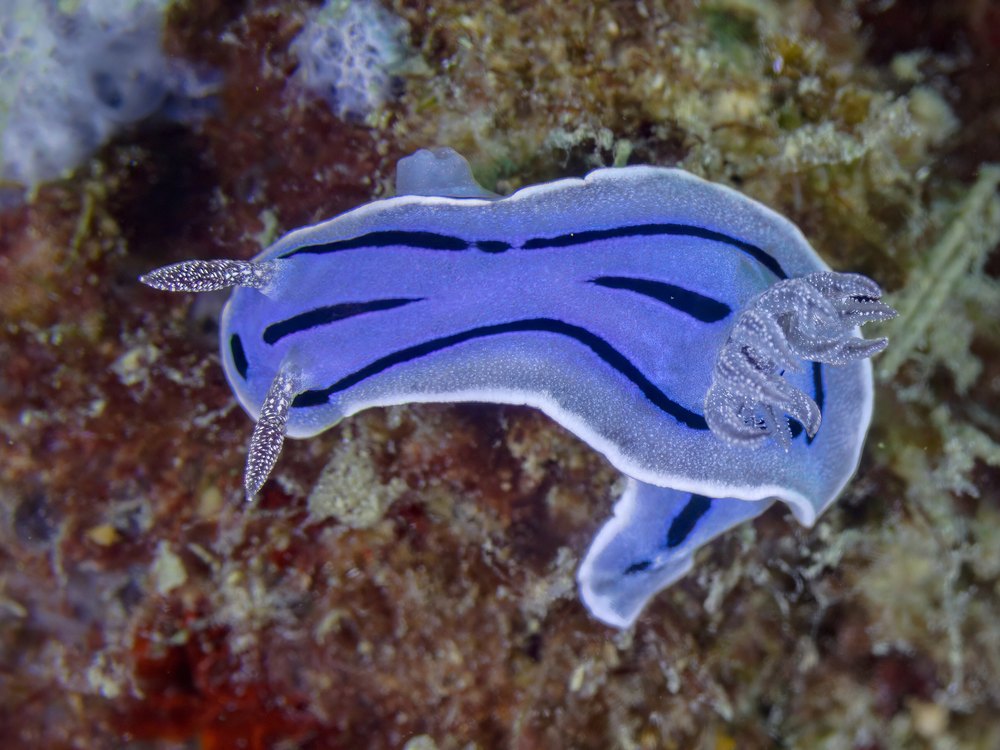
C. willani has a pale blue mantle with a thin white edge. Its describer, Rudman, put it in a group of similarly coloured species with a bluish-white or translucent-white background and dark blue or black stripes.[1] A thin black line outlines the mantle outside the rhinophores and gills, set in from the edge. Another thin black line runs down the middle from between the rhinophores to the gills, and it is broken in the middle in most specimens. The sides of the body and the foot are pale blue with a white border, and some animals have three black lines on the sides.[4]
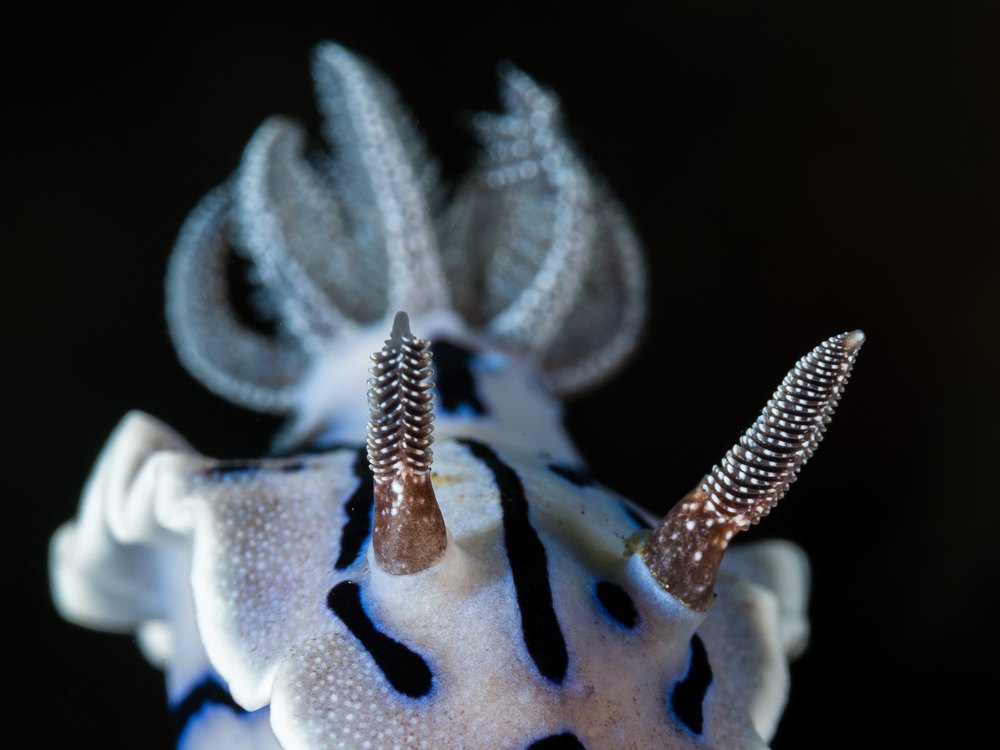
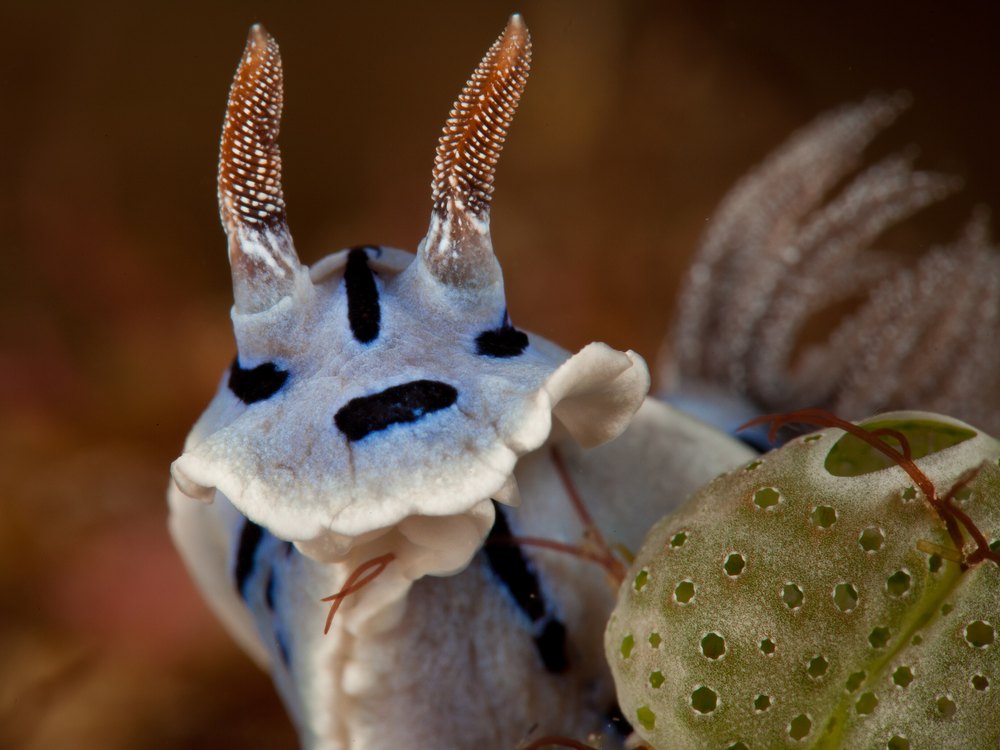
The mantle is long and oval and overhangs the foot. Up to eight simple gills stand upright in a horseshoe that is open at the back. The gills and the rhinophores are translucent brown with white spots or patches.[4] Rudman called the white spots on the gills and rhinophores the most distinguishing outer feature.[1] They can be harder to see in the water through a mask.[2]


Look-alikes
Several other black-striped species look much like it. Photographs sent to Rudman under the name C. willani were in several cases C. lochi, so many pictures of this species on the web are probably of a look-alike.[2] Rudman’s main points for telling them apart:
| Species | How it differs from C. willani |
|---|---|
| C. lochi | Gills translucent pink to yellowish, without white specks. Mantle an even greyish blue to white, without white spots. Body longer, with a narrower mantle “skirt”[2][7] |
| C. boucheti | A black line inside each gill near its base, and a longer body[7] |
| C. dianae | Gills yellow-tipped or orange-yellow, and white spots over the mantle[7] |
| C. annae | Small dark specks all over the bluish parts of the mantle[2] |
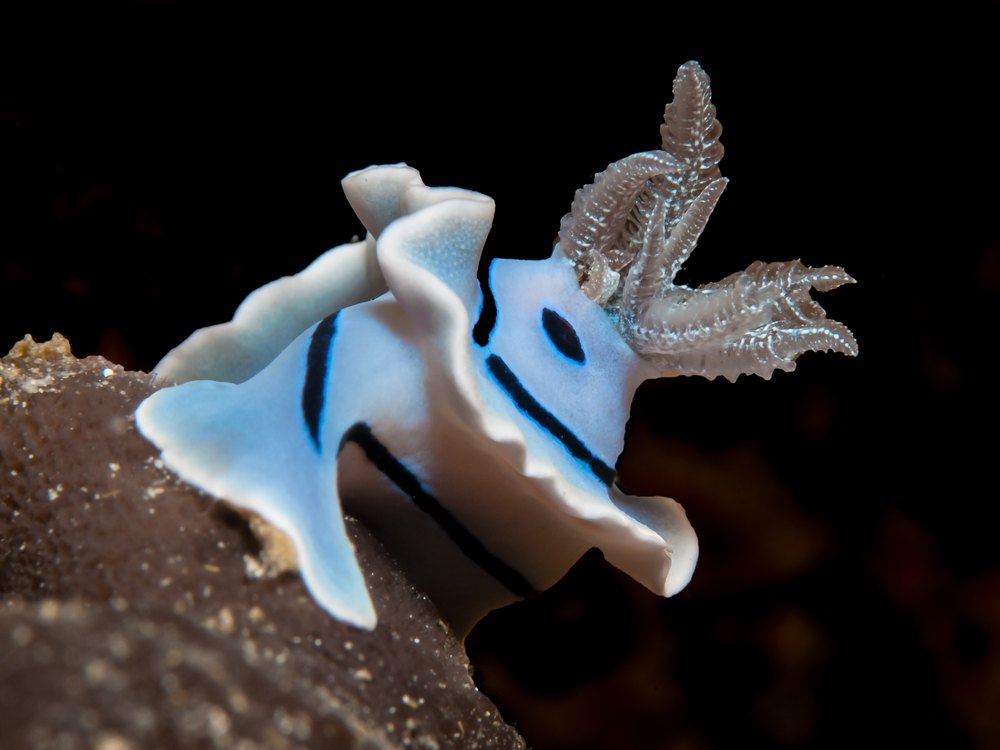
C. willani has a more oval mantle with a wider skirt than C. lochi.[2][7] SEASLUG.WORLD adds that the two also differ in anatomy.[4]

Name
The species name willani honours Dr R. C. Willan of the University of Queensland, who collected the type material and gave the author other chromodorid specimens. SEASLUG.WORLD quotes this from the original description.[4] The genus name Chromodoris dates from Alder and Hancock, 1855.[8]
“Willan’s Chromodoris” is the English name used by Wikipedia, SEASLUG.WORLD, the Catalogue of Life and iNaturalist.[9][4][5][10] It is a descriptive name made from the scientific one, and Rudman’s Sea Slug Forum fact sheet gives no common name.[1]
In other languages
| Language | Name | Note |
|---|---|---|
| Japanese | ミゾレウミウシ (mizoreumiushi) | Given by the World Register of Marine Species and the Catalogue of Life |
| Japanese | クロモドリス・ウィラニ | The Latin name in katakana, used in some Japanese books |
| Chinese | 威廉多彩海蛞蝓 | A descriptive name; its source is not stated |
| French | Doris de Willan | Listed in the Catalogue of Life |
Names are from the Catalogue of Life (as listed by GBIF), the World Register of Marine Species and SEASLUG.WORLD.[5][11][8][4] No names in other languages were found.
Body
Size
The holotype was 14 mm long when preserved, and the largest preserved specimen in the original description was 22 mm.[4][1] Preserved animals shrink, so these are not live lengths. Divers’ reports of live animals are their own estimates, not measurements by scientists. They run from about 2 cm to about 5 cm: 3 cm in Sulawesi and Halmahera, 4 cm at Puerto Galera, 5 cm at Yap and 50 mm off Noosa in Queensland.[2][7] The largest live size is not settled.
Mantle glands
Rudman had great difficulty seeing the mantle glands of this colour group, which are easy to see as opaque white spots in other Chromodoris.[2] A study of C. willani found that the arrangement of these glands can vary a lot within one population, and that too much weight has been put on them for telling species apart.[12]
Chemicals
Five animals and a sample of the sponge they were found on were collected at a depth of 20–25 m at Cape Zampa, Okinawa. The sponge was not identified. The slug extract held two sesterterpenes, deoxymanoalide (39.1 mg) and deoxysecomanoalide (9.4 mg), and both were new to natural sources. The sponge held manoalide (350 mg) and secomanoalide (46.8 mg), and neither was found in the slug.[6] The authors believe the slug makes its two compounds from the sponge’s two, but they did not test this with a feeding experiment.[6]
In laboratory tests the two compounds slowed the growth of two kinds of bacteria and blocked a snake-venom enzyme, phospholipase A2.[6] The authors say that warning colours and toxic substances are believed to work together to protect nudibranchs, but the study tested no predator.[6]
Diet
C. willani eats sponges. Sponge-eating chromodorids generally feed on particular sponges: a review of 137 species found strong food specificity.[13] Its natural food was unknown to Rudman in 2000, and the first evidence came in January 2004 from photographs taken at Bunaken, Indonesia.[2]
Sponges it has been seen on
Rudman identified the sponges from photographs, not from samples, and says so repeatedly. His evidence was animals sitting on or beside a sponge, feeding scars next to them, and the same pairing in many photographs.[2] No photograph shows the mouth in use, and no study of gut contents or feeding experiment has been published.
The sponges are thorectids. The best-supported genus is Semitaspongia, which Rudman identified in photographs from Cebu and Anilao in the Philippines, from Sulawesi in Indonesia and from the Solomon Islands. A second genus, Petrosaspongia, was identified in photographs from Raja Ampat and Halmahera in Indonesia, from Mabul in Malaysia and from Ticao in the Philippines.[2][7] The sponge in the Okinawa study was not identified.[6]
Life cycle
Eggs
Nudibranchs are simultaneous hermaphrodites: each animal has both sexes, and fertilised eggs are laid in an egg mass after mating.[14] The same is said of Chromodoris as a group.[15] Nothing specific to C. willani has been published on mating.
Its egg ribbon is little known. In 2007 Rudman judged from photographs taken at Puerto Galera, Philippines, that a laying animal was making a flat ribbon.[16] An earlier report, from 2001, describes a white egg mass laid flat in a spiral on an aquarium pump. Rudman said that animals under stress often start laying eggs, and that the identification should be checked.[2] Flat egg masses fit the colour group and the narrow genus Chromodoris, which is defined by laying them.[17][2] The larva, the hatching, the young animal and the lifespan have not been described for this species.
Ecology
Sharing a food sponge
Several look-alike species can feed on the same sponge. Records on the Sea Slug Forum include C. willani with C. dianae at Bunaken, with C. lochi at Yap and Lembeh, and with C. annae and C. dianae on one Petrosaspongia sponge at Mabul.[2][7] Groups of animals are often seen on or near a sponge. Rudman suspected that such groups form because the animals all prefer the same food sponge.[7]
Warning colours
Rudman suggested that C. willani and other black-striped species may share a warning pattern, so that fish learn to avoid all of them, but this has not been tested.[2][7] The papers on mimicry in Chromodoris do not name C. willani as a mimic or as part of a tested group of look-alikes.[18][15] No predator of the species has been recorded.
Habitat and range
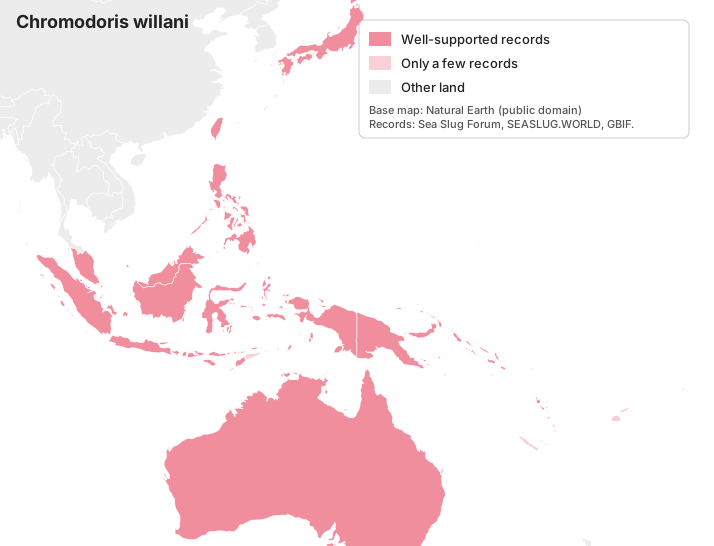
Rudman gave the range as the tropical western Pacific.[1] It was first recorded only from Vanuatu. SEASLUG.WORLD adds Indonesia, the Philippines, Malaysia, Guam and Japan.[4] The table lists the places with solid records.
| Place | Where |
|---|---|
| Japan | Okinawa and the Ryukyu Islands, including Ie Island. The northern edge of the range[5][18] |
| Taiwan | Southern Taiwan[5] |
| Philippines | Many records, including Anilao, Puerto Galera, Cebu and Batangas[5][2] |
| Malaysia | Sabah, including Mabul, Sipadan and Lankayan[5][2] |
| Indonesia | Sulawesi (Bunaken, Lembeh, Wakatobi), Halmahera and Raja Ampat[5][2][7] |
| Papua New Guinea | Madang Province and other records[5][18] |
| Micronesia | Yap[2] |
| Solomon Islands | Russell Islands[2][5] |
| Vanuatu | Efate and Espiritu Santo, the type locality[4][11] |
| Australia | South-east Queensland (Noosa, Mooloolaba), the southernmost mainland records[2][5] |
New Caledonia, Fiji, Timor-Leste, Palau and Tonga have only a few records, mostly photographs on citizen-science sites,[5] and Guam is named by one site without a GBIF record.[4][5] GBIF also holds records from Kenya and Tanzania in East Africa, far outside the range, and from French Polynesia. These are probably look-alikes or outliers and are not counted here.[5] Most of the 1,711 GBIF records are photographs, and an identification from a photograph carries a risk, because colour patterns are unreliable in this genus.[5][18]
Habitat
It lives on tropical reefs from shallow to mid depths. Diver reports and GBIF depth records fall mostly between about 5 and 30 m, and the holotype came from 18 m.[5][2][4] The deepest records are preserved specimens from Okinawa, down to about 55 m.[5]
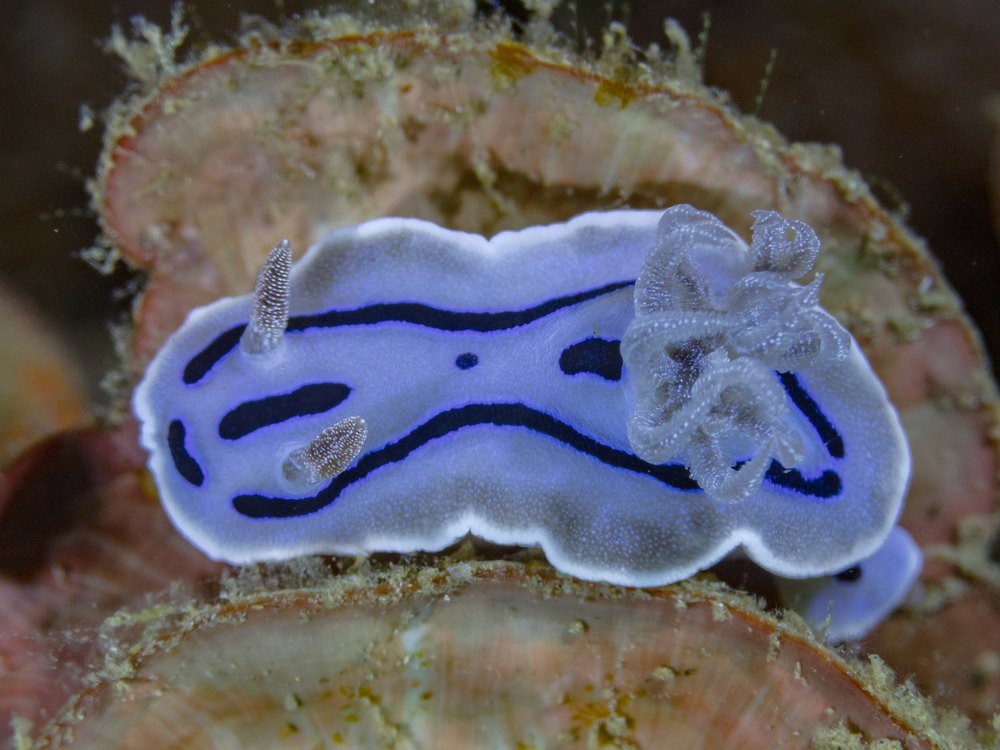

Reports of the setting vary. At Wakatobi it was found on only one reef wall with overhangs, at 5 and 13 m. Rudman thought food was the likely reason for such a patchy spread.[2] Other animals were on sponge-covered reef, on sand and coral rubble, crawling on sandy muck at 16 m at Mabul, and near a wreck at 20 m at Yap.[2] Part of the type series came from the wreck of the President Coolidge off Espiritu Santo, at 30 m.[4]


Evolution
C. willani belongs to Chromodoris in the narrow sense: a group of about 22 species, all with black pigment and all laying flat egg masses.[17][18] Its own sequences were included in these studies. The sister group of the genus is not settled.[17] Inside the genus, the order of the branches is poorly supported, which fits a recent burst of new species.[18]
A tree built from 1,630 nuclear genes puts C. willani in a small group with two unnamed lineages, C. aff. willani and C. cf. lochi FP. Both of the methods used found this group.[15] The look-alike C. lochi is a separate lineage outside it. Which striped species lies next to the group depends on the method.[15] No age has been published for this group or for the genus.[17][18][15]
Forms and variants
Colour and pattern
The colour of the rhinophores varies from a watery translucent version of the body colour to straw yellow-brown.[1] Rudman also accepted animals with orange or pink rhinophores (southern Sulawesi), dark rhinophores with many white speckles (Philippines), and blue-grey to red-orange rhinophores (Halmahera).[2][7] He accepted animals with more black lines than usual, a broken line or an extra spot, and dark and paler animals together on one sponge.[2] In his words, most features can be expected to vary, and only a few key characters, such as the white spots on the gills and rhinophores, matter for identification.[2] No comparison of colour between regions has been published.


Genetic work also separates a close, unnamed lineage called C. aff. willani. See Taxonomy.[15]


Conservation
The IUCN has not evaluated C. willani. GBIF lists it as Not Evaluated, and iNaturalist shows no status.[5][10] No count or survey of the species was found.
Aquarium trade
One Sea Slug Forum message from 2000 reports a specimen sold in an aquarium shop in Brazil for US$26. Rudman noted that the species does not live in Brazilian waters, and that such slugs are very hard to keep because they need particular sponges.[2]
History and culture
The type material was collected by R. C. Willan in July 1976 at Mele Bay, Efate, Vanuatu, at 18 m.[4] Rudman described the species in 1982.[3] He wrote the Sea Slug Forum fact sheet on it, dated 29 November 1998. The forum’s messages, which run to 2009, hold much of what is known about its food, eggs and colour variation.[1][2]
The species has since been used in research: for the chemicals in the Okinawan animals,[6] for a study of mantle glands, which Willan co-wrote,[12] and in the genetic trees of the genus.[17][18][15]
Taxonomy
| Rank | Name |
|---|---|
| Kingdom | Animalia |
| Phylum | Mollusca |
| Class | Gastropoda (snails and slugs)[8] |
| Order | Nudibranchia (sea slugs without a shell)[8] |
| Suborder | Doridina[8][1] |
| Family | Chromodorididae Bergh, 1891[8] |
| Genus | Chromodoris Alder & Hancock, 1855[8] |
| Species | Chromodoris willani Rudman, 1982[8][5] |
Rudman described the species in 1982 in Zoological Journal of the Linnean Society 76: 183–241, on page 193.[3][8] No synonyms are listed.[8][5] The holotype is in the Australian Museum, Sydney (C.129650, 14 mm preserved) and was collected at Pango Peninsula, Mele Bay, Efate, Vanuatu. There are two paratypes (C.129651 and C.129648).[4][5]
The genus
Chromodoris once held many Indo-Pacific species. After a molecular study showed it was not a single branch, Johnson and Gosliner kept the name for the black-lined clade that lays flat egg masses and moved other species to genera such as Goniobranchus.[17] Layton and colleagues later said the genus should be limited to 22 species.[18] C. willani stays in Chromodoris in this sense, and no author found moves it. The World Register of Marine Species still keeps a wider genus.[8]
Species limits
The limits of C. willani have not been fully tested. No paper splits it or merges it with another species. But the genetic papers name a separate, unnamed lineage, C. aff. willani, close to it. Its specimens came from Batangas in the Philippines and from Ningaloo in Western Australia.[15] It has not been described, and it is not known whether it looks like C. willani.
The species is hard to judge by eye. In a study of 345 Chromodoris, only five of 39 taxa had stable colour patterns, and 18 of the 39 were undescribed.[18] Genes from the mitochondria alone can also mislead in this genus.[15] The arrangement of mantle glands, once used to tell species apart, varies within C. willani.[12]
Sources
- Rudman 1998, Sea Slug Forum fact sheet, Chromodoris willani (Australian Museum)
- Sea Slug Forum, 32 messages on Chromodoris willani, 1998–2009, with replies by W. B. Rudman (identifications made from photographs)
- Rudman 1982, Zoological Journal of the Linnean Society 76: 183–241 (original description, on p. 193; citation details only, the paper itself was not read)
- SEASLUG.WORLD, Chromodoris willani (secondary; the site says its description and etymology come from the original description)
- GBIF backbone, Chromodoris willani (names from the Catalogue of Life, IUCN field, occurrence records and depth values, read 2026-10-20)
- Uddin et al. 2009, Chemical and Pharmaceutical Bulletin 57: 885–887 (deoxymanoalides from Chromodoris willani)
- Sea Slug Forum, messages 19417, 19444 and 19469 (Halmahera, Indonesia), with replies by W. B. Rudman
- World Register of Marine Species (MolluscaBase), Chromodoris willani Rudman, 1982 (AphiaID 558217)
- Wikipedia, Chromodoris willani (secondary)
- iNaturalist, Chromodoris willani (preferred common name; no conservation status)
- Catalogue of Life, Chromodoris willani (type material, Japanese name)
- Wilson & Willan 2007, Zootaxa 1549: 29–42 (mantle glands in Chromodoris willani; abstract and first page)
- Rudman & Bergquist 2007, Molluscan Research 27: 60–88 (feeding in sponge-eating chromodorids; abstract)
- Hayashi & Nakano 2024, Scientific Reports 14: 16157 (growth of the nudibranch Hypselodoris festiva; used only for facts about nudibranchs in general)
- Layton, Carvajal & Wilson 2020, Ecology and Evolution 10: 11966–11982 (exon-capture tree of Chromodoris)
- Sea Slug Forum, message 20399 (Puerto Galera, Philippines, 2007), with reply by W. B. Rudman
- Johnson & Gosliner 2012, PLoS ONE 7: e33479 (molecular tree and new classification of the chromodorids)
- Layton, Gosliner & Wilson 2018, Molecular Phylogenetics and Evolution 124: 27–36 (colour patterns in Chromodoris; abstract)