The Clown Anemonefish (Amphiprion ocellaris) is a small orange reef fish with three white bands. Found in warm waters from the Andaman Sea to northwestern Australia, this fish lives among the tentacles of large sea anemones and was made famous by the movie Finding Nemo.[1][2] Each group has one breeding female, and a male can change into a female.[1][3] The IUCN rates the species Least Concern.[4]
Quick facts
Description
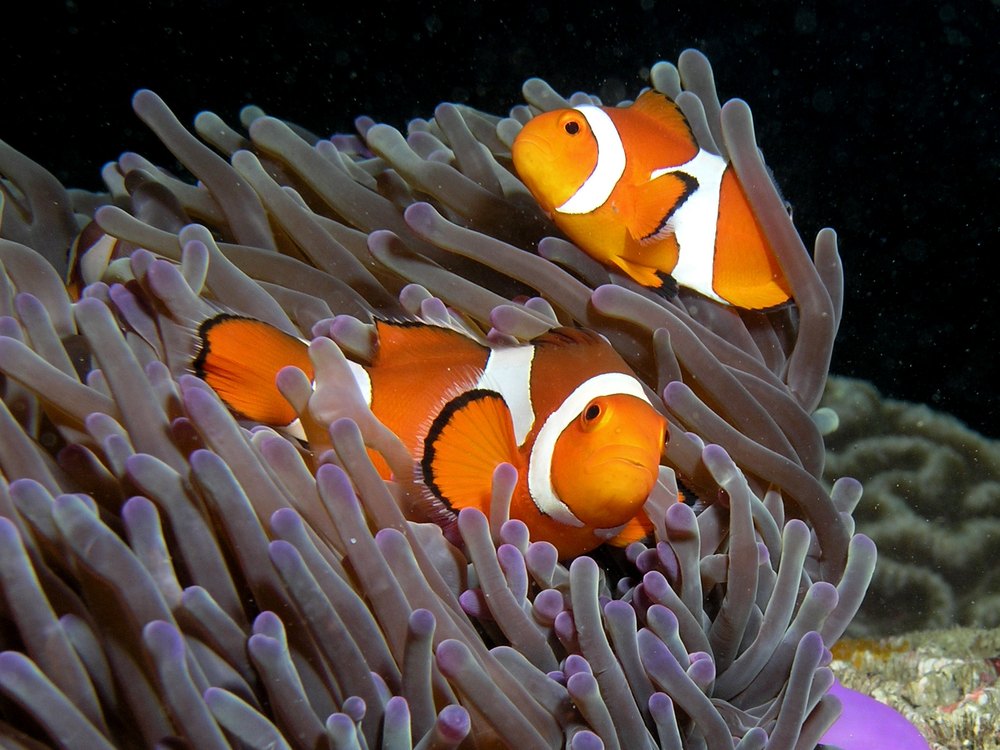
The Clown Anemonefish is bright orange with three white vertical bands: one across the head, one in the middle of the body that bulges forward, and one on the tail stalk. In wild fish in Singapore, all of the fish studied had black edges on the pelvic fins (the paired fins under the belly), while the edges of the other fins varied from fish to fish.[5]
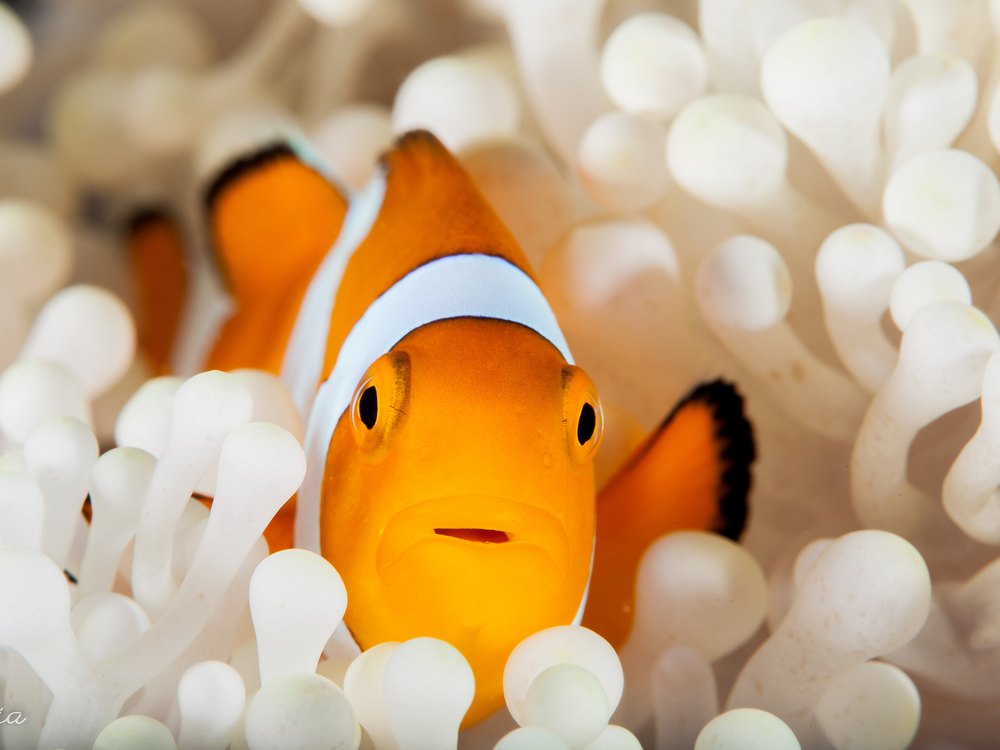

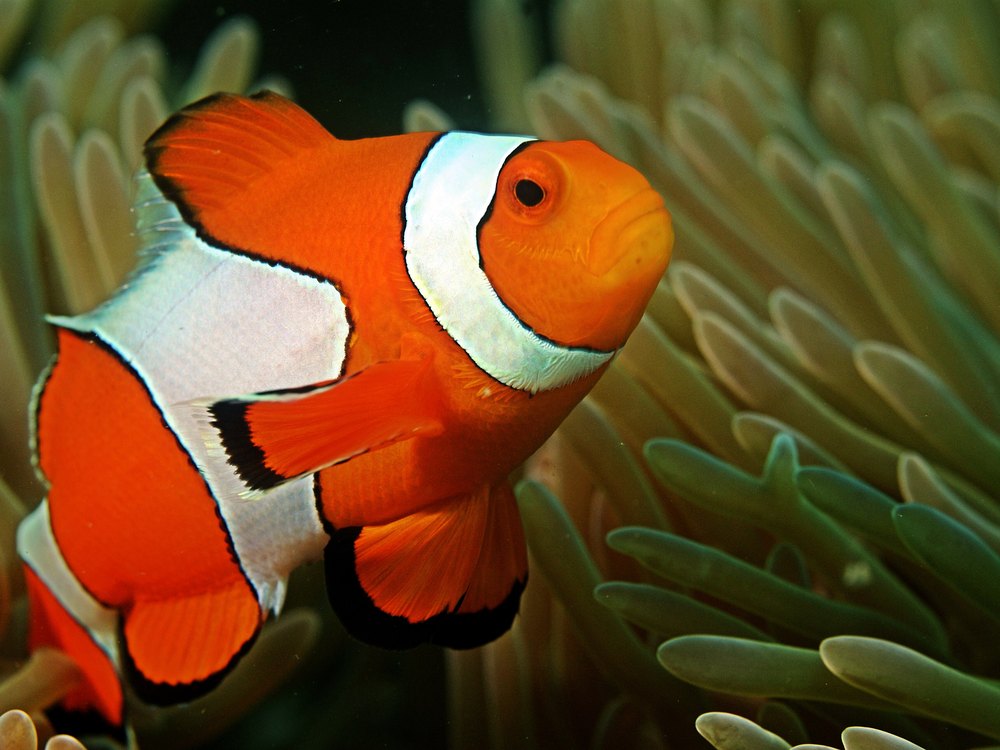

The shape of the bands stayed the same over eight months, but the dark fin edges could fade or darken during that time.[5] A black form and a close look-alike, the Orange Clownfish, are described under Forms and variants.
Name
The scientific name is Amphiprion ocellaris. It was described by Georges Cuvier in 1830, in volume 5, page 399, of the Histoire naturelle des poissons that he wrote with Achille Valenciennes.[6] GBIF, WoRMS, ITIS, the Catalogue of Life and FishBase accept the name and credit it to Cuvier, 1830.[7][8][9][10][11]
“Clown Anemonefish” is the name used by FishBase and the IUCN Red List.[11][4] ITIS also lists “common clownfish” and “false clown anemonefish”.[9] The species name ocellaris is Latin for “having an eye-like spot”. It is said to refer to a large white spot that Cuvier saw on the tail, which the living fish does not have; Günther thought in 1862 that the spot was probably a mark left by preservation.[6] Two older names for the same fish are covered under Forms and variants.
In other languages
| Language | Name | Meaning |
|---|---|---|
| Malay local | bombin; gombing; inggu; badut | badut means clown |
| Chinese local | 眼斑双锠鱼 | eyespot anemonefish |
| Japanese | カクレクマノミ (kakure-kumanomi) | — |
| German | Falscher Clownfisch | “false clownfish” |
The Japanese name comes from a national list of Japanese fish species and the German name from a German list of animal names, both through database records.[12][10] The Malay and Chinese names are from the Florida Museum fish profile and the Biodiversity of Singapore site.
Body
Size
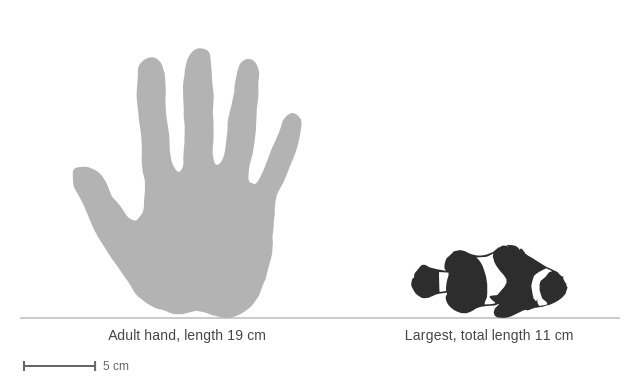
The Clown Anemonefish is a small fish. FishBase gives a maximum total length (nose to tail tip) of 11 cm, and wild fish in Singapore reached up to 11 cm.[11][13] Animal Diversity Web gives an average of about 8 cm and says females are larger than males.[1]
In a study of 65 wild fish at Pulau Tioman, Malaysia, weight grew with length cubed, so the body keeps the same proportions as it grows (isometric growth).[14]
| Length (average) | about 8 cm |
| Length (largest) | up to 11 cm |
Colour and the mucus coat
The skin of an anemonefish (a fish that lives among sea anemones) is covered with mucus, a slimy coat. In a study that included the Clown Anemonefish, this mucus had less sialic acid, a sugar-like molecule, than the mucus of damselfishes that do not live with anemones.[15] This may help the fish live among the stinging tentacles. The study did not show that it stops the stings, and how the fish avoids them is still debated.[15][16]
Senses
In four Clown Anemonefish, the fish made short pulses of sound by snapping their jaws, mostly in aggressive contacts. Each pulse lasted about 10 thousandths of a second and had a main pitch of about 742 Hz (vibrations a second). Bigger fish make lower sounds. The authors say the sounds are not used to attract mates.[17]
A hearing test on three clownfish species, including this one, found that they detect sounds from about 75 to 1,800 Hz, and hear best below 200 Hz.[18]
Behavior
Group and hierarchy
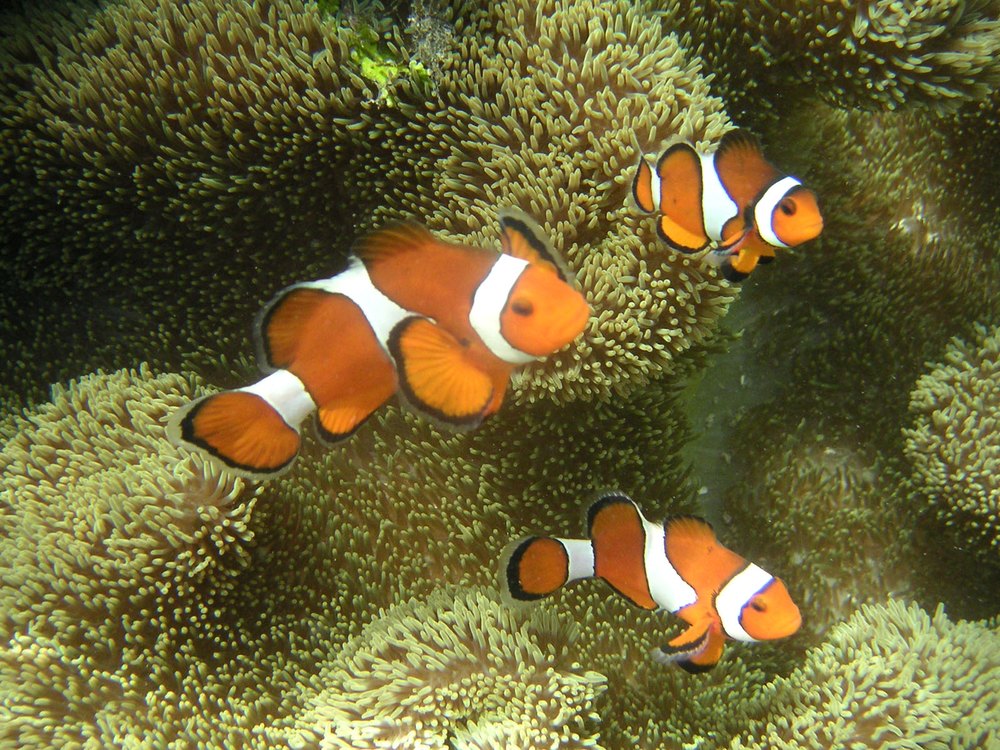
Animal Diversity Web says the Clown Anemonefish is monogamous, territorial and hierarchical, with larger fish aggressive to smaller ones.[1] Animal Diversity Web adds that smaller fish feed close to the anemone, while large dominant fish go up to several metres away.[1]

Sex change
In wild fish at Pulau Tioman, Malaysia, males and non-breeders have ovotestes: gonads with testis tissue in the centre and egg cells at the edge. The ovaries of females have no testis tissue. This means the fish starts as a male and becomes a female (the word for this is protandrous), and a change back is not expected.[14]
In hatchery fish (fish bred on a farm), when the active male was left without an active female, the first signs of the change came after 1 to 2 weeks, and the change to female took about 25 weeks.[3]
Aggression
In 9 captive pairs, the males did about 7 times more parental behaviour and spent over 3 times as long in the nest. The females struck 1.5 times more at a small intruder and showed over 3.5 times the aggression to a large intruder. Towards other females they bit 6.5 times more, struck 3.2 times more and chased 4.1 times more than the males did.[19] The fish also make sounds in aggression (see Body).
Diet
In 60 stomachs of wild fish at Pulau Tioman, most were empty or held few items. The food was larvae of barnacles, sea squirts, crustaceans and snails, plus copepods (tiny crustaceans), algae, fish eggs and scales. The trophic level was 2.98, and the authors call the fish omnivorous.[14] Animal Diversity Web says it eats mostly plankton (small drifting life), with about equal parts algae and animals, and eats parasites from the anemone.[1]
Life cycle
| Stage | What happens |
|---|---|
| Egg | Orange eggs, about 3 to 4 mm long, stuck to bare rock and guarded by the male for about 6 to 8 days[1] |
| Larva | Tiny young drift in the plankton (small drifting life) for about 8 to 12 days[1] |
| Juvenile | The young fish settles on a reef and looks for a host anemone[1] |
| Adult | Lives in an anemone and breeds; up to about 11 cm long[11] |
Spawning and eggs
Animal Diversity Web says the fish spawn all year round in the tropics, most often around the full moon and usually in the morning.[1] Before spawning, the male cleans a patch of bare rock near the anemone and courts the female.[1]
The eggs are orange and about 3 to 4 mm long. Animal Diversity Web gives about 100 to 1,000 eggs a clutch, more in older females, stuck to the rock.[1] The male guards and aerates the eggs.[11] He does most of the egg care.[1] The same source gives 6 to 8 days for the eggs to develop, longer in cooler water.[1]
Hatching
A preprint (a study not yet checked by other scientists) reports that the eggs hatch within 1 to 2 hours after sunset.[20] In a lab experiment, eggs kept in constant artificial light did not hatch.[21]
Larvae and settling
Animal Diversity Web says the newly hatched larvae drift in the plankton for about 8 to 12 days, that they are poor defenders and many die, and that the survivors settle on a reef and look for a host anemone to live in.[1]
Lifespan
Animal Diversity Web estimates that the fish live 6 to 10 years in the wild.[1]
Ecology
Host anemones
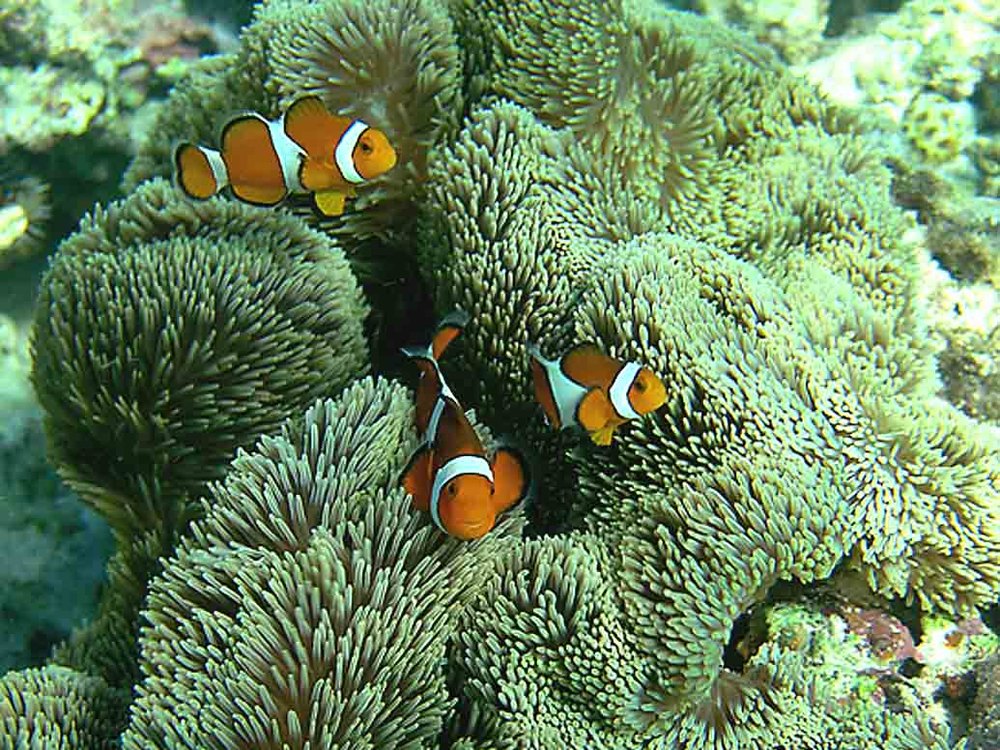
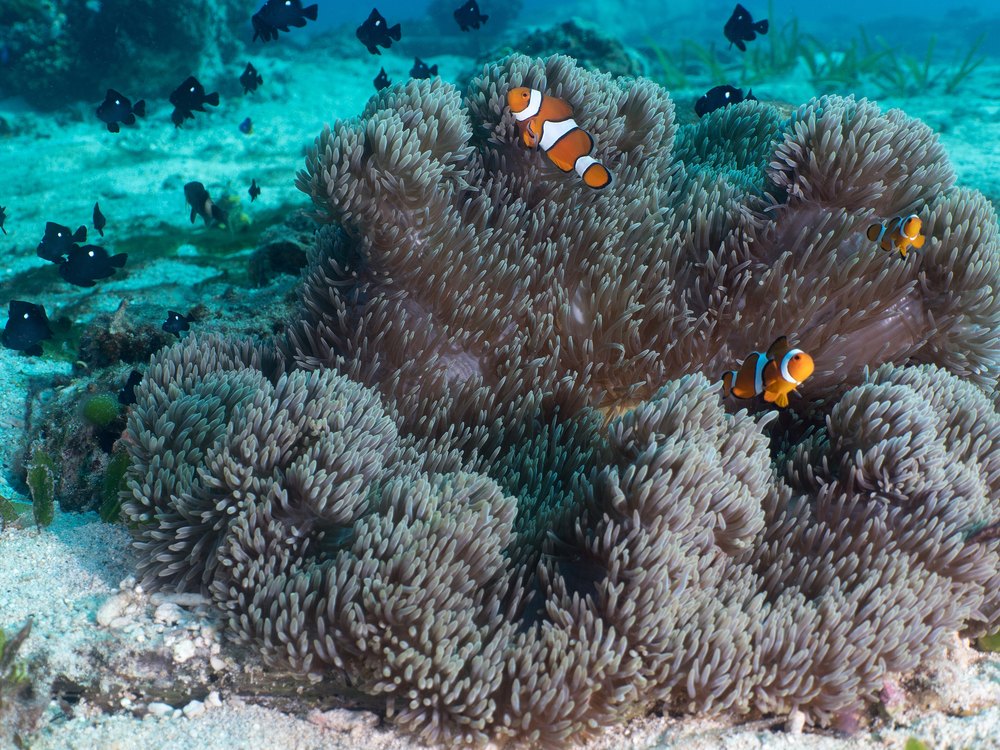
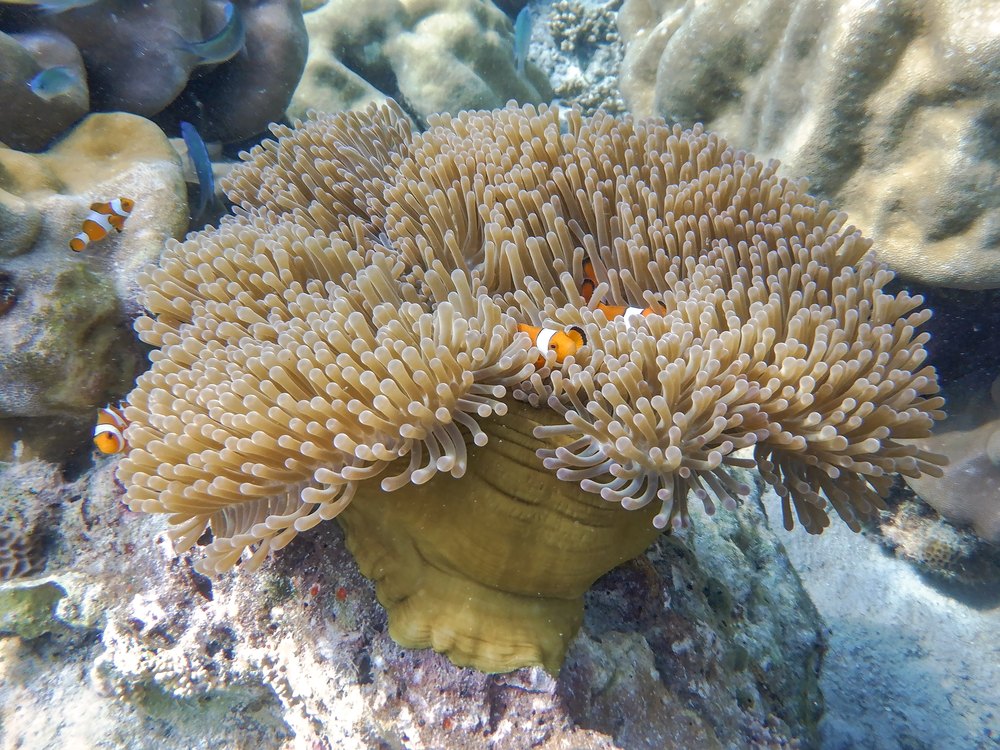
The Clown Anemonefish lives in three kinds of large sea anemone: the magnificent sea anemone Heteractis magnifica, the giant carpet anemone Stichodactyla gigantea and Merten's carpet anemone S. mertensii.[4][11] Adults live among the tentacles of these anemones.[11] What its mucus coat (the slimy coat on the skin) shows about the partnership is in Body.


Warming seas
In a lab experiment, young Clown Anemonefish raised at 3 °C above normal grew and developed faster and had higher metabolic rates (the rate at which the body uses energy).[22]
Habitat and range
Where it lives
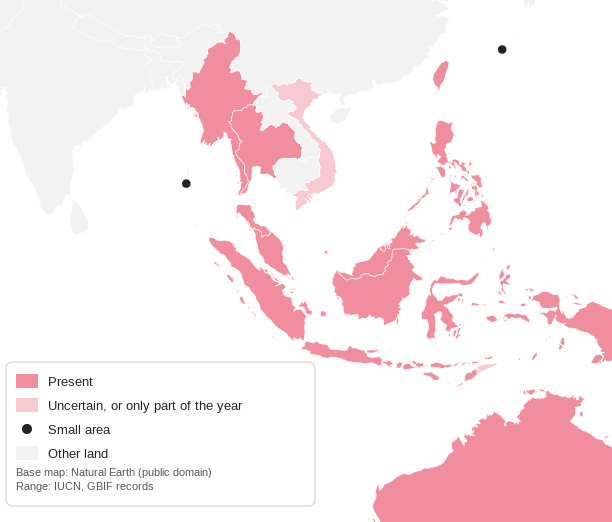
The Clown Anemonefish lives from the Andaman Sea to north-western Australia. IUCN lists Australia (north-west), Brunei, India (Andaman and Nicobar Islands), Indonesia, Japan (Ryukyu Islands), Malaysia, Myanmar, the Philippines, Singapore, Taiwan and Thailand.[4] IUCN also mentions a single record from the Lakshadweep Islands, southern India, based on a 2013 photo, as the westernmost.[4] It has also been recorded in Timor-Leste and Vietnam.[23]
Habitat
It lives in sheltered lagoons and on coral reefs, at depths of 1 to 15 m, usually 3 to 15 m.[4][11]


Evolution
Where anemonefishes sit
Anemonefishes are damselfishes (family Pomacentridae) that live among sea anemones. In one 2021 study they form a tribe (a group between genus and family), the Amphiprionini, of about 28 to 30 species.[24] The Clown Anemonefish and the Orange Clownfish are sister species, meaning each is the other’s closest relative, and the Maroon Clownfish is the next nearest.[24][25] These three form the oldest branch of the group.[24]
How old the group is
Ages come from molecular clocks (dates worked out from DNA differences), and studies give different answers. One study puts the root of the clownfish group at about 19 million years ago, and the main group of the other anemonefishes at about 7 million years ago.[26] Another gives about 15 to 18 million years for the whole anemonefish group.[27] A preprint (a paper not yet peer reviewed) dates the radiation, the burst of new species tied to sea anemones, at about 13 million years ago.[28]
Forms and variants
No subspecies of the Clown Anemonefish are recognised.[7][8] Two names are treated as synonyms, meaning other names for the same species: Amphiprion melanurus Cuvier, 1830 and Amphiprion bicolor Castelnau, 1873.[7][8][29]
The look-alike is the Orange Clownfish (Amphiprion percula). The Clown Anemonefish usually has 11 spines in its dorsal fin, against 10 in the Orange Clownfish, and usually has little or no black edge on its white bands.[6] The two species have mated in captivity,[30] and one study finds a signal of past hybridisation between them.[25] A DNA study of the pair found more separate genetic lineages than the two species alone.[31]
Colour forms
A black form, with white bars and black in place of the orange, occurs off the Northern Territory of Australia; the Australian Museum places it around Darwin.[1][32]
Wild fish in Singapore vary in the black edges of the white bands.[5]
Morphs
Breeders have also made captive-bred morphs for aquariums, which are not wild forms. Aquarium guides list morphs such as Snowflake (irregular, broken white bars), Wyoming White (a nearly all-white body with only traces of orange around the face) and Mocha.[33][34] A 2022 paper identified two other morphs, “Picasso” and “Platinum”, as Orange Clownfish.[35]
Conservation
Status
The IUCN Red List lists the Clown Anemonefish as Least Concern (assessed 3 February 2021, published 2022). The assessment calls it common and locally abundant and gives the population trend as Unknown.[4]
Threats
Climate changeFishing gear[4]Fishing gear. The IUCN says collection for the aquarium trade may affect the fish on a local scale, and that it lives in areas where dynamite fishing is used.[4]
Climate change. The IUCN says the host sea anemones may be vulnerable to bleaching in warm water.[4]
History and culture
Cuvier’s description
The fish Cuvier described in 1830 (see Name) is said to have come from Sumatra, Indonesia.[6]
The aquarium trade
A 2003 report for the UN Environment Programme, From Ocean to Aquarium, names the Clown Anemonefish among the five most traded marine aquarium fish.[36] Its trade records for 1997 to 2002 list 145,015 fish exported, as reported by exporting countries.[36]
The IUCN reports that about 25,515 fish were taken from the Spermonde Archipelago, Indonesia, in 2005 to 2006 for the aquarium trade.[4] The species is also bred in captivity: FishBase says it is bred artificially in Florida for the trade.[11] The morphs sold today are captive-bred (see Forms and variants).
The Nemo effect
The animated film Finding Nemo made clownfish famous. Militz and Foale (2017) studied trade records for the Clown Anemonefish and its close relative the Orange Clownfish, and found little evidence that the film led to more purchases of wild-caught fish soon after its release.[2] Silk and colleagues at the University of Exeter (2017) described the evidence for such a “Nemo effect” as “virtually non-existent”.[37]
Taxonomy
| Rank | Name |
|---|---|
| Kingdom | Animalia |
| Phylum | Chordata |
| Subphylum | Vertebrata |
| Class | Actinopterygii (ray-finned fishes) |
| Superorder | Acanthopterygii[38] |
| Order | Perciformes |
| Suborder | Labroidei[38] |
| Family | Pomacentridae (damselfishes) |
| Genus | Amphiprion |
| Species | Amphiprion ocellaris (Cuvier, 1830)[7][9][10][8] |
Synonyms (2)
| Name |
|---|
| Amphiprion melanurus (Cuvier, 1830) |
| Amphiprion bicolor (Castelnau, 1873) |
From the GBIF backbone.[12]
Higher classification
The species belongs to the damselfishes, family Pomacentridae. [7][8] Lists disagree on the order: GBIF and ITIS use Perciformes, while WoRMS and FishBase use Ovalentaria. [7][8][9][11] Within the family, the anemonefishes were once a subfamily of their own, Amphiprioninae. A 2021 study of damselfish relationships ranks them inside the subfamily Pomacentrinae, and the same study folds the Maroon Clownfish into the genus Amphiprion. [24] The Clown Anemonefish and its closest relative, the Orange Clownfish (Amphiprion percula), form the subgenus Actinicola. [24]
Two species or three lineages
The Clown Anemonefish and the Orange Clownfish look much alike and were mixed up for a long time. Fish from Darwin were called Amphiprion percula in 1927 and again in 1964. [6] DNA work on the pair found five groups, each tied to one region. Two large gaps between them point to three deep lineages, not two. [31] No third species has been described.
Sources
- Animal Diversity Web, Amphiprion ocellaris
- Militz and Foale 2017, Fish and Fisheries
- Madhu, Madhu and Venugopal 2010, Journal of the Marine Biological Association of India 52: 62–69
- IUCN Red List, Amphiprion ocellaris
- Nelson, Chou and Phang, Raffles Bulletin of Zoology 42: 927–930
- Fishes of Australia, Amphiprion ocellaris
- GBIF, Amphiprion ocellaris
- WoRMS, Amphiprion ocellaris
- ITIS, Amphiprion ocellaris
- Catalogue of Life, Amphiprion ocellaris
- FishBase, Amphiprion ocellaris
- GBIF, vernacular names of Amphiprion ocellaris
- Nelson, Phang and Chou 1996, Journal of Fish Biology 48: 1130–1138
- Khoo, Das and Ghaffar 2018, Egyptian Journal of Aquatic Research 44: 233–239
- Anemonefish mucus and sialic acid, BMC Biology 2025
- Anemonefish eco-evo-devo review, EvoDevo 2020
- Colleye et al. 2011, BMC Evolutionary Biology 11: 365
- Parmentier, Colleye and Mann 2009, Journal of Experimental Biology 212: 2023–2026
- Novel behavioural assays in anemonefish, Journal of Fish Biology 2025
- bioRxiv preprint 2026, nocturnal hatching in false clownfish
- Fobert, Burke da Silva and Swearer 2019, artificial light at night and reproductive failure in clownfish (Biology Letters; dataset page)
- Moore et al. 2023, Science of the Total Environment 873: 162296
- GBIF, occurrence records of Amphiprion ocellaris by country
- Tang et al. 2021, Ichthyology & Herpetology 109: 258–318
- Litsios and Salamin 2014, BMC Evolutionary Biology 14: 245
- Litsios et al. 2012, BMC Evolutionary Biology 12: 212
- McCord et al. 2021, PLoS ONE
- De Jode et al. 2024, bioRxiv preprint
- Eschmeyer’s Catalog of Fishes, Amphiprion melanurus
- Balamurugan et al. 2017, Aquaculture Research 48: 2989–3003
- Timm, Figiel and Kochzius 2008, Molecular Phylogenetics and Evolution 49: 268–276
- Australian Museum, Western Clown Anemonefish, Amphiprion ocellaris
- FishStores.org, Snowflake Clownfish care guide
- AquaLife Blog, types of clownfish: species and morphs
- Anikuttan et al. 2022, Frontiers in Marine Science
- Wabnitz et al. 2003, From Ocean to Aquarium
- University of Exeter 2017, on Silk et al., Conservation Biology
- ITIS, Amphiprion ocellaris, classification