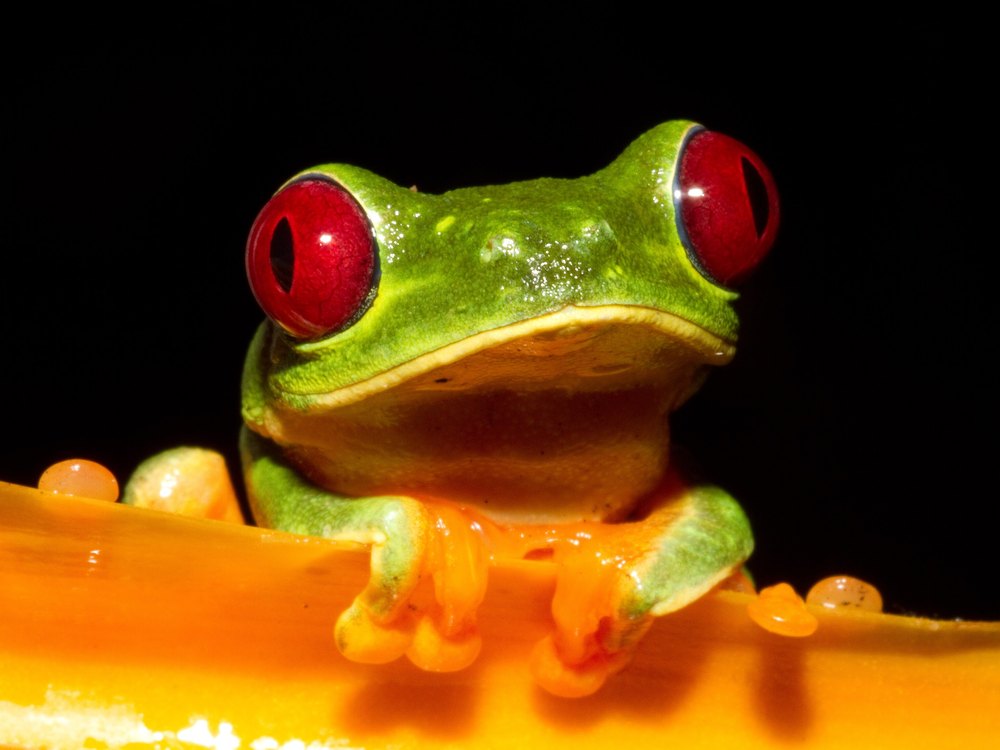
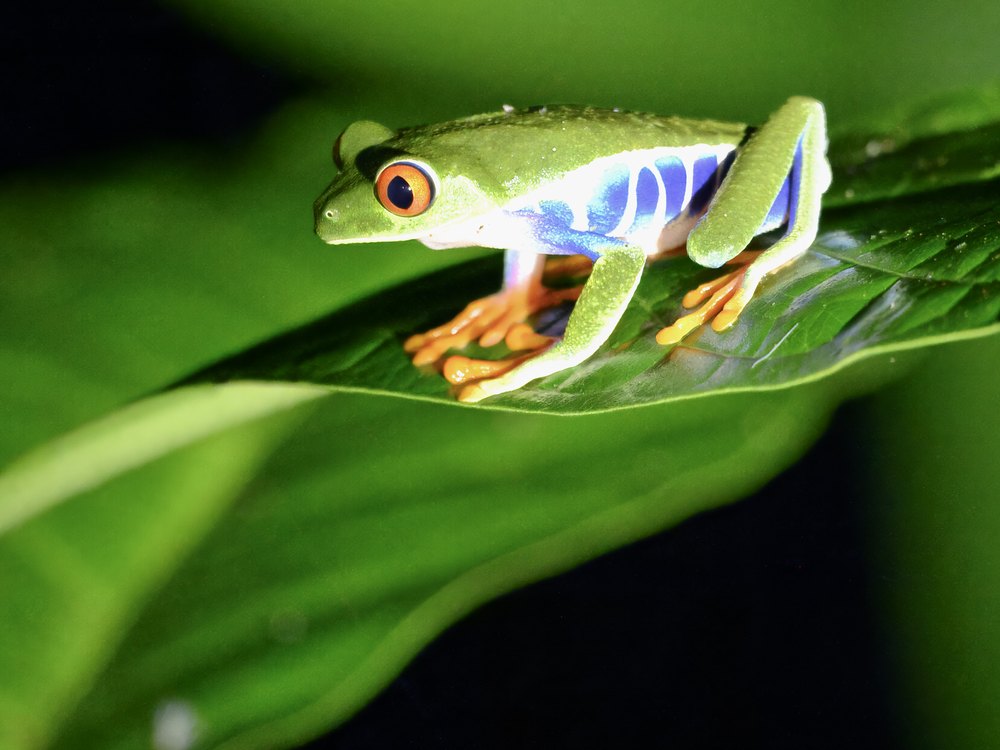
The Red-eyed Tree Frog (Agalychnis callidryas) is a small, leaf-green tree frog of the rainforests of southern Mexico and Central America, named for its bright red eyes. It has orange feet and legs streaked with yellow and blue, and it is active at night.[1] It lays its eggs on leaves above water, and the young inside can hatch early when a snake or wasp attacks the eggs.[2][3]
Quick facts
Description
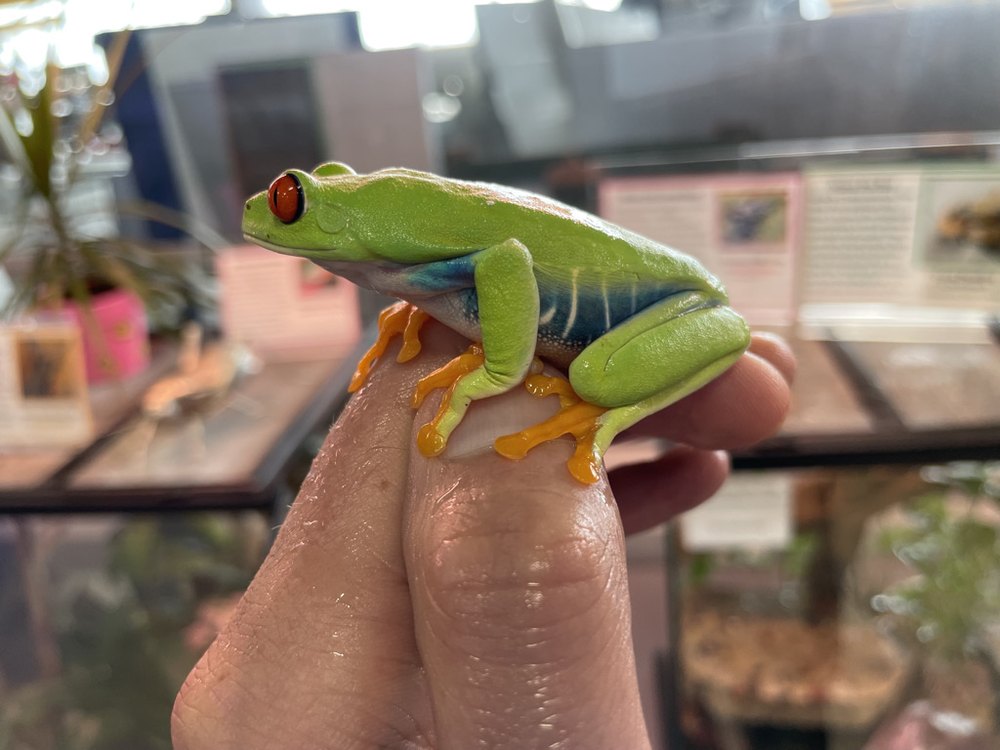
The Red-eyed Tree Frog is easy to know by its bulging red eyes and its webbed orange feet. Its legs have symmetrical streaks of yellow and blue, and the rest of its body is leaf green.[1] The colours of the legs differ from region to region (see Forms and variants).


Name
The scientific name is Agalychnis callidryas. Edward Drinker Cope first described the frog in 1862 under the name Hyla callidryas.[4][5][6] Phyllomedusa callidryas is another older name for it.[4][5]
The English names listed in databases are Red-eyed Treefrog, Red-eyed Leaf Frog, American Red-eyed Tree Frog and Gaudy Leaf Frog.[7][6][5] The frog's family placement has also changed over time (see Taxonomy).
In other languages
| Language | Name | Meaning |
|---|---|---|
| Spanish | Rana de árbol de ojos rojos | red-eyed tree frog |
| French | Rainette aux yeux rouges | tree frog with red eyes |
| German | Rotaugenlaubfrosch | red-eye leaf frog |
| Italian | Raganella occhi rossi | tree frog, red eyes |
| Portuguese | Perereca-de-olhos-vermelhos | tree frog with red eyes |
| Danish | Rødøjet løvfrø | red-eyed leaf frog |
| Czech | Listovnice červenooká | red-eyed leaf frog |
| Hungarian | vörösszemű levelibéka | red-eyed leaf frog |
| Russian | Красноглазая квакша | red-eyed tree frog |
| Japanese | アカメアマガエル | red-eyed tree frog |
| Chinese | 紅眼樹蛙 | red-eyed tree frog |
Names are taken as listed in the GBIF and Catalogue of Life name lists.[7][6]
Body
Size
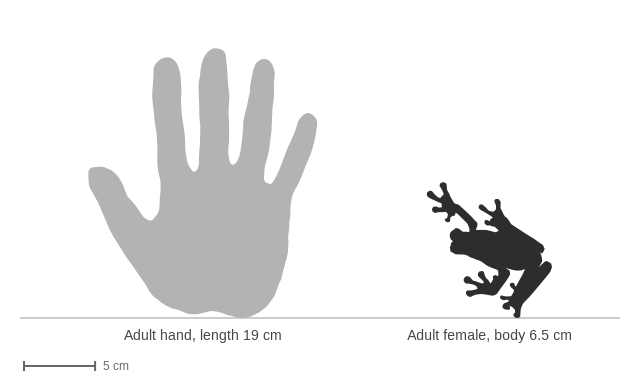
Females are larger than males. In a field study in Belize from 2003 to 2005, females averaged 6.0 to 6.8 cm in length and about 10 g, and males averaged 4.6 to 5.3 cm and about 4 g.[8] Here length means the distance from the nose to the end of the body, not counting the legs.
The same study quotes earlier works that put the usual length at 4.5 to 5.5 cm for males and 5.5 to 7.5 cm for females.[8]
| Female | Male | |
|---|---|---|
| Weight | about 10 g | about 4 g |
| Length | 6.0–6.8 cm | 4.6–5.3 cm |

Skin and colour
Animal Diversity Web says the tadpoles are pale grey on the back and bluish-grey on the sides.[1]
Senses
Embryos (the young developing inside the egg) sense vibrations and use them to hatch early when their clutch is attacked (see Life cycle). Adults send vibrations through the branches to other frogs (see Behavior).
Behavior
Night life
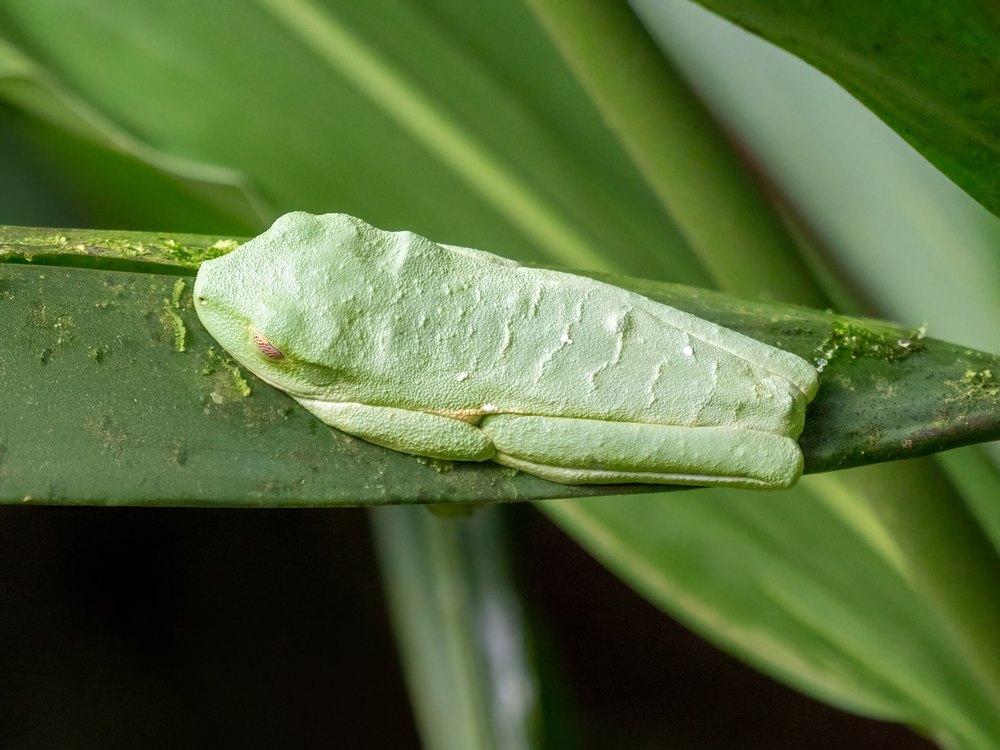
The Red-eyed Tree Frog is nocturnal (active at night) and lives in trees. Animal Diversity Web says it shelters under broad leaves in hot or dry periods and is often seen in groups.[1]

Calls and vibrations
Animal Diversity Web says the frogs shake branches to send vibrations to others.[1] In fights between males, the shaking was the most frequent aggressive display. Tests with a robotic frog and a shaker showed that the plant-borne vibrations are a signal on their own: they were enough to make other males shake back. How often males used it varied with their size and the situation.[9]
Mating
Breeding starts with the rains. Males gather at permanent pools and temporary ponds and call from the plants around them, and females arrive later after heavy rain.[8] In a study in Belize, males began calling at dusk and females reached the pond between 21:00 and 22:00. When females were present, there were about 3.4 males to every female.[8]
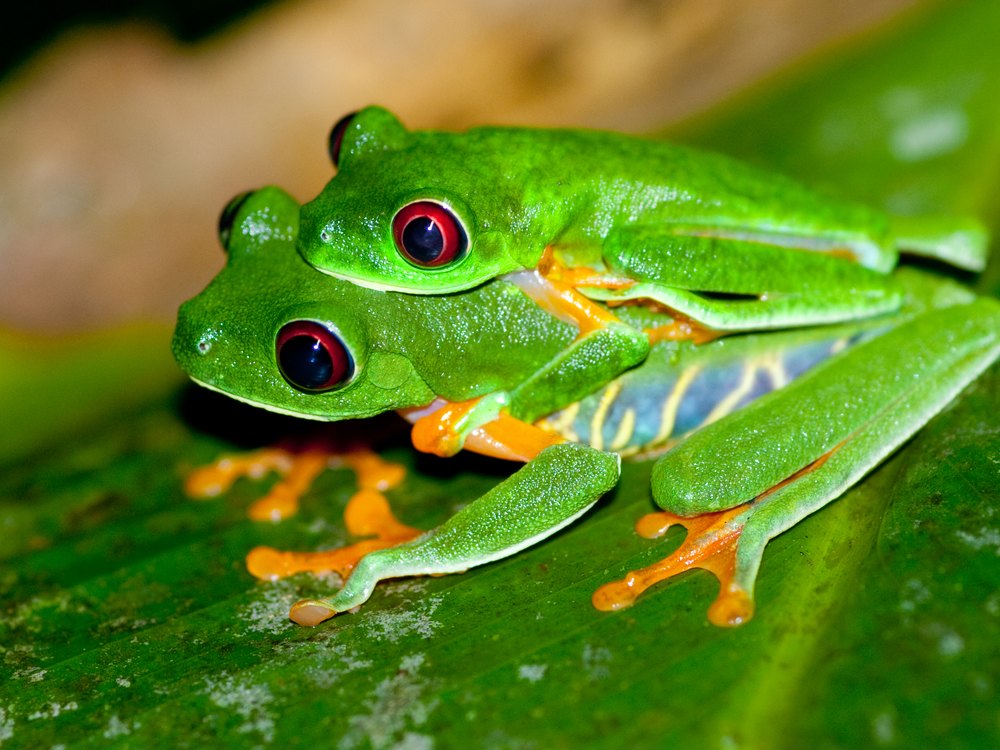

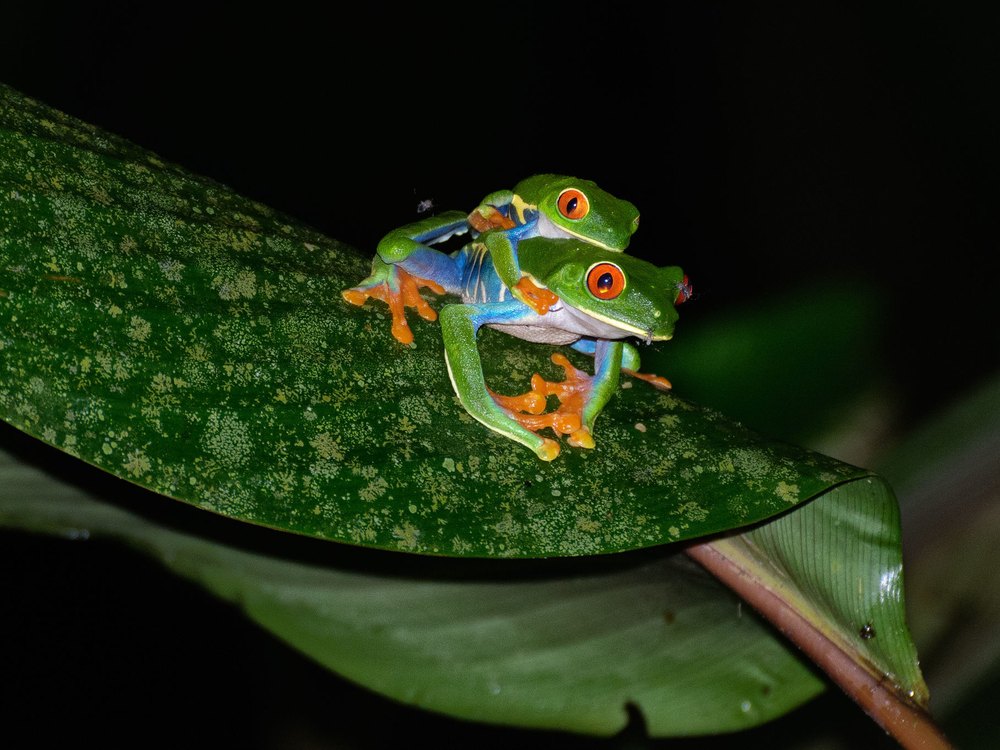

A pair mates in amplexus, the grip in which the male clasps the female's back so that the two vents (the body opening used for mating and egg laying) are close together. The female was about 1.3 times the male's length. Fertilisation was nearly complete: in only 2 of 56 clutches (batches of eggs) were fewer than all eggs fertilised.[8]
In one of the three years, the males that had clasped a female were larger than the others (53.1 mm against 51.0 mm on average); in the other two years there was no difference. The author considers female choice the most likely reason.[8]
Males were not seen fighting over females in Belize: in 15 trials, no male was pushed off a female.[8] Animal Diversity Web says males fight for mating opportunities.[1]
Diet
Animal Diversity Web says the frog eats mainly insects such as flies, grasshoppers and mosquitoes, and other arthropods (animals with jointed legs).[1] The tadpoles feed in the water by filtering food from it for several weeks, and have been known to eat each other.[1]
Life cycle
| Stage | What happens |
|---|---|
| Egg | A jelly mass of eggs sits on a leaf over water; the eggs hatch after 6 to 7 days, or earlier if attacked |
| Tadpole | The young swim in the water below |
| Froglet | A young frog that has just lost its tadpole tail |
| Adult | The adult frog; females are larger than males (see Body) |
Eggs
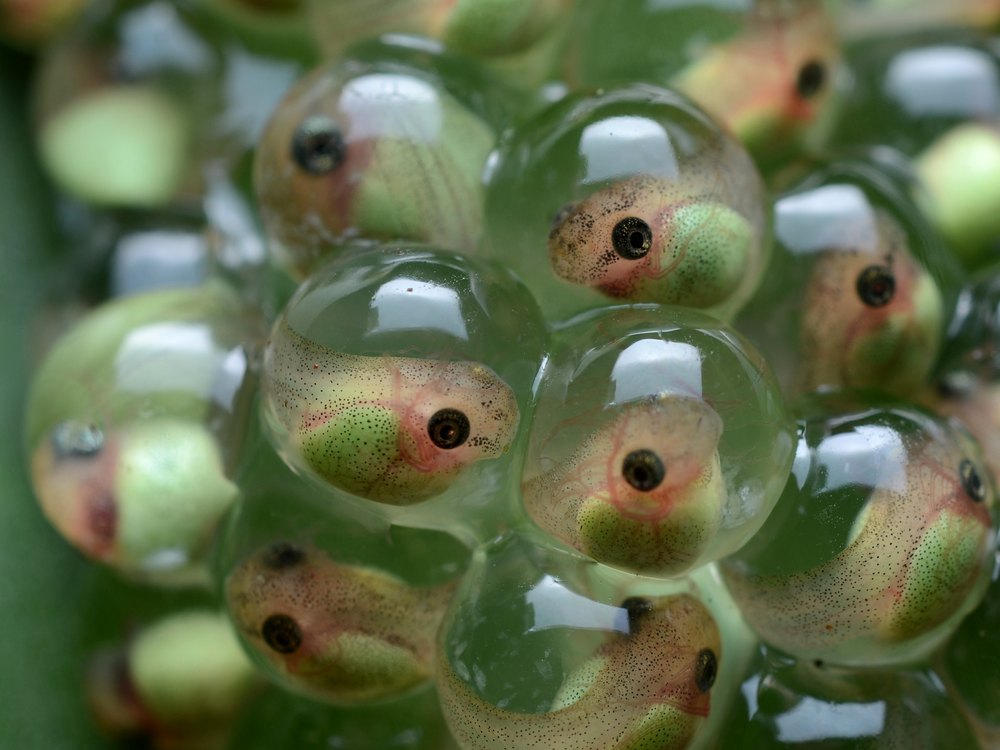
The female lays her eggs in a jelly mass on a leaf that hangs over water.[8][10] A batch of eggs is called a clutch. In Costa Rica a clutch held about 40 eggs, with a range of 24 to 57.[11] A fresh egg is about 6.4 mm across.[10] Neither parent stays to guard the eggs.[1]
Hatching early
Eggs left alone hatch after 6 to 7 days.[3] The timing can change, though. The embryos (the young frogs developing inside the eggs) can hatch at any age from 3 to 7 days.[10] They start to feel vibrations from about day 3 to 4.[3][11]
When a snake or a wasp attacks the clutch, the shaking makes the embryos hatch within seconds and drop into the water below.[3][12] About 80% of embryos that are old enough to hatch get away this way.[3] Heat is another trigger: wet clutches began to hatch at about 37.8 °C.[10]

Tadpoles and froglets
The tadpoles live in the water (see Diet for what they eat). At the end of this stage the tadpole turns into a froglet.
Lifespan
Animal Diversity Web gives an average of 5 years in the wild and 4.1 years in captivity, with reports of over 8 years.[1]
Ecology
Predators of eggs and tadpoles
The eggs sit on leaves above the water, where wasps find them. In a study of wasp attacks, wasps found many clutches and killed some of the eggs.[13] Snakes also eat eggs; how the embryos escape is described under Life cycle.[2][14]
Wasps, fungi and flies all use the egg masses as a resource. Wasp attacks help fungi to colonise a clutch, while flies do not. Flies lay their eggs on clutches whose eggs are damaged or dead, and their young survive better there.[15] In choice tests the flies laid eggs almost only on clutches with dead eggs, although in nature flies also settle on clutches without dead eggs.[16]
In the water, fish and dragonfly larvae eat tadpoles. Tadpoles that grow up with fish develop deeper tail muscles and fins, and their skin also gets darker, while dragonfly larvae and water bugs caused much weaker changes.[17]
Chytrid fungus
Chytrid fungus is a skin fungus that kills many frogs. At five sites in lowland Panama, 20 to 33% of the Red-eyed Tree Frogs tested carried it, with low amounts on the skin.[18] At one lowland site in Costa Rica, 5 of 11 frogs tested positive.[19]
Habitat and range
Where it lives
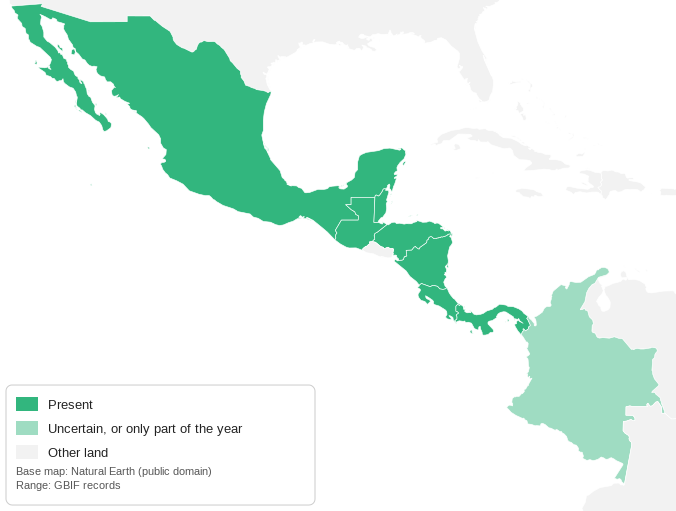
The Red-eyed Tree Frog lives from southern Mexico through Central America. GBIF holds records from Mexico, Belize, Guatemala, Honduras, Nicaragua, Costa Rica and Panama. Costa Rica has by far the most observations (6,757), followed by Panama (646) and Nicaragua (262). Mexico, Guatemala and Honduras are known mostly from museum specimens.[20]
In Colombia, GBIF holds 8 museum specimens collected in 1964 at Rio Manso, Cordoba, and a 2018 Field Museum guide lists the frog at the Cartagena Botanical Garden.[20][21] Neither record shows that the frog is native there.
Habitat
The frog lives in humid rainforest. It spends most of its time in the trees and comes down to low plants near ponds only to breed.[1][18] It needs standing water to breed; the Panama sites included both ponds that dry out and permanent ponds.[1][18]
Animal Diversity Web gives its range as sea level to 1,250 m.[1] A study in Panama describes its habitat as reaching highland forest at 820 to 1,520 m.[18]
Evolution
Where leaf frogs sit
The Red-eyed Tree Frog belongs to the leaf frogs (Phyllomedusidae), a group of tree frogs living in tropical America. Their closest relatives are the tree frogs of Australia and New Guinea (Pelodryadinae).[22] Within the leaf frogs, the genus Agalychnis has a sister genus, Hylomantis (the rough leaf frogs).[23]
How old the group is
The dates come from DNA, and they differ a little between studies. One study puts the split between the leaf frogs and the Australian and New Guinean tree frogs at about 45.5 million years ago (range 42.7 to 48.4).[23] Another gives about 50 million years ago.[24] The branch holding Agalychnis and Hylomantis is about 21.7 million years old (range 20.1 to 23.6).[23] The nearest relative of the Red-eyed Tree Frog is probably Agalychnis terranova of Colombia, judged from one short gene.[25]
Forms and variants
No separate subspecies are recognised for the Red-eyed Tree Frog. The northern form taylori, described as a subspecies in 1957, is treated as its own species by Amphibian Species of the World and ITIS, but GBIF still lists it as a subspecies.[26][27][4]
Colour changes from place to place. In Costa Rica and Panama, flank colour tells Caribbean frogs from Pacific frogs, and leg colour varies in a more complex way.[28] On the Pacific coast of Costa Rica the legs shift from orange in the north to purple in the south, and where the two meet, several colour patterns occur together. The study found no sign that this came from recent hybridisation.[29]
DNA from the mitochondria (the small energy units inside cells, passed on by the mother) falls into five groups in Costa Rica and Panama.[28][30] In some places the colour follows these groups, and in others it does not.[28][30] A separate study found a contact zone between two distinct lineages, where hybrid frogs persist and show a new leg colour pattern.[31] None of these groups is treated as a separate species.
In 2019, McCranie, Sunyer and Martinez-Fonseca raised Agalychnis taylori, from central Veracruz in Mexico to west-central Honduras, from a subspecies to a species. Amphibian Species of the World and ITIS follow this, while the GBIF backbone still treats it as a subspecies of A. callidryas.[26][27][4]
Conservation
Status
GBIF's copy of the IUCN Red List gives Least Concern.[32]
Threats
DiseasePollution[18][19][1][33]Disease. Chytrid fungus (see Ecology) was found on wild Red-eyed Tree Frogs in Panama and Costa Rica, but those studies did not show any decline.[18][19]
Pollution. In a lab study, a fungicide called chlorothalonil slowed the growth of tadpoles and, at higher doses, killed them.[33]
History and culture
Cope's description
Described by Cope in 1862 (see Name), the frog was later moved from the genus Hyla to the genus Agalychnis.[26]
Research on early hatching
Pyburn (1970) described the breeding behaviour of leaf frogs in Mexico.[34] Warkentin (1995) showed that hatching age adapts to predation risk: eggs attacked by snakes hatch early, and unattacked eggs hatch later.[2] Warkentin (2000) studied wasp attacks on eggs and the early hatching they cause.[13] Warkentin (2005) tested vibrations as the cue that tells embryos, the young developing inside the egg, when to hatch.[12] Jung and colleagues (2020) found that embryos use several senses, including the lateral line (a line of touch cells along the body), to escape egg predators.[14] Caldwell and colleagues (2010) showed that vibrations sent through plants are a signal in fights between males.[9]
On a coin
Costa Rica's 2023 50-colon coin shows the frog on its reverse side.[35]
Taxonomy
| Rank | Name |
|---|---|
| Kingdom | Animalia |
| Phylum | Chordata |
| Subphylum | Vertebrata |
| Class | Amphibia |
| Order | Anura (frogs and toads) |
| Family | Phyllomedusidae (leaf frogs)[4][5][6] |
| Genus | Agalychnis Cope, 1864[4][6] |
| Species | Agalychnis callidryas (Cope, 1862)[4][5][6] |
Synonyms (4)
| Name |
|---|
| Hyla callidryas (Cope, 1862) |
| Phyllomedusa callidryas (Cope, 1862) |
| Agalychnis helenae (Cope, 1885) |
| Phyllomedusa helenae (Cope, 1885) |
From the GBIF backbone.[7]
Higher classification
The Red-eyed Tree Frog is a frog of the order Anura, in the leaf frog family Phyllomedusidae (Günther, 1858), which Amphibian Species of the World counts as 67 species in tropical America.[38] The family also holds the genera Phyllomedusa and Cruziohyla.[22][38] The genus Agalychnis has 14 species.[39] The family rank is not settled. Faivovich and colleagues (2005) kept the leaf frogs as a subfamily, Phyllomedusinae, inside the tree frog family Hylidae, while Bossuyt and Roelants (2009) and Duellman and colleagues (2016) treat them as a family.[22][36][38] Amphibian Species of the World says most recent workers lean towards the family rank, but that it is still controversial.[38] GBIF, ITIS and the Catalogue of Life use the family.[4][5][6]
Is it one species
The name Agalychnis callidryas now covers less than it did before 2019. the northern frogs were split off as Agalychnis taylori (see Forms and variants).[26] The authors of that split also suggested that frogs from eastern Honduras and northern Costa Rica might be a third species, for which the name helenae is available, but they did not make that change.[26] Amphibian Species of the World therefore warns that papers on A. callidryas written between 1967 and 2019 must be used with caution, because they may mix several kinds of frog.[26]
Sources
- Animal Diversity Web, Agalychnis callidryas
- Warkentin 1995, PNAS 92: 3507–3510
- Jung et al. 2025, Integrative Organismal Biology 7: obaf012
- GBIF, Agalychnis callidryas
- ITIS, Agalychnis callidryas
- Catalogue of Life, Agalychnis callidryas
- GBIF, vernacular names of Agalychnis callidryas
- Briggs 2008, Ethology 114: 489–498
- Caldwell et al. 2010, Current Biology 20: 1012–1017
- Guevara-Molina, Gomes and Warkentin 2022, Integrative Organismal Biology 4: obac041
- Güell, McDaniel and Warkentin 2024, Integrative Organismal Biology 6: obae006
- Warkentin 2005, Animal Behaviour 70: 59–71
- Warkentin 2000, Animal Behaviour 60: 503–510
- Jung, Serrano-Rojas and Warkentin 2020, Journal of Experimental Biology
- Hughey et al. 2011, Oecologia 168: 1057–1068
- Hughey et al. 2012, Biology Letters 8: 887–889
- Touchon and Wojdak 2014, PLoS ONE 9: e100623
- Rebollar et al. 2014, PLoS ONE 9: e95484
- Zumbado-Ulate et al. 2019, Ecology and Evolution 9: 4917–4930
- GBIF, occurrence records of Agalychnis callidryas by country
- Field Museum 2018, amphibians and reptiles of the Cartagena Botanical Garden, Colombia
- Faivovich et al. 2005, Bulletin of the American Museum of Natural History 294: 1–240
- Almeida-Silva et al. 2024, PeerJ 12: e17232
- Feng et al. 2017, PNAS 114: E5864–E5870
- Rivera-Correa et al. 2013, Zootaxa 3636
- Amphibian Species of the World, Agalychnis callidryas
- ITIS, Agalychnis taylori
- Robertson and Zamudio 2009, Journal of Heredity 100: 715–731
- Clark et al. 2022, Molecular Ecology 31: 1666–1681
- Robertson and Vega 2011, Journal of Biogeography 38: 2122–2135
- Akopyan et al. 2020, Molecular Ecology 29: 4442–4456
- GBIF, IUCN Red List category of Agalychnis callidryas
- Alza, Donnelly and Whitfield 2016, Environmental Toxicology and Chemistry 35: 2998–3004
- Pyburn 1970, Copeia 1970: 209
- Banco Central de Costa Rica, the 50-colon coin
- Duellman, Marion and Hedges 2016, Zootaxa 4104
- Faivovich et al. 2010, Cladistics 26: 227–261
- Amphibian Species of the World, Phyllomedusidae Günther, 1858
- Amphibian Species of the World, Agalychnis Cope, 1864