The West Indian Ocean Coelacanth (Latimeria chalumnae) is a large, slow, night-active lobe-finned fish that lives in deep water along rocky slopes of the western Indian Ocean.[1][2] It became famous in 1938, when a fish caught off South Africa showed that a group known until then only from fossils was still alive.[3] It gives birth to live young and is rated Critically Endangered by the IUCN.[4][5]
Quick facts
Description
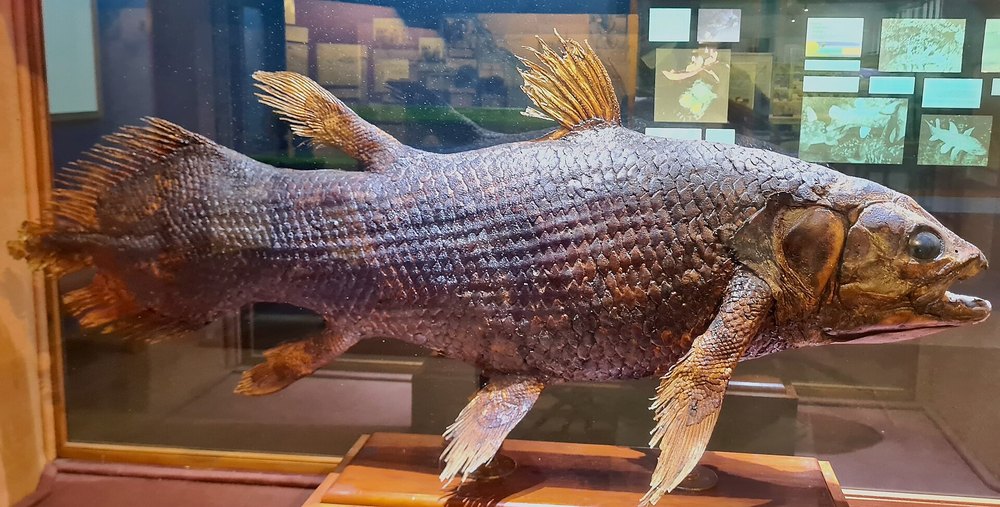
The coelacanth is a heavy, rounded fish with a blue-grey body covered in irregular white blotches.[2][6] The blotches form a pattern that is different in every fish, so researchers use it to tell individuals apart in photographs and video.[2][6] In the caves of the Comoros, the white blotches match the white oyster shells and sponges on the dark volcanic rock of the cave walls.[6]
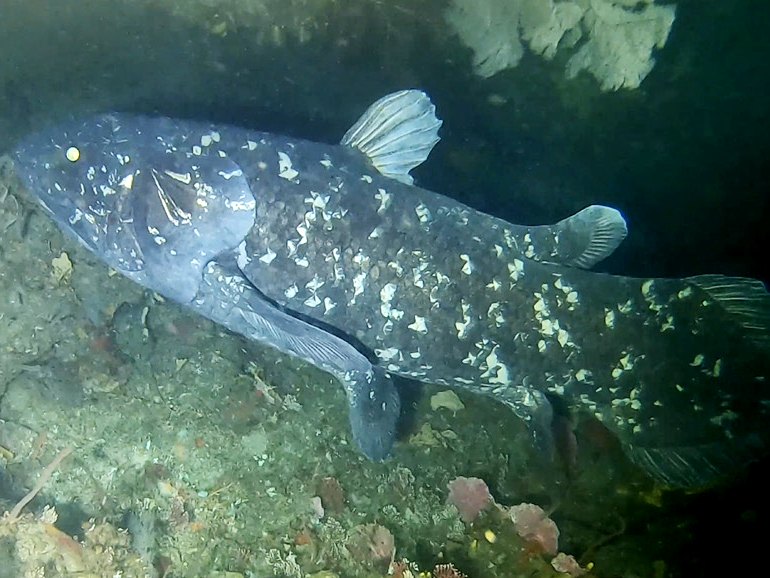
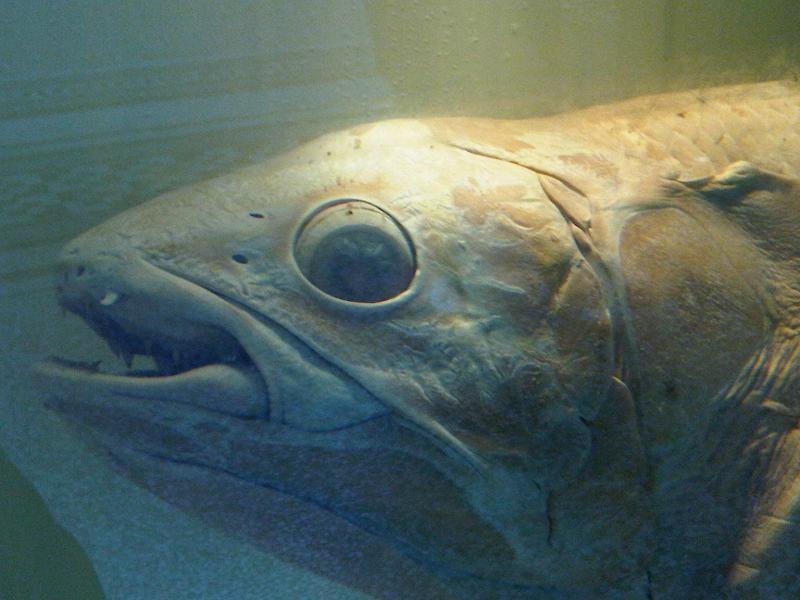
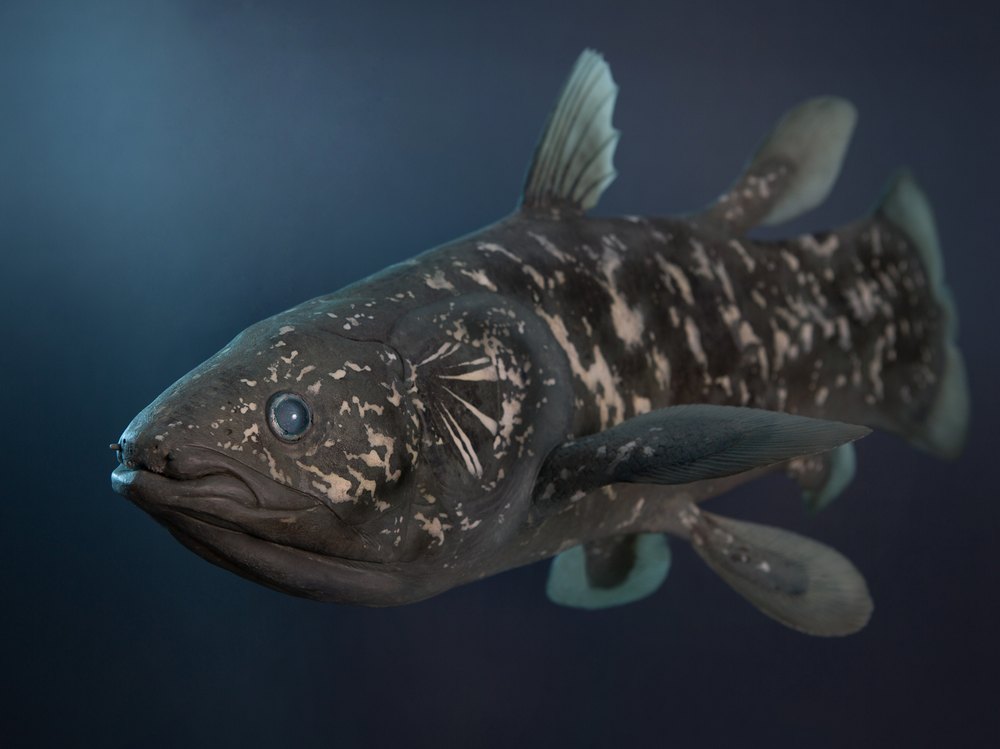
The scales are large, thick and overlapping, and they cover most of the body.[6] The fish has eight fins. The paired fins, which are the two pectoral and two pelvic fins, sit on fleshy lobes.[6][2] The first dorsal fin can be folded down or held upright.[6]
Most photographs of coelacanths show fish that were caught and kept in museum collections, not living ones.
Name
The English name of this fish is West Indian Ocean Coelacanth. In everyday use it is simply “coelacanth”, and it is also called the African coelacanth or the Comoran coelacanth.[7][8] The genus has a second living species, the Indonesian coelacanth (Latimeria menadoensis), so the longer name tells the two apart.[9][10]
The scientific name Latimeria chalumnae was given by the South African fish scientist J. L. B. Smith in 1939, in a short paper in the journal Nature (volume 143, pages 455–456).[3][10][11] The genus name honours Marjorie Courtenay-Latimer, the curator of the East London Museum who saved the first fish in 1938. The species name chalumnae refers to the Chalumna River in South Africa, near where that fish was caught.[7]
A second name, Malania anjouanae, belongs to a different fish. It was the second coelacanth ever found, caught off the island of Anjouan in the Comoros in late 1952, and Smith described it in 1953 as a new genus and species.[12][11] Fish scientists no longer treat it as a separate kind: the databases list Malania anjouanae as a synonym (a later name for the same species) of Latimeria chalumnae.[9][10][11]
In other languages
| Language | Name | Notes |
|---|---|---|
| Comorian local | mamme; mtsamboaboa | other local names; also spelled combessa, gombesa, kombesa |
| Afrikaans local | Seelakant | sea coelacanth |
| French | coelacanthe | — |
| Spanish | celecanto | — |
| Comorian | gombessa | Local name in the Comoros; one paper gives “taboo” as its meaning |
The French and Spanish names come from the IUCN Red List, and the Comorian name comes from the IUCN Red List and FishBase.[5][7] The Comorian and Afrikaans names are from the FishBase common-names list.
Body
Size
The coelacanth is a large fish. Living fish at Grande Comore, in the Comoros, were measured with lasers from a submersible (a small research submarine), and the 52 fish measured, about 88% of the fish at that site, were 100 to 200 cm long, with a measuring error under 5%.[2] Lengths of fish caught earlier by fishers and kept in museums give an average of 128 cm for males and 148 cm for females, so females are clearly the larger sex.[2] The largest captured fish was 190 cm long, and a statistical estimate puts the likely maximum near 199 cm.[4] In South Africa, fish seen from a submersible off Sodwana Bay were estimated at 120 to 180 cm.[6]
| Female | Male | |
|---|---|---|
| Weight (largest) | about 100 kg | |
| Length (average) | 148 cm | 128 cm |
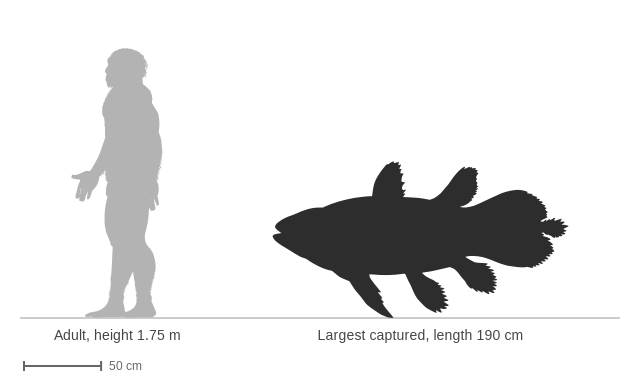
Females are also deeper in the body. Adult females measure 40 to 50 cm from back to belly and males 20 to 30 cm. Body depth is on average 21% of length in males and 26% in females.[2] The living population has two size peaks: 120 to 129 cm, made up of mature males and young mature females, and 160 to 179 cm, made up of mature females only.[2]
Weight
No living coelacanth has been weighed, so every weight comes from museum fish or from older reports. One preserved adult male, 130 cm long and caught in 1960, weighed 26 kg; its weight was worked out from scans.[13] A pregnant female 179 cm long, trawled off Mozambique in 1991, was reported at 98 kg.[7] The largest weights in the literature disagree: a 2021 study says coelacanths can weigh up to 105 kg, while FishBase lists a maximum published weight of 95 kg.[4][7] Published maximum weights range from 95 to 105 kg.
Growth
Growth was worked out from the yearly lines in the scales of 27 museum fish from the Comoros. The curve levels off at a length of 203.8 cm, and the fish approach that length very slowly (growth rate 0.02 per year).[4] The largest fish in the study, 180 cm long and about 84 to 85 years old, had reached 88% of that final length. An older way of reading the scales gave a final length of 296 cm, which is not realistic.[4]
Skin, scales and fins
Each scale carries yearly growth lines, and a scale knocked off with a dart grows back.[4][6] Two fish at Sodwana Bay had a small extra lobe on the tail.[6]
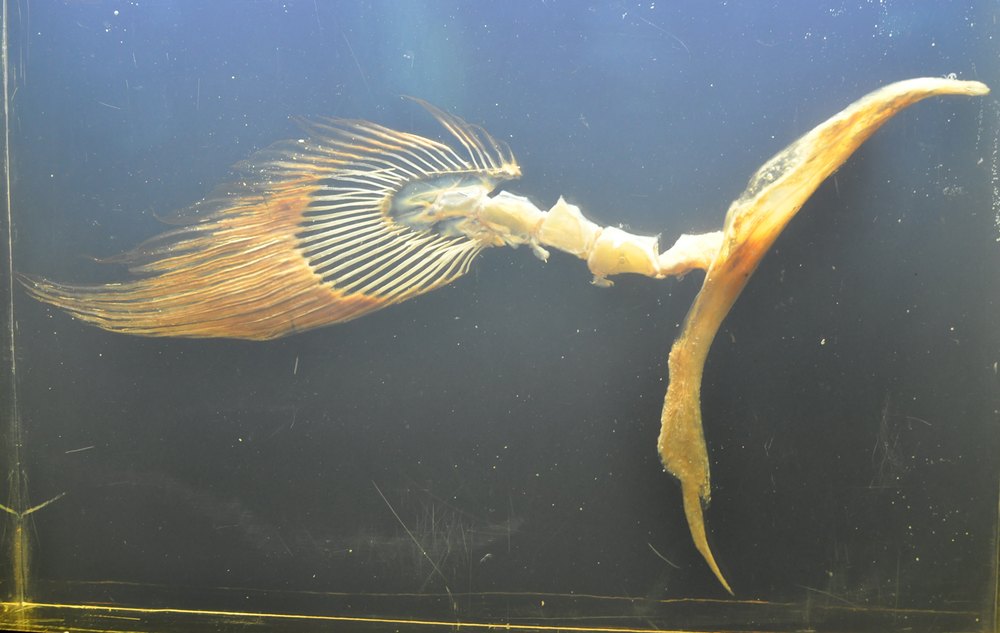
The notochord, the flexible rod that runs along the back in all young vertebrates, stays as a large tube in the adult. It is filled with fluid that is rich in urea and trimethylamine oxide.[13]
Fat organ and lung
In the body cavity lies a long organ filled with fat, mostly a wax-like oil called oleyl oleate. It is the largest buoyancy structure in the body, and it makes up 0.74% of the body volume.[13] Above it sits a tiny, shrunken lung. In a 4 cm embryo the lung is well developed, but in embryos of 32 and 36 cm it has shrunk to a thin filament while the fat organ grows.[14] Older accounts call it a swim bladder, but the fish has a fat-filled organ next to a very small lung.
Together with the other tissues, this makes the fish close to neutrally buoyant (neither sinking nor floating) at 190 to 400 m, which fits its main depth range. At the surface it would float. This comes from one preserved fish and a computer model. The fins can tilt the body easily, so the fish can drift head down with little effort.[13]
Skull joint
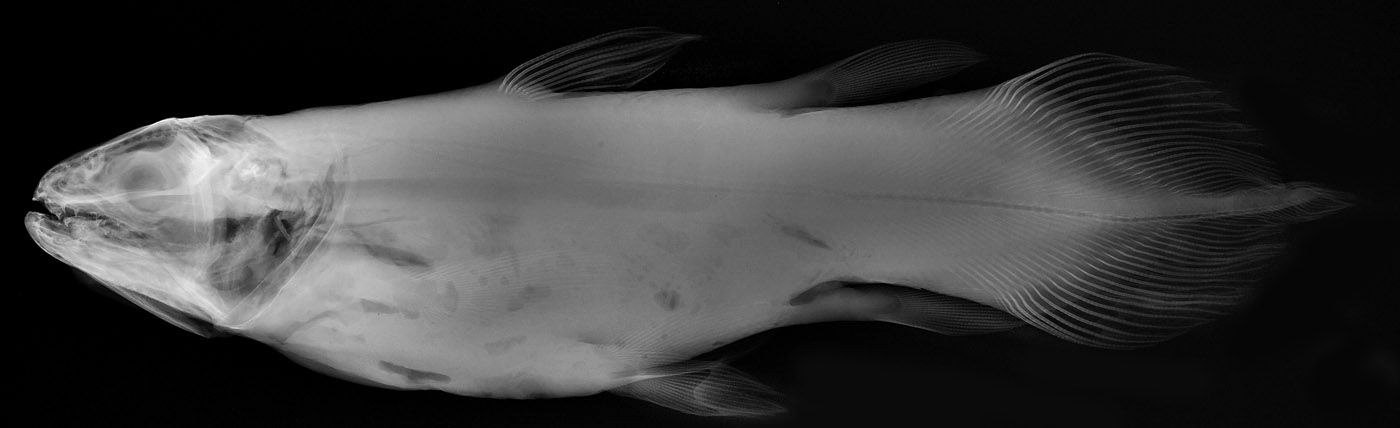
Of the living vertebrates, only the two species of Latimeria have an intracranial joint, a hinge across the skull between the front and rear parts of the braincase. A pair of special muscles runs across it. A 3D model suggests that the joint and the muscles add to the force of the bite.[15]
Senses
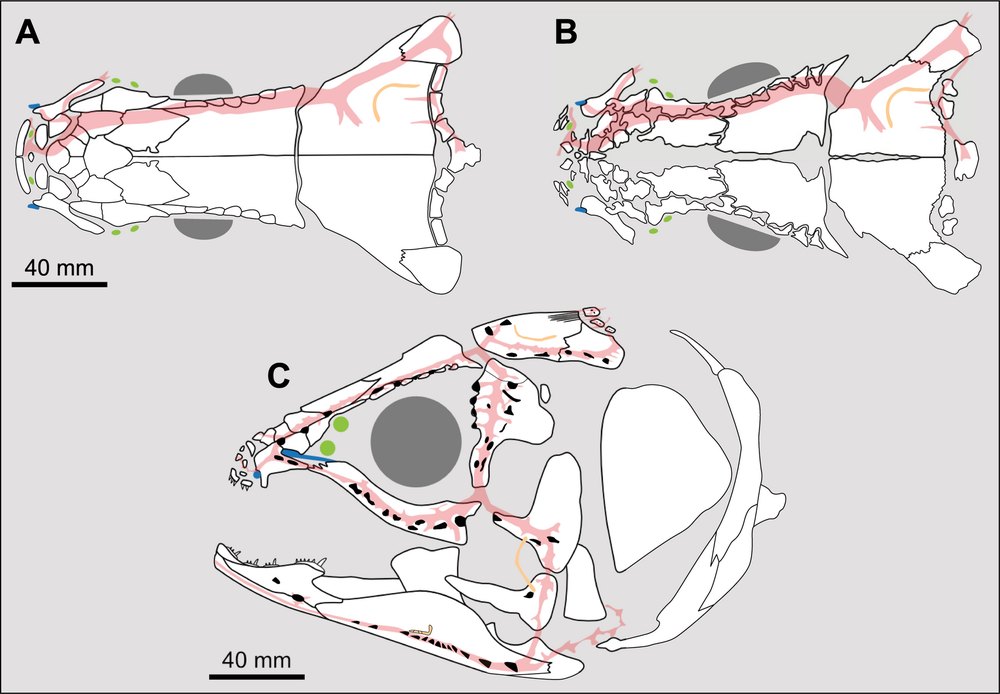
The rostral organ is an electric-sensing sac in the snout, with three pairs of tubules that open through pores on the upper snout. A scan of one preserved male and a model of the organ suggest that it detects weak electric fields directly in front of the mouth and helps the fish aim its strike at prey. It has not been tested in a living fish.[16] The eye holds two light-sensing pigments that respond best to blue light, at 478 and 485 nm, about 20 nm bluer than related pigments. This matches the dim blue light at around 200 m depth.[17]
The inner ear has two sensory patches. Lungs in extinct coelacanths may have helped hearing, but the living species may have lost that role.[18]
Behavior
Day and night
The coelacanth spends the day resting in caves and crevices in the rocky slope, often hanging head down or even upside down. It was not seen to feed there; at Sodwana in South Africa, fish of the right prey size swam past resting coelacanths in daytime without any reaction (for the cave depths, see Habitat and range).[6][2] Around sunset the fish leave the caves and drift out over the slope, and they return before sunrise. In a telemetry study (fish carried small ultrasonic transmitters, so that boats could follow them), a night of activity lasted about 9 hours on average. Nine fish were followed for 1 to 16 nights each.[6][19]
Movement
Most of the night is spent at 200 to 300 m. Large fish also make one deep dive below 400 m on most nights, and the deepest dive recorded reached 698 m.[6][19] The fish stay close to home: the tracked fish kept within about 1 km of their cave, rarely moved more than 3 to 4 km in a night, and swam at an average of about 3.2 m per minute.[6]
Individuals are very faithful to their caves. Of 37 fish identified at Grande Comore in 1989, 17 were still there in 2008, and one fish first recorded in 1987 was seen again in 2008, so it was at least 21 years old.[2] Warm water can drive them out. In 1994 the water at cave depth reached 25.1 °C, fewer fish used the caves, and the counted population fell by 32% before it recovered.[2]
Groups
Coelacanths share caves, but there is no sign of group life. At Sodwana, 15 of 26 encounters (58%) were of single fish and the largest group had 7.[6] At Grande Comore, groups of 11 to 14 fish were seen on nine occasions in 18 years, and the largest ever counted was 16, in a roomy cave. The fish seldom touch, no fighting or other interaction was seen, and the membership of a group changes from day to day. The researchers wrote that it would be premature to call such gatherings social or family groups.[2][6]
Mating
Mating has never been seen, and nothing shows that the cave groups form for breeding.[2] A genetic study of two pregnant females found that all the young in each litter had the same father. The authors suggested that the species may be monogamous, but two litters are a very small sample.[20]
Diet
The coelacanth is a hunter of fish and squid that feeds at night.[5][7] Prey known from stomach contents includes Beryx decadactylus, Polymixia nobilis and Amioides polyacanthus, all fish with a gas-filled swim bladder.[13] A 92 cm museum fish held a 34.5 cm Beryx decadactylus.[13] FishBase also lists a skate, an eel and a swell shark among the prey.[7]
The coelacanth is a drift feeder: it floats slowly with the current and corrects its position with its paired fins, instead of chasing prey. Often it hangs head down just above the sea floor. A sac in its snout, the rostral organ, picks up weak electric fields, and a study of its anatomy suggests that it helps guide the bite when prey is close to the mouth.[16] When a fish comes within 10 to 20 cm of the snout, the coelacanth opens its mouth wide and sucks the prey in, in about one second.[16]
Life cycle
| Stage | Age / time | Notes |
|---|---|---|
| Embryo | At least 5 years inside the mother | The smallest embryo studied was about 4 cm long[14] |
| Pup | Born at about 35 cm | Born live and fully formed[2][4] |
| Juvenile | Aged 9 and 12 years in two museum fish | The smallest museum juvenile was 42.5 cm long[14][4] |
| Adult | Mature at 40 to 69 years | Lifespan about 100 years[4][2] |
Birth and young
The coelacanth is ovoviviparous: the eggs develop inside the mother, and the young are born live.[4][2] Mating has never been seen, so the way the eggs are fertilised is inferred from the anatomy of pregnant females.[4] The embryos live on the yolk of their egg.[2]
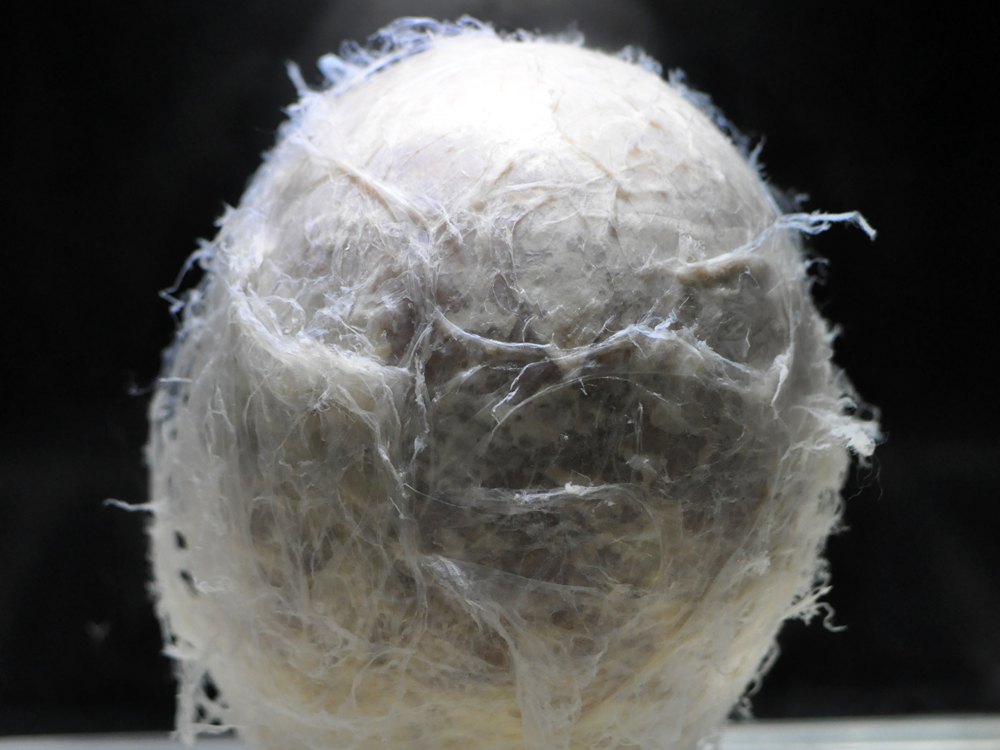
Five litters are known from preserved females, with 5, 19, 23, 23 and 26 pups.[2] The 26 pups of a female caught off Mozambique in 1991 measured 31 to 36 cm.[2] The smallest embryo studied, about 4 cm long, came from a female caught off Tanzania in 2005.[14] A newborn pup is about 35 cm long, and its yolk sac is gone by the time it reaches that size.[2]
The length of the pregnancy is uncertain. In 2021, scale counts on two late embryos gave an age of 5 years, and a growth model applied to the size at birth also pointed to at least 5 years.[4] This would be one of the longest pregnancies of any vertebrate. The authors assumed that the embryos grew as fast as fish after birth, and the result rests on only two embryos.[4] Earlier estimates were shorter. Hureau and Ozouf in 1977 gave 13 months, and Froese and Palomares in 2000 gave about 3 years.[2][7]
Two museum fish give a glimpse of the young. The youngest juvenile aged from its scales was 9 years old, and a slightly older one was 12 years old.[4] The smallest juvenile in the museum collections was 42.5 cm long.[14] Young free-living coelacanths have not been studied in the wild.
Age and lifespan
Coelacanths grow slowly and mature late. Males mature at 40 to 69 years and a body length of 120 to 129 cm, and females at 58 to 66 years and 160 to 179 cm. These ages come from the lengths of mature and immature fish, translated into years with scale-ring growth data.[4]
Two independent methods give a lifespan of about 100 years. The first counts the yearly rings on scales from museum fish. The oldest fish counted was 84 years old, and the study estimated a lifespan of around 100 years.[4] The rings are assumed to form once a year; this was checked indirectly, because tagging or marking the fish was not an option.[4] Older scale counts had given about 20 years, and they were too low by a factor of 5.[4]
The second method uses living fish. Divers in submersibles photographed the same individuals off Grande Comore for 21 years, and the pattern of white blotches identifies each fish. From the yearly losses, the natural death rate is 0.044 per year, which gives a longest lifespan of about 103 years (limits 95 to 117).[2] One fish was seen again after 21 years, so it was at least that old when last seen.[2]
For a fish that is already an adult, the average remaining life is 22.7 years (limits 20.8 to 25.6). This is an average over all adults, including those that die young, and it is not the maximum age.[2] Together with the late maturity and the long pregnancy, it means a female has few litters in a lifetime: one estimate based on a 3-year pregnancy was about seven litters, or about 140 young.[2] That count was made before the 5-year pregnancy was known, so the true number is probably lower.[4]
Ecology
Predators
No one has seen a coelacanth being eaten. Sharks are the suspected predators. A review of the evidence says that sharks probably pose a risk, and it names the sand tiger shark, which has been seen near the Comoros caves, and the bluntnose sixgill shark as sharks that may eat the fish.[1] Damage and deformities on some fins may come from shark encounters.[1] An earlier model of the population treated shark predation as the main natural cause of death.[21]
A camera left in a cave off South Africa filmed a coelacanth sharing the cave with two sand tiger sharks. The coelacanth folded its first dorsal fin about three quarters of the time when no shark was near, and held it spread out more than 95% of the time when a large shark was close. The authors suggest that this is a stress or defence response.[22]
Parasites
Coelacanths carry very few parasites. Two fish from the Comoros held small numbers of nematodes (roundworms) of the family Anisakidae, and other fish had low numbers of isopods (small crustaceans), tapeworms and the larvae of gnathiid isopods. The review that gathers these records does not count parasites as a threat to the species.[1]
Role in the ecosystem
The coelacanth is a large, deep-water predator that sits high in the food chain.[21] It has one of the lowest resting metabolisms (the energy the body uses at rest) of any vertebrate, and its gills are small for its size.[1] Resting in caves by day is thought to help it save energy.[1]
Few young are born, and the animal lives very long, so the population can grow only slowly.[21] In the 21-year study at Grande Comore the number of deaths and new fish each year was small and roughly equal, and the local population stayed near a balance.[1][2]
Habitat and range
Where it lives
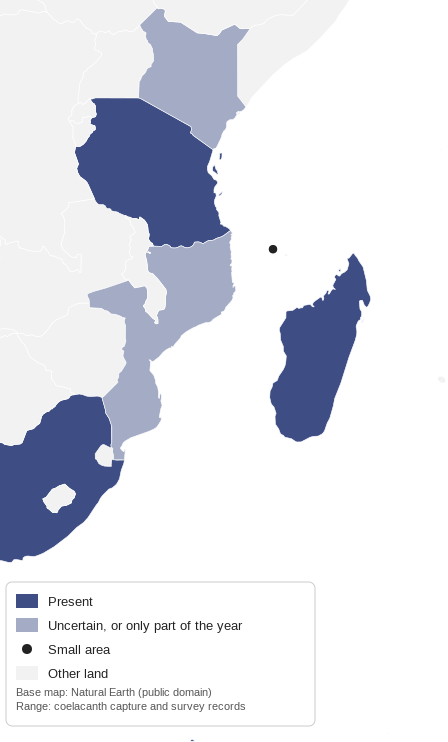
The West Indian Ocean Coelacanth lives off the east coast of Africa. Its range is known almost only from fish caught by fishers and from a few dives, and no one knows how far it extends.[1] The first record from each country is as follows: South Africa 1938, Comoros 1952, Madagascar 1987, Mozambique 1991, Kenya 2001 and Tanzania 2003.[21]
Only two populations have been surveyed: the Comoros and South Africa.[1] In the Comoros the fish are caught mainly off the south-west and west coasts of Grande Comore, and less often off Anjouan.[1] In South Africa a group was found in 2000 in canyons off Sodwana Bay, in the iSimangaliso Wetland Park.[6] Tanzania and Madagascar also have established populations, which have not been surveyed. Madagascar has 34 documented captures from 1987 to 2019 along about 1,000 km of the south-west and west coast.[21] Mozambique and Kenya each have a single fish, caught in a trawl in 1991 and 2001.[21]
By day the fish rests in caves, overhangs and boulder fields on steep slopes. At the Comoros the caves are in young volcanic rock. At Sodwana they cut into the canyon walls, and all but one of the fish seen were in or near caves, overhangs or boulders.[6] Off Tanzania the rock is limestone, and the fish shelter in hollows and ledges worn into it.[1]
Depth and temperature
The fish seen by day in the Comoros caves were at 138 to 259 m, and those at Sodwana at 96 to 133 m.[2][6] At night they move out of the caves to feed, and some go much deeper.[1] The shallowest record is a fish seen at 54 m by a diver in 2004.[23] In Madagascar the fishers estimate capture depths of 60 to 500 m.[21]
The water must be cool. A fish tracked at the Comoros spent 75% of its time at 15 to 19 °C, and it avoids water above about 22 °C, because its blood then carries less oxygen.[1] The caves at Sodwana measured 16 to 22.5 °C.[6] The authors of a 2020 South African study think that a low tolerance of warm water with little oxygen may be why the fish are not found in shallower water there.[23]
Numbers
No estimate exists for the whole species.[1] The figures are local, and each comes from a different method, so they must not be added together.
At Grande Comore, nine surveys from 1986 to 2009 with a submersible and an ROV (a remote-controlled underwater robot) identified 145 fish by their spot patterns. They put the population along an 8 km stretch of coast at 300 to 400 fish. That area is about 9 to 10% of the likely habitat on the island.[1][2] Off South Africa, 32 fish had been identified by 2019 from dives and ROV work.[23] Tanzania and Madagascar have no population estimate.
Evolution
Place among the vertebrates
Coelacanths are lobe-finned fishes, a group that also includes the lungfishes and, in the family tree sense, all land vertebrates. For a long time the coelacanth was a candidate for the closest living relative of land animals. Genome studies now point to the lungfishes instead. A 2013 study of the coelacanth genome compared 251 genes from 21 jawed vertebrates and found that land vertebrates are more closely related to lungfish than to the coelacanth.[24] A 2021 study of the giant lungfish genome used 697 genes from 10 vertebrates, plus stretches of non-coding DNA, and also supported lungfish. It noted that the branches are very short, which is why the question was hard to settle.[25] A third study, of 7,189 genes from 100 species, rejected the version in which coelacanths and land vertebrates are sister groups.[26]
Studies give different dates. One estimate puts the split of the coelacanth line from the other lobe-finned fishes at about 427 million years ago (range 444 to 413), and the split between lungfish and land vertebrates at about 412 million years ago (range 419 to 408).[26] The giant lungfish study dates the last common ancestor of lungfish and land vertebrates to around 420 million years ago.[25] Another study describes the coelacanth line as splitting from the other lobe-finned fishes more than 400 million years ago.[27]
The coelacanth genome changes more slowly than that of land vertebrates. Its protein-coding genes have changed less over time than those of lungfish, chickens or mammals.[24] A slow rate of gene change does not mean an unchanged animal. About a quarter of the genome is made of mobile pieces of DNA, and the authors state that a body that stays similar does not mean the genome stays the same.[24]
Fossil record
The oldest known coelacanth fossils are from the Early Devonian, about 410 million years ago.[28] The group became common later: the order Coelacanthiformes arose in the Permian, and the family Latimeriidae, which holds the living coelacanths, appears in the Middle Triassic, with early members found in Switzerland.[28] More than 100 fossil species are known.[27] Coelacanth genera lasted about 19.5 million years on average, against 13.3 million years for ray-finned fishes.[27]
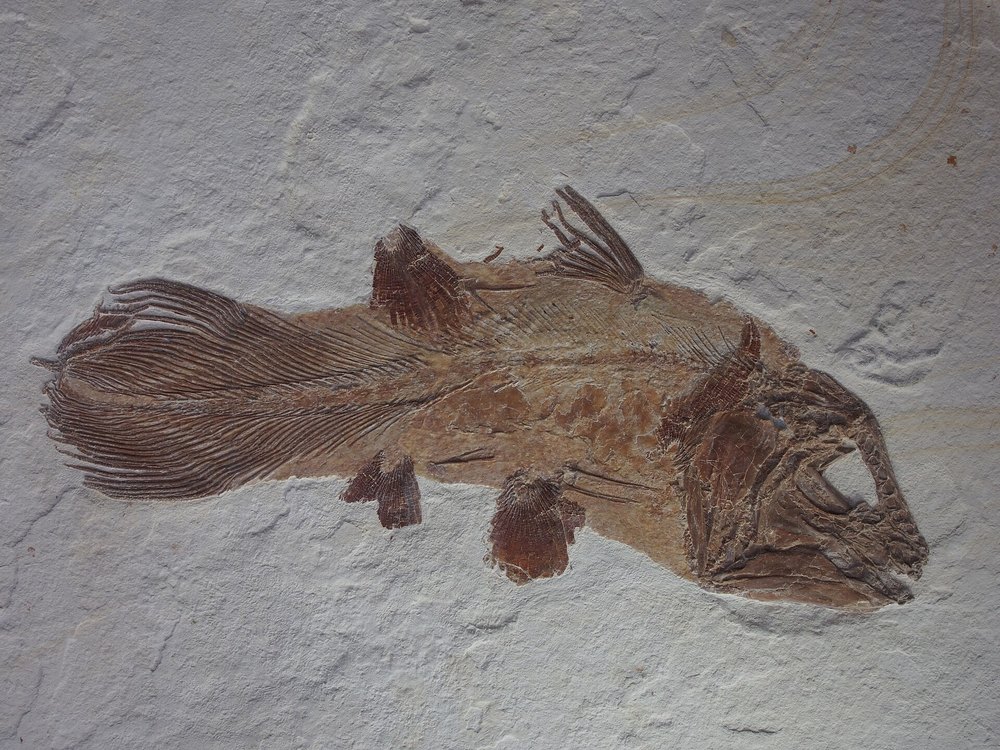
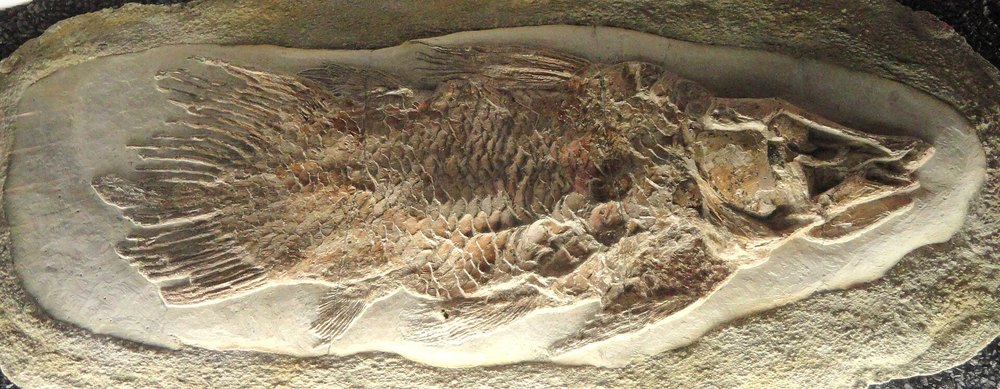


Some fossil coelacanths were large. Two genera reached up to 5 m in length.[27] The last known fossil coelacanth comes from Late Cretaceous phosphate deposits in Morocco, laid down in the final stage of that period, about 66 million years ago.[27] After that there are no coelacanth fossils at all from the Cenozoic, the era that runs to the present day.[27][28] Coelacanths were thought to have died out with the dinosaurs until the fish of 1938 was found.
The fossil record holds no Latimeria. The genus is known only from the living fish, and its closest fossil relatives are Cretaceous. The two living species split much later than the group began, and the dates vary between studies: 30 to 40 million years ago from whole mitochondrial genomes,[8] 30 to 40 million years ago in a later study,[29] and a wider range of 6 to 40 million years across the mitochondrial estimates summarised with the genome.[24]
Forms and variants
No subspecies of the West Indian Ocean coelacanth are recognised. WoRMS, GBIF, the Catalogue of Life, ITIS, FishBase and the Catalog of Fishes list none.[9][10][30][31][7][11]
The Indonesian coelacanth (Latimeria menadoensis) is a separate species. Its mitochondrial DNA (the DNA of the cell's energy units) differs from the Comoran fish by 4.1%,[32] and whole mitochondrial genomes differ by 4.28%.[8] The split between the two species is dated to 30 to 40 million years ago (see Evolution).[8][29]
Within the species, one population stands apart. A study of mitochondrial DNA from 21 Tanzanian and 2 Comoran fish found that the coelacanths of northern Tanzania are genetically distinct. This population has no name of its own.[33]
Conservation
Status
The coelacanth is listed as Critically Endangered on the IUCN Red List, under criteria A2bcd (version 2.3). The assessment was made by J. A. Musick and dated 30 June 2000. It is marked "Needs Updating", and it gives the population trend as unknown and no population figure.[5] The only counts come from single sites (see Habitat and range).[1] The IUCN names unintentional catch in small-scale and subsistence fishing as the ongoing threat.[5]
In the United States the Tanzanian population is listed as threatened under the Endangered Species Act, by a rule dated 29 March 2016. This status covers that one population and not the whole species.[34][35] The species is in Appendix I of CITES, the international agreement on trade in wild animals and plants. Appendix I bans commercial trade, and live or dead fish can move for science only with import and export permits.[5][1]
Threats
BycatchFishing gearClimate changePollutionBycatch. The main threat is bycatch (fish caught by accident) in deep-set gillnets. These are walls of netting hung in the water. In Madagascar a 2021 review judged the large-mesh "jarifa" nets, with a mesh of 15 or 24 cm, set at 100 to 300 m on rough rocky ground, to be the biggest threat to the coelacanth there. They came into use with the demand for shark fins.[21] All 23 Madagascan catches with a known method were taken in such nets, and 35 of 40 Tanzanian catches with a known method were taken in 15 cm jarifa nets between 2003 and 2015.[21] Near Tanga, 19 coelacanths were caught in about five months from August 2004, and 6 in one night.[36][37]
Fishing gear. In the Comoros the fish were taken on handlines until gillnets arrived in the 1990s. Fishing deaths are judged small there.[21][1] A drop of 32% in the counted fish in 1994 was first blamed on fishing, and later work points to warm water instead.[38][2] Dynamite fishing has been recorded in Tanzania and the Comoros.[21]
Specimen sales. Specimens also have a market value. Fishers were once paid US$300 to 400 for a fish, and in the Toliara region of Madagascar payments of 150,000 to 400,000 ariary (about US$40 to 110) are reported.[1][21] In 2012 some fishers said they had set out to catch coelacanths to sell to foreigners.[21]
Pollution. Insecticide residues and plastic litter are named as hazards.[21] A deep-water port planned near Tanga could add pollution, sediment and blasting.[35][37]
Climate change. The fish lives in a narrow temperature band, with an upper limit of about 22 °C (see Habitat and range). Warming of deep water might therefore affect it, but the size of any effect is uncertain.[1]
Protection
The Tanga Coelacanth Marine Park in Tanzania was gazetted on 28 August 2009. It covers about 552 km² along 100 km of coast and was set up because of the coelacanth.[37] Its management plan restricts jarifa nets, but the 2021 review reports that they are still used there.[37][21] In South Africa the canyons at Sodwana Bay lie inside the marine protected area of iSimangaliso Wetland Park, a World Heritage Site.[6] The African Coelacanth Ecosystem Programme, a research and conservation programme, began in April 2002 and is hosted by the South African Institute for Aquatic Biodiversity.[23] The Coelacanth Conservation Council, founded in 1987, gives a number to every recorded specimen and had documented 334 captures by May 2020.[21] Specific laws protect the coelacanth in South Africa, the Comoros and Indonesia, where the other species lives.[36] The 2021 review recommends legal protection and a sanctuary in Madagascar, a ban on bottom gillnets in protected areas, and rewards for releasing live fish.[21]
Ordinary divers cannot see the coelacanth. It needs manned submersibles, remotely operated vehicles (ROVs), or specially trained deep-water divers with special gas mixes and breathing equipment.[6]
History and culture
The 1938 fish
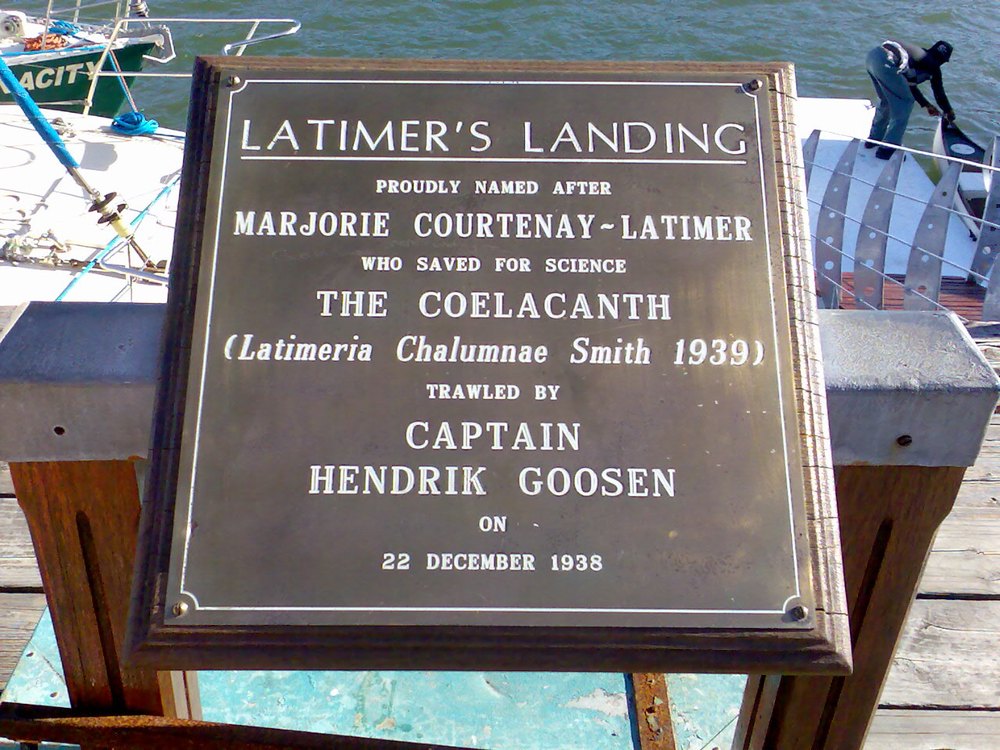
On 22 December 1938 a trawler, the Nerine, brought up an unusual fish off East London, South Africa, from a depth of 72 to 100 m. The skipper, Captain Hendrik Goosen, phoned Marjorie Courtenay-Latimer, the curator of the East London Museum, who found a blue fish about 150 cm long with four stout, leg-like fins.[23][39][40] She could not reach the fish expert J. L. B. Smith, who was away. She sent him a letter with a drawing, and the fish was mounted by a taxidermist, so its organs were lost.[39][40] Smith returned on 3 January 1939 and recognised it as a living member of a group known from fossils.[39][40] He announced it in the journal Nature in 1939 and named it Latimeria chalumnae, after Courtenay-Latimer and the Chalumna River.[3][23]


The second fish
Smith spent the next 14 years searching the coasts of Mozambique, Tanzania and Kenya, and in 1948 handed out leaflets offering a reward of 100 pounds for a second fish.[21][40] In late December 1952 a fisherman caught one by handline off Anjouan in the Comoros. Smith was told of it at sea, and a South African military aircraft flew him to the island.[40][21] He named it Malania anjouanae (later a synonym; see Name), but it proved to be the same species, a fish that had lost some of its fins.[40] France, which then ruled the Comoros, was annoyed at the removal and banned foreign research on the coelacanth there until the Comoros became independent in 1975.[21] The Frenchman Jacques Millot was the first scientist to examine a live coelacanth, a dying female at Mutsamudu on Anjouan on 12 to 13 November 1954.[23][21]
Study and local knowledge
Comorian fishers knew the fish well before 1938, and their name for it is gombessa, a word that Bruton and colleagues translate as "taboo".[21] In 1987 Hans Fricke went to Grande Comore with a research submersible, and his team studied the living fish in its habitat there for more than 20 years.[21][2] In 1997 a coelacanth was found in a market in Sulawesi, Indonesia. It was brown, not blue, and in 1999 it was described as a second species, the Indonesian coelacanth (Latimeria menadoensis).[23][41] In 2000 divers found coelacanths at 104 m in Jesser Canyon at Sodwana Bay, South Africa, then the shallowest sighting.[23] Fish were first recorded in Tanzania in 2003, and by 2020 more than 70 had been caught there.[42][23]
In culture
The coelacanth is often called a "living fossil", a popular name for an animal that was thought to be the last of a group known only from fossils. It is not a scientific term, and the species is not unchanged from its fossil relatives (see Evolution).[27] It is also the standard example of a Lazarus taxon, a group that vanishes from the fossil record and then turns up alive. Smith wrote a popular account of the find, Old Fourlegs (1956).[21] Weinberg told the story again in A Fish Caught in Time (2006).
Taxonomy
| Rank | Name |
|---|---|
| Kingdom | Animalia |
| Phylum | Chordata |
| Subphylum | Vertebrata |
| Superclass | Sarcopterygii[45] |
| Class | Actinistia (coelacanths)[9][30] |
| Order | Coelacanthiformes[9][10][31] |
| Family | Latimeriidae[9][10][31] |
| Genus | Latimeria Smith, 1939[9][11] |
| Species | Latimeria chalumnae (Smith, 1939)[9][10][30][31][11] |
Synonyms (2)
| Name |
|---|
| Latemaria chalumnae (Smith, 1939) |
| Malania anjouanae (Smith, 1953) |
From the GBIF backbone.[44]
Higher classification
The coelacanths are an old group of lobe-finned fishes, the same large group that includes lungfishes and, in the wider sense, all land vertebrates. The order Coelacanthiformes and the family Latimeriidae are the same in every list. [9][10][31][43] Nelson (2006) counts nine families, and Latimeriidae is the only one with living members. [43] The genus Latimeria has two living species, this one and the Indonesian coelacanth. The lists differ only on the name of the class. WoRMS and the Catalogue of Life use Actinistia. GBIF, FishBase and ITIS use Coelacanthi. The IUCN and Nelson use Sarcopterygii as the class and treat the coelacanths as a subclass. [5][7][9][10][30][31][43]
One species, two species or more
The Indonesian coelacanth, Latimeria menadoensis Pouyaud and colleagues, 1999, is accepted as a separate species by the main lists. [9][10][11][30] See Forms and variants. A study of a coelacanth caught off western Papua found a third, older lineage. The authors called it a distinct and so far undescribed species or subspecies. [29]
Sources
- Whittaker 2014, NOAA Fisheries, Endangered Species Act status review report for the coelacanth
- Fricke et al. 2011, Marine Biology 158: 1511–1522
- Smith 1939, “A living fish of Mesozoic type”, Nature 143: 455–456
- Mahé, Ernande & Herbin 2021, Current Biology 31: 3621–3628
- Musick 2000, IUCN Red List assessment of Latimeria chalumnae
- Hissmann et al. 2006, South African Journal of Science 102: 491–500
- FishBase, Latimeria chalumnae
- Inoue et al. 2005, Gene 349: 227–235
- WoRMS, Latimeria chalumnae
- GBIF backbone, Latimeria chalumnae
- Eschmeyer's Catalog of Fishes, Latimeria and Malania anjouanae
- Smith 1953, “The second coelacanth”, Nature 171: 99–101
- Buoyancy and hydrostatic balance in a West Indian Ocean coelacanth, BMC Biology 2022
- Cupello et al. 2015, Nature Communications 6: 8222
- Dutel et al. 2015, Current Biology 25: 1228–1233 (bite force and the intracranial joint)
- Berquist et al. 2015, Scientific Reports 5: 8962
- Yokoyama et al. 1999, PNAS (colour vision of the Comoran coelacanth)
- Manuelli et al. 2026, Communications Biology 9: 400 (a dual respiratory and auditory function for the coelacanth lung)
- Hissmann, Fricke & Schauer 2000, Marine Biology 136: 943–952 (time and space use by ultrasonic telemetry)
- Lampert et al. 2013, Nature Communications 4: 2488
- Cooke, Bruton & Ravololoharinjara 2021, South African Journal of Science 117(3/4)
- Sakaue et al. 2021, Frontiers in Marine Science 8: 755275
- Fraser et al. 2020, South African Journal of Science 116(3/4)
- Amemiya et al. 2013, Nature 496: 311–316
- Meyer et al. 2021, Nature (the giant lungfish genome)
- Irisarri et al. 2017, Nature Ecology & Evolution 1: 1370–1378
- Cavin et al. 2021, PLOS ONE (coelacanth evolution and the lack of a Cenozoic record)
- Ferrante & Cavin 2025, PLOS ONE 20(6): e0320214
- Kadarusman et al. 2020, Scientific Reports (a Latimeria population in western Papua)
- Catalogue of Life (ChecklistBank dataset 3LR), Latimeria
- ITIS, Latimeria chalumnae
- Holder et al. 1999, PNAS 96: 12616–12620
- Nikaido et al. 2011, PNAS (coelacanth populations off Tanzania)
- NOAA Fisheries, final rule listing the Tanzanian population of the coelacanth as threatened, Federal Register 81 FR 17398 (29 March 2016)
- NOAA Fisheries, African coelacanth species page
- Benno et al. 2006, South African Journal of Science 102: 486–490
- Tanzania Marine Parks and Reserves Unit 2011, Tanga Coelacanth Marine Park General Management Plan
- Hissmann, Fricke & Schauer 1998, Conservation Biology 12: 759–765
- Linda Hall Library, Marjorie Courtenay-Latimer (Scientist of the Day)
- Knysna Museums, The Coelacanth
- Pouyaud et al. 1999, Comptes Rendus de l’Académie des Sciences, Série III 322 (description of Latimeria menadoensis; citation record)
- Nyandwi, “Coastal Tanzania, a new home to the living coelacanth: an oceanographic analysis”, Tanzania Journal of Science
- Nelson 2006, Fishes of the World, 4th edition, p. 459 (Wiley)
- GBIF backbone, Latimeria chalumnae, synonyms
- ITIS, Latimeria chalumnae, classification