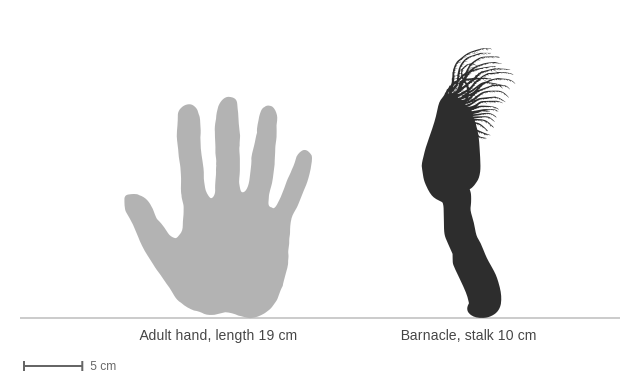
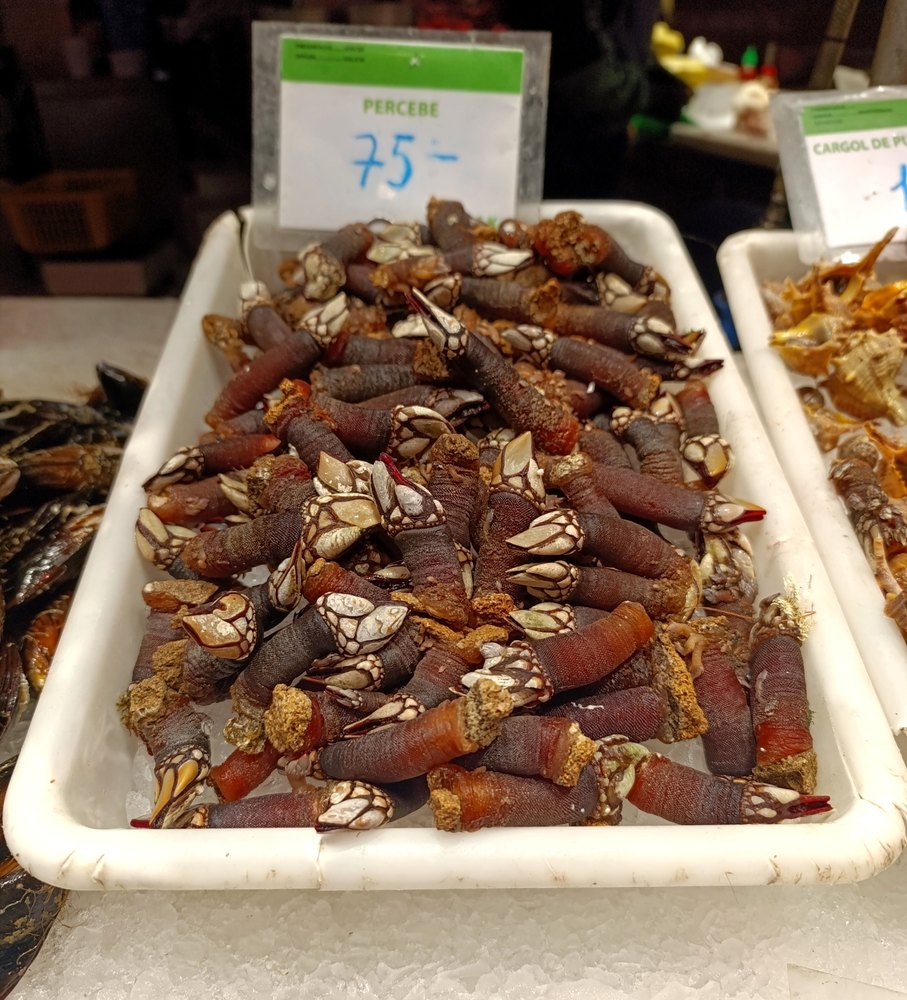
The Common Goose Barnacle (Pollicipes pollicipes) is a stalked crustacean that grows in dense clusters on wave-battered rocky shores of the north-east Atlantic, from Brittany in France to Dakar in Senegal.[1] Its shelled head, the capitulum, is whitish-grey and sits on a fleshy stalk that can pass 10 cm in length.[1][2] Each animal is a hermaphrodite, with both sexes in one body, and it does not fertilise its own eggs, so it needs neighbours.[1][3] Females breed from a length of about 12.5 mm, usually within the first year.[1][3] In Spain and Portugal the stalks are a prized food, known as percebes, and Galician fish markets sold over 230 tonnes in 2024.[4] The IUCN has not evaluated the species.
Quick facts
Description
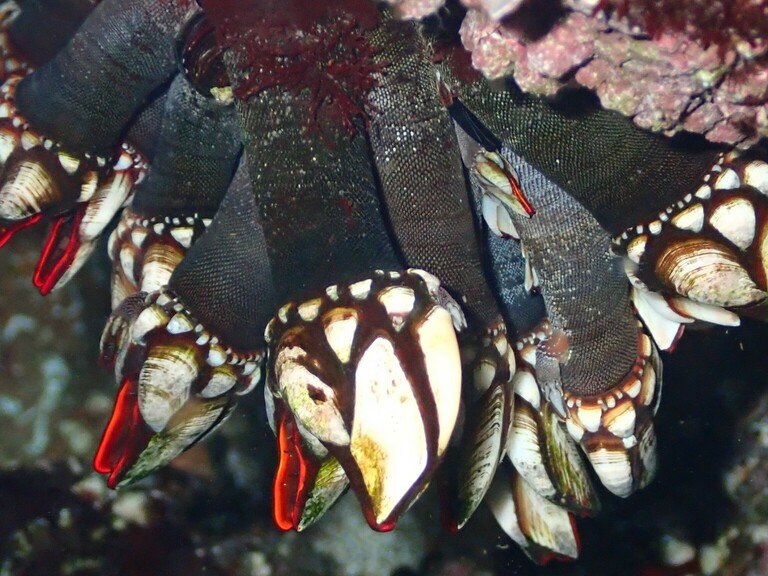
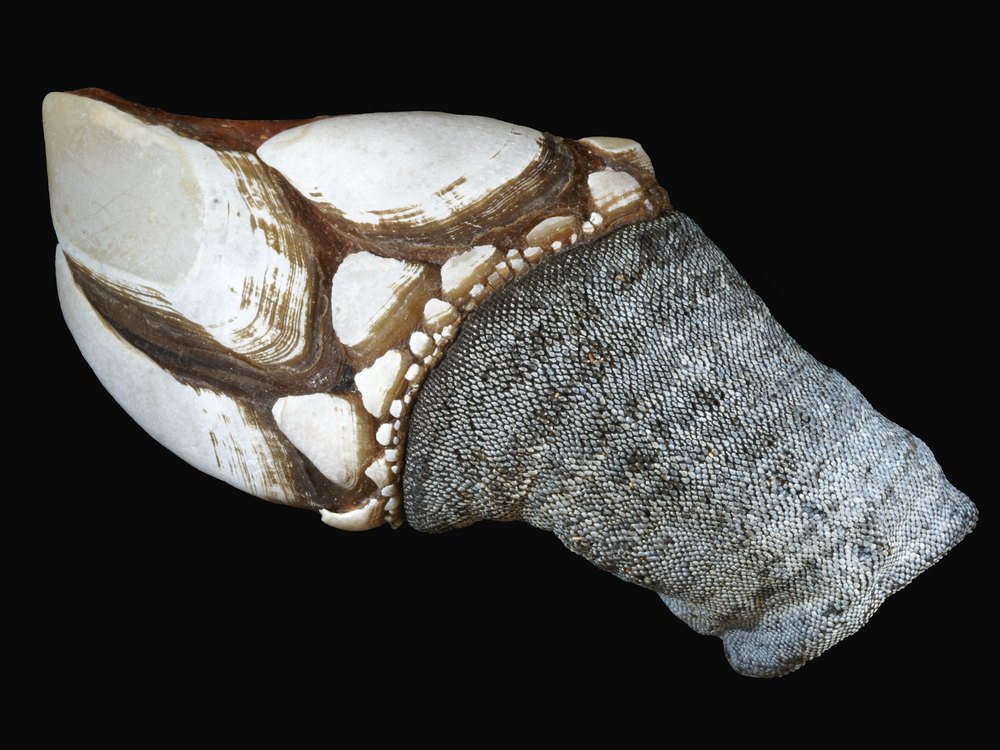
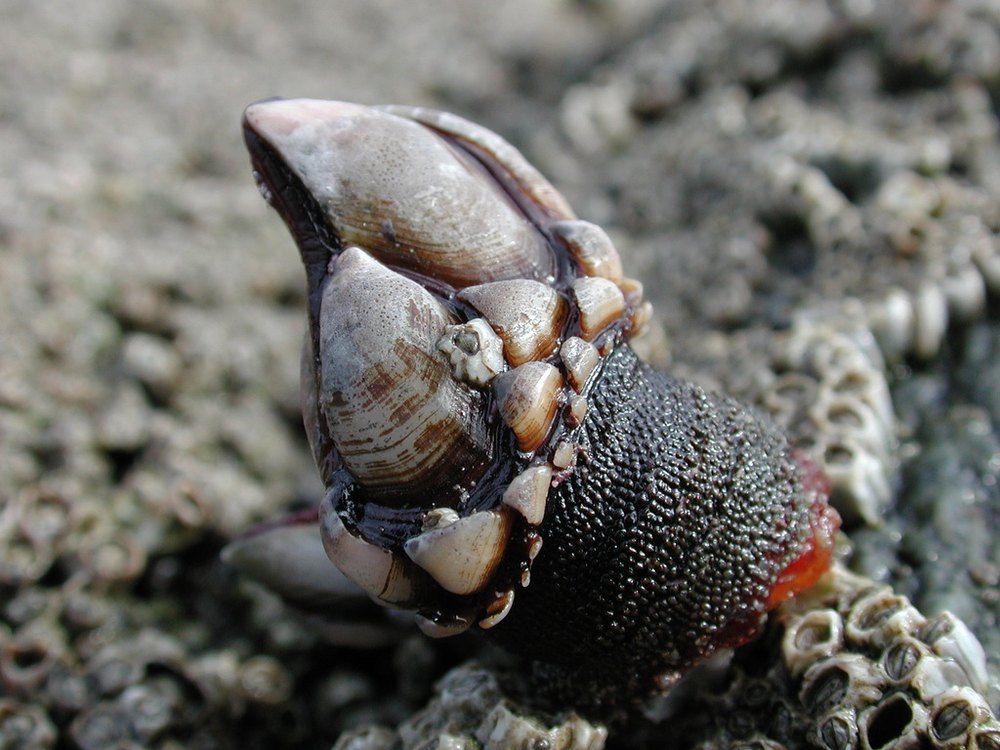
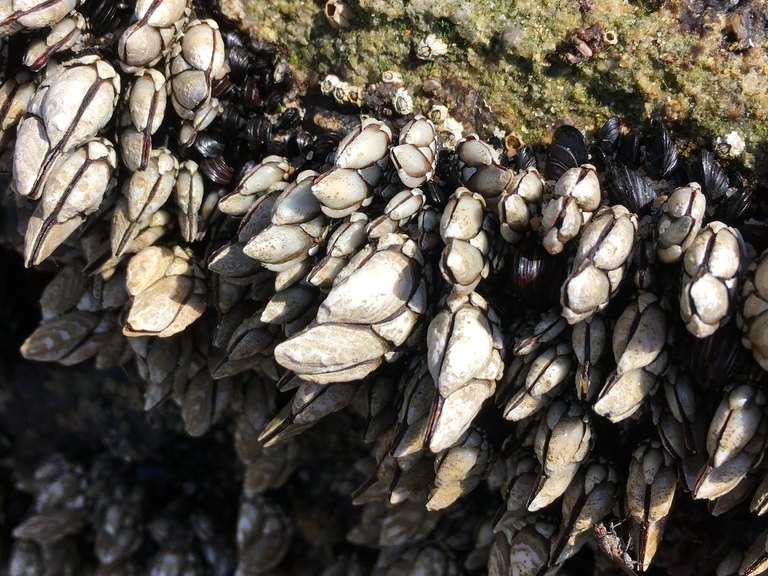
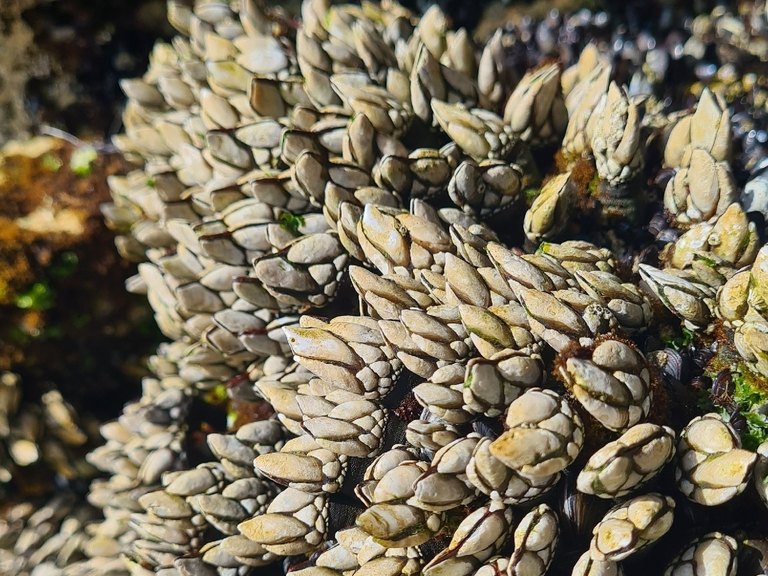
The Common Goose Barnacle looks like a small pale claw on a rubbery stalk. The shelled head is whitish-grey.[1][2] It is made of hard chalky plates, a few large ones and many small ones that overlap towards the base.[1] The plates open at the top like a slit, and the soft body inside has a crimson-red edge around the opening.[1] Barnacles from the lower shore and below it often show this red edge clearly, while those high on the shore have brownish edges.[1]
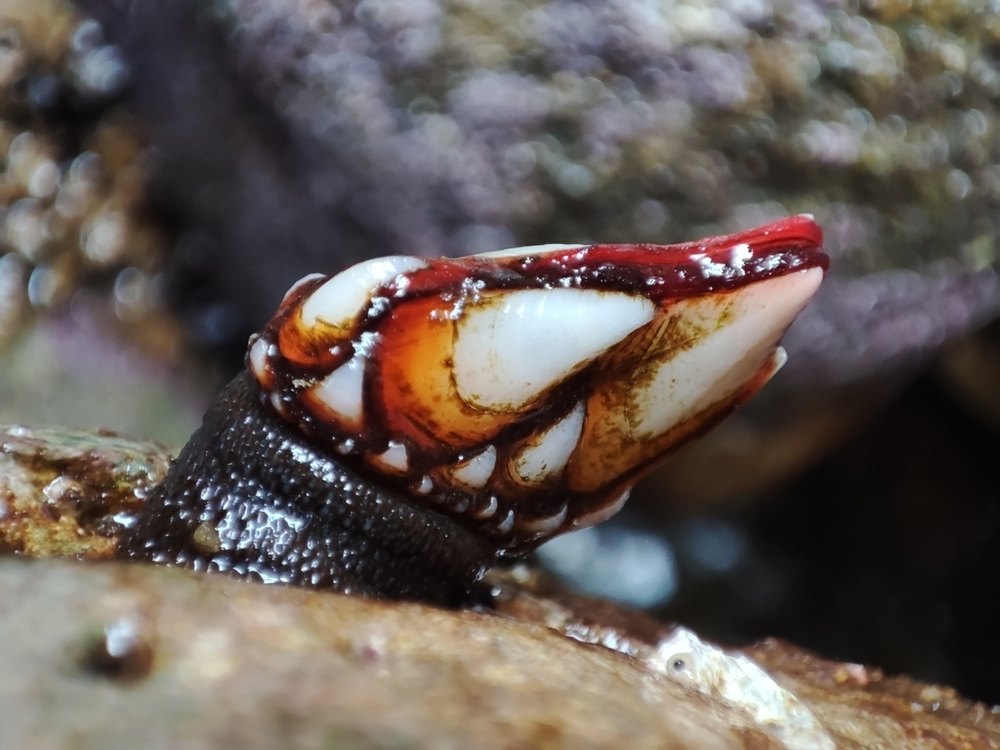
Below the head the stalk is narrower and usually longer. It is covered in small pointed scales that stick outwards like short spines, set in an elastic skin.[1] Two body shapes are known along the Iberian coasts: a large, short barnacle with a smooth stalk, and a thin, long one with a wrinkled stalk.[1]
Name
The usual English name is Common Goose Barnacle; MarLIN calls it the rocky shore goose barnacle, and one genome paper calls it the gooseneck barnacle.[2][6] “Goose barnacle” is also the everyday name of the floating Lepas barnacles that drift on the open sea, which are a different group.[6] The Iberian name percebe is used in Spanish and Galician, perceve in Portuguese and pouce-pied (“thumb-foot”) in French.[4][7] The scientific name Pollicipes pollicipes was first published as Lepas pollicipes by Gmelin.[7]
In other languages
| Language | Name | Notes |
|---|---|---|
| Spanish local | percebe | — |
| Galician local | percebe | — |
| Portuguese local | perceve | — |
| French local | pouce-pied; pouce-pied de l’Atlantique | “thumb-foot”; “Atlantic thumb-foot” |
| German | Felsen-Entenmuschel; Atlantische Entenmuschel | “rock duck mussel”; “Atlantic duck mussel” |
| Dutch | Atlantische eendenmossel | “Atlantic duck mussel” |
The Spanish, Portuguese, French, German and Dutch entries come from the vernacular-name list of the World Register of Marine Species; the Galician entry is the name used in Galician-language notices.[4][7]
Body
Size
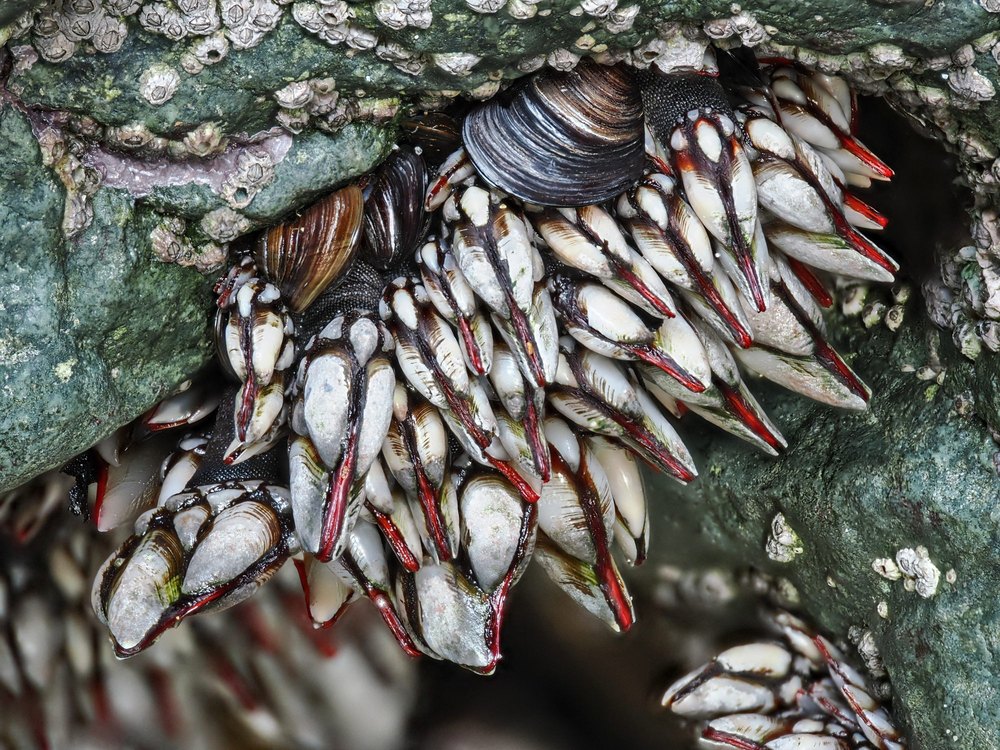
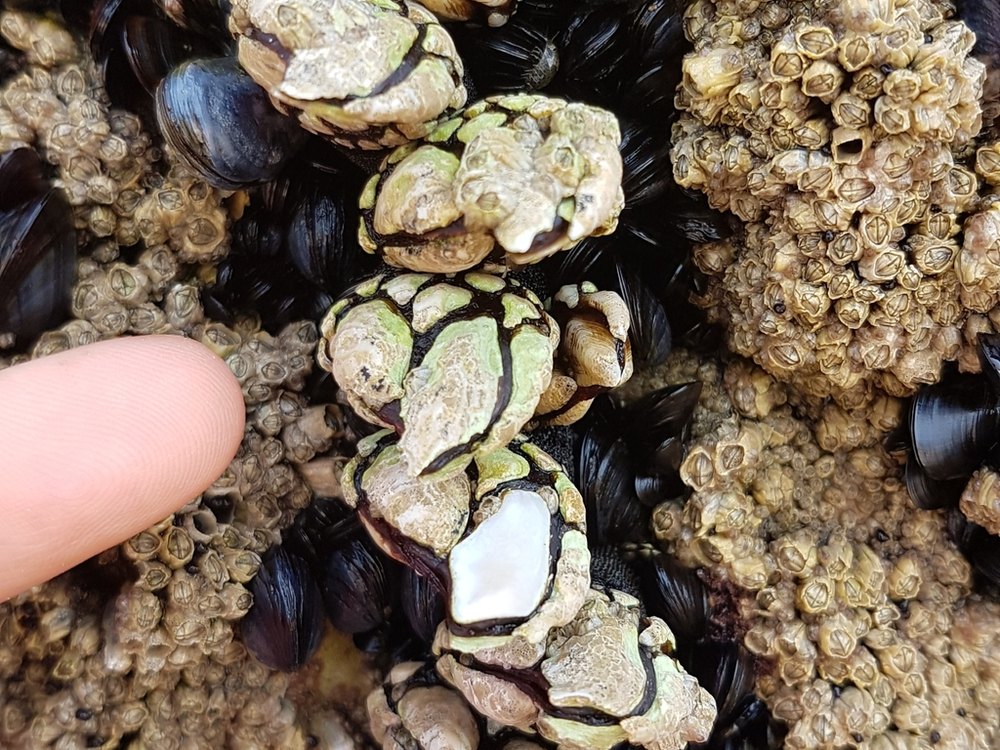
Barnacle size is usually given as the rostro-carinal length (RC length), the distance between two plates of the shell, the rostrum at the front and the carina at the back.[1] The stalk, called the peduncle, can grow longer than 10 cm.[2] The smallest mature female measured 12.5 mm RC length in south-west Portugal, and about 12 mm in Galicia.[1] The largest animal in a Portuguese egg-count study had an RC length of 25 mm.[1] Barnacles on the low shore reach a larger top size than those higher up in south-west Portugal.[1][8]
Plates and stalk
The shelled head is called the capitulum. Its plates are made of calcite: a pair of scuta and a pair of terga at the opening, a single carina at the back and a single rostrum at the front, plus rows of smaller side plates.[1] Apart from the whitish-grey colour, the head differs from related species in that its side plates are set further apart from the middle one.[1] The stalk is made of tiny chalky scales in an elastic matrix, and new scales are added at its top end below the head.[1] Growth is continuous: the stalk lengthens and the plates thicken, and only the inner lining is shed.[1]
Cirri and attachment
The barnacle has six pairs of cirri, feathery limbs that sweep food out of the water.[1] The last three pairs are the longest, each with 13 to 19 segments.[1] The glue gland lies in the stalk just below the head, made of large gland cells 40 to 70 micrometres across, and the cement flows down canals in the stalk to the base on the rock.[1]
Behavior
The Common Goose Barnacle lives in dense clusters on wave-swept rock, mostly on steep faces, in gullies and in crevices of the middle and lower shore.[1] The openings of wild barnacles do not face one fixed direction. Their orientation varies widely over short distances, and no clear facing towards the backwash of the waves has been found.[1]
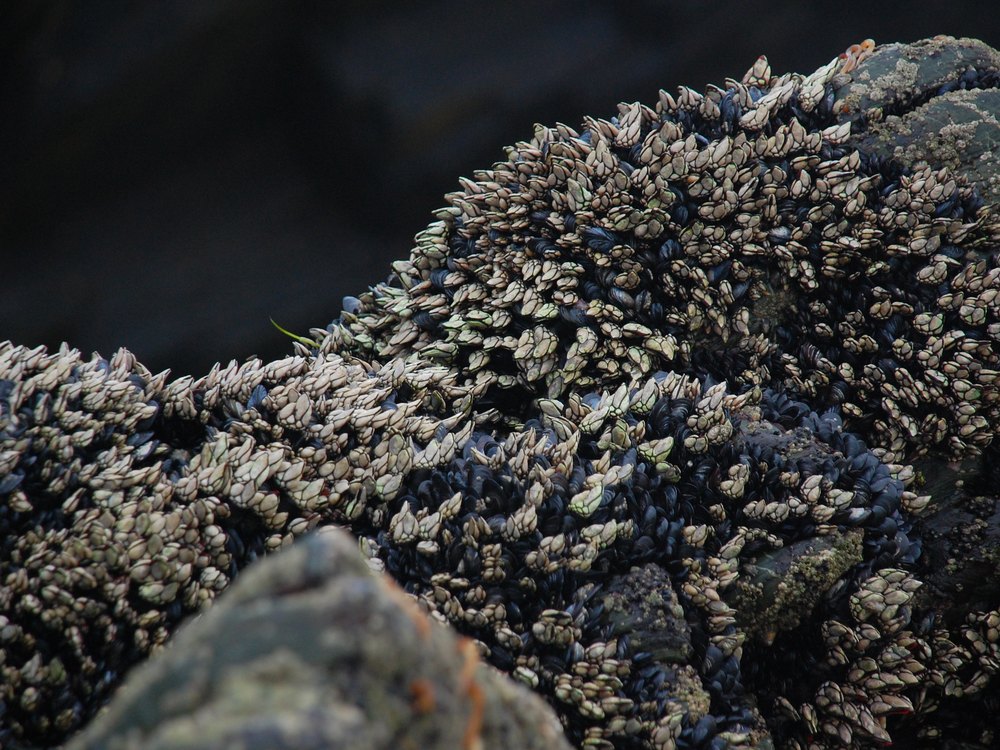
The clusters build up through settlement: the larvae settle mostly on adults of their own kind (see Life cycle). In the wild, small juveniles settle mostly on the lower half of an adult’s stalk.[1] Adults hardly move, but they can detach and relocate very slowly along the rock, and juveniles move down the stalk of the adult they settled on towards the rock.[1]
Diet
The Common Goose Barnacle is a suspension feeder that catches food from the water with its six pairs of cirri (see Body).[1] In a study of wild barnacles, the gut held diatoms and other single-celled algae, pieces of large algae, small crustaceans and their remains, barnacle larvae and shed skins.[1] Small barnacles held more small organic particles, and adults held more large organic material.[1] Barnacles high on the shore held less identifiable contents than those lower down.[1]
In laboratory tanks, adults and juveniles fed mostly with the cirri held out in the current, with at least one cirrus curled to the mouth to pass captured food in.[1] A slow, rhythmic beating of the cirri happened only in very weak or no flow and is thought to serve breathing, not feeding.[1] The switch from beating to extension came at flows of 8 to 14 cm per second, and extension continued at about 48 cm per second.[1] In the wild, barnacles with more time under water to feed, such as those on the low shore, grew faster.[1]
Life cycle
| Stage | Size or age | Notes |
|---|---|---|
| Nauplius (larva) | About 16 days to the cyprid (lab, 20 °C) | Six swimming stages, about 0.2 to 0.55 mm long; lab figures[1][9] |
| Cyprid (larva) | Settles within days | About 0.4 to 0.5 mm long; settles on live adults[1] |
| Juvenile | About 1.3 mm RC length a month in year one | Growth of recruits in SW Portugal[8] |
| Adult | Females breed from 12.5 mm RC length | Breeding April to September at Cabo de Sines; maturity within a year[1][3] |
Breeding
The Common Goose Barnacle is a simultaneous hermaphrodite, with both sexes in one body, although males mature at a slightly smaller size than females.[1] It does not fertilise its own eggs. At one site and date, barnacles more than 5 cm from the nearest neighbour carried no egg masses, while 60% of those with neighbours did.[1][3] Mating is by pseudo-copulation: the penis releases sperm into the mantle cavity of a neighbour, seen in aquaria and on the shore in Portugal.[1]
Breeding is seasonal. At Cabo de Sines it runs from April to September, and in winter the gonads mostly rest.[1][3] In Brittany the main brooding lasts only from July to September, and across Iberia it lasts about five months.[1] The eggs sit in paired sheets inside the mantle cavity. Researchers usually assume about 25 days to complete development, though eggs taken at a later stage hatched sooner in a lab.[1] A barnacle has several broods at different stages at once, and one of 14 to 16 mm RC length has 1 or 2 broods a year, against about 4 at 18.5 to 21 mm.[1] In SW Portugal a brood averaged 16,229 eggs at 14 to 16 mm and 34,172 at 18.5 to 21 mm, and the largest, an animal of 25 mm, carried 130,000.[1] In north-west Spain larvae are released mainly around the new and full moon, at morning high tide.[1]
Larvae
The eggs hatch into free-swimming nauplii, which pass through six stages. In lab rearing they grew from about 0.2 to 0.4 mm at the first stage to about 0.55 mm at the sixth.[1] The last stage changes into the cyprid, a settling larva about 0.4 to 0.5 mm long.[1] In a lab, the nauplii reached the cyprid in 25 days at 11 °C, 15 to 16 days at 20 °C and 10 days at 24 °C.[9] Survival was best at 15 to 20 °C, at 19 to 31%.[9] How long wild larvae spend in the plankton is not known; these are lab times only.
The cyprid settles on its own kind. In lab trials, 82 to 97% of the cyprids that settled did so on live adults, and cyprids settled best when they were 3 days old or less.[1][5]
Growing up
Young barnacles grow fast. In SW Portugal, recruits reached 15.7 mm RC length in their first year, about 1.3 mm a month.[8] A different study, which marked shells with a dye called calcein, found growth peaked at about 1.1 mm a month at 5 mm RC length, slowed to about 0.5 mm at 12.5 mm and fell below 0.25 mm above 18 mm.[10] Most barnacles in Galicia and SW Portugal mature within a year.[1]
Age cannot be read from the shell, so no direct lifespan is known. A growth curve from Morocco gives an age of at least 7 years for a barnacle of 26 mm RC length.[1]
Ecology
Predators
Several animals have been seen eating the Common Goose Barnacle.[1] They are the dogwhelk Nucella lapillus, the spiny starfish Marthasterias glacialis, the yellow-legged gull Larus michahellis, sea breams of the genus Diplodus, and the grey triggerfish Balistes capriscus.[1] A 2022 review of the genus by Cruz and colleagues reports partly swallowed barnacles in the mouth region of the spiny starfish, and stomachs of large sea breams (Diplodus vulgaris, over 0.5 kg) holding many barnacles; triggerfish have been seen biting them and probably swallowing them.[1] Experiments in central and south-west Portugal showed that predation causes deaths after settlement. It varies from place to place, is thought to be weaker on exposed sites, and may confine the barnacle to very exposed shores.[1]
Community
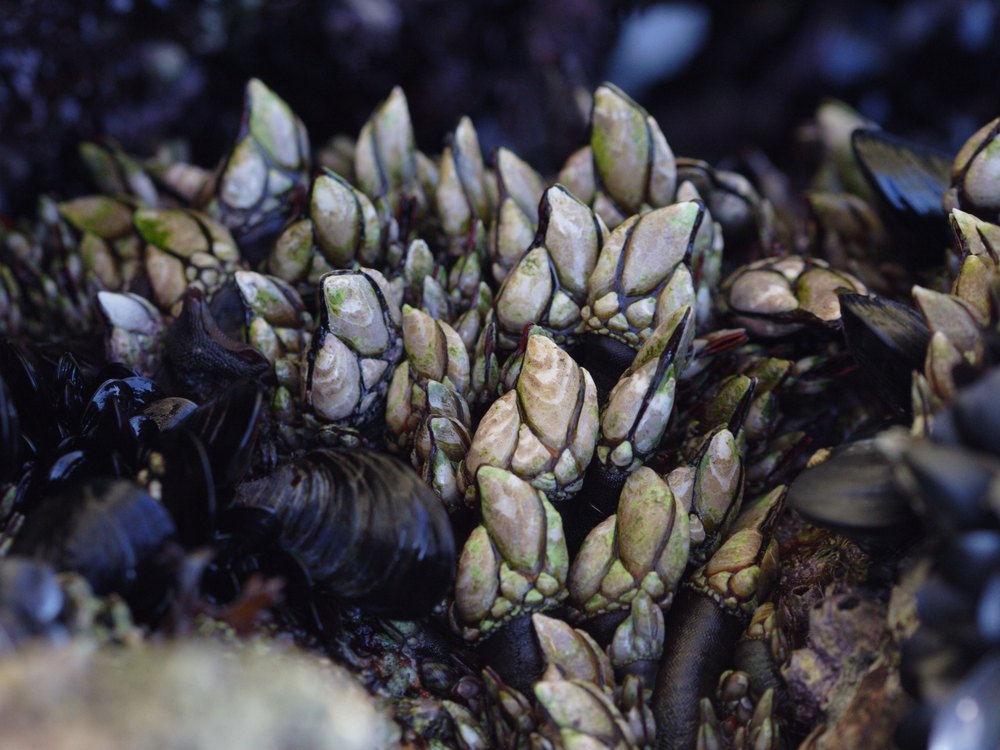
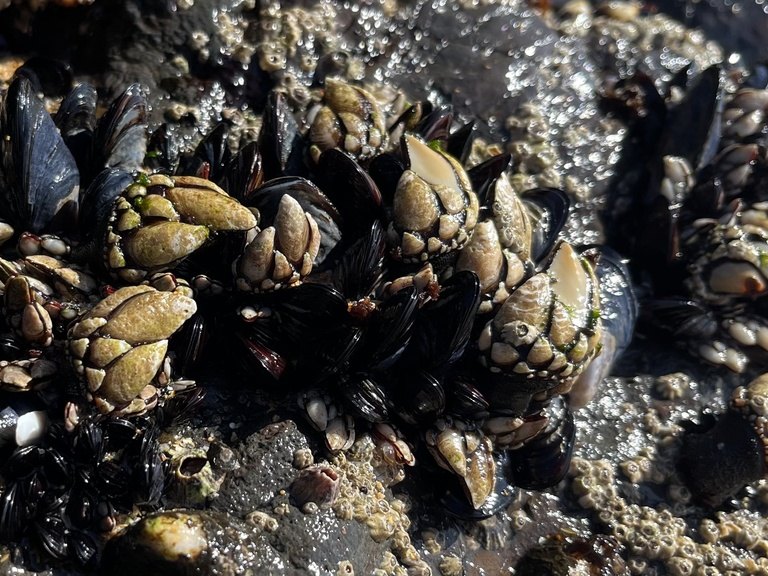
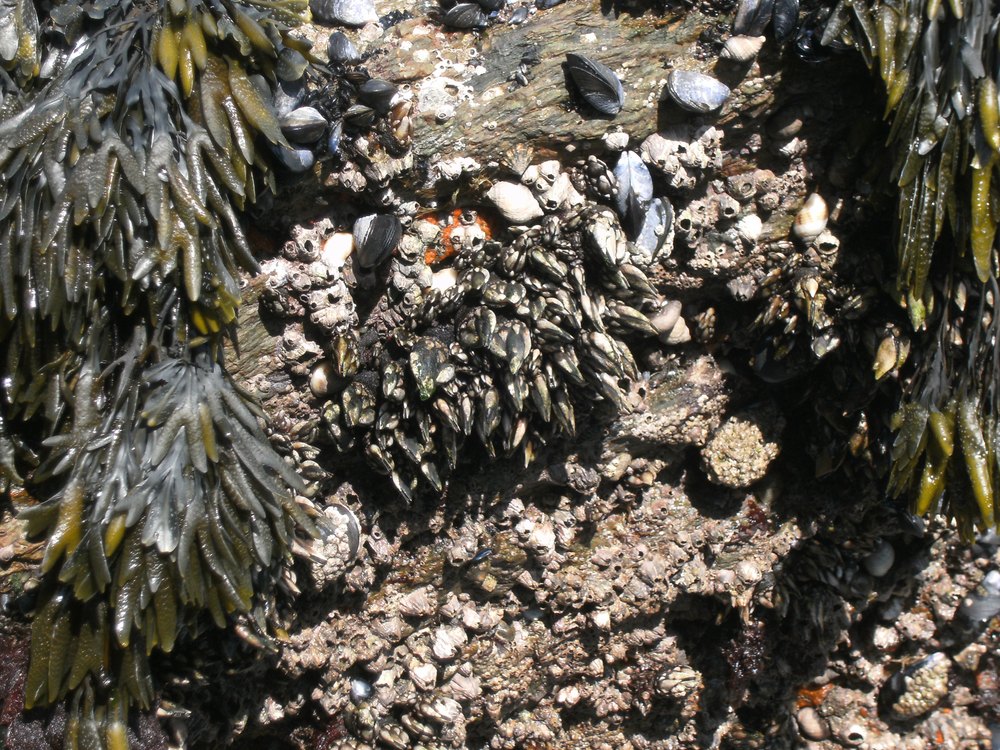
Clumps of the barnacle sit among other shore animals and seaweeds. The most common mussel beside it is Mytilus galloprovincialis, and other barnacles on the same rocks include Chthamalus montagui, Chthamalus stellatus, Megabalanus tintinnabulum and Perforatus perforatus.[1] Limpets are abundant too, above all Patella ulyssiponensis, with Patella depressa and the pulmonate limpet Siphonaria pectinata.[1] Red coralline algae such as Corallina officinalis, other seaweeds, anemones, the purple sea urchin Paracentrotus lividus and the spiny starfish complete the picture.[1]
The barnacle’s own plates carry a small community. Coralline algae, sea lettuce (Ulva), bryozoans, small mussels and other barnacles settle on them.[1] Algae also bore into the plates of the capitulum and the scales of the stalk.[1] In south-west Portugal, limpets have been seen grazing on the plates, mostly while the shore is awash with waves; the review notes that they may knock young barnacles off adults.[1] Large numbers of amphipods, small crustaceans, are commonly found when clumps are collected in south-west Portugal.[1]
Role on the shore
The 2022 review calls the barnacle a habitat-forming species, and information on how many there are has been used to pick priority areas for conservation.[1] Its clumps hold the shell-bearing animals and algae listed above. Where waves or drifting logs open gaps in mussel beds, species of Pollicipes can move in.[1] See Habitat and range for how much barnacle grows on a square metre of rock.


Habitat and range
Where it lives
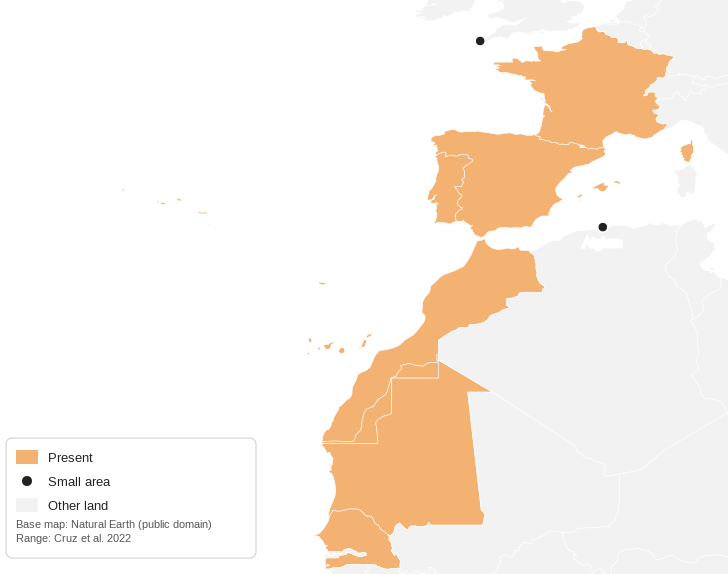
The Common Goose Barnacle lives on rocky coasts of the north-east Atlantic. On the European mainland its northern limit lies in Brittany, at the plateau de la Meloine near the Bay of Morlaix (48°43′N), according to a 2022 review of the genus by Cruz and colleagues, which quotes a French researcher.[1] A few scattered animals have been found near Land’s End in Cornwall (50°4′N), probably a marginal population; a maximum of eight animals was counted in a suitable 20 by 20 m area in 2021.[1] An old record from Berck-sur-Mer in northern France is considered doubtful.[1] Ireland is probably without the barnacle: a Kerry record was confirmed wrong and removed, and older records are vague.[1]
The southern limit is Cape Manuel at Dakar, Senegal (14°38′N).[1][11] Between the two limits it is present on the Atlantic coasts of France, Spain, Portugal, Morocco, Western Sahara and Mauritania, in the Canary Islands, and at Gibraltar.[1] On the Mediterranean side the review accepts it in Algeria, with recent records east to Aguelli Island near Algiers.[1] Records from the Mediterranean coasts of Spain and France are only old, and are considered doubtful; records from Wales and Northern Ireland could not be confirmed.[1] There are no records from the Azores or Madeira.[1] The barnacle on the Cape Verde Islands is a separate species (see Forms and variants).[1][11] The range is patchy, because long sandy coasts break up the rocky habitat, such as the 750 km of sandy coast from Mauritania to Dakar.[1]
Habitat
The barnacle lives on wave-exposed rocky shores, usually on vertical or steep rock where wave action is strong, and also in surge gullies, channels, crevices and caves.[1] It is most often found on capes and headlands, and numbers can change within a few metres with the direction the rock faces.[1] Two studies link more waves to more barnacles, one in the Gaztelugatxe Marine Reserve in the Basque Country and one in south-west Portugal, where wave exposure explained 47.5% of the variation in the model.[1][12]
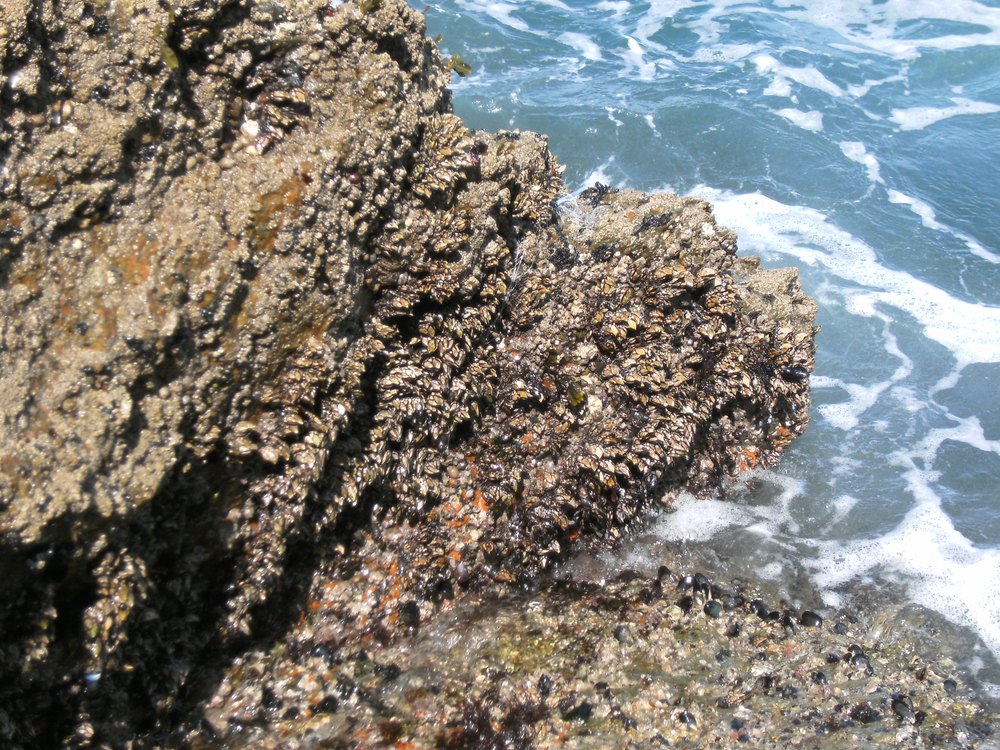

It lives mostly between the tides, commonly on the middle shore and also on the low shore.[1] The upper limit in south-west Portugal is 4 to 5 m above chart datum, the zero level of sea charts.[1] It also reaches shallow water below the tide line: at Gaztelugatxe, maximum depths of 1.5 or 2 m below the lowest astronomical tide were reported.[1] The substrate is rock. One population has been found on a ship stranded on a beach at Nouakchott, Mauritania.[1]

Population
Numbers are known only from regional surveys. In a survey of three regions of Portugal (2011), biomass ranged from 1.3 to 7.7 kg per m² on the middle shore and from 0.5 to 2.4 kg per m² on the low shore, with the highest middle-shore value at the Berlengas.[1] In Cantabria, recruitment is weak, with a peak in autumn.[13] A comparison across Europe found a significantly lower reproductive effort and lower recruitment in Brittany than elsewhere, possibly because Brittany is the northern limit.[14]
In the Basque Country, an AZTI evaluation reported in 2025 gave a total biomass of 5,508 kg in Gipuzkoa in 2024, against 6,151 kg in 2022, with the average size falling from 32.5 to 30.9 mm; the biomass of Bizkaia was stable over the last three evaluations.[15]
Evolution
Stalked barnacles belong to the order Thoracica, whose main suborders began to diversify in the Early Carboniferous, about 340 Ma (million years ago), in a dated tree built from three genes and fossil calibrations.[16] The oldest accepted fossil barnacle in a 2021 review, Praelepas, is middle Carboniferous (320 to 330 Ma); the review does not accept older Cambrian and Silurian fossils as barnacles.[17] The family Pollicipedidae, which holds Pollicipes, Capitulum and the shark parasite Anelasma, has fossils from the Cretaceous to the present.[17] For the Common Goose Barnacle itself, WoRMS lists a fossil range of recent only.[7]
A genome-scale study finds the stalked Pollicipedomorpha to be a single natural group, sister to the acorn barnacles, while the morphology-based tree of the 2021 review puts them as the oldest living branch of the plated barnacles.[6][17] Three Pollicipes species, including this one, appear to have arisen at about the same time in a radiation in the proto-Atlantic, and their order is not settled.[18]
Forms and variants
No subspecies of the Common Goose Barnacle are recognised.[7] The barnacles of the Cape Verde Islands were once counted as part of the species, but they are the separate species Pollicipes caboverdensis: their sequences of a standard DNA marker, the CO1 gene, differ by 13 to 14% from those of Portugal and Senegal, which differ from each other by less than 1%.[11]
Within the species, genetic studies describe populations rather than named forms. A mitochondrial study found a northern group of populations from about 47°N to 28°N in which gene flow is shaped by coastal currents and hydrographic structures, and rejected genetic uniformity within it.[19] A study of 569 individuals found a demographic expansion before the last glacial maximum and three possible refuges: the North African coast, north-west Iberia, and the English Channel and Brittany.[20] In 1,423 barnacles from 15 sites in southern Portugal, Galicia and Asturias, young barnacles were more structured than adults, a pattern the authors call chaotic genetic patchiness: young barnacles differ more from site to site than adults do.[21]
Conservation
Status
The IUCN has not evaluated the Common Goose Barnacle.[22]
Threats
OverharvestingIllegal harvestingOil spillsClimate changePollution[1][14][23][24]Overharvesting. Galician stocks collapsed in the 1970s and 1980s, and the Galician market was then supplied by imports from France, Portugal, Morocco, Canada and Peru.[1] In the Berlengas, harvesters took 14 to 24 kg per day in the autumns of 2005 and 2006 against a limit of 20 kg, and 25% of observations were above the limit.[24] Recovery after harvest depends on the barnacles left behind. In 423 harvest gaps in south-west Portugal, Galicia, Asturias and Brittany, 90% began to recolonise within two years when adults stood at the gap edge, against 60% when none did.[23]
Illegal harvesting. According to the 2022 review of the genus, poaching is the main problem in the Berlengas and the biggest threat to the Moroccan fishery, and a trans-national poaching system runs from France to Spain because control and prices differ widely.[1] In the Basque Country, the regional research institute AZTI warns that unreported catch and poaching distort its biomass estimates.[15]
Oil spills. The tanker Prestige sank off Cape Finisterre on 13 November 2002. Monitoring from January 2003 to October 2004 found 430 µg/kg dry weight of 13 hydrocarbons (PAHs) in the tissue of the Common Goose Barnacle after the spill.[1] About six months later the level was below the 200 µg/kg (sum of 6 PAHs) that the Spanish food safety agency proposed as the limit for commercial use, and after one year the median was 26 µg/kg against 74 µg/kg in mussels.[1] These are tissue measurements, not counts of barnacles.[1]
Climate change. Warmer seawater is linked to better larval survival and growth, settlement, recruitment and reproduction in this species.[1] In Brittany, at the northern edge of the range, reproductive effort was lower than elsewhere in Europe, and the authors suggest that warming may help populations recover after exploitation.[14]
Pollution. Barnacles from north-west Portugal sampled in 2010 and 2011 held 0.35 to 3.75 mg/kg of cadmium and 413 to 1,854 mg/kg of zinc, and the highest hydrocarbon levels were near a refinery.[1]
Management
Galicia has used co-management since 1992: the regional government gives exclusive harvesting rights to the cofradias, the local fishers’ guilds, which must submit a plan for approval.[1][25][26] There were 12 plans in 1992, 29 in 2001 and 37 in 2021, covering all the fishing beds.[1] The order of 19 December 2024 approved the plans for 2025 to 2027, with 37 entries: 6 in Lugo, 21 in A Coruña and 10 in Pontevedra.[27] Each plan sets a work zone, the method (on foot or by boat), likely harvest days and control points.[27] The plans set a minimum size (a shell-base diameter above 15 mm, or an RC length above 18.3 mm), rotate the fishing beds, and give each harvester 3 to 10 kg a day; most cofradias pay for their own surveillance and a biologist.[1][26] Galicia had 1,308 harvesters on average in 2013 to 2016, and landings averaged 333 t worth about 9 million euros a year in 2015 to 2019.[1]
Portugal first legislated in 1989, when the Berlengas reserve was created with the fishery fully banned.[1] Specific Berlengas rules followed in 2000 and rules for the Sudoeste Alentejano e Costa Vicentina Natural Park (PNSACV) in 2006.[1] The Berlengas allow at most 40 licences, close January to March and August to September, keep no-take zones and set 20 kg a day; since 2021 it has formal co-management, the first for a Portuguese fishery.[1] The PNSACV allows at most 80 professional licences, closes 15 September to 15 December and limits professionals to 10 to 15 kg a day.[1] In 2015 to 2019 Portugal averaged 456 licensed fishers and 136 t a year, with a peak of 146 t in 2016.[1] A 2013 assessment of the Portuguese fishery, reported in the 2022 review, found a decline in the state of the fishery and the resource in all regions except the Costa Vicentina park, with the central coast worst.[1]
In Asturias the west is run by co-management in eight plans and 250 zones, the east by limited entry with a May to September season.[1] In 2013 to 2016 the west had 204 fishers and 44 t a year, the east 234 fishers and 11 t.[1] Cantabria has kept a harvester census since 2018, requires daily reporting through official landing points since 2016, and closes Sonabia permanently; it landed 4.6 t a year in 2019 to 2020.[1] In the Basque Country, harvesting is on foot only, with a closed season from 1 May to 30 September and 5 kg per person a day.[15] The Gaztelugatxe Marine Reserve is no-take.[1] In 2025 the Gipuzkoa quota was cut to 522 kg from 1,350 kg after the biomass fell (see Habitat and range).[15]
Brittany has the third largest fishery by weight, about 55 t a year in recent years with peaks above 100 t in the early 2000s, and about 90% comes from Morbihan, where roughly 50 harvesters work under co-management.[1] Morocco regulates the fishery, with a season from 1 November to 31 May and a minimum RC length of 25 mm since 2015.[1] The Canary Islands fishery has been closed since 2011.[1]
History and culture
Naming
J. F. Gmelin described the species as Lepas pollicipes in the Vermes volume of Systema Naturae, the genus where most barnacles were then placed.[7] It now sits in Pollicipes (see Taxonomy).[7]
Harvest and the percebeiros
The barnacle was eaten long before the festivals: its remains are found in some archaeological sites along the Atlantic coast of Europe, among them the Neolithic site of Rocha das Gaivotas in Portugal.[28]
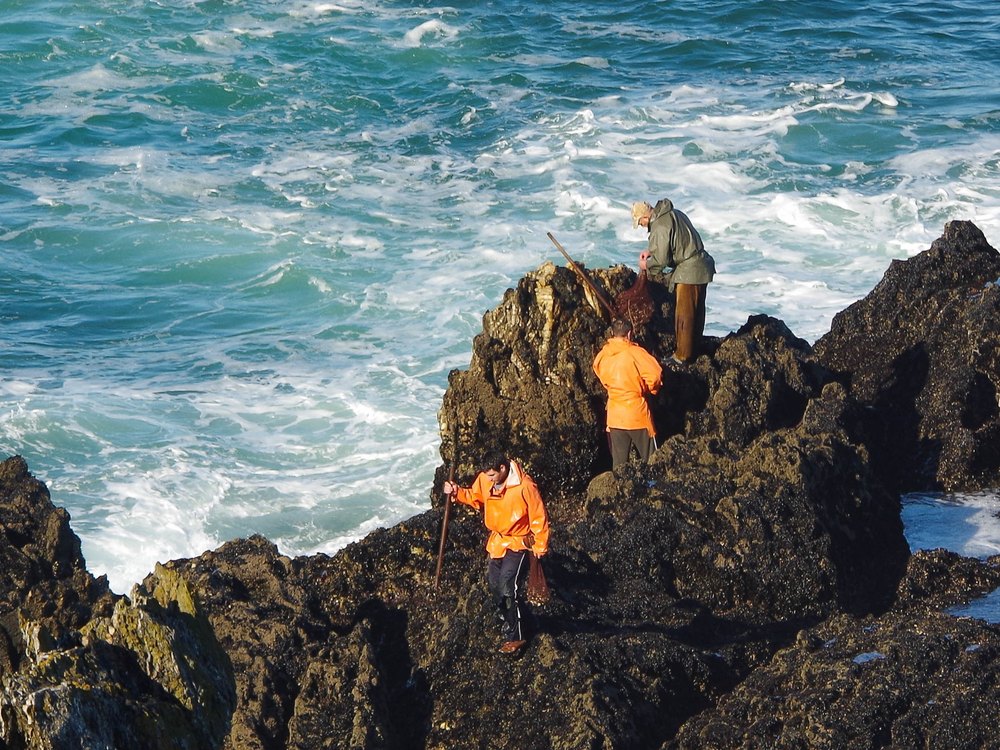
Percebeiros, the harvesters of percebes, work on foot or by boat at the wave line of exposed rocks.[1][27] They take the barnacles with a scraper, and a study of harvest gaps recommends never removing a whole clump and a scraper no wider than 3.5 cm.[23] The Galician authorities describe the work as done in harsh, risky conditions.[4]

The Festa do Percebe do Roncudo in Corme, in the municipality of Ponteceso, began in 1992 and has been held every year since, billed as the first festival dedicated to the barnacle.[4] The 33rd edition took place on 19 July 2025, and the festival is declared a Galician festival of tourist interest.[4] Other Galician percebe festivals are listed for Xove, Cedeira, Rinlo, Ribadeo, Aguino, Ribeira, Lubre, Ares and A Guarda.[29]
Galician fish markets sold more than 230 t of percebe in 2024, worth almost 9 million euros.[4] The Xunta calls the barnacle an ambassador of its Galicia Calidade brand.[4]
The barnacle goose legend
Around 1188 Gerald of Wales wrote in his Topographia Hibernica of birds called barnacles, “like wild geese but smaller”, that are “born at first like pieces of gum on logs of timber washed by the waves”.[30] He wrote that they hang from the wood by their beaks in shells, and that he had seen more than a thousand tiny bodies on one log.[30] He added that bishops and religious men ate them in times of fast, as not flesh.[30]
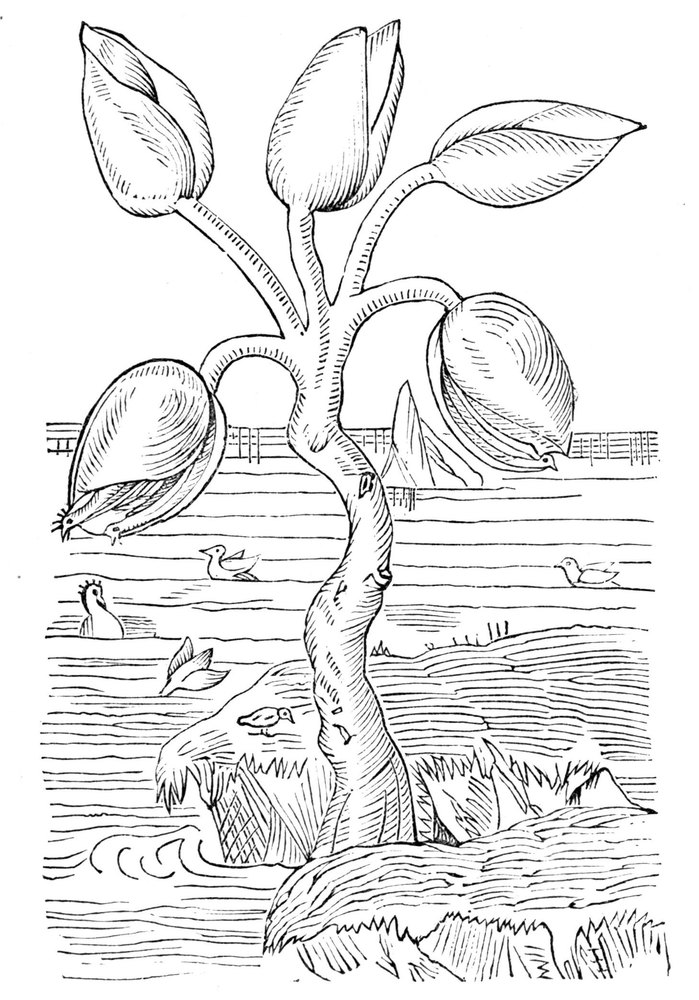

The legend concerns floating stalked barnacles such as Lepas, which grow on floating logs, and not this species. The Common Goose Barnacle lives on wave-battered rock, only rarely on other surfaces, and Gerald does not name it.[1][30]


Research
A 2022 review by Cruz and colleagues, 150 pages long, revisited the genus 25 years after Margaret Barnes’ earlier review and covers biology, ecology and fisheries.[1] In the same year Bernot and colleagues published a chromosome-level genome assembly of the species.[6]
Taxonomy
| Rank | Name |
|---|---|
| Kingdom | Animalia |
| Phylum | Arthropoda |
| Subphylum | Crustacea |
| Class | Thecostraca |
| Order | Pollicipedomorpha |
| Family | Pollicipedidae |
| Genus | Pollicipes |
| Species | Pollicipes pollicipes (Gmelin, 1791) |
Synonyms (5)
| Name |
|---|
| Mitella pollicipes (Gmelin, 1789) |
| Lepas gallorum (Spengler, 1790) |
| Pollicipes smythii (Leach, 1818) |
| Pollicipes cornucopia (Leach, 1824) |
| Lepas pollicipes (Gmelin, 1989) |
From the GBIF backbone.[31]
Higher classification
The Common Goose Barnacle is a stalked barnacle, a crustacean that lives fixed to rock on a fleshy stalk. It belongs to the family Pollicipedidae, which also holds the genus Capitulum (the Japanese goose barnacle) and Anelasma, a barnacle that lives on sharks. [17] The genus Pollicipes has four living species. Its closest relatives are the eastern Pacific P. elegans and the Cape Verde species P. caboverdensis. [7][18] The Cape Verde barnacles were once counted as part of this species (see Forms and variants). [11]
A group still being reorganised
Barnacle classification has been rewritten recently. WoRMS and the Catalogue of Life follow a 2021 revision, which places the species in the class Thecostraca and the order Pollicipedomorpha. GBIF still uses the older class Maxillopoda and the order Pedunculata. [7][17][22] The older order for the plated stalked barnacles, Scalpelliformes, was found not to be a natural group, because plateless forms arose from plated ones more than once. [16] Even the family is in question. The relationships among the four genera of the Pollicipedomorpha are unsettled, and the family may not be one natural group. [6][17]
Sources
- Cruz, T., Jacinto, D., Fernandes, J. N., Seabra, M. I., Van Syoc, R. J., Power, A. M., Macho, G., Sousa, A., Castro, J. J. and Hawkins, S. J. 2022. Pedunculate cirripedes of the genus Pollicipes: 25 years after Margaret Barnes’ review. Oceanography and Marine Biology: An Annual Review 60: 19–168
- MarLIN, Marine Life Information Network. Rocky shore goose barnacle (Pollicipes pollicipes)
- Cruz, T. and Hawkins, S. J. 1998. Reproductive cycle of Pollicipes pollicipes at Cabo de Sines, south-west coast of Portugal. Journal of the Marine Biological Association of the United Kingdom 78: 483–496
- Xunta de Galicia. 9 July 2025. Press note on the 33rd Festa do Percebe do Roncudo, Corme
- Franco, S. C., Aldred, N., Cruz, T. and Clare, A. S. 2016. Modulation of gregarious settlement of the stalked barnacle, Pollicipes pollicipes: a laboratory study. Scientia Marina 80: 217–228
- Bernot, J. P., Avdeyev, P., Zamyatin, A., Dreyer, N., Alexeev, N., Pérez-Losada, M. and Crandall, K. A. 2022. Chromosome-level genome assembly, annotation, and phylogenomics of the gooseneck barnacle Pollicipes pollicipes. GigaScience 11: giac021
- WoRMS, World Register of Marine Species. Pollicipes pollicipes (Gmelin, 1791), AphiaID 106177
- Cruz, T., Castro, J. J. and Hawkins, S. J. 2010. Recruitment, growth and population size structure of Pollicipes pollicipes in SW Portugal. Journal of Experimental Marine Biology and Ecology 392: 200–209
- Franco, S. C., Aldred, N., Cruz, T. and Clare, A. S. 2017. Effects of culture conditions on larval growth and survival of stalked barnacles (Pollicipes pollicipes). Aquaculture Research 48: 2920–2933
- Jacinto, D., Penteado, N., Pereira, D., Sousa, A. and Cruz, T. 2015. Growth rate variation of the stalked barnacle Pollicipes pollicipes (Crustacea: Cirripedia) using calcein as a chemical marker. Scientia Marina 79: 117–123
- Fernandes, J. N., Cruz, T. and Van Syoc, R. 2010. Pollicipes caboverdensis sp. nov. (Crustacea: Cirripedia: Scalpelliformes), an intertidal barnacle from the Cape Verde Islands. Zootaxa 2557: 57–68
- Jacinto, D. and Cruz, T. 2016. Predicting Pollicipes pollicipes (Crustacea: Cirripedia) abundance on intertidal rocky shores of SW Portugal: a multi-scale approach based on a simple fetch-based wave exposure index. Scientia Marina 80: 229–236
- Bidegain, G., Gutiérrez-Cobo, M. B., Guinda, X., Silió, A., Puente, A. and Juanes, J. A. 2024. Recruitment and growth of the gooseneck barnacle Pollicipes pollicipes (Gmelin, 1791) in the Cantabrian Coast (Northern Spain, Gulf of Biscay). Regional Studies in Marine Science 80: 103911
- Aguión, A. et al. 2022. A large-scale comparison of reproduction and recruitment of the stalked barnacle Pollicipes pollicipes across Europe. Marine Biology 169
- eldiario.es Euskadi, 16 October 2025. The Basque Country halves the maximum percebe quota in Gipuzkoa after a fall in biomass
- Pérez-Losada, M., Harp, M., Høeg, J. T., Achituv, Y., Jones, D., Watanabe, H. and Crandall, K. A. 2008. The tempo and mode of barnacle evolution. Molecular Phylogenetics and Evolution 46: 328–346
- Chan, B. K. K., Dreyer, N., Gale, A. S., Glenner, H., Ewers-Saucedo, C., Pérez-Losada, M., Kolbasov, G. A., Crandall, K. A. and Høeg, J. T. 2021. The evolutionary diversity of barnacles, with an updated classification of fossil and living forms. Zoological Journal of the Linnean Society 193: 789–846
- Van Syoc, R., Fernandes, J., Carrison, D. and Grosberg, R. 2010. Molecular phylogenetics and biogeography of Pollicipes (Crustacea: Cirripedia), a Tethyan relict. Journal of Experimental Marine Biology and Ecology 392: 193–199
- Quinteiro, J., Rodríguez-Castro, J. and Rey-Méndez, M. 2007. Population genetic structure of the stalked barnacle Pollicipes pollicipes (Gmelin, 1789) in the northeastern Atlantic: influence of coastal currents and mesoscale hydrographic structures. Marine Biology 153: 47–60
- Campo, D., Molares, J., Garcia, L., Fernandez-Rueda, P., Garcia-Gonzalez, C. and Garcia-Vazquez, E. 2010. Phylogeography of the European stalked barnacle (Pollicipes pollicipes): identification of glacial refugia. Marine Biology 157: 147–156
- Parrondo, M. et al. 2022. Chaotic genetic patchiness in the highly valued Atlantic stalked barnacle Pollicipes pollicipes from the Iberian Peninsula: implications for fisheries management. Frontiers in Marine Science 9: 801780
- GBIF Secretariat. Pollicipes pollicipes (Gmelin, 1790). GBIF Backbone Taxonomy
- Gómez-del Campo, V. et al. 2024. Recovery after exploitation of stalked barnacles is facilitated by the presence of conspecifics: a study of post-harvest gap recolonization dynamics in SW Europe. Reviews in Fish Biology and Fisheries 35: 279–296
- Jacinto, D., Cruz, T., Silva, T. and Castro, J. J. 2011. Management of the stalked barnacle (Pollicipes pollicipes) fishery in the Berlengas Nature Reserve (Portugal): evaluation of bag and size limit regulation measures. Scientia Marina 75: 439–445
- Environmental Defense Fund, Fishery Solutions Center. The Galician goose barnacle territorial use rights fishery
- Molares, J. and Freire, J. 2003. Development and perspectives for community-based management of the goose barnacle (Pollicipes pollicipes) fisheries in Galicia (NW Spain). Fisheries Research 65: 485–492
- Diario Oficial de Galicia no. 251, 31 December 2024. Order of 19 December 2024 approving the percebe management plans for 2025 to 2027
- Dean, R. M. 2010. Delicacy or desperation? Eating peduncular barnacles in Neolithic Portugal. Journal of Ethnobiology 30: 80–91
- Páxinas Galegas. Festas do percebe (list of percebe festivals)
- Gerald of Wales, Topographia Hibernica, about 1188, on barnacle geese. In the Internet Medieval Sourcebook, Fordham University
- GBIF backbone, Pollicipes pollicipes, synonyms