The common octopus (Octopus vulgaris) is a bottom-living octopus of the Mediterranean Sea and the north-east Atlantic. It has eight arms, hides in dens among rocks and sand, and lives only about one to two years.[1][2] Females guard their eggs and die after they hatch.[3][4] The name has long been used for look-alike octopuses around the world, and in the strict sense it covers only the Mediterranean and north-east Atlantic animals.[5][6] The IUCN rates the species Least Concern.[7]
Quick facts
Description
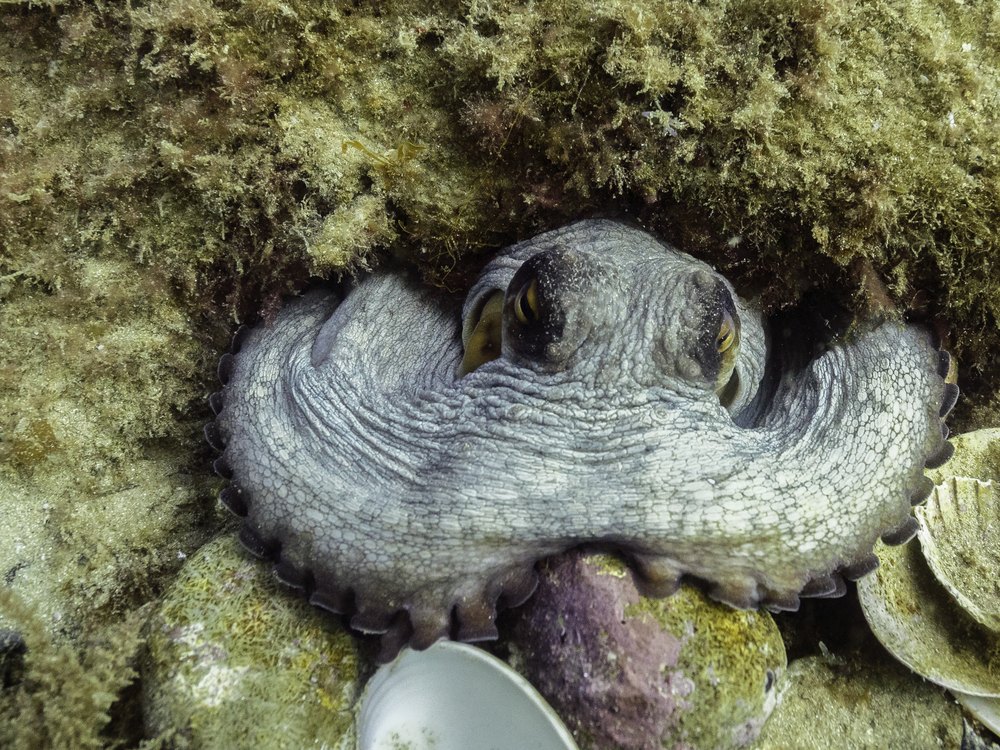
The common octopus has a rounded body called the mantle, a head with two large eyes, and eight arms lined with suckers.[1] Its skin is smooth, but it can raise small bumps and change its texture and colour to match what is around it.[1][8]
Its camouflage does not copy the whole background. In a field study of two octopus species, including the common octopus, the animals built their body pattern from selected features of nearby objects instead of trying to match a large field of view.[8]
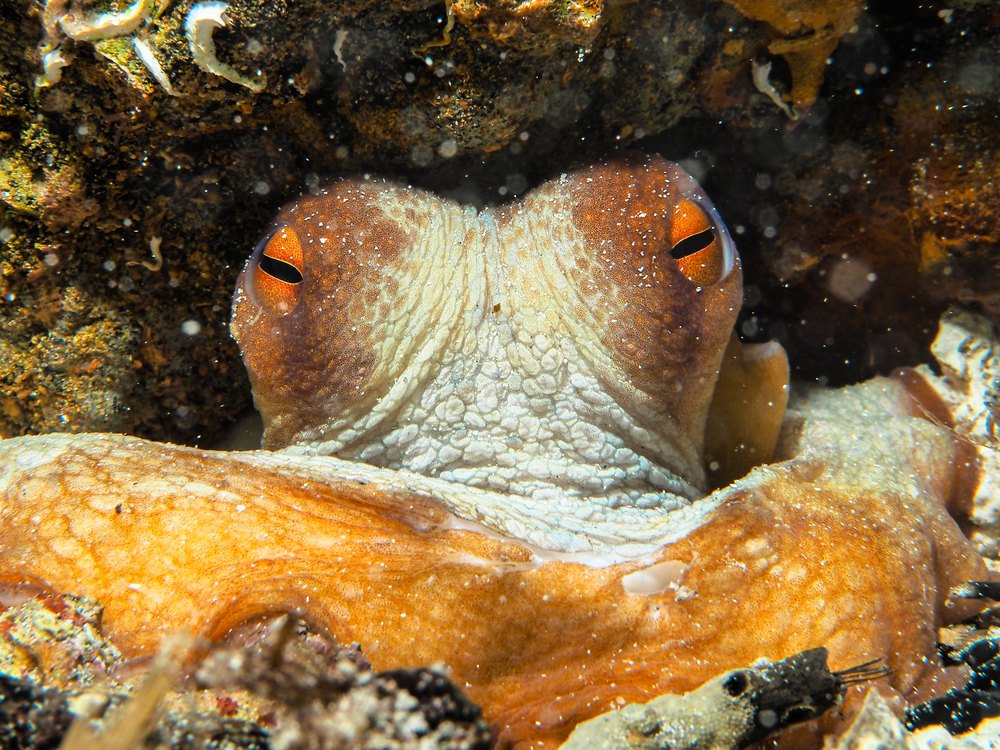

The eyes are single-chambered, with spherical lenses. The pupil closes quickly after a sudden light.[9] Like other cephalopods, the octopus makes dark ink, which gets its colour from melanin.[10]

Name
“Octopus” is Latinised Greek, from oktō (eight) and pous (foot). The classical Greek name for the animal was polypous.[11] The species name vulgaris is Latin for “common, usual, ordinary”, so the scientific name and the English name say the same thing.[12] Georges Cuvier described the species in 1797, and the zoological catalogues in use today follow him. Some authors write “Lamarck, 1798” instead.[13]
The name Octopus vulgaris has also been applied to look-alike octopuses in the western Atlantic, South Africa, East Asia and Australia. Most of these are now treated as separate or still unnamed species, so “common octopus” in the strict sense means the animal of the Mediterranean and the north-east Atlantic (see Taxonomy).[5][14]
In other languages
| Language | Name | Meaning |
|---|---|---|
| Galician local | polbo común | — |
| Basque local | olagarro arrunta | — |
| Breton local | morgazh | — |
| Irish local | ochtapas coiteann | — |
| Greek local | χταπόδι | — |
| Croatian local | Obična hobotnica | — |
| Turkish local | Adi Ahtapot | — |
| Spanish | pulpo común | common octopus; also pulpo de roca, “rock octopus” |
| Italian | polpo comune | common octopus; also polpo di scoglio, “rock octopus” |
| French | poulpe commun | common octopus; also poulpe de roche, “rock octopus” |
| Portuguese | polvo-comum | common octopus |
| Catalan | pop roquer | “rock octopus” |
| German | Gemeiner Krake | common octopus |
| Dutch | gewone octopus | common octopus |
| Polish | ośmiornica zwyczajna | common octopus |
Names are from the MolluscaBase list of common names; the Portuguese name also appears in the IUCN Red List. Meanings are literal translations. In several of these languages the same word is used for any large octopus.[13][7] These names are from the Catalogue of Life and WoRMS, as listed by GBIF.
Body
The lengths are the largest reported for the species group. The mantle is the rounded body behind the head, measured in the western Mediterranean.
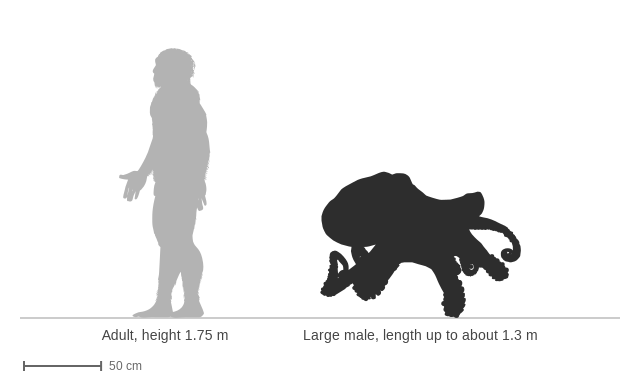
The FAO species catalogue covers the whole species group, meaning the octopuses from several regions that were all called Octopus vulgaris. It gives a maximum total length (arms included) of 1.2 m for females and 1.3 m for males, a maximum weight of 10 kg, and a common weight of up to 3 kg.[3] In the western Mediterranean the mantle is about 9.5 cm long in males and 13.5 cm in females when they first mature.[3] A newly hatched paralarva in a laboratory stock from the north-western Mediterranean weighed 1.4 mg.[15]
Size ranges
| Female | Male | |
|---|---|---|
| Weight (common) | about 3 kg | |
| Length (up to) | 1.2 m | 1.3 m |
Arms and suckers
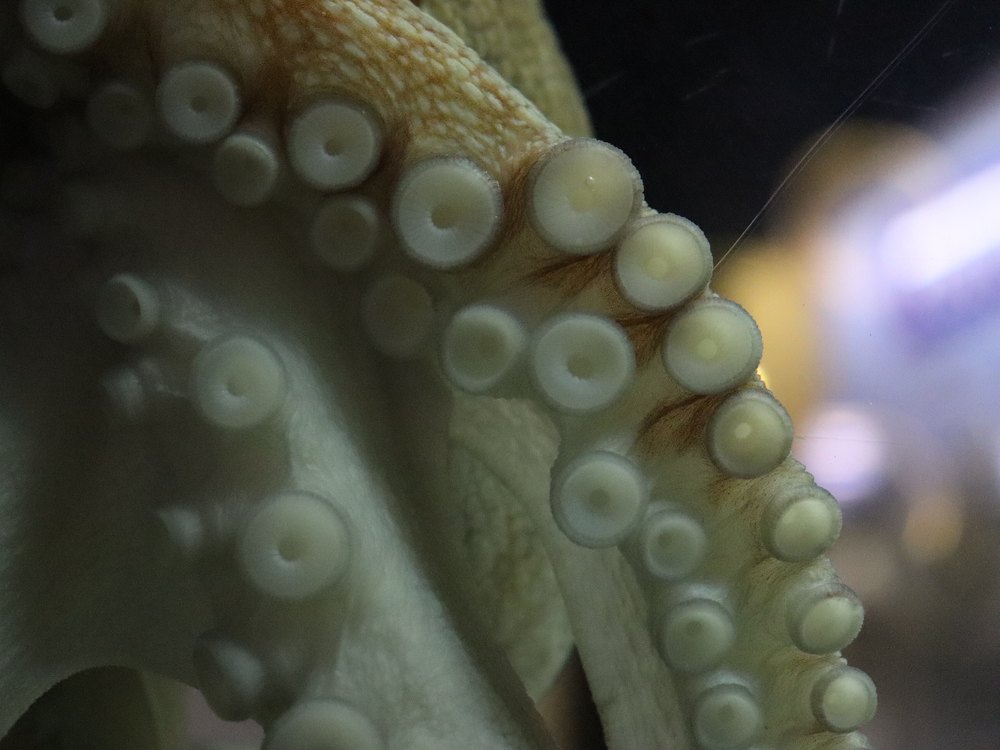
The octopus has eight arms, and each one is lined with suckers.[1]
Arms can be lost to predators. In videos of conger eel attacks, some common octopuses lost parts of their arms.[16] In adults from the Bay of Naples, about 64% of the wound had closed six hours after the tip of an arm (the outer tenth) was removed, and octopuses can regrow a lost arm completely.[17]

Brain
Octopuses have one central brain, but more nerve cells lie in the arms than in the brain. A recent study of octopus arms says the nerve cords running down the eight arms hold about four times as many neurons as the central brain.[18] The statement is about octopuses in general, and the study itself used another species, the California two-spot octopus.
In the common octopus, one part of the brain, the vertical lobe, holds about 25 million neurons, about half of the neurons in the central nervous system.[19]
Behavior
Dens
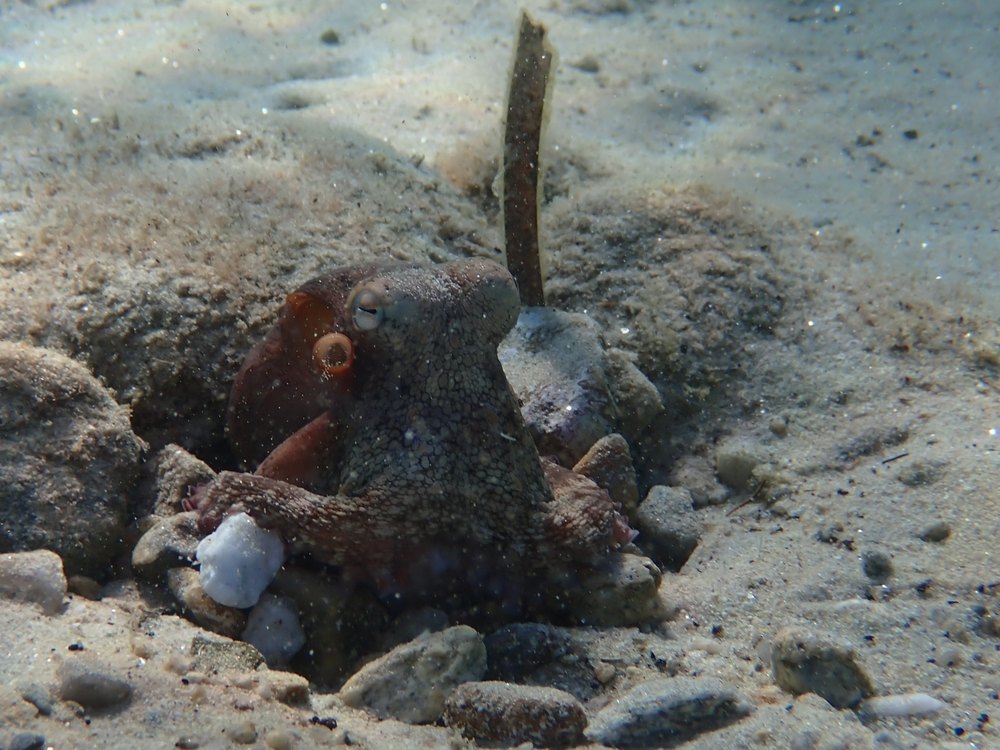
The common octopus lives alone in a den and is described as territorial.[1] On soft sandy sediment off Greece, a diving census found that most dens were not natural rock: 38.7% were of human origin, 29.7% were wells, 21.5% were rock or stone and 2.9% were shells. In that survey 7.3% of the octopuses were outside their den. The authors concluded that the supply of solid material limits where the species can live on soft sediment.[20]
The same survey counted between 0 and 6.88 octopuses per 1,000 m². Animals heavier than 500 g were found deeper as depth increased.[20]

Day and night
Reports differ on when it is active. One reference calls it a typically nocturnal animal that leaves its den at dusk and returns at dawn.[1] In a laboratory study that compared two octopus species, reports of the common octopus’s activity time were described as conflicting, and the animals tested had mostly switched to daytime activity, with differences between individuals.[21]
Defence
The first defence is camouflage. When attacked, the octopus can also release ink.[10] Divers filmed three conger eel attacks on common octopuses in north-west Spain. In the videos the octopuses wrapped the eel’s head, covered its gills and released ink. In one video the eel caught the octopus.[16]
Cannibalism
Common octopuses sometimes eat each other. Three attacks were filmed in the wild in the Ría de Vigo, Spain. Both sexes attacked, the victim weighed 20% to 25% of the attacker, and in two of the three cases the prey was carried to the den.[22]
Learning
Common octopuses can learn in laboratory tests. In one test, four octopuses were taught that one of two visual cues earned a reward. Then the rule was switched so that the other cue was the right one, and this was repeated several times. Learning a rule and then learning its opposite is called reversal learning. One octopus managed four switches and got better each time, and another did not.[23] In a later test of finding the right place, most octopuses that got only a reward for correct choices did not learn the first task, but they learned within a few sessions when a signal was added for wrong choices.[24] A 1992 study at the Naples zoological station reported that octopuses can also learn by watching: in the test, a trained octopus was rewarded for attacking a red ball rather than a white one, while an untrained octopus watched from the next tank. When the watcher was then offered both balls, it was reported to pick the same colour as the one it had seen.[25]
Diet
The common octopus is a carnivore. The FAO catalogue says the adults eat bivalves (clams and mussels) and crustaceans.[3] The IUCN, using the wide sense of the name, adds fish and other molluscs, and says it also takes bristle worms and brittle stars.[7] A brooding female almost stops feeding.[3]
| Food | Stage | Notes |
|---|---|---|
| Bivalves and crustaceans | Adult | Species group[3] |
| Crabs | Paralarva | 53.4% off north-west Iberia[26] |
| Siphonophores, copepods, cnidarians, pteropods | Paralarva | 12.2%, 12.3%, 8.4% and 3.7% off north-west Iberia[26] |
| Other common octopuses | Adult | Filmed in the Ría de Vigo[22] |
Paralarvae
Wild paralarvae off north-west Spain were tested for prey DNA. Of 64 paralarvae, 81.25% had prey DNA in them, from 122 prey units in groups that included decapods (crabs and shrimps), copepods, krill, amphipods, echinoderms, molluscs and hydroids.[27] Off the Iberian Peninsula, wild paralarvae had 3 to 15 suckers per arm, and crabs, siphonophores, copepods, cnidarians and pteropods explained 90% of the variation in their diet.[26]
In a hatchery in Vigo, three-day-old paralarvae attacked, immobilised, drilled and ate live cladocerans and copepods with 100% efficiency, and took decapod prey (Pisidia longicornis) in 60% of attacks. Of the successful attacks, 85% were aimed at the prey’s head and front body.[28]
Beak and saliva
The paralarva uses its beak, mouth parts and radula (a tongue-like strip of tiny teeth) to break through the shell of its prey.[28] The posterior salivary glands make a rich mix of proteins. In one study of the glands, 90 clusters among 10,075 proteins matched venom toxin families.[29]
Life cycle
| Stage | Age / time | Notes |
|---|---|---|
| Eggs | A little over 2 mm each | 120,000 to 400,000 per female in the species group[3] |
| Brooding | 25–65 days (species group); 85–128 days in one Galician den | Warmer water shortens it[3][4] |
| Paralarva | About 1–2 months | Hatches at 1.4 mg and drifts in open water[15][26] |
| Juvenile | Settles on the bottom after about 60 days in the laboratory | About 0.17 g when it settles[15] |
| Adult | Mantle 9.5–13.5 cm at first maturity | Western Mediterranean[3] |
Mating
The male approaches and the female first fends him off, then accepts. A pair may mate for several hours, and may repeat it for about a week.[1] Mating is not exclusive. In four brooding females, genetic tests of 11 embryos showed that at least two males had fathered each clutch.[30]
Eggs and brooding
In the Mediterranean and in the Inland Sea of Japan, spawning peaks twice a year, in April and May and again in October. The FAO figures cover the species group.[3] One wild female in Galicia, north-east Atlantic, laid 160 egg strings holding an estimated 139,040 to 241,760 eggs over 35 days.[4] She brooded for 128 days in a den that was 12.9 to 19.3 °C. Embryos developed for 85 to 128 days, depending on laying date, temperature and egg position, and hatching lasted 43 days.[4]
Females spawn once and die. FAO notes that many die after the larvae hatch, and a study of Galician females also describes them as dying after breeding.[3][31]
Paralarvae and settling
Newly hatched paralarvae are tiny and drift with the plankton. In a laboratory stock from the north-western Mediterranean, fed and kept at an average of 21.2 °C, they weighed 1.4 mg at hatching and doubled in weight about every 8.5 days. After 60 days they averaged 173.2 mg and became bottom-dwelling, settling between day 47 and day 54. Only 8.9% survived to settlement.[15] In the wild, paralarvae are carried by currents offshore and finish the drifting phase over about two months.[26] The FAO catalogue says they settle after about 40 days at a minimum size of about 12 mm.[3] Wild hatchlings have three suckers on each arm.[26]
Growth and lifespan
In the western Mediterranean, an octopus grows from 3 to about 20 cm in 17 months.[3] In a release study of tagged wild octopuses in the Ría de Vigo, life expectancy was 18 months for males and 16 months for females.[2]
Ecology
Predators
The Red List names large fish such as conger and moray eels, and marine mammals such as common and bottlenose dolphins, as predators. It says the greatest mortality is in the drifting paralarva stage.[7] In Greece, stomachs from 27 stranded Mediterranean monk seals showed octopuses to be the most important prey by number and weight, and the common octopus made up 33.9% of the prey items.[32]
Parasites
A single-celled parasite, Aggregata octopiana, lives in the gut. In 114 trawled octopuses from the Spanish Mediterranean, 96% had its cysts, mostly in the intestine and the spiral caecum (a pouch of the gut).[33] A review reports 98% to 100% infection in the common octopus, and in wild animals from the Adriatic, Ionian and Tyrrhenian seas no deaths were linked to it.[34]
Ocean conditions
Off Galicia, paralarvae of the common octopus and of loliginid squids were more abundant when shelf currents ran towards the pole, the water was warm and the water column was less stable.[35]
Habitat and range
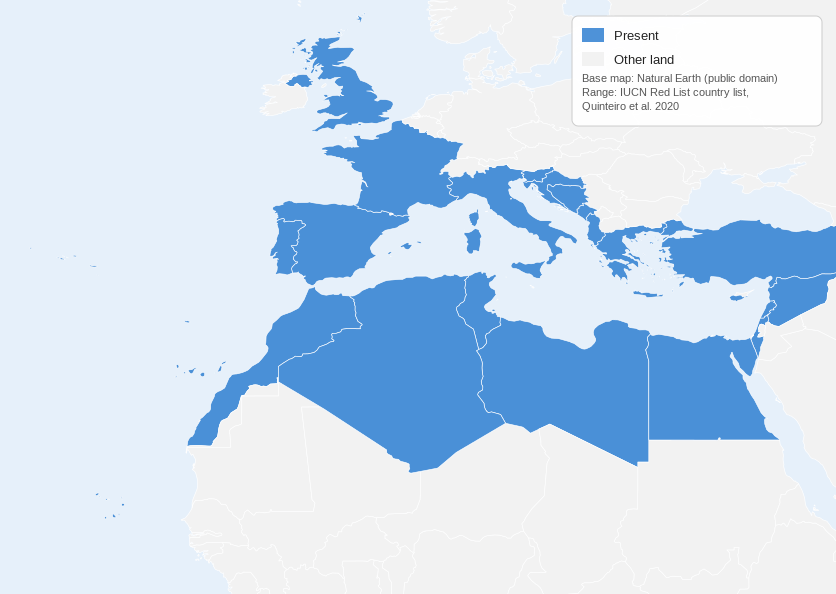
In the strict sense, the common octopus lives on European and North African Atlantic coasts and in the Mediterranean.[5] A study of 296 animals took samples from the Azores, Madeira, the Canary Islands, Cabo Verde, Galicia and Atlantic Morocco.[36] The Red List gives the type locality as the presumed western Mediterranean Sea.[7]
The Red List uses the name in its wide sense, so its figures cover octopuses from many oceans. It says the species lives on the bottom from the shore down to 200 m, in water of 6 to 33 °C, and is not found where salinity falls below 29 parts per thousand. Its habitats include rocky reefs, gravel, sand, muddy sand, mud and kelp, and it makes limited seasonal migrations.[7] Another reference gives a depth of from the surface to 100–150 m, with numbers dropping with depth.[1]
Evolution
The common octopus is a coleoid, the group of cephalopods that lost an outer shell and includes octopuses, squid and cuttlefish. One review dates the origin of cephalopods to about 530 million years ago, the split between the nautilus line and the coleoids to about 416 million years ago, and the split of the coleoids into an eight-armed line (octopuses and vampire squid) and a ten-armed line (squid and cuttlefish) to about 276 million years ago.[37]
Dates for the octopus line itself vary. A molecular-clock study puts the lineages of the vampire squid and the deep-sea dumbo octopuses in the Early Mesozoic, at 242 million years ago give or take 38.[38] For the finless octopuses (Incirrata), which include the common octopus, the same study gives about 100 million years ago in its discussion, although its abstract says they diversified in the Jurassic. Another study estimates about 220 million years ago for the split between octopuses and the vampire squid, and 150 and 170 million years for the squid and octopus lineages.[39]
Among the oldest known octopus fossils are three from the Upper Cenomanian (Late Cretaceous) of Lebanon, and one of them is placed in the living family Octopodidae.[40] The Carboniferous animal Pohlsepia, once called the oldest octopus, was re-examined in 2026 and reinterpreted as a decomposed relative of the nautilus.[41]
Within the family, the group around the common octopus split from a south-eastern Pacific group between 19.0 and 40.9 million years ago.[42] The East Asian and Australasian members of the complex separated from each other between 5.4 and 11.6 million years ago.[43]
Forms and variants
ITIS records O. v. americanus (D’Orbigny, 1842) only as an invalid junior synonym of O. vulgaris. MolluscaBase treats O. americanus as a separate species, and a 2025 review does the same.[13][44][5] The wider group of look-alike octopuses that carried the name Octopus vulgaris is described under Taxonomy.
Conservation
The common octopus is listed as Least Concern on the IUCN Red List. The assessment was made on 8 April 2016 and published in 2018, and it uses the name in its wide sense: its list of countries includes Brazil, Chile, Japan and Taiwan as well as the Mediterranean.[7] The Red List says there is no information on the population status, and the trend is listed as unknown.[7] The Red List notes that the species is fished over much of its range, mostly without regulation, but is under heavy fishing pressure only in selected places.[7]
Threats
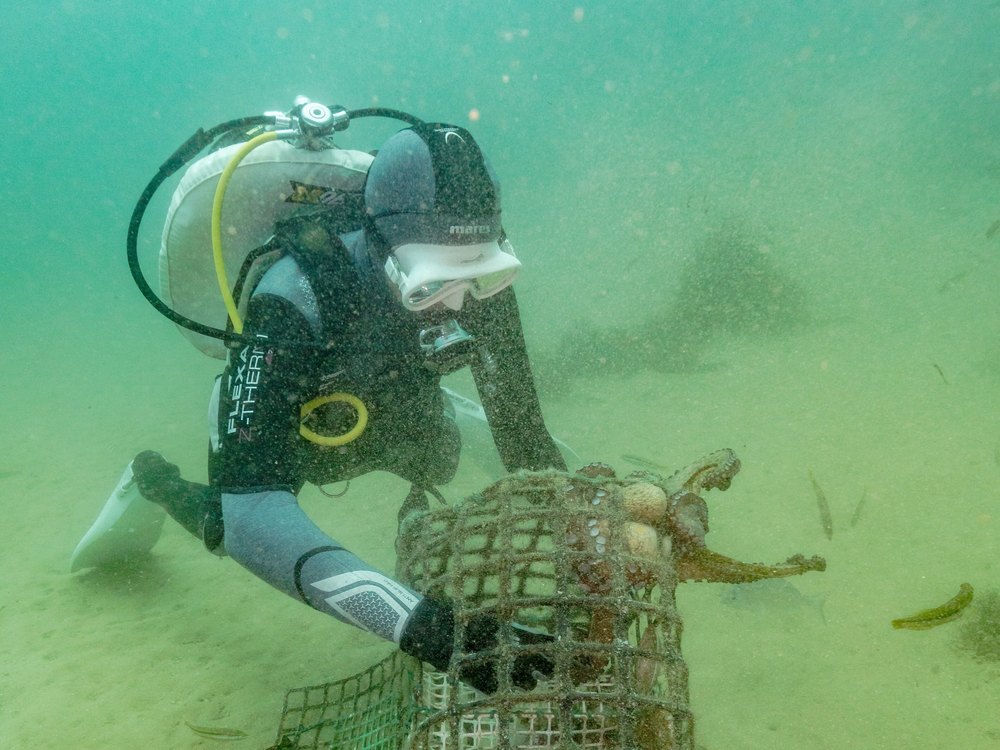
Unregulated fishingBottom trawlingClimate change[7][45]Unregulated fishing and bottom trawling. The Red List names unregulated fishing as the major threat. The octopus is taken by hand-jig, in pots, in trammel nets and in traps, and is a target of bottom trawling off the Saharan Bank. Landings in the eastern-central Atlantic were about 149,000 tonnes in 2001, mostly from Western Sahara and Mauritania. Heavy fishing in particular places is not thought likely to harm the species across its whole range.[7] The Red List says it is often considered the most important fished cephalopod in the Mediterranean, and says north-west Africa has the largest fishery in the world that targets a single species.[7] No conservation measures are in place, and the Red List asks for research on the effect of harvesting and for monitoring.[7]
Climate change. A modelling study of the species complex projected that Octopus vulgaris would lose much of its range by 2050 and 2100 under four climate scenarios.[45]

Farming
The Red List says that farming the species would need more research into the best conditions in large tanks and into rearing paralarvae.[7]
Laws on research and welfare
The European Union’s Directive 2010/63/EU on animals used in science covers live cephalopods, and also their earlier stages when the animal is expected to feel pain or lasting harm after it has developed further.[46] In the United Kingdom, a 2012 amendment to the Animals (Scientific Procedures) Act added “any living cephalopod”, though a cephalopod in its embryonic form is not protected.[47] The Animal Welfare (Sentience) Act 2022 defines “animal” to include any cephalopod mollusc.[48] These laws protect animals in research and in welfare policy, not wild populations.
History and culture
Early descriptions
Aristotle described the octopus in the 4th century BCE. He wrote that it “pairs in winter and breeds in spring, lying hidden for about two months”, that its spawn is “shaped like a vine-tendril”, and that the female “broods over them, and in consequence gets out of condition”. Some fifty days later, he wrote, “the eggs burst and the little polypuses creep out”. He wrote that the octopus does not live out the year.[49] He used the word polypus for the animal and named no species.[49]
Cuvier gave the species its present name in his Tableau élémentaire de l’histoire naturelle des animaux, published in Paris in 1797 (page 380).[13]
Drawings and models
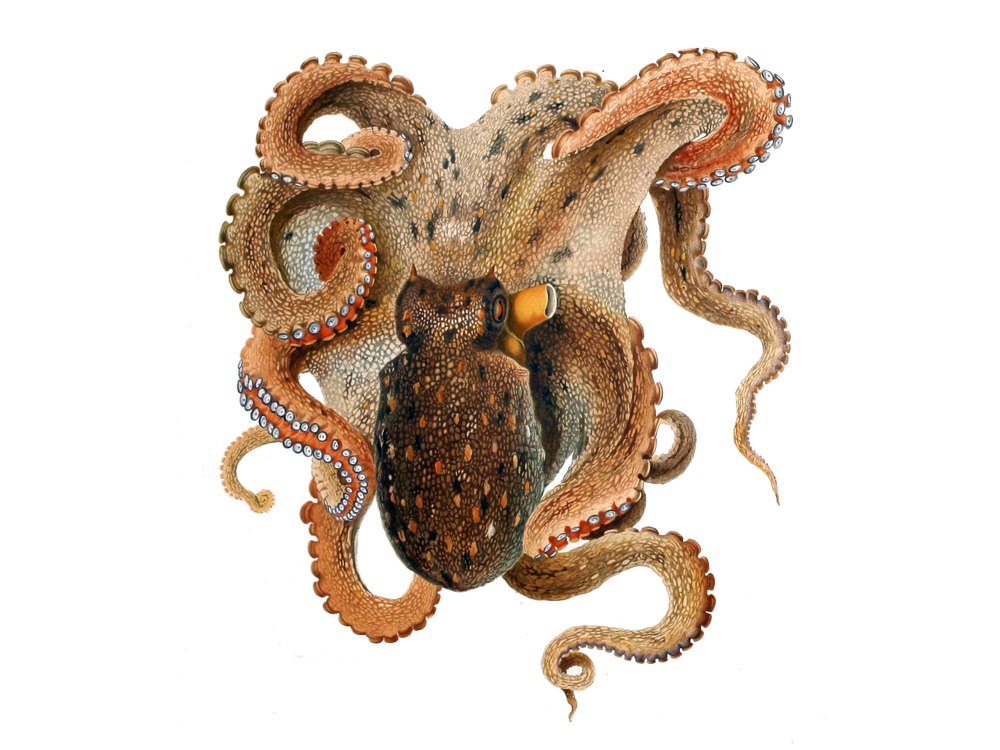
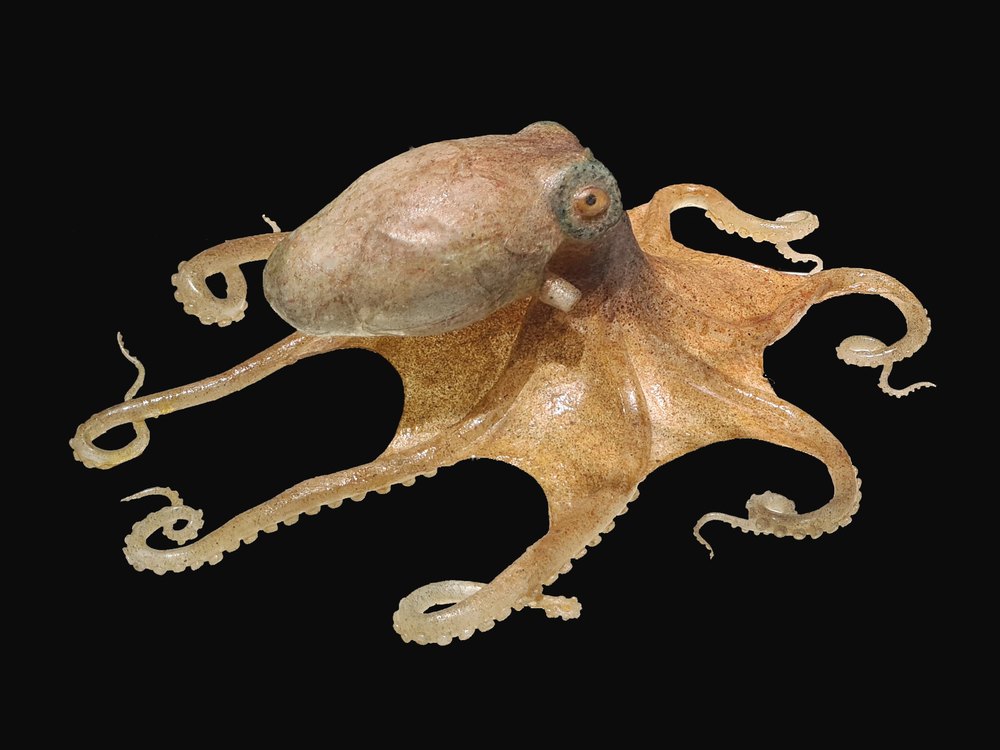
A coloured plate by Comingio Merculiano shows the animal in the 1896 monograph on the cephalopods of the Gulf of Naples by Jatta.[50] A glass model of the common octopus in the Blaschka style is kept in the Zoological Museum of Strasbourg.[51]


Octopuses in ancient art
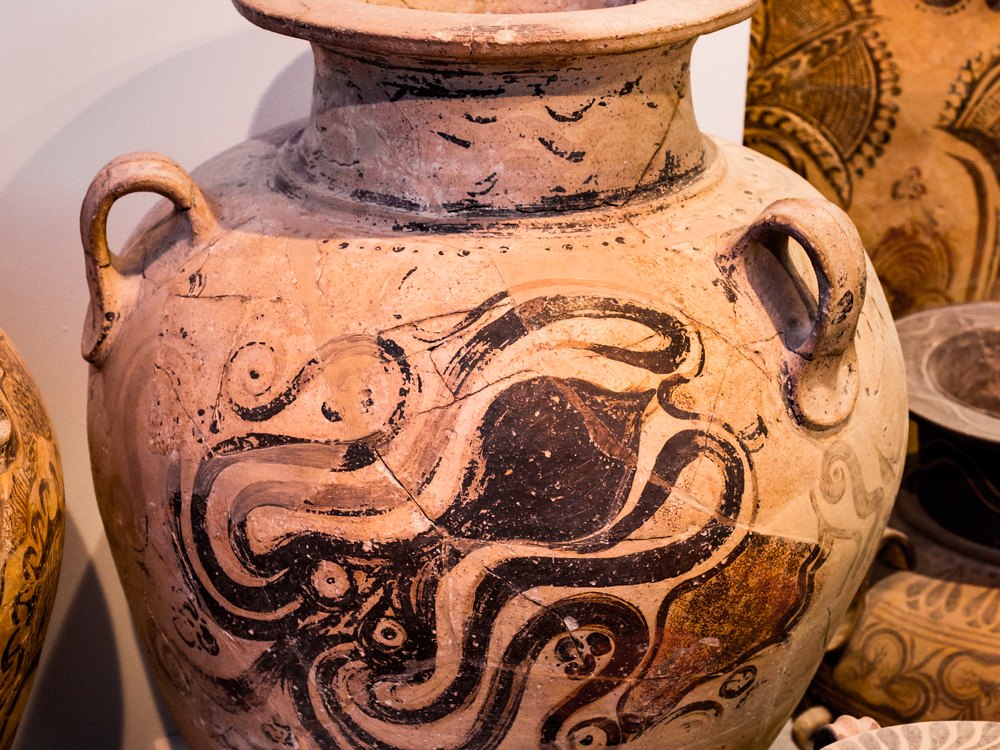
Octopuses were painted on Minoan pottery from Crete. The Palaikastro octopus flask, about 1500 BCE, carries a swimming octopus among sea urchins, coral and shells.[52] Such pictures show “an octopus”, not a particular species.

Taxonomy
| Rank | Name |
|---|---|
| Kingdom | Animalia |
| Phylum | Mollusca |
| Class | Cephalopoda |
| Order | Octopoda (octopuses)[13] |
| Family | Octopodidae[13] |
| Genus | Octopus Cuvier, 1797[13] |
| Species | Octopus vulgaris (Cuvier, 1797)[13][53][44] |
Synonyms (10)
| Name |
|---|
| Sepia octopus (Gmelin, 1791) |
| Octopus rugosus (Bosc, 1792) |
| Sepia granulata (Bosc, 1792) |
| Sepia rugosa (Bosc, 1792) |
| Octopus vulgare (Cuvier, 1797) |
| Octopus americanus (Montfort, 1802) |
| Octopus albus (Rafinesque, 1814) |
| Octopus heteropus (Rafinesque, 1814) |
| Octopus maculatus (Rafinesque, 1814) |
| Octopus moschatus (Rafinesque, 1814) |
A selection of the oldest names. The GBIF backbone lists 25 species-level synonyms.[59]
Octopus vulgaris is the type species of the genus Octopus.[13] MolluscaBase, GBIF and ITIS accept the name with Cuvier, 1797 as the author and date.[13][53][44] The original specimen is missing, and a neotype (a new reference specimen) from the Catalonian Sea, off Banyuls-sur-Mer, was designated later.[54] MolluscaBase lists 25 other names as synonyms, among them Octopus rugosus (Bosc, 1792), Octopus heteropus Rafinesque, 1814 and Sepia octopus Gmelin, 1791.[13]
A species complex
Octopus vulgaris has long been used as a name for a whole group of look-alike octopuses. A 2025 review says the group holds at least six closely related species: O. vulgaris in the strict sense, on European and North African Atlantic coasts and in the Mediterranean; O. sinensis in the north-west Pacific; O. tetricus in eastern Australia and New Zealand; O. djinda in south-western Australia; O. americanus in the western Atlantic; and an unnamed southern lineage called Type III in the eastern South Atlantic and the Indian Ocean.[5]
Authors differ on details. East Asian animals, long treated as the Atlantic species, have been argued to be O. sinensis.[55] A morphological study of seven genetic groups found that O. sinensis, Brazilian “O. vulgaris” and O. vulgaris in the strict sense can be told apart, and that several look-alikes are probably being misidentified under one name.[14] Octopus americanus was redescribed from the Caribbean as a hidden species of the complex.[56] A genomic study of two specimens, one from South Africa and one from Amsterdam Island, found Type III to be a genetically distinct lineage.[57] Whether O. insularis of the tropical Atlantic belongs to the complex is disputed: one description calls it a hidden species within it, and the 2025 review says it does not belong.[58][5] A DNA study found the East Asian group to be the sister of the Australian O. tetricus group, so the old broad species was not a single natural group.[43]
Mediterranean and nearby Atlantic samples share identical sequences of the 482-base-pair COI gene fragment tested, and these are firmly assigned to O. vulgaris. Its identity is still debated in Africa, Brazil and Japan.[54] MolluscaBase treats O. americanus, O. sinensis, O. tetricus and O. djinda as separate species. ITIS still lists O. v. americanus as a subspecies.[13][44]
Sources
- Animal Diversity Web, Octopus vulgaris
- Release study of tagged common octopus in the Ría de Vigo, Vie et Milieu 60(1), 2010 (life expectancy)
- FAO cephalopod species catalogue, species account for Octopus vulgaris Cuvier, 1797, pp. 211–212
- Garci et al. 2016, Journal of the Marine Biological Association of the UK 96: 1341–1346
- Cortés et al. 2025, Current Zoology 72: 1–13
- Fee et al. 2023, Molecular Biology Reports
- Allcock, Headlam & Allen 2018, IUCN Red List assessment of Octopus vulgaris
- Josef et al. 2012, PLOS ONE 7: e37579
- Hanke & Kelber 2020, Frontiers in Physiology 10: 1637
- Derby 2014, Marine Drugs 12: 2700–2730
- Online Etymology Dictionary, octopus
- Lewis & Short, A Latin Dictionary, vulgaris, Perseus
- MolluscaBase, Octopus vulgaris Cuvier, 1797
- Amor et al. 2017, Zoologica Scripta 46: 275–288
- Villanueva 1995, Canadian Journal of Fisheries and Aquatic Sciences 52: 2639–2650
- “The best defense is a good offense”, Ecology and Evolution, March 2024
- Shaw et al. 2016, Zoological Letters 2
- Olson et al., “Neuronal segmentation in cephalopod arms”, Nature Communications (2025; preprint on PMC)
- Bidel et al. 2023, eLife 12: e84257
- Katsanevakis & Verriopoulos 2004, Scientia Marina 68: 147–157
- Meisel et al. 2006, Journal of Comparative Psychology 120: 191–197
- Hernández-Urcera et al. 2014, Journal of Comparative Psychology
- Bublitz et al. 2017, Frontiers in Physiology 8: 54
- Bublitz et al. 2021, Frontiers in Behavioral Neuroscience 15: 614523
- Fiorito & Scotto 1992, Science 256: 545–547
- Roura et al. 2023, Scientific Reports 13
- Olmos-Pérez et al. 2017, Frontiers in Physiology 8: 321
- Nande et al. 2017, Frontiers in Physiology 8: 573
- Almeida et al. 2020, Antibiotics 9: 757
- Quinteiro et al. 2011, Molluscan Research 31
- Sieiro et al. 2020, Frontiers in Physiology 11: 760
- Diet of the monk seal in Greek waters (stomachs of 27 stranded seals)
- Aggregata infection in the common octopus, Journal of Sea Research 2013
- Protist (Coccidia) and related diseases, in Handbook of Pathogens and Diseases in Cephalopods, 2019
- Otero et al. 2016, Progress in Oceanography (upwelling and paralarvae off Galicia)
- Quinteiro et al. 2020, PLOS ONE 15: e0230294
- Kröger, Vinther & Fuchs 2011, BioEssays 33
- Tanner et al. 2017, Proceedings of the Royal Society B 284: 20162818
- Sánchez et al. 2018, PeerJ 6: e4331
- Fuchs, Bracchi & Weis 2009, Palaeontology 52
- Clements et al. 2026, Proceedings of the Royal Society B 293
- Amor et al. 2017, Journal of the Marine Biological Association of the UK 97: 753–758
- Amor et al. 2014, PLOS ONE 9: e98982
- ITIS, Octopus vulgaris
- Borges et al. 2022, Frontiers in Marine Science 9
- Directive 2010/63/EU, Article 1(3) and 1(4), legislation.gov.uk
- Animals (Scientific Procedures) Act 1986 Amendment Regulations 2012, regulation 3
- Animal Welfare (Sentience) Act 2022, section 5
- Aristotle, History of Animals, D’Arcy Thompson translation, MIT Classics
- Merculiano plate in Jatta 1896, I cefalopodi viventi nel Golfo di Napoli, Wikimedia Commons
- Blaschka model of the common octopus, Zoological Museum of Strasbourg, Wikimedia Commons
- Smarthistory, Octopus vase (Palaikastro, about 1500 BCE)
- GBIF backbone, Octopus vulgaris
- De Luca et al. 2014, Frontiers in Ecology and Evolution 2: 55
- Gleadall 2016, Species Diversity 21: 31–42
- Avendaño et al. 2020, Aquatic Ecology 54: 909–925
- Emami-Khoyi et al. 2026, Ecology and Evolution 16: e73235
- Leite et al. 2008, Journal of Molluscan Studies 74: 63–74
- GBIF backbone, Octopus vulgaris, synonyms