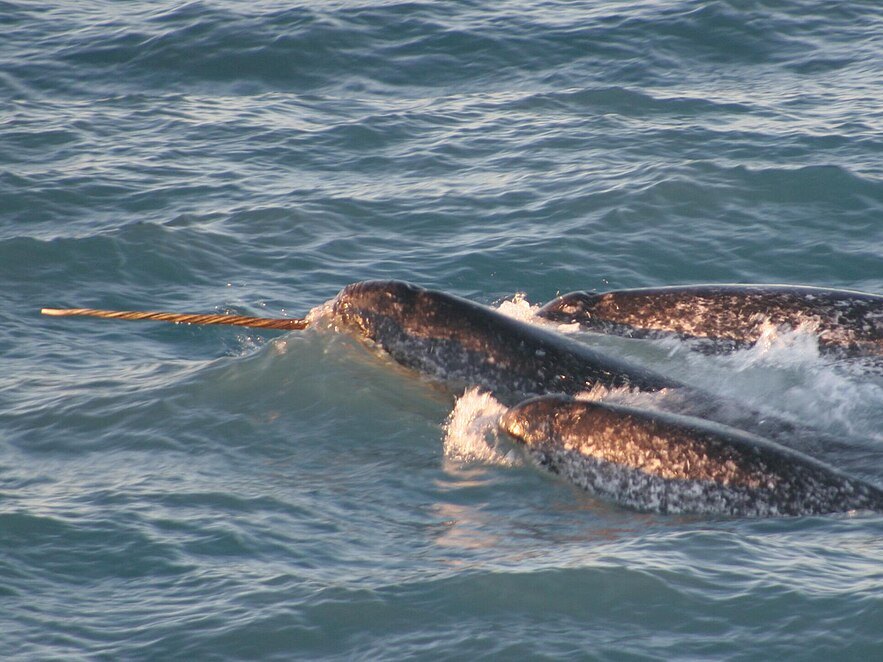
The narwhal (Monodon monoceros) is a toothed whale of the Arctic. Most adult males have one long, spiral tusk, which is a tooth.[1][2] Narwhals live in Arctic waters around Canada, Greenland, Svalbard and Russia. In winter they feed deep under dense pack ice, diving to more than 1,800 m.[3][4] The IUCN rates the species Least Concern.[3]
Quick facts
Description
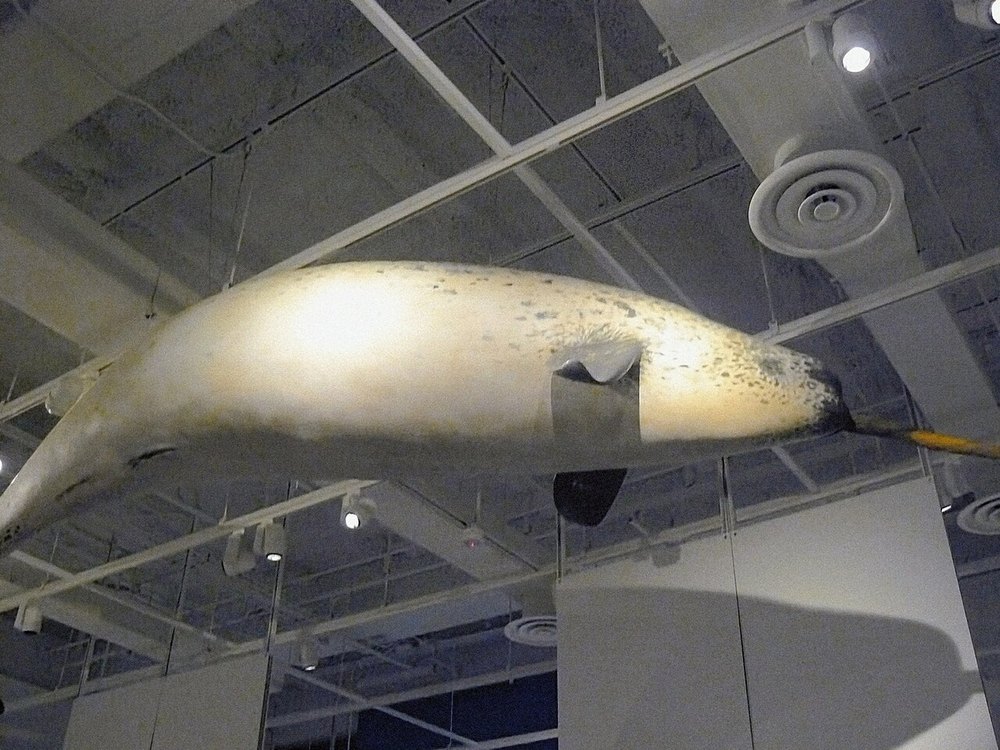
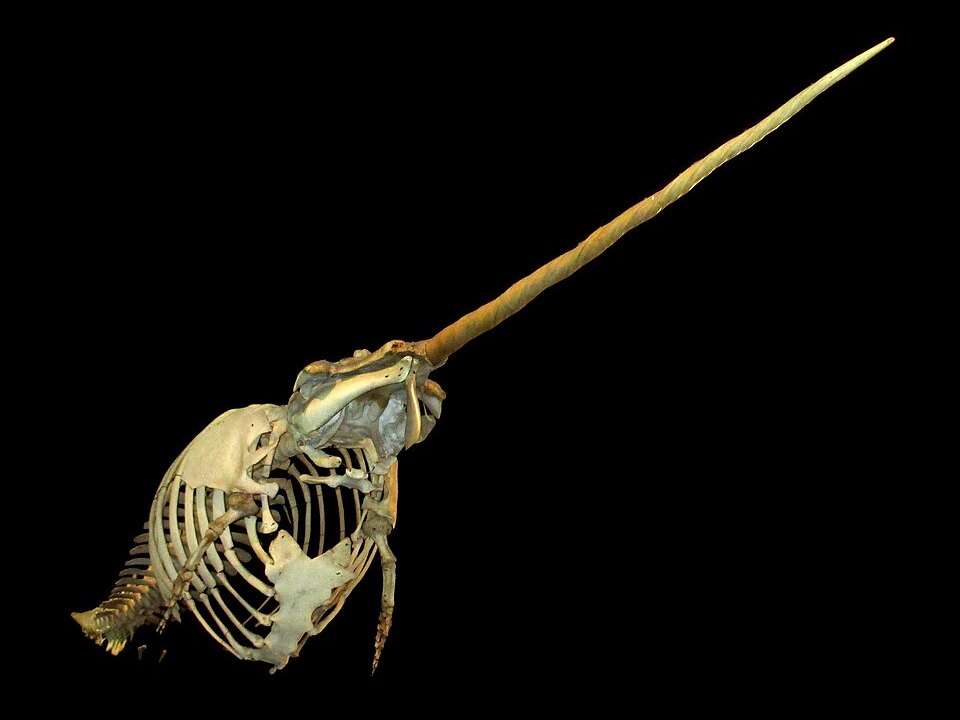
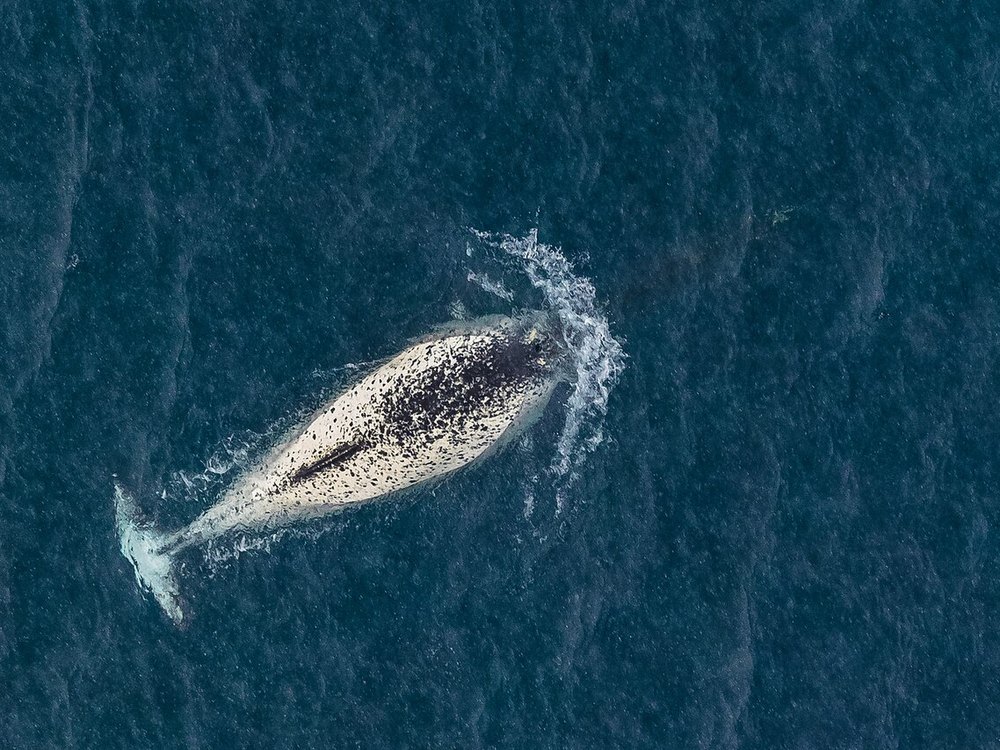
Adult narwhals have only two teeth, both set sideways in the upper jaw. In most adult males the left tooth grows into a very long, straight ivory tusk that spirals to the left along its length.[1][2] The narwhal has no dorsal fin.[1] Males are larger than females.[2]
The species is a toothed whale. It finds its way and its food with clicks, using an unusually narrow beam of sound.[6] Narwhals spend about two months each summer in ice-free bays and fjords, then travel with the forming ice to winter grounds in deep, ice-covered water far offshore.[3]
Name
The English word “narwhal” comes from Dutch narwal or Danish and Norwegian narhval, which come from Old Norse náhvalr, made of nár, “corpse”, and hvalr, “whale”. One suggested reason is the grey, mottled skin.[7] Other English names in use are sea unicorn and horned whale.[8] Carl Linnaeus described the species in the tenth edition of Systema Naturae in 1758. It is the only living species in its genus.[8][1]
In other languages
| Language | Name | Notes |
|---|---|---|
| Inuktitut local | killalugaq | — |
| Kalaallisut (Greenlandic) local | qernertaq; tauvar | — |
| Chukchi local | kaipuuliak | — |
| Icelandic local | náhveli | — |
| Inuktitut | tuugaalik | “with tusk”; also qirniqtaq qilalugaq (“black whale”) and allanguaq (“with black and white dots”)[1] |
| Greenlandic | qilalugaq qernertaq | —[9] |
| Danish | narhval | —[9] |
| Norwegian | narhval; narkval | Bokmål and Nynorsk[9] |
| Icelandic | náhvalur | also the Faroese word[9] |
| German | Narwal | —[9] |
| French | narval | —[1] |
| Russian | нарвал (narval) | —[9] |
Inuktitut and French names come from the Canadian status report; the other names come from an online dictionary. Names in other languages are not listed because no reliable dictionary source was found.[1][9] These names are from the WoRMS list of common names.
Body
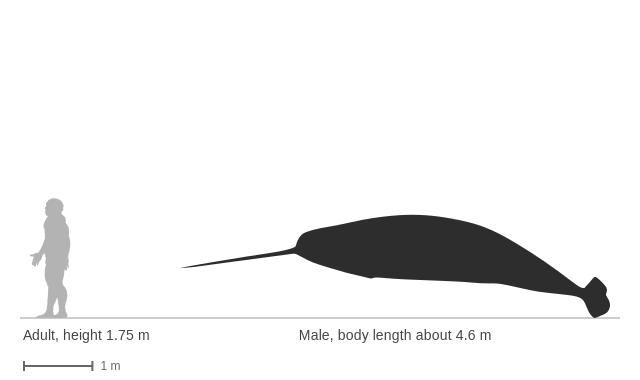
Hunted narwhals measured in Canada show that males are longer than females. At Arctic Bay in 1986–89, adult males averaged 4.58 m (3.96–5.40 m, 56 males) and females 4.13 m (3.56–4.94 m, 20 females). At Pond Inlet in 1982–83, males averaged 4.35 m (3.90–4.86 m, 37 males) and females 3.81 m (3.48–4.20 m, 17 females).[1] In Greenland, hunted whales gave an estimated final length (the length a whale approaches as it stops growing) of 405 cm for females and 462 cm for males in the east, and 399 cm and 456 cm in the west.[10] The final weight estimated from 75 whales in West Greenland was 904 kg for females and 1,645 kg for males.[11]
A newborn is about 1.5–1.6 m long and weighs about 80 kg.[1][2] In Scoresby Sound, East Greenland, the body length of both sexes and the tusk length of males rose significantly between 2007 and 2019.[12]
Size ranges
| Female | Male | |
|---|---|---|
| Weight (estimate) | 904 kg | 1,645 kg |
| Length (average) | 3.8–4.1 m | 4.4–4.6 m |
Tusk
In males the tusk is the left tooth, which grows out of the head as a straight spiral. It grows continuously throughout the whale’s life.[1][5] Yearly growth layers in the ivory can be counted to give age and a chemical record.[13] The tusk is normal in males. In most females both teeth stay inside the jaw.[2][1] Exceptions are rare: among 173 hunted whales from Greenland, tusked females were 1.5% of the females, tuskless males 2.8% of the males and males with two tusks 0.9% of the males. One tusked female was sexually mature and had 18 ovarian scars. In one female the complete tusk was estimated at 146–151 cm. A young male with two tusks had tusks under 90 cm each.[5]
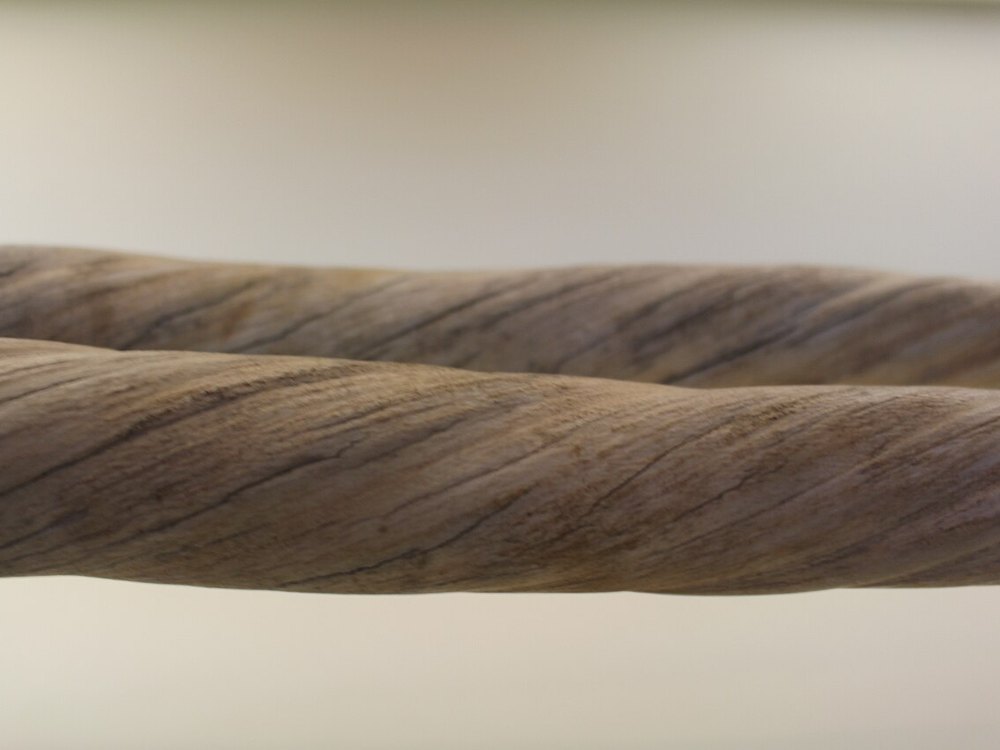
What the tusk is for is still being studied. A 2022 study of Greenland whales concluded that it is most likely a secondary sexual trait, used in competition between males and possibly in female choice.[5] One research team has proposed that the tusk is also a sense organ. In 2014 they reported tiny tubes in the ivory that connect to nerves, and changes in the heart rate of captive narwhals when salt water or fresh water was put on the tusk.[14] Other researchers see no evidence that the tusk senses salt or finds food.[15]
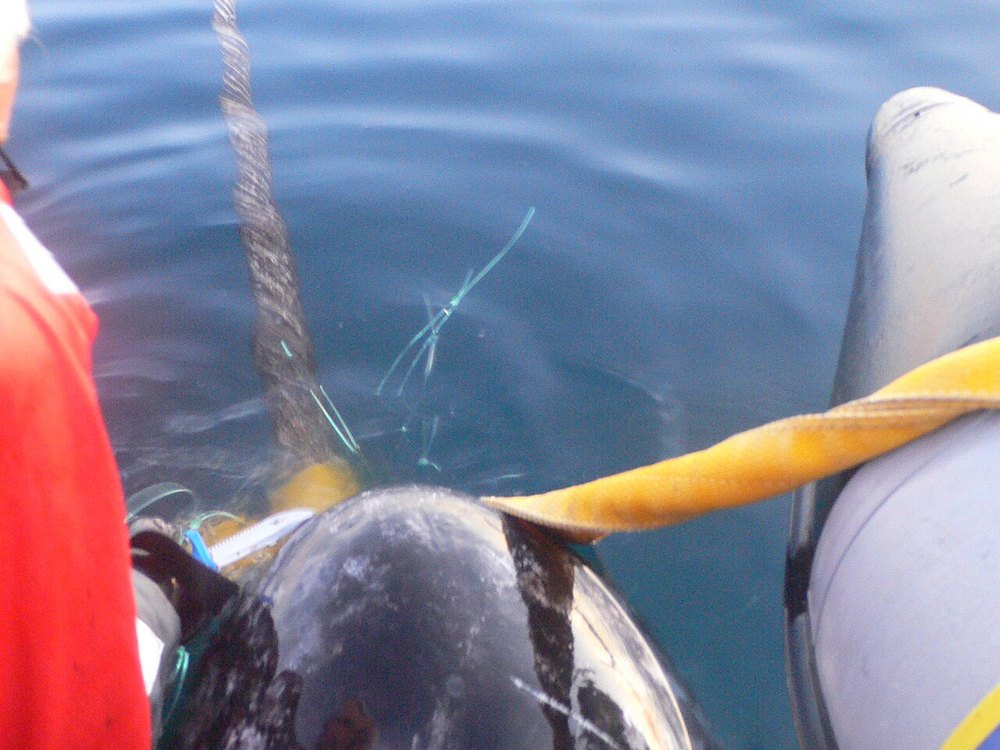
Narwhals have been filmed hitting fish with the tusk. In August 2022 drone footage from Creswell Bay, Nunavut, showed three narwhals chasing one Arctic char. One whale hit the fish with the tusk tip about 12 times, with 6 more possible hits, and the fish was not stunned and got away. In a second case, one of three young adult males hit a fish five times in quick succession, and the fish was briefly stunned and then escaped. A third fish was apparently eaten after repeated hits, though this was only partly confirmed. The authors concluded that the force could stun and perhaps kill a fish, and that some of the hitting may be exploratory play.[16] Hitting prey is rare in the records and is not the main way narwhals feed.[17][16]
Behavior
Pods
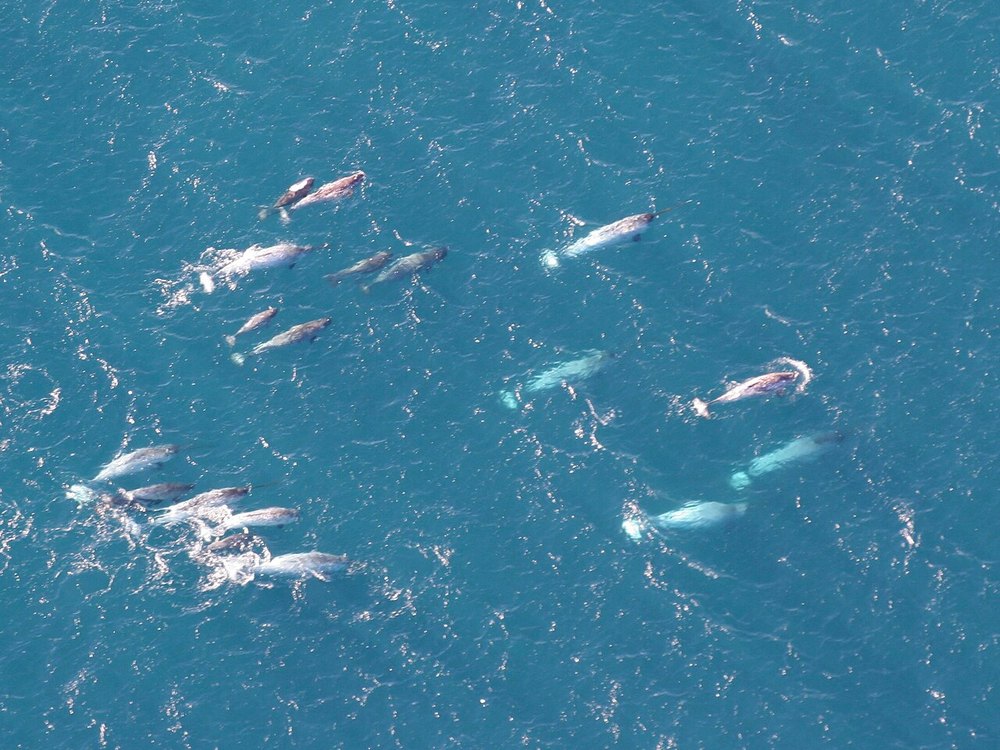
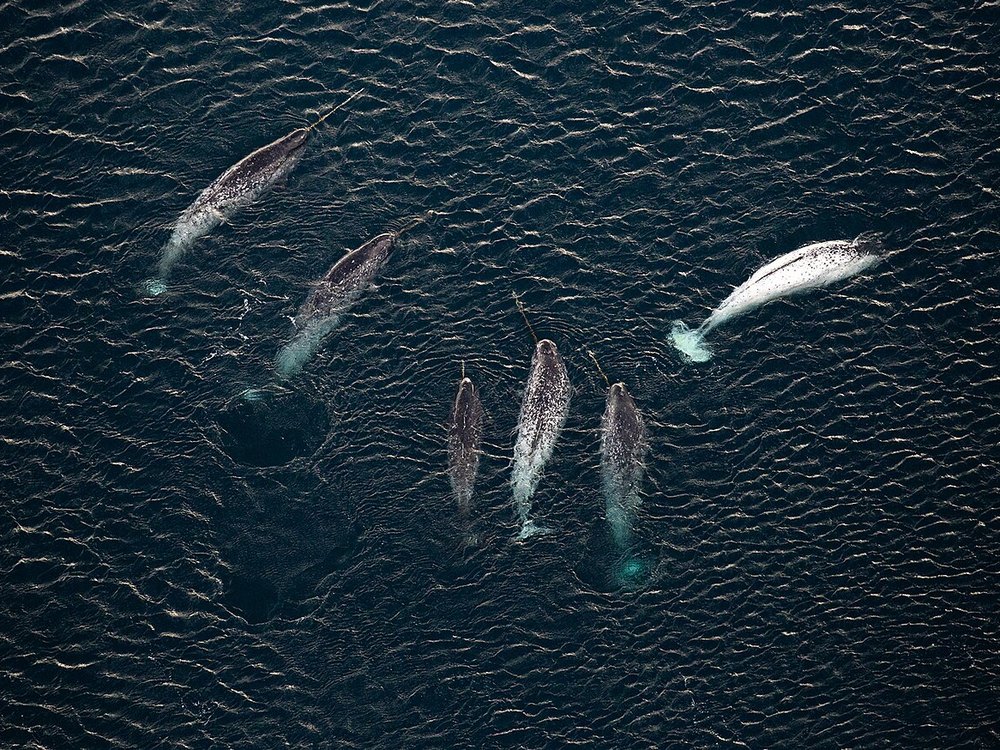
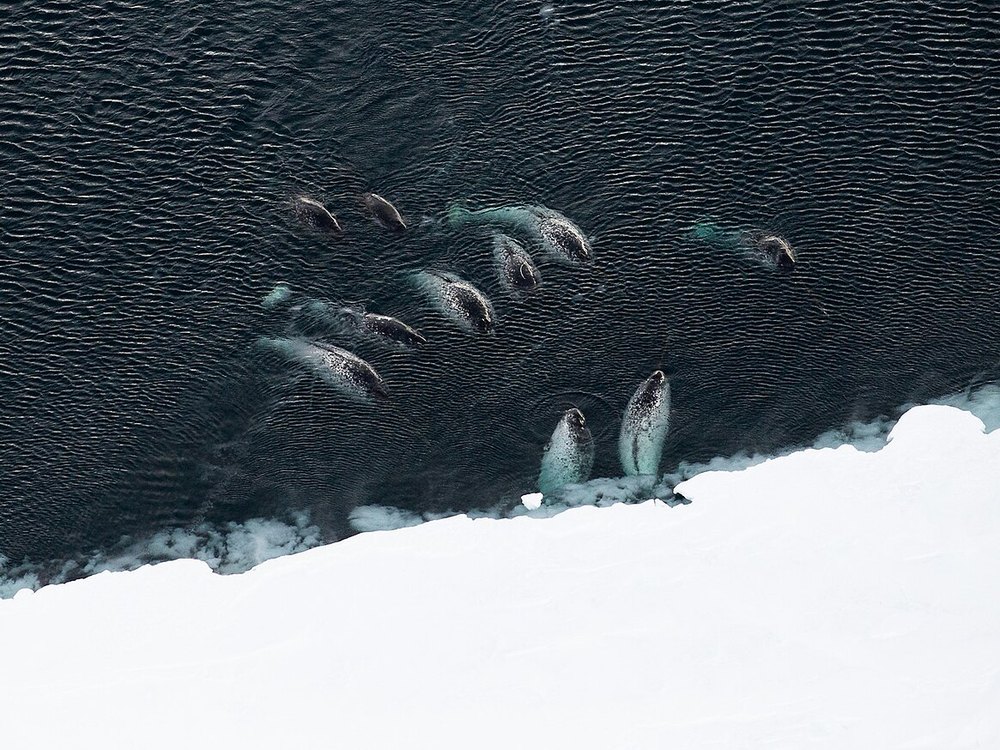
Narwhals usually travel in pods of fewer than 10 animals, and during the spring and fall migrations they gather in groups of many hundreds.[1] Another account gives pods of 2 to 25, with an average of 3.6.[2] On 5 July 1979, 1,216 narwhals were counted at the ice edge in northern Smith Sound.[1] In winter, more than 50,000 narwhals occupy dense pack ice in Baffin Bay and Davis Strait between November and April.[4]
Migration
Narwhals spend about two months each summer in ice-free bays and fjords, and some gather at the fronts of glaciers that reach the sea. In autumn they migrate with the forming fast ice to winter areas that are deep, offshore and ice covered, along the continental slope. The trip takes about two months.[3] Satellite tags on whales that summered at Bylot Island showed that they stayed near the island until the end of September, then moved south along east Baffin Island in September and October. One headed south on 21 October 1998, and two reached the northern Davis Strait in early November.[18] Narwhals return to the same winter grounds year after year.[4] The average swimming speed is about 5.0 km/h, with peaks up to 20 km/h.[1]
Diving
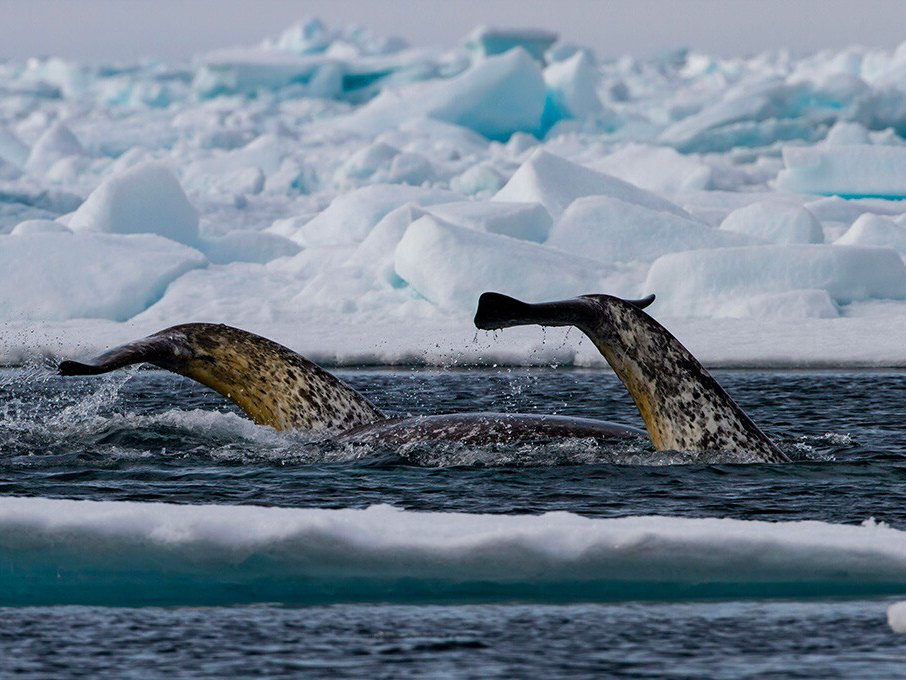
Narwhals are among the deepest-diving whales. In winter they regularly descend to more than 1,800 m, 10 to 25 times a day, and the dives last more than 25 minutes. The estimated aerobic dive limit, the time a whale can stay down on the oxygen it carries, is 25–30 minutes.[4] Winter dives start and end in the same crack in the ice, and the whales move very little sideways.[4] Two winter grounds differ. On one, whales spent most of their time at 200–400 m and made about 25 dives a day. On the other, they spent most of their time at 800 m or deeper and made 13 to 26 dives a day, with more than 3 hours a day below 800 m.[19]
Sound
Narwhals make three kinds of sound: clicks for echolocation, rapid trains of clicks called buzzes, and calls. Six whales fitted with sound tags in Scoresby Sound, East Greenland, made buzzes mostly at depths of 350–650 m, where they were feeding. Their calls came mostly in the top 100 m, and more than half of the calls were within 7 m of the surface, where the whales spent over half their time.[20] People who study narwhals also describe squealing, growling and whistling used for communication.[1]
The click beam is the narrowest reported for any species. In Baffin Bay pack ice in 2013, the beam averaged 5.0 degrees wide where the sound fell by 3 dB from the centre. The loudest clicks reached 222 dB (re 1 µPa, peak to peak), and the average apparent loudness was 215 dB.[6] Narwhal clicks are mostly below 60 kHz, while beluga clicks peak above 60 kHz.[21]
Diet
Narwhals eat fish and squid. A study of 121 stomachs from the eastern Canadian High Arctic and West Greenland found a restricted diet in every season.[17] Most stomachs from summer were empty, with little sign of recent feeding.[17]
| Season | Food found in stomachs |
|---|---|
| Summer | Arctic cod, polar cod and Gonatus squid[17] |
| Fall | Gonatus fabricii squid only[17] |
| Late fall and winter | Greenland halibut (51% of stomachs) and Gonatus fabricii (73%)[17] |
The Greenland halibut averaged 39 cm and 556 g, and the squid averaged 23 g, with a mantle 85 mm long.[17] Wintering whales dive up to about 1,800 m and feed on animals living close to the sea floor, among them Greenland halibut, in dense pack ice.[4] A large part of the energy a narwhal takes in each year comes in winter, while summer feeding is light and opportunistic.[3] Buzzes recorded at 350–650 m in East Greenland show feeding in the middle of the water as well.[20] Capelin fell and Greenland halibut rose in the diet of Baffin Bay narwhals between 1994–2000 and 2006–2011.[22] Greenland halibut fisheries on both sides of Baffin Bay and Davis Strait overlap with the winter feeding areas.[3]
Life cycle
| Stage | Age / time | Notes |
|---|---|---|
| Pregnancy | About 14 to 15.3 months | Conception falls between 20 March and 19 May, with a peak in mid-April[1][2] |
| Birth | Mostly July and August | A single calf of about 1.6 m and 80 kg[1] |
| Between calves | About 3 years on average | About 20% of females calve every 2 years[1] |
| Maturity | Females about 8–9 years, males about 12–20 years | The newest direct study; older estimates are lower[10] |
The pregnancy rate was estimated at 0.38–0.42 in East Greenland and 0.38 in West Greenland.[10] A projection model gave a population growth of 3.8% a year in East Greenland and 2.6% in West Greenland.[10] Estimates of the age at maturity differ between studies. An earlier study gave 6–7 years for females and 9 years for males, and the Canadian status report gave 5–8 years for females and 11–13 years for males.[11][1]
Lifespan and age
Age is read from the eye lens. One form of the amino acid aspartic acid slowly changes into its mirror form at a steady rate, and the ratio between the two gives the age. The rate was calibrated on yearly growth layers in tusks.[13][10] The newest study put the maximum life span at about 100 years.[10] The 2004 Canadian status report suggested about 50 years, and said most animals probably do not reach 30.[1] The IUCN gives a generation length of 21.9 to 33.0 years.[3]
Ecology
Predators
Killer whales are known to eat narwhals in their summer areas.[3][23] Interviews with Inuit in 11 eastern Nunavut communities (2007–2010) suggested that killer whales there specialise little beyond marine mammals, and that the Inuit have seen narwhals use sea ice and shallow water as refuges.[23] In Admiralty Inlet, 7 narwhals tracked by satellite moved closer to shore when a killer whale family group came within about 100 km, and the effect lasted 10 days, as long as the killer whales stayed.[24] A model based on 63 identified killer whales (2009–2018), a population of 163 ± 27, predicted that they could eat more than 1,000 narwhals during their seasonal stay in the Arctic.[25] More killer whales entered Hudson Bay when less sea ice allowed them to pass Hudson Strait.[3]
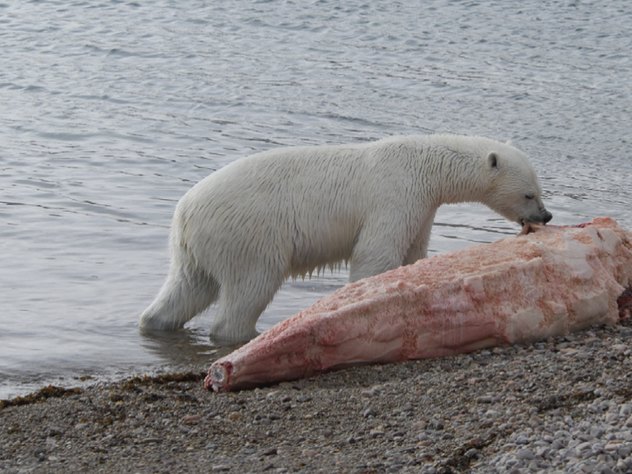
Polar bears feed on narwhals that are trapped or stranded. On 18 August 1988, four narwhals and two dead belugas lay stranded on a low beach at Creswell Bay, Somerset Island, and the narwhals had been attacked and partly eaten by polar bears.[26]
Parasites and disease
Narwhals and belugas share two kinds of whale lice, Cyamus monodontis and Cyamus nodosus.[27] A lungworm was found in narwhals captured for public display in northwest Canada in 1970, the only record in a recent review.[27] Blood from 339 narwhals taken between 1984 and 2003 held antibodies to Brucella bacteria, and no deaths have been blamed on the bacteria.[27] Antibodies to influenza A virus and to the parasite Toxoplasma gondii have also been reported.[27] A herpesvirus was found in an adult female captured alive for tagging in Tremblay Sound, Nunavut, in August 2018. She had two open wounds on her back but looked healthy, and the virus differs from the one found in belugas.[28] The IUCN reports no significant epidemic in narwhals.[3] In 2024 the Canadian status report said modelling suggests narwhals can catch SARS-CoV-2, and that the health effects are unknown.[29]
Habitat and range
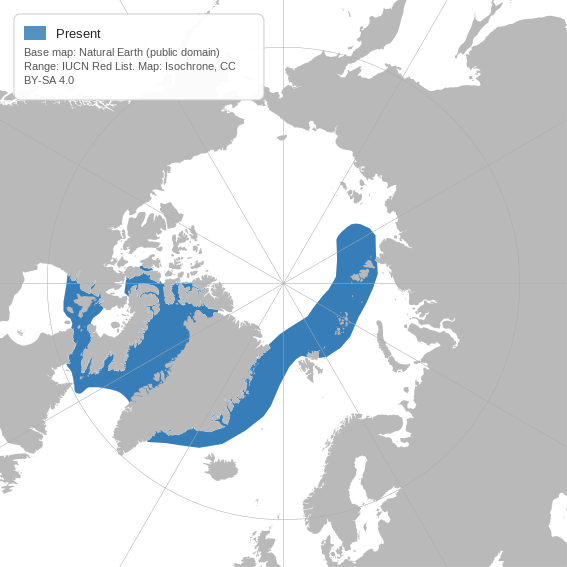
Narwhals live mainly in the Arctic: northeastern Canada, northern Greenland, Svalbard and the waters of northern Russia as far east as the East Siberian Sea. The main range runs from the central Canadian Arctic, around Peel Sound, Prince Regent Inlet and northern Hudson Bay, east to Greenland. Strays have reached Newfoundland, the British Isles, Germany and the Netherlands, and the Chukchi and Bering seas as far south as the Alaska Peninsula and the Commander Islands.[3]
Summer grounds
In summer, narwhals prefer coastal waters that are deep and sheltered from the wind.[1] Their summer stocks are named after the bays and fjords where they gather, such as Admiralty Inlet, Eclipse Sound and Inglefield Bredning.[3]
Winter in the pack ice
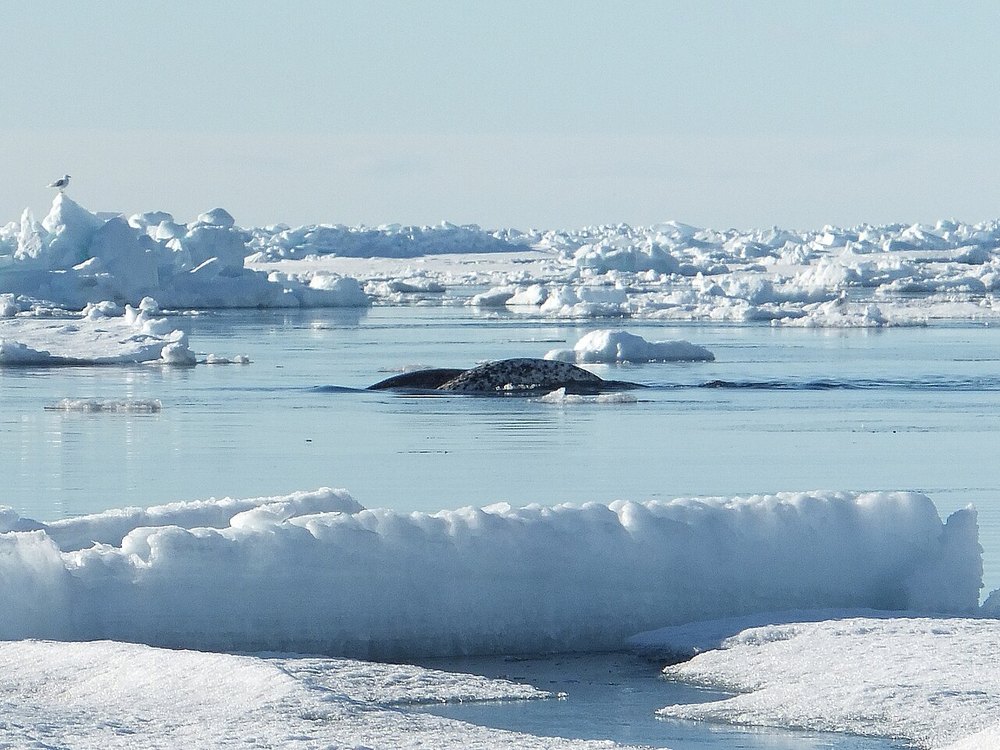
In fall and winter, narwhals use deep fjords and the continental slope, at depths of 1,000 to 1,500 m.[1] Few other whales use areas with such dense sea ice. In leads and cracks of the Baffin Bay pack ice the average density has reached about 77 narwhals per km², in areas where more than 98% of the water is covered by ice.[3]
Numbers
The IUCN counts about 12 subpopulations, mostly named after the places where whales gather in summer. Its 12 estimates add up to 173,134 whales, about 123,000 of them mature. The total leaves out Northeast Greenland and the Russian Arctic, where no estimate exists. Ten subpopulations number over 10,000 whales and two number over 35,000. One is thought to be increasing, five are stable and for five the trend is unknown.[3] The largest is Somerset Island, with 49,768 whales in a 2013 aerial survey, followed by Admiralty Inlet with 35,043.[3] In 2024 the Canadian status report called the Northern Hudson Bay and Baffin Bay population large: more than 161,100 whales, 93,500 of them mature, with 19,232 in Northern Hudson Bay (2018) and 141,909 in Baffin Bay (2013). It judged the trend stable or possibly increasing.[29]
Evolution
The narwhal and the beluga are the only living members of the family Monodontidae. Their closest relatives are the porpoises, and these three groups sit with the oceanic dolphins in the superfamily Delphinoidea.[30] A study of whole mitochondrial genomes put the split between narwhals and belugas at 4.98 million years ago (95% range 3.10 to 6.84 million years). The common ancestor of all living narwhal mitochondrial lineages was much younger, about 105,000 years old (95% range 53,000 to 175,000).[31] Both the monodontid and the porpoise families arose in the Late Miocene.[30]
Fossil monodontids are rare, and they lived in warmer seas than the living pair. Denebola brachycephala, from the Late Miocene of Baja California, Mexico, is the oldest described monodontid. Bohaskaia monodontoides comes from the Early Pliocene of Virginia and North Carolina.[32] Casatia thermophila, from the lower Pliocene of Tuscany, Italy (5.1 to 4.5 million years old), is closer to the beluga than to the narwhal, and its describers see it as evidence for a warm-water origin of the family.[33] Haborodelphis japonicus lived in the Early Pliocene of Hokkaido, Japan.[34] Because these fossils all come from lower latitudes, the narwhal’s adaptation to Arctic life is probably recent.[32][33]
Odobenocetops was a Peruvian dolphin relative with large, uneven tusks. Its describers linked it to the Monodontidae through three features of the skull, but its tusks evolved separately from the narwhal’s, in a way that resembles the walrus.[35]
Forms and variants
The narwhal is the only species in its genus, and no subspecies has been identified.[1]
Tusk variation
An erupted tusk is normal in males, and in most females both teeth stay inside the jaw.[1][2] Among 173 hunted whales from Greenland, sampled in 1993 and from 2010 to 2019, 2.9% showed anomalies: 1.5% of the females had a tusk, 2.8% of the males had none, and 0.9% of the males had two tusks.[5] The tusked female was sexually mature and had 18 scars on her ovaries.[5]
Conservation
The narwhal is listed as Least Concern on the IUCN Red List, assessed on 3 July 2017. A Least Concern listing carries no criteria. The population trend is listed as Unknown, with an estimated 123,000 mature individuals. Earlier assessments rated the species Near Threatened. The IUCN also records that the area and quality of habitat are declining.[3] The narwhal is in Appendix II of CITES, which controls trade,[3] and in Appendix II of the Convention on Migratory Species.[36] In Canada, COSEWIC rated it Special Concern in 2004 and Not At Risk in May 2024.[29] Importing narwhal products into the United States has been banned under the Marine Mammal Protection Act since 1972.[3]
Threats
HuntingIce entrapmentShip and seismic noiseClimate changePollution[3]Hunting. Narwhals were never hunted on a large commercial scale, except for several decades in the early 20th century in the eastern Canadian Arctic. Today they are hunted only by some Indigenous communities in Canada and Greenland, for food and for ivory. Their strong loyalty to the same grounds makes them very vulnerable to overhunting.[3] From 2007 to 2011 the retrieved catch averaged 358 a year in Greenland and 621 a year in Canada, and the Canadian figure includes 624 whales taken from an ice entrapment in 2008. Corrected for animals struck and lost, the Canadian catch averaged 620 a year (515–768) in 2011–2015.[3]
Ice entrapment. When leads and cracks in the ice freeze over, hundreds of narwhals can be trapped in a small opening, an event known as sassat. Hunters normally harvest trapped whales.[3] About 1,000 narwhals died in an entrapment in Canada in 2008, and about 100 died in two entrapments in northwest Greenland in 2009–10. The authors of that study were concerned that seismic surveys might make whales more likely to be trapped, and called for urgent study of their effects.[37]
Noise. Six live-caught narwhals were tagged and exposed to ship noise and airgun pulses. Their buzzing rate was halved at 12 km from the ship, they stopped foraging at 7–8 km, and the effects could be detected beyond 40 km.[38] In Eclipse Sound, narwhal sound recordings were most frequent in July and October, and they were fewer when ships were near, most clearly within 20 km in October.[39]
Climate and other threats. The IUCN says the effects of climate change on narwhals are uncertain. A 2008 study ranked the narwhal among the three Arctic marine mammals most sensitive to climate change, with the hooded seal and the polar bear, because they rely on sea ice and feed in a specialised way.[3][40] Organochlorine pollutants and heavy metals have been found in narwhals.[3]
East Greenland
Three small stocks in East Greenland are in serious trouble. A summer 2022 survey of Southeast Greenland counted 365 whales (95% range 173–769), the lowest number ever seen in all three management areas, with 188 near Kangerlussuaq and 176 in Scoresby Sound and none south of Kangerlussuaq. A model put the Tasiilaq stock at 769 whales in 1955 and 3 in 2024, which the working group called near extirpated. The group advised zero catches in all three areas.[41] In March 2026 the North Atlantic Marine Mammal Commission endorsed zero catches of narwhals and belugas in East Greenland.[42]
History and culture
Unicorn horns
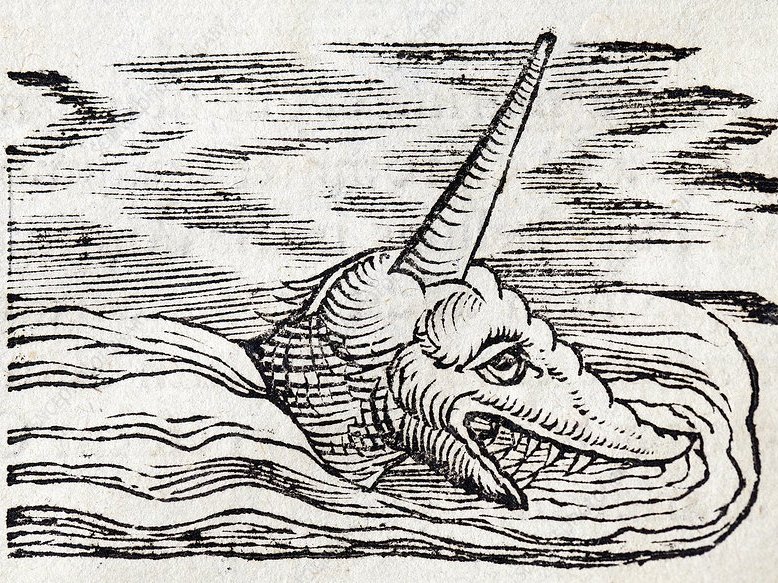
For centuries, spiral tusks were sold in Europe as the horns of unicorns. Tusks reached Western Europe mostly along old routes from the Baltic area, and unicorns were drawn with spiral horns only after Scandinavian sailors began to trade narwhal horns, according to the Cleveland Museum of Art. When Mary Queen of Scots was said to own a unicorn horn, Elizabeth of England offered a high reward for one, and an explorer brought her a horn that she had set with jewels. It is now lost.[43]



Denmark treated narwhal ivory as a speciality of the realm. Christian IV’s expedition of 1605–1607 brought back numerous tusks, and in 1636 a Copenhagen company received a monopoly on the Greenland trade. A 1653 expedition weighed eight whole tusks and a small young one at 88½ pounds in all. The Danish coronation chair was made of narwhal tusk by Bendix Grodtschilling between 1662 and 1671.[44]

Ole Worm
The Danish physician and collector Ole Worm (1588–1654) showed, with a skull in his museum, that the “unicorn horn” was the tusk of an Arctic whale. The skull and its long tusk appear in the frontispiece engraving of Museum Wormianum, which his son published in 1655.[45] The Cleveland Museum dates his investigation to 1638, when he was asked to look into what was sold as unicorn horn. The belief did not end at once, but the trade and the pictures of unicorn horns faded afterwards.[43]
Hunting and use
The skin with its blubber, called maktaaq in Inuktitut and mattak in Greenlandic, is eaten raw. Fisheries and Oceans Canada calls it a highly valued traditional food rich in vitamin C, zinc and retinol.[46] The Nunavut Agreement of 1993 gave Inuit priority access and harvesting rights and created the Nunavut Wildlife Management Board. In 2009 Inuit hunters took 461 narwhals, of which 365 (79%) had tusks, with an average tusk length of 168.5 cm. From 1990 to 2007 the harvest averaged 422 a year, and an average of 102 tusks were exported each year. A hunter needs a tag for each narwhal, and tusks sold or exported from Canada must carry a tag.[46] Export permits are issued only for tagged products from a sustainable harvest.[46] In the United Kingdom, the Ivory Act was extended on 28 January 2025 to cover narwhal ivory, and it bans importing, exporting and dealing in such items, with a limited exemption for existing trade in artistic and cultural objects.[47]
Taxonomy
| Rank | Name |
|---|---|
| Kingdom | Animalia |
| Phylum | Chordata |
| Subphylum | Vertebrata |
| Superclass | Tetrapoda[49] |
| Class | Mammalia |
| Subclass | Theria[49] |
| Infraclass | Eutheria[49] |
| Order | Artiodactyla (even-toed hoofed mammals, including whales)[8][3] |
| Suborder | Cetacea (whales)[8] |
| Infraorder | Odontoceti (toothed whales)[8] |
| Family | Monodontidae (narwhal and beluga)[8][48][49] |
| Genus | Monodon[8] |
| Species | Monodon monoceros (Linnaeus, 1758)[8][48][49][50][51] |
Synonyms (10)
| Name |
|---|
| Monodon moneceros (Linnaeus, 1758) |
| Ceratodontis ceratodon (Brisson, 1762) |
| Monodon narhval (Borowski, 1781) |
| Monodon narhwal (Blumenbach, 1799) |
| Narwalus andersonianus (Lacépède, 1804) |
| Narwalus microcephalus (Lacépède, 1804) |
| Narwalus vulgaris (Lacépède, 1804) |
| Ceratodon monodon (Pallas, 1811) |
| Monodon microcephalus (Fleming, 1811) |
| Tachynices megacephalus (Brookes, 1828) |
From the GBIF backbone.[53]
Higher classification
The narwhal belongs to the family Monodontidae, which today holds only the narwhal and the beluga, and to the toothed whales.[30] The databases agree on the family and on the toothed whales, but they rank the whale group differently. The Mammal Diversity Database places whales inside the order Artiodactyla, the even-toed hoofed mammals. WoRMS uses the older compromise name Cetartiodactyla, and ITIS, the Catalogue of Life and GBIF still list an order Cetacea.[8][48][49][50][51] This is a difference in how the whale group is ranked, not a disagreement about the narwhal.
A narwhal and beluga hybrid
A skull collected in 1990 in Disko Bay, West Greenland, was shown by DNA in 2019 to come from a hybrid of a female narwhal and a male beluga.[52] The two species belong to the same family but to different genera.[8][30]
Sources
- COSEWIC 2004, assessment and status report on the narwhal
- Animal Diversity Web, Monodon monoceros
- Lowry, Laidre & Reeves 2017, IUCN Red List assessment of Monodon monoceros
- Laidre & Heide-Jørgensen 2007, Oceanography 20(4)
- Garde et al. 2022, Polar Research 41, “Tusk anomalies in narwhals from Greenland”
- Koblitz et al. 2016, PLOS ONE (narwhal biosonar)
- Online Etymology Dictionary, narwhal
- Mammal Diversity Database, Monodon monoceros
- Wiktionary, narwhal
- Garde et al. 2015, Journal of Mammalogy 96(4)
- Garde et al. 2007, Journal of Mammalogy 88
- Garde et al. 2022, Arctic Science 8: 329–348
- Garde et al. 2012, Polar Research 31: 15865
- Nweeia et al. 2014, The Anatomical Record 297: 599–617
- National Geographic news coverage of the tusk sensing study, 2014 (news)
- O’Corry-Crowe et al. 2025, Frontiers in Marine Science
- Laidre & Heide-Jørgensen 2005, Marine Mammal Science, “Winter feeding intensity of narwhals”
- Heide-Jørgensen et al. 2001, Arctic 54
- Laidre et al. 2003, Marine Ecology Progress Series 261: 269–281
- Blackwell et al. 2018, PLOS ONE 13: e0198295
- Zahn et al. 2021, Scientific Reports (narwhal and beluga clicks)
- Marine Mammal Science 2014, diet change in Baffin Bay narwhals (fatty acids and isotopes)
- Ferguson, Higdon & Westdal 2012, Aquatic Biosystems 8: 3
- Breed et al. 2017, PNAS 114: 2628–2633
- Lefort, Garroway & Ferguson 2020, Global Change Biology 26: 4276–4283
- Smith & Sjare 1990, Arctic 43
- Barratclough et al. 2023, Pathogens 12: 937
- Nielsen et al. 2023, Diseases of Aquatic Organisms 154: 131–139
- COSEWIC 2024, assessment and status report on the narwhal (Northern Hudson Bay and Baffin Bay)
- McGowen et al. 2020, Systematic Biology 69: 479–501
- Louis et al. 2020, Proceedings of the Royal Society B 287: 20192964
- Velez-Juarbe & Pyenson 2012, Journal of Vertebrate Paleontology 32: 476–484 (Bohaskaia)
- Bianucci et al. 2019, Journal of Vertebrate Paleontology 39: e1645148
- Ichishima et al. 2019, Papers in Palaeontology 5: 323–342
- de Muizon 1993, Nature 365: 745–748 (Odobenocetops)
- Convention on Migratory Species, Monodon monoceros
- Heide-Jørgensen et al. 2013, Biological Conservation 158: 50–54
- Tervo et al. 2021, Biology Letters 17: 20210220
- Ewing et al. 2025, Scientific Reports (ship traffic in Eclipse Sound)
- Laidre et al. 2008, Ecological Applications 18: S97–S125
- NAMMCO 2023, report of the Working Group on Narwhal (SC/30/10)
- NAMMCO 2026, press release of the 33rd annual meeting
- Cleveland Museum of Art, “Hunting the unicorn horn: narwhal tusks and medieval monsters”
- Journal18, narwhal ivory in Denmark-Norway
- Linda Hall Library, Scientist of the Day: Ole Worm
- Fisheries and Oceans Canada, narwhal management plan (Nunavut Settlement Area)
- UK Government 2025, Ivory Act protections for four more species
- WoRMS, Monodon monoceros (AphiaID 137116)
- ITIS, Monodon monoceros (TSN 180485)
- Catalogue of Life, Monodon monoceros
- GBIF Backbone Taxonomy, Monodon monoceros
- Skovrind et al. 2019, Scientific Reports (the hybrid skull from Disko Bay)
- GBIF backbone, Monodon monoceros, synonyms