Schistocerca gregaria flaviventris is the southern subspecies of the Desert Locust, found in southern Africa.[1][2]
Names and classification
It was first named Acridium flaviventris by Burmeister in 1838. Some later authors treated that name as a synonym of the Desert Locust itself, and the rank of subspecies has been used since Uvarov in 1929.[2]
Description
It differs from the northern subspecies, gregaria, in its DNA and in the shape of the male’s tail parts.[3]
Range
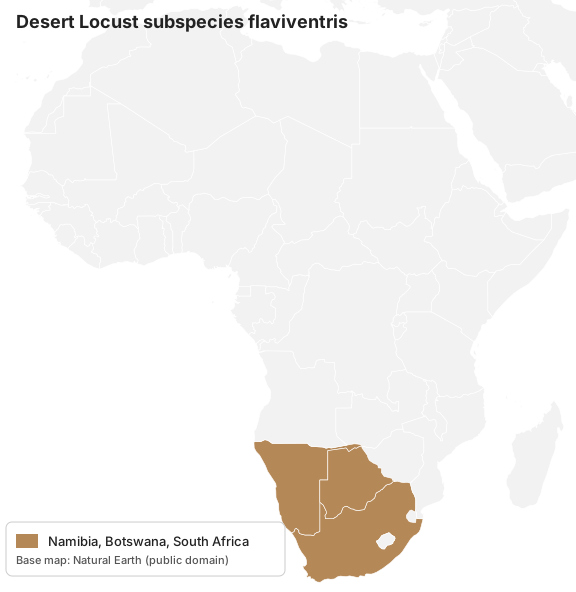
It is endemic to the Kalahari dune sandveld of southern Namibia, Botswana and South Africa (Northern Cape), and the equatorial forest isolates it from the northern subspecies. Solitary adults fly widely and are found over the Northern Cape, Namaqualand and the Karoo, and in southern Namibia.[4] A study of the Desert Locust’s range describes it as a “much less known subspecies” that occupies “a limited area in Southern Africa”, and says it might expand if the climate changes.[5]
Status
The two subspecies can be told apart by their DNA (94% by mutations in the COI gene) and by the shape of the male’s tail parts (100%). The southern subspecies forms a single branch of the family tree, and the two rarely interbreed.[3] See the Desert Locust page for both.
Sources
- GBIF backbone, Schistocerca gregaria
- Orthoptera Species File, Schistocerca gregaria flaviventris
- Chapuis et al. 2016, Systematic Entomology (the two subspecies)
- ARC-DOA Locust Fact-Sheet Series, Southern African Desert Locust
- Meynard et al. 2017, Global Change Biology (the southern African subspecies)