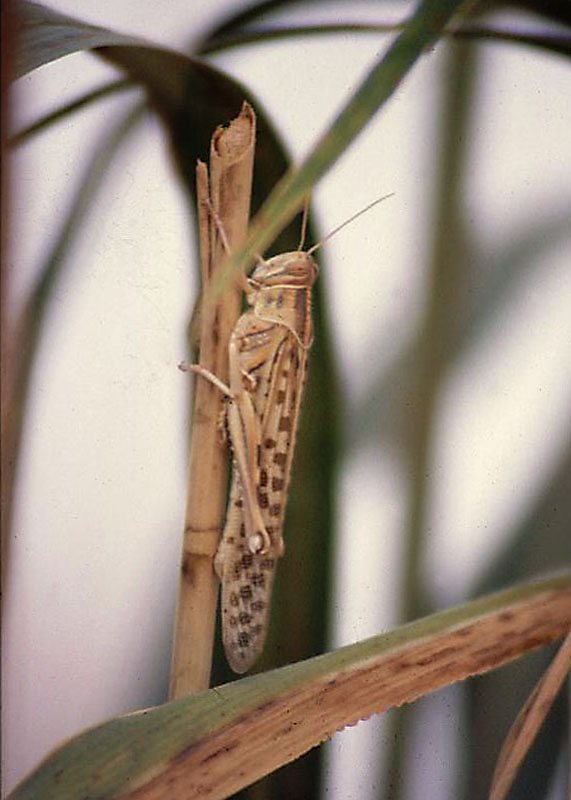
The solitarious form is the Desert Locust living alone, at low density. It is green as a hopper and brown as an adult, it avoids other locusts, and its adults fly at night.[1][2]
Appearance
Solitarious hoppers are green.[3] Solitarious adults are brown, a light sandy brown.[1][4] Compared with the gregarious form, they have relatively longer hind legs, while gregarious locusts have relatively longer wings and a relatively broader head.[5] The size difference between males and females is larger in solitarious locusts.[6]

Behavior
Solitarious locusts move little and slowly, groom seldom and actively avoid other locusts.[2] Adults fly at night. They take off about 20 minutes after sunset and are attracted to lights.[4] Very little is known about how solitary hoppers behave and survive in the wild.[4]
Life cycle
A solitarious female lays pods of 90–160 eggs, against fewer than 80 in the gregarious form.[4] Solitarious hoppers sometimes go through a sixth growth stage: in one laboratory line, 46% of females took an extra stage.[7] The brain is smaller, since a gregarious brain is about 30% larger overall.[8]
Origin and change
Crowding makes a solitarious locust gregarious. Repeatedly touching a hind leg for about 4 hours is enough, and the behaviour changes within hours.[2][9] A mother that has been crowded passes the change to her young.[10] Colour takes one crowded generation to change, and body shape takes two or more.[5]
Sources
- FAO Locust Watch, frequently asked questions about locusts
- Rogers et al. 2014, Journal of Insect Physiology 65: 9–26 (rapid gregarization)
- FAO, instructions for the Desert Locust survey form (archived copy)
- Symmons & Cressman 2001, FAO Desert Locust Guidelines 1: Biology and behaviour (archived copy)
- Symmons 1994, FAO The Desert Locust Guidelines I: Biology and behaviour
- CIRAD (Lecoq), Schistocerca gregaria species sheet
- Pelissie et al. 2016, PLOS ONE 11: e0155736 (extra moult in solitarious hoppers)
- Ott & Rogers 2010, Proceedings of the Royal Society B 277: 3087–3096 (brains of the two forms)
- Anstey et al. 2009, Science 323: 627–630 (serotonin and gregarization)
- Simpson & Miller 2007, Journal of Insect Physiology 53: 869–876 (the mother’s crowding and her young)