The German Shepherd Dog is a medium-sized German herding breed. The FCI calls it a versatile working, herding and service dog.[1]
The breed standard
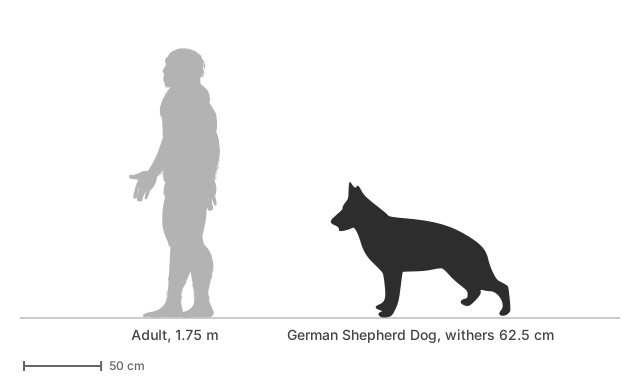
The FCI standard sets a height of 60–65 cm and a weight of 30–40 kg for males, and 55–60 cm and 22–32 kg for females. The dog is described as medium-sized, slightly elongated, powerful and well-muscled. There are two coat types, a double coat and a long double coat, both with undercoat. Colours are black with reddish-brown, brown or yellow to light grey markings, single-coloured black, or grey with darker shading. The colour white is not allowed.[1] The standard asks for a well-balanced dog with strong nerves, self-assured, good-natured, attentive and willing to please. Dogs with weak character that bite are disqualified.[1] In a study of UK veterinary records, the median adult weight was 40.1 kg for males and 34.8 kg for females, so pet dogs averaged at or above the top of the show-standard range.[2]
Name and origin
According to the FCI standard, which was translated by the German breed society, the society was founded at Frankfurt on 20 September 1899. Its methodical breeding drew on the central German and southern German herding dogs of the time, with the aim of creating a working dog inclined to high achievement.[1] A study of breed relationships describes the breed as derived from a herding dog of unknown ancestry in the late 1800s, and lists the German Shepherd Dog in a group of breeds it calls the “New World” clade.[3] The American Kennel Club recognised the breed in 1908.[4]
Health and lifespan
In a study of 12,146 German Shepherd Dogs under UK veterinary care, the median age at death was 10.3 years: 11.1 for females and 9.7 for males.[2] A separate life-table study gave a life expectancy at birth of 10.16 years, with remaining life expectancy falling to 1.5 years at age 11–12.[5] Both studies draw on UK veterinary records.
The commonest causes of death in the first study were musculoskeletal disease (16.3%), inability to stand (14.9%), cancer (14.5%) and spinal cord disorders (13.6%). The commonest recorded disorders were ear infection (7.89%), osteoarthritis (5.54%), diarrhoea (5.24%) and overweight (5.18%).[2]
Behavior
In an owner-reported survey of 292 German Shepherds, 4.5% were reported to have snapped, bitten or tried to bite an unfamiliar person in the recent past, 2.1% a member of the household and 16.4% an unfamiliar dog. The averages across the 33 breeds in the survey were 4.7%, 2.0% and 10.7%.[6] Breed explains only about 9% of behavioural differences between individual dogs, so an individual’s behaviour can differ a lot from the breed’s average.[7]
Popularity
The German Shepherd Dog ranked 4th on the American Kennel Club’s list of most popular breeds in 2025.[8] In UK veterinary records, its share of newly born dogs fell from 3.5% in 2005 to 2.2% in 2013.[2]
Sources
- FCI breed standard 166, German Shepherd Dog
- O’Neill et al. 2017, Canine Genetics and Epidemiology 4: 7 (German Shepherd Dogs under UK veterinary care)
- Parker et al. 2017, Cell Reports 19: 697–708
- American Kennel Club, breeds by year recognized
- Teng et al. 2022, Scientific Reports 12 (life tables by breed, UK veterinary records)
- Duffy, Hsu & Serpell 2008, Applied Animal Behaviour Science 114: 441–460
- Morrill et al. 2022, Science 376 (breed and behaviour)
- American Kennel Club, most popular dog breeds of 2025