The dog is the domesticated descendant of wolves and the oldest domestic animal. Dogs live alongside people on every continent where people live, from about 700 million to 1 billion of them, and most are free-ranging.[1][2] People have bred them into hundreds of breeds that differ in size by almost two orders of magnitude.[3]
Quick facts
Description
No other mammal species varies as much in body size as the dog does, with adult weights from about 1 kg to over 100 kg between breeds.[3][6][7] Coat, ear and tail shapes vary widely too. Dogs have a sense of smell built on about 800 working smell-receptor genes, roughly twice the number in people, and the way a dog sniffs, with the nostrils sampling separately, helps explain how well it detects scents.[8][9] Their eyes have two kinds of colour-sensing cone, against the three that most people have.[10]
Dogs are social animals with a flexible social life. Unlike wolves, they do not live in family packs, and free-roaming dogs form loose groups of unrelated animals.[11] They look at people's faces more than socialised wolves do.[12][13]
Name
The English word “dog” comes from Old English docga, and its earlier origin is unknown.[14] Before it spread, the general word was “hound”, from Old English hund, which is still the word for a dog in German, Hund.[14][15] “Canine” comes from Latin canis. Scientific sources also use “Domestic Dog”, and free-ranging dogs are variously called village dogs, feral dogs or free-roaming dogs.[16]
In other languages
| Language | Name | Notes |
|---|---|---|
| German | Hund | from an old Germanic word, related to English “hound” |
| French | chien | — |
| Italian | cane | — |
| Portuguese | cão | — |
| Spanish | perro | origin uncertain |
| Japanese | 犬 (inu) | — |
| Korean | 개 (gae) | — |
| Chinese | 狮 (gǒu) | — |
Names in other languages are not listed because no reliable dictionary source was found.[15]
Body
Breed standards set the size range. Adult weights run from 1–3 kg for a Chihuahua[6] to 73–104 kg for a male Mastiff.[7] The Guinness World Records give the tallest dog ever as 111.8 cm and the shortest living as 9.14 cm.[4][5]
| Example | Typical adult size | Source |
|---|---|---|
| Chihuahua | 1–3 kg | FCI standard[6] |
| Labrador Retriever | 25–36 kg, 55–62 cm | AKC[17] |
| Great Dane | Males 80–90 cm at the shoulder | FCI standard[18] |
| Mastiff | 73–104 kg (males) | AKC[7] |
Breed standards give show-ring ideals, not measurements of real populations.
Behavior
Dogs are described as a gregarious species with a flexible social structure. Free-roaming dogs are usually alone or in groups of two to six, and the old idea of a strict “alpha” hierarchy does not describe their relationships.[11] They communicate with body posture, facial expression, tail and ear position, voice, scent and touch.[11] Dogs look at people’s faces when they cannot solve a task, which socialised wolves did not do in one study.[12] In another study, a dog gazing at its owner raised the owner’s level of the hormone oxytocin, and oxytocin given to dogs made them gaze more.[13] Human-directed play is a distinct feature of dogs and varies between breeds.[11]
Diet
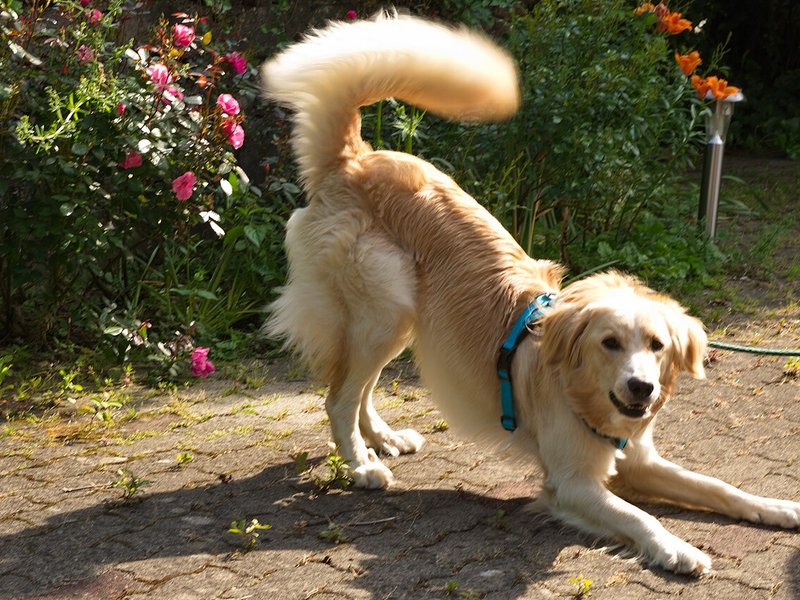
Dogs are better than wolves at digesting starch. Their genomes show signs of selection on genes for starch digestion and fat metabolism.[19] The gene for the starch-digesting enzyme amylase is present in 4 to 34 copies in dogs, against 2 to 8 in wolves, and the number varies strongly between breeds.[20][21] The change was not universal, and most dingoes still carry two copies.[20] Free-ranging dogs rely heavily on human waste, and in one rural village study human faeces made up a fifth of what dogs ate.[22]
Life cycle
| Stage | Time | Notes |
|---|---|---|
| Pregnancy | About 63 days | Counted from ovulation, 62–64 days[24] |
| Litter | 3.5 to 7.1 puppies | Small litters in miniature breeds, large in giant breeds[25] |
| Maturity | 6–24 months | Earlier in small breeds[24] |
Heat
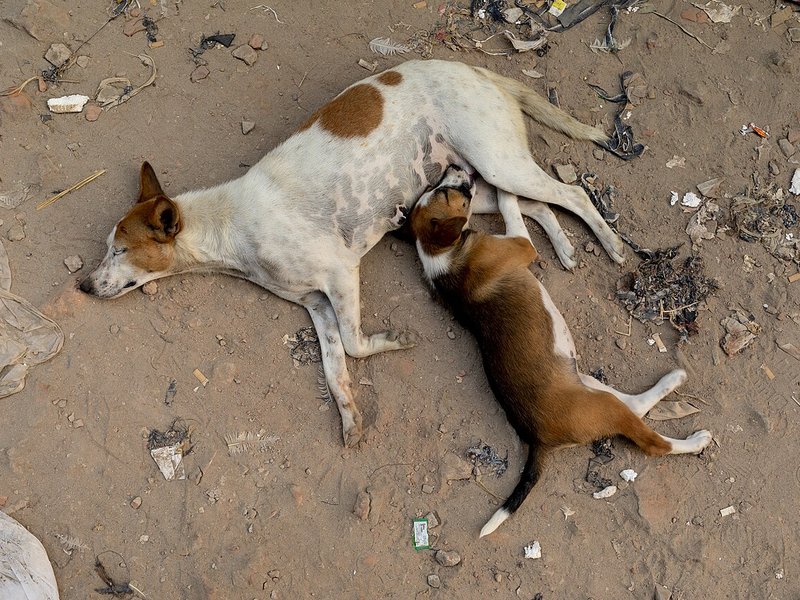
Dogs usually come into heat about twice a year, at intervals of about 6–7 months, and heat lasts 2–3 weeks.[23][11]
Lifespan
Dogs live about 11–12 years on average. Life expectancy at birth ranges from 4.5 to 12.7 years across breeds.[26][27]
Large dogs die younger mainly because they age faster, not because they begin to age earlier.[3] In UK veterinary data, crossbreeds outlived purebreds by about 1.2 years, though a US study found no difference.[27][28] In a study of free-ranging dogs in West Bengal, only about 19% of puppies survived to breeding age.[22] The oldest dog verified by Guinness was an Australian Cattle Dog named Bluey, who lived 29 years and 5 months and died in 1939.[29]
Ecology
Free-ranging dogs
Most dogs are not pets kept indoors. Roughly 70–75% roam freely.[1][2] Their home ranges are shaped by people more than by territory: in a GPS study in western Kenya, dogs spent most of their time at their household and visited rubbish dumps and fields often.[30] In central India, dogs stayed close to farmland and villages, and Indian foxes avoided places where dogs lived.[31]
Effect on wildlife
Dogs have contributed to 11 vertebrate extinctions and are a known or likely threat to at least 188 threatened species, through predation, disturbance, disease, competition and hybridisation. The authors say these figures are probably an underestimate.[32]
Disease
Dogs transmit rabies in up to 99% of human cases. The World Health Organization counts 44,203 rabies deaths a year, probably too low, and an earlier study estimated about 59,000 a year.[33][34] Dogs are also the definitive hosts of the tapeworms that cause echinococcosis, a disease with about 19,300 deaths a year (a 2015 estimate).[35] Dogs can also carry canine distemper to wild carnivores, but in the Russian Far East, wildlife were more important than dogs in infecting Amur tigers, so vaccinating dogs alone would not protect tigers.[36]
Habitat and range
Dogs live wherever people do, on every continent that humans have settled, and have no natural range of their own. Their numbers vary greatly between countries, depending on the human population and on whether the habitat is urban or rural.[1] Estimates of the world population run from about 700 million to 1 billion dogs.[1][2]
Evolution and domestication
Dogs were the first domesticated animal, and they were domesticated before farming began.[37] They descend from an extinct population of Late Pleistocene wolves, not from any living wolf, and no ancient wolf genome studied so far is a direct match for the ancestors.[38] Where and how many times dogs were domesticated is still debated. The estimates for when dogs and wolves split range from about 40,000 to 14,000 years ago.[38][39][40]
Two studies in 2026 changed the picture of the oldest dogs. Their genomes show that the famous 30,000-year-old “dogs” from Goyet, Predömostí, Razboinichya and Eliseevichi belonged to extinct wolf populations, or were later dog bones. The oldest genetically confirmed dogs are about 14,000 to 16,000 years old, and the two papers differ on which specimen is oldest.[41][37] By then dogs were already widespread across Europe and Anatolia.[37] Dogs in the Near East and Africa derive up to half of their ancestry from a population related to south-western Eurasian wolves.[38]
Scientists disagree about how domestication began. One account says wolves that scavenged near human camps were slowly selected for tameness, and another says people took in wolf pups.[42] Changes in the genome affect starch digestion, brain and nervous-system genes, and genes tied to the head and face.[19][43] Structural changes in two genes in a region on chromosome 6 are linked to the unusual friendliness of dogs towards people.[44]
Forms and variants
Breeds
In the kennel-club sense, a breed is a group of dogs registered in a studbook and bred to a written standard.[45] Most of the world’s dogs do not belong to any breed. They are free-ranging village dogs or crossbreeds.[1][2] No single authority decides what counts as a breed, so the number depends on who is counting.
| Registry | Recognised breeds | Groups |
|---|---|---|
| Fédération Cynologique Internationale (FCI) | 364 | 10[46][45] |
| The Royal Kennel Club (UK) | About 226 | 7[47] |
| American Kennel Club (AKC) | 205, from 1 January 2026 | 7[48] |
The lists overlap but do not nest: each registry recognises breeds the others do not. The Royal Kennel Club’s count depends on whether varieties such as the poodle sizes are counted separately.[47]
The FCI sorts its breeds into ten groups: sheepdogs and cattledogs; pinscher, schnauzer, molossoid and Swiss mountain dogs; terriers; dachshunds; spitz and primitive types; scent hounds; pointing dogs; retrievers, flushing dogs and water dogs; companion and toy dogs; and sighthounds.[45]
How different the breeds are
A study of 1,346 dogs from 161 breeds sorted them into 23 genetic clades, groups of related breeds.[49] A later study of more than 4,000 dogs found ten major lineages that broadly match what the breeds were bred to do, such as terrier and sheepdog.[50] The two analyses used different samples and should not be equated. Breed predicts less about an individual dog than people expect: a 2022 study of 2,155 sequenced dogs found that breed explains just 9% of behavioural variation among individuals.[51]
Well-known breeds
See all breedsSizes, origins and uses follow each breed’s FCI standard.[45] Eight of the 26 breeds on the full list are shown here. Even the full list is a selection of the 364 breeds the FCI recognises, and there may be more.
Popularity
The most registered breeds in the United States in 2025 were the French Bulldog, Labrador Retriever, Golden Retriever, German Shepherd Dog, Dachshund, Poodle, Beagle, Rottweiler, German Shorthaired Pointer and Bulldog, in that order.[52] In the UK in 2024, the Labrador Retriever led with 34,141 registrations, followed by the Cocker Spaniel and the French Bulldog.[53]
Health and breeding ethics
Selective breeding has built health problems into some breeds. In brachycephalic (short-nosed) dogs, the risk of breathing problems rises sharply as the muzzle gets shorter. In one study, the airway syndrome occurred only in dogs whose muzzles were less than half the length of the skull, and a thicker neck and obesity raised the risk further.[54] A study of 22,333 UK dogs found that short-nosed breeds had higher or lower odds of 10 of 30 common disorders, eight of them higher.[55] Across 227 breeds, the average inbreeding coefficient was 0.249, or about 25%. Body size and inbreeding both predicted how much illness a breed had, with smaller and less inbred breeds healthier.[56]
Governments and kennel clubs have started to respond. On 10 October 2023 the Supreme Court of Norway ruled that breeding Cavalier King Charles Spaniels breaches the Animal Welfare Act, by three judges to two. It found that breeding English Bulldogs is not a breach as long as a specific breeding programme is followed. Owning and importing the breeds is not banned.[57] In the Netherlands, breeding companion animals in ways that harm their health has been banned since 1 July 2014, and in 2019 Utrecht University published criteria for judging short-nosed dogs.[58] Germany bans breeding that causes inherited pain or suffering (§11b of its Animal Welfare Act), but as of 2020 it had not issued an ordinance spelling out which traits count.[59] In the UK, the Kennel Club changed the French Bulldog standard in November 2021 so that the muzzle is clearly visible in profile and the nostrils visibly open.[60]
Crossbreeds and hybrids
Designer crosses are not recognised as breeds. Wally Conron bred the first labradoodle in Australia to produce a non-shedding guide dog, and in 2019 he said he regretted it because others bred the dogs without regard for their health.[61] Two wolfdog breeds are recognised by the FCI, the Czechoslovakian Wolfdog, which began as an experiment in 1955, and the Saarloos Wolfdog, which began in 1932 with a cross between a German Shepherd and a wolf.[62][63] Wolf-dog crosses are banned or restricted in many places, so owners should check local law.
The dingo and other free-living dogs
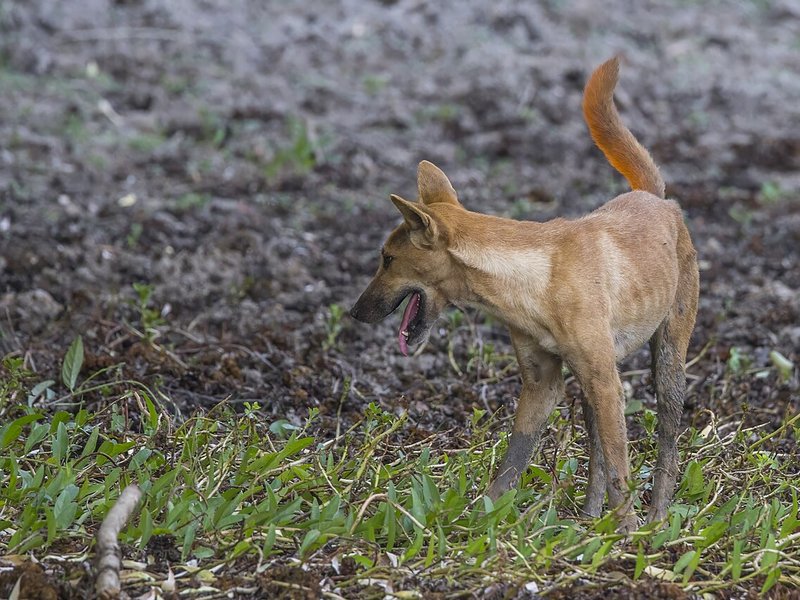
The dingo is Australia’s free-living dog, and its classification is disputed. Three names are in use: Canis familiaris, Canis lupus dingo and Canis dingo, and a 2025 review calls for an independent review of the question.[64][65] A 2023 genetic study found far fewer dingo-dog hybrids in Victoria than older tests had suggested.[66] The Carolina Dog is a free-roaming landrace of the south-eastern United States.[67] The captive New Guinea singing dogs descend from a few animals and are severely inbred.[68]
Conservation
The Domestic Dog has not been assessed by the IUCN Red List.[16] The IUCN’s Canid Specialist Group treats the dingo and the New Guinea singing dog as dogs, but whether the dingo is a separate species, a wolf subspecies or a feral dog is still disputed.[69][64]
History and culture
Working dogs and early breeds
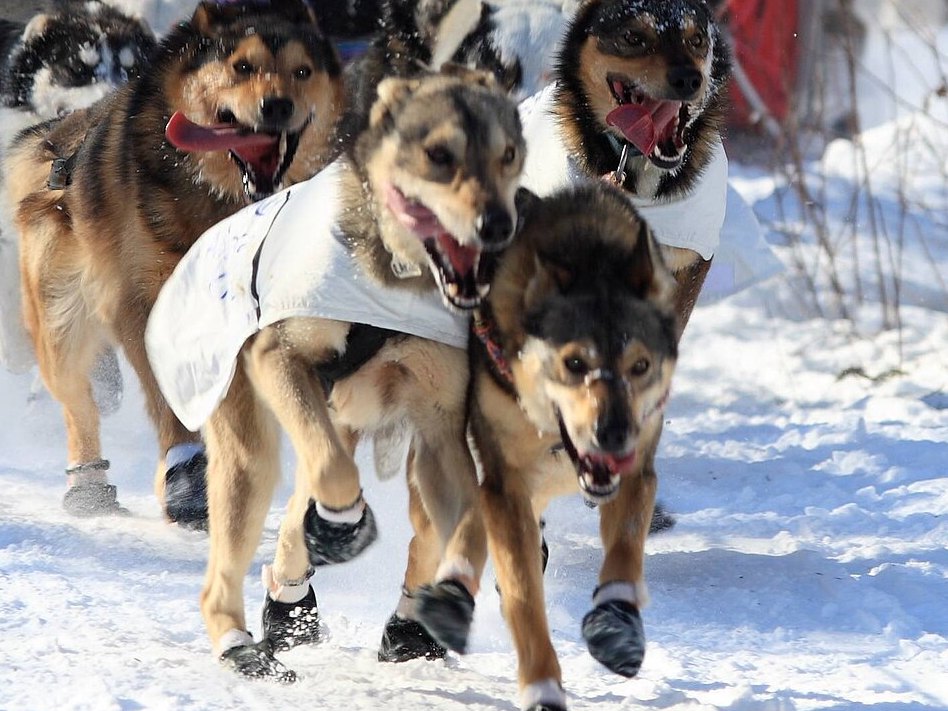
A limestone tablet from the Sixth Dynasty of Egypt (2345–2181 BC) records the name of a royal guard dog: “The dog which was the guard of His Majesty, Abutiu is his name”.[70] In Homer’s Odyssey, the old dog Argos recognises Odysseus after twenty years, wags his tail and dies.[71] Dogs pulled sleds in the Arctic by about 9,500 years ago, according to a genome from Zhokhov Island in Siberia associated with sled equipment.[72]
The modern breed system is only about 150 years old. The first modern dog show was held in Newcastle in 1859, for pointers and setters only. The Kennel Club in Britain was founded on 4 April 1873 and published its first stud book in 1874, and Charles Cruft held his first all-breed show in 1891.[73][74] The American Kennel Club was founded on 17 September 1884.[75] The Fédération Cynologique Internationale was created in 1911 by Germany, Austria, Belgium, France and the Netherlands.[76] A study of museum German Shepherd genomes from 1906 to 1993 found that genetic diversity fell through the 20th century, with repeated bottlenecks from popular sires.[77]


_Kakadu_3.jpg)

.jpg)
.jpg)
Famous dogs
Laika became the first animal to orbit Earth on Sputnik 2 on 3 November 1957. The spacecraft was not designed to return, and NASA says she probably survived only a few hours.[78] Sources disagree on how she died: early Soviet statements said she was euthanised, and later accounts say she died of overheating.[79][78] On 19 August 1960, the stray dogs Belka and Strelka orbited Earth and returned alive.[80] In the 1925 serum run to Nome, the sled dog Togo ran about 261 miles of the route under Leonhard Seppala, the longest and most dangerous leg, though the dog Balto, who ran 55 miles, often gets the credit.[81] Hachiko, born in 1923, was found dead near Shibuya Station in Tokyo on 8 March 1935, and an autopsy found heartworm and later analysis suggested a lung tumour.[82] In 2005 researchers in South Korea announced Snuppy, the first cloned dog, an Afghan hound.[83]
Beliefs and practices
In Zoroastrianism, the sagdid ritual brings a dog to look at a corpse to drive away the demon Nasu.[84] Views of dogs differ across religions and schools of thought. In South Korea, a law passed on 9 January 2024 by 208 votes to 0 bans the raising, slaughter and sale of dogs for food, though not eating dog meat, and takes effect in 2027.[85]
Dogs and people today
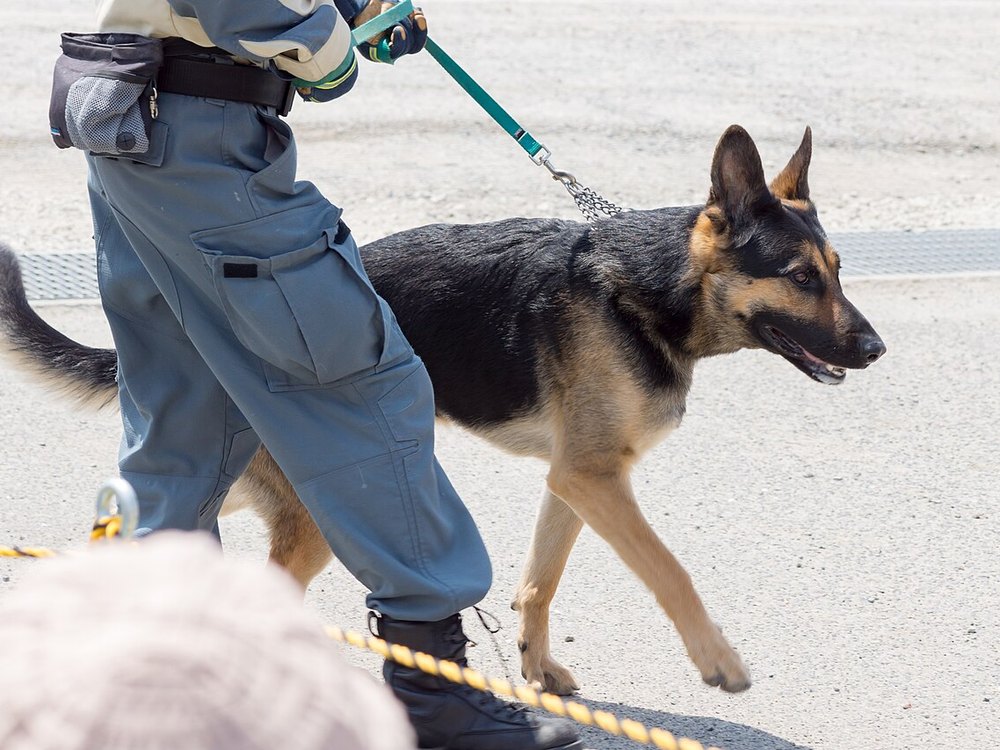
At the end of 2025 there were 18,978 working guide dogs among the members of the International Guide Dog Federation.[86]
Taxonomy
| Rank | Name |
|---|---|
| Kingdom | Animalia |
| Phylum | Chordata |
| Class | Mammalia |
| Order | Carnivora |
| Family | Canidae |
| Genus | Canis |
| Species | Canis familiaris Linnaeus, 1758[16] |
Many databases treat the dog as a subspecies of the wolf and write Canis lupus familiaris. Both names date from Linnaeus in 1758, and the difference is the rank given to the dog, not its descent from wolves.[16][87] The Mammal Diversity Database and the IUCN Canid Specialist Group use Canis familiaris, while GBIF uses Canis lupus familiaris.[16][87][69] A 2003 ruling of the International Commission on Zoological Nomenclature protected the wolf’s name Canis lupus but did not rule on the dog’s name.[88][89]
Sources
- Smith et al. 2019, Animals 9(12): 1020
- Hughes & Macdonald 2013, Biological Conservation 157: 341–351
- Kraus, Pavard & Promislow 2013, American Naturalist
- Guinness World Records, tallest dog ever
- Guinness World Records, shortest dog living
- FCI breed standard 218, Chihuahua
- American Kennel Club, Mastiff breed page
- Niimura & Nei 2007, PLoS ONE 2: e708 (olfactory receptor genes)
- Craven, Paterson & Settles 2010, Journal of the Royal Society Interface
- Neitz, Geist & Jacobs 1989, Visual Neuroscience
- Merck Veterinary Manual, social behavior of dogs
- Miklósi et al. 2003, Current Biology
- Nagasawa et al. 2015, Science 348: 333–336
- NPR, 13 August 2025, on the origin of the word “dog”
- Names in other languages: Duden, Treccani, Priberam, RAE, Standard Korean Dictionary, Jisho, CC-CEDICT, Larousse
- Mammal Diversity Database, Canis familiaris
- American Kennel Club, Labrador Retriever breed page
- FCI breed standard 235, Great Dane
- Axelsson et al. 2013, Nature 495: 360–364
- Ollivier et al. 2016, Royal Society Open Science (amylase genes in ancient dogs)
- Arendt et al. 2014, Animal Genetics
- Paul et al. 2016, Scientific Reports (free-ranging dogs in West Bengal)
- Concannon 2011, Animal Reproduction Science (reproductive cycles of the dog)
- Merck Veterinary Manual, overview of the reproductive system
- Borge et al. 2011, Theriogenology (litter size)
- Teng et al. 2022, Scientific Reports (VetCompass life tables)
- O’Neill et al. 2013, The Veterinary Journal (longevity of dogs in England)
- Urfer et al. 2020, Canine Medicine and Genetics 7: 7
- ABC News, 3 March 2024, on Bluey and Guinness
- GPS study of dogs in western Kenya, Ecology and Evolution 2021
- Vanak & Gompper 2010, Journal of Applied Ecology 47: 1225
- Doherty et al. 2017, Biological Conservation 210: 56–59
- World Health Organization, rabies fact sheet
- Hampson et al. 2015, PLoS Neglected Tropical Diseases
- World Health Organization, echinococcosis fact sheet
- Amur tiger distemper study, PNAS 2020
- Marsh et al. 2026, Nature 651, “Dogs were widely distributed across western Eurasia during the Palaeolithic”
- Bergström et al. 2022, Nature 607: 313–320
- Skoglund et al. 2015, Current Biology 25: 1515–1519
- Freedman et al. 2014, PLoS Genetics 10: e1004016
- Bergström et al. 2026, Nature 651, “Genomic history of early dogs in Europe”
- Commensalism or cross-species adoption? Frontiers in Veterinary Science 2021
- Pendleton et al. 2018, BMC Biology 16: 64
- vonHoldt et al. 2017, Science Advances 3: e1700398
- FCI breeds nomenclature (ten groups) and breed standards
- Fédération Cynologique Internationale, presentation of the organisation
- The Royal Kennel Club (UK), breeds A to Z
- American Kennel Club, press release of 30 December 2025
- Parker et al. 2017, Cell Reports 19: 697–708
- Dutrow, Serpell & Ostrander 2022, Cell 185: 4737–4755
- Morrill et al. 2022, Science 376
- American Kennel Club, most popular dog breeds of 2025
- Countryfile, on Kennel Club registrations for 2024
- Packer et al. 2015, PLoS ONE 10: e0137496 (brachycephalic airway syndrome)
- O’Neill et al. 2020, Scientific Reports 10: 17251
- Bannasch et al. 2021, Canine Medicine and Genetics 8: 12
- Supreme Court of Norway, HR-2023-1901-A (10 October 2023)
- Utrecht University, criteria for breeding healthy short-nosed dogs (in Dutch)
- Bundestierärztekammer 2020, statement on the dog ordinance (in German)
- The Kennel Club, French Bulldog breed standard amended, November 2021
- Fox News, 26 September 2019, quoting an ABC (Australia) podcast
- FCI, Czechoslovakian Wolfdog (standard 332)
- FCI, Saarloos Wolfdog (standard 311)
- Jackson et al. 2021, Australian Zoologist 41(3): 347–357
- Cairns et al. 2025, Australian Mammalogy 47(3)
- Cairns et al. 2023, Molecular Ecology (dingo and dog ancestry)
- Wikipedia, Carolina Dog (secondary)
- Wikipedia, New Guinea singing dog (secondary)
- IUCN SSC Canid Specialist Group, 2021 report
- Wikipedia, Abuwtiyuw (secondary)
- Homer, Odyssey 17, Murray translation (Perseus)
- Sinding et al. 2020, Science 368: 1495–1499
- The Kennel Club, timeline of the 1800s
- Crufts, about
- American Kennel Club, history
- Fédération Cynologique Internationale, history
- Scarsbrook et al. 2025, PNAS 122, 120 years of German Shepherd genomes
- NASA, “60 years ago: the first animal in orbit”
- Associated Press, 12 April 2008, on the Laika monument
- RussianSpaceWeb, Korabl-Sputnik 2
- National Park Service, Togo
- University of Tokyo, on Hachiko
- Lee et al. 2005, Nature 436: 641–642 (cloned dogs)
- Wikipedia, Sagdid (secondary)
- The Korea Times, 9 January 2024
- International Guide Dog Federation, facts and figures
- GBIF backbone, Canis lupus familiaris
- ICZN 2003, Opinion 2027, Bulletin of Zoological Nomenclature 60(1): 81–84
- Gentry, Clutton-Brock & Groves 2004, Journal of Archaeological Science 31: 645–651
- Open Tree of Life, synthetic tree and taxonomy
- Gopalakrishnan et al. 2018, Current Biology 28
- Chavez et al. 2019, Scientific Reports