The Ball Python (Python regius), also called the Royal Python, is a small African python that coils into a tight ball when it feels threatened.[1][2] It lives in West and Central Africa and is one of the most popular pet snakes in the world. That popularity has produced a large trade[3] and breeding for thousands of named colour and pattern forms called morphs.[4]
Quick facts
Description
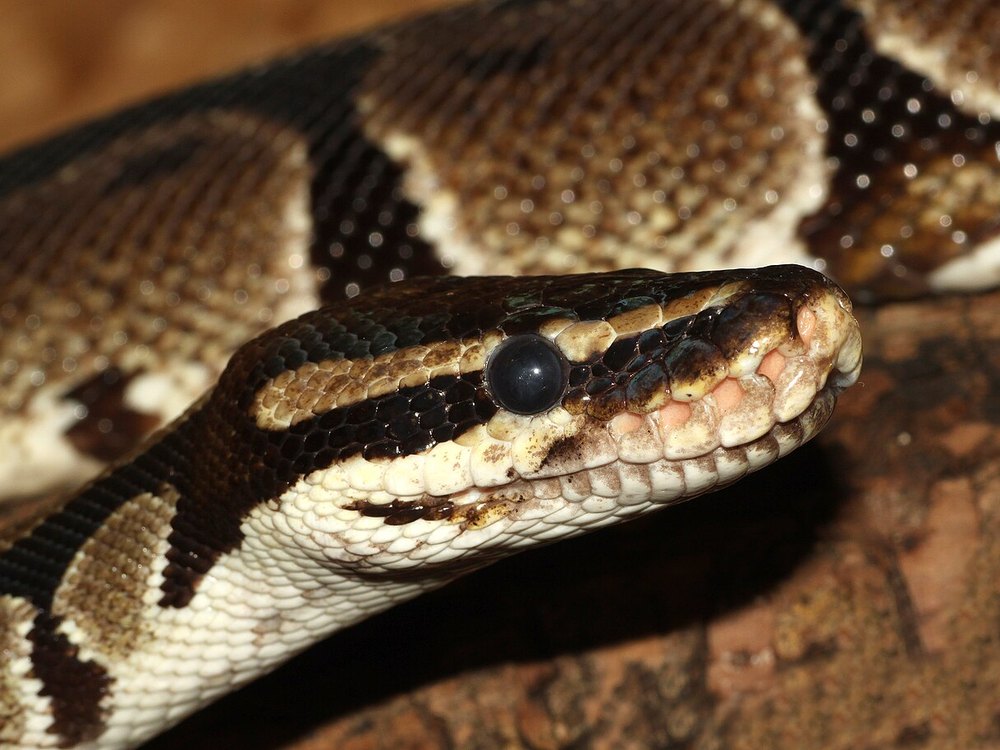
The Ball Python is the smallest of the African pythons.[2] In the wild it is dark brown to black, with light brown blotches along the back and sides and a white or cream belly.[2] An early museum description counts 10–18 light spots along a dark band on the back, and a pale stripe from the nostril through the eye.[6] Four of the scales on its upper lip are deeply pitted. In pythons and other snakes with such pits, they sense the heat of warm-blooded prey.[6][7]
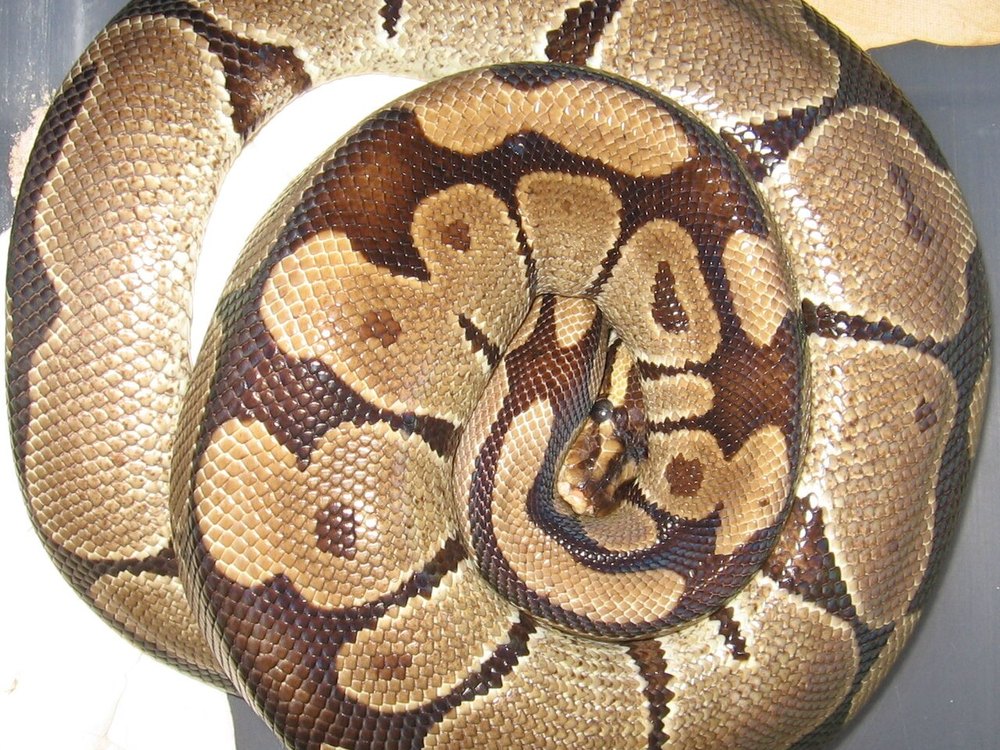
When threatened, it tucks its head into the middle of a tight coil instead of biting, which gives it its common name.[2][8] It is active at night and at dusk, and spends the day hidden in burrows, termite mounds and similar shelters.[3][9] It eats mostly small mammals, and females lay eggs and coil around them until they hatch.[2][3]

Name
George Shaw named the species Boa regia, the “Royal Boa”, in 1802, but gave no reason for the name.[1][6] Regius is Latin for “kingly”. Based on Reptile Database: “apparently because it was often kept as a pet by African kings and other rulers”.[1][6] Shaw based his description on an older plate by Albertus Seba, which described a snake worshipped by the natives of Africa with divine honour.[10] “Ball Python” refers to the way it coils when frightened.[2] The species is also called the Royal Python, especially in the UK and Europe.[11]
In other languages
| Language | Name | Meaning |
|---|---|---|
| German | Königspython | king python |
| French | python royal | Royal Python |
| Dutch | koningspython | king python |
| Russian | королевский питон | Royal Python |
| Polish | pyton królewski | Royal Python |
| Norwegian | kongepyton; ballpyton | king python; Ball Python |
| Japanese | ボールニシキヘビ (borunishikihebi) | Ball Python |
Meanings are literal translations of the words. Names in some other languages are not listed because no reliable dictionary source was found.[12]
Body
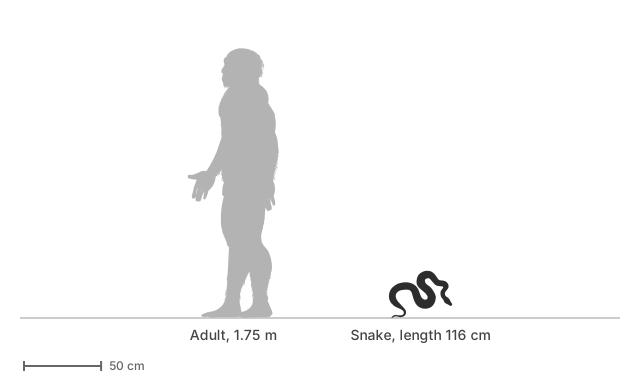
The longest recorded length is about 182 cm.[2] In a study of wild-caught snakes from Togo, females averaged 116 cm and males 111 cm from snout to vent. The heaviest snakes weighed about 1.6 kg.[13][2] Females are larger than males.[13] Both sexes have small spurs on either side of the vent, which are larger in males and are used to grip the female when mating.[2] Museum specimens measured in 1893 had 53–63 rows of scales around the body and 196–207 belly plates.[6]
Size ranges
Behavior
The Ball Python is mostly active at night and at dusk.[3][14] Hunters in Togo find resting snakes by day in abandoned rodent burrows, in termite mounds, and under dead oil palm trunks and piles of vegetation.[9] Most are found between January and March.[9] The defensive ball, with the head hidden inside the coils, is its main defence against predators.[2][8]

Diet
Wild Ball Pythons eat mostly small mammals, and the young also take birds.[15][16] In one study in the rainforests of south-eastern Nigeria, snakes under about 70 cm ate mostly small birds and snakes over about 100 cm ate mostly small mammals. Males took more birds and females more mammals.[16][2]
| Food | Type | Notes |
|---|---|---|
| Rodents and other small mammals | Mammal | The main food of adults; Gambian pouched rats and striped grass mice are named[2] |
| Small birds | Bird | More important for young snakes and for males in the Nigerian study |
Life cycle
| Stage | Age / time | Notes |
|---|---|---|
| Eggs | 3–11 per clutch | Sources give 1–11, 3–11, 5–8 and 6–18; in Togo most clutches have 5–8[2][8][9][15] |
| Incubation | About two months (55–60 days) | [2][3] |
| Maturity | Males 1–1.5 years, females 2–3 years | Sources differ by several months[2][8] |
Eggs in the wild
In Togo, egg collection peaks in February–March. The female coils around the eggs until they hatch.[9][2]
Ecology
Predators
Few predators of wild Ball Pythons have been documented. People are the main one: hunters collect them for the pet trade, for meat, skins and traditional medicine, and dig up their burrows and clutches.[9][14]
Parasites and disease
In a study of 1,250 wild-caught snakes from Togo, adult males carried more ticks than females.[13] An African tick, Amblyomma latum, has been found on Ball Pythons imported to Egypt and other countries.[17] An autopsy of a Royal Python in Nigeria found parasites called tongue worms (Armillifer) in the lungs, a warning for people who eat snake meat.[18] Most other disease research is on captive animals.[19]
The effect of trade
Hunters in southern Togo reported finding fewer snakes than five years earlier, and blamed hunting, more farms, forest loss and fire. There is no formal monitoring of the population, so the size of the decline is not measured.[9]
Habitat and range
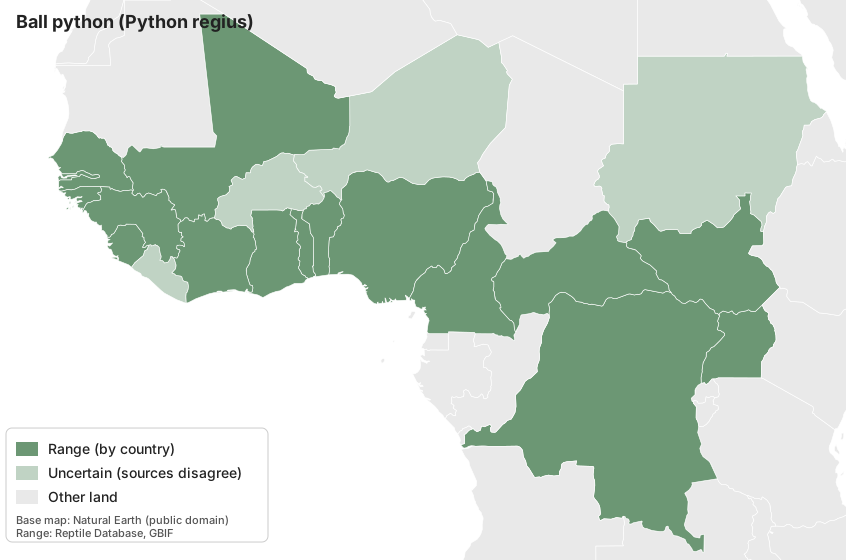
The Ball Python lives across West and Central Africa, from Senegal in the west to Uganda and South Sudan in the east.[1][11] A list drawn from the IUCN assessment also names Chad and the Republic of the Congo, which the Reptile Database does not.[15] It lives from sea level to about 1,000 m, in grassland, savanna, open woodland, forest edges, farmland and plantations.[15][2] Among hunters’ finds in southern Togo, 85% were in forest, 70% in farmland and 31% in oil palm plantations.[9] Very dry areas seem difficult for it.[15]
Evolution
The oldest known fossil relative of the pythons is Messelopython, a snake from Messel in Germany that is at least 47.6 million years old.[20] Python fossils are known from Miocene Europe, and the genus later lost ground as the climate cooled.[21] According to a 2025 study, the genus Python split from the other python genera about 43 million years ago, the African and Asian pythons parted about 33 million years ago, and the Ball Python separated from the other African pythons about 26 million years ago.[21] Scientists disagree on where the genus began: one study suggests Africa, another Asia, and a third a European origin for the whole python family.[22][21][20]
Forms and variants
Morphs
Almost all of the Ball Python’s variety comes from captive breeding, not from the wild. A morph is a heritable colour or pattern form that breeders have kept and bred. Most began as unusual wild-caught animals, and the first captive-bred albinos went on sale in 1992 for $7,500 each.[23] About 7,600 named morphs existed in April 2026, counting combinations of genes, according to a German veterinary working group citing the main morph database.[4] No authoritative registry exists, and the number of single-gene morphs is much smaller.[4][24]
How morphs are inherited
A snake shows the look only with two copies of the gene. One copy makes it a “het”, which looks normal.
One copy gives a visible look, and two copies (the “super” form) look different again. The hobby also calls this co-dominant.
One copy is enough, and two copies look the same. Few morphs are listed this way.
Some looks, such as Pastel, exist in several “lines”, improved over generations by choosing the best animals.
No simple ratio.The ratios follow from standard Mendelian genetics for a single gene.
Well-known morphs
See all morphsYears and first producers are from the World of Ball Pythons database.[24] Only morphs with a freely licensed photo are shown here. This is a small selection of the thousands of named morphs, and there may be more.
What scientists know about the genes
The genes are known for only a few morphs. Albino is linked to the TYR gene, Lavender Albino to OCA2 and Ultramel to TYRP1.[25] Piebald is caused by a change in the TFEC gene.[26] Several stripe-like morphs involve the EDNRB gene.[27] The genes behind Spider, Mojave, Pastel and Champagne have not been identified.
Health concerns
Most morphs are thought to affect only the animal’s looks, but a few are linked to health problems. The Spider morph is linked to “wobble syndrome”: twisting head movements, poor movement, and difficulty striking or constricting prey. In a small imaging study, spider snakes had malformed balance organs in the inner ear.[28] The German veterinary group lists the Spider as a confirmed case of breeding that causes suffering, and lists Champagne and several two-copy “super” forms as probable or potential cases, although it says scientific data on the super forms are still lacking.[4] The UK trade association REPTA prohibits Spiders and several super forms among its members.[29]
Conservation
The Ball Python is listed as Near Threatened on the IUCN Red List, from an assessment in 2021 that was amended in 2022. It was Least Concern in 2010.[15][30][11] The population is thought to be decreasing. In four protected sites in Nigeria, counts fell sharply between 1999 and 2008, though this is a local result and not a range-wide rate.[15] It has been on Appendix II of CITES, which controls trade, since 1977.[15][30]
More than 3 million live Ball Pythons have been exported from West Africa since the early 1980s. Benin, Ghana and Togo supply 98.8% of exports from the species’ range, and more than 90% have been recorded as ranched since about 2003.[3][30] In ranching, hunters collect gravid females and eggs, farms hatch the eggs and rear the young, and some of them are meant to be released. Researchers have found little evidence that releases happen as planned, and say ranching may not benefit wild populations.[30][9] Togo’s export quota has been 62,500 ranched and 1,500 wild snakes a year since 2007.[30]
Threats
Collection for the pet tradeHunting for meat and skinsTraditional medicineFarmland expansionPesticides[15][14]History and culture
Python cults in West Africa
Pythons have a place in the religions of the Slave Coast. In Ouidah in Benin, the Fon and the Xwéda honour the python as a divinity, Dangbé, and keep pythons in a sacred temple. Early European travellers wrote of the snake house at Whydah, and in 1864 the explorer Richard Burton described brown pythons with yellow-white stripes, under five feet long, resting in the temple. Killing one had once been punished by death.[31][32] The Government of Benin today calls the temple’s animals “Royal Pythons”, although none of the older writers named the species.[33]
Among the Igbo of Nigeria, a missionary wrote in 1921 that pythons were “sacred” and called “our mother”, and that anyone who killed one would mourn for a year.[31] The writer did not name the species, so this may not refer to the Ball Python. In Benin, Ball Pythons have been reported in larger numbers in sacred areas, probably because of local taboos.[14] Elsewhere in Benin, 53% of Ball Pythons hunted were sold as bushmeat and 39% for belief-based uses.[14]
The pet trade
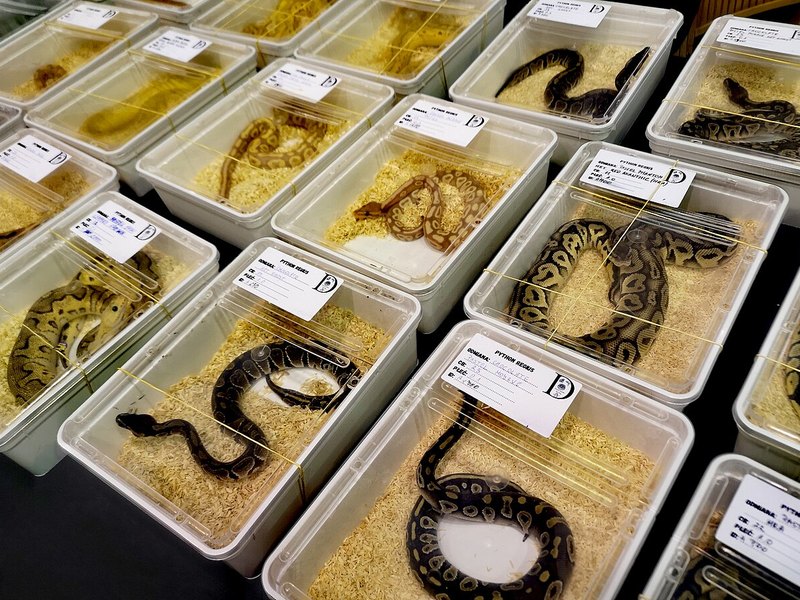
Wild-caught Ball Pythons were cheap and common in pet shops at the start of the 1990s, and by the end of the decade they were one of the most popular pet snakes.[23] Trade then grew from wild-caught to ranched animals, and captive breeding grew in the United States and Europe as well.[3] In 2012 the United States listed four other constrictor species as injurious wildlife, but not the Ball Python, even though it made up 78.6% of constrictor imports.[34] Escaped or released Ball Pythons have been reported in the Florida Keys, but no breeding population is known.[35]

Science
In 2014 scientists identified a virus, the Ball Python nidovirus, as a likely cause of a severe, sometimes fatal respiratory disease in captive snakes.[19] The first full genome of the Ball Python was published in 2025.[36]
Taxonomy
| Rank | Name |
|---|---|
| Kingdom | Animalia |
| Phylum | Chordata |
| Class | Reptilia |
| Order | Squamata |
| Suborder | Serpentes (snakes) |
| Family | Pythonidae (pythons)[1] |
| Genus | Python |
| Species | Python regius (Shaw, 1802)[1] |
The species was first described as Boa regia in 1802. No subspecies are recognised.[1] Its synonyms include Python bellii Gray, 1842.[1]
Sources
- The Reptile Database, Python regius
- Wikipedia, Ball python (secondary)
- Harrington et al. 2020, “Snakes and ladders”, Nature Conservation 41: 1–24
- DGHT 2026, position paper on morph breeding (German veterinary working group; in German)
- Di Ianni et al. 2023, Genes 14(9): 1744 (virgin birth in a ball python)
- Boulenger 1893, Catalogue of the Snakes in the British Museum, vol. 1, pp. 88–89
- Gracheva et al. 2010, Nature 464: 1006–1011 (infrared sensing in snakes)
- Animal Diversity Web, Python regius (secondary; some details are out of date)
- D’Cruze et al. 2020, “Searching for snakes”, Nature Conservation 38: 13–36
- Seba 1734, Locupletissimi rerum naturalium thesauri, vol. 1
- GBIF, Python regius (occurrence records and IUCN category)
- Names in other languages: Reptile Database (German), GBIF vernacular names (Catalogue of Life and TAXREF), Jisho (Japanese)
- Aubret et al. 2005, Journal of Herpetology 39: 315–320 (body size, ticks)
- Toudonou et al. 2022, Nature Conservation 50: 85–114
- VKM 2023, scientific assessment of risk to populations of pythons listed by CITES (Norwegian Scientific Committee for Food and Environment), chapter on Python regius
- Luiselli & Angelici 1998, Italian Journal of Zoology 65: 183–185 (diet; reported through Wikipedia)
- Abouelhassan et al. 2023, Experimental and Applied Acarology (ticks on imported ball pythons)
- Ayinmode et al. 2010, Ghana Medical Journal 44(3), pentastomiasis in a royal python
- Stenglein et al. 2014, mBio 5(5): e01484-14 (ball python nidovirus)
- Zaher & Smith 2020, Biology Letters 16: 20200735 (oldest known stem python fossil)
- Tolley & Alexander 2025, Frontiers of Biogeography 18 (python phylogeny and ages)
- Reynolds, Niemiller & Revell 2014, Molecular Phylogenetics and Evolution (boas and pythons)
- Barker, Reptiles magazine, “Ball python morph history”
- World of Ball Pythons, morph database (years and first producers)
- Brown et al. 2022, PLOS ONE 17(10): e0276376 (genes behind albino, lavender albino and Ultramel)
- Garcia-Elfring et al. 2023, Current Biology 33: 755–763 (the piebald gene)
- Dao et al. 2023, G3 (EDNRB and striped morphs)
- Starck et al. 2022, PLOS ONE 17(8): e0262788 (inner-ear malformations in spider morph pythons)
- REPTA, deleterious gene policy (UK trade association)
- D’Cruze et al. 2020, “Betting the farm”, Nature Conservation 40: 65–91
- Hambly 1931, Serpent Worship in Africa, Field Museum
- Burton 1864, A Mission to Gelele, King of Dahome, vol. 1
- Government of Benin, page on the Dangbe python temple, Ouidah (in French)
- US Fish and Wildlife Service, final rule, Federal Register 77(14), 23 January 2012
- Hanslowe et al. 2018, Management of Biological Invasions 9(3): 369–377 (snakes in the Florida Keys)
- Hunt et al. 2025, G3 15(11): jkaf197 (first genome assembly)
- Open Tree of Life, synthetic tree and taxonomy