The Rottweiler is a medium-to-large black-and-tan dog from Germany, named after the town of Rottweil. The FCI classes it as a companion, service and working dog.[1]
The breed standard
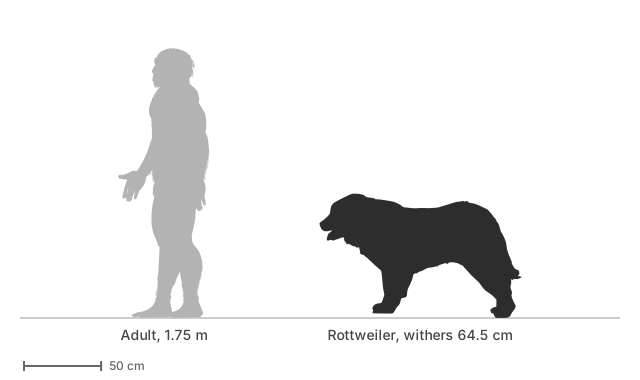
The FCI standard gives a height at the withers of 61–68 cm for males, with a weight of 50 kg, and 56–63 cm for females, with a weight of about 42 kg.[1] The coat is coarse, dense and flat, and the only permitted colour is black with clearly defined rich tan markings on the cheeks, muzzle, throat, chest, legs, above the eyes and under the base of the tail. White markings and a long or wavy coat are disqualifying.[1] The standard describes the temperament as good-natured, placid, devoted and eager to work, and alert but even-tempered.[1]
Name and origin
The FCI standard states that the breed is considered one of the oldest and that its origin goes back to Roman times, when the dogs were herding and driving dogs that crossed the Alps with the Roman legions. This is the standard’s own account. It says the name comes from the old free city of Rottweil, where the dogs were known as “Rottweil butcher’s dogs”, and that they were officially recognised as police dogs in 1910.[1] A study of breed relationships places the Rottweiler in a group of drover breeds, and notes DNA segments shared with the Cane Corso.[2] The AKC recognised the Rottweiler in 1931.[3]
Health and lifespan
Studies of UK dogs report median lifespans for Rottweilers of about 8.4 to 10.6 years, depending on the dataset. A study of 5,321 Rottweilers in UK veterinary records found a median longevity of 9.0 years (middle half of dogs 7.2–10.5), with females living longer than males (9.5 against 8.7 years).[4] A Kennel Club owner survey gave a median age at death of 100.5 months, about 8.4 years, but from only 76 deaths.[5] The Dogs Trust table of UK dogs gives a median life expectancy of 10.6 years (10.4–10.7), based on 6,275 dogs of which 3,442 had died.[6] These differ because they use different data, years and definitions.
In the veterinary-records study the commonest causes of death were cancer (33.0%), inability to stand (16.0%) and a mass-associated disorder (7.1%). The authors concluded that Rottweilers are relatively short-lived and that cancer is a common cause of death. The most frequently recorded disorders were aggression (7.46% of dogs), overweight or obesity (7.06%), ear infection (6.14%) and degenerative joint disease (4.69%); aggression here means a diagnosis recorded by a clinic. Median adult bodyweight was 44.9 kg.[4]
Behavior
In an owner-reported survey of 210 Rottweilers, 4.8% were reported to have snapped, bitten or tried to bite an unfamiliar person in the recent past, 1.0% a member of the household and 7.6% an unfamiliar dog. The averages across the 33 breeds in the survey were 4.7%, 2.0% and 10.7%.[7] In a separate sample of 92 Rottweilers from breed clubs, 5.4% were reported to have done so to an unfamiliar person. The survey does not measure how serious a bite was.[7] Breed explains only about 9% of behavioural differences between individual dogs, so an individual’s behaviour can differ a lot from the breed’s average.[8]
Popularity
The Rottweiler ranked 8th on the AKC’s list of most popular breeds in 2025.[9]
Sources
- FCI breed standard 147, Rottweiler
- Parker et al. 2017, Cell Reports 19: 697–708 (DNA relationships of 161 breeds)
- American Kennel Club, breeds by year recognized
- O’Neill et al. 2017, Canine Genetics and Epidemiology 4: 13 (Rottweilers under primary veterinary care in the UK)
- Lewis et al. 2018, Canine Genetics and Epidemiology 5: 10 (Kennel Club health survey)
- Dogs Trust, “Life expectancy for 155 breeds and crossbred group” table (UK; median life expectancy)
- Duffy, Hsu & Serpell 2008, Applied Animal Behaviour Science 114: 441–460
- Morrill et al. 2022, Science 376 (breed and behaviour)
- American Kennel Club, most popular dog breeds of 2025