The Shiba is a small Japanese dog, used to hunt birds and small animals and now kept as a companion. The FCI says the word “Shiba” originally refers to something small.[1]
The breed standard
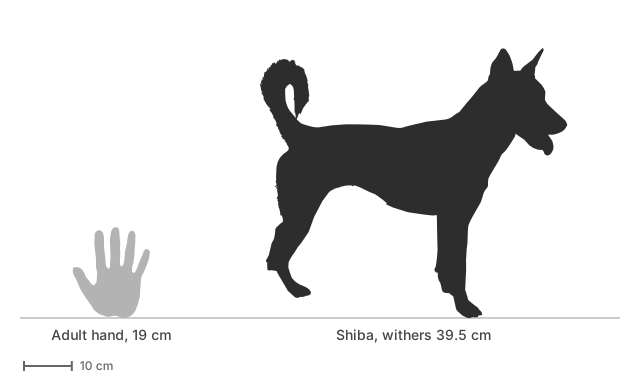
The FCI standard describes a small, well-balanced dog with strong bones and muscles. Males stand 39.5 cm at the withers and females 36.5 cm, with a tolerance of 1.5 cm either way. No weight is given. The ears are small, triangular and pricked, and the tail is thick, set high and carried curled or in a sickle curve. The outer coat is harsh and straight over a soft, dense undercoat.[1] The allowed colours are red, black and tan, sesame, black sesame and red sesame. All must have “urajiro”, a whitish coat on the sides of the muzzle and cheeks, the underside of the jaw and neck, the chest and stomach, the underside of the tail and the inside of the legs.[1] The standard describes the temperament as faithful, with keen senses and high alertness.[1]
Name and origin
The FCI calls the Shiba a native breed of Japan, used in the mountains facing the Sea of Japan to hunt small animals and birds. Crossing with imported English Setters and English Pointers between 1868 and 1912 left pure Shibas “exceedingly scarce”. Preservation began seriously around 1928, the breed standard was unified in 1934, and the FCI says the Shiba was designated a natural monument in 1937.[1] The Kennel Club (UK) also describes a survival programme in 1928 that used dogs from three regional types, Mino, Sanin and Shinshu, but gives 1936 for the national monument listing.[2]
Health and lifespan
No UK or US population health study of the Shiba was found. One Japanese study used records of 12,039 dogs buried or cremated at eight animal cemeteries in Tokyo between 2012 and 2015. For 614 Shibas it estimated a life expectancy at birth of 15.5 years (95% confidence interval 15.3–15.8) and a median age at death of 15.7 years.[3] The authors note that the data come only from Tokyo and that owners may round ages up or down, so the figures describe those dogs and not the breed everywhere.[3]
Behavior
In an owner-reported survey in Japan and the USA, the group of ancient and spitz-type breeds scored lowest of eight breed groups for attachment and attention-seeking. The group was mostly Shiba Inus (128 of 152 dogs), so the result is for the group, not for the Shiba alone.[4] Breed explains only about 9% of behavioural differences between individual dogs, so an individual’s behaviour can differ a lot from the breed’s average.[5]
Popularity
The AKC recognised the Shiba in 1992.[6] The Shiba ranked 44th on the AKC’s list of most popular breeds in 2025.[7]
Sources
- FCI breed standard 257, Shiba
- The Kennel Club (UK), Japanese Shiba Inu breed page
- Inoue, Kwan & Sugiura 2018, Journal of Veterinary Medical Science 80: 1153 (pet cemetery records, Tokyo)
- Tonoike et al. 2015, Scientific Reports 5: 17710 (behaviour of genetically clustered breeds in Japan and the USA)
- Morrill et al. 2022, Science 376 (breed and behaviour)
- American Kennel Club, breeds by year recognized
- American Kennel Club, most popular dog breeds of 2025