The Siberian Husky is a medium-sized sledge dog. The FCI describes it as quick and light on its feet, able to carry a light load at a moderate speed over great distances.[1]
The breed standard
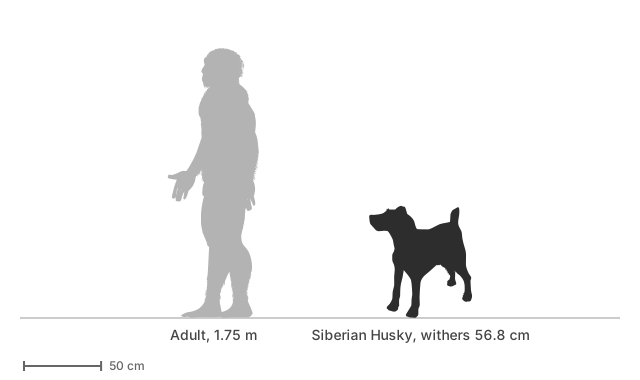
The FCI standard gives a height at the withers of 53.5–60 cm for males and 50.5–56 cm for females, and a weight of 20.5–28 kg for males and 15.5–23 kg for females. These are the extreme limits. The coat is double and of medium length, and an absent undercoat in the shedding season is normal.[1] Eyes may be brown or blue, one of each, or particoloured. Many colours are allowed, including black, grey, agouti, sable, red and white, with no preference for any. Merle and brindle patterns are disqualified.[1] The standard describes a friendly and gentle dog that is also alert and outgoing, without the possessive qualities of a guard dog, and not overly suspicious of strangers or aggressive with other dogs.[1]
Name and origin
The FCI lists the U.S.A. as the country of the standard. The Kennel Club (UK) says the breed originates in north-east Siberia and was also known as the Chukchi sled dog, after the people who used it for long-distance sled hauling. It adds that in 1925 a team of Siberians helped bring serum to Nome, Alaska, during a diphtheria epidemic.[2] A DNA study of North American Arctic dog breeds found that the Siberian Husky and the Alaskan Malamute appear to have kept most of their ancient Siberian ancestry, unlike the Alaskan Husky, which showed European ancestry.[3]
Health and lifespan
Hereditary cataract is a recognised problem in the breed. A study of 50 Siberian Huskies seen for cataracts at four university veterinary hospitals found hereditary cataracts in 84% of them, against 52% of 96 dogs of other breeds, and the Huskies were much younger when first seen (3.5 years on average, against 9.5 years). These were referral cases, so the figures do not show how common cataracts are across the whole breed.[4] A 2025 genetic study found that common variants in the CPT1A gene are strongly associated with a type of cataract in both eyes in the Siberian Husky and three other Northern breeds. How the gene leads to cataracts is not yet known.[5]
A UK life-table study lists dogs recorded as “Husky”, which may not be the registered breed only. They had a life expectancy at birth of 9.5 years, from a small sample of 154 dogs, and the authors say such small samples give uncertain tables.[6]
Behavior
In an owner-reported survey of 54 Siberian Huskies, 0% were reported to have snapped, bitten or tried to bite an unfamiliar person in the recent past, 1.9% a member of the household and 5.6% an unfamiliar dog. The averages across the 33 breeds in the survey were 4.7%, 2.0% and 10.7%.[7] This is a small sample.[7] Breed explains only about 9% of behavioural differences between individual dogs, so an individual’s behaviour can differ a lot from the breed’s average.[8]
Popularity
The AKC recognised the Siberian Husky in 1930.[9] The Siberian Husky ranked 30th on the AKC’s list of most popular breeds in 2025.[10]
Sources
- FCI breed standard 270, Siberian Husky
- The Kennel Club (UK), Siberian Husky breed page
- Brown et al. 2015, Heredity 115: 488–495 (North American Arctic dog breeds)
- Uhl et al. 2021, Veterinary Ophthalmology 24: 252–264 (cataracts in Siberian Huskies)
- Ricketts et al. 2025, PLOS ONE 20: e0320878 (CPT1A and cataracts in Northern dog breeds)
- Teng et al. 2022, Scientific Reports 12 (life tables by breed, UK veterinary records)
- Duffy, Hsu & Serpell 2008, Applied Animal Behaviour Science 114: 441–460
- Morrill et al. 2022, Science 376 (breed and behaviour)
- American Kennel Club, breeds by year recognized
- American Kennel Club, most popular dog breeds of 2025