The Emperor Penguin (Aptenodytes forsteri) is a large penguin that breeds on the sea ice around Antarctica.[1] It breeds through the Antarctic winter, when the air at the colonies can fall below −40 °C.[1] The female lays a single egg and goes to sea to feed. The male keeps the egg warm on his feet and fasts until she returns.[2] With the King Penguin, it forms the genus Aptenodytes, the sister group of all other living penguins.[3][4][5] The IUCN Red List lists the Emperor Penguin as Endangered (uplisted from Near Threatened in April 2026).[6][7]
Quick facts
Description
An adult Emperor Penguin has a black head, chin, throat and back, black flippers above and a black tail, and a white underside. Orange-yellow patches on the sides of the head fade towards the shoulders into yellow on the upper breast. The bill is long and black, with a pink, orange or lilac stripe on the lower half.[9][10] No source read describes a difference in plumage between the sexes.
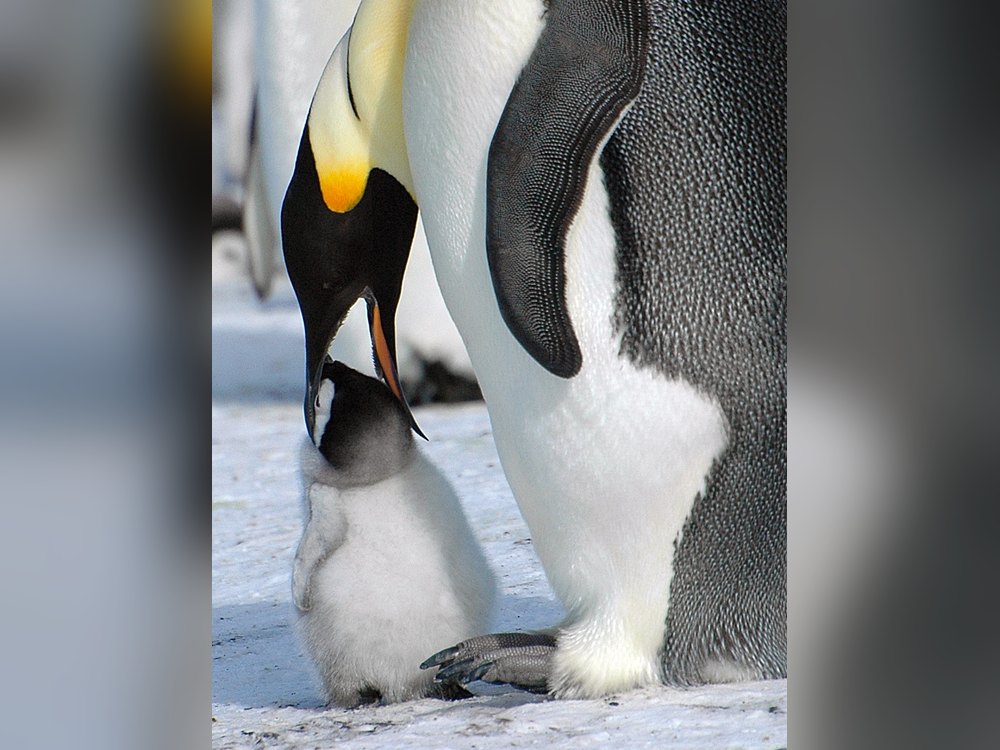
A chick is covered in grey down. Later it grows a black crown and white cheeks and chin, and a juvenile is greyish blue.[9] Chicks beg with a whistle that rises and falls in pitch.[9][10]
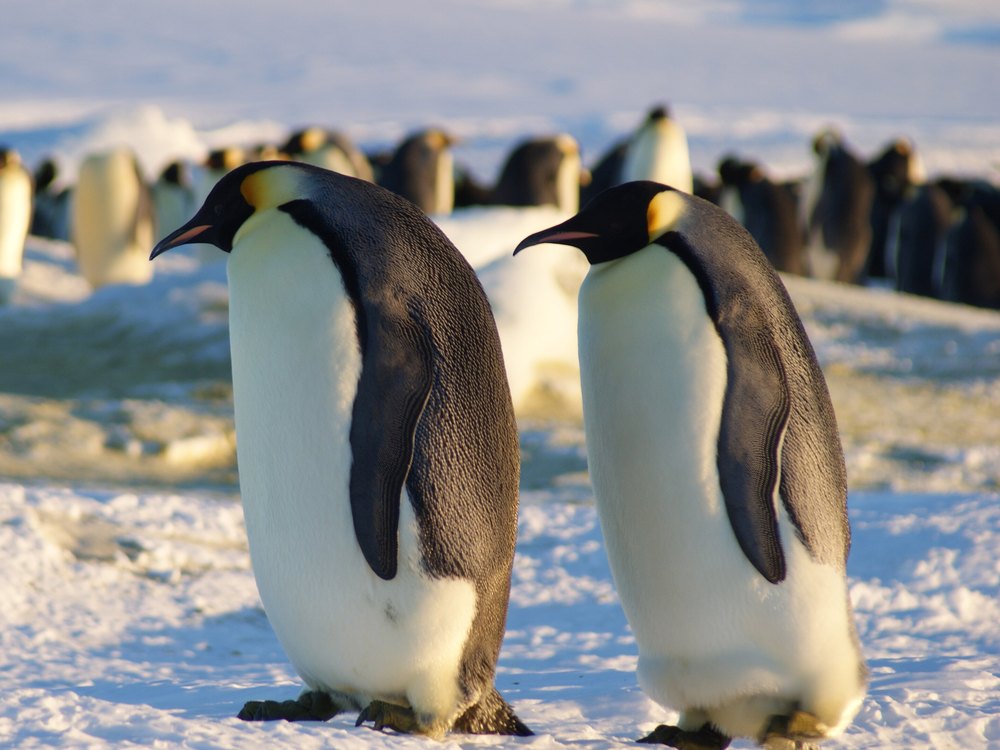
The King Penguin
The King Penguin, Aptenodytes patagonicus, is the other living member of the genus, and the two were often confused in early writing (see Name). In his 1844 note, Gray gave the length from the tip of the bill to the tip of the tail as 50 inches for the Emperor and 44 inches for the King.[11]
Name
Gray named the species Aptenodytes forsteri in 1844.[11] His short note says only that the Forsters sailed with Cook on his second voyage. Later writers say that the name honours the German naturalist Johann Reinhold Forster, who sailed on that voyage in 1772–75.[11][12][10] Rosove’s 2018 study says Gray’s credit to Forster as the first describer was “almost certainly mistaken”. He names Bellingshausen in 1820 as the likely first observer.[12] The genus name Aptenodytes is glossed on Wikipedia as Greek for “without-wings diver”, but no stronger source was found for this.[10]
The English names were already in use when Gray wrote. The travellers called the larger species the “Emperor” and the smaller the “King”.[11] The sources read do not say why the word “emperor” was chosen.
The two names were swapped and mixed for a long time. Gray argued that two species had been mixed up under one old name, and he named Pennant’s bird (the King) pennantii and Forster’s bird (the Emperor) forsteri.[11] In 1935, Mathews and Iredale wrote that “for many years the two names were reversed”, and proposed a new name, excelsior, that is not in use today.[13] In many languages the pair is still named “emperor” and “king”: for the King Penguin, French has manchot royal and German has Königspinguin.[14]
In other languages
| Language | Name | Meaning |
|---|---|---|
| French | manchot empereur | Emperor penguin. French pingouin means an auk, not a penguin |
| German | Kaiserpinguin | Emperor penguin |
| Spanish | pingüino emperador | Emperor penguin |
| Italian | pinguino imperatore | Emperor penguin |
| Portuguese | pinguim-imperador | Emperor penguin |
| Dutch | keizerspinguïn | Emperor penguin |
| Swedish | kejsarpingvin | Emperor penguin |
| Finnish | keisaripingviini | Emperor penguin |
| Polish | pingwin cesarski | Imperial penguin |
| Czech | Tučňák císařský | Imperial penguin |
| Hungarian | Cászárpingvin | Emperor penguin |
| Turkish | İmparator Penguen | Emperor penguin |
| Russian | Императорский пингвин | Imperial penguin |
| Japanese | コウテイペンギン (kotei pengin) | Emperor penguin |
| Chinese (simplified) | 帝企鹅 | Emperor penguin |
| Chinese (traditional) | 皇帝企鵝 | Emperor penguin |
Names are from the IOC World Bird List and the Catalogue of Life, as listed by GBIF.[14][15] Only names that these databases agree on are shown. Names in Indigenous languages were not found.
Body
Size
Reports of standing height differ. Animal Diversity Web gives 101 to 132 cm.[9] Older measurements, as quoted on Wikipedia, are lower: 83 to 97 cm for 22 wild birds (Friedman, 1945), at most 1.08 m for 86 wild birds (Prévost, 1961), and 81 to 94 cm for museum skins. The same page says that reports of 1.5 m come from measuring from bill to tail instead of standing height.[10] The original measurements were not checked, so the true range is not settled.
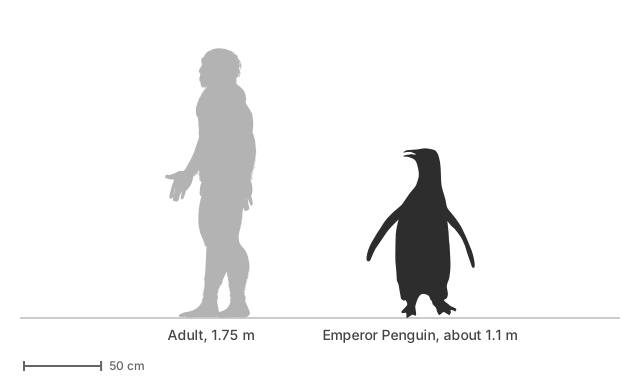
Adults weigh from about 15 kg to about 40 kg, depending on age, sex, season and place.[16] The Australian Antarctic Division gives up to 40 kg at the start of breeding.[17] Animal Diversity Web gives 25 to 45 kg and says that males are heavier than females.[9]
Weight during the fast
Males lose much of their weight while they fast. In field data quoted by the Open University, the mean mass of males fell by 40.5%, from 38.2 kg to 22.75 kg, at about 35 g a day. Males leave the colony at about 23 kg.[18] The Australian Antarctic Division says that males have lost “nearly half” of their body mass by the end of incubation, and Animal Diversity Web says about 40%.[2][9] Females lose about 22% during their shorter fast. At sea they then eat 6–8 kg a day and gain about a third of their body mass.[18]
Egg and young
The egg weighs about 450 g.[9] Wikipedia gives 460–470 g and about 12 × 8 cm.[10] Ten fledglings tracked from one colony weighed nearly 16 kg on average, but the researchers chose the fattest birds. Juveniles at Atka Bay weighed 14.00 ± 1.32 kg.[19][16]
Feathers
A study of four dead birds found four types of body feather: contour feathers, afterfeathers, plumules and filoplumes. The two normal birds had about 8.7–9.0 contour feathers per square centimetre on the belly and 5.8–6.5 on the back. A model estimate gave about 24,000–30,000 contour feathers and 120,000–151,000 insulating feathers (afterfeathers and plumules) per bird. Plumule density was four times contour density.[20] The authors argue that the plumules, a down attached to the skin, are a main insulator, and that contour density is lower than earlier reports of 11–46 per square centimetre.[20] The sample was small: four birds, and three for density.
Behavior
Huddling
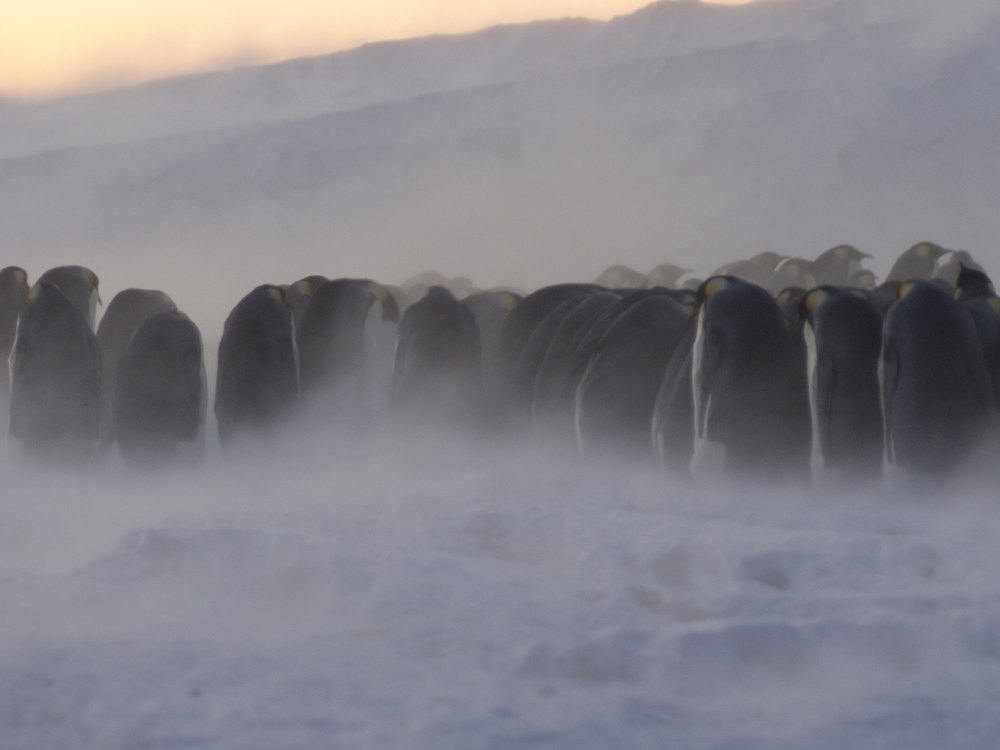
Emperor Penguins huddle against the cold, but the huddle is not a neat rotation. In a study at Pointe Géologie with loggers on 8 birds, huddling bouts lasted 1 h 48 min on average (905 bouts). The birds spent about 41% of each day huddling, in about 4 bouts a day. The mean highest temperature inside a huddle was 26.2 ± 9.7 °C.[8] An earlier study of 8 birds found episodes of 1.6 ± 1.7 hours, with males huddling for 38 ± 18% of their time.[21] Without huddling, males could fast for only about 60 days, against about 120 days with it.[8]
Video of huddles shows that, about every 30 to 60 seconds, a wave of small steps passes through the huddle and reshuffles it. A huddle is so dense that single birds can hardly move without these steps.[22] Another study found that a wave starts when any bird inside a dense huddle steps forward.[23] A mathematical model, not a field study, has each bird try to cut only its own heat loss. Birds on the exposed edge move downwind, and the huddle keeps its shape while it drifts slowly downwind.[24] The Australian Antarctic Division says huddling can cut heat loss by as much as 50%, but this figure was not traced to a paper.[17]
Travel on the ice
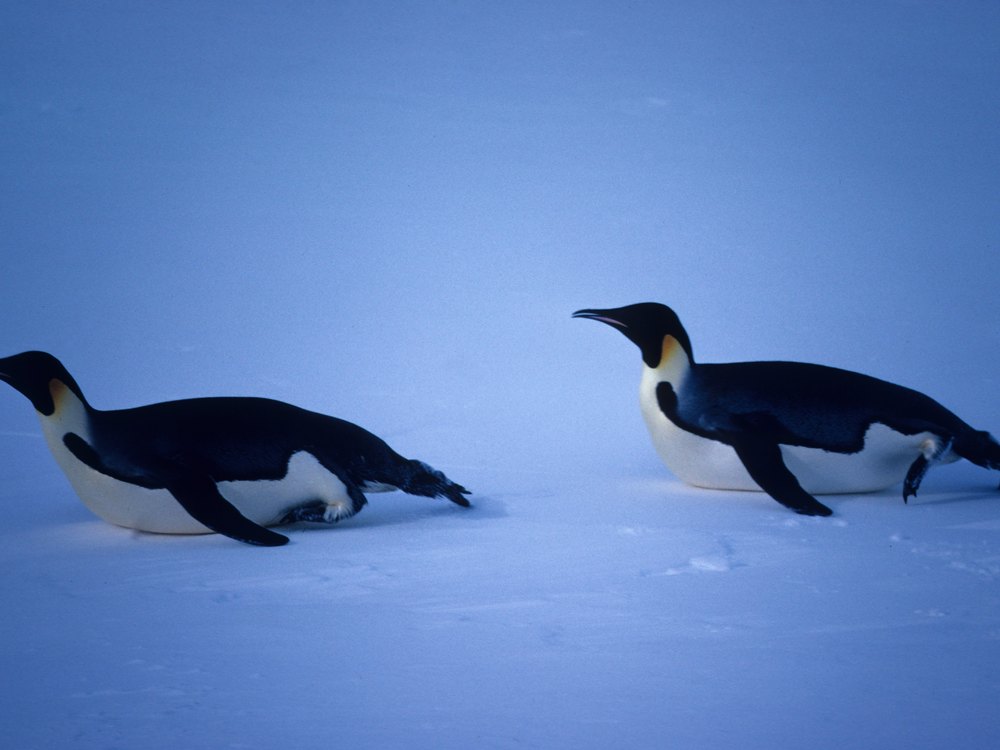
Brooding males walk about 30 m a day on average. A walk back to open water uses 2.8 to 4.5 times the basal metabolic rate.[18] Fledglings tracked from Auster crossed nearly 50 km of fast ice and then 200 to 300 km of pack ice.[19]
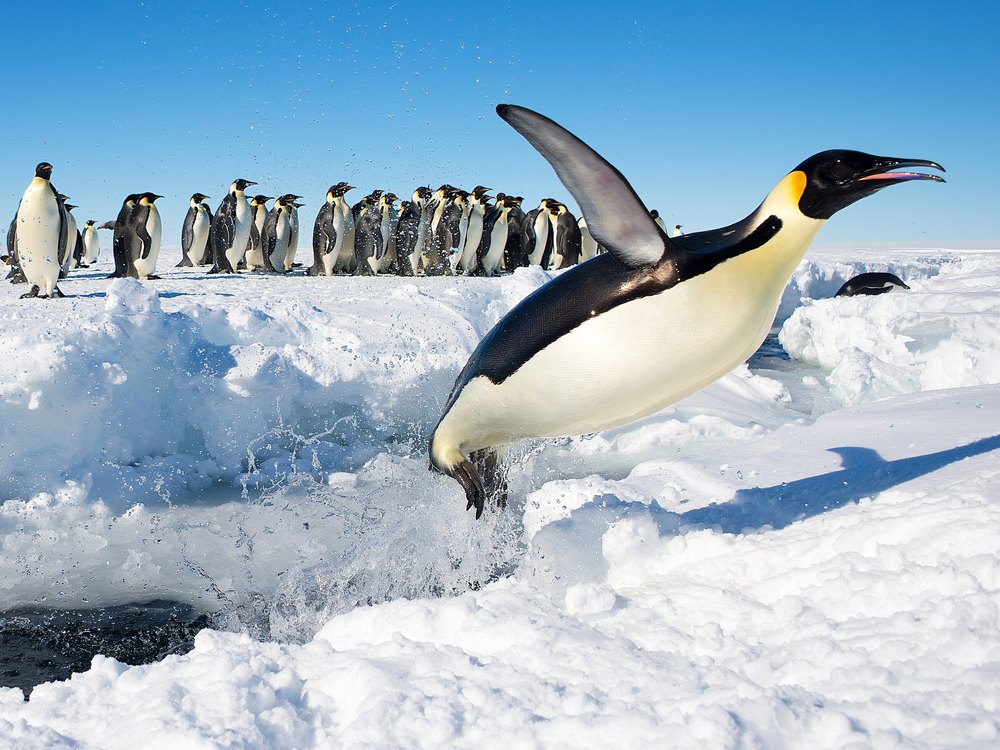
Voice
Emperor Penguins build no nest and have no fixed nest site, so they find mates and chicks by call.[25] A review reports that the display call is the only signal used for recognition, and that it carries an individual signature. Only 2 of 17 penguin species are known to make two sounds at once from the voice box, the Emperor and the King. The beats between the two voices carry information about identity.[25] The review’s experiments on how chicks recognise parents were done on the King Penguin, so the Emperor Penguin’s chick recognition is not confirmed.[25]
Pairs
Emperor Penguins and King Penguins keep the same mate far less often than smaller penguins, even though adults survive well. Divorce did not depend on how well the pair had bred before.[26] The pair stays together for one breeding season, and many pairs do not reunite the next year.[26]
Diet
The Emperor Penguin is a carnivore. It eats mainly fish, along with crustaceans and some squid.[17][27] Diet varies by place and season. In the Ross Sea, fish made up about 88–95% of the food by mass in stomach samples from three colonies. At Cape Washington, Antarctic silverfish (Pleuragramma antarcticum) were 89% of the fish, and the rest of the food was crustaceans, including a krill, Euphausia crystallorophias. At Coulman Island and Cape Roget, the squid Psychroteuthis glacialis made up 3.5% and 0.8%.[27] The Australian Antarctic Division names silverfish among the most frequent prey, with other fish, Antarctic krill and some squid.[17]
Adults eat 2–3 kg a day, and up to 6 kg a day when they fatten up before a moult or before breeding.[17][9]
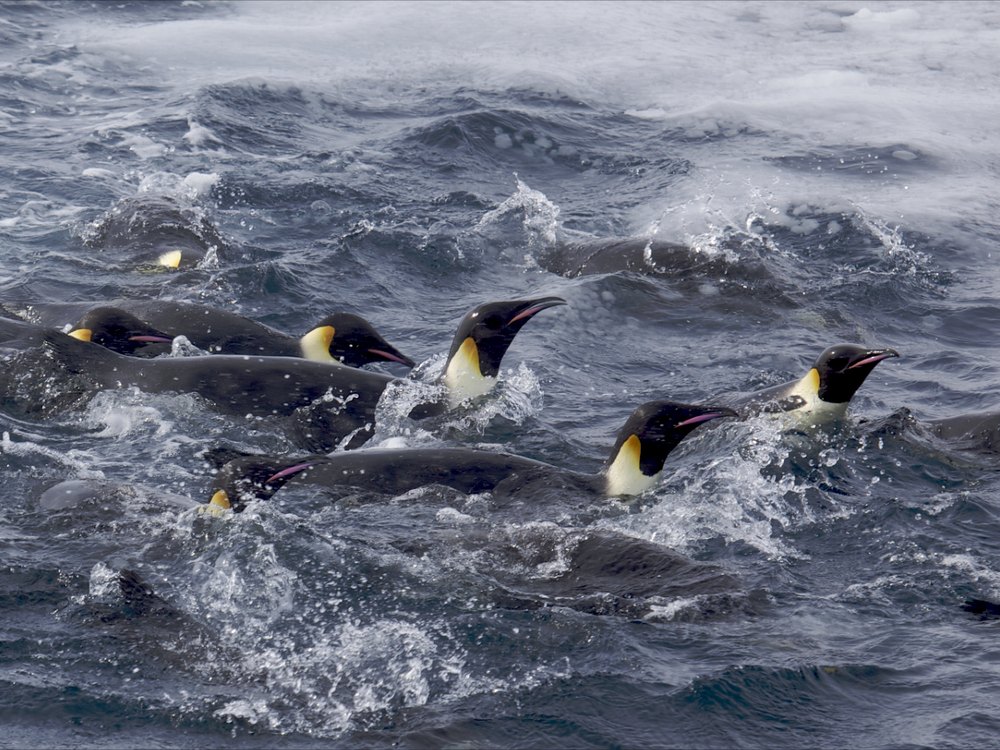


Diving
The deepest and longest dives come from a three-year study in East Antarctica that used time-depth recorders. It logged 137,364 dives by 93 penguins. Of these, 264 dives went below 400 m and 48 lasted more than 12 minutes. The two most extreme dives, 564 m deep and 21.8 minutes long, were separate dives by different birds.[28] These come from an abstract. The very long dives were mostly in winter (65% in May to August), and the very deep dives in spring (83% in September to November).[28]
Most dives are much shorter. The Australian Antarctic Division says dives average three to six minutes.[29] It gives most dives as between 100 and 200 m on one page and as 150–250 m on another, so the typical depth is not firm.[29][17] At Coulman Island, a study of parents feeding chicks recorded a deepest dive of 534 m.[30] Females on their winter trip after laying foraged on 93.2% of their days at sea. On those days they spent 4.71 hours in the water and made about 26 dives.[31]
Foraging trips
After laying, a female took about 8 days to reach the ice edge, spent 50–60 days at sea, and took about 4 days to cross the fast ice back.[31] When chicks are small, a parent’s trip lasts 15–29 days. Before the chicks fledge, it falls to under 10 days.[32] Parents return to feed a chick about once a week.[16]
Life cycle
| Stage | Time | Notes |
|---|---|---|
| Egg | About 64 days | One egg, passed from the female to the male, who keeps it on his feet under a fold of skin while he fasts[2][32][16] |
| Chick, brooded | About 6–7 weeks | Hatches between July and August depending on the colony. It cannot keep itself warm, so one parent always stays with it[32][2] |
| Chick in the crèche | From about week 7 until it fledges | Chicks stand in groups while both parents feed at sea. By October the chick is left alone between visits[32][16] |
| Juvenile | Fledges at about 5 months; at sea for at least 2 years[9][16] | Moults its down, leaves the colony between November and January and spends the next years at sea[32][19] |
| Adult | First breeding at about 3–6 years[9][10] | Breeds once a year in winter. Adults moult at the end of the summer[1][16] |
Arrival and courtship
Adults return to the colonies between late March and early May. Courtship, mating and egg laying take 6–10 weeks. At Pointe Géologie the arrivals peaked on 7 April (± 3 days) and at Atka Bay on 27 April (± 7 days).[32] Courtship starts in March or April depending on latitude.[16]
Egg and incubation
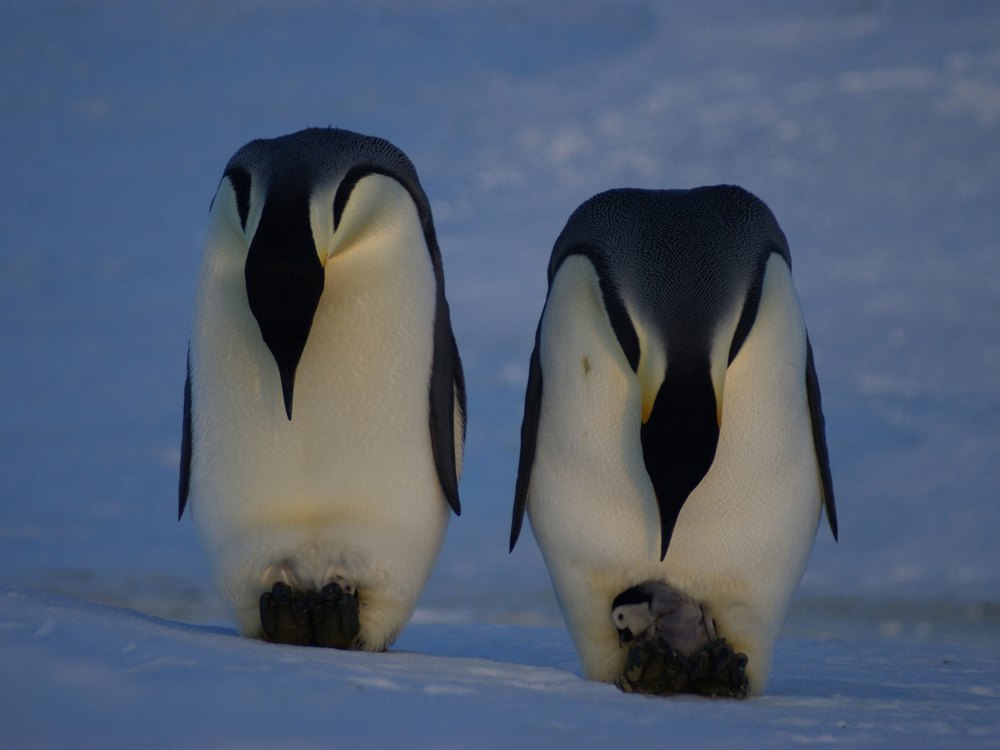
The female lays one egg. She passes it to the male, who keeps it on his feet at about 38 °C, and she goes to sea to feed.[2] Incubation lasts about 64 days on average in studies at two colonies,[32][16] though the Australian Antarctic Division gives 65 to 75 days.[2] The male eats only a little snow.[2] His fast lasts about 4 months in all, nearly 2 months of it before the females return.[2][9] The Open University summary puts it differently, at about 6 weeks of courtship fast followed by 2 more months.[18] If the female is late, the male feeds the chick “curds” from his oesophagus.[18]
Chick
Females come back about the time of hatching, which falls between July and August depending on the colony.[2][32] The chick cannot hold its own body heat for the first 6–7 weeks, so one parent always stays with it.[32] The Australian Antarctic Division says about 50 days.[2] After this the chicks form crèches.[32] By October a chick is thermally independent and is left alone while both parents feed at sea.[16] Animal Diversity Web says a chick eats about 84 kg of food in its first 5 months, and the Australian Antarctic Division says about 42 kg from each parent. The two figures agree but probably share one origin.[9][17]


Fledging and the years at sea
A chick fledges between November and January, when it has moulted and leaves the colony for the first time.[32] At about five months, the parents leave the chicks.[19] Most juveniles do not return to the colony for at least two years, and they survive less well than adults in their first year at sea.[16] The Australian Antarctic Division magazine says birds are three years old or older when they first return.[19] In one tracking study, the first six months of fledglings spread across nearly a quarter of the Southern Ocean, from 7°E to 93°E and more than 2,300 km from the colony. One bird travelled nearly 7,000 km.[19]
Growing up
Animal Diversity Web gives the age at first breeding as 4 to 6 years for both sexes.[9] Wikipedia says some can breed at about three years.[10] The sources disagree, so about 3 to 6 years is a safe reading.
Breeding success varies by colony and year. No single average was found. At Pointe Géologie one season in 2014, after sea ice was lost, had a success rate under 5%. Estimated chick survival was 71% in the 2017 season of the same study.[32] The Open University summary says that about 30% of eggs and chicks are abandoned every year and that abandoned young always die.[18]
Moult
Adults moult at the end of the austral summer, mostly on pack ice.[16] They fast for about a month while they replace their feathers, and they are not waterproof, so they cannot feed. They fatten at sea before and after.[2]
Lifespan
Animal Diversity Web gives 15 to 20 years in the wild.[9] The Australian Antarctic Division says that some live more than 40 years, but that most do not reach that age in the wild.[17] A figure of 40 or 50 years is an estimate from survival rates, not a record: no banded bird of a known maximum age was found.[9][10]
Ecology
Emperor Penguins are among the top predators of the Antarctic sea.[9] Animal Diversity Web lists parasites that include tapeworms, roundworms and a louse, Austrogoniodes mawsoni. Parasites were found in 26% of a small group at Atka Bay.[9]
Predators
Animal Diversity Web lists killer whales, leopard seals and south polar skuas as predators. It says leopard seals kill adults and chicks, and skuas steal and eat eggs and chicks.[9] No primary study of predation was found.
Moving colonies
Colonies are not fixed. After the Halley Bay colony failed in 2016–18, the Dawson-Lambton colony 55 km to the south grew more than tenfold in the same three years.[33] The colony at Mertz Glacier moved and has been rejoined with the main colony since 2017.[1] Of five newly noted locations in West Antarctica, three could be previously undiscovered colonies and two are likely relocations after ice shelves calved. New colonies near Case Island are likely due to birds leaving colonies elsewhere in the region that lost fast ice early.[34]
Habitat and range
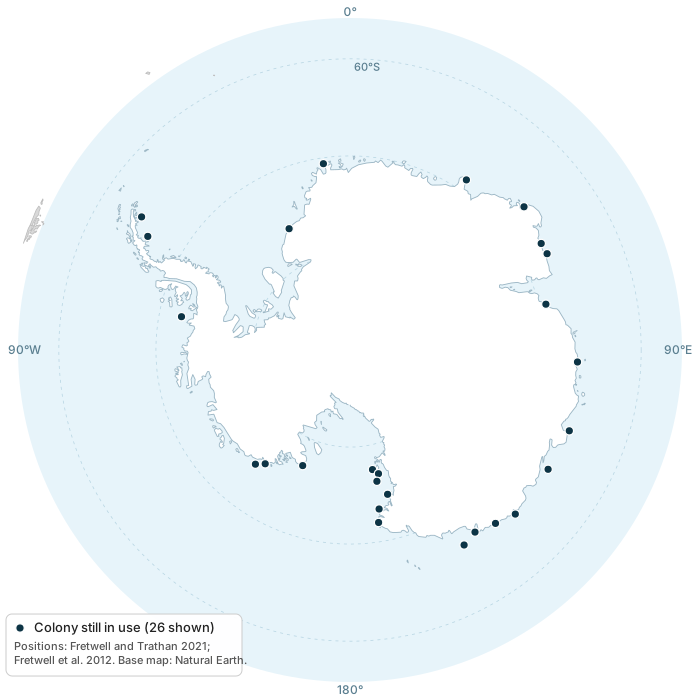
The Emperor Penguin lives around the Antarctic coast. Its range is circumpolar.[1] In the 2021 list of colony sites, the northernmost is Snow Hill on the Antarctic Peninsula, at 64.5°S. The southernmost extant ones are Cape Crozier and Cape Colbeck, at about 77°S.[1] In 2009, 34.8% of the population bred north of 70°S.[35] Breeding is only in Antarctica, but juveniles forage far out in the Southern Ocean.[19][37]


Habitat
Almost all colonies sit on fast ice, sea ice attached to the coast. This ice must stay stable for about 9 months, from the birds’ arrival in March or April until the chicks leave in December or January. In February and March adults haul out to moult, and may travel up to 1,200 km from their breeding sites.[1] Colonies are of several kinds:[1]
- On the windward side of bays, headlands, glacier tongues and ice shelves (30 of 54 colonies in the list before 2020).
- On fast ice among small island groups, or by semi-permanent ice creeks, mostly around Dronning Maud Land.
- Offshore on fast ice among icebergs trapped on shoals. The farthest, Ninnis Bank, is about 180 km from land.
- On ice shelves, and on land.
In years when sea ice forms late, one colony has been seen to move onto an ice shelf.[38] Temperatures at the colonies may fall below −40 °C during incubation, in July and August.[1] The birds feed mainly in leads and polynyas (areas of open water) within the pack ice.[1]
Colonies and numbers
The first global survey from space used satellite images from mostly September to December 2009. It counted 46 colonies, including four new ones, and gave about 238,000 breeding pairs, or about 595,000 adults.[35] The paper’s abstract gives the 238,000 as breeding pairs, while its results text gives the same number as adults, so the unit is not certain.[35] Before this, the last published count was 135,000–175,000 pairs.[35]
A later survey with Sentinel-2 images listed 54 reported colony locations, 50 of them extant in 2019. It added eight newly found colonies and three rediscovered sites, for 61 breeding locations.[1] This is about 20% more sites, but because many are small the authors expect only a 5–10% rise in the population.[1] A 2024 paper reported four more colonies,[36] and a 2026 paper five more locations in West Antarctica, two of them probable relocations.[34] No single current total of colonies was found. Each count above is for its own year and method and should not be added to another.
The five largest colonies in the 2009 survey, as best estimates for that year:[35]
| Colony | 2009 estimate | Note |
|---|---|---|
| Coulman Island | 25,298 | The largest in the 2009 survey |
| Halley Bay | 22,510 | Breeding failed from 2016 and satellite checks suggest the birds have left[33][1] |
| Dibble Glacier | 12,476 | New to science in this survey |
| Cape Washington | 11,808 | |
| Cape Colbeck | 11,438 |
Colonies on land
Very few colonies are on land. A 2014 paper put 44 of 46 colonies on sea ice, with the other two small colonies on land.[38] Another paper counts three land colonies: Emperor Island in the Dion Islands, Taylor Glacier and Amundsen Bay.[39] A management plan calls Taylor Glacier the largest of two known colonies entirely on land.[40] The number depends on the source and date, so it is given loosely.
The first land colony found was on Emperor Island, in the Dion Islands, in 1948.[41] Another list gives 1947.[1] About 150 pairs bred there until 1970. The colony then declined to fewer than 20 pairs by 1999, and aerial photographs in 2009 showed no trace of it.[39] The Taylor Glacier colony, in Mac. Robertson Land, was the second land colony found, in October 1954.[41] Ground counts there averaged about 3,000 pairs over 1988–2002.[40] The 2009 satellite estimate for it was only 519, so the two methods disagree.[35][40]
Vagrants
The species is rarely seen north of 60°S.[37] Records outside Antarctica, as listed in 2012, include the Falkland Islands, South Georgia, Tierra del Fuego, Heard Island, Macquarie Island, the Kerguelen Islands, Southland in New Zealand and offshore of Argentina.[37] Satellite-tracked fledglings foraged up to 1,200 km north of the pack ice, reaching latitudes of 54°14′S and 56°54′S.[37] In 2011 an immature male came ashore at Peka Peka Beach on the Kapiti Coast of New Zealand. It was cared for at Wellington Zoo for 72 days and released on 4 September 2011 at 51°42′S.[37][42]
Evolution
Penguins are the sister group of the tube-nosed seabirds, such as albatrosses and petrels. One genome study dated the split of penguins from the tube-nosed birds at about 60 million years ago (95% range 56.8–62.7).[43] The oldest penguin fossils, Waimanu, are from the mid-Paleocene of New Zealand and are about 62 million years old.[44][45] Penguins lost flight more than 60 million years ago.[4] The genome study of Cole and colleagues infers an origin in the New Zealand region, with later spread to South America and Antarctica.[4]
Several giant penguins lived and died out. Kumimanu biceae, from 55.5–59.5 million years ago, was estimated at about 101 kg and 1.77 m long.[45] Icadyptes, from the late Eocene of Peru, stood over 1.5 m tall.[46] Giant size arose more than once.[45] The largest living penguins are the two Aptenodytes species.[45][4]
The family tree
Three genome-scale studies place Aptenodytes, the Emperor and King Penguins, as the sister group of all other living penguins.[3][4][5] After that comes the brush-tailed penguins (Pygoscelis), then two pairs: banded and little penguins, and yellow-eyed and crested penguins.[4] Older studies were split on whether Aptenodytes alone or Aptenodytes with Pygoscelis was the first branch. Cole and colleagues explain the conflict by gene flow between ancient lineages.[4]
The age of the living penguins is disputed. Studies give 21.9 million years ago (range 19.06–25.19),[3] about 14 million with fossils included (about 24 without them),[4] and 12.7 million (range 9.9–15.7).[47] An older study gave about 40 million (range 34.2–47.6).[48] The split of the Emperor and King Penguins is not settled either. A compilation of published dates gives about 8.9 million years, with a range of 2.5–15.3, but does not name the two studies behind it.[49]
The only fossil assigned to Aptenodytes is A. ridgeni, known from one set of bones found at Motunau Beach, New Zealand, in 1968. It is probably about 3 million years old, from the late Pliocene, and probably about 10% larger than an Emperor Penguin.[50] The Paleobiology Database gives 2.4 to 1.63 million years.[51] The fossil record of the genus is therefore far younger than its genetic split.
Conservation
The IUCN Red List lists the Emperor Penguin as Endangered (uplisted from Near Threatened in April 2026).[6] The IUCN announced the change on 9 April 2026. The assessors were the IUCN SSC Penguin Specialist Group and BirdLife International. The listing is based on projections that the population will halve by the 2080s.[6] Satellite images show a loss of about 10% of the population between 2009 and 2018, more than 20,000 adult penguins. The main driver is the early break-up and loss of sea ice, at record lows since 2016.[6] The final listing was to appear later in 2026.[52] Older sources, including Animal Diversity Web, still say Near Threatened.[9]
Numbers and trend
There is no direct count. A study of satellite images found an 81% probability that there were fewer adults in 2018 than in 2009. The median decrease was 9.6%, but the range was wide (from −26.4% to +9.4%). The yearly trend was −1.3% (range −3.3% to +1.0%), and declines probably occurred in four of eight fast-ice regions.[53] In the sector from 0° to 90°W, about a third of the world population, numbers fell by 22%, or 1.6% a year. This is more than models based on high emissions predicted.[54] In the Ross Sea there was a 90% probability that springtime attendance was lower in 2005–2024 (mean change −23%, range −46% to +20%), with a steep fall of about 23,000 birds, about 32% of the regional population, in 2020–2024.[55]
Sea ice and climate
The Terre Adélie population fell by 50% over 50 years. Adult survival dropped in the late 1970s, during a long warm period with less sea ice.[56] A 2009 projection for the same colony gave a probability of at least 36% that it would shrink by 95% or more by 2100, with the median falling from about 6,000 to about 400 breeding pairs.[57]
A 2020 study projected what happens to all colonies. Under business-as-usual emissions, 80% of colonies are projected to be quasi-extinct by 2100 (a fall of more than 90%), and the total number of birds to fall by at least 81%. If the Paris Agreement goals are met, only 19% (1.5 °C) to 31% (2 °C) of colonies are quasi-extinct, and the global fall is at least 31% to 44%. Two main refuges remain in the Ross and Weddell Seas.[58] Trathan and colleagues recommended a listing of Vulnerable, based on projected falls of at least 50% over this century.[59]
Breeding failures
The Emperor Penguin colony on Emperor Island, in the Dion Islands, is the first documented loss of a whole colony in the recent warming. Local warming and shorter sea-ice seasons were linked to the loss.[39] At Halley Bay there were three years of almost total breeding failure from 2016, after a stormy September in 2015 and a strong El Niño.[33] In 2022, sea ice in the Bellingshausen Sea region was at a record low. In four of five breeding sites there, the ice broke up before the chicks fledged, and breeding failed completely. The authors call it the first recorded widespread breeding failure of the species.[60] A colony of about 820 pairs on the Lazarev Ice Shelf has not been seen since the fast ice broke up early in 2014.[1]
Protection
In 2022 the U.S. Fish and Wildlife Service listed the species as threatened under the Endangered Species Act, because of the loss of sea-ice habitat. It projected a loss of 26% to 47% of breeding pairs by 2050, depending on emissions. It named the Indian Ocean, Western Pacific, Bellingshausen and Amundsen Sea sectors as likely to fall by over 90%, and the Ross and Weddell Seas as relatively stable.[61]
The Emperor Penguin is not an Antarctic Specially Protected Species under the Environmental Protocol. A proposal was first made at the 2022 meeting in Berlin and has been put forward again at each meeting since. At the 48th Antarctic Treaty meeting in Hiroshima, in May 2026, it was again not adopted, and a small minority of Parties opposed it. The Parties instead reaffirmed that its protection is a priority.[62][63][64] BirdLife says a listing would create legally binding duties to prevent harm to the penguins and their habitat.[7]
Several Antarctic Specially Protected Areas include colonies, as of a 2017 report that used 2012 data: Taylor Rookery (No. 101), Beaufort Island (No. 105), Emperor Island (No. 107), Pointe-Géologie (No. 120), Cape Crozier (No. 124), Haswell Island (No. 127), Amanda Bay (No. 169), and Cape Washington and Silverfish Bay (No. 173). The report found that 96% of the population was within 36 Important Bird Areas, but the two largest colonies at that time, Coulman Island and Halley Bay, were not protected areas.[65]
History and culture
Early sightings and description
Emperor Penguins were probably first seen on Cook’s second voyage in 1772–75, but were not formally recorded as a species until 1844.[66] Rosove names Bellingshausen in 1820, Wilkes in 1840 and James Clark Ross in 1841 as the real early observers.[12] Gray described the species from birds brought home by Ross’s Antarctic expedition (1839–43).[11][12] His note names no single type specimen or place.[11]
The first colony
The first breeding colony was found in 1902, and 32 more were seen over the next century.[66] It was at Cape Crozier on Ross Island, found by men of the Discovery expedition. The colony lay on the sea ice in a small bay below the cliff of the Ross Ice Shelf.[12][67]
The winter journey
In the winter of 1911, Edward Wilson, Henry Bowers and Apsley Cherry-Garrard walked from Cape Evans to Cape Crozier, a journey of 19 days outward, to get emperor embryos.[67] They hoped the embryos would show something about the history of birds.[67][68] Wilson and Bowers collected five eggs, and the men also killed three birds for oil for their stove. Three eggs survived the return. Cherry-Garrard delivered them in 1913 to the Natural History Museum.[67][68] One later account says the eggs added little to the study of penguin embryos.[68] It was the first known visit to a colony in winter during the egg period.[67] Cherry-Garrard told the story in The Worst Journey in the World (1922).[67]
Studying the species
A long record from the Terre Adélie colony, 1962–2005 in one study, fed the 2001 and 2009 studies of climate and decline.[56][57] In 2009, a study used faecal stains on the ice, seen in satellite images, to locate colonies. It found 38 sites, 10 of them new.[69] The 2012 survey was the first count of the whole coast from space.[35] Sentinel-2 images then added new colonies.[1]
In film and print
The documentary March of the Penguins (La Marche de l’empereur), filmed around the French base at Dumont d’Urville in Adélie Land, won the Academy Award for Best Documentary Feature at the 78th Academy Awards on 5 March 2006.[70][71] The animated film Happy Feet won Best Animated Feature at the 79th Academy Awards on 25 February 2007.[72] No folklore or traditional use of the Emperor Penguin was found, and Antarctica had no Indigenous human society.
Taxonomy
| Rank | Name |
|---|---|
| Kingdom | Animalia[15][73] |
| Phylum | Chordata[15][73] |
| Class | Aves (birds)[15][73] |
| Order | Sphenisciformes[74][15][73] |
| Family | Spheniscidae (penguins)[74][15][73] |
| Genus | Aptenodytes J. F. Miller, 1778[74][15][73] |
| Species | Aptenodytes forsteri G. R. Gray, 1844[74][15][73][75] |
Gray described the species in the Annals and Magazine of Natural History (series 1) 13: 315.[11][74][15][73][75] GBIF, the Catalogue of Life and ITIS list no synonyms.[15][73][75] Gray’s note does not name a type specimen or a place.[11] The genus has two living species, the Emperor and the King Penguin (Aptenodytes patagonicus).[74] The IOC World Bird List counts 6 genera and 19 species of penguin; other lists count 18 or 19.[74][3][4]
No subspecies are recognised by the IOC World Bird List or by the lists it is compared with: AviList, Clements, HBW/BirdLife and Howard & Moore.[74][76] Genetic studies find one population or at least four genetic clusters, but none proposes subspecies.[77][78][79]
Sources
- Fretwell & Trathan 2021, Remote Sensing in Ecology and Conservation 7: 139–153 (new colonies found with Sentinel-2; doi 10.1002/rse2.176)
- Australian Antarctic Division, Emperor penguin breeding cycle (last updated 2008)
- Vianna et al. 2020, PNAS 117: 22303–22310 (genomes of 18 penguin species; text read through PMC7486704, supplementary tables not read)
- Cole et al. 2022, Nature Communications 13: 3912 (genomes and the return of penguins to the sea)
- Pan et al. 2019, GigaScience 8: giz117 (high-coverage penguin genomes; abstract and background)
- IUCN press release, 9 April 2026, “Emperor penguin and Antarctic fur seal now Endangered due to climate change”
- BirdLife International news, 9 April 2026, “Emperor penguin now Endangered due to climate change”
- Ancel, Beaulieu, Le Maho & Gilbert 2009, Proceedings of the Royal Society B 276: 2163–2169 (huddling at Pointe Géologie)
- Animal Diversity Web, Aptenodytes forsteri (secondary; it contradicts itself in places)
- Wikipedia, Emperor penguin (secondary; used only where named in the text)
- Gray 1844, “Aptenodytes”, Annals and Magazine of Natural History (1) 13: 315 (scan, Internet Archive)
- Rosove 2018, Polar Record 54: 43–52 (“Who discovered the emperor penguin?”; abstract)
- Mathews & Iredale 1935, “Notes on penguins”, Bulletin of the British Ornithologists’ Club 55: 101–102 (scan, Internet Archive; year taken from the archive record)
- IOC World Bird List v15.2, multilingual names (about 50 languages)
- GBIF backbone, Aptenodytes forsteri (usageKey 2481661; names from the Catalogue of Life and other databases)
- Houstin et al. 2022, PLoS ONE (biologging of emperor penguins; background section)
- Australian Antarctic Division, Emperor penguin
- Open University OpenLearn, “Animals: the extremes, polar biology”, section 3.2, Penguins (secondary; summarises Groscolas’s field work)
- Australian Antarctic Division magazine, issue 15 (2008), “Young emperor penguins: where do they go?”
- Williams, Hagelin & Kooyman 2015, Proceedings of the Royal Society B 282: 20152033 (feathers of four birds)
- Gilbert et al. 2006, Physiology & Behavior (huddling of males with data loggers; abstract, seen through a search summary)
- Zitterbart et al. 2011, PLoS ONE 6: e20260 (coordinated movements in huddles; abstract)
- Gerum et al. 2013, New Journal of Physics 15: 125022 (waves in huddles; abstract)
- Waters, Blanchette & Kim 2012, PLoS ONE 7: e50277 (a mathematical model of huddling)
- Aubin 2004, Anais da Academia Brasileira de Ciências 76(2) (“Penguins and their noisy world”, a review of six species)
- Bried, Jiguet & Jouventin 1999, The Auk 116: 504–512 (mate fidelity in penguins; abstract, seen through a search summary)
- Cherel & Kooyman 1998, Marine Biology 130: 335–344 (food of emperor penguins in the Ross Sea; abstract, seen through a search summary)
- Wienecke, Robertson, Kirkwood & Lawton 2007, Polar Biology 30: 133–142 (extreme dives; abstract)
- Australian Antarctic Division, How deep can they dive? (does not name the study)
- Kooyman & Kooyman 1995, The Condor 97: 536–549 (diving of parents feeding chicks at Coulman Island; abstract, seen through a search summary)
- Kirkwood & Robertson 1997, Ecological Monographs 67: 155–176 (winter foraging of females; abstract, seen through a search summary)
- Winterl et al. 2024, Nature Communications (remote sensing of emperor penguin abundance and breeding success at Pointe Géologie and Atka Bay)
- Fretwell & Trathan 2019, Antarctic Science 31: 133–138 (three years of breeding failure at Halley Bay; abstract)
- Fretwell et al. 2026, Communications Biology, “Dynamic emperor penguin colonies” (abstract)
- Fretwell et al. 2012, PLoS ONE 7: e33751 (the first global satellite survey; doi 10.1371/journal.pone.0033751)
- Fretwell 2024, Antarctic Science, “Four unreported emperor penguin colonies discovered by satellite” (abstract)
- Miskelly et al. 2012, Notornis 59: 116–122 (an emperor penguin in New Zealand in 2011; introduction lists earlier records)
- Fretwell et al. 2014, PLoS ONE 9: e85285 (“Emperor penguins breeding on iceshelves”; abstract)
- Trathan, Fretwell & Stonehouse 2011, PLoS ONE 6: e14738 (first recorded loss of an emperor penguin colony; abstract and parts of the text)
- Management plan for Antarctic Specially Protected Area No. 101, Taylor Rookery (ATCM XXVIII)
- Revised management plan for ASPA No. 101, Taylor Rookery, Measure 1 (2015)
- New Zealand Birds Online, Emperor penguin
- Li et al. 2014, GigaScience 3: 27 (genomes of the emperor and Adélie penguins)
- Slack et al. 2006, Molecular Biology and Evolution 23: 1144–1155 (early penguin fossils; abstract)
- Mayr, Scofield, De Pietri & Tennyson 2017, Nature Communications 8: 1927 (a Paleocene giant penguin from New Zealand)
- Clarke et al. 2007, PNAS 104: 11545–11550 (Eocene penguins from Peru; abstract)
- Gavryushkina et al. 2017, Systematic Biology 66: 57–73 (total-evidence dating of penguins; results text)
- Baker, Pereira, Haddrath & Edge 2006, Proceedings of the Royal Society B 273: 11–17 (multiple-gene study of penguin origins)
- TimeTree 5 (Kumar et al. 2022), emperor and king penguin (a compilation of published dates; the two studies behind it are not named)
- New Zealand Birds Online, Ridgen’s penguin
- Paleobiology Database, Aptenodytes occurrences
- BirdLife Red List Forum, “2026-1 Emperor Penguin (Aptenodytes forsteri)” (a consultation page, not the final listing)
- LaRue et al. 2024, Proceedings of the Royal Society B, first multi-year time series of the global population (abstract)
- Fretwell et al. 2025, Communications Earth & Environment, “Regional emperor penguin population declines exceed modelled projections” (abstract)
- Foster et al. 2026, Proceedings of the Royal Society B, “Evidence of emperor penguins’ sensitivity to sea ice fluctuations” (abstract)
- Barbraud & Weimerskirch 2001, Nature 411: 183–186 (emperor penguins and climate change; abstract)
- Jenouvrier et al. 2009, PNAS 106: 1844–1847 (a projection for the Terre Adélie colony; abstract)
- Jenouvrier et al. 2020, Global Change Biology 26: 1170–1184 (projections to 2100)
- Trathan et al. 2020, Biological Conservation 241: 108216 (abstract)
- Fretwell, Boutet & Ratcliffe 2023, Communications Earth & Environment 4: 273 (breeding failure after record-low sea ice in 2022; abstract)
- U.S. Fish and Wildlife Service press release, 25 October 2022, “Emperor Penguin Gets Endangered Species Act Protections”
- Lowy Institute, “Protecting the emperor penguin: what the Antarctic Treaty can actually do” (commentary)
- Antarctic and Southern Ocean Coalition, ATCM 2026 closing press release (an advocacy group, not an official record)
- Oceanographic Magazine, “Failure to act on Antarctica leaves emperor penguin out in the cold” (news)
- Harris, Lorenz & Syposz 2017, “Representation of Important Bird Areas in the series of ASPAs”, ATCM XL, att. 026 (based on 2012 count data)
- Wienecke 2010, Polar Record 46: 271–276 (the history of the discovery of emperor penguin colonies, 1902–2004; abstract)
- Cherry-Garrard, The Worst Journey in the World (1922) (Project Gutenberg #14363)
- Montgomerie 2017, “Uncle Bill’s Eggs”, American Ornithological Society, Wing Beat blog (blog)
- Fretwell & Trathan 2009, Global Ecology and Biogeography 18: 543–552 (faecal stains seen from space; abstract)
- Wikipedia, March of the Penguins (secondary)
- Academy of Motion Picture Arts and Sciences, the 78th Academy Awards (2006)
- Academy of Motion Picture Arts and Sciences, the 79th Academy Awards (2007)
- Catalogue of Life (ChecklistBank dataset 3LR), Aptenodytes forsteri
- Gill, Donsker & Rasmussen (eds) 2026, IOC World Bird List v15.2, master list (doi 10.14344/IOC.ML.15.2; Sphenisciformes rows and order notes)
- ITIS, Aptenodytes forsteri (TSN 174449)
- IOC World Bird List v15.2 compared with other lists (AviList 2025, Clements v2025, HBW/BirdLife v10, Howard & Moore 4.1)
- Cristofari et al. 2016, Nature Communications 7: 11842 (circumpolar migration and one population; abstract)
- Younger et al. 2017, Molecular Ecology 26: 3883–3897 (subtle population structure; abstract)
- Garnier et al. 2025, Ecology and Evolution (genetic and demographic data on dispersal)