The Emperor Scorpion (Pandinus imperator) is a large, black scorpion of the humid forests of West Africa.[1][2] Adults reach about 20 cm,[2][3] they kill prey mainly with their heavy pincers, and a mother carries her young on her back.[2][1] It is also kept as a pet, and trade in it is controlled under CITES.[3][4]
Quick facts
Description
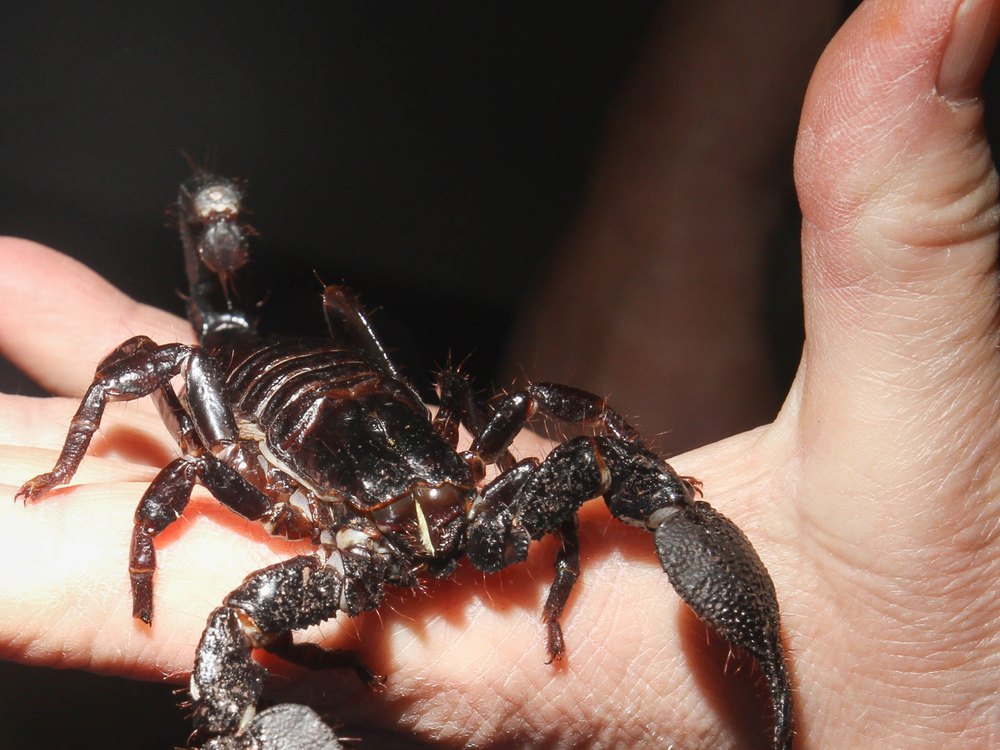
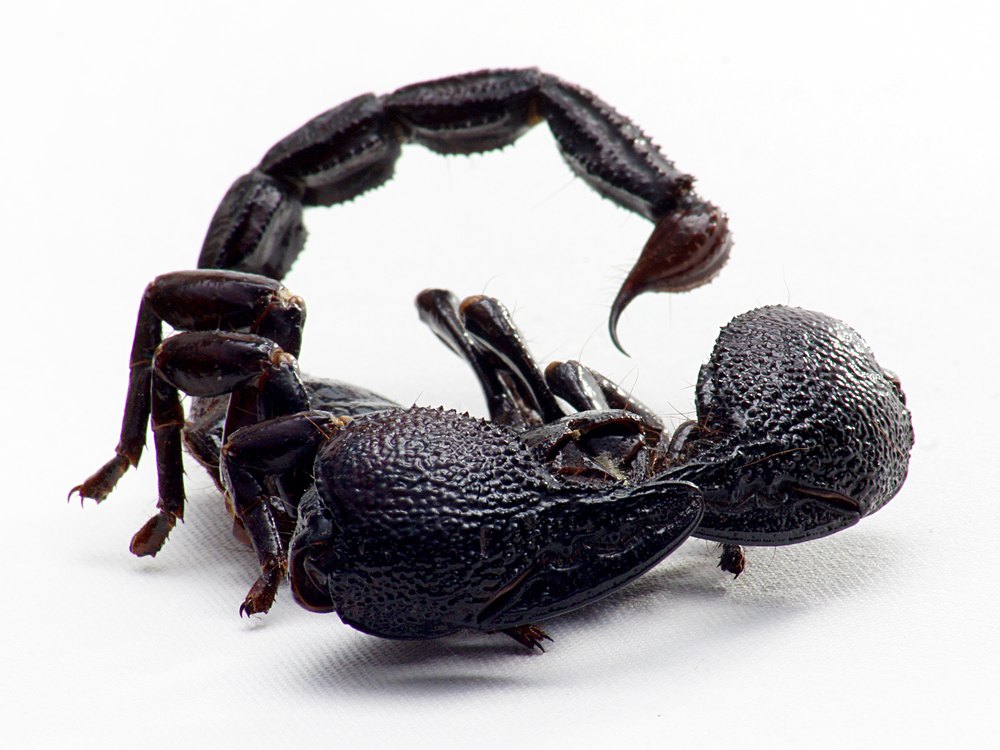
The Emperor Scorpion is a large, heavy scorpion. Adults are black, with strong, granular pincers (the pedipalps) and a red-brown tail tip.[3] Males usually have larger pectines, the comb-like organs on the underside of the body.[2]
Name
The species was first described as Buthus imperator by C. L. Koch in 1841, in his work Die Arachniden. The volume that holds the description is dated 1842 on its title page, but its first 56 pages appeared in 1841, so 1841 is the correct year under the zoological rules. Some authors still cite 1842.[5] The genus Pandinus was named by Thorell in 1876.[6][7] Animal Diversity Web uses the English name Emperor Scorpion.[2] ITIS and the Catalogue of Life also list the English name “common emperor scorpion”.[8][6]
The first specimen
Koch described the animal from a specimen in the collection of Erlangen University, where it had possibly been shown in an earlier exhibition, according to the authors who studied it later. The label gave no place of collection. The specimen, the holotype, was considered lost, and a later revision wrote that the type locality was unknown.[5][9] In 2015, during the digitisation of the entomology collections of the State Museum of Natural History in Stuttgart, it was found in a drawer labelled “Holotypus: Buthus imperator KOCH 1842”. The drawer also held 18 other scorpions, and how they reached Stuttgart is a mystery.[5] The dry specimen measures 160.9 mm in total length, and about 170 mm if its missing and broken parts are added. Its authors say it clearly belongs to P. imperator and differs from the two closest species, P. gambiensis and P. ulderigoi.[5]
In other languages
| Language | Name |
|---|---|
| Chinese | 統治者懼蠍 |
| Croatian | Carski škorpion, carski štipavac |
| Czech | veleštír obrovský |
| French | Scorpion empereur |
| German | Kaiserskorpion |
| Italian | Scorpione imperatore |
| Polish | Skorpion cesarski |
| Portuguese | Escorpião-imperador |
| Romanian | Scorpion imperial |
| Spanish | escorpión emperador |
| Ukrainian | Скорпіон імператорський |
| Language not stated | A̱gbaguru |
Unverified: these names are listed by GBIF and the Catalogue of Life, which give no country or printed source for them.[10][6]
Body
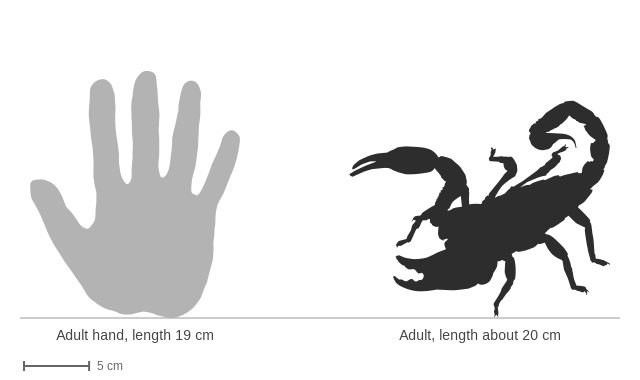
Animal Diversity Web gives an average adult length of 20 cm, and The Scorpion Files gives up to 20 cm.[2][3] Females are larger than males.[2] Mahsberg calls it one of the largest scorpions and probably the heaviest, citing Krapf (1988).[1]
In a sample of five adult females that were not pregnant, collected in a secondary forest in Ivory Coast and kept in the laboratory, body weight averaged 29.96 g (standard deviation 6.51 g).[1] Sources disagree on pregnant females: Animal Diversity Web says they can weigh more than 28 g, and The Scorpion Files says over 50 g.[2][3] A young scorpion in its second instar, the stage after the first moult, weighed 0.33 g on average (34 captive-bred young), so its mother was about a hundred times heavier.[1]
Size changes across the range. Prendini describes a gradient in which scorpions are smaller in the dry north, for example at Mouvielo in Burkina Faso, and larger in the humid south, for example in Kakum National Park in Ghana.[9]
Size ranges
| Weight (adult female, average) | about 30 g |
| Length (adult) | about 20 cm |
Senses
The eyesight is very poor, and the main senses are touch and vibration.[2] The pincers carry many hairs that detect chemicals, which Mahsberg suggests help a mother tell an intruder, prey and her own young apart.[1] Scorpions of this family react very sensitively to vibrations in the ground. In captive tests, mothers with young reacted to scratching on the ground: 43.8% attacked or stung, 48.4% turned to face it in defence and 7.8% did not respond (153 tests). Females without young mostly did not respond or fled (70.3%), 28.1% turned to defend and 1.6% attacked (64 tests).[1]
Glow under ultraviolet light
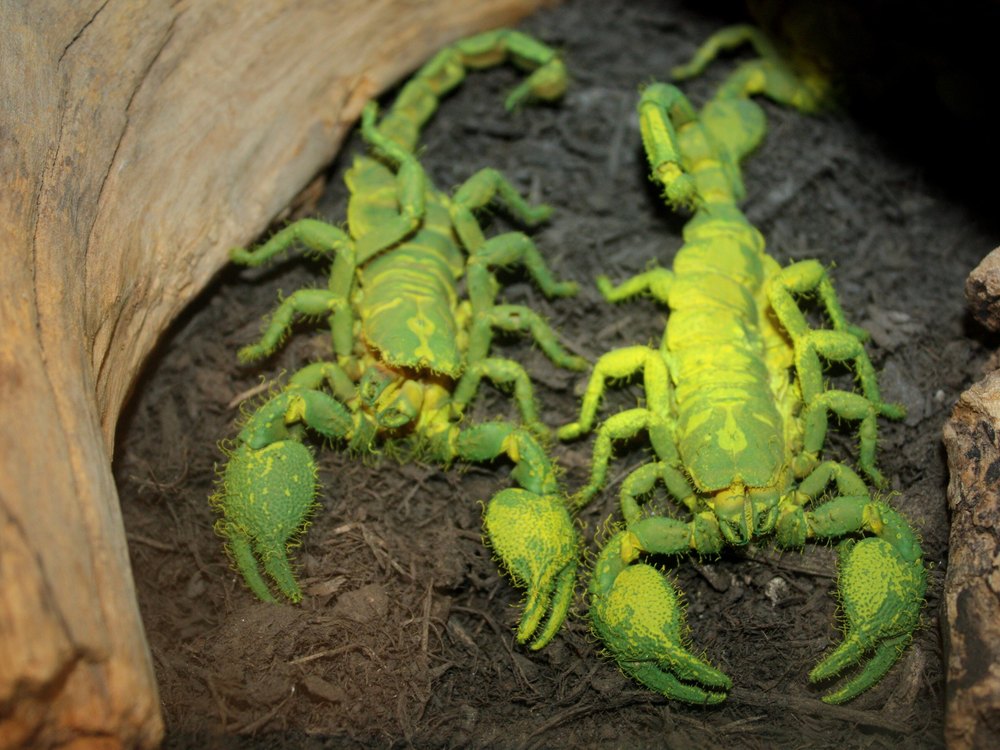
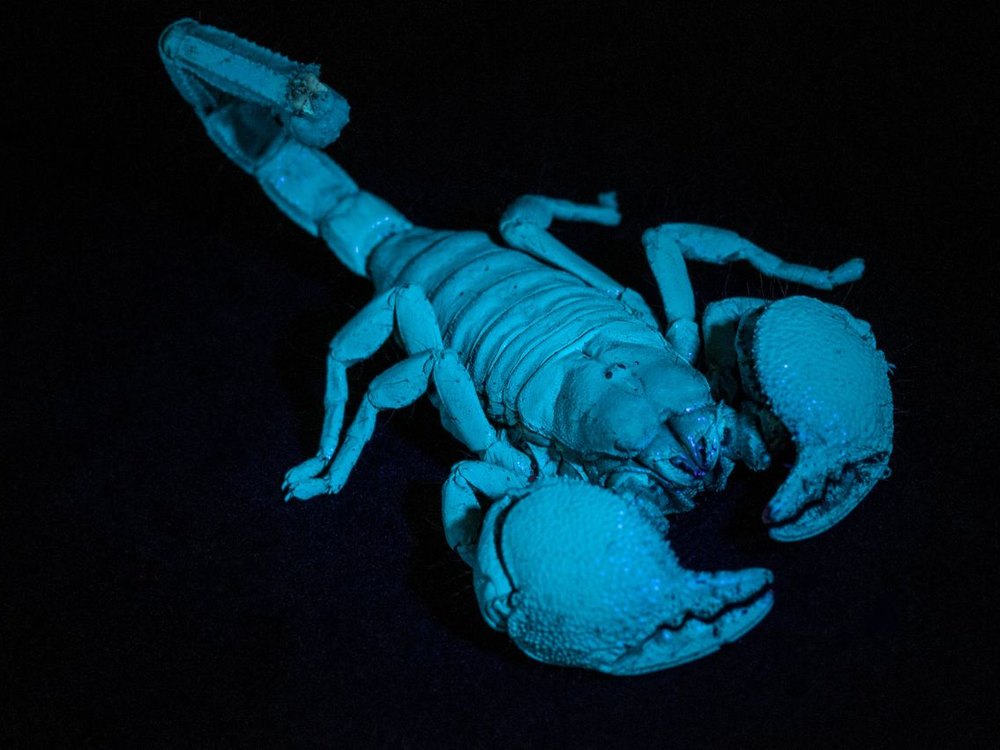
Like other scorpions, the Emperor Scorpion glows under ultraviolet light. In scorpions generally the glow comes from two compounds in the outer cuticle, beta-carboline and 4-methyl-7-hydroxycoumarin, and it is strongest under ultraviolet light of 395 nm, which the cuticle re-emits as green light at about 500 nm.[11] No function has been shown. The ideas include catching prey, attracting mates, warding off predators and rivals, and sensing light to help find shelter, and the experiments so far are on other species.[11]
Venom and sting
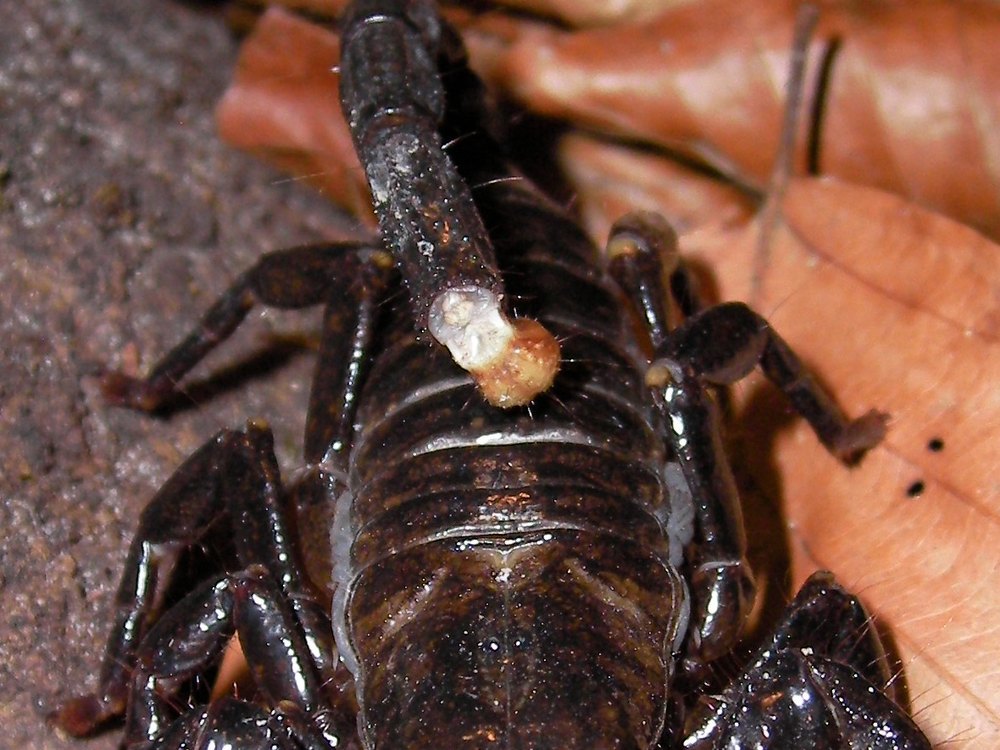
Adults kill and dismember prey with the pincers and only rarely use the sting. Young animals rely on the sting much more (see Diet).[12][2] The venom is described as mild and is used mainly for defence.[2] The Scorpion Files calls the species mildly venomous with a painful sting, and says the pincers can pinch painfully. Young animals and females with young are more likely to sting.[3]
Behavior
In captive tests the scorpions were active only at night, and by sunrise at the latest all had hidden in a shelter.[1] Animal Diversity Web also calls the species nocturnal and says it is rarely active before nightfall.[2]
Living in groups
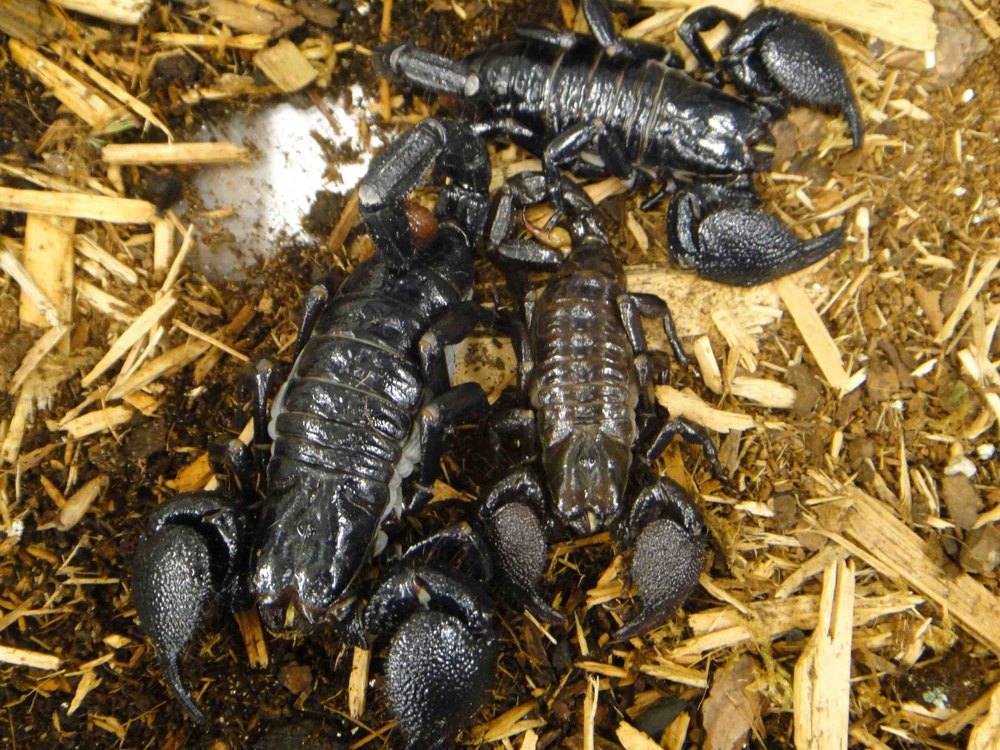
In the field, groups of up to 15 animals have been seen, and the mixed-age groups at least partly appeared to be family groups. In the laboratory, mixed-age groups of related and unrelated animals lived together and rarely showed aggression or cannibalism. Mahsberg concluded that the species is an “intermediate subsocial scorpion”, one in which mothers and young stay together but there is no colony with a division of labour.[1] In Togo, usually at least two or three animals were found together under one shelter.[4]
Defence
When touched, the Emperor Scorpion normally does not react aggressively, unlike scorpions of the family Buthidae such as Androctonus. It flees or takes a defensive posture. Mothers with young are very aggressive.[1] In a confined space it faces the threat with its sting ready.[2] Cannibalism is very low in captivity: in one experiment, four young in a group without a mother were eaten by their siblings.[1]
Diet
The Emperor Scorpion is a carnivore. Animal Diversity Web says it eats mainly insects and other arthropods. Termites are a common food, and small vertebrates are eaten only occasionally.[2] Mahsberg reports that an analysis of prey remains in the field showed that millipedes and large beetles make up the greatest share of the diet.[1] The two accounts differ on the main prey. A 2022 note reports an Emperor Scorpion preying on a Northern Flat-backed Toad (Sclerophrys maculata).[13]
Pincers and sting
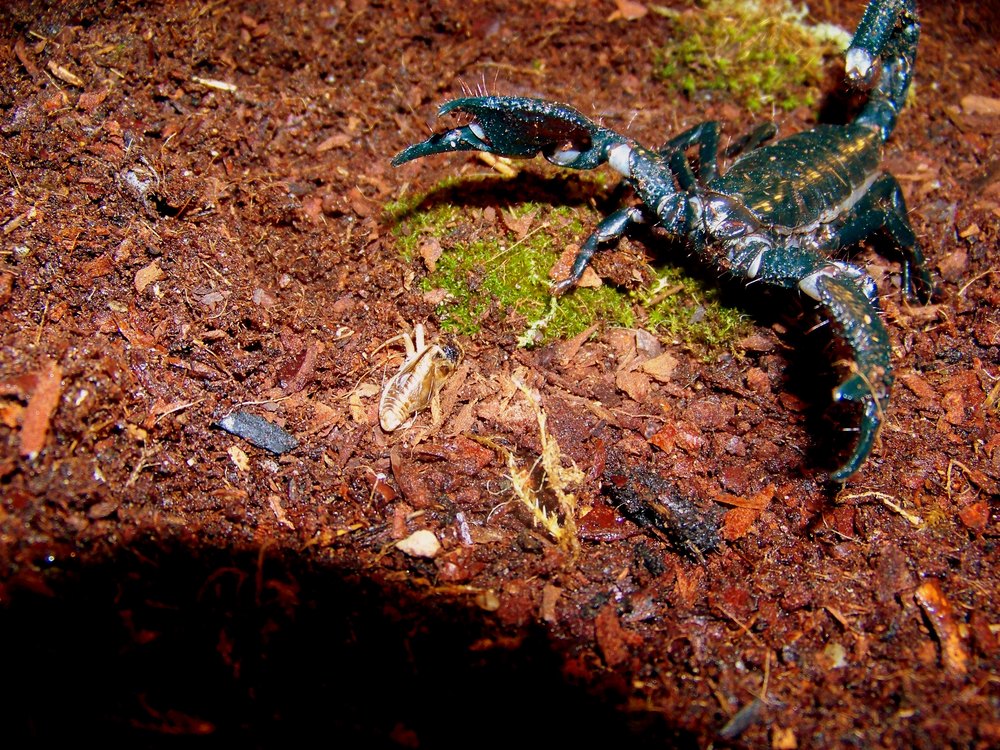
In laboratory tests, young scorpions up to 6 cm long stung nearly all prey. At 10 cm they stung only large, violently struggling prey. Adults killed prey with the pincers and apparently refused prey too large to hold with the pincers alone.[12] Animal Diversity Web likewise says adults tear prey apart with the pincers while juveniles rely on the sting.[2]


Young and the mother
In captive tests only the mother could seize, crush and dismember large cockroaches. Second-instar young could not overpower large prey even in groups. All young kept without a mother and given live prey died before 157 days, and young kept with their mother grew significantly faster.[1]
Life cycle
| Stage | Age / time | Notes |
|---|---|---|
| Birth | Born live | Gestation averages 9 months in one source[2] |
| Newborn (first instar) | Until the first moult | The young climb onto the mother’s back[2] |
| Second instar | About 0.33 g; leaves the mother’s back about a week after the first moult | Captive-bred young[1] |
| Juvenile | Up to about 6 cm while the sting is still the main weapon | Captive[12] |
| Adult | About 20 cm; maturity at about 4 years | Age at maturity from Animal Diversity Web[2] |
The Emperor Scorpion bears live young, and fertilisation is internal.[2] Animal Diversity Web says it breeds year-round and that gestation averages 9 months.[2] Brood size is given differently: Animal Diversity Web says 10 to 12 young, and the Togo government study says females carry 20 to 30.[2][4]
Mother and young
Young climb onto the mother’s back after birth, and in captivity the second-instar young leave her back about a week after the first moult.[2][1] The young stay close to the mother afterwards. In the laboratory one mother tolerated young that were 18 months old, and in the field offspring probably rarely leave their mother before they finally disperse.[1] In the same study, young raised with the mother had better survival and growth than young raised alone (see Diet). In one laboratory experiment the young were still second instars between 86 and 276 days of age, with groups fed about once every ten days.[1]
Lifespan
Animal Diversity Web says the species usually lives 5 to 8 years in captivity. The lifespan in the wild is not known.[2]
Ecology
Burrows and shelter
The Scorpion Files says the Emperor Scorpion lives in empty or self-made burrows up to 30 cm long.[3] In Togo, survey teams found shelters in old termite mounds, piles of dead grass and rotting tree trunks,[4] and Mahsberg names logs and termite mounds as preferred shelters.[1]
Predators
Animal Diversity Web lists birds, bats, mammals and spiders as predators of the Emperor Scorpion.[2]
Habitat and range
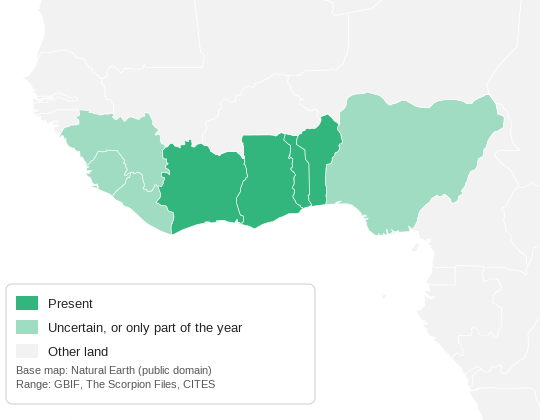
The species lives in West Africa. GBIF holds 340 records, 292 of them with a country, mostly from Ghana (59), Côte d’Ivoire (58) and Benin (41), followed by Nigeria (29), Togo (27), Liberia (21), Guinea (14) and Sierra Leone (10).[10] The Scorpion Files also lists Guinea-Bissau and the Democratic Republic of the Congo,[3] and GBIF has a few records from Burkina Faso and Cameroon; these countries are not shaded. Prendini found no credible records east of the Adamawa massif in Cameroon, and thinks specimens from Cameroon and Gabon that were called P. imperator are probably another species, P. dictator.[9]
Habitat
Mahsberg calls it “a forest dweller of tropical West Africa” of rain and gallery forests. The animals he studied came from a secondary forest in Ivory Coast.[1] The Scorpion Files lists tropical forest and rainforest with a humid environment, and Animal Diversity Web says hot and humid forests.[3][2] In Benin, 34 GBIF records from 2013 come from sacred and relict forests.[10] It also uses land in the forest zone that people have cleared. In southern Togo, populations were counted on fallow land abandoned by farmers, mainly with oil palms and old cassava fields, and the species was also found in central Togo.[4] Animal Diversity Web adds leaf litter, forest debris and stream banks as places where it lives.[2]
Numbers
In February 2016, Togo surveyed five sites in the south of the country, counting scorpion galleries on 1 hectare at each. It found 98 to 145 galleries per hectare and estimated 122 to 217 scorpions per hectare, assuming that a quarter to half of the galleries held two animals. All sites were fallow land.[4][14]
Evolution
Scorpions are an ancient order of arachnids, and studies date the origin of the living scorpions differently. One timetree gives a window of 335 to 266 million years ago for the divergence of all living scorpions,[15] while a study of transcriptomes puts their diversification between the Devonian and the early Carboniferous, which is older.[16] Both of the two living scorpion groups, Buthida and Iurida, may already have existed in the Triassic.[17] The family Scorpionidae has only potential but unconfirmed fossil records, from the Neogene.[17]
Within Scorpionidae, one analysis of anatomy and DNA places Opistophthalmus at the base, then Scorpio, with Heterometrus and Pandinus as sister genera.[18] The Asian forest scorpions of the group Heterometrinae split from other Scorpionidae on the African continent, after India separated from it, in the Cretaceous.[19] The genus Pandinus in its wide sense is a single natural group in that analysis, and the species most like P. imperator are P. gambiensis, once treated as a subspecies of it, and P. ulderigoi.[9][5] No fossil of Pandinus is known.[17]
Forms and variants
No colour forms or subspecies are recognised by GBIF, the Catalogue of Life or The Scorpion Files, and adults are black.[10][6][3] ITIS still lists two subspecies as valid, P. i. imperator and P. i. subtypicus.[8] Pandinus gambiensis, once a subspecies of P. imperator, was raised to a species in 1967.[9]
Conservation
The Emperor Scorpion is Not evaluated by the IUCN Red List.[2][10] It has been listed in Appendix II of CITES, which controls international trade, since 16 February 1995, after a proposal by Ghana.[4][20] Ghana gave as reasons the heavy pet trade, the small broods, the long gestation and the long dependence of the young, and said that most animals in trade came from the wild.[20] The Scorpion Files quotes an estimate from the IUCN trade programme that around 100,000 Emperor Scorpions were exported from West Africa in 1995 and 1996.[3]
Threats
Collection for the pet tradeHabitat lossClimate change[14][4]Collection for the pet trade. The main threat named in the sources is collecting for the pet trade. The CITES Animals Committee wrote that collectors remove all specimens in an area until no more can be found, and that digging them up destroys a large share of the burrows the species needs to survive.[14]
Slow breeding. The species is also vulnerable because it has few young, a long gestation and young that depend on their mother for a long time.[4][20]
Habitat loss and climate change. The Togo study names habitat loss and climate change, in the form of irregular or delayed rain, and notes that fallow land used by the scorpion can be farmed again from one year to the next.[4]
Trade rules
Trade from three countries has been under review. In 2013 CITES recommended suspending trade from Togo and Benin, and in 2014 from Ghana. In 2025 the recommendation for Togo was withdrawn, on the condition that Togo publishes an annual export quota of 20,000 animals, and the recommendations for Benin and Ghana still stood.[21] Togo’s quota, published in January 2024, is 8,000 wild and 12,000 ranched animals a year, and live ranched animals may be no longer than 10 cm, not counting a tail of 5 cm.[21] The Animals Committee noted in 2017 that all animals exported from Togo appeared to fit the wild source code and that no permanent marking system could tell wild from ranched animals.[14] A European Union regulation of 2017 prohibited the introduction of wild and ranched P. imperator from Benin, Ghana and Togo.[22]
History and culture

The pet trade
The Emperor Scorpion is popular as a pet for its large size, its large pincers and its easy breeding in captivity.[5] The Scorpion Files calls it the most common scorpion in captive care.[3] In Togo, local collectors supply most of the animals, while animals bred in captivity come mainly from hobby breeders in the United States and Europe.[4] Ranch farms in Togo need at least 8 to 10 months to produce animals of a suitable size for export.[14] Animals sold under the invalid name Pandinus africanus were seen to be another species, Pandinoides cavimanus, and The Scorpion Files says the name may be used to avoid CITES rules.[23]
Venom research
Researchers have studied the venom for molecules that might be useful. Two small proteins in it, called pandinin 1 and pandinin 2, kill bacteria in laboratory tests. They worked against the two main kinds of bacteria, Gram-positive and Gram-negative, at doses of 2.4 to 5.2 micromolar for the first kind and 2.4 to 38.2 micromolar for the second (a micromolar dose is a measure of concentration, and a smaller number means a stronger effect). Only pandinin 2 also acted on a yeast, Candida albicans, which can infect people, and it burst sheep red blood cells.[24] In 1992, researchers reported two other venom proteins, the imperatoxins, which act on the channels that release calcium inside muscle cells: one blocks them and one opens them.[25] Animal Diversity Web adds that the venom contains scorpine, a protein that may fight malaria and bacteria.[2]
Taxonomy
| Rank | Name |
|---|---|
| Kingdom | Animalia |
| Phylum | Arthropoda |
| Subphylum | Chelicerata |
| Class | Arachnida |
| Order | Scorpiones (scorpions) |
| Superfamily | Scorpionoidea[26] |
| Family | Scorpionidae[7] |
| Subfamily | Pandininae[26] |
| Genus | Pandinus Thorell, 1876[6] |
| Species | Pandinus imperator (C. L. Koch, 1841)[10][6][8][3] |
Higher classification
The Emperor Scorpion is in the family Scorpionidae, within the order Scorpiones, the true scorpions. The Scorpion Files list 19 genera and 207 living species in the family, which also holds the Asian forest scorpions (Heterometrus and its relatives).[7] Pandinus has five species in that list: P. gambiensis, P. imperator, P. sahelicus, P. ugandaensis and P. ulderigoi.[7] The closest relatives are described under Evolution.
A wide or a narrow genus, one species or several
Authors disagree about how wide the genus Pandinus is. Prendini (2016) writes the name as Pandinus (Pandinus) imperator and keeps the former subgenera inside one wide genus. Rossi (2015) had raised those subgenera to full genera, which Prendini says was done without testing whether each is a natural group. The Scorpion Files follow Rossi, which is why they list only five species in Pandinus.[7][9] The species itself was also split and lumped. Lourenço (2014) treated roeseli as a valid species and described camerounensis, but Prendini merged both into imperator. He found that the size difference between them fades in the raw data and that the genes of small and large populations differ little.[9] A European Union regulation of 2017 still lists Pandinus roeseli beside Pandinus imperator.[22]
Sources
- Mahsberg 1990, Acta Zoologica Fennica 190: 267–272
- Animal Diversity Web, Pandinus imperator
- The Scorpion Files, Pandinus imperator
- Togo Ministry of Environment 2016, study on four species of fauna in international trade (CITES SC67 Doc. 15, Annex 3)
- Holstein, Wendt & Rossi 2017, Arachnologische Mitteilungen 54: 44–47
- Catalogue of Life, Pandinus imperator
- The Scorpion Files, family Scorpionidae
- ITIS, Pandinus imperator
- Prendini 2016, Bulletin of the American Museum of Natural History 407: 1–66
- GBIF, Pandinus imperator
- Gaffin & Barker 2014, Journal of Arachnology 42: 111–118 (ultraviolet fluorescence in scorpions; tested on another species)
- Casper 1985, Journal of Arachnology 13: 277–283 (prey capture and stinging behaviour)
- Ofori, Mensah, Attuquayefio & Kaiser 2022, Herpetology Notes 15: 619–620 (predation on a toad by an Emperor Scorpion)
- CITES Standing Committee, 69th meeting, 2017, Doc. 30, review of significant trade (comments of the Animals Committee on Pandinus imperator from Togo)
- Howard et al. 2019, Organisms Diversity & Evolution 19: 71–86
- Sharma et al. 2018, Molecular Phylogenetics and Evolution 122: 37–45
- Dunlop & Garwood 2024, PeerJ 12: e18557
- Prendini, Crowe & Wheeler 2003, Invertebrate Systematics 17: 185–259
- Loria & Prendini 2020, Scientific Reports 10: 22301
- CITES Conference of the Parties, 9th meeting, 1994, proposals 63–65 (Ghana) to list Pandinus dictator, P. gambiensis and P. imperator in Appendix II
- CITES Notification to the Parties No. 2025/031, 13 March 2025
- Commission Implementing Regulation (EU) 2017/1915
- The Scorpion Files, scorpions and CITES
- Corzo et al. 2001, Biochemical Journal 359: 35–45
- Valdivia et al. 1992, PNAS 89: 12185–12189
- ITIS, Pandinus imperator, classification