The Giant African Millipede (Archispirostreptus gigas) is a very long, cylindrical millipede whose body is made of 62 to 70 rings.[1][2] It lives in coastal eastern Africa, from Somalia to South Africa, in forest and in shrubland that may be linked to savanna.[3] The IUCN rates the species Least Concern because it is widely distributed, but its population size and trend are unknown.[3]
Quick facts
Description
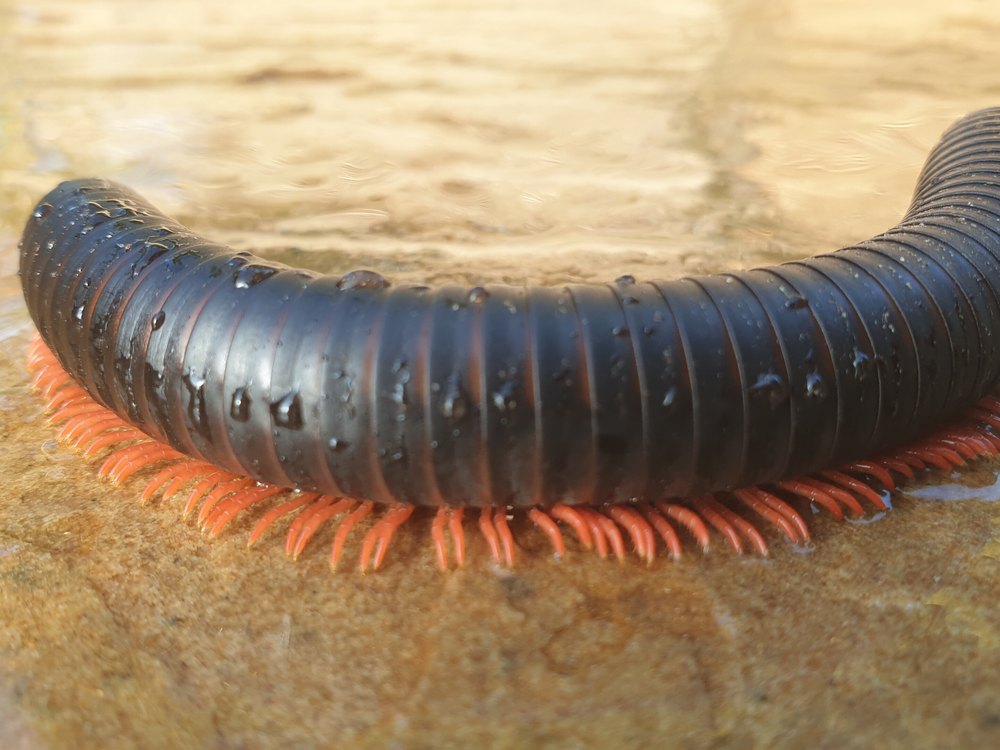
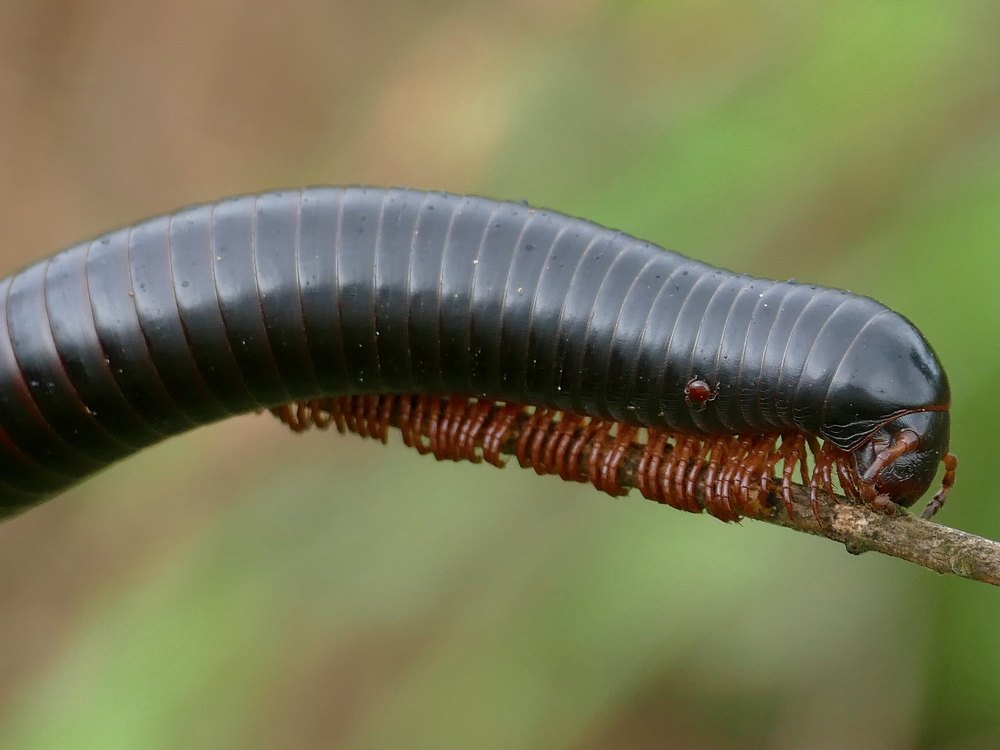
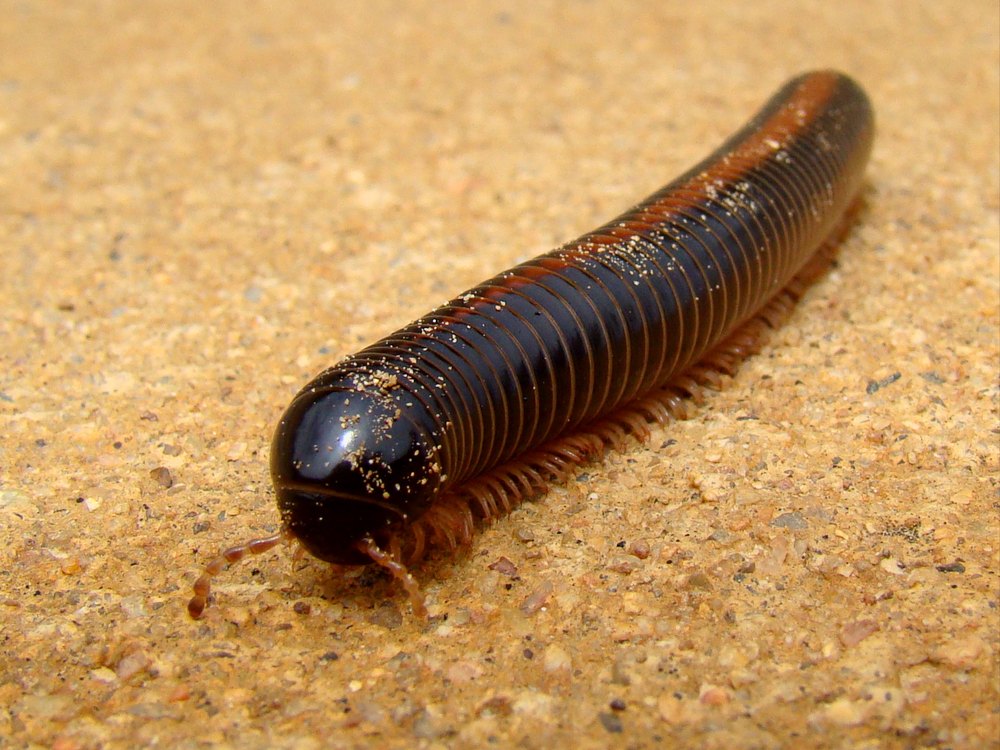
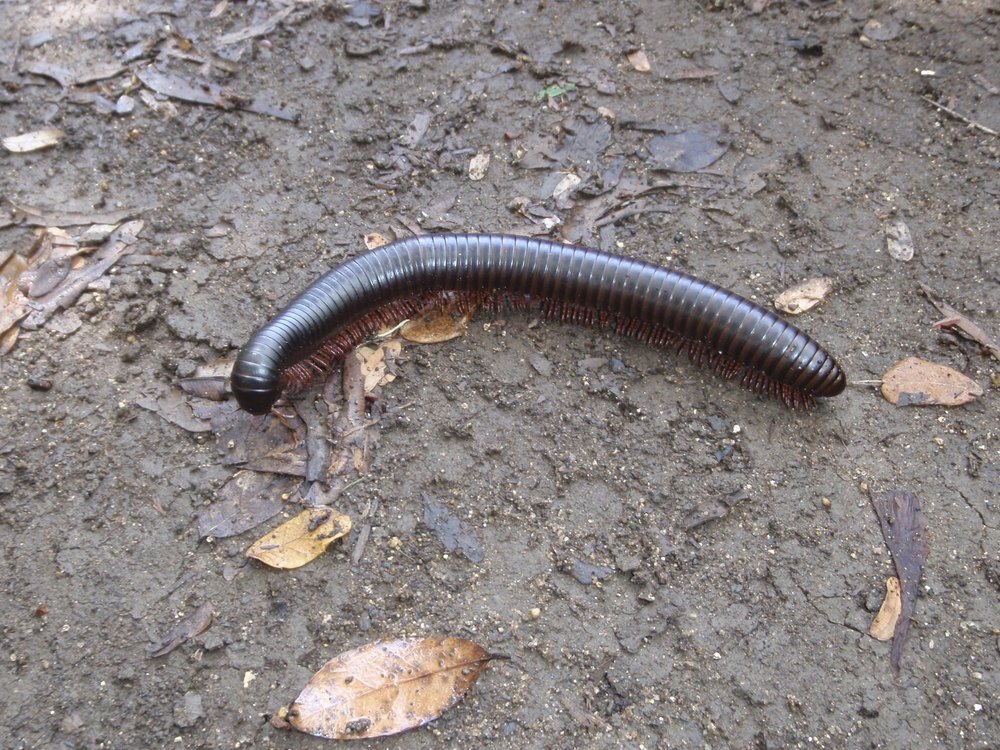
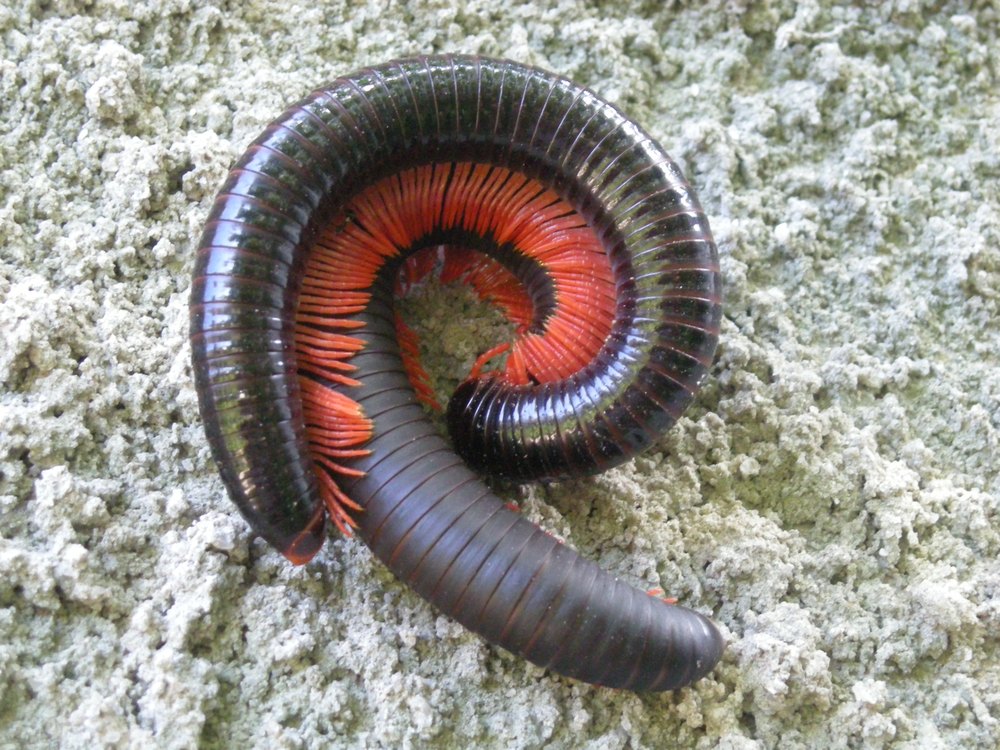
The museum description of the Giant African Millipede (Archispirostreptus gigas) gives its colour as black.[1] The body is long and cylindrical. It is made of rings, and each ring is a diplosegment, a body ring formed from two fused segments.[1] The first ring behind the head, called the collum, is rounded and has no lobe at its front edge. It carries a few fine grooves.[1]


Males are told apart from females by their first pair of legs, which is modified, and by the gonopods. A gonopod is a leg changed into a sex organ.[1]
Name
The species was first named Spirostreptus gigas (see History and culture). It later sat in the genus Graphidostreptus and now belongs to Archispirostreptus, of which it is the type species.[1][5][2] GBIF and MilliBase list at least 10 older or alternative names for the same animal.[5][2]
The trade name
“Giant African millipede” is also a trade label. Pet sellers and zoos use it for several similar large millipedes of the family Spirostreptidae, not for one species.[6] In 2026 Alvear and colleagues showed that two zoo stocks in the United States sold or shown under the name were Spiropoeus fischeri, a different millipede, and they say the species of captive animals is often uncertain.[6] Figures from pet and zoo pages may therefore describe another animal.
In other languages
| Language | Name | Meaning |
|---|---|---|
| Dutch | Afrikaanse reuzenmiljoenpoot | African giant millipede |
| German | Afrikanischer Riesentausendfüßler | African giant thousand-footer |
| French | Iule géant d’Afrique | giant African julid (a kind of millipede) |
| Italian | Millepiedi gigante africano | African giant thousand-feet |
Names are from the vernacular-name list that GBIF shows for this species, credited there to the Catalogue of Life.[5]
Body
Size
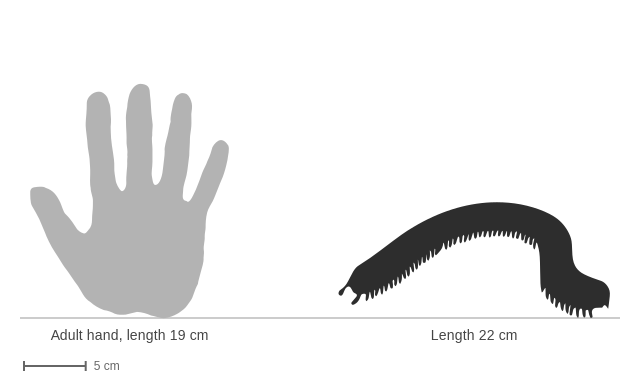
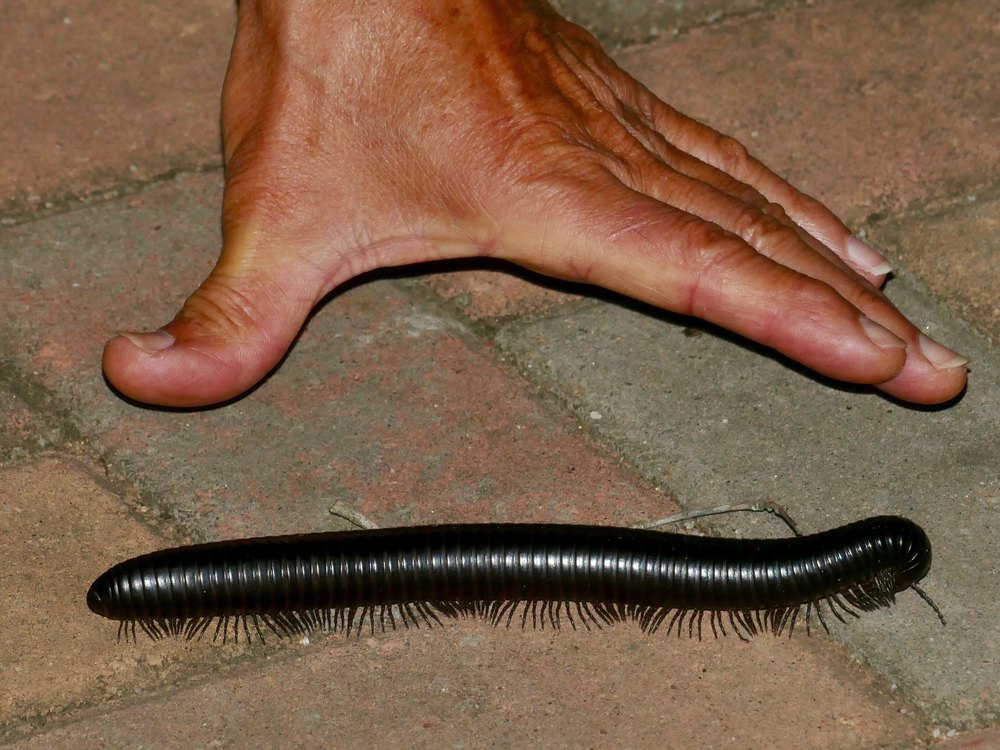
Museum measurements of preserved specimens give a body length of 178 to 260 mm and a width of 15 to 19 mm.[1] The description does not say whether the specimens came from the wild or from captivity, and it gives no weight.[1]
Larger lengths are claimed. Alvear and colleagues (2026) call it the longest millipede, at up to 30 cm, without giving a measurement.[6]
| Length (adult) | 178–260 mm |

Defensive secretion
Many millipedes of this order defend themselves with benzoquinones, stinging chemicals. Smolanoff and colleagues (1975) list A. gigas among eight African species said to make two of them, toluquinone and 2-methoxy-3-methyl-1,4-benzoquinone, and they cite an earlier analysis for it.[7]
Gut and digestion
Both the midgut and the hindgut contain no oxygen. Methane-making Archaea, a group of single-celled microbes, live in the gut, mostly of the genus Methanobrevibacter.[8][4] Every animal tested made large amounts of methane. One adult made more than a smaller tropical millipede, Epibolus pulchripes (a relative), and several orders of magnitude more than small European millipedes. The midgut holds enzymes that break down starch, cellulose and chitin, and starch and laminarin (a storage sugar of algae) were broken down fastest.[9]
Breathing
The millipede has a tracheal system, a network of air tubes, and also carries haemocyanin, a copper-based blood pigment that carries oxygen. Its haemocyanin binds oxygen tightly, releases it more readily when the blood turns acidic, and is tuned by calcium and lactate.[10]

Behavior
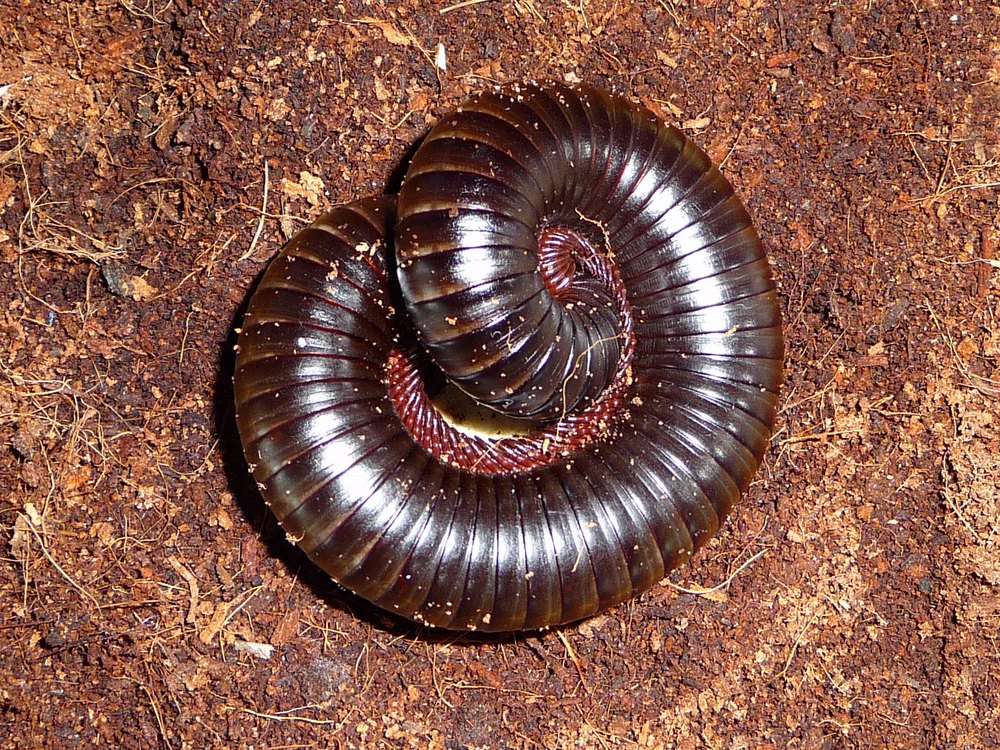
According to San Diego Zoo, the Giant African Millipede is active at night and curls into a tight coil when it is disturbed.[11]


The IUCN Red List classes the species as not a migrant, so it does not travel seasonally between regions.[3]
Diet
Captive Giant African Millipedes in a Czech laboratory study lived on garden substrate and hardwood leaf litter, with cuttlefish-bone powder added as a source of calcium. They also ate large amounts of kitchen waste such as pieces of potato, cucumber and cabbage heads.[4] These animals came from a pet shop and from breeders, and were kept at about 25 °C.[4]
For wild animals, the IUCN gives no food list, but it places the species in forests and, in South Africa, in mopane shrubland.[3] A study of its blood pigment calls it a forest-floor dweller, where dead leaves and other plant litter lie.[10] For how it digests its food, see Body.

Life cycle
| Stage | What it looks like / size |
|---|---|
| Egg | Laid in a hole in the ground, according to San Diego Zoo. [11] |
| Hatchling | White, few rings. [11] |
| Juvenile | Gains rings as it moults. [11] |
| Adult | 178 to 260 mm long (preserved museum specimens). [1] |
Stages
According to San Diego Zoo, the female lays hundreds of eggs in a hole in the ground a few weeks after mating, and the eggs hatch after about three months.[11] The hatchlings are white, with few body segments and roughly three pairs of legs. They moult within the first 12 hours, then at least 7 to 10 more times over several years. Each moult adds one body segment with four legs.[11]

Lifespan
San Diego Zoo gives a life span of 5 to 7 years, without saying whether that is in the wild or in a zoo.[11]
Ecology
Parasites and companions
A fungus, Rickia gigas, was first described from the Giant African Millipede (Archispirostreptus gigas). It belongs to the Laboulbeniales, a group of tiny fungi that grow on the outside of insects and other arthropods. Its thalli (the fungus bodies) grow mostly on the legs and sometimes on the first body rings, and they pass 2 mm in length, which makes this one of the largest fungi of its group.[12] The type specimen comes from Tanga in Tanzania, outside the Amboni Caves, collected in 1974. The fungus is also known from Ruvu South Forest Reserve in Tanzania and from pet-trade animals.[12] The same paper reports that it can infect millipedes kept in terraria.[12]
Mites of the genus Julolaelaps live on the millipede. Three species were known from it before 2023: J. celestiae, J. kilifiensis and J. moseri. A fourth, J. gigas, was described that year from a captive animal in Korea.[13] The authors say the link between these mites and their hosts can range from harmless to parasitic, and that experiments are needed to tell which applies here.[13]
The hindgut holds single-celled ciliates of the genus Nyctotherus, including N. velox and a new species, N. archispirostreptae, which are considered commensals (companions that do no harm). In laboratory-bred animals there were fewer than 50 per millipede.[14] In a study of 69 zoo-housed animals submitted for examination between 2018 and 2021, most deaths came in midwinter and 80% of the animals had inflammation in their tissues.[15]
Habitat and range
Habitat
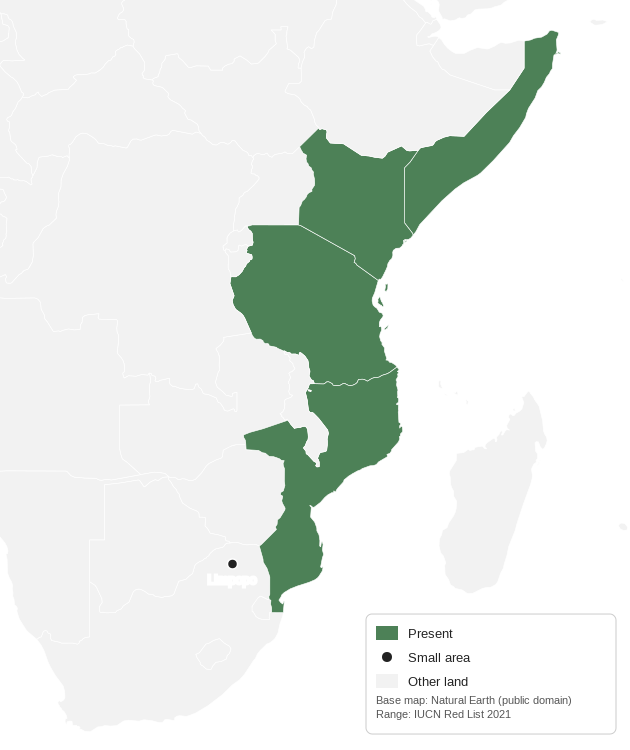
In South Africa the Giant African Millipede is known from mopane basalt shrubland (low scrub dominated by mopane trees) and may also be linked to other savanna habitats. Along the east coast it seems to live mainly in forest.[3] The IUCN lists suitable habitat as subtropical or tropical dry forest and subtropical or tropical dry shrubland.[3] The specimens examined in the 2010 revision of the genus came from Tsavo and from Ngaia Forest in Kenya.[1]
Range
The IUCN lists the species as native and resident in Kenya, Mozambique, Somalia, Tanzania (including Zanzibar) and South Africa, where it names only Limpopo Province. It describes the range as stretching from Somalia to South Africa, and says the exact localities in most of these countries are unknown.[3] The known localities suggest a spread mostly along the east coast, though the authors of the 2010 revision say the known range may be a collecting artefact.[1][3] A 2009 survey of the Middle East records other Archispirostreptus species in Arabia, not this one.[16]
Evolution
Millipedes are among the oldest land animals, and the dates for them differ between studies. A genome-based tree puts the common ancestor of all living millipedes (class Diplopoda) at about 467 million years ago, with a 95% range of 424 to 531 million years.[17] Another study dates the split between millipedes and centipedes to about 474 to 479 million years ago, depending on the dating model used.[18] A third study places the deepest splits among the myriapods (millipedes, centipedes and their kin) in the Cambrian or Ordovician, and finds millipede ages that overlap with the fossils used to calibrate them.[19] From fossils, one author argues that millipedes were on land no later than the Ordovician, then spread quickly in the Silurian, so that most major groups existed by the Early Devonian.[20] Juliform millipedes, the group that holds the Spirostreptida, are already found in Lower Devonian rock in Gaspestria and Sigmastria, which are relatives and not ancestors of the Giant African Millipede.[20]
Pneumodesmus newmani from Scotland, a millipede with breathing pores, is often named as the oldest air-breathing land animal. Older work gives its age as about 428 million years. Dating of zircon crystals in the rock above and below the fossil bed gave 413.7 and 414.3 million years (each with an error of several million years), so a 2017 study puts it at about 414 million years.[21]
The Giant African Millipede belongs to the Spirostreptida. In the one tree that included it, with only two Spirostreptida species sampled, the order's two suborders split about 217 to 285 million years ago, depending on the dating model.[18] The tree in the box under Taxonomy is drawn as a fan where the studies disagree.
Forms and variants
No subspecies of the Giant African Millipede are recognised by GBIF, MilliBase or the IUCN.[5][2][3] A 2024 paper described a relative, Archispirostreptus microgigas from Tanzania, and listed a 1987 specimen from the Lindi Region as A. cf. gigas because its gonopods (male sex legs) differ in one small part, though its other features match a normal A. gigas.[22]
Conservation
Status
The IUCN lists the Giant African Millipede (Archispirostreptus gigas) as Least Concern (assessed 26 July 2017, published 2021), because it occurs from Somalia to South Africa.[3] The population size and trend are unknown. The extent of the range and the area the species occupies are also unknown, but both are likely to be far above the thresholds for the Vulnerable category.[3] It occurs in at least one protected area. No recovery plan or monitoring scheme exists. The IUCN says research is needed on its exact distribution, habitat needs, population size and trend.[3]
Threats
Habitat lossCollection for the pet trade[3]Habitat loss. The IUCN names the conversion of natural vegetation to farmland and housing as a likely pressure in parts of the range. It codes housing, crops and plantations as ongoing threats, with scope and severity unknown.[3]
Collection for the pet trade. Animals are also collected for the international pet trade, but the IUCN says the extent and effect of this are unknown.[3]
Trade rules
The IUCN records no international trade controls for the species.[3] In the United States, a 2014 release from Customs and Border Protection (CBP) describes 20 live giant millipedes, sent from Germany in a parcel labelled “toy car model”. CBP says the parcel lacked the import permits required by federal agencies and was misrepresented to avoid the rules.[23] The release does not name the species.
History and culture
The first description
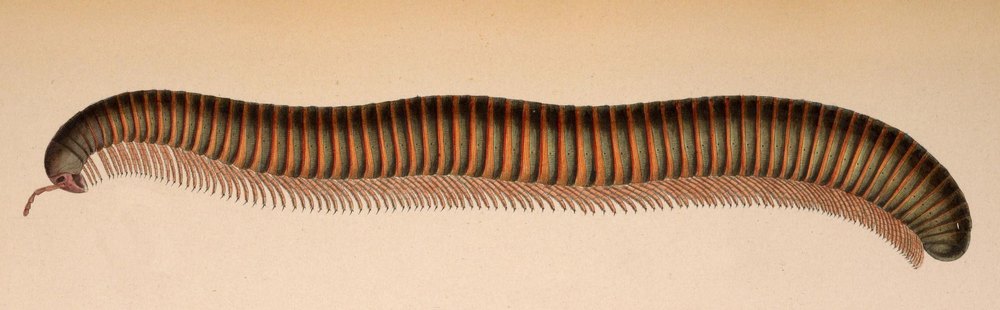
The German zoologist Wilhelm Peters described the species in 1855 as Spirostreptus gigas, in the monthly reports of the Berlin Academy of Sciences (volume 14).[5] The type, a male, came from Tete in Mozambique. Its present location is unknown.[1]

The pet and zoo trade
The IUCN says the species is present in the international pet trade.[3] Pet and zoo animals sold under the name are not always this species (see Name). A fungus found on animals in the trade is described under Ecology.[12]
Research
Laboratory colonies have made the millipede a study animal. Its blood pigment, haemocyanin (a copper-based protein that carries oxygen), has been described in detail.[10] Its defensive fluid contains benzoquinones, stinging chemicals.[7] Its gut produces methane through Archaea.[4][8] Ciliates from its hindgut and mites from captive animals have been described from lab and zoo stock (see Ecology).[14][13]
Taxonomy
| Rank | Name |
|---|---|
| Kingdom | Animalia |
| Phylum | Arthropoda |
| Subphylum | Myriapoda |
| Class | Diplopoda (millipedes) |
| Order | Spirostreptida[5][3] |
| Family | Spirostreptidae[5][3] |
| Genus | Archispirostreptus Silvestri, 1895[5] |
| Species | Archispirostreptus gigas (Peters, 1855)[5][2] |
Synonyms (10)
| Name |
|---|
| Graphidostreptus gigas (Peters, 1855) |
| Spirostreptus gigas (Peters, 1855) |
| Spirostreptus plumaceus (Voges, 1878) |
| Spirostreptus semicylindricus (Voges, 1878) |
| Spirostreptus opistheurys (Attems, 1896) |
| Epistreptus procerus (Attems, 1935) |
| Spirostreptus procerus (Attems, 1935) |
| Aethiopistreptus attemsii (Verhoeff, 1938) |
| Graphidostreptus msalaensis (Kraus, 1958) |
| Spirostreptus msalaensis (Kraus, 1958) |
From the GBIF backbone.[24]
Higher classification
The Giant African Millipede is in the family Spirostreptidae, in the order Spirostreptida. MilliBase places it in the subfamily Spirostreptinae and the tribe Spirostreptini.[2] GBIF lists 14 names in Archispirostreptus.[5] Enghoff (2024) describes a smaller Tanzanian species, A. microgigas, and names A. gigas and A. divergens as its possible closest relatives, because all three share a rounded lobe on the gonopod, the male sex leg.[22]
Changes in the genus
The 2010 revision by Mwabvu and colleagues found two groups of species inside Archispirostreptus, a southern African and an east African one, with different gonopods. They moved the southern African group into a new genus, Cacuminostreptus, and A. gigas stayed in Archispirostreptus.[1] The same revision also merged two other pairs of species names, but none of these changes touched A. gigas.[1] The common name is also used in the pet trade for several similar large millipedes (see Name).
Sources
- Mwabvu, Hamer, Slotow and Barraclough 2010, “A revision of the taxonomy and distribution of Archispirostreptus Silvestri 1895 (Diplopoda, Spirostreptida, Spirostreptidae)”, Zootaxa 2567: 1–49
- MilliBase, Archispirostreptus gigas (Peters, 1855)
- Rudolf, Hamer and Hochkirch 2021, IUCN Red List assessment of Archispirostreptus gigas
- Šustr, Chroňková, Semanóvá, Tajovský and Šimek 2014, “Methane production and methanogenic Archaea in the digestive tracts of millipedes (Diplopoda)”, PLoS ONE 9(7): e102659
- GBIF Backbone Taxonomy, Archispirostreptus gigas (Peters, 1855), with its synonyms, vernacular names and occurrence records
- Alvear, Young, Vasquez-Valverde and Marek 2026, “Identification of Spiropoeus fischeri Brandt, 1833 from captive bred millipedes in Zoos”, Biodiversity Data Journal 14: e196645
- Smolanoff, Demange, Meinwald and Eisner 1975, “1,4-Benzoquinones in African millipeds”, Psyche 82: 78–80
- Horváthová et al. 2021, “Methanogenesis in the digestive tracts of the tropical millipedes Archispirostreptus gigas and Epibolus pulchripes”, Applied and Environmental Microbiology 87(15)
- Šustr et al. 2020, “Enzymatic activities in the digestive tract of spirostreptid and spirobolid millipedes”, Comparative Biochemistry and Physiology B 240: 110388
- Damsgaard et al. 2013, “Molecular and functional characterization of hemocyanin of the giant African millipede, Archispirostreptus gigas”, Journal of Experimental Biology 216: 1616–1623
- San Diego Zoo, giant African millipede animal page
- Santamaria, Enghoff and Reboleira 2016, “Laboulbeniales in millipedes: genus Rickia”, Phytotaxa 243(2): 101–127
- Joharchi, Keum and Jung 2023, “First record of Julolaelaps in Korea, new species on a captive giant African millipede”, ZooKeys 1180: 51–65
- Kisidayová et al. 2023, “Some aspects of the physiology of the Nyctotherus velox, a commensal ciliated protozoon taken from the hindgut of the tropical millipede Archispirostreptus gigas”, Life 13: 1110
- Delaney, Pushinsky, Cook and Fox 2023, “Histologic lesions of giant African millipedes (Archispirostreptus gigas) from a zoological institution”, Veterinary Pathology
- Shelley 2009, “The milliped families Spirostreptidae and Paradoxosomatidae in the Middle East; first records of the Diplopoda from Saudi Arabia”, Insecta Mundi 0083: 1–8
- Rodriguez et al. 2018, “Step-wise evolution of complex chemical defenses in millipedes: a phylogenomic approach”, Scientific Reports 8: 3209
- Brewer and Bond 2013, “Ordinal-level phylogenomics of the arthropod class Diplopoda (millipedes) based on an analysis of 221 nuclear protein-coding loci”, PLoS ONE 8(11): e79935
- Benavides, Edgecombe and Giribet 2023, “Re-evaluating and dating myriapod diversification with phylotranscriptomics under a regime of dense taxon sampling”, Molecular Phylogenetics and Evolution 178: 107621
- Wilson 2006, “Juliformian millipedes from the Lower Devonian of Euramerica: implications for the timing of millipede cladogenesis in the Paleozoic”, Journal of Paleontology 80(4): 638–649
- Suarez, Brookfield, Catlos and Stockli 2017, “A U-Pb zircon age constraint on the oldest-recorded air-breathing land animal”, PLoS ONE 12(6): e0179262
- Enghoff 2024, “A lesser giant millipede from Tanzania (Diplopoda, Spirostreptida, Spirostreptidae)”, Zootaxa 5437(3): 424–432
- U.S. Customs and Border Protection, “CBP intercepts giant millipedes at SFO mail facility”, 29 August 2014
- GBIF backbone, Archispirostreptus gigas, synonyms