The Giant California Sea Cucumber (Apostichopus californicus), long studied as Parastichopus californicus, is a large sea cucumber of cold rocky coasts from Alaska to Baja California.[1][2] It is about 25 cm long on average when contracted.[3] It is fished by divers for its muscular body wall, and the IUCN listed it as Vulnerable in 2026.[2]
Quick facts
Description
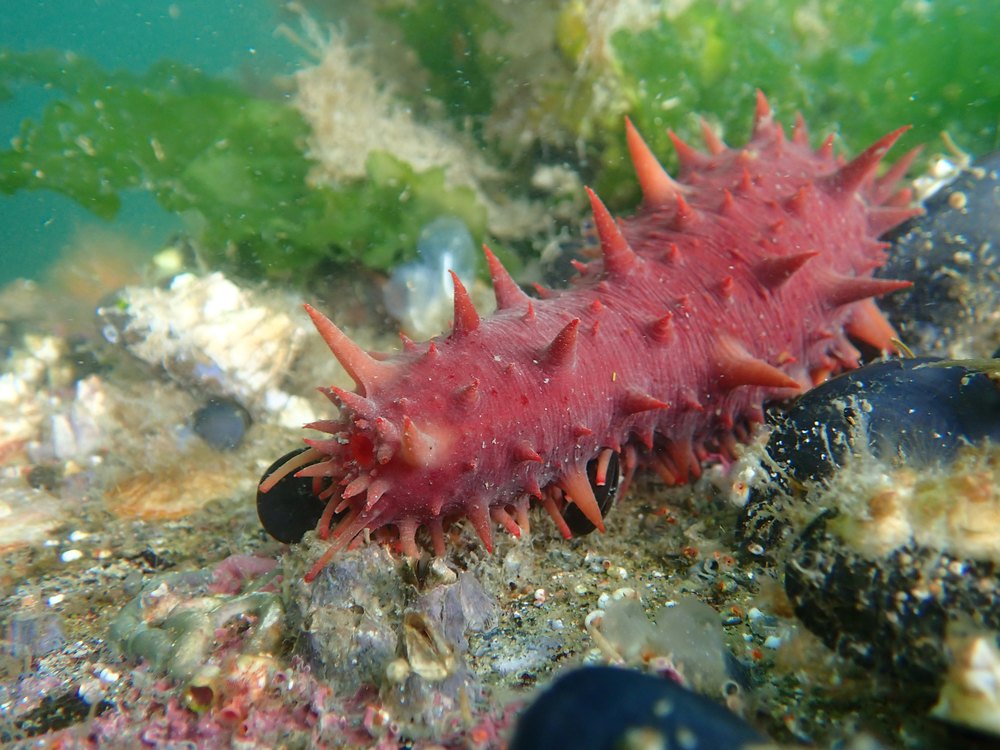
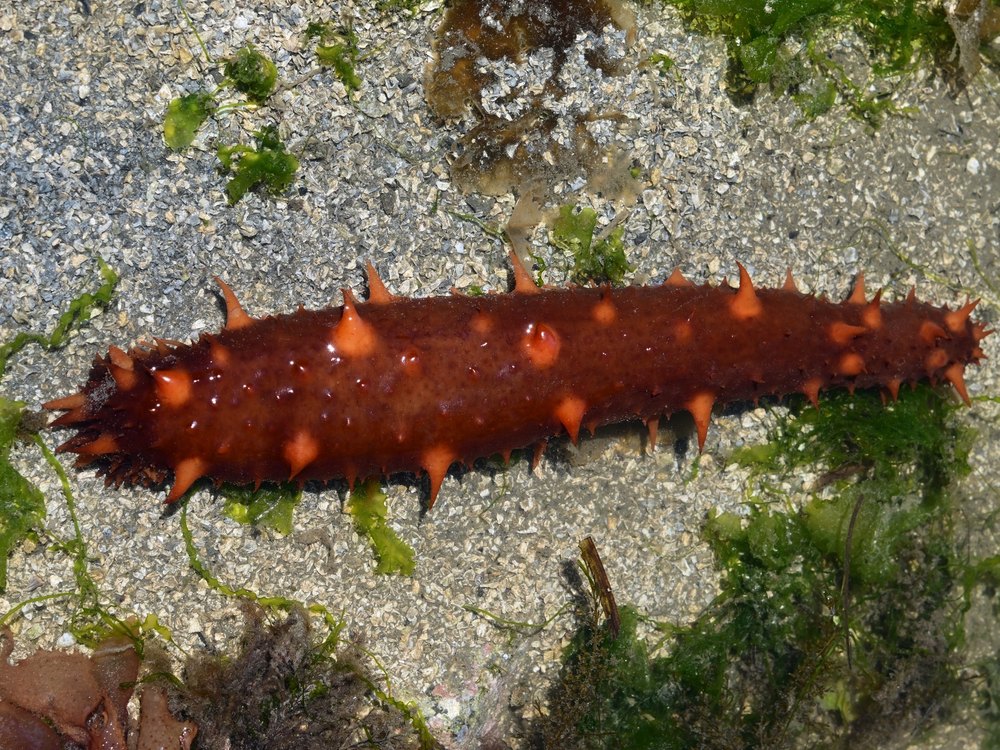
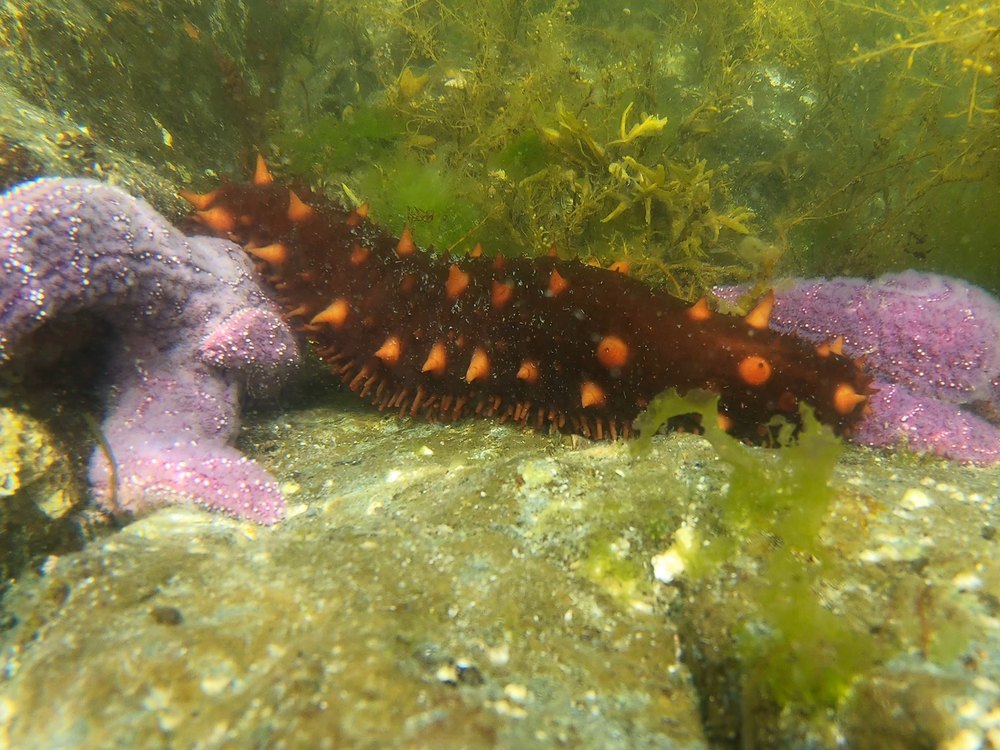
The Giant California Sea Cucumber has a long, soft, sausage-shaped body that is nearly the same thickness from end to end, with a flattened underside covered in sucker-tipped tube feet.[6] Its back is dark red, brown or yellow and is covered in conical papillae (fleshy spines) that are paler than the skin and often red-tipped.[7][6] The original description called the colour reddish-brown above and lighter below.[6] Around the mouth on the underside is a ring of short, mop-like tentacles.[6][4][5] Males and females look alike from outside.[4]
Name
In Canada the animal is called the giant red sea cucumber.[5] The scientific name is Apostichopus californicus, used by WoRMS, GBIF and ITIS, and by Fisheries and Oceans Canada and the Alaska Department of Fish and Game.[1][8][9][10][11] Most older papers use the genus name Parastichopus, so the same animal appears as Parastichopus californicus in the older literature.[3]
In other languages
| Language | Name | Meaning |
|---|---|---|
| Tlingit local | yein | sea cucumber |
| French | holothurie de Californie | California sea cucumber |
The Tlingit word is the general word for sea cucumber, recorded in a subsistence study in Southeast Alaska.[12] The French name is listed in WoRMS and Catalogue of Life.[1][13]
Body
Size
In a study of 900 animals collected by divers at 12 sites in the San Juan Islands, Washington, the whole weight (the animal as caught) ranged from 91 to 2,043 g, with an average of 581 g.[3] The split weight, the market weight after the animal is cut open and drained, averaged 222 g.[3] On average the whole animal weighed about 2.6 times its split weight, and the split weight ranged from 0.179 to 0.691 of the whole weight (median 0.396) in the animals sampled independently of the fishery.[3] Animals taken on commercial dive trips were smaller, with a whole weight of 135 to 1,000 g (average 410 g), partly because divers keep to a minimum size.[3]
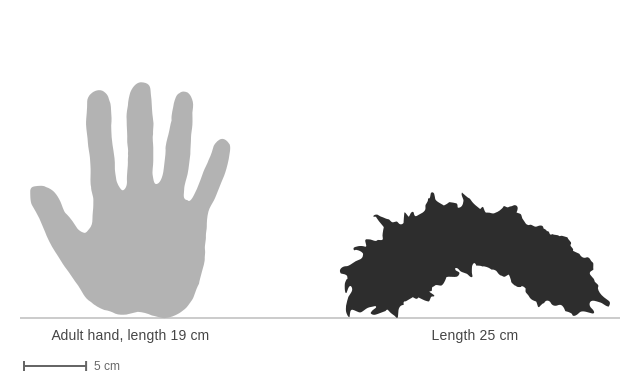
Length was not measured directly in that study. It was estimated from the split weight, and the estimated contracted length (the animal curled up) ranged from 12 to 39 cm, averaging 25 cm in animals sampled independently of the fishery and 20 cm in animals taken on dive trips.[3] For British Columbia landings of 1997 to 2001, an earlier study found an average split weight of 313 g.[3]
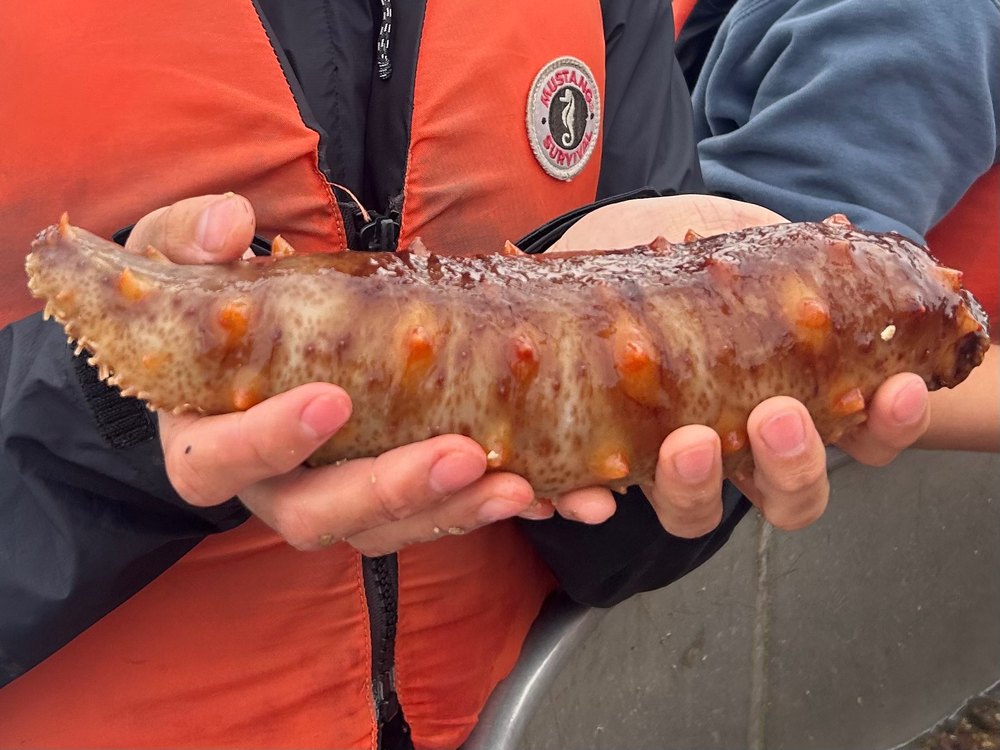
Size is hard to state for this animal. The body wall is soft and the fluid inside the body cavity moves in and out, so length and weight change with how relaxed or contracted the animal is.[4][3] Body mass, skin thickness and muscle weight also change through the year as the internal organs are lost and regrown.[5]
| Weight (whole animal) | 91–2,043 g |
| Length (contracted, estimated) | 12–39 cm |
Body wall and organs
The soft body wall holds an endoskeleton of tiny calcareous plates called ossicles, and five long muscle bands run along the body.[4] The skin is thickest in autumn and winter, when the animal has no internal organs.[5]
The animal moves on tube feet (small suction-cup feet worked by water pressure), which hold on at any angle.[4] Around the mouth sit 20 mop-like tentacles, which are modified tube feet.[4][5]
Sea cucumbers are the only echinoderms with a specialised internal breathing organ, the respiratory tree, a branched organ in the gut.[4]
The sexes are separate. The gonads are two tufts of branching tubules, cream-white in ripe males and bright orange in ripe females.[4] The sex of an immature or just-spawned animal cannot be told by eye.[3]
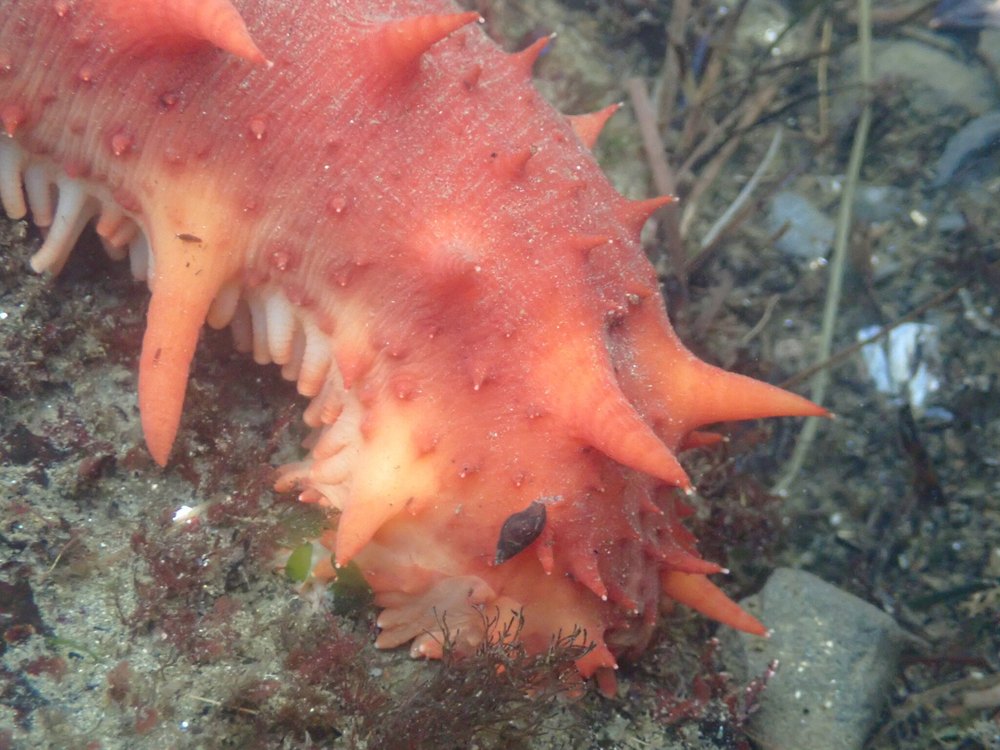
Seasonal organ loss
Each autumn and winter the sea cucumber breaks down its gut, gonads, respiratory trees and circulatory system. The organs are absorbed, not thrown out, and regrown in about 30 days.[4][5] Feeding stops during this period, and the animal lives on energy stored in its body wall, so its weight drops.[4]
A university invertebrate key says the animal can also expel much of its internal organs through the body, and may do so when it is disturbed or kept in warm, stale water.[7]
Behavior
Movement
The Giant California Sea Cucumber moves slowly over the bottom, crawling on its tube feet and by contracting the long muscles of its body wall. It can climb at any angle.[4] In adults the average speed was 19.2 cm per hour in summer and 7.9 cm per hour in autumn.[4] Fisheries and Oceans Canada gives a similar figure, up to 4 m a day.[5]
It is thought to feed continuously while it crawls, and its path is not directed towards any goal while it feeds.[4] Feeding and movement both slow in autumn and winter.[4] The animals are thought to move to different depths with the seasons.[5]
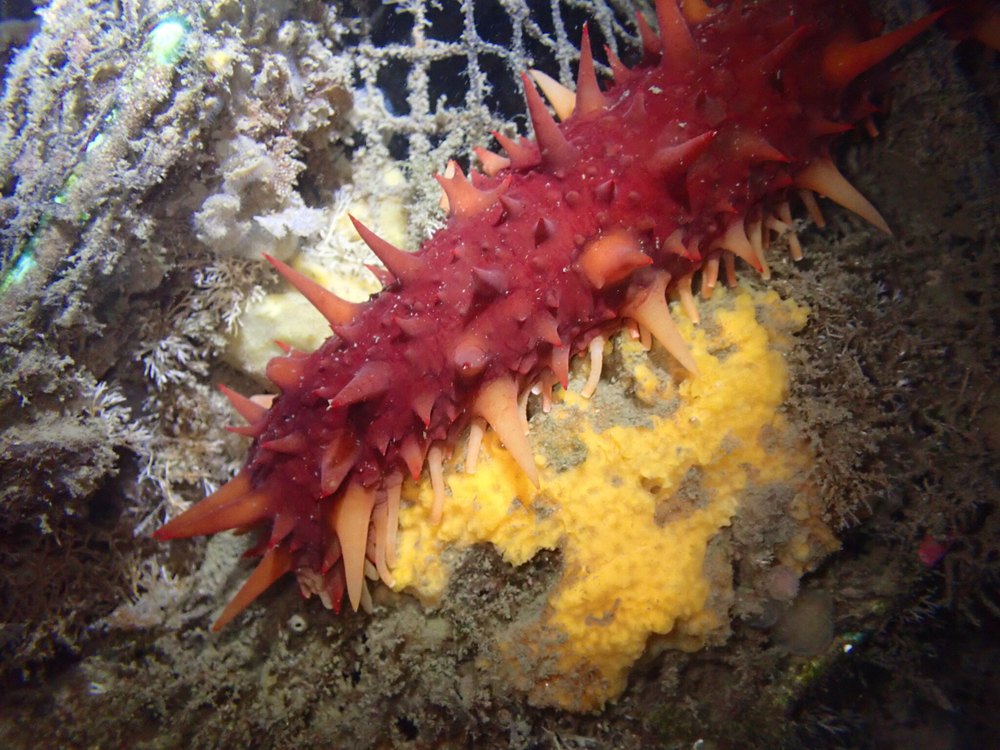
Juveniles are far harder to find than adults. They hide in crevices and under overhangs on steep rock, often among red algae, in water about 2 to 20 m deep.[4]
Escape from sea stars
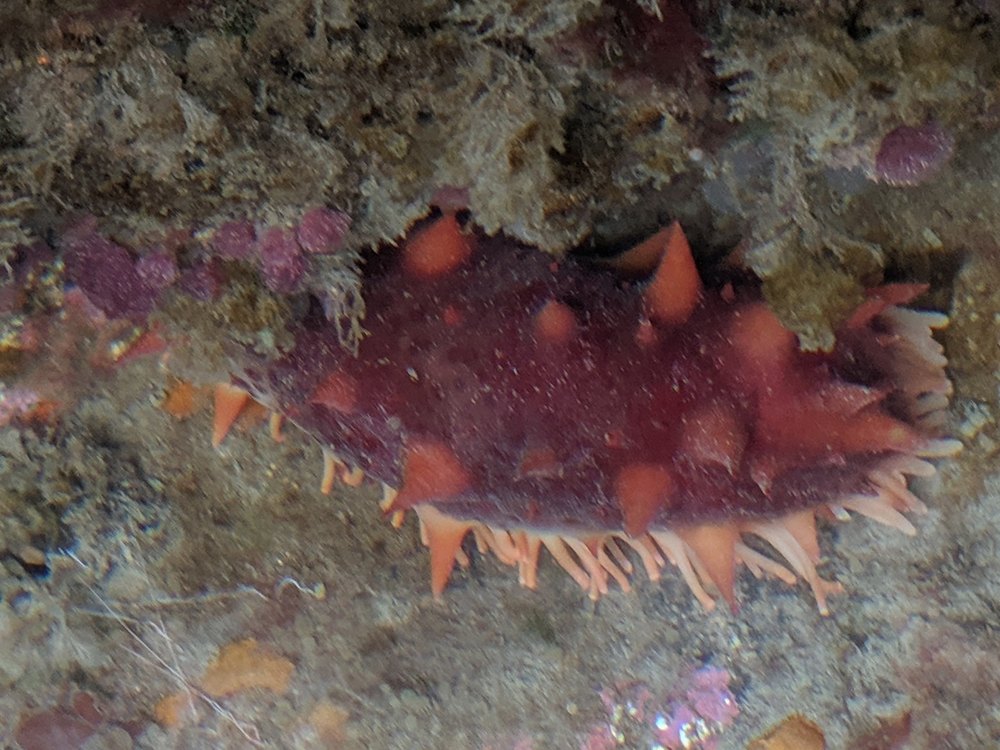
When a sunflower star (Pycnopodia helianthoides) touches it, an adult swims away by bending its body in strong, wave-like undulations that carry it a short distance clear of the predator.[4] Younger animals do this less regularly and move only a little.[4] The escape gets more effective as the animal grows, and animals older than about 2 years were able to avoid sea stars in aquarium tests.[4]
Diet
The Giant California Sea Cucumber is mainly a deposit feeder, which means it eats the material that has settled on the bottom. This includes settled plankton, bacteria and decaying plant and animal matter, which it takes in together with sediment. Sticky, mop-like tentacles around the mouth collect the food and pass it into the gut.[4] It prefers sediment that is rich in organic matter and moves more when it is on such ground.[4]
It can also feed as a suspension feeder, catching particles that float in the water with its tentacles.[4] It does not feed while its internal organs are being absorbed in autumn and winter (see Body).[4]
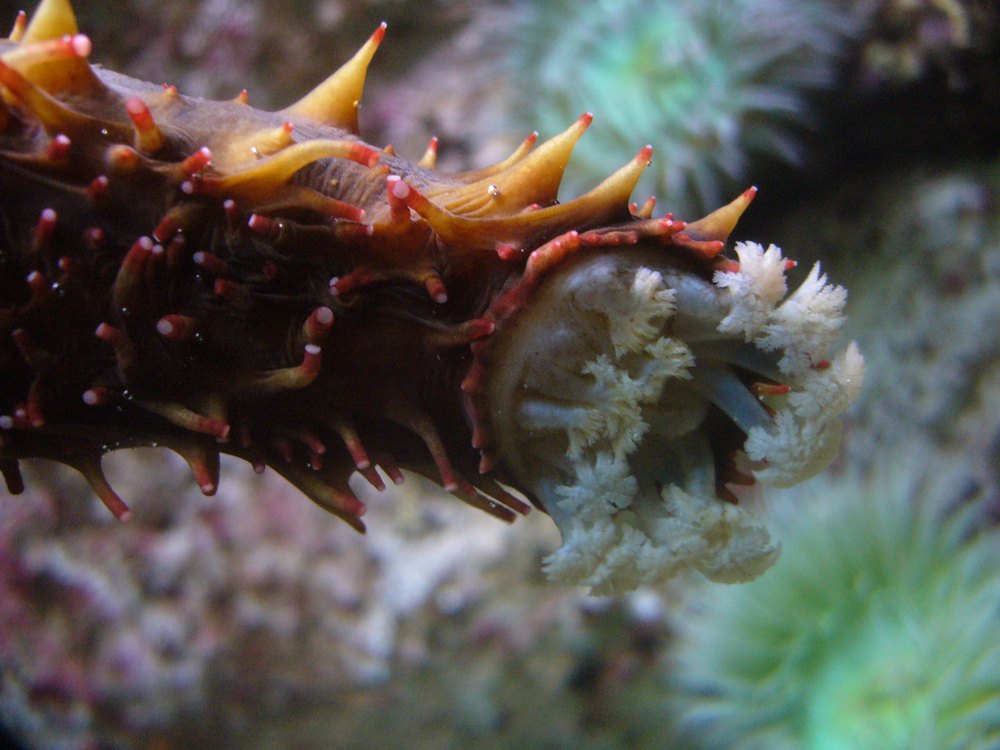

Life cycle
| Stage | Age / time | Notes |
|---|---|---|
| Egg | After spawning | The egg is about 150 micrometres across.[4] |
| Larva | About 65 to 125 days in the lab | The larva floats in the plankton (see Larvae).[4] |
| Juvenile | 2 years | Wild juveniles in the San Juan Islands, Washington (see Growth).[3] |
| Adult | From about 5 years | An animal of about 5 years is treated as able to spawn (see Growth).[3] |
Spawning
The sexes are separate. The sea cucumber is a broadcast spawner, which means it releases eggs and sperm into the water. A female can release hundreds of thousands of eggs in one spawning.[4]
The season differs between places. In Indian Arm, British Columbia, in 1982 and 1983, spawning ran from late spring through summer and peaked in June and July.[14][3] In the San Juan Islands, Washington, the peak came earlier, in April and May in 2014 and in March and April in 2015.[3] In the lab, spawning can be brought on at any time of year.[4]
Larvae
The fertilised egg reaches the gastrula stage, an early hollow ball of cells, about 40 to 64 hours later. The feeding larva, called an auricularia, begins on day 6 and starts to feed around day 13. It feeds on plankton and stays in the water for about 65 to 125 days in the lab.[4]
The auricularia then turns into a barrel-shaped larva that does not feed, the doliolaria, within 24 to 48 hours. Within another 24 to 48 hours this becomes the pentactula, which has five tentacles around the mouth.[4] The pentactula settles on the bottom. It becomes a juvenile once it has more than five tentacles.[4] The time spent in the water varies, even within one batch of larvae.[4]
Growth
The ages of wild animals in the San Juan Islands were estimated from body size, and the youngest animals sampled were 2 years old. Their average split weight and contracted length were 61 g and 14 cm at 2 years, 109 g and 18 cm at 3 years, 157 g and 21 cm at 4 years, and 197 g and 24 cm at 5 years.[3] Growth slowed as the animals aged, and animals older than about 5 years could not be told apart by age.[3]
The sea cucumber is said to reach about 500 g in 4 to 5 years.[4]
Ecology
Predators
Sea otters eat it where they have been reintroduced. Otters were brought back to Southeast Alaska in the late 1960s, and a study there found that sea cucumber density fell in the areas they occupied, by up to 100% in areas occupied since 1994.[15] Density also declined in areas without otters, and the size of the decline depended on how long otters had been present and how many there were.[15] In British Columbia, otters are thought to take urchins first and then other prey, including sea cucumbers.[16]
Juveniles have been found in nursery spots on rock walls that were free of the sea star Solaster.[4] In central and north British Columbia, sunflower star predation on the sea cucumber is thought to have been taking place before sea star wasting disease began in 2014 to 2015.[16] How the adults escape sea stars is described under Behavior.
Partners and parasites
A scale worm lives on adults, and a parasitic snail, Enteroxenos parastichopoli, lives inside them.[4] A flavivirus, a type of virus, is carried by the sea cucumber and appears to be a neutral or beneficial partner. It was found in animals from Southeast Alaska and from Friday Harbor in Washington.[17]
Role in the ecosystem
The sea cucumber feeds on the settled material on the seabed and takes it into its gut together with sediment (see Diet). Fisheries scientists in British Columbia state that a decline in sea cucumbers could harm the way nutrients cycle through coastal ecosystems, but the effects on whole ecosystems are not known.[16]
In a cage trial under salmon and sablefish pens, farmed sea cucumbers took in waste from the fish. The trial found that total organic carbon in the sediment fell by 60.3% and total nitrogen by 62.3%.[4] This was a test of fish and sea cucumber farming together, not a measurement in the wild.[4]
Disease
From late August to October 2021, a wasting event struck sea cucumbers at Nanoose Bay on Vancouver Island, British Columbia. It followed summer heatwaves, and up to 94% of the animals at a single site showed signs of wasting, an average of 50% across seven affected sites.[18] Healthy animals were common below 19 m.[18]
A laboratory test did not reproduce the wasting. Of 56 animals held at 12, 17 or 22 °C for 79 hours, 5 died, all at 22 °C, and none showed wasting symptoms. The authors concluded that wasting may not be triggered by heat stress alone, and the cause of the event is unknown.[18]
Habitat and range
Where it lives
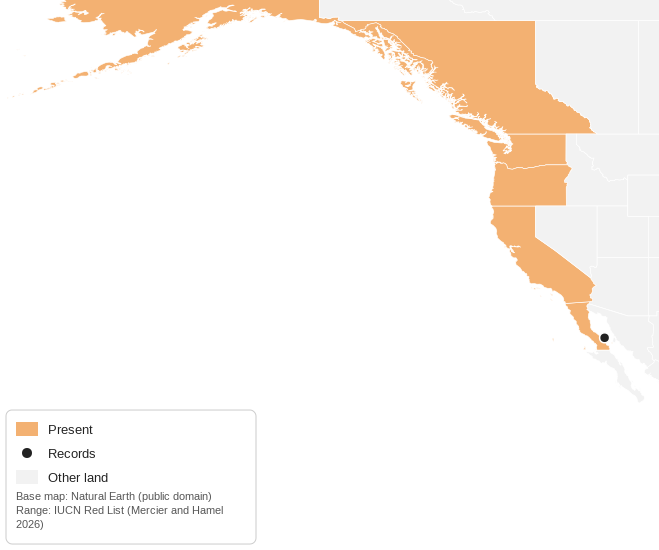
The range runs from the Aleutian Islands in Alaska to Cedros Island, Baja California, in Mexico.[2] The IUCN lists one specimen from Angel de la Guarda Island in the Gulf of California.[2]
Habitat
It lives from the low intertidal zone to about 250 m deep.[5][2] It occurs on hard and soft bottoms, and is most abundant in areas with moderate currents over cobbles, boulders, shells, sand, crevassed bedrock and algae.[2] It appears to avoid muddy bottoms and areas with freshwater runoff.[2]
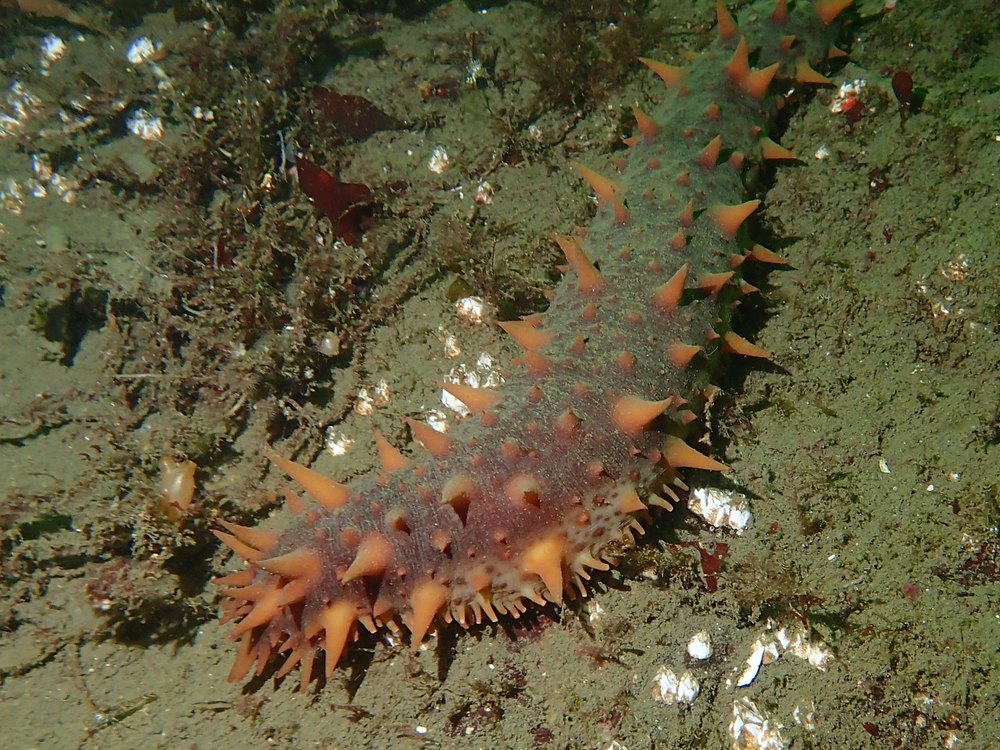
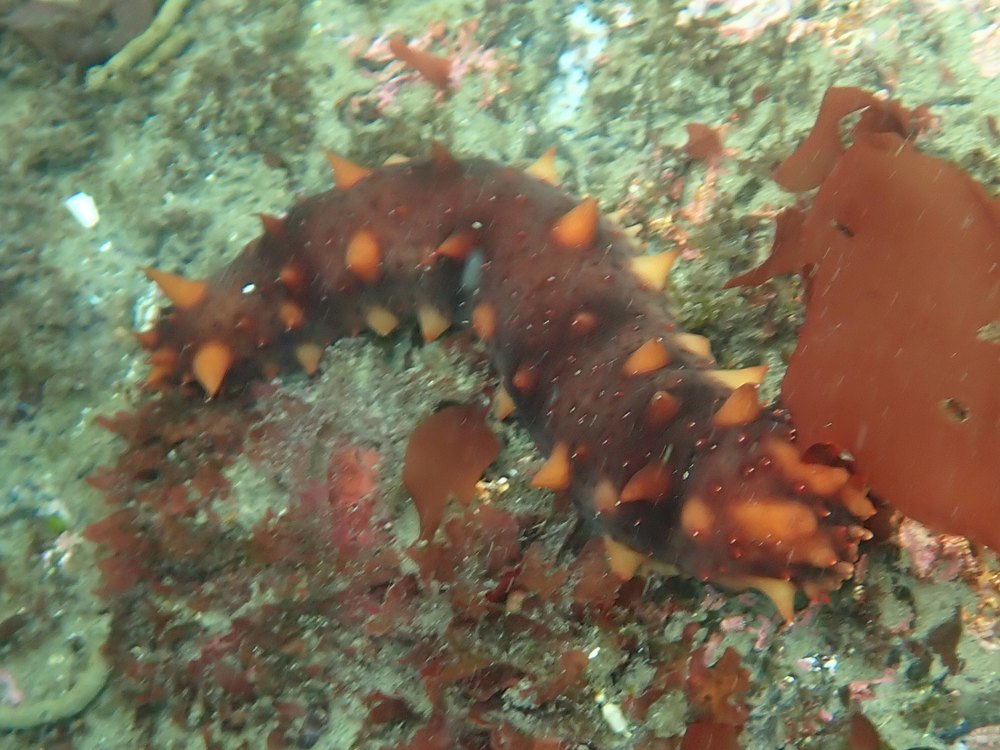
In British Columbia, dive surveys in four experimental fishing areas between 1998 and 2015 found densities of 0.003 to 0.140 animals per square metre.[2][16]
Population
Nobody counts these animals over the whole coast, so the weight that fishers bring ashore each year (the landings) is used as a rough guide to how many there are. Landings in Washington were 1,000 to 1,800 tonnes a year in 1988 to 1993 and about 90 tonnes in 2020.[2] In California, landings peaked at 300 tonnes in 1990 to 1996 and were 2 to 3 tonnes in 2020.[2] In Canada they have been stable at about 1,600 to 1,700 tonnes a year from 2012 to 2023.[2]
Evolution
The Giant California Sea Cucumber belongs to the family Stichopodidae, a group of large sea cucumbers that includes the genera Apostichopus, Parastichopus, Stichopus, Isostichopus and Thelenota.[19] Only one split in this group has a date: Stichopus and Isostichopus diverged roughly 5.5 to 10.7 million years ago, a range calibrated with Isostichopus species on either side of the Isthmus of Panama.[20]
The family may not be a single natural group. A 2025 genome-scale study of 37 species recovered Stichopodidae as polyphyletic, meaning its members do not all descend from one common ancestor within it.[21] An earlier molecular study of sea cucumbers found that three of the five orders then recognised did not each form a single branch of the tree.[22] The branching order inside the family is unresolved.
Forms and variants
No subspecies of the Giant California Sea Cucumber are recognised.[1][8][9][13] The colour of the back varies (see Description), but this is not a named form.
Conservation
Status
The IUCN Red List classes the Giant California Sea Cucumber as Vulnerable (criteria A2bd), in an assessment made on 1 October 2025 and published in 2026.[2] Its population trend is decreasing.[2] The assessors estimate that the global population fell by about 36 to 40% over the last three generations, a span of 17 to 22 years per generation, and that the declines have not ceased.[2]
The estimate rests on fisheries data used as an index of abundance, not on surveys of the whole range.[2] Populations have stayed stable along the coasts of British Columbia and Alaska, while landings in Washington and California fell by 91 to 99% over 24 to 32 years, in areas that make up about 40% of the range.[2] The landings figures are under Habitat and range.
Threats
Overharvesting[2]Overharvesting. Harvesting for human consumption is the only threat the IUCN lists.[2] It is ongoing, and affects less than half of the range, but where it is heavy it causes rapid to very rapid declines.[2] Few young animals join the population in most years, and natural mortality of adults is relatively high.[2]
Management
In Southeast Alaska divers work 16 harvest areas in rotation.[23][2] The guideline harvest level is 6.4% of the lower bound of the estimated total biomass of an area, taken once every three years as 19.2%, so each area then rests for two seasons.[23] The levels are set from biomass surveys made before each season.[24] The season starts on the first Monday in October and ran to 31 March; from the 2025/26 season it runs to 30 April, partly because of the animal’s spawning biology.[24] A separate set of 16 areas is closed to commercial fishing to protect subsistence use.[23]
British Columbia limits entry to 85 licence eligibilities and sets a total allowable catch shared in individual and area quotas.[10] Landings are checked by a dockside monitoring programme.[10] The dive season opens in October and lasts about eight weeks, when the muscle weight is greatest after the organs have been absorbed.[10][2] Only part of the coast is open at any time: the fishery began a 10-year restriction to 25% of the coast in the late 1990s, and a later plan has opened the coast in rotation.[16] Reference points for the fishery are a limit of 0.029 animals per m² and an upper level of 0.038 animals per m².[16]
In Washington, divers harvested without seasonal or area limits from 1971 to 1987, when the state set harvest districts and a season.[2]
History and culture
The dive fishery
DFO records landings in British Columbia from 1971.[16] The fishery stayed open access until 1990, and the number of licences rose from 40 in 1985 to 215 in 1990.[2]
In Southeast Alaska the first experimental permits were requested in 1981, and only one or two were issued a year until 1986.[23] The catch grew quickly: 15 t (34,043 lb) in 1986/87, 364 t (801,405 lb) with 57 divers in 1988/89, and 1,052 t (2,318,305 lb) with 205 divers in 1989/90.[23] The state closed the fishery in May 1990 because it was expanding fast, and reopened it in October 1990 under a management plan.[23] The number of divers peaked at 424 in 1995/96.[23] Entry was capped at a maximum of 436 permits from 2001.[23]
In British Columbia the price paid to harvesters rose from $3.50 per split pound in 2010 to $9.90 in 2024, a rise of 183%.[10] It fell in 2025 after China raised its tariffs.[10]
Trade
The catch is sold as frozen muscle strips and as dried skin.[10] Skins are boiled and salted in Vancouver plants and shipped to China to be dried, and China is the largest market.[10] The domestic market is small.[10] In Alaska the plants separate the muscle bundles from the skins, and the dried skins go to Asian cuisine.[23]
Subsistence use
A 1990 report of the Alaska Department of Fish and Game recorded the subsistence harvest and use of the sea cucumber in Southeast Alaska.[12] In British Columbia, harvest for food, social and ceremonial purposes is open along the whole coast all year, with no catch limits unless a First Nation sets its own or a treaty applies.[10]
Taxonomy
| Rank | Name |
|---|---|
| Kingdom | Animalia |
| Phylum | Echinodermata |
| Class | Holothuroidea (sea cucumbers)[25] |
| Order | Synallactida[26] |
| Family | Stichopodidae[19] |
| Genus | Apostichopus Liao, 1980[27] |
| Species | Apostichopus californicus (Stimpson, 1857)[1][8][9][13] |
Synonyms (3)
| Name |
|---|
| Holothuria californica (Stimpson, 1857) |
| Parastichopus californicus (Stimpson, 1857) |
| Stichopus californicus (Stimpson, 1857) |
From the GBIF backbone.[30]
Higher classification
The species belongs to the class Holothuroidea, the sea cucumbers, which are echinoderms like sea stars and sea urchins.[25] WoRMS places it in the order Synallactida and the family Stichopodidae.[19][26] The family has ten accepted genera in WoRMS, among them Stichopus, Parastichopus and Isostichopus.[19] WoRMS counts eight accepted species in Apostichopus.[27] In 1937 Deichmann grouped this species with parvimensis, the other California species of its kind.[28]
Parastichopus or Apostichopus
In 1937 Deichmann moved the species from Stichopus to Parastichopus.[28] The move to Apostichopus came from the WoRMS editor in 2013, and no published paper made it.[29] Woo and colleagues (2017) judged that the transfer did not meet Article 8 of the zoological Code, the rule that a new name needs a published work. They keep only A. armatus and A. japonicus in the genus.[29] WoRMS, GBIF and ITIS nevertheless use Apostichopus, while older papers use Parastichopus.[1][8][9][28] No published family tree places this species against Parastichopus in the strict sense or against the Japanese sea cucumber.[21][29]
Sources
- WoRMS, Apostichopus californicus (Stimpson, 1857) (AphiaID 529363)
- Mercier, A. and Hamel, J.-F. 2026. Apostichopus californicus. The IUCN Red List of Threatened Species 2026: e.T180436A272706437
- Mueller, K. W. 2016. Fishery biology of the sea cucumber Parastichopus californicus (Stimpson, 1857) from the San Juan Islands, Washington. Lummi Natural Resources Department, 2013–2015 Sea Cucumber Study
- Fortune, A. C. 2018. Integrated multi-trophic aquaculture with the California sea cucumber (Parastichopus californicus): investigating grow-out cage design for juvenile sea cucumbers co-cultured with Pacific oysters (Crassostrea gigas). MSc thesis, University of Victoria
- Fisheries and Oceans Canada, Giant Red Sea Cucumber species profile
- Stimpson, W. 1857. On the Crustacea and Echinodermata of the Pacific shores of North America. Boston Journal of Natural History 6: 444–532
- Walla Walla University Invertebrate Key, Apostichopus californicus (Stimpson, 1857)
- GBIF Secretariat, Apostichopus californicus (Stimpson, 1857), GBIF Backbone Taxonomy (species 5967442)
- ITIS, Apostichopus californicus (Stimpson, 1857) (TSN 1078919)
- Fisheries and Oceans Canada, Integrated Fisheries Management Plan, Sea Cucumber by dive, Pacific Region, 2026/2027
- Alaska Department of Fish and Game, Commercial fisheries: Southeast Alaska sea cucumber dive fishery
- Mathews, V., Kookesh, M. and Bosworth, R. 1990. Subsistence harvest and use of sea cucumber in Southeast Alaska. Alaska Department of Fish and Game, Division of Subsistence, Technical Paper 190
- Catalogue of Life, Apostichopus californicus (Stimpson, 1857) (ChecklistBank)
- Cameron, J. L. and Fankboner, P. V. 1986. Reproductive biology of the commercial sea cucumber Parastichopus californicus (Stimpson) (Echinodermata: Holothuroidea). I. Reproductive periodicity and spawning behaviour. Canadian Journal of Zoology 64: 168–175
- Larson, S. D., Hoyt, Z. N., Eckert, G. L. and Gill, V. A. 2013. Impacts of sea otter (Enhydra lutris) predation on commercially important sea cucumbers (Parastichopus californicus) in southeast Alaska. Canadian Journal of Fisheries and Aquatic Sciences 70: 1498–1507
- Fisheries and Oceans Canada. 2022. Updated reference points and harvest options for the giant red sea cucumber (Apostichopus californicus) fishery in BC using data from Experimental Fishing Areas. Science Advisory Report 2022/051
- Crandell, J. G., Altera, A. K., DeRito, C. M. et al. 2023. Dynamics of the Apostichopus californicus-associated flavivirus under suboxic conditions and organic matter amendment. Frontiers in Marine Science 10: 1295276
- Dawson Taylor, D., Farr, J. J., Lim, E. G., Fleet, J. L., Smith, S. J. and Wuitchik, D. M. 2023. Heat stress does not induce wasting symptoms in the giant California sea cucumber (Apostichopus californicus). PeerJ 11: e14548
- WoRMS, Stichopodidae (AphiaID 123184)
- Byrne, M., Rowe, F. and Uthicke, S. 2010. Molecular taxonomy, phylogeny and evolution in the family Stichopodidae (Aspidochirotida: Holothuroidea) based on COI and 16S mitochondrial DNA. Molecular Phylogenetics and Evolution 56: 1068–1081
- Whelpley, J. M., Uehling, A. T., Paulay, G. and Ryan, J. F. 2025. Phylogenomic analyses of all major sea cucumber lineages provide a robust backbone of Holothuroidea. bioRxiv preprint
- Miller, A. K., Kerr, A. M., Paulay, G., Reich, M., Wilson, N. G., Carvajal, J. I. and Rouse, G. W. 2017. Molecular phylogeny of extant Holothuroidea (Echinodermata). Molecular Phylogenetics and Evolution 111: 110–131
- Alaska Department of Fish and Game. 2014. Fishery Management Report 14-46: Southeast Alaska and Yakutat dive fisheries
- Alaska Department of Fish and Game. 2025. 2024/25 Southeast Alaska sea cucumber fishery (memo, 30 October 2025)
- WoRMS, Holothuroidea (sea cucumbers) (AphiaID 123083)
- WoRMS, Synallactida (AphiaID 1036229)
- WoRMS, Apostichopus (AphiaID 241373)
- Deichmann, E. 1937. The Templeton Crocker Expedition. IX. Holothurians from the Gulf of California, the west coast of Lower California and Clarion Island. Zoologica (New York Zoological Society) 22(10): 161–176
- Woo, S. P., Ogawa, A., Tan, S. H., Yasin, Z., Kajihara, H. and Fujita, T. 2017. A taxonomic revision of the genus Apostichopus (Holothuroidea: Stichopodidae) from Japan. Zootaxa 4350: 121–135
- GBIF backbone, Apostichopus californicus, synonyms