The Grey Wolf (Canis lupus) is a large wild member of the dog family that lives across much of North America, Europe and Asia. It usually lives in a pack, which is a family group made up of a breeding pair and their young.[1] Grey Wolves eat mostly large hoofed animals, and adult males in Yellowstone National Park average 50 kg.[2][3] Persecution once wiped the species out over about a third of its range, but protection has let it recover in many places. The IUCN rates it Least Concern in the 2018 assessment, with a stable trend and about 200,000 to 250,000 animals.[4]
Quick facts
Description
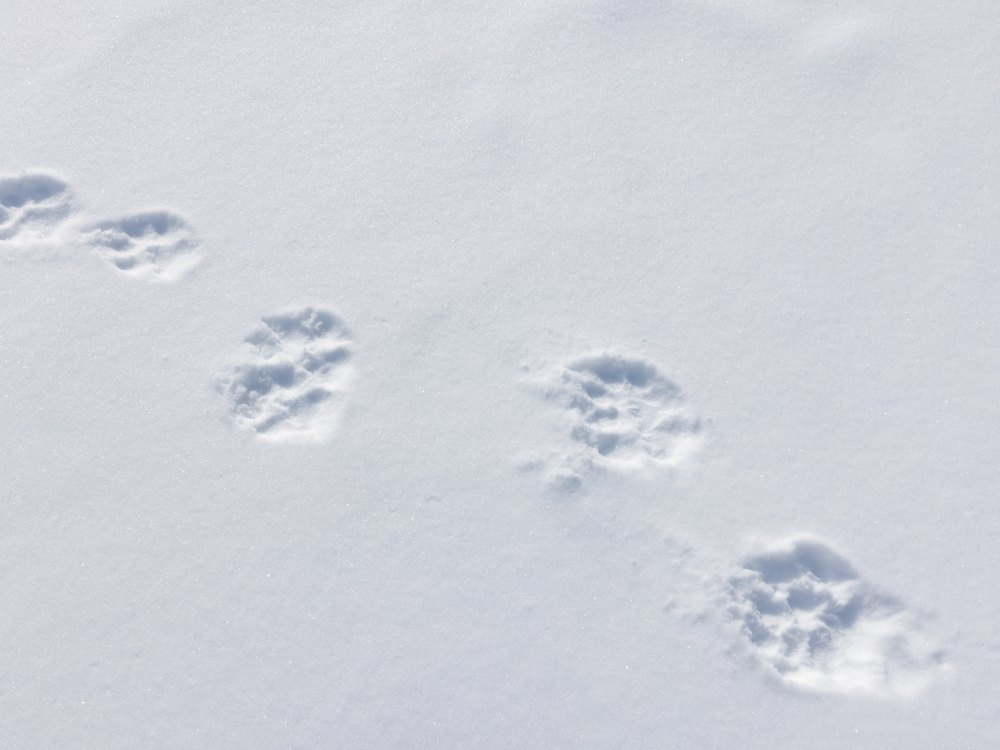
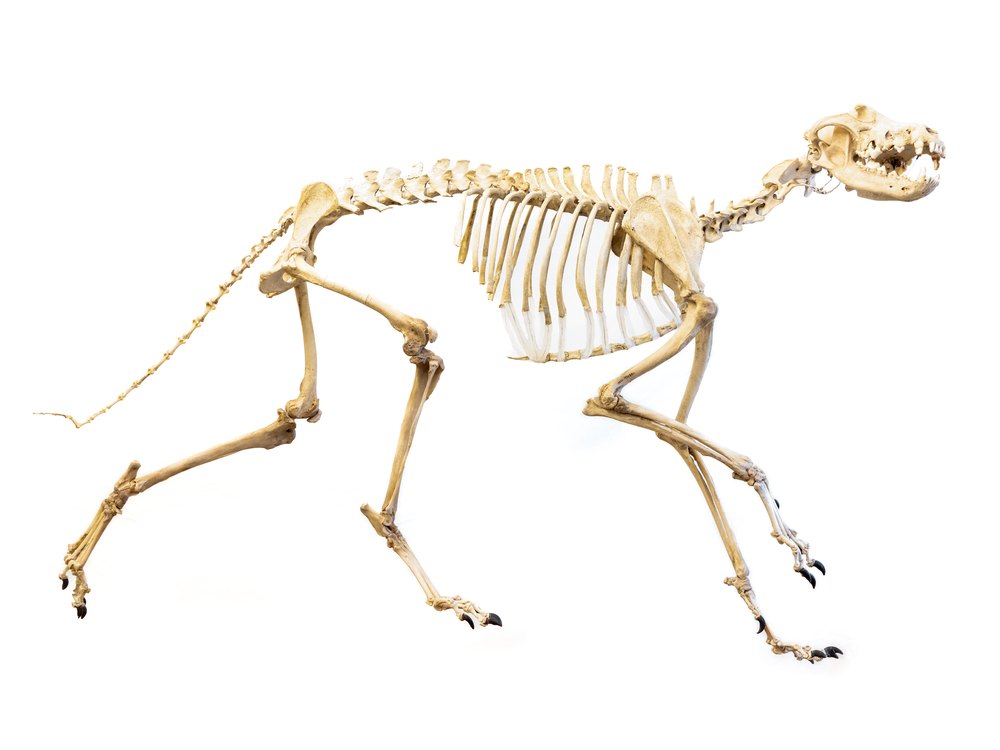
The Grey Wolf looks like a large, long-legged dog with a narrow chest, big feet and a straight tail. The National Park Service says a wolf has longer legs, bigger feet and a narrower chest than a large domestic dog, and that a wolf's tail does not curl the way a dog's may.[6] Compared with the Red wolf, a separate species, it has a larger body, a broader snout and shorter ears.[7]
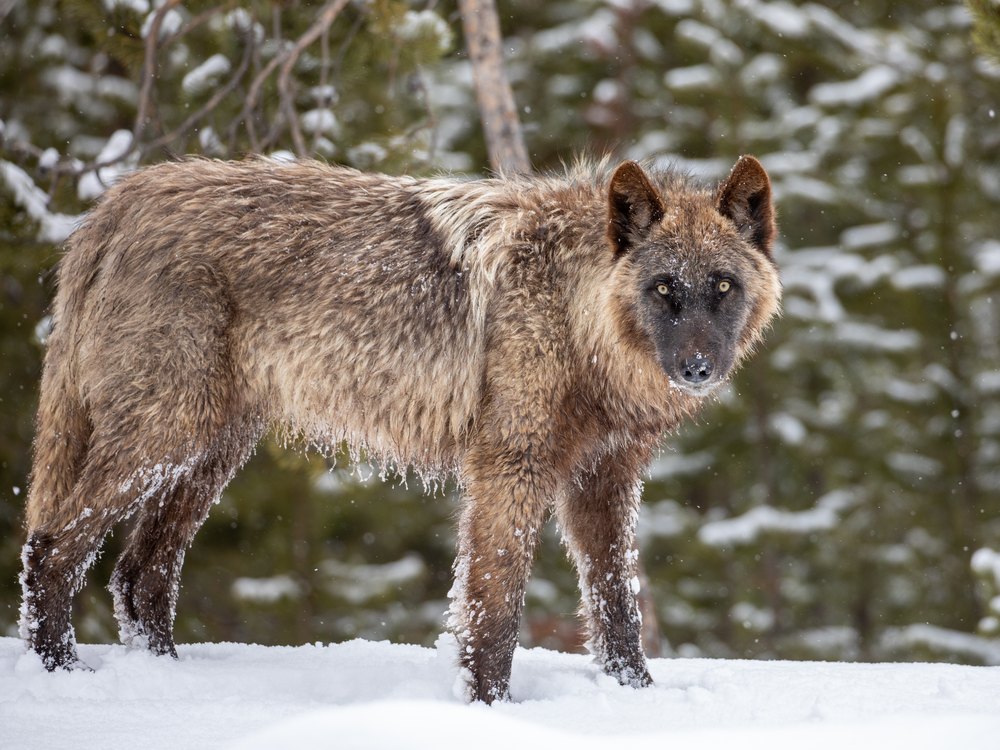
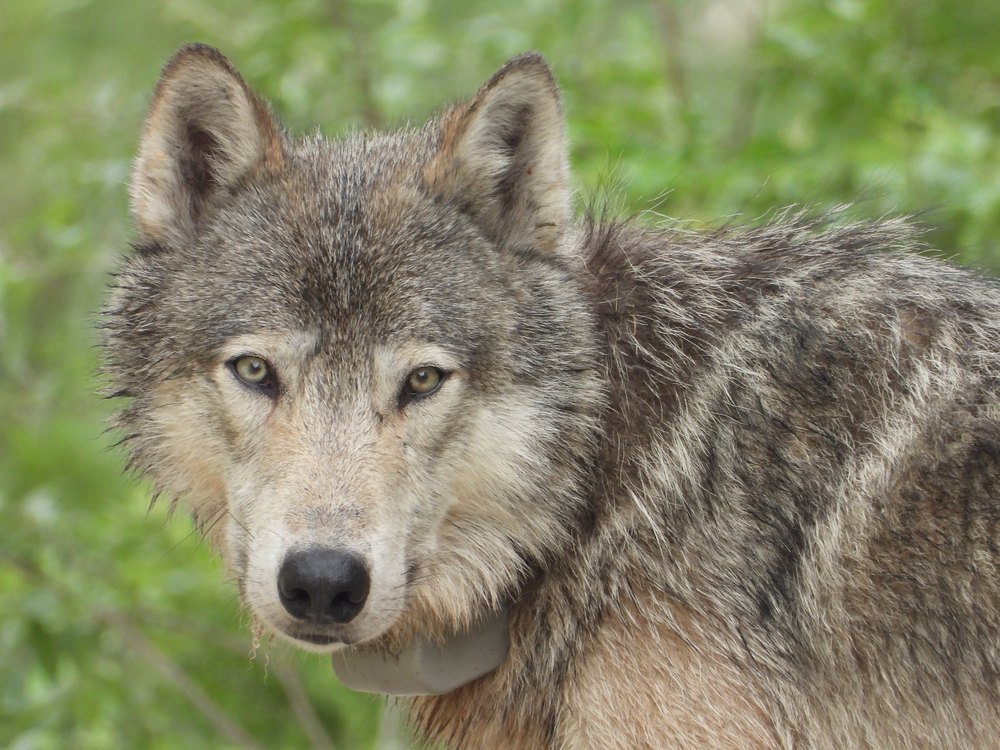
The coat is thick. A thick outer layer covers a soft undercoat, and the dense underfur insulates well in the cold.[7][8] The winter coat is very woolly and can be about 6 cm thick.[6]
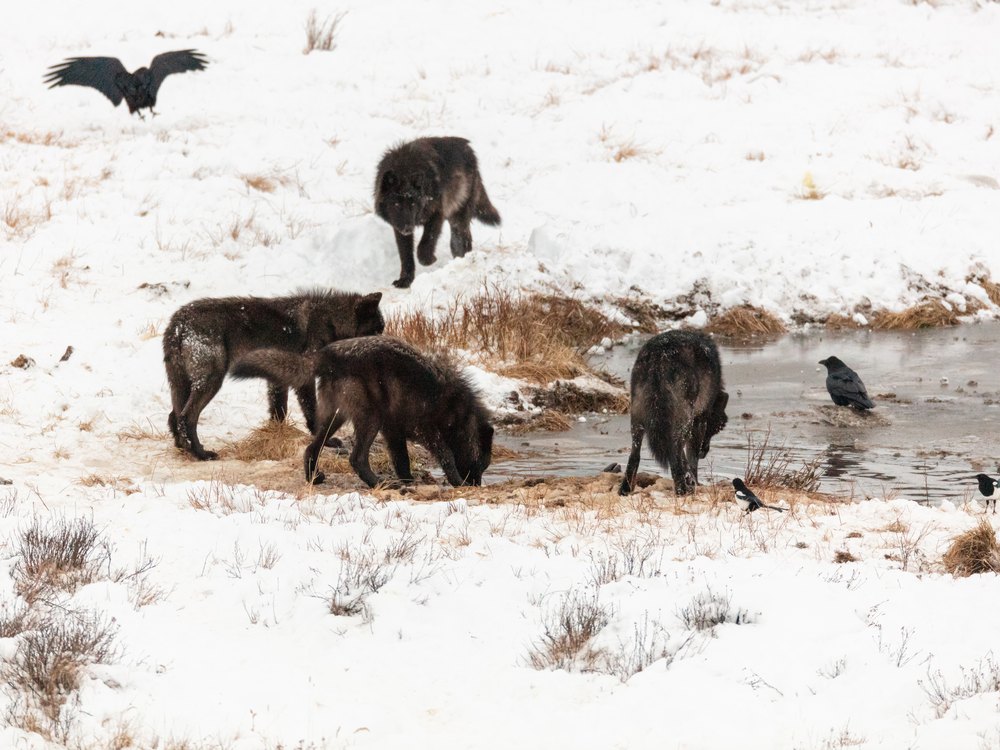
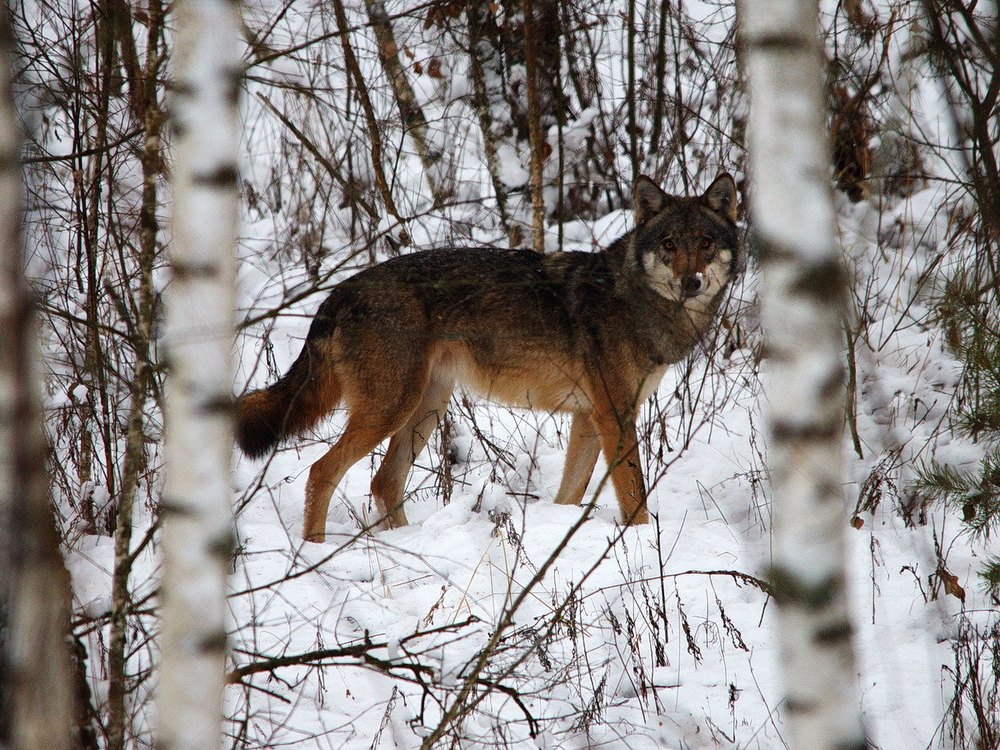
The colour varies more than in almost any other species, the US Fish and Wildlife Service says. It lists white, grey, brown and black.[9] Parks Canada describes the wolves of Pukaskwa National Park, Ontario, as ranging from greys and blacks to browns and reds and almost pure white.[8] In Yellowstone National Park the coat is grey or black in a ratio of about 50 to 50, and rarely white.[2][10] In Alaska the pelt runs from black to nearly white, with every shade of grey and tan between, and grey or black wolves are the most common. Wolves in Southeast Alaska tend to be darker.[11] For black coats, see Forms and variants.
Biologists tell one wolf from another by small marks. A scent-gland spot on the tail is easy to see, and a blaze on the chest helps to tell black wolves apart from each other.[12]
Name
In English the animal is called the Grey Wolf, the Gray Wolf in the US spelling, or simply the wolf. The IUCN lists "Grey Wolf", "Gray Wolf" and "Wolf" as its English names.[4]
The scientific name is Canis lupus. In Latin, lupa means she-wolf.[13]
In other languages
| Language | Name | Notes |
|---|---|---|
| Russian local | volk | — |
| Mongolian local | saaral chono | — |
| Nepali local | bwanso | — |
| Tibetan local | chengu | — |
| Arabic local | dheeb, jisui | — |
| Turkish local | kurt | — |
| Spanish | lobo | — |
| French | loup, loup gris | "grey wolf" for the second name |
| German | Wolf | — |
| Italian | lupo | — |
| Polish | wilk | — |
| Finnish | susi | — |
| Swedish | varg | — |
| Norwegian | ulv | — |
| Romanian | lup | — |
| Hungarian | farkas | — |
| Estonian | hunt | — |
| Czech and Slovak | vlk | — |
| Croatian | vuk | — |
| Latvian | vilks | — |
| Lithuanian | vilkas | — |
| Albanian | ujku | — |
The names are from the common-name list of the IUCN Red List page for the Grey Wolf.[4]
Body
Size
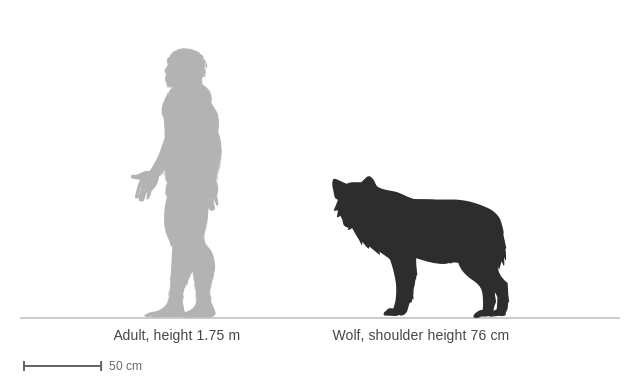
Adult wolves in Yellowstone National Park (wild) weigh 50 kg (110 pounds) for males and 41 kg (90 pounds) for females on average. The heaviest wolf known in the park weighed 67 kg (148 pounds), weighed without food in the stomach.[2]
In Interior Alaska (wild), most adult males weigh 38.6 to 52.3 kg (85 to 115 pounds). Females are 2 to 5 kg (10 to 15 pounds) lighter than males and rarely weigh more than 50 kg (110 pounds). A wolf reaches adult size at about 1 year old.[11] Wolves in Southeast Alaska tend to be somewhat smaller than those in the north of the state.[11]
Other agencies give figures for their own wild wolves. In Washington State, females weigh about 32 to 36 kg (70 to 80 pounds) and males about 43 to 45 kg (95 to 100 pounds), with a shoulder height of about 76 cm (30 inches).[14] In Pukaskwa National Park, Ontario, males weigh up to 70 kg and females up to 50 kg.[8] In Denali National Park, Alaska, females average about 40 kg (88 pounds) and males about 48 kg (105 pounds), and some males reach 59 kg (130 pounds).[15]
Across the species, the Animal Diversity Web lists 30 to 80 kg for males and 23 to 55 kg for females.[7]
| Female | Male | |
|---|---|---|
| Weight (average) | about 41 kg | about 50 kg |
Senses
The National Park Service calls the wolf's sense of smell excellent but says it has not been measured. Hearing is little studied.[2] Wolves see well at night. They have two kinds of colour cones, for blue and yellow, and none for red or green.[3]
Behavior
Packs
A wolf pack is a family. Mech (1999) watched free-living wolves on Ellesmere Island, Northwest Territories, over 13 summers and found that a typical pack is a breeding pair and their young, with the parents guiding the group.[1] The older idea of an "alpha" wolf that wins its rank by fighting came from studies of captive wolves that were not related and had been put together.[1] On Ellesmere the female mainly looked after the pups, and the male mainly defended the group and brought food back from hunting trips.[1]
Pack size depends on the place. At the end of 2024 the nine wild packs living mainly in Yellowstone National Park, Wyoming, ranged from 4 to 25 wolves and averaged 11.8.[16] The largest Yellowstone pack on record, Druid Peak, had 37 wolves in 2001.[2] In Alaska the average pack has six or seven wolves.[11] In Minnesota packs average 4 to 6 wolves and sometimes reach 10 to 12.[17] In Denali National Park, Alaska, the average is 4 to 5.[15]
A pack usually has one breeding pair.[1] Where food is plentiful, more than one litter can be born in a pack. The Leopold pack in Yellowstone once had 25 pups in at least four litters, in 2008.[3]
Young wolves leave the home pack, which is called dispersing. In Yellowstone both sexes leave at an average age of 2 years and 1 month, with a range of 1 to 4 years.[2] In Minnesota young wolves typically leave at 1 to 3 years old, and some have travelled as far as about 890 km (550 miles).[17]
The Animal Diversity Web says that wolves usually move at night, that packs wander in autumn and winter, and that they stay near the den in spring and summer.[7]
Territory and scent marking
Each pack holds a home range against other packs. In Yellowstone the average home range over the whole park is 428 km². Inside the park's interior the average is 620 km², and individual packs range from 105 to 1,675 km².[3] In Minnesota a pack territory averages about 130 to 155 km² (50 to 60 square miles). Where deer are plentiful a territory can be under 26 km² (10 square miles), and where deer are scarce it can be over 260 km² (100 square miles).[17] Parks Canada gives 75 to 2,500 km² for Pukaskwa National Park, Ontario, depending on food.[8]
Wolves mark their territory with scent. Scratching the ground, defecating and urinating all help a pack keep its territory.[18] Peters and Mech (1975) studied wolves in northeastern Minnesota and reported that urinating with a raised leg is the main way a pack marks its territory.[19] Parks Canada says that wolves howl and scent-mark to avoid conflicts with other packs.[8]
Voice
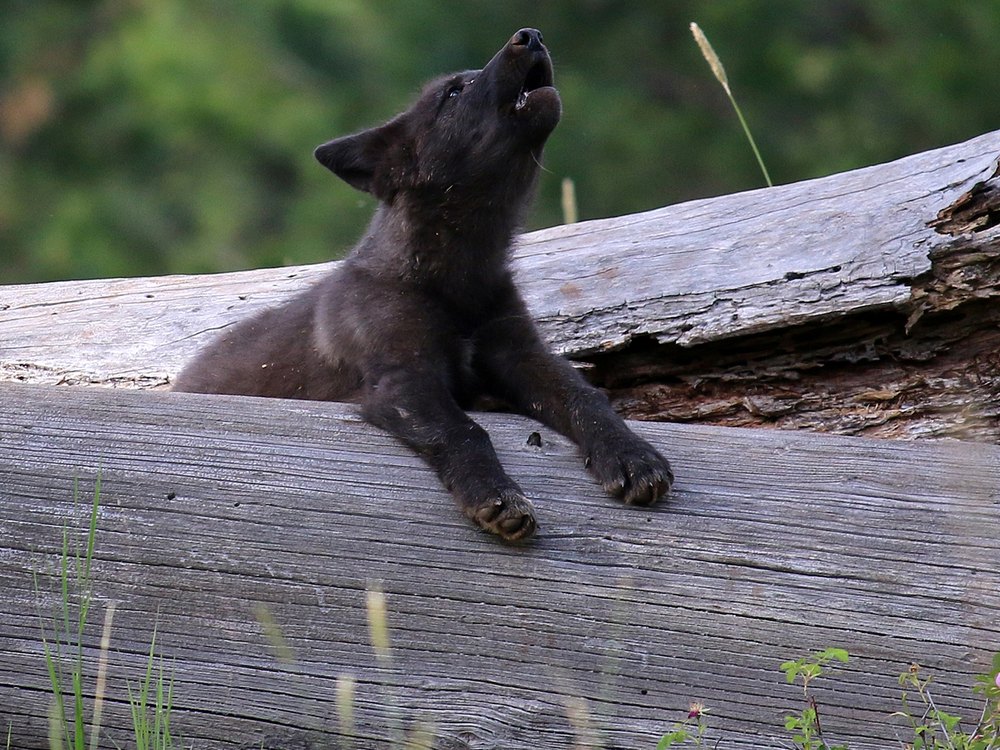
Wolves howl, and a howl carries a long way. In Yellowstone a howl can be heard up to 11 km (6.6 miles) away in forest and up to 16 km (9.6 miles) in open country.[2] The park lists several uses of howling, among them communication inside the pack, advertising the territory and coordinating social activities.[2] Smithsonian's National Zoo says that different wolves have different howls that other wolves can tell apart.[18]
Harrington and Mech (1979) played howls to wolves in Superior National Forest, northeastern Minnesota. They found high rates of reply at rendezvous sites (open places where pups wait while the adults hunt) and at kill sites. Lone wolves without a territory rarely replied.[20]
Diet
Hunting
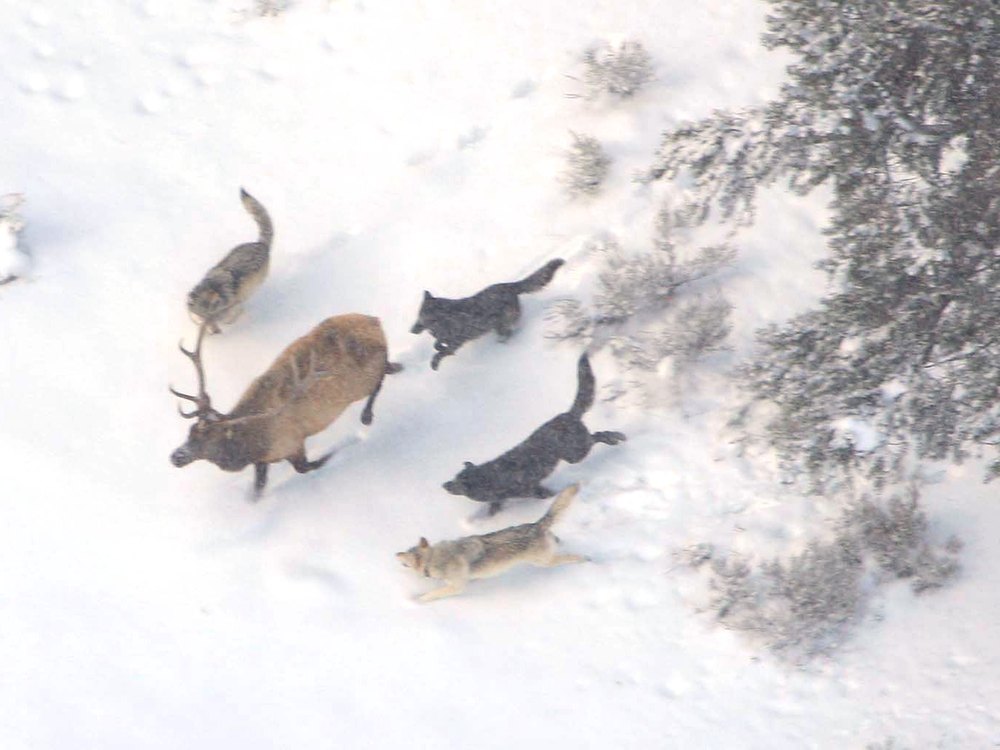
The Grey Wolf hunts mainly large hoofed animals such as deer, moose, elk, caribou, bison and musk ox. It also takes smaller prey such as beaver and hare.[7]
Newsome and colleagues (2016) reviewed 177 diet studies from 1939 to 2014, based on 94,607 scats (droppings) and stomach samples. Wild hoofed animals made up most of the diet. In the North American studies that included each species, the average share of the diet was 42% mule deer (13 studies), 41% elk (20), 35% white-tailed deer (28), 30% moose (54) and 25% caribou (19).[21] In the European studies the average share was 24% wild boar (76 studies), 24% roe deer (66), 21% chamois (9), 31% moose (12) and 20% red deer (38).[21] Meriggi and colleagues (2011) reviewed 20 studies in Italy and found that wild boar, roe deer and red deer were the main wild prey there.[22]
In mainland Alaska the main prey are moose and caribou, and in Southeast Alaska the wolf takes Sitka black-tailed deer, mountain goats and beavers.[11]
In Yellowstone the main prey is elk. Smith and colleagues (2004) studied wild wolves in Yellowstone in the winters of 1995 to 2000. They found a kill rate of 1.6 elk per wolf per 30 days in early winter and 2.2 in late winter, 1.9 over the whole winter, and elk made up about 90% of the winter prey.[23] The park gives 18 to 22 elk per wolf per year when all ages, including calves, are counted.[2] In 2024 the park recorded 211 kills made by wolves: 126 were elk (59.7%) and 47 were bison (22.3%).[16] In 2025 it recorded 153 kills: 72 elk (47.1%), 41 bison (26.8%) and 11 mule deer (7.2%), the highest share of bison in the last 31 years of records.[24]
What it eats
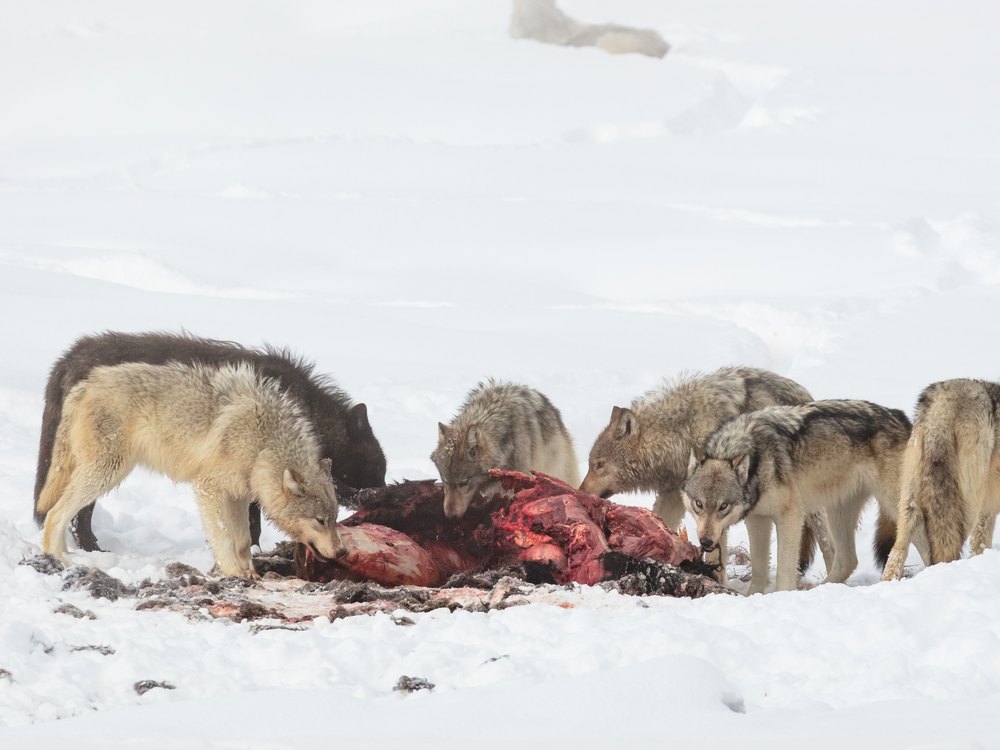
A wolf eats in bursts. The Animal Diversity Web gives up to 9 kg of meat at a single meal.[7]
Wolves also scavenge. Yellowstone describes them as generalist carnivores that scavenge.[2] Newsome and colleagues (2016) note that scats and stomach contents may reflect scavenged meat as well as meat from kills. They also found that domestic animals, livestock included, made up only 8% of the wolf diet in North American studies, and appeared in only 10 of them.[21]
The diet is not only meat. Gable and colleagues (2017) found blueberry seeds in 10 wolf scats in and around Voyageurs National Park, Minnesota, and a scat holding only berries equals about 0.468 kg of berries.[25] Wolves have also been seen eating blueberries in Denali National Park, Alaska.[15]
Life cycle
| Stage | Age / time | Notes |
|---|---|---|
| Gestation | About 63 days | Usually 60 to 63 days[2][7][18] |
| Litter | 4.4 pups on average | Yellowstone, counted when the pups leave the den[2] |
| Weaning | 5 to 9 weeks | Yellowstone[3] |
| Maturity | Adult size at about 1 year, breeding from about 2 years | Females about 2 years, males about 3[7][11] |
Breeding
Wolves breed between January and March, depending on where they live.[7] In Yellowstone National Park the pups are born around mid-April.[2] A pack raises one litter a year (see Behavior for how a pack works). Pregnancy lasts about 63 days.[2][7][18]
Litter size depends on the place and on when it is counted. In Yellowstone the average was 4.4 pups when they came out of the den, with a largest litter of 11, and 3.2 of them were still alive in late December.[2] In 2024 a minimum of 41 pups were born in the park and 37 (90%) lived to the end of the year.[16] In Pukaskwa National Park, Ontario, the average litter is 6, and in Alaska about 7.[8][11] Across the species litters run from 1 to 14 pups.[7]
Pups
In Yellowstone the pups' blue eyes open at 12 to 14 days.[3] The den is an underground chamber with a tunnel, dug under large roots, boulders or a hillside, or a cave.[2] Others use rock crevices, hollow logs or overturned stumps.[18] Until they are 45 days old the pups are fed food that pack members bring up from the stomach.[7]
Yellowstone pups were weaned from milk at 5 to 9 weeks.[3] In Pukaskwa National Park, pups can travel with the pack at about 5 months old.[8]
Growing up
A young wolf is close to adult size at about 1 year.[11] Females reach maturity at about 2 years and males at about 3.[7] Young wolves leave to start their own packs (see Behavior).
In Yellowstone, wolves live 4 to 5 years on average, and the oldest wolf in the park reached 12.5 years. Outside the park the estimated average is 2 to 3 years.[2] A 2005 study of wild wolves in Montana and Idaho says two males lived at least 13 years and one female 12.2 years.[26] In captivity, Animal Diversity Web gives up to 15 years.[7]
Ecology
Rivals and predators
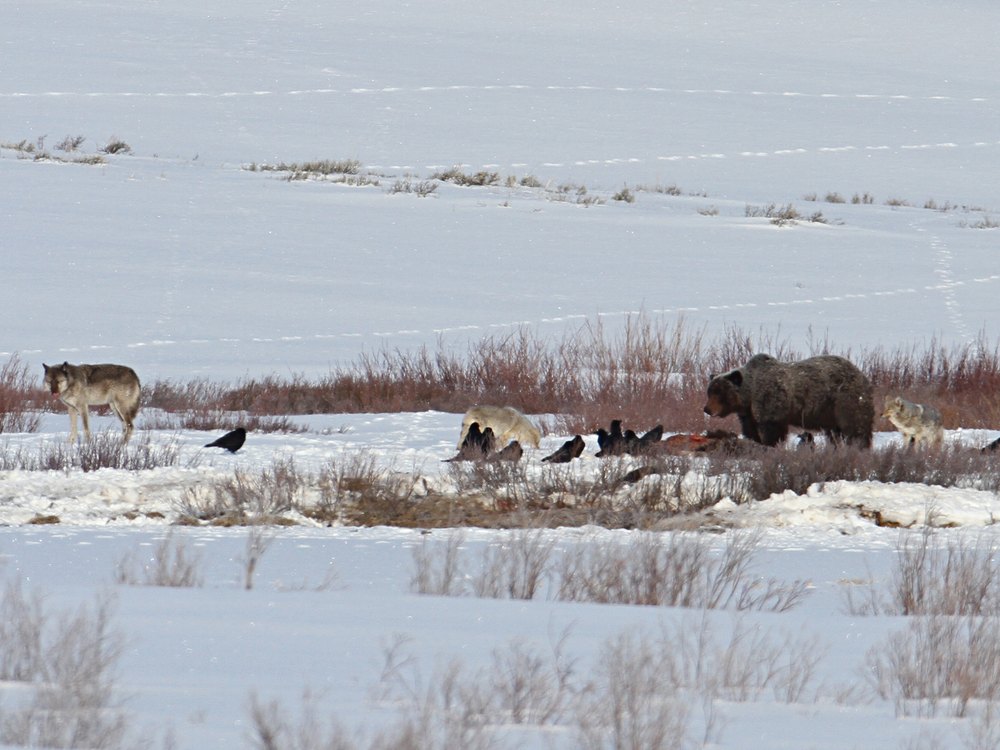
Other wolf packs are one of the main dangers to a wolf. In Yellowstone National Park, two of the six wolves wearing radio collars that died in 2025 were killed by other packs.[24] Bears take wolf kills, but they do not seem to make wolves hunt more. Tallian et al. (2017) studied Scandinavia and Yellowstone and found no support for the idea that brown bears make wolves kill more often. Packs living with brown bears killed less often in spring and summer than packs without them.[27]
Cougars share the same prey. On the northern range of Yellowstone, the park counted 34 to 46 cougars in 2025, which is 1.7 to 2.5 per 100 km². The park team detected 62 cougar kills that year, mostly mule deer (20) and elk (19). For the wolf kills, see Diet.[24] In Banff National Park, Canada, from 1993 to 2004, wolves killed cougars and took prey from them, but cougars did not do the same to wolves, and cougars avoided places where wolves had recently been.[28]
Disease
Canine distemper, a virus, has killed wolf pups in Yellowstone. In 1999 and 2005 pup deaths in the northern part of the park peaked at the same time as the share of wolves with distemper antibodies, which suggests that the virus helped cause them (Almberg et al., 2009, data 1991 to 2007).[29] Several viruses reached the wolves from other canids soon after the reintroduction, and sarcoptic mange, a skin disease caused by mites, spread more slowly. The authors found no sign that disease had endangered the reintroduction, but wolf numbers now show signs of being limited by parasites.[30] Rabies has been confirmed in wild wolves: a study in Iran reported a rabid Grey Wolf.[31]
Role in the ecosystem
The best-known idea about the wolf's place in nature is the Yellowstone trophic cascade, an effect that runs down the food web. During the 20th century elk browsed willow and aspen so heavily that young trees could not grow. The idea is that returning wolves cut the number of elk and made them avoid risky places, so the plants recovered. Ripple and Beschta (2012) reviewed the evidence. After the reintroduction elk numbers fell and beaver and bison numbers rose, and woody plants grew taller and gave more cover in some places but not all.[32] Painter et al. (2015) measured young aspen on the northern Yellowstone winter range. In 1998, 90% were browsed and none was taller than 200 cm, and in 2012 only 37% in the east and 63% in the west were browsed. They credited wolf predation together with other changes: more predation by bears, competition from a growing bison herd, and changes in hunting outside the park.[33]
Other studies are more cautious. Kauffman et al. (2010) found that aspen were not recovering in Yellowstone even with many wolves present, and that the pattern fitted a slow rise in elk numbers better than a quick change in elk behaviour. Elk browsed aspen as heavily where wolves put them at higher risk.[34] Marshall et al. (2013) found that less browsing alone did not restore willows along small streams, because the willows also needed the water conditions that existed before wolves were removed.[35] Peterson et al. (2014) concluded that the question cannot be answered simply, because many causes act on the northern range.[36] The National Park Service calls the effects patchy and tied to sites with enough water. The area covered by woody plants has not grown, but existing stands are taller, and cougar and bear recovery and elk hunting outside the park are other causes of the change in the elk.[37]
On Isle Royale, Michigan, wolves were brought in from the Great Lakes region after the island's wolves had dwindled to two (see Conservation).[38]
Habitat and range
Where it lives
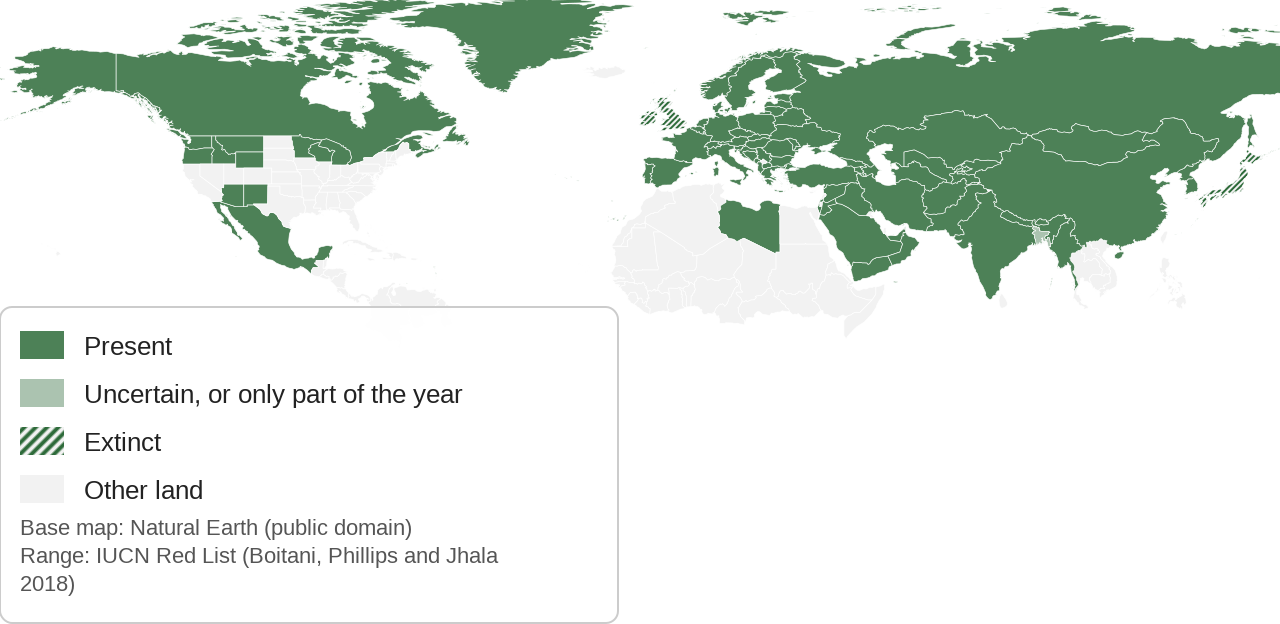
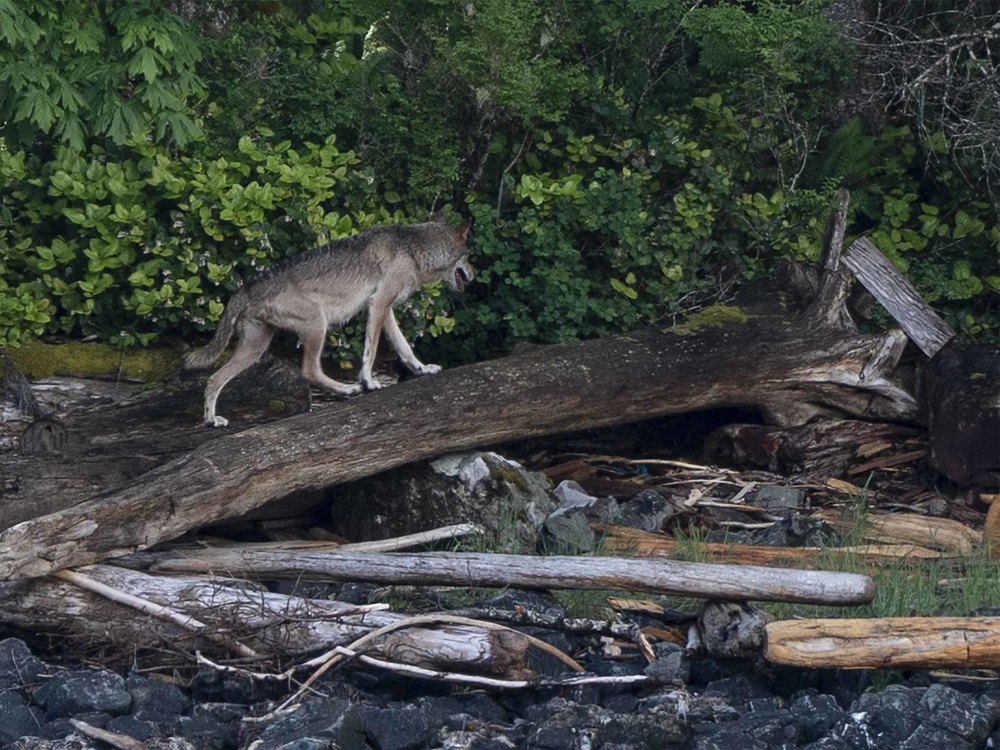
The wolf once lived across most of the northern hemisphere, from about 75° N to 12° N, and persecution has cut its range by about one third.[4] The IUCN lists 66 countries where it lives now. They stretch across Canada, the United States, Mexico and Greenland, across Europe from Portugal and Spain to Russia, and across Asia from Turkiye and the Arabian Peninsula through Central Asia, Mongolia and China to Korea, India, Nepal, Bhutan and Myanmar, with Libya in North Africa.[4] It is extinct in Ireland, Japan and the United Kingdom, and possibly extinct in Bangladesh.[4] Young wolves that leave their pack can turn up in almost any European country except the United Kingdom and Ireland.[4]
Habitat
The Grey Wolf lives in nearly all northern habitats that hold enough food. The IUCN lists boreal, subarctic, temperate and dry subtropical forest, shrubland of the same climates, tundra, grassland, bogs, marshes and tundra wetlands, rocky areas, hot and temperate desert, and pastureland as suitable. It occurs from sea level to 3,000 m, and across its whole range densities run from about one wolf per 12 km² to one per 120 km².[4] In Europe wolves tolerate people and the human landscape, and the average human density in permanent wolf range there is 90 people per km².[39]
Population
The world total is in Conservation. For regions: Russia had about 40,000 wolves in 2011 to 2015.[40] A Government of Canada page, revised in 2014, gives 50,000 to 60,000 for Canada and says the wolf still occupies 80% of its original Canadian range.[41] The Alaska Department of Fish and Game estimates 7,000 to 11,000 for Alaska.[11] Yellowstone had 84 wolves at the end of 2025 (see Conservation).[24]
In Europe the Large Carnivore Initiative for Europe counted about 19,000 wolves in the 27 EU countries in 2022, and more than 21,500 in geographic Europe, which leaves out Belarus and Russia. It describes nine populations. The largest are the Dinaric-Balkan population with 5,000 to 5,500 wolves and the Carpathian population with 3,900 to 4,700, and the smallest is the Scandinavian population with about 550.[39] Of 34 countries, 19 reported increasing numbers and three reported falling numbers, all three in the Dinaric and Balkan region.[39]
Evolution
The tree under Taxonomy places the Grey Wolf among the wolf-like canids. Chavez et al. 2019 date the split of the African wild dog from the dhole and the genus Canis (wolves, coyote and jackals) to about 3.9 million years ago (range 3.3 to 4.5).[42] Koepfli et al. 2015 date the first branching inside Canis to about 1.9 million years ago (range 1.5 to 2.4).[43] The tree is simplified. The African golden wolf appears to come from interbreeding between grey wolves and Ethiopian wolves, and a branching tree cannot show such mixing between species.[44] The Eastern wolf and the Red wolf are left out because their ancestry is debated.[45][46]
The dire wolf is not drawn, because it was not a Canis wolf: Perri et al. 2021 found that its branch separated from living canids about 5.7 million years ago.[47] The Dog is a close relative that comes from ancient wolf populations, and no wolf sampled so far is its direct ancestor (see Taxonomy).[48]
Forms and variants
Colour forms
Grey Wolves are grey, black or white (see Description). The black coat is caused by a change in a gene called CBD103, at a gene position known as the K locus. Dogs carry this variant, and it entered North American wolf populations by past interbreeding with domestic dogs. It then became common in forest wolves, and the pattern suggests that natural selection favoured it.[5] In Yellowstone, 102 of 104 black wolves tested carried the variant and none of 120 grey wolves did.[5]
Subspecies
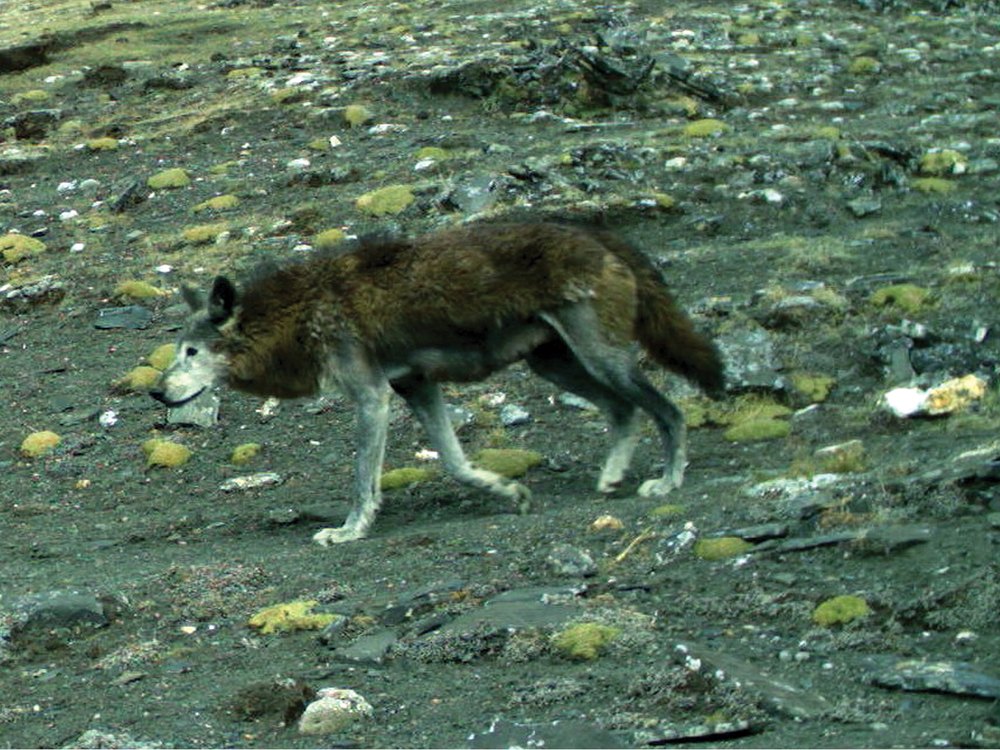
The number of Grey Wolf subspecies depends on the checklist. The IUCN names two in Europe, signatus on the Iberian Peninsula and italicus in Italy, France and Switzerland, and two in Asia, pallipes across most of Asia from Israel to China and arabs on the Arabian Peninsula.[4] It adds chanco, proposed as a distinct subspecies for the same wolf, and five forms often recognised in North America: arctos (Arctic), lycaon (Eastern wolf), nubilus (Plains), occidentalis (Northwestern) and baileyi (Mexican).[4] The Mammal Diversity Database treats the Eastern wolf as its own species (see Taxonomy).[49] ITIS lists 15 subspecies.[50]
Some names are not usable. The old name laniger for the Tibetan or Himalayan wolf is unavailable, because Hamilton Smith had already used it in 1840 for a domestic dog. The next available names are chanco (Gray, 1863) and filchneri (Matschie, 1908).[51]
See all 10 named subspeciesConservation
Status
The IUCN Red List rates the Grey Wolf as Least Concern. The 2018 assessment (Boitani, Phillips and Jhala, assessed on 30 August 2018) gives a stable population trend and a world population of about 200,000 to 250,000 wolves.[4] The global rating hides problems in some regions. The European populations are assessed separately at regional level, and there the IUCN says the wolf populations are "seriously threatened".[4] See Habitat and range for the numbers by region.
Threats
Killing in conflict with peopleIllegal killingHabitat loss[4][39]Killing in conflict with people. The main threat named in the 2018 assessment is persecution because of livestock losses and fear of attacks on people.[4] In Europe, wolves kill about 40,000 head of livestock a year, and a few countries, among them France, Croatia, Italy, Greece, Lithuania, Norway and Turkiye, are hit much harder than the rest.[39] France alone reported 11,064 sheep and goats killed in 2020.[39] In the United States, wolves caused 2,040 cattle deaths in 2015, 4.9% of all cattle deaths due to predators.[52]
Illegal killing. Illegal hunting for fur happens in some range countries.[4]
Habitat loss. Habitat fragmentation adds to the persecution.[4]
Wolf and dog hybrids. The European assessment calls the spread of wolf and dog hybrids a matter of high concern. It is widespread across Europe, and in Italy and the southern countries it is, or can quickly become, very problematic for wolf conservation.[39]
Management
Under CITES (the international treaty on trade in wild animals and plants), wolves are listed in Appendix II, except the wolves of Bhutan, India, Nepal and Pakistan, which are in Appendix I.[4] In 2018 the wolf was in Appendix II of the Bern Convention, a European treaty on wildlife, and in Annexes II and IV of the EU Habitats Directive, the EU's protection lists.[4] In December 2024 the countries that signed the Bern Convention voted, with 38 votes in favour, to move the wolf from Appendix II to Appendix III, a lower level of protection.[53] In 2025 the EU changed the wolf's status in the Habitats Directive from Annex IV, the highest protection level, to Annex V (Directive (EU) 2025/1237, in force from 14 July 2025).[54][55] The wolf is still a protected species, but it can be hunted under national management, and countries may keep a higher level of protection.[55] There is no recovery plan for the species as a whole.[4]
In the lower 48 United States, wolves were listed under the Endangered Species Act in 1974 as subspecies. In 1978 the listing was changed to cover the whole species: threatened in Minnesota and endangered elsewhere.[56] A rule that took the protection away from the remaining wolves took effect on 4 January 2021.[56] In February 2022 a court cancelled that rule, so the wolf is again listed as threatened in Minnesota and endangered elsewhere in the lower 48 states. The ruling does not change the listing status of the wolves of the northern Rocky Mountains, which were taken off the list earlier.[57]
In Canada, Alaska, Montana, the former Soviet Union and Mongolia the fur is used under sustainable-use rules.[4]
Reintroduction
The IUCN lists the reintroduction of wolves in the western United States and Mexico as successful.[4] Yellowstone National Park, where the last wolf pack was killed in 1926, received 31 wolves from western Canada in 1995 and 1996. By the end of 2025 the park held 84 wolves in seven packs.[24][58] Wolf numbers there now show signs of being limited by parasites.[30]
The Mexican wolf (Canis lupus baileyi) is still listed as endangered. At the end of 2025 the US Fish and Wildlife Service counted a minimum of 319 wild Mexican wolves, 143 in Arizona and 176 in New Mexico, up from 114 in 2016.[59] The 2021 delisting rule did not affect its separate listing.[56]
On Isle Royale, an island national park in Lake Superior, the native wolves dwindled to just two. The National Park Service relocated 19 wolves from the Great Lakes region to the island, and in April 2026 it held an estimated 37 wolves and 524 moose.[38][60]
History and culture
Persecution
In North America, Massachusetts Bay and Virginia were offering bounties on wolves as early as the 1630s. The bounty system spread with settlement and stayed in many state laws into the twentieth century.[61] Professional wolf hunters used strychnine in large quantities in the 1870s.[61] In 1905 the United States Forest Service hired trappers to kill wolves on national forest grazing land.[61] In 1914 the US Congress paid for experiments in predator control, and the next year it started a lasting eradication programme run by the Bureau of Biological Survey.[61] Only scattered wolf populations survived.[61]
Yellowstone National Park took part. Between 1914 and 1926, at least 136 wolves were killed in the park, and in 1926 the last wolf pack there was killed. Single wolves were still reported now and then afterwards.[58]
Wolves were wiped out across much of Europe too. In Norway and Sweden the wolf was gone as a breeding animal by 1966.[62] In France, a conservation project in the French Alps says the wolf was effectively extinct in the 1930s, after centuries of organised campaigns.[63] In Germany, wolves were persecuted and eradicated. The first pack to settle again was confirmed in 2000, in the east of the country, after more than 150 years without resident wolves.[64]
Return of the wolf
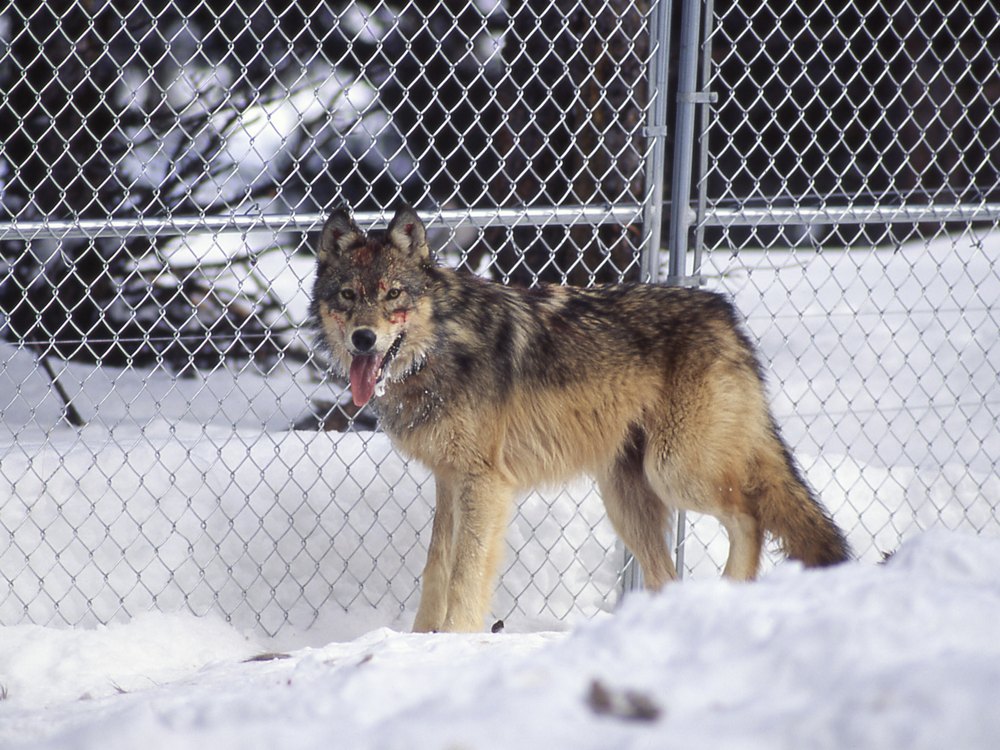
In January 1995, 14 wolves from western Canada were penned in Yellowstone: eight arrived on 12 January and six more on 19 January.[58] A second group of 17 arrived in January 1996, 11 on 23 January and six on 27 January, making 31 wolves in all.[58] Wolves also came back on their own elsewhere. In France, two wolves were first seen in Mercantour National Park in 1992.[63]
Wolves in stories
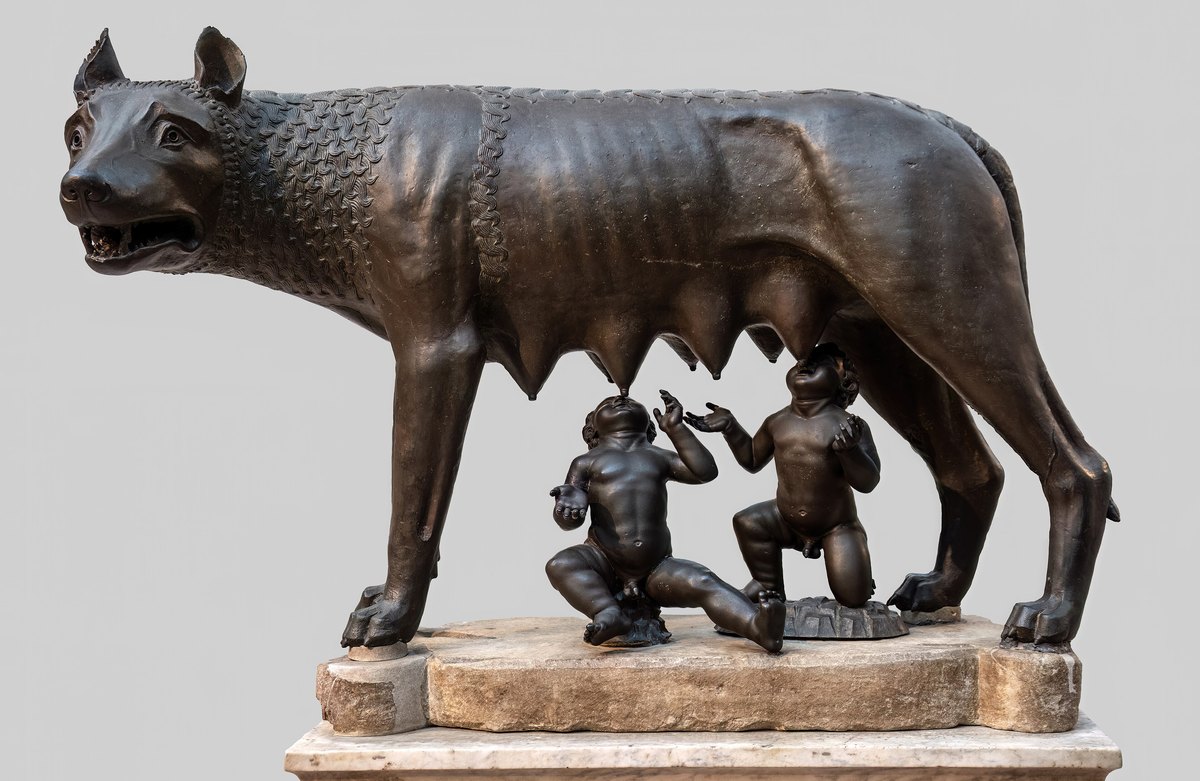
Rome's founding story has a wolf at its start. The Roman historian Livy tells how the twin boys Romulus and Remus were left by the river and found by a thirsty she-wolf that came down from the hills. Drawn by the crying of the children, she let them suck.[65] Livy adds that some writers thought the "she-wolf" was really a woman named Larentia, who had earned that nickname among the shepherds.[65] The bronze Capitoline Wolf in Rome is dated by the Capitoline Museums to the 5th century BC. The twin boys were added in the 15th century.[66][67]


In Norse myth, the gods bound the wolf Fenrir with a fetter called Gleipnir, made of six things such as a woman's beard and the breath of a fish.[68]
The Zhou shu, a Chinese history compiled in 636, says a she-wolf fed a boy with meat. When he grew up, she bore ten boys in a mountain north of Gaochang, and Ashina was the family name of one of them.[69]
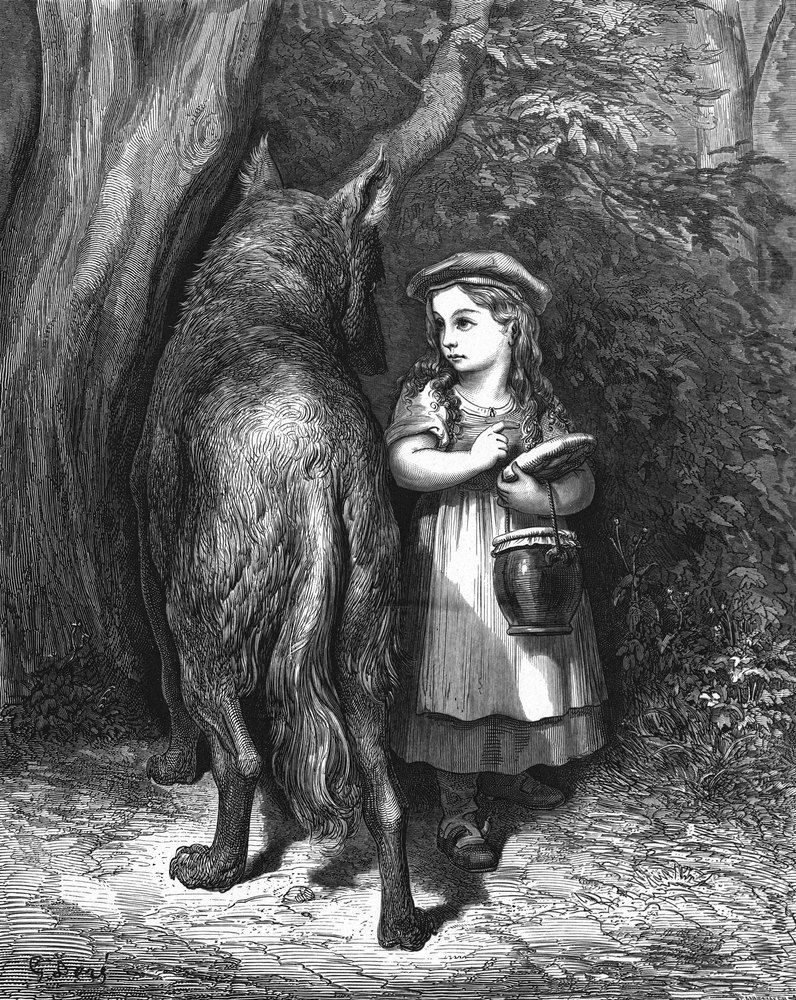
In Charles Perrault's 1697 version of Little Red Riding Hood, the wolf eats the girl at the end.[70] In 2013 Jamshid Tehrani analysed 58 folktales with methods from evolutionary biology. His study separates Little Red Riding Hood from "The Wolf and the Kids", which are two different tale types.[71]

Belief in people who change into wolves also reached the courts. Peter Stumpp was executed on 31 October 1589 in Bedburg, near Cologne. His guilt rests on a confession made under torture, and no court records of the trial survive. Historians rely on pamphlets, one of them printed in London in 1590.[72]
Some individual wolves became famous. In the story "Lobo, the King of Currumpaw", Ernest Thompson Seton describes an old grey wolf that ruled a cattle range in northern New Mexico, and says it was caught in traps and died on 31 January 1894. This is Seton's story, not a record.[73] In real life, the male wolf OR-7 left the Imnaha pack in Oregon in September 2011 and entered California in late December 2011, the first known wolf in that state since 1924.[74][75]
Attacks on people
Linnell et al. reviewed wolf attacks on people between 2002 and 2020 and found 489 relatively reliable cases. Of these, 67 were victims of predatory attacks (9 fatal), 380 were victims of rabid wolves (14 fatal), and 42 were victims of provoked or defensive attacks (3 fatal).[76] They note that attacks by rabid wolves follow the spread of rabies in people and other wildlife, so the risk is very low in Europe, where rabies is nearly gone.[76]
For 1950 to 2002 in Europe (without Russia) and North America, the same authors count 37 victims of rabid wolves (4 fatal) and 31 predatory or defensive attacks (4 fatal).[76] A Danish summary of their 2002 report says predatory attacks mainly target children.[77]
Taxonomy
| Rank | Name |
|---|---|
| Kingdom | Animalia |
| Phylum | Chordata |
| Subphylum | Vertebrata |
| Superclass | Tetrapoda[84] |
| Class | Mammalia[78] |
| Subclass | Theria[84] |
| Infraclass | Eutheria[84] |
| Order | Carnivora[78] |
| Suborder | Caniformia[84] |
| Family | Canidae (dogs, wolves and foxes)[78] |
| Genus | Canis[78] |
| Species | Canis lupus (Linnaeus, 1758)[50][78] |
Synonyms (7)
| Name |
|---|
| Lupus lupus (Linnaeus, 1758) |
| Canis nubilus (Say, 1823) |
| Lupus gigas (Townsend, 1850) |
| Canis pambasileus (Elliot, 1905) |
| Canis tundrarum (Miller, 1912) |
| Canis furlongi (Hay, 1927) |
| Canis petrolei (Stock, 1938) |
From the GBIF backbone.[83]
Higher classification
The Grey Wolf belongs to the dog family, Canidae, in the order Carnivora, the meat-eating mammals.[78] The Mammal Diversity Database lists eight species in Canis: the Grey Wolf, Eastern wolf, Red wolf, African golden wolf, golden jackal, coyote, Ethiopian wolf and the Dog.[49] A 2019 workshop of the IUCN Canid Specialist Group moved the black-backed and side-striped jackals to the genus Lupulella.[51] Chavez and colleagues (2019) group Canis with the dhole and the African wild dog as the wolf-like canids (see Evolution).[42]
The Dog and the look-alikes
The Dog is a separate species, Canis familiaris, for the IUCN and the Mammal Diversity Database. The workshop treats the dingo and the New Guinea singing dog as feral dogs.[49][51] Skoglund and colleagues (2015) put the split between dog and modern wolf ancestors at 27,000 to 40,000 years ago, earlier estimates gave 11,000 to 16,000, and the gap comes from the mutation rate used.[82] Bergström and colleagues (2022) studied 72 ancient wolf genomes and found dogs closest to ancient eastern Eurasian wolves.[48] Several wolf-like forms are debated. The workshop kept the Himalayan wolf inside the species as chanco and discussed the Indian wolf with it.[51] Their mitochondrial DNA split from other wolves about 200,000 to 700,000 years ago, and Krofel and colleagues (2022) support the name pallipes for the Indian wolf.[80][81] The African golden wolf, Canis lupaster, is a species of its own.[49][51] The Eastern and Red wolves are species in the database. vonHoldt and colleagues (2016) found no unique ancestry in either, while Hohenlohe and colleagues (2017) argued against a recent hybrid origin.[45][46][49] See Forms and variants for subspecies counts.
Sources
- Mech, L. D. 1999. Alpha status, dominance, and division of labor in wolf packs. Canadian Journal of Zoology 77: 1196–1203
- National Park Service, Yellowstone National Park. 2022. YS 24-1 Yellowstone wolf facts
- National Park Service, Yellowstone National Park, Wolf facts
- Boitani, L., Phillips, M. and Jhala, Y. V. 2018. Canis lupus. The IUCN Red List of Threatened Species 2018: e.T3746A119623865
- Anderson, T. M., vonHoldt, B. M., Candille, S. I. et al. 2009. Molecular and evolutionary history of melanism in North American gray wolves. Science 323: 1339–1343
- National Park Service, North Cascades National Park, Wolf description and biology
- Animal Diversity Web, University of Michigan Museum of Zoology, Canis lupus (gray wolf)
- Parks Canada, Grey wolf, Pukaskwa National Park
- US Fish and Wildlife Service, Gray wolf (Canis lupus) species page
- National Park Service, Yellowstone National Park, Wolves
- Alaska Department of Fish and Game, Wolf (Canis lupus) species page
- National Park Service, Denali National Park and Preserve, Identifying Denali’s wolves
- Plutarch. Life of Romulus 3–4 (translated by B. Perrin, Loeb Classical Library, 1914; LacusCurtius, University of Chicago)
- Washington Department of Fish and Wildlife, Gray wolf (Canis lupus)
- National Park Service, Denali National Park and Preserve, FAQ about wolves
- National Park Service, Yellowstone Center for Resources. 2025. Yellowstone Wolf, Cougar and Elk Project Annual Report 2024
- Minnesota Department of Natural Resources. 2020. Monitoring Minnesota’s wolf population (fact sheet)
- Smithsonian’s National Zoo and Conservation Biology Institute, Gray wolf
- Peters, R. P. and Mech, L. D. 1975. Scent-marking in wolves. American Scientist 63: 628–637
- Harrington, F. H. and Mech, L. D. 1979. Wolf howling and its role in territory maintenance. Behaviour 68: 207–249
- Newsome, T. M., Boitani, L., Chapron, G. et al. 2016. Food habits of the world’s grey wolves. Mammal Review 46: 255–269
- Meriggi, A., Brangi, A., Schenone, L., Signorelli, D. and Milanesi, P. 2011. Changes of wolf (Canis lupus) diet in Italy in relation to the increase of wild ungulate abundance. Ethology Ecology & Evolution 23: 195–210
- Smith, D. W., Drummer, T. D., Murphy, K. M., Guernsey, D. S. and Evans, S. B. 2004. Winter prey selection and estimation of wolf kill rates in Yellowstone National Park, 1995–2000. Journal of Wildlife Management 68: 153–166
- National Park Service, Yellowstone National Park. 2025. Yellowstone Wolf, Cougar and Elk Project Annual Report 2025
- Gable, T. D., Windels, S. K. and Bruggink, J. G. 2017. Estimating biomass of berries consumed by gray wolves. Wildlife Society Bulletin 41: 129–131
- Holyan, J., Boyd, D. K., Mack, C. M. and Pletscher, D. H. 2005. Longevity and productivity of three wolves, Canis lupus, in the wild. The Canadian Field-Naturalist 119: 447–448
- Tallian, A., Ordiz, A., Metz, M. C. et al. 2017. Competition between apex predators? Brown bears decrease wolf kill rate on two continents. Proceedings of the Royal Society B 284: 20162368
- Kortello, A. D., Hurd, T. E. and Murray, D. L. 2007. Interactions between cougars (Puma concolor) and gray wolves (Canis lupus) in Banff National Park, Alberta. Écoscience 14: 214–222
- Almberg, E. S., Mech, L. D., Smith, D. W., Sheldon, J. W. and Crabtree, R. L. 2009. A serological survey of infectious disease in Yellowstone National Park’s canid community. PLoS ONE 4: e7042
- Almberg, E. S., Cross, P. C., Dobson, A. P., Smith, D. W. and Hudson, P. J. 2012. Parasite invasion following host reintroduction: a case study of Yellowstone’s wolves. Philosophical Transactions of the Royal Society B 367: 2840–2851
- Ghorani, M., Eslami, F. and Jafari, G. 2022. The first case report of rabies in a grey wolf (Canis lupus) in Chaharmahal and Bakhtiari Province (Iran). Veterinary Medicine and Science 8: 1300–1304
- Ripple, W. J. and Beschta, R. L. 2012. Trophic cascades in Yellowstone: the first 15 years after wolf reintroduction. Biological Conservation 145: 205–213
- Painter, L. E., Beschta, R. L., Larsen, E. J. and Ripple, W. J. 2015. Recovering aspen follow changing elk dynamics in Yellowstone: evidence of a trophic cascade? Ecology 96: 252–263
- Kauffman, M. J., Brodie, J. F. and Jules, E. S. 2010. Are wolves saving Yellowstone's aspen? A landscape-level test of a behaviorally mediated trophic cascade. Ecology 91: 2742–2755
- Marshall, K. N., Hobbs, N. T. and Cooper, D. J. 2013. Stream hydrology limits recovery of riparian ecosystems after wolf reintroduction. Proceedings of the Royal Society B 280: 20122977
- Peterson, R. O., Vucetich, J. A., Bump, J. M. and Smith, D. W. 2014. Trophic cascades in a multicausal world: Isle Royale and Yellowstone. Annual Review of Ecology, Evolution, and Systematics 45: 325–345
- National Park Service, The big scientific debate: trophic cascades
- Michigan Technological University. 2026. Isle Royale wolf population nears historic high as moose numbers plummet (news release, 27 April 2026)
- Large Carnivore Initiative for Europe (IUCN SSC). 2022. Assessment of the conservation status of the Wolf (Canis lupus) in Europe. Bern Convention, T-PVS/Inf(2022)45
- Poyarkov, A. D., Korablev, M. P., Bragina, E. and Hernandez-Blanco, J. A. 2022. Overview of current research on wolves in Russia. Frontiers in Ecology and Evolution 10: 869161
- Government of Canada, Environment and Climate Change Canada. Grey wolf: non-detriment finding (revised 17 February 2014)
- Chavez, D. E., Gronau, I., Hains, T., Kliver, S., Koepfli, K.-P. and Wayne, R. K. 2019. Comparative genomics provides new insights into the remarkable adaptations of the African wild dog (Lycaon pictus). Scientific Reports 9: 8329
- Koepfli, K.-P., Pollinger, J., Godinho, R. et al. 2015. Genome-wide evidence reveals that African and Eurasian golden jackals are distinct species. Current Biology 25: 2158–2165
- Gopalakrishnan, S., Sinding, M.-H. S., Ramos-Madrigal, J. et al. 2018. Interspecific gene flow shaped the evolution of the genus Canis. Current Biology 28: 3441–3449
- vonHoldt, B. M., Cahill, J. A., Fan, Z. et al. 2016. Whole-genome sequence analysis shows that two endemic species of North American wolf are admixtures of the coyote and gray wolf. Science Advances 2: e1501714
- Hohenlohe, P. A., Rutledge, L. Y., Waits, L. P. et al. 2017. Comment on “Whole-genome sequence analysis shows that two endemic species of North American wolf are admixtures of the coyote and gray wolf”. Science Advances 3: e1602250
- Perri, A. R., Mitchell, K. J., Mouton, A. et al. 2021. Dire wolves were the last of an ancient New World canid lineage. Nature 591: 87–91
- Bergström, A., Stanton, D. W. G., Taron, U. H. et al. 2022. Grey wolf genomic history reveals a dual ancestry of dogs. Nature 607: 313–320
- Mammal Diversity Database, Canis lupus Linnaeus, 1758 (gray wolf)
- ITIS, Canis lupus Linnaeus, 1758 (TSN 180596)
- Alvares, F. et al. 2019. Old World Canis spp. with taxonomic ambiguity: workshop conclusions and recommendations. IUCN/SSC Canid Specialist Group, CIBIO, Vairão, Portugal
- USDA APHIS Veterinary Services, National Animal Health Monitoring System. 2017. Death loss in U.S. cattle and calves due to predator and nonpredator causes, 2015
- General Secretariat of the Council of the European Union. 2025. Outcome of the 44th meeting of the Standing Committee of the Bern Convention. Information note 5423/25 (16 January 2025)
- European Commission, Large carnivores (Habitats Directive)
- European Commission, EU Large Carnivore Platform: facts and common misconceptions
- US Fish and Wildlife Service. 2020. Endangered and Threatened Wildlife and Plants; Removing the Gray Wolf (Canis lupus) From the List of Endangered and Threatened Wildlife. Federal Register 85(213): 69778–69895 (3 November 2020)
- Ward, E. H. 2022. U.S. District Court vacates gray wolf delisting rule. Congressional Research Service, Legal Sidebar LSB10697 (18 February 2022)
- National Park Service, Yellowstone National Park, History of wolf management
- US Fish and Wildlife Service, Mexican Wolf Recovery Program. 2026. Mexican wolf population statistics, Blue Range Reintroduction Project (data current as of 31 December 2025)
- National Park Service, Isle Royale National Park, Wolf and moose populations
- Dunlap, T. R. 1984. Values for varmints: predator control and environmental ideas, 1920–1939. Pacific Historical Review 53: 141–161
- Wabakken, P., Sand, H., Liberg, O. and Bjärvall, A. 2001. The recovery, distribution, and population dynamics of wolves on the Scandinavian peninsula, 1978–1998. Canadian Journal of Zoology 79: 710–725
- LIFE WolfAlps, The wolf in the French Alps
- Jarausch, A., Harms, V., Kluth, G., Reinhardt, I. and Nowak, C. 2021. How the west was won: genetic reconstruction of rapid wolf recolonization into Germany’s anthropogenic landscapes. Heredity 127: 92–106
- Livy. Ab urbe condita 1.4 (English translation, Perseus Digital Library, Tufts University)
- Musei Capitolini, Roma Capitale, Lupa Capitolina (Capitoline Wolf)
- Musei Capitolini, Roma Capitale, education pages: Lo Spinario, un’immagine, tanti significati
- Snorri Sturluson. The Prose Edda, Gylfaginning (translated by A. G. Brodeur, American-Scandinavian Foundation, 1916; public-domain transcription)
- Linghu Defen et al. 636. Zhou shu (Book of Zhou), juan 50, Tujue (public-domain transcription)
- Perrault, C. 1697. Little Red Riding Hood, in Histoires ou contes du temps passé (English text from A. Lang, The Blue Fairy Book, c. 1889; D. L. Ashliman, University of Pittsburgh)
- Tehrani, J. J. 2013. The phylogeny of Little Red Riding Hood. PLOS ONE 8: e78871
- National Geographic, History. A German werewolf’s “confessions” horrified 1500s Europe
- Seton, E. T. 1898. Lobo, the king of Currumpaw, in Wild Animals I Have Known (Standard Ebooks edition from the Project Gutenberg text)
- US Fish and Wildlife Service. 2014. Oregon wolf OR7 may have found mate (press release)
- Oregon Department of Fish and Wildlife, Imnaha pack
- Linnell, J. D. C., Kovtun, E. and Rouart, I. 2021. Wolf attacks on humans: an update for 2002–2020. NINA Report 1944. Norwegian Institute for Nature Research
- Linnell, J. D. C., Løe, J., Okarma, H. et al. 2002. The fear of wolves: a review of wolf attacks on humans. NINA Oppdragsmelding 731 (Frygten for ulve” , University of Copenhagen)
- GBIF Secretariat, Canis lupus Linnaeus, 1758, GBIF Backbone Taxonomy (species 5219173)
- Catalogue of Life, Canis lupus Linnaeus, 1758 (ChecklistBank)
- Hennelly, L. M., Habib, B., Modi, S., Rueness, E. K., Gaubert, P. and Sacks, B. N. 2021. Ancient divergence of Indian and Tibetan wolves revealed by recombination-aware phylogenomics. Molecular Ecology 30: 6687–6700
- Krofel, M., Hatlauf, J., Bogdanowicz, W. et al. 2022. Towards resolving taxonomic uncertainties in wolf, dog and jackal lineages of Africa, Eurasia and Australasia. Journal of Zoology 316: 155–168
- Skoglund, P., Ersmark, E., Palkopoulou, E. and Dalén, L. 2015. Ancient wolf genome reveals an early divergence of domestic dog ancestors and admixture into high-latitude breeds. Current Biology 25: 1515–1519
- GBIF backbone, Canis lupus, synonyms
- ITIS, Canis lupus, classification