The Amazonian Giant Centipede (Scolopendra gigantea) is a large centipede of the dry Caribbean coast of northern South America.[1][2] Wild animals measured in a Venezuelan cave were 145 to 210 mm long, and in that cave they were found eating bats.[3] Linnaeus named it in 1758.[1][4] The IUCN has not evaluated it.[5][6]
Quick facts
Description
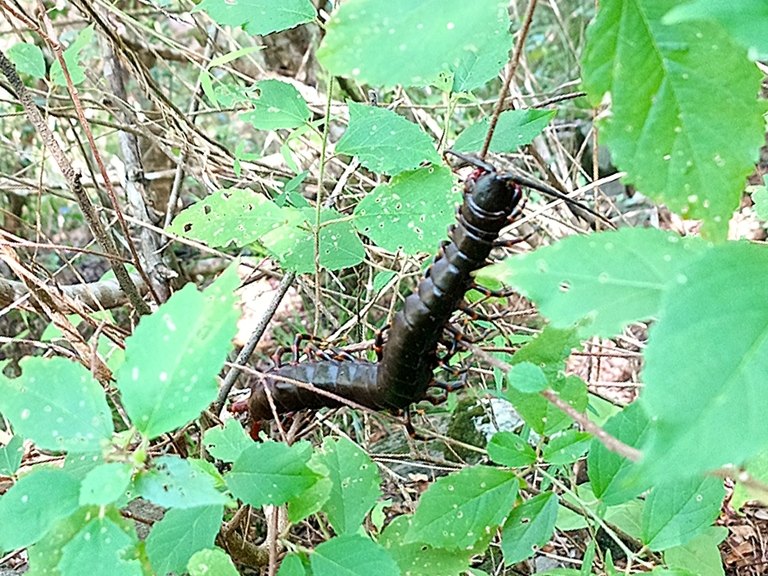
The Amazonian Giant Centipede has a long, flat body made of many segments, and each segment carries one pair of legs.[6]
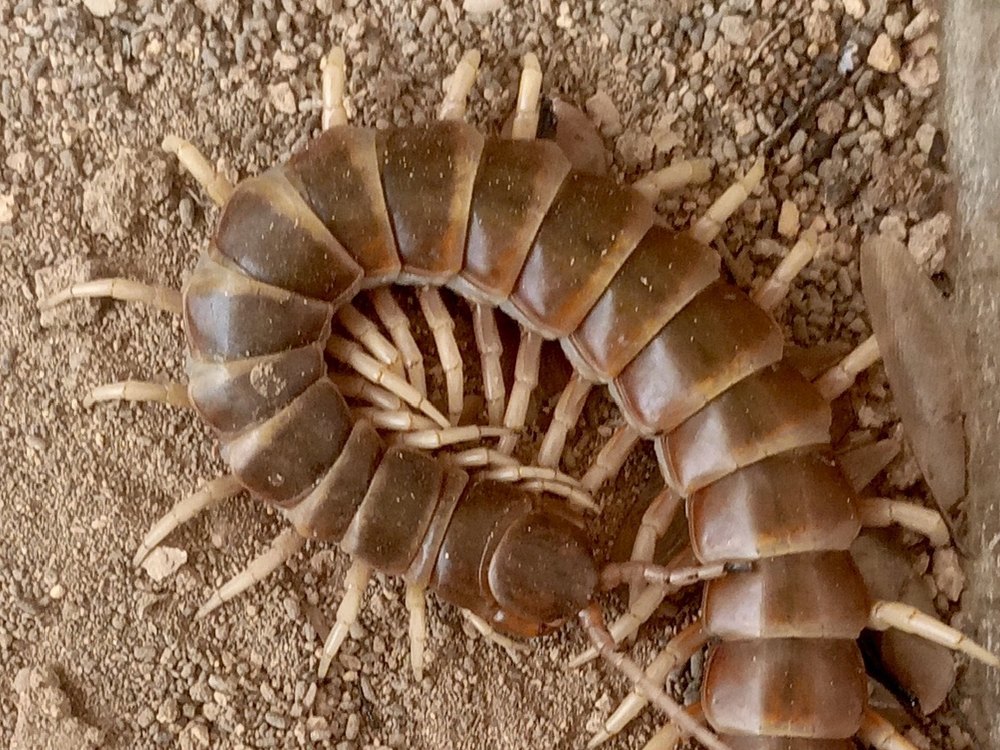
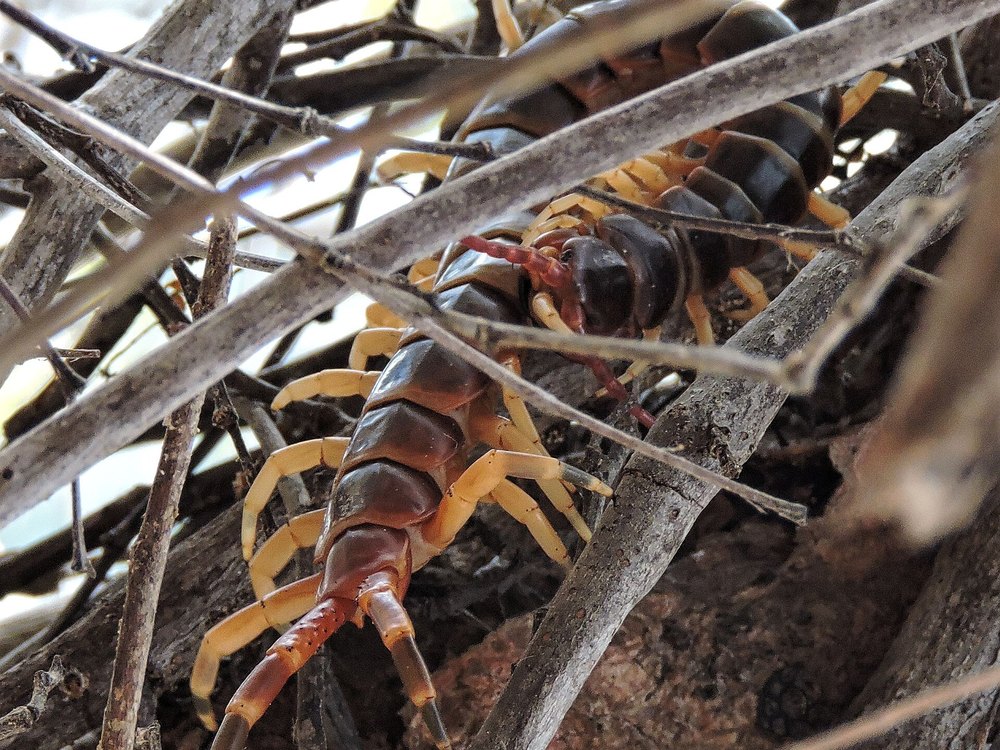
An Amazonian Giant Centipede that bit a newborn in Venezuela in 1999 was described as dark brown, with yellow ends to its legs.[7]
Name
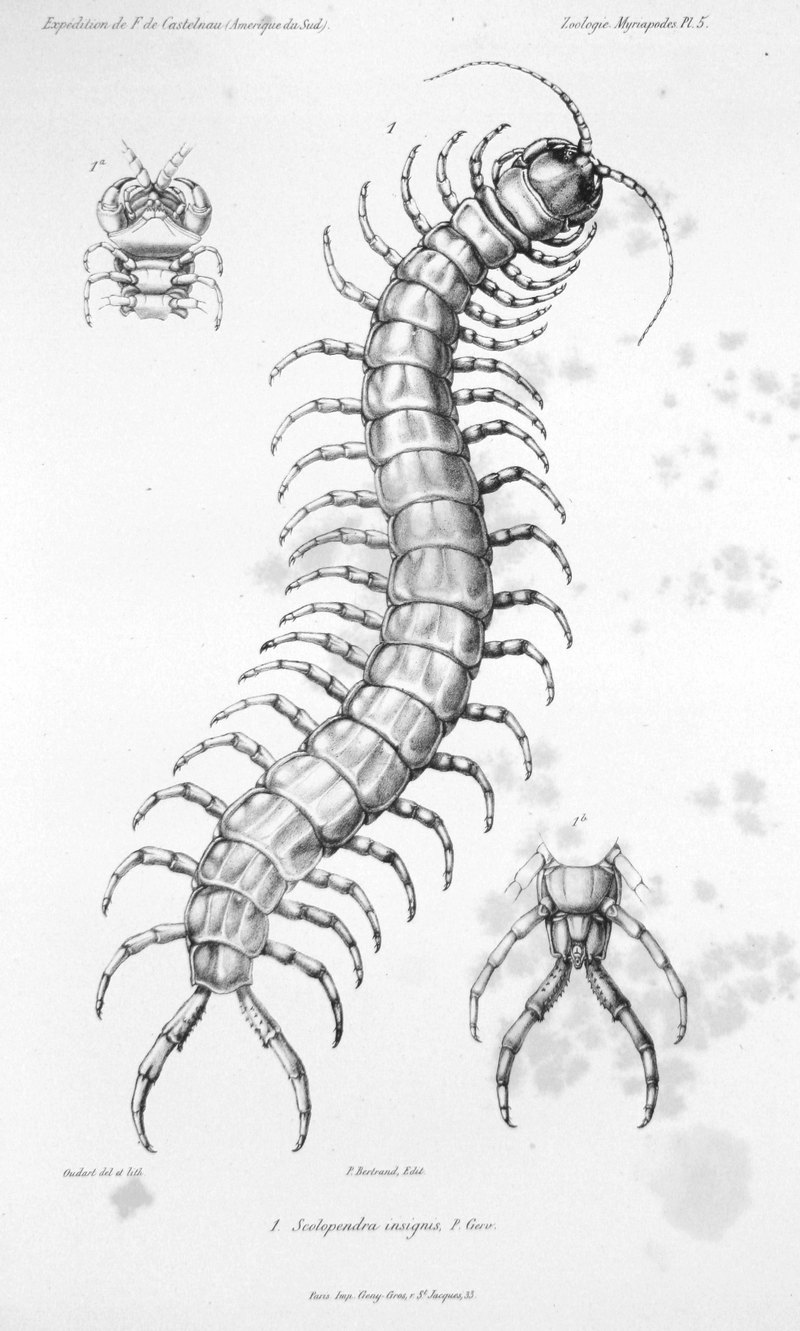
The scientific name Scolopendra gigantea was given by Linnaeus in 1758, and the genus name Scolopendra is also his.[4][8] The species word gigantea is Latin for “giant”; in the same entry Linnaeus calls the animal the largest of its kind and much larger than the next species he lists.[4]
In other languages
| Language | Name | Meaning |
|---|---|---|
| Papiamento (Aruba) local | Lisinbein | — |
| Russian | Сколопендра гигантская (Skolopendra gigantskaya) | “giant scolopendra” |
| Ukrainian | Сколопендра гігантська (Skolopendra gihantska) | “giant scolopendra” |
The Papiamento name is the one an Aruban news site uses for this centipede.[9] The Russian and Ukrainian names come from the Catalogue of Life checklist.[10]
Body
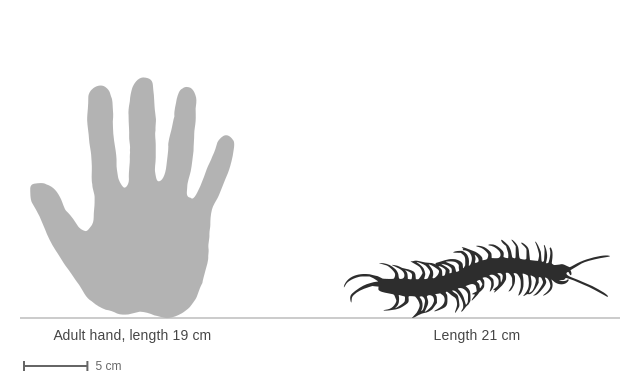
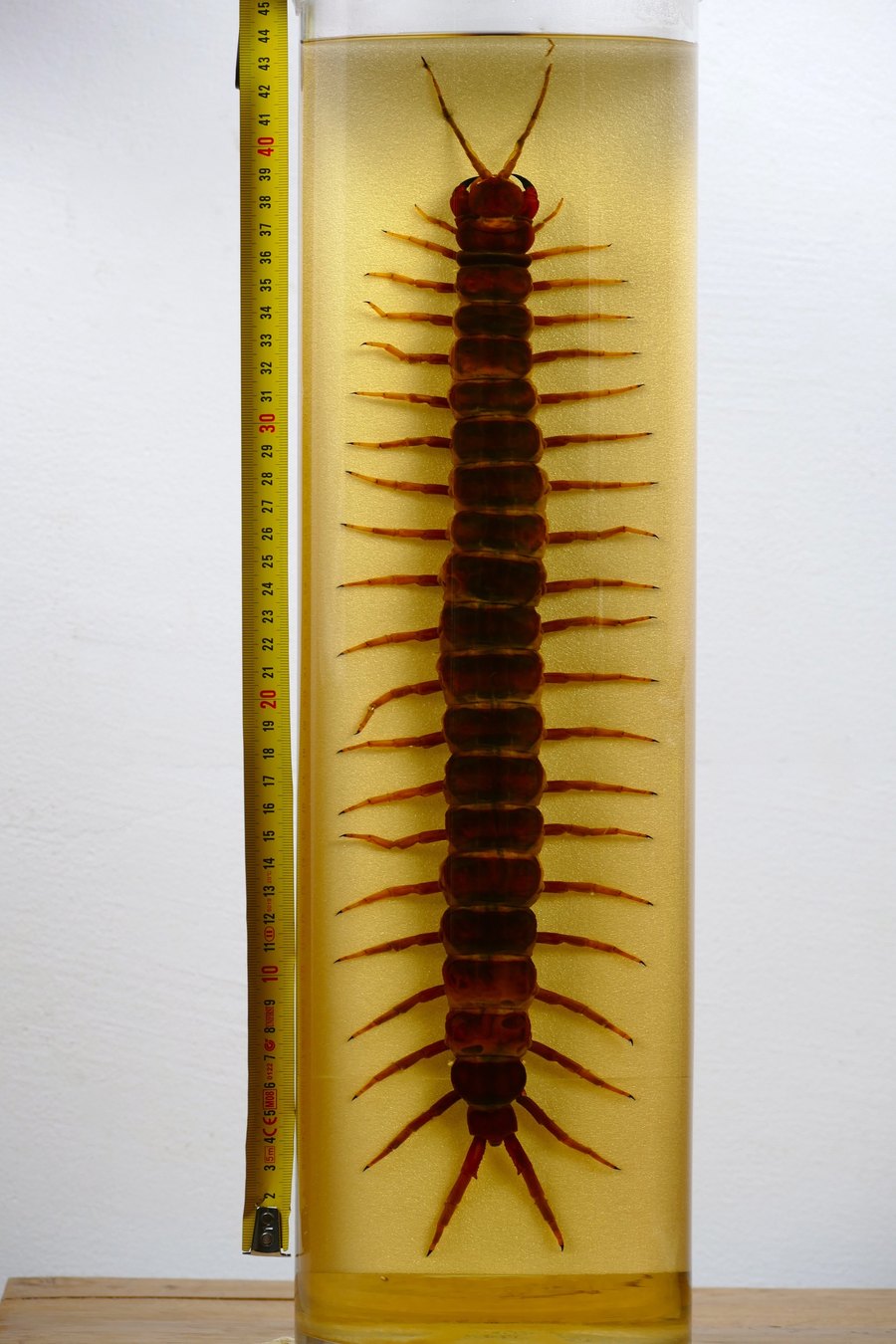
Three wild Amazonian Giant Centipedes measured in one Venezuelan cave were 145 mm, 160 mm and 210 mm long. The 145 mm animal was a mature female and weighed 15.2 g; that weight included a bat she had been eating, and the authors put her weight before the meal at about 9.0 to 9.5 g.[3]
Size
Larger sizes come from other accounts. Khanna and Yadav (2005) quote a Venezuelan specimen of “nearly 275 mm” documented in a 2000 paper by Shelley and Kiser.[11] Guinness World Records lists 260 mm.[12]
| Length (wild) | 145–210 mm |
Venom claws and venom
The venom claws, called forcipules, are the first pair of legs, turned forward under the head.[3] Centipedes of this order often make a first puncture with them in the neck of a vertebrate prey animal.[3] Bites on people are painful and last several hours, with swelling, and are rarely serious (see History and culture).[13]
Legs and senses
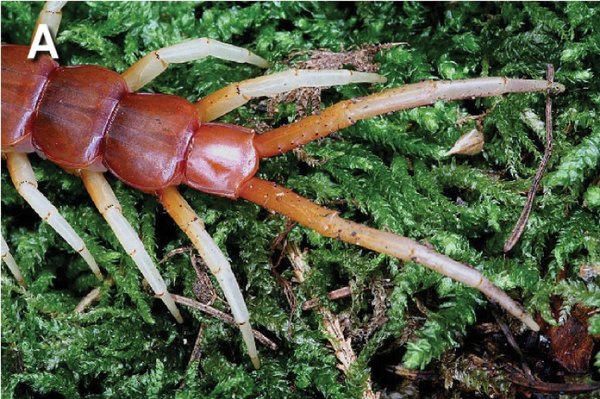
The Amazonian Giant Centipede climbs cave walls and ceilings (see Behavior). The last pair of legs is the least specialised kind found among centipedes of this order.[14] The antennae are long and made of many small joints.[6]
Behavior
Cave roosts and movement
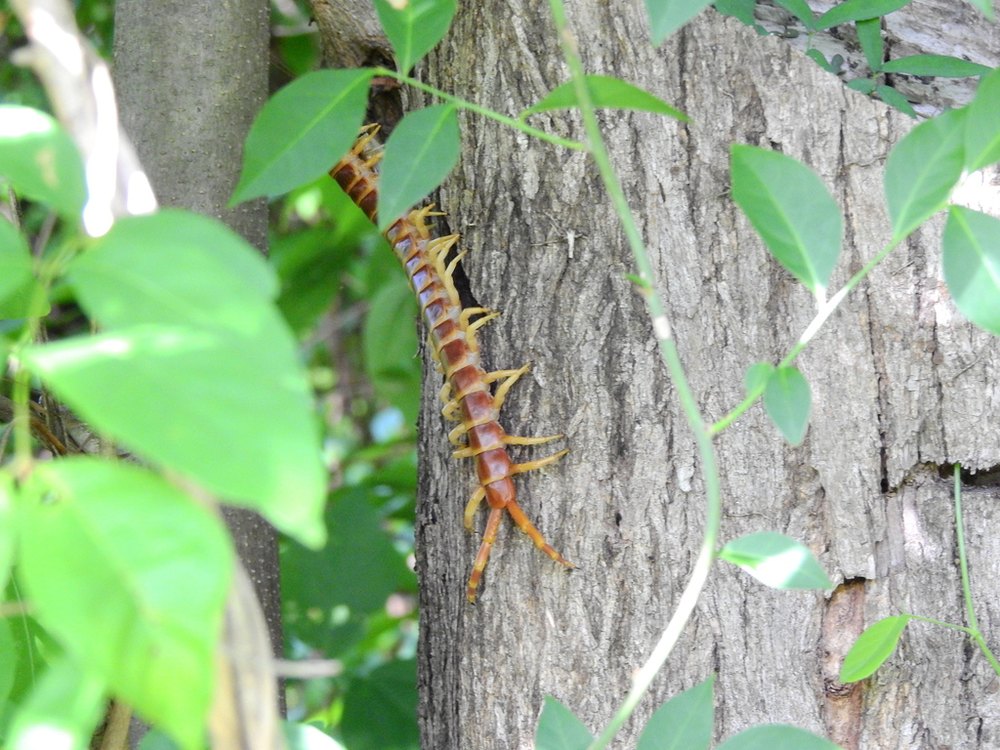
The Amazonian Giant Centipede has been watched in Cueva del Guano, a bat cave in a thorn-scrub region of the Paraguaná Peninsula in Venezuela. Centipedes were seen there both at night and by day, and some rested for hours on the walls and ceiling of the cave’s first chamber.[3] They climb the ceiling belly up, gripping with the last five to eight pairs of legs.[3] A centipede feeding on a bat was touched with a stick. It did not flee but coiled partly around the bat and held it tighter.[3]
Diet
The Amazonian Giant Centipede is a carnivore that kills its prey with venom from its venom claws.[3] It holds the prey with its first seven or eight pairs of legs, and the number of front legs used changes with the size of the prey.[3]
| Food | Where | Notes |
|---|---|---|
| Ghost-faced bat (Mormoops megalophylla) | Cueva del Guano, Venezuela | Killed on 21 December 2000 by a 145 mm centipede, which had eaten about 35% of the bat’s weight when collected[3] |
| Southern long-nosed bat (Leptonycteris curasoae) | Cueva del Guano, Venezuela | 7 December 2001, a 210 mm centipede feeding on a bat lying on the cave floor[3] |
| Davy’s naked-backed bat (Pteronotus davyi) | Cueva del Guano, Venezuela | 13 March 2003, a 160 mm centipede anchored by its last eight leg pairs while feeding[3] |
| Baker’s cat-eyed snake (Leptodeira bakeri) | Aruba | 2 January 2017, a centipede of about 180 mm began to eat the snake after it died[15] |
Prey records
Molinari and colleagues found centipedes feeding on three bats in the one cave between 2000 and 2003. In the first case the centipede began feeding at the bat’s neck.[3]
On Aruba the snake died about half an hour after it was first seen, and the centipede then began to eat it.[15]
Life cycle
| Stage | Age / time | Notes |
|---|---|---|
| Egg | — | — |
| Young | — | — |
| Adult | Wild, 145 to 210 mm | A mature wild female of 145 mm (see Body)[3] |
Ecology
The Amazonian Giant Centipede shares its cave roost on the Paraguaná Peninsula with bats, and it was found eating them (see Diet).[3] On Aruba it was seen eating a dead snake (see Diet).[15]


Habitat and range
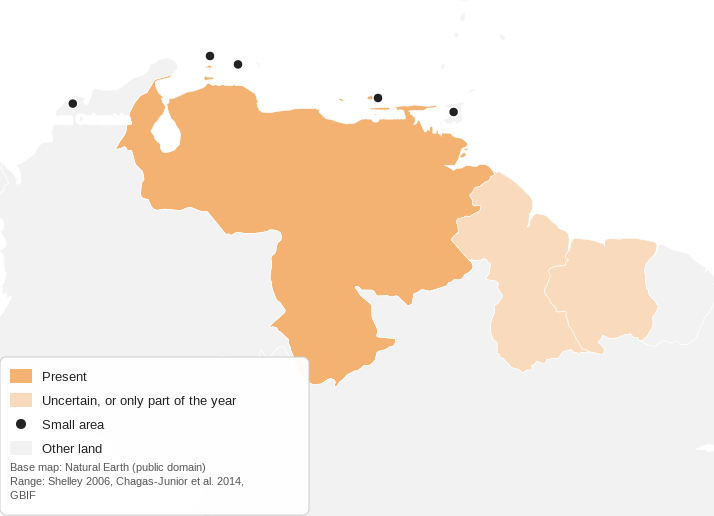
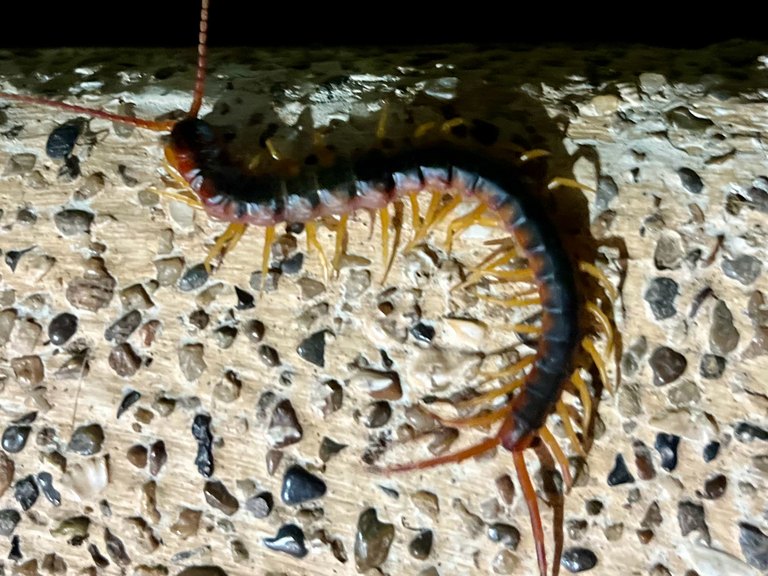
The Amazonian Giant Centipede lives on the Caribbean coast of northern South America, from the department of Córdoba in Colombia east along the Venezuelan coast, and on Trinidad, Aruba, Curaçao and Margarita Island in Venezuela.[1] In Colombia it is known only from the Caribbean Region.[2]
Altitude and places
Colombian specimens were collected between 9 and 40 m above sea level, at sites such as near Barranquilla in Atlántico, San Marcos in Sucre, Santa Catalina in Bolívar and the Tayrona and Isla de Salamanca parks in Magdalena.[2] The Venezuelan cave record lies in a thorn-scrub region.[3]
Records from Suriname and Guyana are old or unconfirmed.[1]
Evolution
The Amazonian Giant Centipede is a scolopendromorph, a centipede of the order Scolopendromorpha. Living centipedes fall into five orders: Scutigeromorpha, Lithobiomorpha, Craterostigmomorpha, Scolopendromorpha and Geophilomorpha.[16] How these orders are related is still debated, and a tree built from mitochondrial genes differs from the one drawn from body structure.[16]
Inside the order, a study of genes named the group Taktikospina for all scolopendromorphs except the family Mimopidae, and Tykhepoda for three blind families.[17] The sighted family Scolopendridae, which holds the Amazonian Giant Centipede, is supported as a group and splits into two clades.[18] In another study the New World species of Scolopendra were closer to two other genera than to Scolopendra in the strict sense, so the genus is not one branch of the tree.[19]
Centipedes through time
In a dated tree built from mitochondrial genes, the lineage leading to the scolopendromorphs split from the lineage of Lithobiomorpha and Geophilomorpha about 397 million years ago, in the Lower Devonian, about 400 million years ago (95% range 381 to 415 million years).[16] That date marks the split from the other orders, not the age of the order or of the species. In the same tree the earliest split among living centipedes, between Scutigeromorpha and the rest, falls in the Middle Ordovician about 464 million years ago (95% range 426 to 500 million years).[16]
Fossil scolopendromorphs are rare. Before 2018 the group was known from five specimens: two from the Carboniferous of Mazon Creek in the USA and three from the Cretaceous Crato Formation in Brazil.[20] Two Permian fossils from Russia, Permocrassacus novokshonovi and Permocryptops shelleyi, were the first centipedes reported from that period.[20]
Forms and variants
No subspecies of Scolopendra gigantea are listed in GBIF or the Catalogue of Life.[5][10] The five other names once given to the species are now synonyms; they are listed under Taxonomy.[5][21]
Conservation
The Amazonian Giant Centipede has not been evaluated by the IUCN Red List, so it has no conservation category.[5]
History and culture
First description
Carl Linnaeus named Scolopendra gigantea in 1758 in the tenth edition of Systema Naturae (page 638), with the place given only as “America”.[4] The name rests on Patrick Browne’s 1756 account of a large centipede from Jamaica, and no type specimen was kept.[1]
In 2000 a replacement type specimen, called a neotype, was chosen from Valencia in Carabobo, Venezuela, and that city is now the type locality.[1][21]
Bites and venom research
A bite case from Venezuela is documented for this centipede. In January 1999 a 28-day-old girl was bitten twice on the back of the left hand at the Capaya rural health centre in Miranda state.[7] Her mother caught the centipede, which the authors named as S. gigantea.[7] About six hours later the baby had intense local pain, swelling and blood clots at the two punctures, and a fever of 38 °C.[7] She was given hydrocortisone and acetaminophen; the swelling had gone after 72 hours and she fed normally after three days.[7] The authors call it the first centipede bite recorded in a newborn.[7]
The same paper gives figures for Venezuela. In 1999 only seven patients with a suspected centipede bite were admitted to hospital in the north-central region, and Ministry of Health records show only twelve such bites in 30 years, all in adults. The authors think the real numbers are higher.[7] A 2021 study of venomous animals in Venezuela describes the bite as acute and very painful, lasting several hours, with swelling, and says some authors almost never consider it serious.[13]
Taxonomy
| Rank | Name |
|---|---|
| Kingdom | Animalia |
| Phylum | Arthropoda |
| Subphylum | Myriapoda |
| Class | Chilopoda (centipedes) |
| Subclass | Pleurostigmophora[8] |
| Order | Scolopendromorpha |
| Family | Scolopendridae |
| Subfamily | Scolopendrinae[8] |
| Genus | Scolopendra Linnaeus, 1758 |
| Species | Scolopendra gigantea (Linnaeus, 1758) |
Synonyms (5)
| Name |
|---|
| Scolopendra gigas (Leach, 1815) |
| Scolopendra insignis (Gervais, 1844) |
| Scolopendra epileptica (Wood, 1861) |
| Scolopendra prasinipes (Wood, 1861) |
| Scolopendra annulipes (Lucas, 1884) |
From the GBIF backbone.[23]
Higher classification
GBIF, the Catalogue of Life and ITIS place the species in the class Chilopoda (centipedes), the order Scolopendromorpha and the family Scolopendridae.[5][8][22] Only ITIS adds a subfamily, Scolopendrinae.[8]
Sources
- Shelley, R. M. 2006. A chronological catalog of the New World species of Scolopendra L., 1758. Zootaxa 1253: 1–50
- Chagas-Junior, A., Chaparro, E., Jiménez, F., Triana, D. and Seoane, J. 2014. The centipedes (Arthropoda, Myriapoda, Chilopoda) from Colombia: Part I. Zootaxa 3779(2): 133–156
- Molinari, J., Gutierrez, E. E., de Ascenção, A. A., Nassar, J. M., Arends, A. and Márquez, R. J. 2005. Predation by giant centipedes, Scolopendra gigantea, on three species of bats in a Venezuelan cave. Caribbean Journal of Science 41(2): 340–346
- Linnaeus, C. 1758. Systema Naturae, 10th edition, p. 638 (Scolopendra gigantea)
- GBIF Secretariat, Scolopendra gigantea Linnaeus, 1758, GBIF Backbone Taxonomy (species 5179388)
- Meshew, P. 2001. Scolopendra gigantea. Animal Diversity Web, University of Michigan Museum of Zoology
- Rodriguez-Acosta, A., Gassette, J., Gonzalez, A. and Ghisoli, M. 2000. Centipede (Scolopendra gigantea Linneaus 1758) envenomation in a newborn. Revista do Instituto de Medicina Tropical de São Paulo 42(6): 341–342
- ITIS, Scolopendra gigantea (TSN 1091056)
- Aruba Today, Fun facts about the ‘Lisinbein’ (Scolopendra gigantea)
- Catalogue of Life, Scolopendra gigantea Linnaeus, 1758
- Khanna, V. and Yadav, B. E. 2005. A taxonomic re-assessment of the centipede Scolopendra gigantea Linnaeus (Chilopoda: Scolopendridae) and confirmation of its occurrence in India. Zoos’ Print Journal 20(9): 1988
- Guinness World Records, largest centipede
- De Sousa, L., Borges, A., De Sousa-Insana, L. and Vasquez-Suarez, A. 2021. Mortality caused by venomous animals in Venezuela (2000–2009). Biomédica 41(1): 29–40
- Kronmuller, C. and Lewis, J. G. E. 2015. On the function of the ultimate legs of some Scolopendromorpha. ZooKeys 510: 269–278
- van Buurt, G. and Dilrosun, F. 2017. Predation by an Amazonian Giant Centipede (Scolopendra gigantea) on a Baker’s Cat-eyed Snake (Leptodeira bakeri). Reptiles & Amphibians 24(2): 127
- Ji, J.-H. et al. 2025. Unusual genetic diversity within Thereuopoda clunifera revealed by phylogeny and divergence times using mitochondrial genomes. Insects 16(5): 486
- Benavides, L. R., Edgecombe, G. D. and Giribet, G. 2023. Re-evaluating and dating myriapod diversification with phylotranscriptomics under a regime of dense taxon sampling. Molecular Phylogenetics and Evolution 178: 107621
- Joshi, J. and Karanth, K. P. 2011. Cretaceous-Tertiary diversification among select scolopendrid centipedes of South India. Molecular Phylogenetics and Evolution 60(3): 287–294
- Vahtera, V., Edgecombe, G. D. and Giribet, G. 2013. Phylogenetics of scolopendromorph centipedes: can denser taxon sampling improve an artificial classification? Invertebrate Systematics 27: 578–602
- Khramov, A. V., Shear, W. A., Mercurio, D. and Kopylov, D. S. 2018. The first Permian centipedes from Russia. Acta Palaeontologica Polonica 63(3): 549–555
- ChiloBase 2.0, Scolopendra gigantea Linnaeus, 1758 (record 789)
- Catalogue of Life, Scolopendra gigantea Linnaeus, 1758
- GBIF backbone, Scolopendra gigantea, synonyms