The Tasmanian Devil (Sarcophilus harrisii) is the largest living meat-eating marsupial, a mammal that carries its young in a pouch.[1] It is a stocky, mostly black animal that often has white marks on the chest and rump.[1][2] It lives wild only on the island of Tasmania, Australia.[3] The IUCN listed it as Endangered in 2008, and a contagious cancer called devil facial tumour disease has cut its numbers.[4][5]
Quick facts
Description
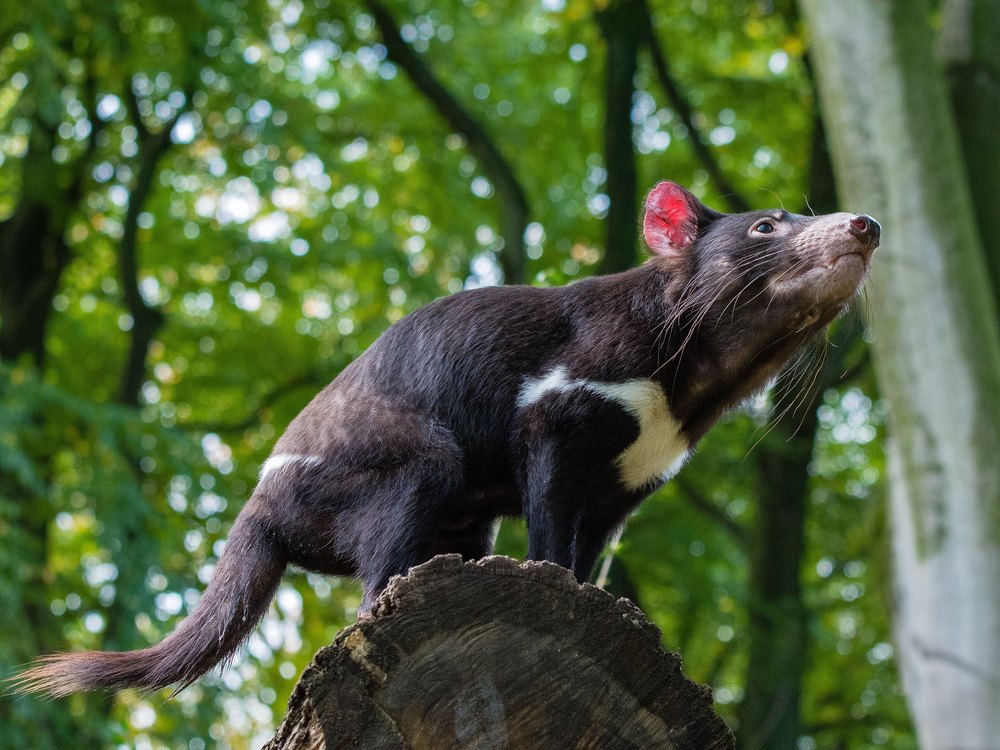
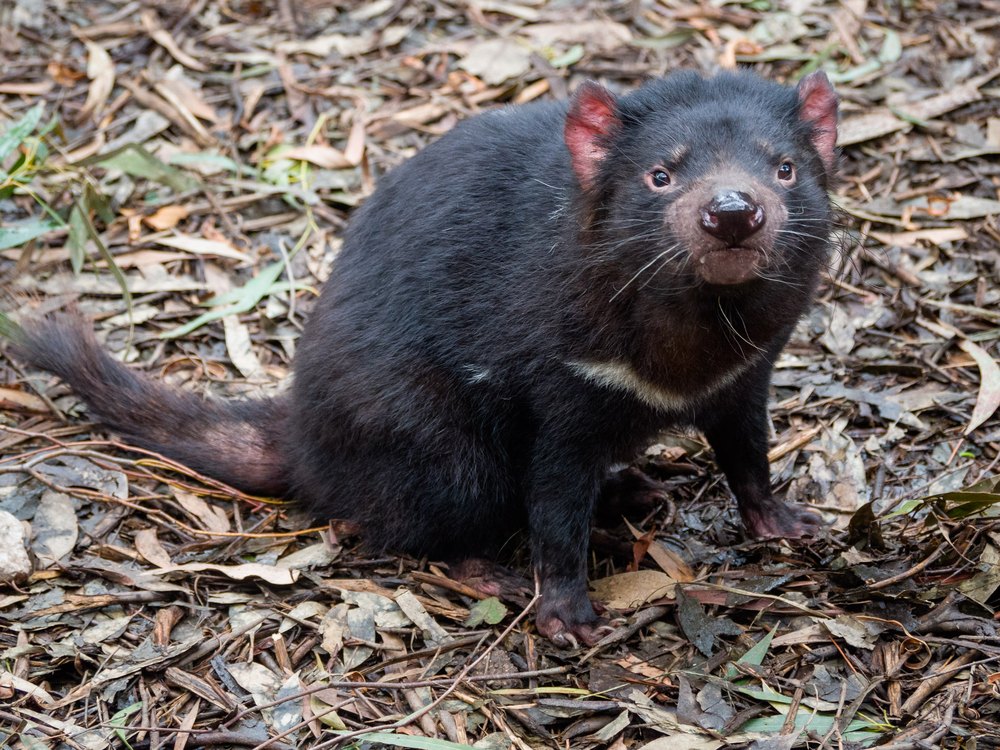
The Tasmanian Devil is a thick-set, squat animal with a large, broad head and a short, thick tail.[3] The coat is mostly or wholly black, often with white markings on the rump and chest.[3] Other descriptions give a brownish-black coat with a white patch on the throat and white spots on the sides and the rump.[8] The white patch on the chest is often called the bib.
The ears are rounded and the snout is pinkish.[8] For size and the difference between the sexes, see Body.
Name
The genus name Sarcophilus comes from the Greek sarx, “flesh”, and philos, “loving”, so “flesh-lover”.[1] The species name harrisii is the Latinised form of Harris. It honours George Harris, whose description was published in 1808.[1][9] The genus name was given by F. Cuvier in 1837.[1] Harris himself wrote that its common name was the “native devil”.[1] The Tasmanian government says early settlers gave it the name “devil” because they were frightened by its night-time screams, coughs and growls.[3] The history of the name is told under History and culture.
In other languages
| Language | Name | Meaning |
|---|---|---|
| English (Tasmania and Australia) local | Tasmanian Devil; devil; Tassie Devil; Tassie; native devil | — |
| palawa kani local | purinina | — |
| French | diable de Tasmanie | devil of Tasmania |
| German | Tasmanischer Teufel; Beutelteufel | Tasmanian devil; pouch devil |
| Spanish | demonio de Tasmania | devil of Tasmania |
| Italian | diavolo della Tasmania; diavolo di Tasmania; diavolo orsino | devil of Tasmania; bear-like devil |
| Portuguese | diabo-da-Tasmânia | devil of Tasmania |
| Dutch | Tasmaanse duivel; buidelduivel | Tasmanian devil; pouch devil |
| Danish | tasmansk djævel | — |
| Swedish | tasmansk djävul | — |
| Norwegian | tasmansk djevel; pungdjevel | Tasmanian devil; pouch devil |
| Finnish | pussiahma | pouch wolverine (ahma is the wolverine) |
| Polish | diabeł tasmański | Tasmanian devil |
| Czech | ďábel medvědovitý | bear-like devil |
| Hungarian | erszényes ördög | pouched devil |
| Russian | Сумчатый дьявол (sumchatyi dyavol); Тасманийский дьявол (tasmaniiskii dyavol) | pouched devil; Tasmanian devil |
| Japanese | タスマニアデビル (tasumania debiru) | Tasmania devil (the English words) |
| Chinese | 袋獫 | pouch badger |
Most names are from the Catalogue of Life, as listed by GBIF.[10] Native devil is the name Harris recorded in 1808.[1] The palawa kani name purinina is given by the Tasmanian government; palawa kani is the modern language of Tasmanian Aboriginal people.[3]
Body
Size
Males are heavier than females. In wild devils measured by Guiler in 1978, 50 males weighed 8.2 kg on average and 50 females 6.1 kg[1]. Weights differ between regions. On the north-east coast, males averaged 10.2 kg and females 7.1 kg, while in high country males averaged 8.43 kg and females 5.4 kg[1]. Animal Diversity Web gives a range of 5.5 to 12 kg for males and 4.1 to 8.1 kg for females[8]. The Tasmanian government says large males weigh up to about 12 kg[3]. All these weights are from wild devils.
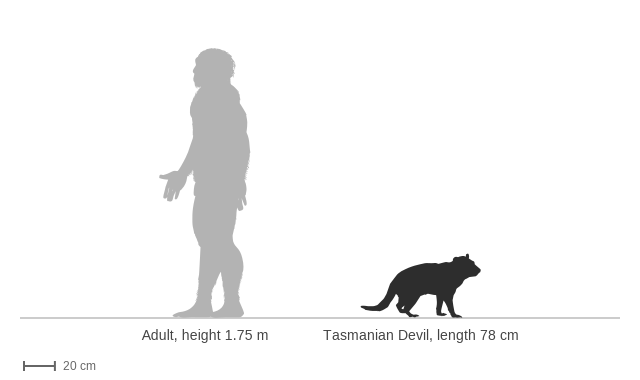
The length figures below are total length, which includes the tail. In 37 wild-caught males it averaged 82 cm (75 to 97.5 cm), and in 32 females 78 cm (71 to 84 cm). The tail is about 26 cm in both sexes, and the ear is about 6 cm long[1]. Large males stand about 30 cm high at the shoulder[3][8].
| Female | Male | |
|---|---|---|
| Weight (average) | 6.1 kg | 8.2 kg |
| Length with tail (average) | 78 cm | 82 cm |
Skull and bite
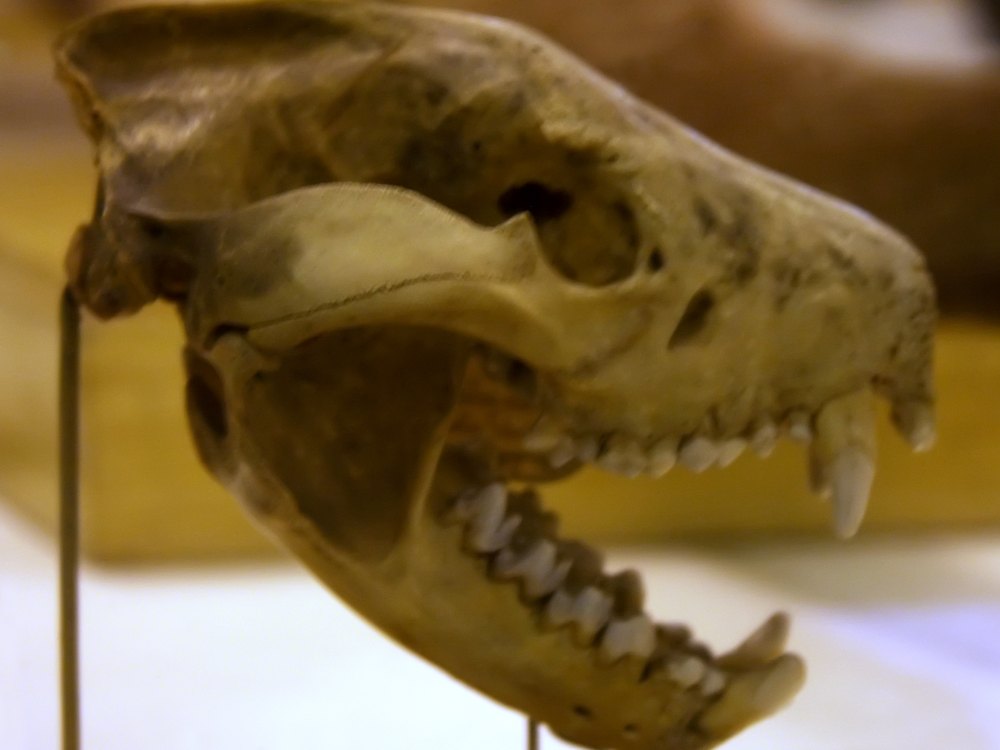
The skull of a male is longer and wider than that of a female. In 18 males and 15 females the greatest skull length averaged 137.9 mm and 130.3 mm, and the width across the cheekbones 110.7 mm and 98.0 mm. The upper canine tooth measures about 10 mm from front to back in males and 9 mm in females[1].
A 2005 study by Wroe and colleagues compared the bite of many living mammals. It estimated bite force from computer models of the skull and jaw muscles. Relative to body size, the Tasmanian Devil came out with the strongest bite of the animals compared[11]. The result says nothing about the absolute force of the bite.
Senses
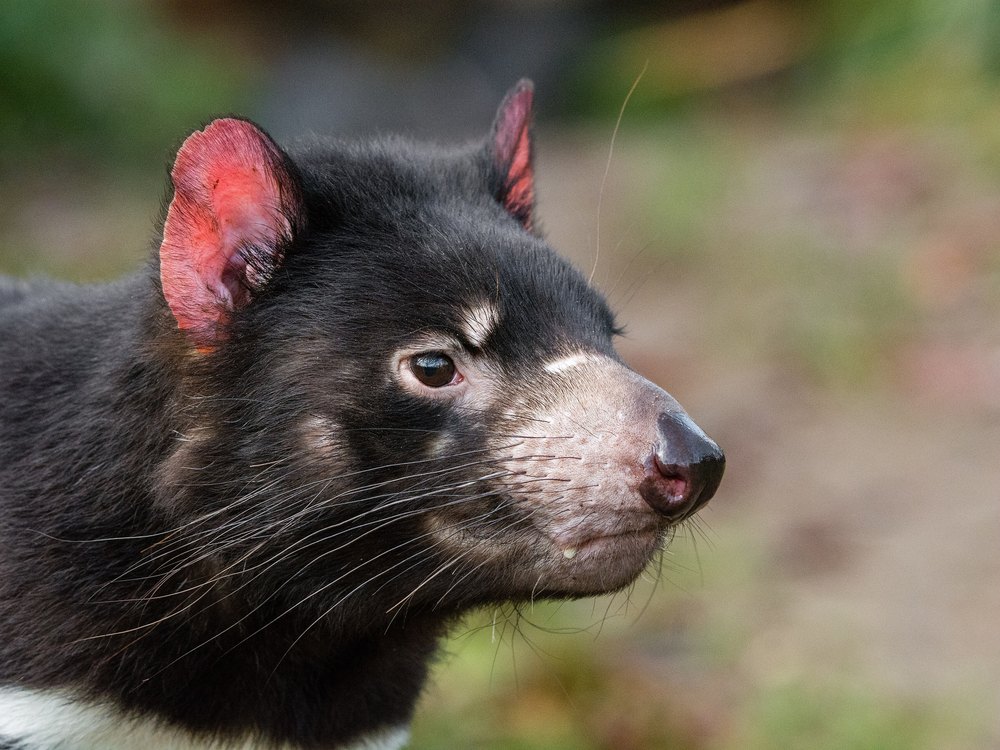
Animal Diversity Web lists smell, sight, touch and taste as well developed, and says smell is used to find food at night[8].
The Tasmanian government says the ears flush red with blood when a devil is stressed or very excited, and that a fat tail is usually a sign of an animal in excellent condition[12].
Behavior
Daily life
The Tasmanian Devil (Sarcophilus harrisii) lives mostly alone. Home ranges overlap and average 13.3 km² (range 4 to 26.7 km²) in the wild, and each adult uses about 3.8 dens.[1] Animal Diversity Web calls the devil not territorial.[8] It is nocturnal, spending the day in a den or in dense bush.[3] Animal Diversity Web adds that it sunbathes in quiet places.[8]
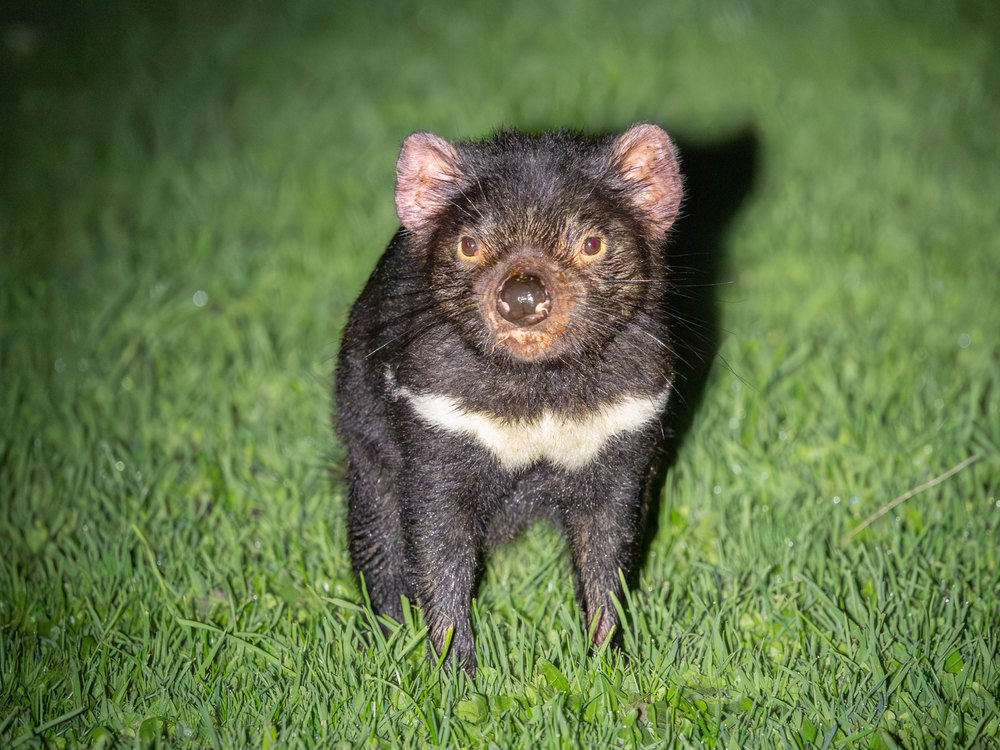
How far it walks at night depends on the source. Mammalian Species reports an average of 7.7 hours and 8.6 km of travel per night while hunting, with routes of up to 20 km.[1] The Tasmanian government says up to 16 km along trails.[3]
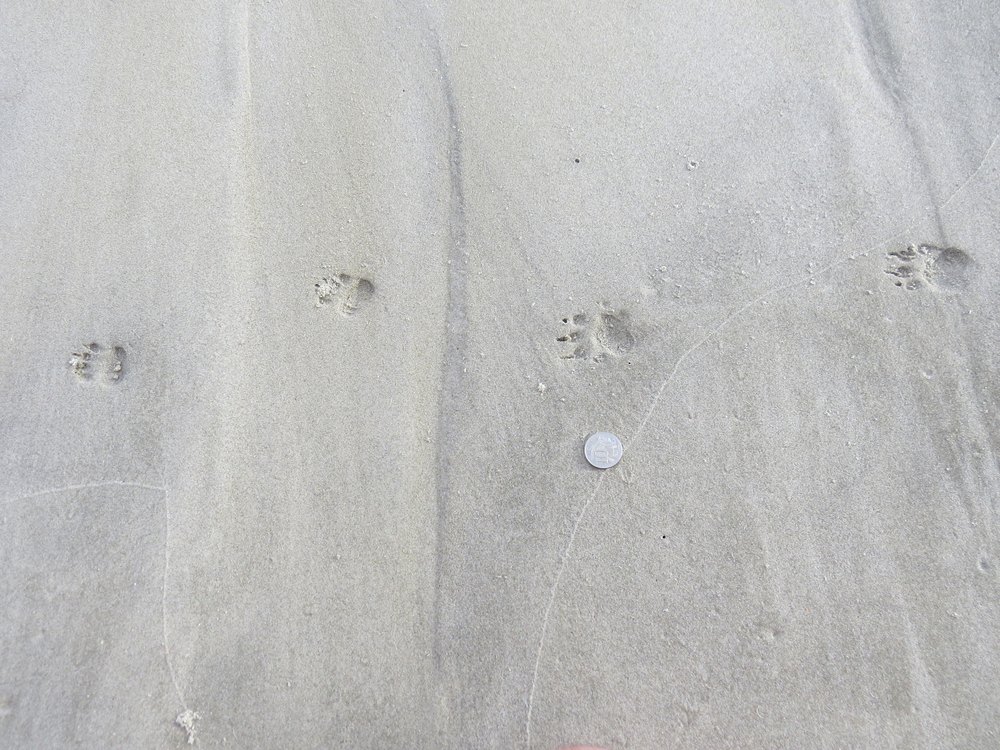
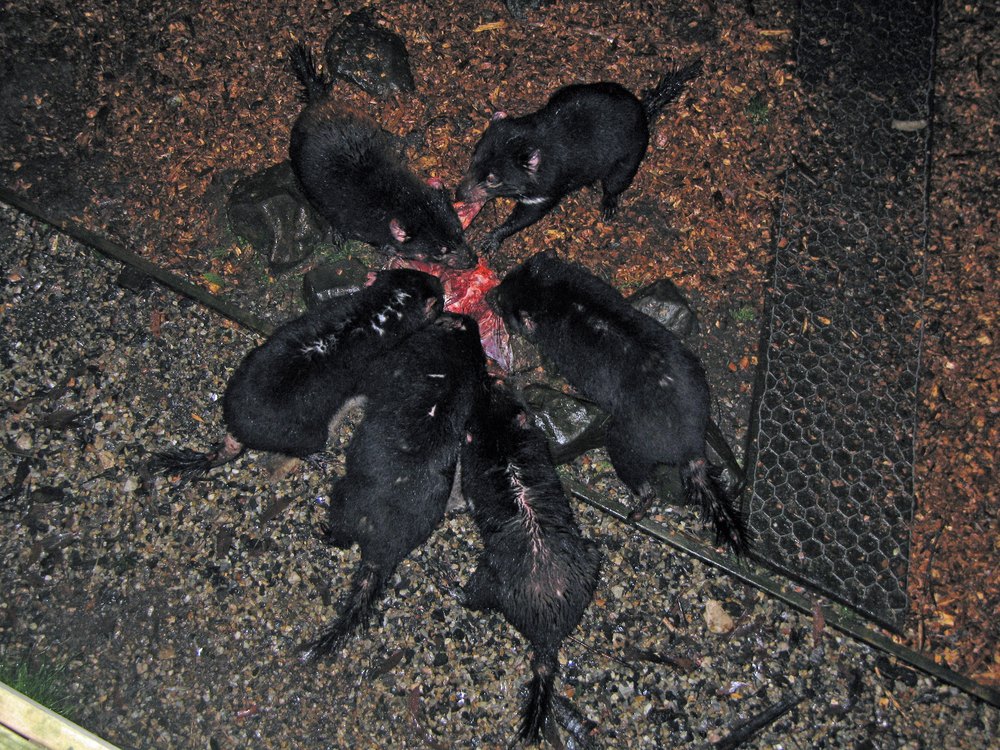
Feeding groups
Devils meet at carcasses.[2][8] In the wild, a visit to a carcass lasts 34 minutes on average, and adult males stay 57.1 minutes on average.[1] A study of devils at feeding sites found no clear feeding hierarchy; how long an animal fed depended on how full it already was.[2] Animal Diversity Web says captive devils form a learned dominance order.[8]
In a study of 26 captive adults, devils at carcasses gave a low, short, quiet call the authors named the “arff”. More arffs went with more feeding success, fewer fights and more cooperation. The calls were matched to the right individual 90 to 91% of the time (9 devils). The authors suggest that tumours in the mouth may stop sick devils making a recognisable arff.[13]
Fights and calls
The repertoire is large: 20 body postures and 11 sound forms, counted in a study of feeding sites.[2] Snorts, barks and growls are among the sounds.[1] The Tasmanian government lists at least eleven vocalisations, including a snort, a bark, a jaw snap (clap), a screech and a sneeze, and says many are bluff, a ritual to scare off another animal and avoid a fight.[12]
Fights seldom turn physical. When they do, they leave scars on the muzzle and rump. Adult males are scarred most often and most badly, which the authors link to their longer feeding bouts and to aggression during mating.[2] Bite wounds are mostly to the head.[1]
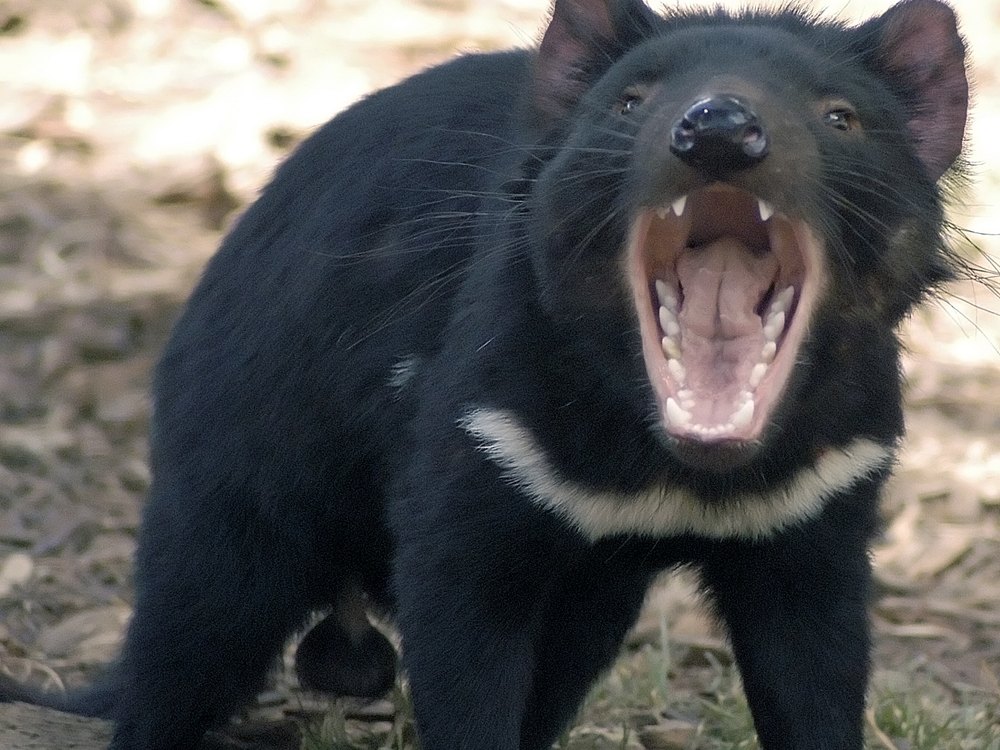
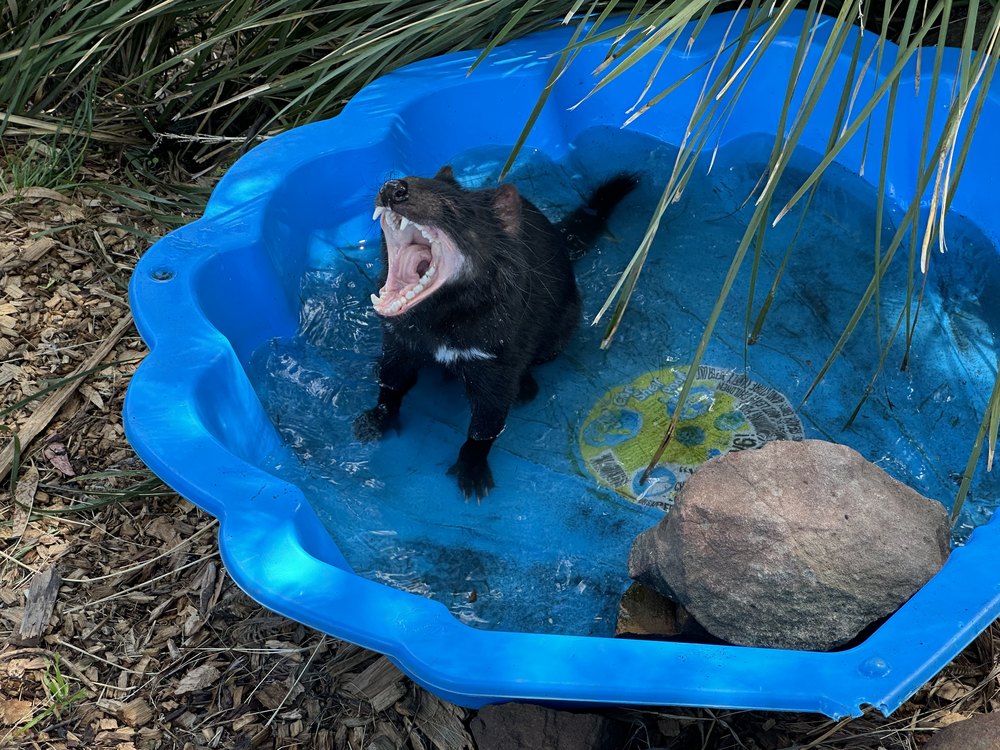
The wide-open mouth called a gape is a defence display. The Tasmanian government says it is performed more from fear and uncertainty than from aggression.[3]
The same study says devils probably also communicate by scent, through urine and by dragging the anal and genital area on the ground.[2]


Diet
What it eats
The devil is a generalist that hunts and scavenges. Mammalian Species calls it a predator and scavenger of medium to large mammals, and the Tasmanian government says it is mainly a scavenger and a hunter.[1][3] Carrion means dead animals. Animal Diversity Web says large prey is mostly eaten as carrion.[8] The Red List text says devils hunt prey of up to about 20 kg, such as Bennett’s wallabies and common wombats, by ambush and short chases.[4]
Prey includes wombats, Bennett’s wallabies, pademelons and possums. Smaller items include small mammals, birds, reptiles and insects.[1][3] Animal Diversity Web adds snakes, larvae and small amounts of plants.[8] Where sheep are poorly managed, devils eat sheep.[1] Young devils rely more on small mammals and birds.[1]
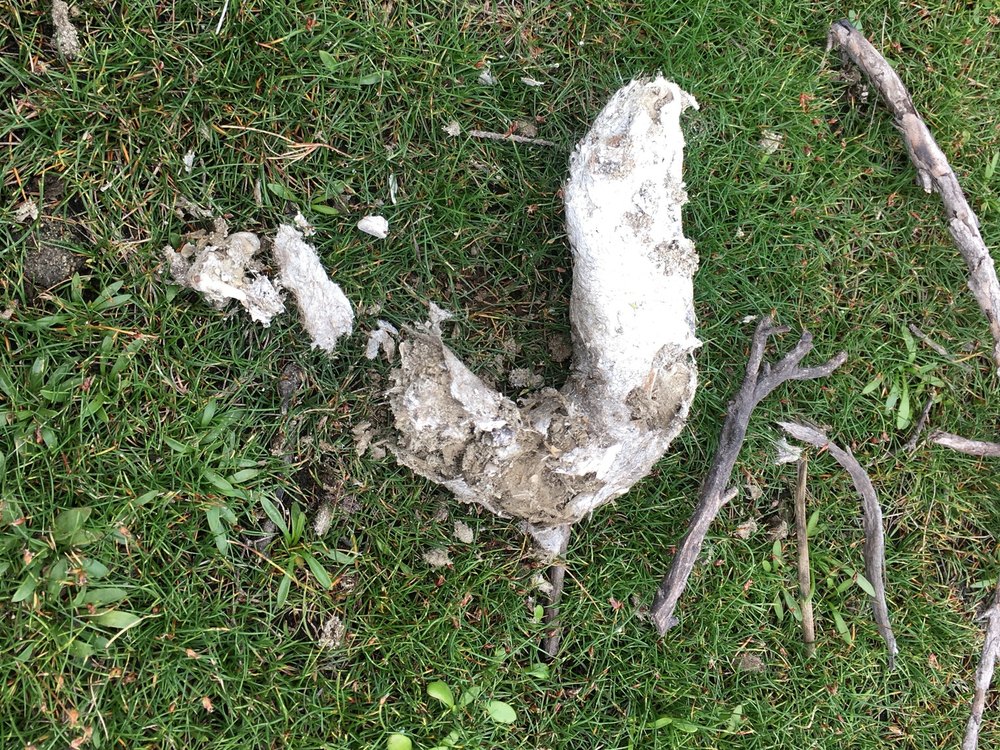
A study of scat (droppings) in western Tasmania found birds in 50% of scats, wallabies and pademelons in 36% and possums in 30%. These figures count how often each food turned up in scats, so they add to more than 100%.[1]

How it feeds
The devil is a gorge feeder. One meal can reach up to 40% of its body mass, and a large meal comes about every 4 to 8 days.[1][2] It eats hair and bone along with the flesh.[1][8] Captive devils are clumsy killers of small prey.[1]
Life cycle
| Stage | Age / time | Notes |
|---|---|---|
| Mating | Mostly mid-February to late March | Births follow mostly in April, one litter a year[1][8] |
| Gestation | 17.9 to about 21 days | Estimates differ[1][3][8] |
| Litter | Average 2.67 young; the mother has four teats | Usually 2 or 3 survive to weaning[1] |
| In the pouch | About 14 to 15 weeks | Weaned from mid-December to early February[1] |
| Maturity | Females at nearly 2 years | Some breed as yearlings[1][14] |
Mating
Devils mate mostly from mid-February to late March, and the young are born mostly in April.[1] The Tasmanian government gives the breeding season as February to May.[3] A female has one litter a year.[8] After mating, a male may keep a female in her den for up to 12 days.[1]
The Mammalian Species account gives an average pregnancy of 17.9 days (range 14 to 22 days), while the Tasmanian government and Animal Diversity Web say about 21 days.[1][3][8]
Young in the pouch
The mother has only four teats.[1] The average litter in the study quoted by Mammalian Species was 2.67, and usually 2 or 3 survive to weaning.[1] The young stay in the pouch for about 14 to 15 weeks.[1] The Tasmanian government says about four months.[3]
Growing up
Young devils are weaned from mid-December to early February.[1] Animal Diversity Web puts weaning at 5 to 6 months.[8] After they leave the mother, up to 80% of juveniles die in their first year on their own.[1]
Females mature at nearly 2 years. Some breed as yearlings once they weigh 4 to 4.5 kg or more, and males mature at about 3.5 kg.[1][14]
Lifespan
Before the late 1990s a wild devil lived 3 to 4 years on average, and a few reached 8.[1] The Tasmanian government says very few wild devils live longer than 6 years.[3] In captivity devils live up to about 8 years, and signs of old age appear after about 50 months.[1][8] A female in the wild before the disease usually bred each year for 3 years and died in her fifth or sixth year.[14]
Effect of the disease on breeding
The disease is described under Ecology. In a 2008 study of wild devils, breeding by 1-year-old females rose on average 16-fold where the tumour disease had arrived.[14] At Freycinet in 2000, 0 to 12.5% of 1-year-old females bred. At Mt William in 2004, 13.3% did, and in 2006, 83.3% did.[14] At Freycinet, 21 of 29 females had more than one litter before the disease and 6 of 17 after it.[14] The authors wrote that females now generally have one breeding opportunity.[14]
Survival at Freycinet fell by at least 60%, and the population was almost entirely animals under 3 years old.[14] A later study found that the disease shortened average wild life by about 2 years.[15]
Ecology
Role in the ecosystem
The Tasmanian Devil (Sarcophilus harrisii) is the largest living meat-eating marsupial and the top mammal predator on Tasmania since the Thylacine disappeared.[1] It hunts prey up to about 20 kg, such as Bennett’s wallabies and common wombats, and it eats carrion, which means dead animals. Devils gather where lambing, calving or wallaby shooting leaves carcasses.[4]
Where devils have become rare, carcasses last about 2.6 times longer, and smaller predators eat more carrion.[16]
Studies disagree about feral cats. A 2016 survey along the gradient of devil decline found more cats and black rats, and fewer small native animals, where devils had been scarce longest, and the authors call the devil a keystone species, one whose loss changes the whole animal community.[17] A 2015 study at four monitored populations found no link between devil and cat numbers.[18] The evidence is mixed.
By 2006 and 2007 there was hard evidence of foxes in Tasmania, mostly where disease had reduced devils. The 2008 IUCN assessment says the idea that devils keep foxes from settling is a common view that has not been tested.[4]
Devils released on Maria Island in 2012 killed many common brushtail possums in the grassland, and possum numbers fell island-wide from 2012 to 2016.[19] Cat DNA was in 14% of 96 devil scats there.[20]
Predators and road deaths
Adult devils have no predators except dogs. The young are prey for wedge-tailed eagles and adult spotted-tailed quolls.[1] The 2008 IUCN assessment passes on a report of about 50 devils a year killed by dogs, from about 20 dog owners, and says the real number is more likely several hundred.[4] The Tasmanian government also says some dogs kill devils and quolls.[21]
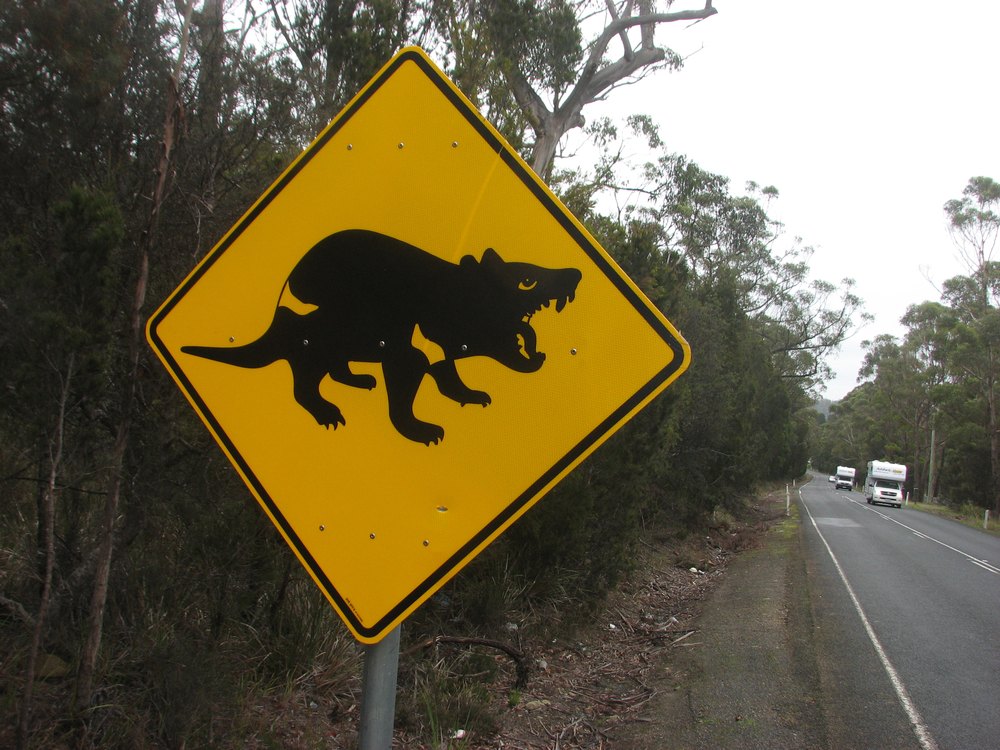
Roads kill many devils. A three-year study of main roads suggested that 2 to 3% of all devils were killed by vehicles, based on a population of 60,000 to 90,000 at the time. Roadkill caused up to 50% of deaths over 17 months at Cradle Mountain and 20% over 12 months at Freycinet.[4] One population declined by 50% within 18 months after a road was paved.[1] The Tasmanian government says more young devils are killed in summer, when they leave their mothers.[21]

Devil facial tumour disease
Devil facial tumour disease is a transmissible cancer, which means a cancer that spreads from animal to animal. It is passed on as living cancer cells when devils bite each other, most of all between adults in the breeding season.[4] Tumours grow on the face or in the mouth and are often very large. Death usually follows within about 6 months of the first signs.[1][5]
There are two separate forms. DFT1 was first seen in 1996 at Mount William in the north-east, and its cells come from a female devil.[4][6] DFT2 was found in 2014 in the south-east. Its cells carry a Y chromosome, so they come from a male, and the two cancers began in different devils.[6] Genome studies estimate that DFT1 arose around 1986 (between 1982 and 1989) and DFT2 around 2011 (between 2009 and 2012).[7]
DFT1 had been reported across about 15,000 km² of eastern Tasmania before 2003, and across 36,000 km² by 2005. In 2008 it was confirmed over more than 60% of the devil’s range, spreading 7 to 50 km a year depending on the place.[4] By 2020 it occupied more than 90% of the range.[22] Only parts of the west and north-west are confirmed free of it.[5]
Spotlight counts across Tasmania fell by 64% between 1985 and early 2008, and by about 95% in the north-east.[4] Average devil density in diseased areas fell by 77%.[23]
DFT2 had spread little by 2019: all 40 tumours found in 23 devils were in the south-east channel area, and 2 devils carried both cancers.[24]
Some devils show signs of resistance. In three populations the same genome regions, which hold immune and cancer-risk genes, changed in a matching way.[25] A study of 7 devils whose tumours shrank and 3 whose tumours did not found three such regions.[26] Of 52 wild devils tested, 6 had antibodies against the tumour cells.[27] These are signs of a genetic response, and the species is not shown to be resistant.
Other diseases
Devils carry many parasites. The roundworm Trichinella pseudospiralis was found in 30% of 153 devils at nine places.[1] The tapeworm Dasyurotaenia robusta lives only in devils and is listed as Rare under the Tasmanian Threatened Species Protection Act 1995.[4]
Habitat and range
Habitat
Devils live in all native land habitats of Tasmania, and also in forestry plantations and pasture, from sea level to nearly the highest peaks. Before the disease, numbers were highest in dry and mixed eucalypt forest and coastal heath in the east and north-west, and lowest on the buttongrass plains of the south-west. Devils prefer open forest and woodland and mostly avoid tall, dense wet forest. Densities are highest where grazing land and forest are mixed.[4] They travel along lowlands, saddles and creeks, keep off steep and rocky ground, and visit carcass and rubbish dumps and roads.[4]
Dens are old wombat burrows, thick grass tussocks, dense riverside plants and caves, and sometimes the space under buildings. Devils change dens every one to three days.[4] Seabird colonies, such as those of the short-tailed shearwater, are thought to be a traditional favoured habitat.[4] The Tasmanian government advises keeping fallen logs and wombat burrows, which devils use as breeding sites.[21]

Range
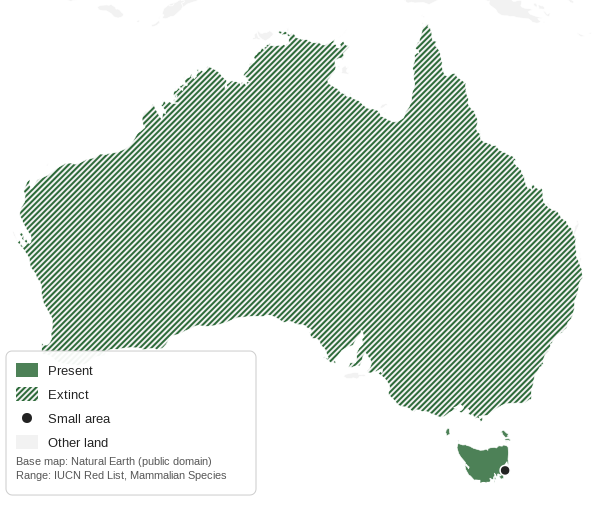
The Tasmanian Devil is native only to Tasmania. It also lives on Robbins Island off the north-west coast. Bruny Island had devils in the early 1800s, but there is no confirmed record after 1900.[4] On the Australian mainland the species is extinct; see Evolution. In 2008 two management units were recognised: the north-west, west of the Forth River, and the rest of Tasmania.[4]
Introduced populations
On Maria Island off the east coast, devils were released from 2012 as a colonisation project, since devils were absent there before.[19] On Badger Island an unauthorised release in the mid-1990s grew to 120 devils on 14 km², and all were thought removed by August 2007.[4]
The Tasmanian government calls the Forestier and Tasman Peninsulas important for local populations that are free of the disease.[30] Releases of captive-bred and vaccinated devils are told in Conservation.
Evolution
Fossil record
The oldest fossil Sarcophilus in the Mammalian Species account comes from the early Pleistocene of Nelson Bay in Victoria.[1] Other Pleistocene finds include Wellington Caves in New South Wales, Mt Hamilton in Victoria and Devil’s Lair in Western Australia.[1] A Cape York record is dated to 11,000 to 10,000 years ago, and recent fossil devils are also known from Flinders Island in Bass Strait.[1]
Mainland extinction
Devils disappeared from mainland Australia about 3,200 years ago.[28] A dating study of 24 devil bones, combined with earlier radiocarbon dates, put the end between 3,179 and 3,227 years before present, at the same time as the Thylacine.[28] Climate is one proposed cause. DNA from 202 devils (17 from the mainland, 185 from Tasmania) shows a large, varied mainland population that stayed stable until about 3,000 years ago; the authors name climate change linked to El Niño as the one factor common to the mainland and Tasmania, and say people or dingoes may have finished off the mainland devils.[29] The Tasmanian government links the loss to a drier climate and the spread of the dingo, and the IUCN assessment lists competition with dingoes and people.[3][4] The cause is not settled. The same DNA study traces all Tasmanian devils to one lineage from about the same time, which fits a bottleneck (a sharp fall in numbers).[29]
Relatives
The devil belongs to the carnivorous marsupials. In a 2017 family tree the Thylacine branches off first, the numbat comes next, and the dasyurids (quolls, devil, antechinuses, dunnarts and kin) form the third group. The quolls are the devil’s closest relatives, its sister group.[31] Branch ages depend on the method. For the group holding the devil, the quolls and the mulgaras (small desert marsupials), the study gives 11.5 million years by its preferred method and 13.0 or 15.8 million years by another; two earlier studies quoted in it give 13.4 and about 18.[31]
The fossil devils are placed differently by different authors (see Forms and variants).[1]
Forms and variants
No subspecies of the living Tasmanian Devil is recognised: GBIF and the Mammal Diversity Database both list a single species with no subspecies.[32][33]
Colour pattern
Most devils are black, often with white marks on the chest and rump.[3][8] In one field study 13% of the devils had none of the conspicuous markings.[2] Both kinds are shown below.
Extinct mainland forms
Two fossil forms of Sarcophilus are named from mainland Australia. S. laniarius Owen, 1838 was described from Wellington Valley, New South Wales; Werdelin (1987) proposed it as the correct name for the species because it was published earlier, and measured the Wellington Caves fossils as 16% larger than living devils. The proposal was accepted only briefly, and the Mammalian Species account treats the fossils as the same species as the living devil.[1] S. harrisii dixonae Werdelin, 1987 was named for subfossil bones from Mt Hamilton, Victoria, that differ from living devils in teeth and skull; the Mammal Diversity Database lists it as a synonym.[1][33]
Conservation
Status
The IUCN lists the Tasmanian Devil as Endangered (IUCN 2008, criteria A2be+3e), assessed on 30 June 2008 by Hawkins and colleagues for the whole species.[4] The population trend is decreasing.[4] The 2008 assessment gave a best estimate of 10,000 to 25,000 mature individuals in 2007; the authors say the possible error is high.[4] A 2021 model, built from 35 years of spotlight counts and 21 years of capture-recapture data, puts the wild population at a peak of 53,000 in 1996 and about 16,900 in 2020.[22]
The Tasmanian government list shows the devil as Endangered under both the Tasmanian Threatened Species Protection Act 1995 and the Commonwealth Environment Protection and Biodiversity Conservation (EPBC) Act 1999.[34]
Threats
DiseaseCollisionsKilling in conflict with people[4]Disease. Devil facial tumour disease is a cancer that spreads from devil to devil, mainly by biting. It was first noticed in 1996 in north-east Tasmania, and the IUCN names it as the cause of the decline.[4] Devils persisted at all nine monitoring sites studied (see Ecology for the fall in numbers).[23] A second, separate contagious cancer was found in 2014 (see Ecology).[6]
Road deaths. The IUCN assessment lists roadkill as a cause of death, and at Cradle Mountain a busy road became a local drain on the population.[4] The Tasmanian government advises drivers to take care at dusk and at night, and to move roadkill off the road so that scavenging devils are not hit.[21]
Killing by people and dogs. The IUCN reports that poisoning in sheep areas in the 1980s and 1990s probably killed more than 5,000 devils a year (an unpublished estimate), and that persecution in 2008 was much smaller.[4] Trapping and relocating devils and poisoning them are illegal in Tasmania (dog killings are told in Ecology).[21]
Protection and breeding programmes
The Save the Tasmanian Devil Program began in 2003.[35] In 2008 its four planned actions were insurance populations, disease suppression, selection for resistance and a vaccine.[4] An insurance population is a group of healthy animals kept safe from the disease, mostly in captivity. By 2012 it held over 600 captive devils.[35] About 700 devils were in captivity in 2015, more than 500 of them in 40 Australian institutions.[1] A 2022 study of 553 insurance devils and 830 wild samples found that the insurance group represents the genetic diversity of the wild population.[36]
A disease-suppression trial on the Forestier Peninsula, where diseased devils were removed, began in January 2006; the IUCN said it was too early to judge the result.[4] Captive-bred devils have been released into the wild: 33 genetically diverse insurance devils went to Wukalina and Mount William in 2017.[30] In September 2015, devils vaccinated with heat-killed tumour cells were released at Narawntapu National Park.[1] A 2018 study found that 95% of vaccinated devils in two trials made antibodies against the tumour cells.[37]
History and culture
First description
George Harris read the first scientific description to the Linnean Society of London on 21 April 1807, and it was published in 1808 under the name Didelphis ursina.[38] His specimen was a male kept by Lieutenant Governor Collins, sent as a present to Sir Joseph Banks.[38] Harris wrote that devils were very common when Hobart Town was first settled, were destructive to poultry, and that the convicts ate them, the taste being said to be “not unlike veal”.[38]
The name
Harris described devils quarrelling through the night with a hollow barking and a sudden snorting.[38] Harris’s name Didelphis ursina had already been used by Shaw in 1800, so Boitard replaced it in 1841 with Ursinus harrisii, which gives today’s Sarcophilus harrisii.[9][32]
Bounties and protection
Australian Geographic, a magazine, reports that the Van Diemen’s Land Company put a bounty on devils in 1830, along with thylacines and wild dogs, and that settlers disliked devils for their alleged threat to livestock, mainly chickens.[39] The same article says devils were trapped and poisoned for well over a century.[39] The Mammalian Species account and Australian Geographic both give 1941 as the year devils became legally protected.[1][39] Today the devil is wholly protected by Tasmanian and Commonwealth law.[21]
Emblem and popular image
The Tasmanian government lists the devil as the state’s faunal (animal) emblem.[35] SBS News reported on 31 May 2015 that the devil had been declared the state’s official animal emblem. The environment minister, Matthew Groom, said it was recognised worldwide as uniquely Tasmanian, and that the choice would help raise awareness of devil facial tumour disease.[40] The same report calls devils the inspiration for the Looney Tunes character Taz.[40]
Taxonomy
| Rank | Name |
|---|---|
| Kingdom | Animalia |
| Phylum | Chordata |
| Subphylum | Vertebrata |
| Superclass | Tetrapoda[41] |
| Class | Mammalia |
| Subclass | Theria[41] |
| Infraclass | Metatheria[41] |
| Order | Dasyuromorphia (carnivorous marsupials) |
| Family | Dasyuridae (dasyurids) |
| Subfamily | Dasyurinae[41] |
| Tribe | Dasyurini[41] |
| Genus | Sarcophilus F. Cuvier, 1837 |
| Species | Sarcophilus harrisii (Boitard, 1841) |
Higher classification
The Tasmanian Devil belongs to the order Dasyuromorphia (the carnivorous marsupials), the family Dasyuridae and the tribe Dasyurini. It is the only living species of the genus Sarcophilus.[32][33] The Mammal Diversity Database and GBIF both accept Sarcophilus harrisii as the valid name and give the authority as Boitard, 1841; the Mammalian Species account writes Boitard, 1842.[1][32][33] Boitard first named it Ursinus harrisii.[1][33]
Sources
- Mammalian Species 49(942): 1–12, 2017, account of Sarcophilus harrisii
- Pemberton & Renouf 1993, communication and social behaviour of the Tasmanian devil at feeding sites, Australian Journal of Zoology 41: 507
- Tasmanian Government, Natural Resources and Environment Tasmania, Tasmanian devil species page
- Hawkins et al. 2008, IUCN Red List assessment of Sarcophilus harrisii
- Cambridge Transmissible Cancer Group, devil facial tumour disease
- Pye et al. 2016, a second transmissible cancer in Tasmanian devils, PNAS 113: 374–379
- Stammnitz et al. 2023, the evolution of two transmissible cancers in Tasmanian devils, Science
- Animal Diversity Web, Sarcophilus harrisii
- Australian Faunal Directory, Sarcophilus harrisii (Boitard, 1841)
- GBIF vernacular names of Sarcophilus harrisii
- Wroe et al. 2005, comparative bite force in big biting mammals, Proceedings of the Royal Society B 272: 619–625
- Natural Resources and Environment Tasmania, Tasmanian devil FAQs
- Davis & Clarke 2020, the “arff” call of the Tasmanian devil, Bioacoustics 29: 638–653
- Jones et al. 2008, life-history change in devil populations hit by facial tumour disease, PNAS
- Strickland et al. 2024, adaptive potential in the face of a transmissible cancer in Tasmanian devils, Molecular Ecology 33: e17531
- Cunningham et al. 2018, top carnivore decline has cascading effects on scavengers and carrion persistence, Proceedings of the Royal Society B 285(1892)
- Hollings, Jones, Mooney & McCallum 2016, Ecology 97: 394–405
- Fancourt et al. 2015, devil declines and catastrophic cascades: is mesopredator release of feral cats inhibiting recovery of the Eastern Quoll?, PLOS ONE 10: e0119303
- Scoleri et al. 2023, top predator restricts the niche breadth of prey: effects of assisted colonization of Tasmanian devils on a widespread omnivorous prey, Proceedings of the Royal Society B 290
- McLennan et al. 2022, DNA metabarcoding reveals a broad dietary range for Tasmanian devils introduced to a naive ecosystem, Ecology and Evolution
- Natural Resources and Environment Tasmania, Living with Tasmanian Devils and Quolls
- Cunningham et al. 2021, Ecology Letters 24: 958–969
- Lazenby et al. 2018, Journal of Applied Ecology 55: 1368–1379
- James et al. 2019, tracing the rise of malignant cell lines: distribution, epidemiology and evolutionary interactions of two transmissible cancers in Tasmanian devils, Evolutionary Applications
- Epstein et al. 2016, rapid evolutionary response to a transmissible cancer in Tasmanian devils, Nature Communications 7
- Margres et al. 2018, Genome Biology and Evolution 10: 3012–3025
- Pye et al. 2016, demonstration of immune responses against devil facial tumour disease in wild Tasmanian devils, Biology Letters 12
- White, Saltré, Bradshaw & Austin 2018, Biology Letters 14: 20170642
- Brüniche-Olsen et al. 2018, Journal of Biogeography 45: 963–976
- Natural Resources and Environment Tasmania, Save the Tasmanian Devil Program news, 2025
- Kealy & Beck 2017, total evidence phylogeny and evolutionary timescale for Australian faunivorous marsupials, BMC Evolutionary Biology 17: 240
- GBIF Backbone Taxonomy, Sarcophilus harrisii (Boitard, 1841)
- Mammal Diversity Database, Sarcophilus harrisii
- Natural Resources and Environment Tasmania, threatened species list (vertebrates)
- Tasmanian Department of Premier and Cabinet, state symbols
- Farquharson et al. 2022, the Tasmanian devil insurance program, iScience
- Pye et al. 2018, immunization strategies producing a humoral IgG immune response against devil facial tumor disease in the majority of Tasmanian devils destined for wild release, Frontiers in Immunology 9
- Harris 1808, description of two new species of Didelphis from Van Diemen’s Land, Transactions of the Linnean Society 9: 174–178
- Australian Geographic, iconic Australian animals that once had a bounty on them
- SBS News (AAP), Tasmanian devil declared animal emblem, 31 May 2015
- ITIS, Sarcophilus harrisii, classification