Quick facts
Description
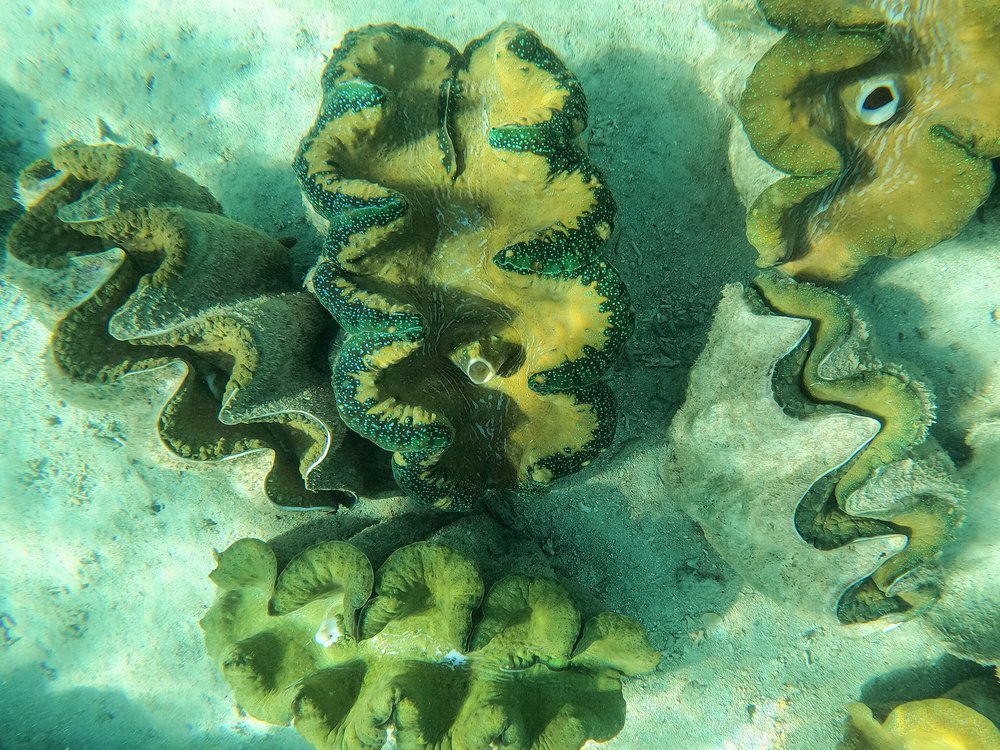
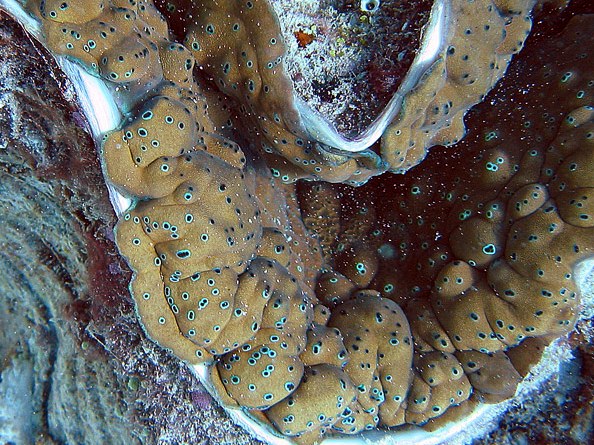
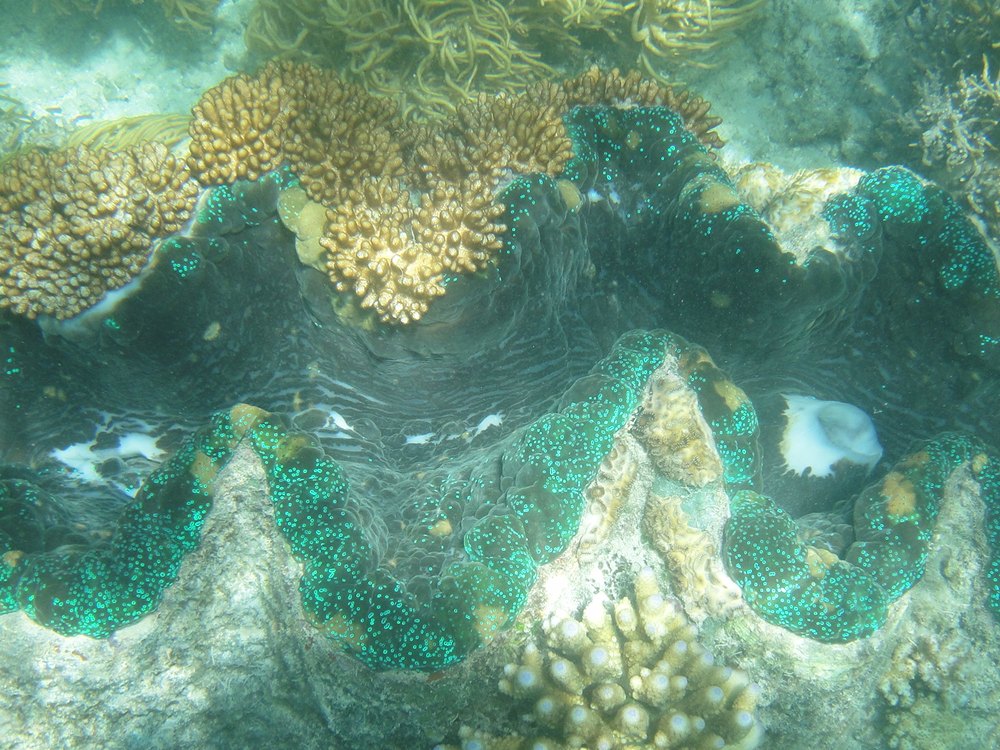
The Giant Clam is a bivalve, an animal with a two-part shell. Its large body and the long, triangular projections along the upper edges of the shell make it easy to recognise.[1] The soft body that lies over the shell edge is the mantle, a fleshy fold of body, and it is mostly dull brown and olive-green.[1] The mantle carries numerous eyes, and each eye is surrounded by an iridescent blue-green circle.[1]
Other species of the genus Tridacna look similar. They differ in a clear feature: the incurrent siphon of the Giant Clam, the opening that water flows in through, has no tentacles.[1] For sizes and weights, see Body.

Name
The accepted scientific name is Tridacna gigas (Linnaeus, 1758).[4][5][6][7] Linnaeus first described the species as Chama gigas in 1758, and it was later moved to the genus Tridacna, which Bruguière named in 1797.[4][5] The databases list two other names for the same species: Chama gigantea G. Perry, 1811 and Dinodacna cookiana Iredale, 1937.[4][1]
The English common name is Giant Clam.[1] NOAA Fisheries uses the name True Giant Clam for this species. The words “giant clam” also cover other species, and the proposed rule names 10 of them.[7][8]
In other languages
| Language | Name | Meaning |
|---|---|---|
| Filipino local | taklobo | the usual word for giant clams |
| Indonesian local | kima raksasa | giant kima |
| French | bénitier géant | giant bénitier (a French word used for giant clams) |
| German | Große Riesenmuschel | large giant mussel |
| Japanese | オオシャコガイ (oo-shako-gai) | big shako-gai (shako-gai is the Japanese word for giant clams) |
| Turkish | dev deniz taragi | giant sea scallop |
French names come from GBIF vernacular names and the IUCN; German, Japanese and Turkish names come from WoRMS and Catalogue of Life.[9][1][4][6] The Filipino name is from the University of the Philippines Marine Science Institute; the Indonesian name is from Indonesian news and journal reports.
Body
Size
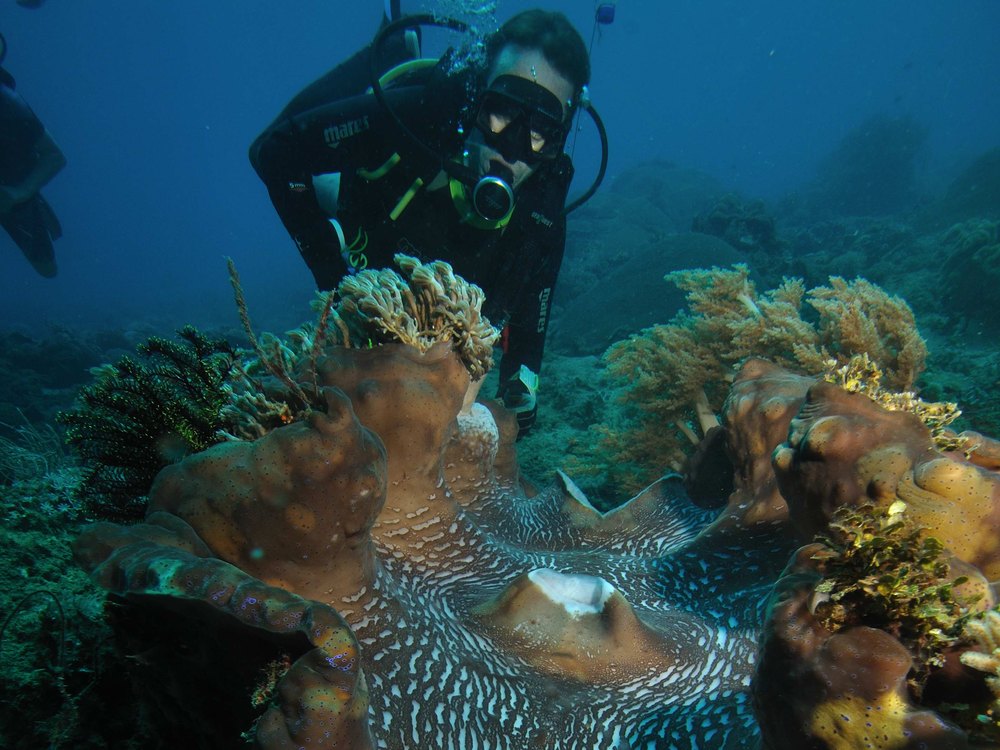
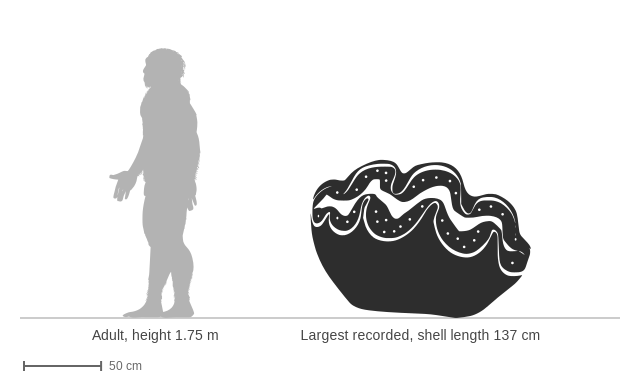
The Giant Clam is the only truly gigantic species among the giant clams. The largest specimen on record is 137 cm long, and the heaviest known specimen weighed about 300 kg.[1]


| Weight (heaviest) | about 300 kg |
| Length (largest) | up to 137 cm |
A young clam is about 0.2 mm long when it settles on the bottom.[3] Growth is quick at first. Clams reared in a laboratory reached an average length of 2.6 cm at 10 months after fertilisation.[2] In a field trial in Palau, clams of 12 to 25 cm grew 8 to 12 cm a year.[2] Shading slowed the growth of young clams, and they grew better on a rough surface than on a smooth one.[2]
Behavior
Adult and nearly grown Giant Clams are free-living, which means they are not attached to the sea floor.[1] Animal Diversity Web says that when the clam is disturbed it pulls in its mantle and closes its shell.[10]
In a related giant clam, Tridacna maxima, sound was tested in the wild off Mo'orea in French Polynesia. In that study, outboard-motor noise played from an underwater speaker about 1 m away made the clams pull their mantles back partly more often than in quiet water. Sound alone did not change how long a clam took to close its shell after a disturbance, but sound together with water movement made the clams slower to close. The authors suggest that clams probably sense sound as the tiny movement of the water it causes.[11]
Spawning (releasing eggs and sperm into the water) is tied to the tides and the phases of the moon (see Life cycle).[1]
Diet
Filter feeding
The Giant Clam feeds in two ways. It filters plankton (drifting small life) out of the water with its gills, and it gets sugars from algae that live in its mantle.[10]
A study of Giant Clams on Davies Reef, on the Great Barrier Reef, measured how much each way contributes. Filter feeding supplied about 65 percent of the carbon, the building material and fuel for breathing and growth, in small clams of 100 mg dry tissue weight. In large clams of 10 g it supplied about 34 percent. The rest came from the algae.[12] So the share from filtering falls as the clam gets bigger.
The algae partners
The partners are zooxanthellae, tiny algae that live inside the clam's tissue. They make sugars from sunlight (photosynthesis), and the clam uses these sugars as food.[10] The algae sit in the mantle. In studies of giant clams, a branched system of tubes runs from the stomach out into the outer mantle and carries the algae. The smallest tubes end blindly and do not join the clam's blood-like body fluid.[13]
A parent does not hand the algae to its young. Each new generation takes them up from the surrounding water.[2] The eggs hold no algae, and the swimming larvae take them in after the earliest larval stage.[3] Hatchery work found that young clams could still take up algae from the water through their first 38 days of life.[3]
Warm water and strong light can make the clam lose these algae and their colour, which is called bleaching (see Conservation).[1]

Life cycle
| Stage | Age / time | Notes |
|---|---|---|
| Egg and larva | About 10 days until settling | Drifting larvae; the young clam is about 0.2 mm long when it settles[3][2] |
| Juvenile | 2.6 cm at 10 months | Laboratory-reared clams[2] |
| Young adult | Farmed males 3.5 years, females about 10 years | Males mature at 42 cm and females at 53 cm[1] |
| Adult | 76 years measured | Largest recorded shell 137 cm[1] |
Spawning
Every giant clam is a simultaneous hermaphrodite, which means one animal has both male and female parts at the same time.[1] The Giant Clam is a broadcast spawner: it releases its eggs and sperm into the open water. A single spawning can produce up to 500 million eggs, one of the highest egg counts of any animal.[1]
On the Great Barrier Reef, spawning takes place in the austral summer (the southern summer). It usually coincides with incoming tides near the full moon, the third quarter and the new moon.[1][2]
Larvae and settling
The fertilised eggs become larvae, the tiny drifting young that float among the plankton. After about 10 days the larva settles on the sea floor and changes into a young clam.[2][3] Most larvae die. In one 1986 rearing study, fewer than 1 percent of the larvae were still alive after 5 months.[2]
The larvae take up their algae partners from the water (see Diet).
Growth and maturity
For early growth, see Body. Males mature at 42 cm and females at 53 cm.[1]
In farms, clams reach the male stage at 3.5 years, at an average length of 18.7 cm, and the female stage at about 10 years.[1]
Lifespan
One Giant Clam was measured at 76 years old, and another estimate gives at least 60 years.[1] Some of the oldest farmed clams were 34 years old, and two others were 40 to 45 years old. All of them had lived at the Waikiki Aquarium in Honolulu.[1]
Ecology
Hosts and parasites
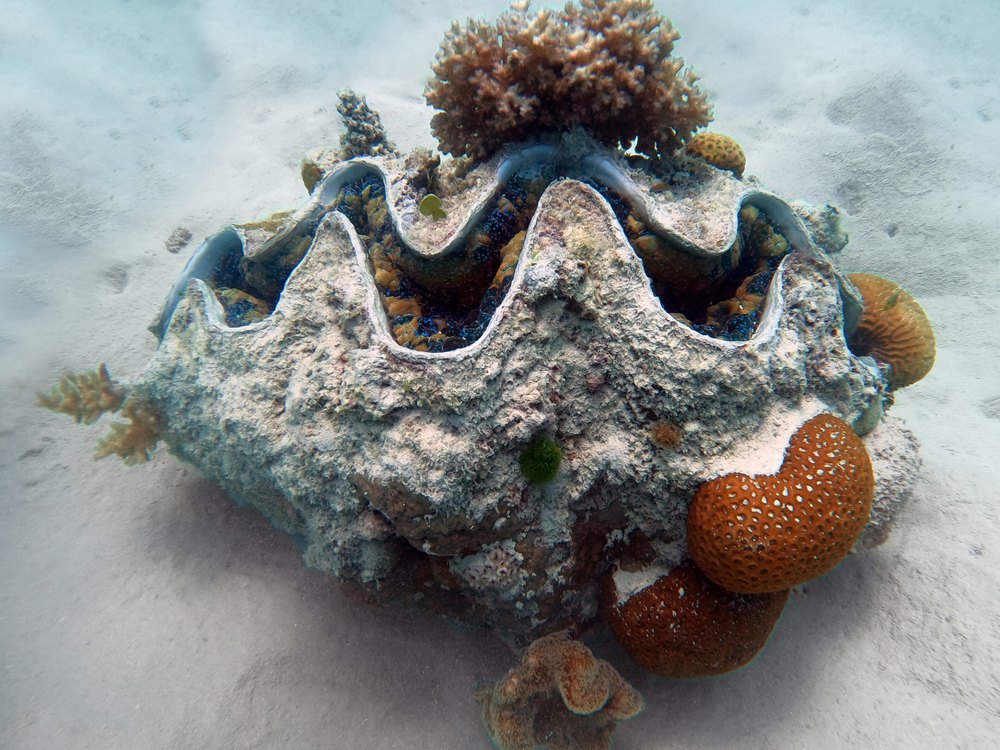
The Giant Clam is a known host for several small animals that live on or in it. These include two copepods (tiny crustaceans), Anthessius alatus and Lichomolgus tridacnae. Two pea crabs, Tridacnatheres whitei and Xanthasia murigera, are also hosts, as are five small shrimps: Anchistus australis, Anchistus demani, Anchistus miersi, Marygrande mirabilis and Paranchistus armatus.[1]
When clams are raised together in large numbers, small snails of the genus Turbonilla can become a problem. These snails are ectoparasites (they live on the outside of their host and feed on it). They have been shown to affect the growth, survival and body processes of young Giant Clams.[1][14]

Role on the reef
A cultured population of Giant Clams can produce a large amount of living tissue: 29 tonnes of wet tissue per hectare each year, which is an estimated 1,682 kg of dry weight.[1] Giant clams also filter large amounts of sea water, over 28,000 litres per hectare every hour.[1]
An experiment placed Giant Clams on damaged reefs. These reefs then had more kinds of fish, and more fish, than plots without clams.[1] The shells give extra shelter to other reef animals.[1] The clam's eggs and sperm are also food for other animals; the blue sprat, a small fish, was seen feeding on the released eggs and sperm.[1]
Habitat and range
Where it lives
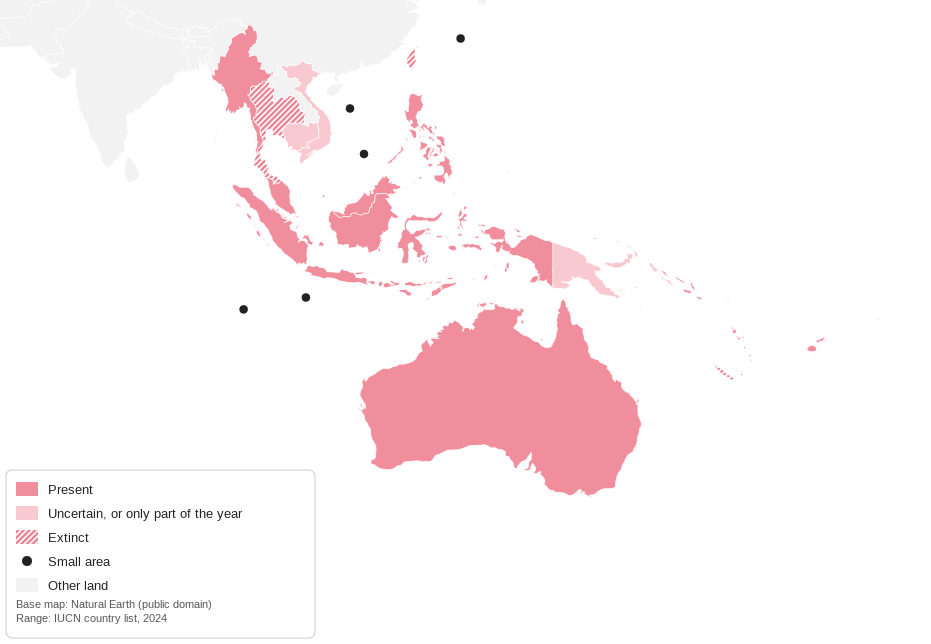
The Giant Clam has been found across the Indo-Pacific, from Myanmar to Kiribati and from the Ryukyu Islands of southern Japan to Queensland in Australia. It does not occur naturally in the Cook Islands.[1][15] There are at least 31 regions with natural wild populations, but in 26 of them the species is uncertain or locally extinct.[1] Wild populations are now rare nearly everywhere, often fewer than 10 clams in one group.[1]
Native and present: Australia, Indonesia, Malaysia (Sabah), the Marshall Islands, Myanmar, Palau, the Philippines, the Solomon Islands, Timor-Leste, and the Paracel and Spratly Islands. Possibly present: Papua New Guinea. Possibly extinct: China, Christmas Island, the Cocos (Keeling) Islands, Japan (Nansei-shoto, the Ryukyu Islands), Tuvalu and Viet Nam. Extinct: New Caledonia, Singapore, Taiwan and Thailand. Presence uncertain: Cambodia, India and Kiribati.
Restocked or introduced: Fiji and Vanuatu (restocked, present), Tonga (restocked, possibly present), Guam and the Northern Mariana Islands (restocked, possibly extinct), the Federated States of Micronesia (restocked, presence uncertain), the Cook Islands and Samoa (introduced, present) and American Samoa (introduced, possibly extinct).
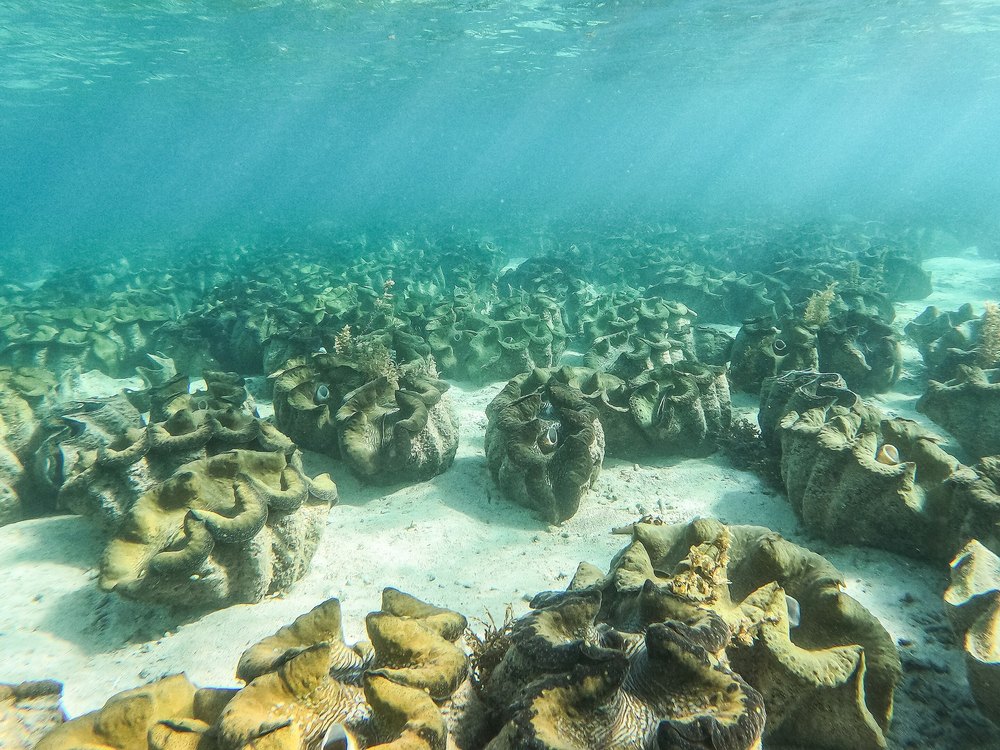
The Great Barrier Reef in Australia is the exception. It still holds relatively undisturbed and stable populations with natural young clams settling. The largest known subpopulation there has 277 individuals, 208 of them mature.[1] Reported density runs from 0.2 clams per hectare at Tarawa Atoll, Kiribati, to 431.9 per hectare at Michaelmas Reef, Australia.[1]
Habitat
The Giant Clam typically lives on coral reefs with good light, resting on sand or hard reef.[1] The IUCN lists lagoons, reef rubble, sandy and gravelly sea floor and seagrass beds as suitable, from the surface down to 20 m.[1]

Evolution
Where giant clams sit
Giant clams form the subfamily Tridacninae inside the cockle family, Cardiidae.[4][5][6] Their nearest relatives are the heart cockles, some of which also keep tiny algae inside their tissue. A study of gene activity found that giant clams and heart cockles are sister groups (each other's nearest relatives) that split in the Cretaceous, the last period of the age of dinosaurs.[16] Within the giant clams, the genus Hippopus is the sister of Tridacna, and the Giant Clam is the first species to branch off from the other Tridacna species studied.[17]
The partnership with algae arose twice: once at the base of the giant clams, and once inside a group of heart cockles. The shell features linked to the partnership appear in both groups only after the Late Oligocene.[16]
How old the group is
Two studies give different ages. Li and colleagues (2020) date the start of the giant clam group to about 27 million years ago and the spread of the genus Tridacna to about 6 million years ago.[16] Ma and colleagues (2022) date the first split among six Tridacna species to about 18.08 million years ago.[17] The studies sampled different species.
Fossils reach back further. Giant clams have a fossil record from the Late Eocene, and members that carried algae appear from the Late Oligocene.[16] The oldest fossil of the genus Tridacna is Tridacna evae from the Aquitanian, an early stage of the Miocene, found in Oman.[18]
Forms and variants
No subspecies of the Giant Clam are recognised; WoRMS and GBIF list none.[4][5] Two older names are treated as synonyms of the species (see Name).[4]
Other Tridacna species look somewhat alike, but they are relatives, not forms of the Giant Clam. They include Tridacna derasa, Tridacna maxima, Tridacna noae, Tridacna squamosa and Tridacna crocea.[17] The Giant Clam can be told apart by its size (see Body) and by its tentacle-free siphon (see Description).
Conservation
Status
The IUCN Red List lists the Giant Clam as Critically Endangered (criteria A2acd, an observed population decline), assessed on 23 May 2024. Every earlier assessment, from 1983 to 1996, rated it Vulnerable. The assessors estimate a population decline of about 84 percent over about 100 years, counted from 1924 and treated as three generations of the clam. The population trend is decreasing.[1]
Since 1983 the species has been in Appendix II of CITES, the treaty that controls international trade in wild animals and plants.[1] In the United States, NOAA Fisheries published a proposed rule on 25 July 2024 to list the Giant Clam as endangered under the Endangered Species Act. The rule is a proposal.[8][1]
Threats
Over-collectionIllegal killingClimate changePollutionHabitat loss[1]Over-collection and illegal harvest. Overharvest for meat and for the shell trade is reported as a major cause of the decline. Adults are not fixed to the reef (see Behavior), so they are easy to collect.[1] Before the 1980s, exports of the adductor muscle (the muscle that closes the shell) and poaching by long-range foreign boats caused severe losses across the Indo-Pacific. Between 2012 and 2017, authorities in Australia, Cambodia, Malaysia and the Philippines reported more boats harvesting illegally.[1]
Climate change. Warm water and strong light make the clam bleach, which means it loses its algae partners and grows and survives less well.[1]
Habitat loss. Poor water quality and habitat destruction also threaten the species.[1]
Pollution. Sewage and farm run-off add to the harm: extra ammonium and phosphate gave clams weaker shells, and copper and low salinity lowered the survival of larvae.[1]
Parasites. In farms, parasitic snails of the genus Turbonilla harm young clams.[1][14]
Protection and farming
The Giant Clam has legal protection under wildlife or fishing laws in Australia, China, Taiwan, Indonesia, Malaysia, Myanmar, the Philippines, Singapore, New Caledonia, the Solomon Islands and the Pitcairn Islands. Papua New Guinea, Micronesia, Palau, the Marshall Islands, Kiribati, Tonga and Vanuatu instead limit harvest with size or bag limits, gear rules or permits.[1]
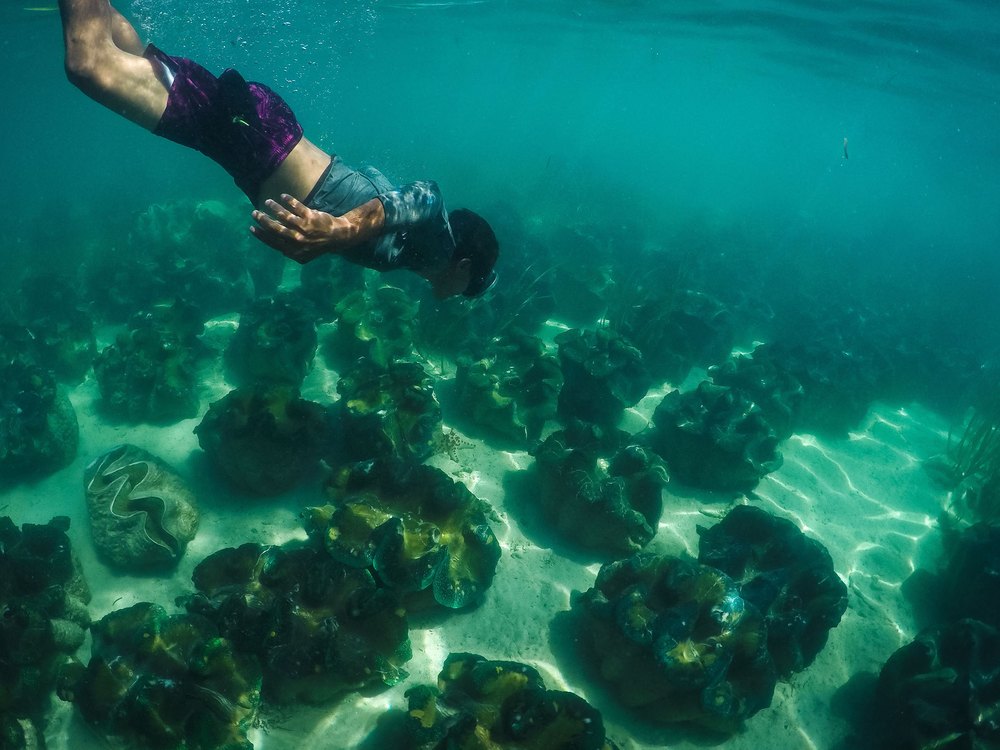

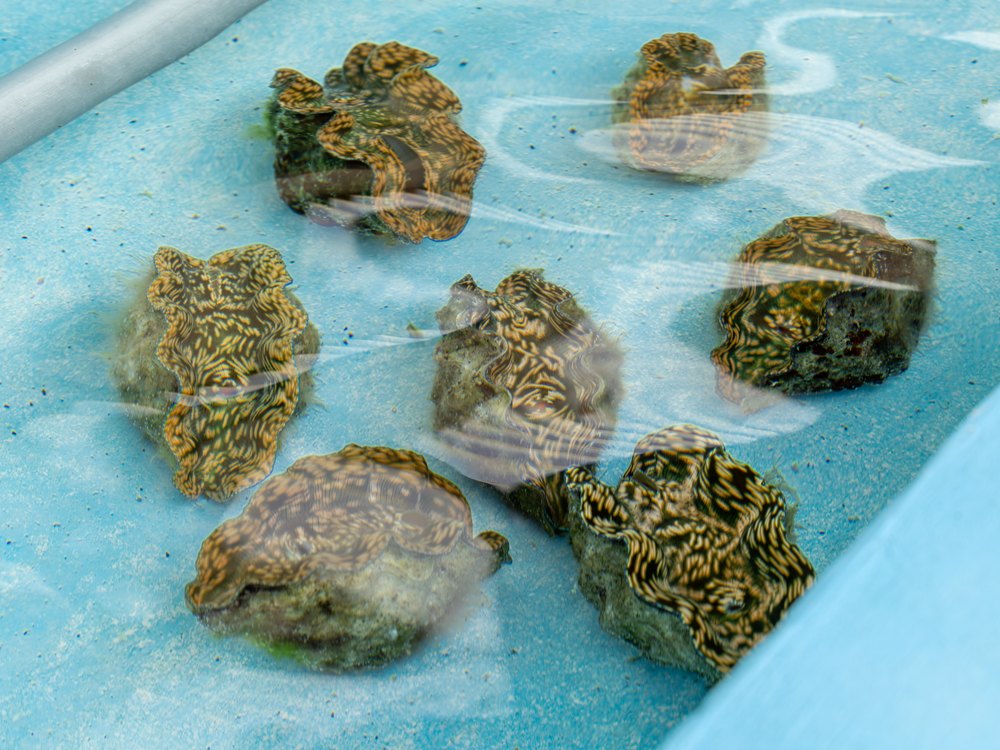
Mariculture, which means farming in the sea, is well established for this species. Most Giant Clams in trade are farmed.[1] In the 1980s, a programme funded by the Australian Centre for International Agricultural Research bred clams and released them. In the Philippines, clams released in 1985 produced young of their own, first seen near Bolinao about 30 years later.[1]

History and culture
Early use
People have used giant clam shells for a long time. A shell adze (an axe-like tool) from Ilin Island, Mindoro, in the Philippines dates to the early Middle Holocene. It is made from Tridacna shell.[19] The Giant Clam was also kept as a reserve food for hard times.[1]


Shells in trade
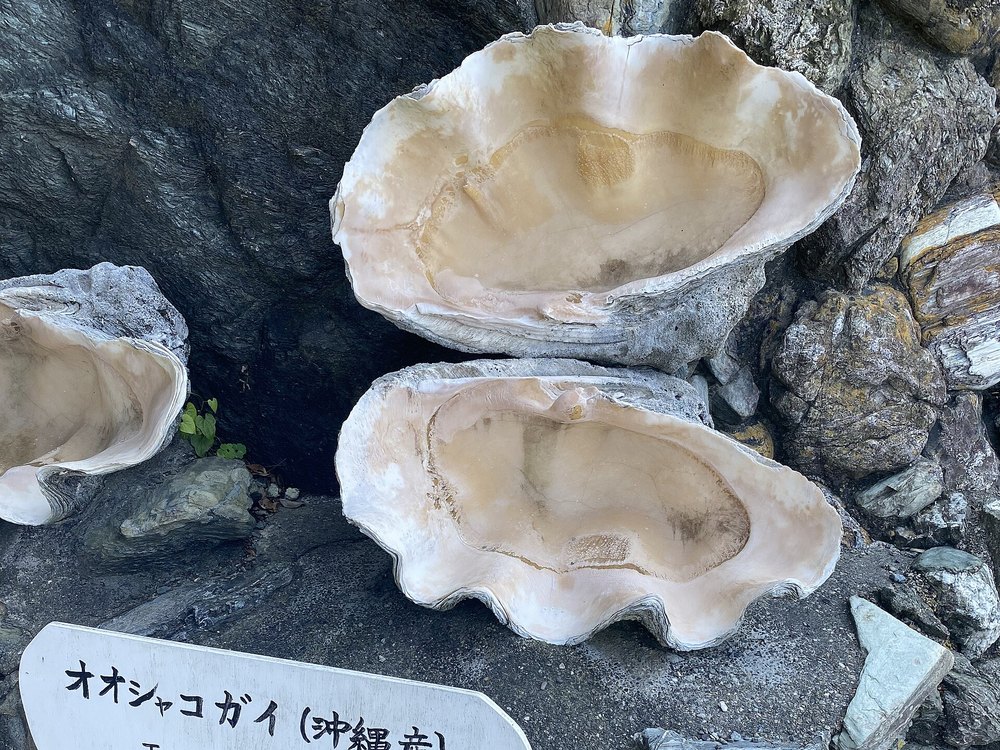
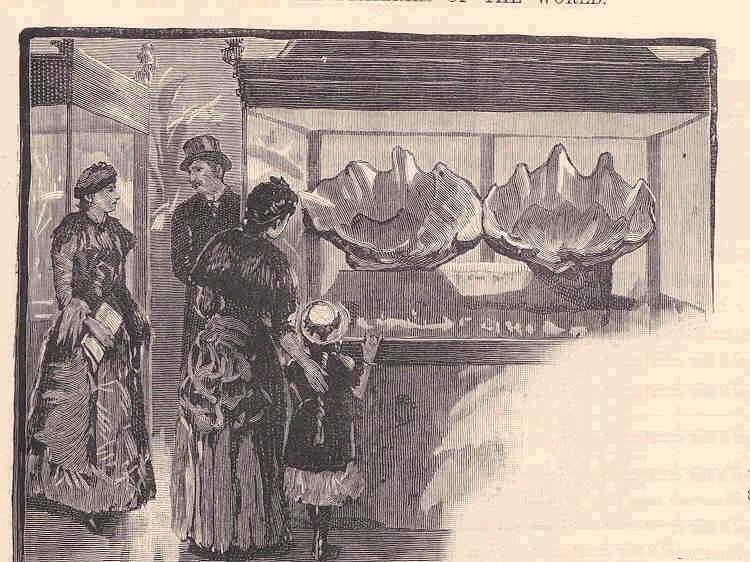
In the 1990s, Giant Clam shells were exported to Japan, the United States and Europe. In the Philippines, large shells became bird baths, wash basins and garden ornaments. In Palau, a mariculture centre sold thousands of shells as ornaments in the early 1990s, shaped mostly into large bowls and soap dishes.[1] In Java and Jakarta, shells were also collected for floor tiles.[1]
Today the shells are used in the handicraft carving industry on Hainan Island, China, and may serve as a substitute for ivory. Many fishermen of Tanmen, Hainan, have moved from ordinary fishing to fishing for giant clams.[1] In the Philippines, carved shells go mainly to China's engraving industry.[20] Officials in Palawan seized 324 pieces of giant clam shell, about 80 tonnes in all, in a raid reported in March 2021, and more than 150 tonnes since October 2020. The penalty is up to three years in prison and a fine of up to 3 million pesos.[20]
The man-eating clam story
Stories tell of giant clams that trap and drown divers. The University of Hawai‘i Sea Grant calls the clams harmless and says the myth comes from their size.[21]
Taxonomy
| Rank | Name |
|---|---|
| Kingdom | Animalia |
| Phylum | Mollusca |
| Class | Bivalvia (two-part shelled mollusks) |
| Order | Cardiida[4][5] |
| Family | Cardiidae (cockles)[4][5][6] |
| Subfamily | Tridacninae (giant clams)[4][6] |
| Genus | Tridacna Bruguière, 1797[4] |
| Species | Tridacna gigas (Linnaeus, 1758)[4][5][6][7] |
Synonyms (3)
| Name |
|---|
| Chama gigas (Linnaeus, 1758) |
| Chama gigantea (G.Perry, 1811) |
| Dinodacna cookiana (Iredale, 1937) |
From the GBIF backbone.[9]
Higher classification
The Giant Clam belongs to the subfamily Tridacninae of the cockle family, Cardiidae, in the order Cardiida.[4][16] WoRMS lists two genera in the subfamily: Tridacna and Hippopus.[23] The subfamily has about ten living species, and NOAA’s proposed rule for the Endangered Species Act covers ten giant clams.[8][22] NOAA calls this species the true giant clam, to set it apart from the others.[7]
Own family or part of the cockles
Lamarck named a family Tridacnidae for the giant clams in 1819. WoRMS now lists that name as a superseded rank, and uses the subfamily Tridacninae inside Cardiidae.[24] The sources do not agree on who named the subfamily: WoRMS gives Lamarck, 1819, while Hernawan (2012) gives Goldfuss, 1820.[22][24]
Sources
- IUCN Red List, Tridacna gigas
- FAO seafarming bibliography
- WorldFish, symbiont strain and early growth of tridacnids
- WoRMS, Tridacna gigas
- GBIF, Tridacna gigas
- Catalogue of Life, Tridacna gigas
- NOAA Fisheries, True Giant Clam
- NOAA Fisheries, proposed rule for 10 species of giant clams
- GBIF, vernacular names of Tridacna gigas
- Animal Diversity Web, Tridacna gigas
- Doyle et al. 2020, PeerJ (boat noise and the clam Tridacna maxima)
- Klumpp, Bayne and Hawkins 1992, J. Exp. Mar. Biol. Ecol. 155: 105–122
- Norton et al. 1992, the tubular system of the giant clam
- Boglio and Lucas 1997, Aquaculture 150: 25–43 (pyramidellid snails on cultured giant clams)
- Neo et al. 2017, Oceanography and Marine Biology: An Annual Review 55: 87–388
- Li et al. 2020, BMC Evolutionary Biology 20: 50
- Ma et al. 2022, Frontiers in Marine Science 9: 964202
- Harzhauser et al. 2008, Palaeontology 51: 199–213
- Pawlik et al. 2015, Antiquity 89: 292–308
- Mongabay, March 2021
- University of Hawai‘i Sea Grant, 5 January 2022
- Hernawan 2012, Biodiversitas 13(3): 118–123
- WoRMS, Tridacninae
- WoRMS, Tridacnidae Lamarck, 1819 (superseded rank, Tridacninae)