Canis lupus arctos is the Arctic wolf, the white wolf of the Queen Elizabeth Islands in the Canadian High Arctic, which has also spread into northern and eastern Greenland.[1][2]
Names and classification
Pocock named it in 1935 in his paper “The races of Canis lupus”.[3][2] Riewe and Mech call it the High Arctic wolf or the arctic wolf. GBIF gives the name American Tundra Wolf.[1][4][5]
The Integrated Taxonomic Information System lists it as a valid subspecies, and GBIF lists it as an accepted subspecies of the Grey Wolf.[3][5] Chambers and colleagues (2012), in a review of North American wolf subspecies, wrote that the genetic and measurement data do not give clear support for recognising the Arctic wolf, and that Arctic wolf populations have no DNA type of their own.[6]
Description
Riewe opens his 1975 study by calling it a white, medium-sized wolf.[1] Wolves of the tundra in general have lighter coats, more rounded ears and longer, thicker fur than wolves of the forest.[2]
Four wolves weighed in the Jones Sound region of Devon and Ellesmere Islands in the 1970s averaged about 32 kg: two males weighed 34 and 43 kg and two females 23.5 and 24.9 kg.[1] In north-east Greenland, five wolves collected in 1906 to 1908 averaged 27 kg for two males and 26 kg for three females, and eight wolves measured there averaged 155 cm (males) and 151 cm (females) in length. The authors think the low weights reflect winter hunger, not a smaller build. By comparison, 18 males from the Northwest Territories mainland averaged 44.5 kg.[2]
Range
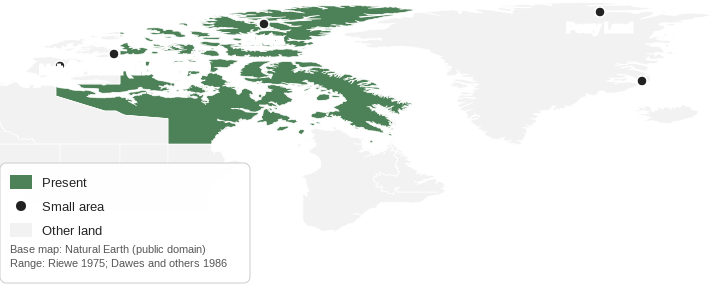
The Arctic wolf ranges over the Queen Elizabeth Islands of the Canadian Arctic Archipelago.[1][2] Study areas include the Fosheim Peninsula on the west side of Ellesmere Island, near Eureka at 80 degrees north,[4] and the Jones Sound region of Devon and Ellesmere Islands.[1]
In Greenland, wolves were wiped out in the east by the late 1930s. Wolves then came again from Ellesmere Island across North Greenland into Peary Land and south into East Greenland, reaching the Scoresby Sund region by the winter of 1983.[2] Marquard-Petersen (2011) reports that wolves reached eastern Greenland from 1979 and more than doubled the range occupied in Greenland, a 15% rise in the subspecies’ global range, with about 23 wolves in three packs by 2011.[7]
Muskoxen, especially calves in summer, and arctic hares are the main food on Ellesmere Island, with seals occasionally.[4] In the Jones Sound region the wolves also took Peary caribou, and they dug through 50 cm of snow and 38 cm of sea ice to reach a dead ringed seal on 10 May 1973.[1] Near Eureka in the summers of 2000 to 2006, the number of adult wolves followed an index of arctic hare numbers (r squared 0.89) but not muskox numbers.[8]
Wolves usually travel alone or in pairs in the Jones Sound region. The largest pack Riewe saw himself was four, though he was told of packs of 15 to 20 and about 30.[1] One pack near Eureka had two to eight adults plus pups in the ten summers from 1986 to 1995, and the first breeding female raised four to six pups a year in 1986 to 1989.[9] That pack died out between the summers of 2000 and 2001, and new wolves settled the area in 2003. In 2006 the pack had seven adults and five pups, and they were unafraid of humans.[4]
Classification evidence
Hall and Kelson (1959) accepted 24 North American subspecies of the Grey Wolf, while Kelsall (1968), Banfield (1974) and Nowak (1983) argued for fewer.[2] Dawes and colleagues (1986) called it questionable to keep the Greenland wolf (orion) apart from arctos. They wrote that Greenland wolves have probably never developed traits of their own because wolves keep arriving from Canada, and that it is reasonable to refer the wolves of North and East Greenland to arctos.[2]
Chambers and colleagues (2012) found no clear support for the Arctic wolf as a subspecies.[6] In the other direction, a study of 42,036 genetic markers in 111 North American wolves (Schweizer and colleagues, 2016) found six ecotypes (groups shaped by their habitat), one of them High Arctic.[10]
History
Bounty payments for wolves returned in the Northwest Territories in 1964, at $40 a wolf plus the pelt. At Grise Fiord the average number of wolves taken each year rose from 1.7 in 1956–57 to 1962–63, to 4.4 in 1963–64 to 1967–68, and 9.6 in 1968–69 to 1970–71. Riewe blames hunting from snowmobiles, and no wolf was taken in 1971–72.[1] Some Grise Fiord residents blamed wolves for the fall in Peary caribou, but Riewe found no proof that wolves control caribou numbers.[1]
Status
In a July 1973 aerial survey of about 22,000 square kilometres in the north-west Jones Sound region, Riewe counted 12 wolves, which gives about one wolf per 900 square kilometres in the area of greatest concentration.[1]
Sources
- Riewe, R.R., 1975, The high arctic wolf in the Jones Sound region of the Canadian High Arctic, Arctic 28(3): 209–212
- Dawes, P.R., Elander, M. and Ericson, M., 1986, The wolf (Canis lupus) in Greenland: a historical review and present status, Arctic 39(2): 119–132
- Integrated Taxonomic Information System, Canis lupus arctos Pocock, 1935 (TSN 726812)
- Mech, L.D., 2007, Possible use of foresight, understanding, and planning by wolves hunting muskoxen, Arctic 60(2): 145–149
- GBIF Secretariat, GBIF Backbone Taxonomy, Canis lupus arctos Pocock, 1935
- Chambers, S.M., Fain, S.R., Fazio, B. and Amaral, M., 2012, An account of the taxonomy of North American wolves from morphological and genetic analyses, North American Fauna 77: 1–67
- Marquard-Petersen, U., 2011, Status of the arctic wolf in Greenland, Wildlife Biology 17: 383–388
- Mech, L.D., 2007, Annual arctic wolf pack size related to arctic hare numbers, Arctic 60(3)
- Mech, L.D., 1995, A ten-year history of the demography and productivity of an arctic wolf pack, Arctic 48(4)
- Schweizer, R.M. and colleagues, 2016, Genetic subdivision and candidate genes under selection in North American grey wolves, Molecular Ecology 25: 380–402