Canis lupus baileyi is the Mexican wolf, the Grey Wolf of the south-western United States and northern Mexico, which lives in the wild again only because wolves bred in captivity have been released there.[1]
Names and classification
Nelson and Goldman described the subspecies in 1929. The type specimen is a male collected in 1899 near Colonia Garcia, about 97 km (60 miles) south-west of Casas Grandes in Chihuahua, Mexico, and the description rests on 65 specimens.[2] It is also called the Mexican gray wolf (US spelling). In Spanish it is lobo mexicano or lobo gris mexicano.[1][3]
The US Fish and Wildlife Service lists it as the endangered subspecies Canis lupus baileyi, and has protected it as such since 1976.[1] The Integrated Taxonomic Information System lists it as a valid subspecies, and GBIF lists it as an accepted subspecies of the Grey Wolf.[4][3] A review by the US National Academies in 2019 concluded that “the Mexican gray wolf is a valid taxonomic subspecies of the gray wolf”, and called it the most genetically distinct subspecies of the Grey Wolf in North America.[2]
Description
Adults weigh 23 to 41 kg (50 to 90 pounds) and stand 66 to 81 cm (26 to 32 inches) at the shoulder.[5] The National Academies review gives the body length as 150 to 180 cm and the shoulder height as 63 to 81 cm.[2]
Nelson and Goldman described a small, narrow, arched skull with a slender, flattened muzzle, and a darker, more reddish coat than in other North American wolves.[2] The coat is generally grey with a darker saddle over the back. Solid black or white Mexican wolves have never been documented.[2]
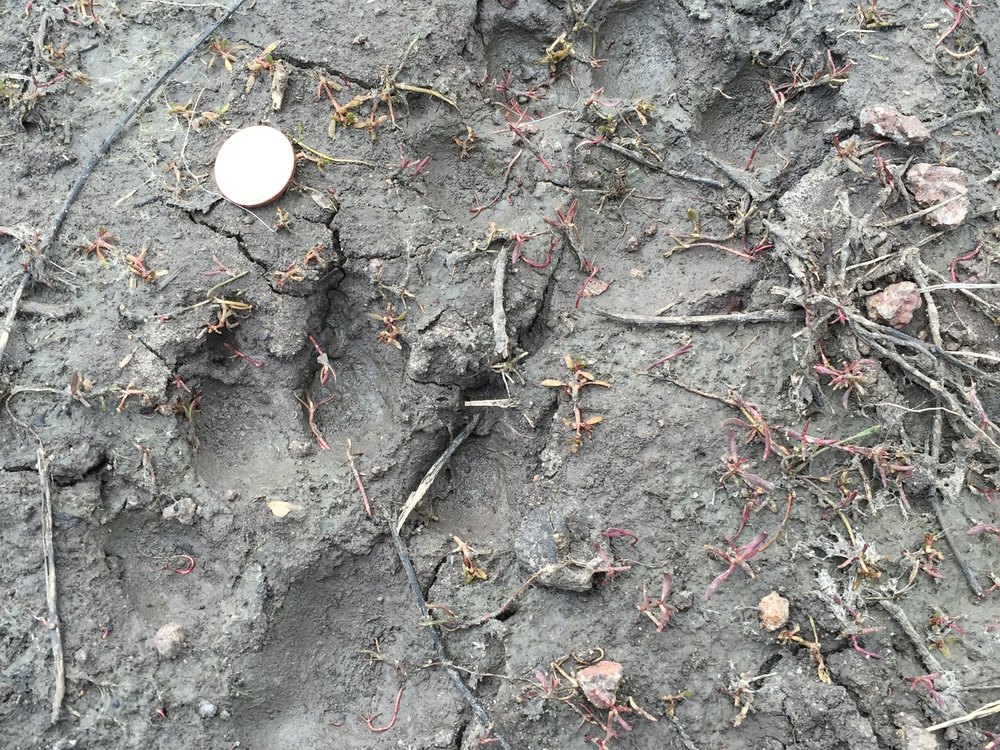
Range
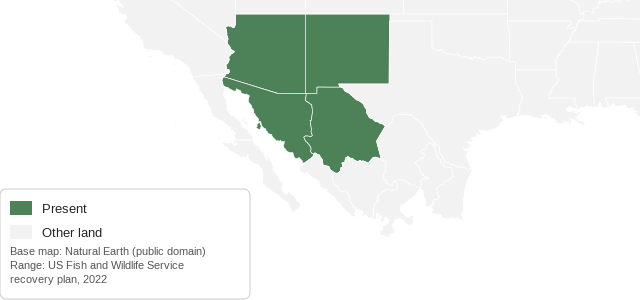
Mexican wolves again live in parts of Arizona and New Mexico in the south-western United States, and in the northern Sierra Madre Occidental of Chihuahua and Sonora in Mexico. They are there because of releases from a joint captive-breeding programme, in the United States since 1998 and in Mexico since 2011.[1] In the United States the release area is the Mexican Wolf Experimental Population Area, in Arizona and New Mexico.[6]
The wolf needs large areas of forested mountain land with enough deer and elk to feed a pack.[1] In the Blue Range area of Arizona and New Mexico, elk made up 80.3% of the diet by weight in the summers of 2005 and 2006.[5]
In the past the wolf roamed the high country of the Desert Southwest: New Mexico, Arizona, Texas and southern Utah and Colorado, according to the National Park Service.[5] Early taxonomists put its range in southern Arizona, southern New Mexico, south-western Texas and northern Mexico, and later authors drew it wider. The exact limits are still debated.[2]
Classification evidence
Leonard and colleagues (2005) found that Mexican wolf DNA and that of some historic wolves from the south-western United States formed a unique southern branch of the Grey Wolf family tree, and they argued for a wider reintroduction area than the one planned.[7]
Earlier work on mitochondrial DNA (inherited only from the mother) found no clear split between the Mexican wolf and other wolves, and some haplotypes (DNA types) were shared with other wolves and with coyotes. Critics used this to question the subspecies, but the 2019 review still judged it valid.[2] The review found no evidence of dog genes in the genomes of Mexican wolves. All North American Grey Wolves, the Mexican wolf included, carry some coyote ancestry, but there is little evidence of coyote hybridisation in the Mexican wolf.[2]
History
The wolf was nearly wiped out by programmes to kill predators that ran from the mid 1800s to the mid 1900s.[1] The last wolf on the land of today’s Valles Caldera preserve, New Mexico, was killed in 1932, and the subspecies was declared extinct in the wild in the United States in 1970.[5] It was listed as endangered on 28 April 1976, a recovery plan followed in 1982, and the first wild release was made in the Blue Range Wolf Recovery Area in 1998.[5][1]
All wolves in the captive programme descend from seven founders.[1][6] The programme is run as the Mexican Wolf Saving Animals From Extinction (SAFE) Program, and it picks breeding pairs to keep relatedness and inbreeding low.[6] From 1998 to September 2024 there were 75 initial releases (222 wolves) and 94 translocations (164 wolves). Pup fostering is counted in those numbers: 126 captive-born pups were placed in wild dens, and 18 wild-born pups were moved between wild dens.[6]
With seven unrelated founders the wolf went through a genetic bottleneck. Since the low point in 2018, the wild population’s founder genome equivalents (a measure of how much of the founders’ variety is left) rose from 1.96 to 2.09, and its average inbreeding fell from 0.2201 to 0.2114. The release plan ties these changes to the fostered pups.[6]
Status
The wolf is endangered under the US Endangered Species Act.[1] The US Fish and Wildlife Service counts the minimum number of wolves known alive at the end of each year in Arizona and New Mexico. It was 4 in 1998, 59 in 2006, 42 in 2009, 112 in 2014, 98 in 2015 and 319 in 2025 (143 in Arizona and 176 in New Mexico). The count has grown every year since 2015 or 2016.[8]
The 2022 recovery plan names illegal killing and other human-caused deaths, the risk of dying out because the population is small, and the loss of gene variety as the main threats.[1] It sets the first target for downlisting (moving the wolf from endangered to threatened) as a US population that averages at least 320 wolves over four years, and the target for removing it from the list needs an eight-year average of at least 320 as well as other conditions.[1]
Sources
- US Fish and Wildlife Service, 2022, Mexican Wolf Recovery Plan, Second Revision
- National Academies of Sciences, Engineering, and Medicine, 2019, Evaluating the Taxonomic Status of the Mexican Gray Wolf and the Red Wolf, National Academies Press
- GBIF Secretariat, GBIF Backbone Taxonomy, Canis lupus baileyi Nelson and Goldman, 1929
- Integrated Taxonomic Information System, Canis lupus baileyi Nelson and Goldman, 1929 (TSN 726813)
- National Park Service, Valles Caldera National Preserve, Mexican wolf
- US Fish and Wildlife Service, 2024, 2025 Initial Release and Translocation Proposal
- Leonard, J.A., Vilà, C. and Wayne, R.K., 2005, Legacy lost: genetic variability and population size of extirpated US grey wolves (Canis lupus), Molecular Ecology 14: 9–17
- US Fish and Wildlife Service, 2026, Mexican Wolf Population Statistics 1998–2025 (data to 31 December 2025)