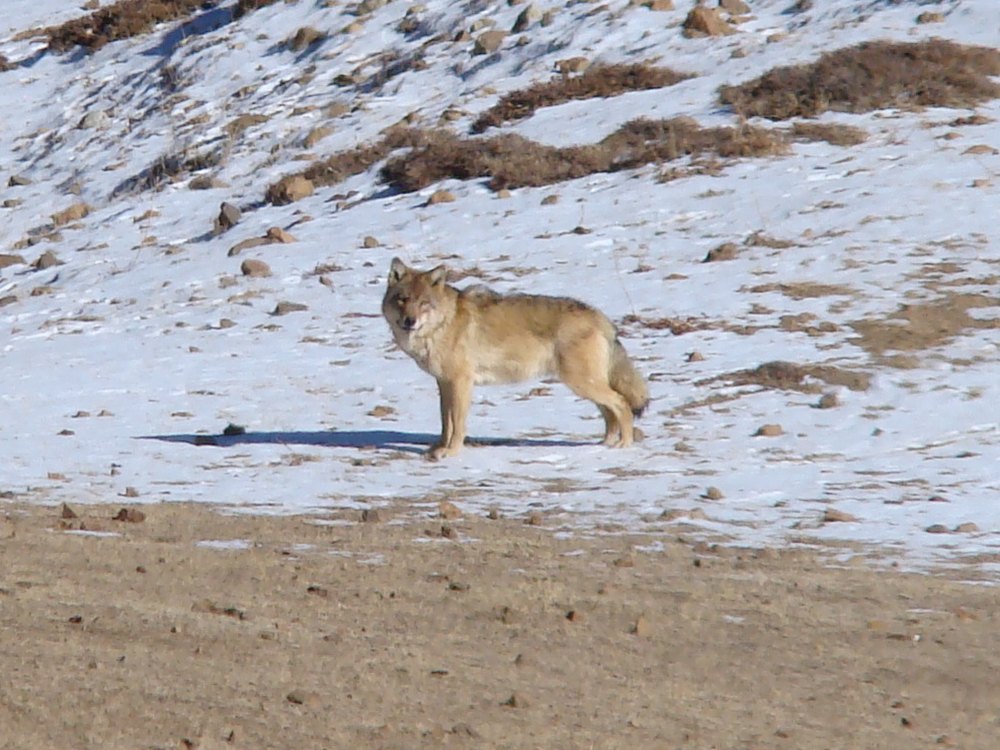
Canis lupus chanco is the Himalayan wolf, the wolf of the high Himalaya and the Tibetan Plateau, also called the Tibetan wolf or the woolly wolf.[1][2]
Names and classification
John Edward Gray named it Canis chanco in 1863, from a wolf of “Chinese Tartary”, which the Mammal Diversity Database places in Xinjiang, China, far from the Himalaya.[3] Later authors used the name for the Himalayan lineage, after Pocock combined an older Tibetan name, laniger, with chanco in 1941.[1] Laniger (Hodgson, 1847) cannot be used because the dog already carried that name, while filchneri (Matschie, 1908), from Gansu, is an available synonym.[3]
Lists disagree on its rank. The IUCN Red List and ITIS list it as the subspecies Canis lupus chanco.[4][5] The Mammal Diversity Database lists only chanco as a synonym of the Grey Wolf and notes that the Tibetan Plateau form has been considered by some a distinct species that needs further study.[3] The IUCN/SSC Canid Specialist Group uses Canis lupus chanco and does not give it species rank.[6] Aggarwal and colleagues proposed the species Canis himalayensis in 2007 from mitochondrial DNA, although their own analysis gave mixed results,[7][1] and a 2024 study of 24 Himalayan wolves supports the species rank.[8] Werhahn and colleagues say it deserves subspecies recognition and that species rank may be justified with more nuclear DNA,[1] while Hennelly and colleagues call the Tibetan wolves an evolutionarily significant unit (a lineage with its own long history).[9] A 2025 skull study calls it Canis cf. lupus chanco, a potential cryptic wolf species.[10]
In India it is also called the woolly wolf.[2]
Description
The coat is described as woolly, which gives the animal one of its names.[2][11] In Ladakh and Spiti it is described as one of the oldest wolf lineages and as adapted to extreme cold.[11]
Four adult skulls from India measured 198 to 234 mm in length, with an average of 214.84 mm; the skull was significantly longer and broader than that of the Indian wolf.[12][2] Shape analysis shows a shorter muzzle and a wider zygomatic arch (cheekbone) than in other wolf populations, but the ranges overlap and no single measurement identifies the animal.[10]

Range
Where it lives
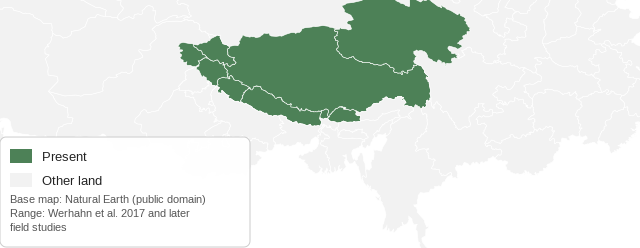
Its range extends from the Himalaya north across the Tibetan Plateau to the Qinghai Lakes region.[1] In India it is found in Ladakh, Himachal Pradesh and Jammu and Kashmir, with sightings from Uttarakhand and Sikkim.[2] In Nepal it has been confirmed in Upper Mustang and in Humla, where the study area lay at 3,700 to 5,390 m.[13][1] In Bhutan, 13 scats collected during the 2022 to 2023 snow leopard survey were all from the Himalayan wolf lineage.[14] In Dulan County, Qinghai, 78% of camera detections were at 4,200 to 4,300 m.[15] The Indian study area in Ladakh and Spiti runs from valleys at about 2,800 m to peaks of 7,000 m, with a yearly rainfall rarely above 100 mm.[11] In Ladakh it meets the Indian wolf and the Holarctic grey wolf along a narrow zone of mixed ancestry, which reaches into northern Pakistan.[9][16]
Food and home range
A study of 542 wolf scats in Ladakh and Spiti found that livestock made up 56.46% of the diet, pika 13.54%, blue sheep 8.26%, marmot 6.99% and ibex 3.13%. Wolves took more livestock in western Ladakh and Spiti and more wild prey in Changthang.[11] In Gouli Nature Reserve in Qinghai, blue sheep and pika were the most common prey.[15] Three GPS-collared wolves in Himachal Pradesh had a 95% home range of 1,689.80 km² on average, with a range of 827.54 to 3,055.45 km².[2] Camera traps in Qinghai caught them mainly in daytime, with peaks at 8:00 to 15:00 and 17:00 to 21:00 in the cold season.[15]
Classification evidence
Whole genomes put the common ancestor of the Tibetan lineage and the Holarctic wolves at about 496,000 years ago (95% range 388,000 to 644,000 years).[9] Earlier mitochondrial work gave about 800,000 years, and the paper that reports it gives 3.8% difference in cytochrome b and 6.9% in the D-loop from the Holarctic wolf.[1] Highland wolves from the Chinese plateau carry fixed gene changes in EPAS1, ANGPT1 and RYR2, genes that help the body cope with low oxygen.[17] A haplotype tied to adaptation above 4,000 m is found in the lineage, and a mixing zone with grey wolves lies where the plateau drops.[18] Hennelly and colleagues say species rank needs more sampling west of the plateau.[9]
Status
Down To Earth reports that the IUCN Red List assessed the subspecies on 27 June 2023 as Vulnerable (criterion C2a(ii)), with 2,275 to 3,792 mature individuals in one subpopulation and a suspected ongoing decline. The same report names livestock conflict, habitat loss, fewer wild prey, crossing with free-ranging dogs and illegal hunting for fur and body parts.[4] The Indian share is put at 227 to 378 mature individuals, taken from a 2020 estimate of 378 to 630 wolves in Ladakh and Spiti.[4] It is Schedule 1 of the Indian Wildlife (Protection) Act 1972, and the Indian populations are regionally endangered.[12] CITES lists the wolf populations of Bhutan, India, Nepal and Pakistan in Appendix I.[19] It lives mostly outside protected areas, under less human pressure than the Indian wolf.[2]
Sources
- Werhahn, G., Senn, H., Ghazali, M. et al. 2017. The unique genetic adaptation of the Himalayan wolf to high-altitudes and consequences for conservation. Royal Society Open Science 4: 170186.
- Khan, W. et al. 2022. Woolly wolf and Indian wolf compared: home range, diet, skull and howl. Frontiers in Ecology and Evolution 10: 775612.
- Mammal Diversity Database, Canis lupus Linnaeus, 1758, taxon page and synonym list. American Society of Mammalogists.
- Down To Earth, 12 January 2024. The first-ever IUCN assessment of the Himalayan wolf is out and it is grim.
- Integrated Taxonomic Information System (ITIS), Canis lupus, list of subspecies.
- Alvares, F. et al. 2019. Old World Canis spp. with taxonomic ambiguity: workshop conclusions and recommendations. IUCN/SSC Canid Specialist Group.
- Aggarwal, R.K. et al. 2007. Mitochondrial DNA coding region sequences support the phylogenetic distinction of two Indian wolf species. Journal of Zoological Systematics and Evolutionary Research 45: 163.
- Srinivas, Y. & Jhala, Y.V. 2024. Genetic distinctness of the Himalayan and Indian peninsular wolves. Conservation Genetics 25: 33.
- Hennelly, L.M. et al. 2021. A new species or a distinct lineage? Genomic diversity and divergence of the Tibetan and Indian wolves. Molecular Ecology 30: 6687.
- Viranta, S., Werhahn, G. & Machado, H. 2025. Skull shape of the Himalayan wolf, Canis cf. lupus chanco. Mammal Research 70: 195.
- Shrotriya, S. et al. 2022. Diet of the Himalayan wolf in Ladakh and Spiti, India. Frontiers in Ecology and Evolution 10: 815996.
- Srinivas, Y. & Jhala, Y.V. 2021. Morphological identification of the wolves, jackals and dhole of India. Biodiversity Data Journal 9: e67677.
- Chetri, M. et al. 2016. Himalayan wolf in the Upper Mustang, Nepal. ZooKeys 582: 143.
- Dhendup, T. et al. 2026. Genetic evidence of the Himalayan wolf in Bhutan. Ecology and Evolution 16: e74201.
- Guan, T. et al. 2025. Camera-trap study of the Tibetan wolf in Dulan County, Qinghai. Biology 14: 1273.
- Hennelly, L.M. et al. 2024. Genomic and mitochondrial diversity of wolves in Pakistan. Journal of Heredity 115: 339.
- Zhang, W. et al. 2014. Hypoxia adaptations in the grey wolf (Canis lupus chanco) from Qinghai-Tibet Plateau. PLoS Genetics 10: e1004466.
- Werhahn, G., Senn, H., Macdonald, D.W. & Sillero-Zubiri, C. 2020. The diversity in the genus Canis challenges conservation biology: a review of available data on Asian wolves. Journal of Biogeography 47: 1272.
- Boitani, L., Phillips, M. & Jhala, Y. 2018. Canis lupus. The IUCN Red List of Threatened Species 2018.