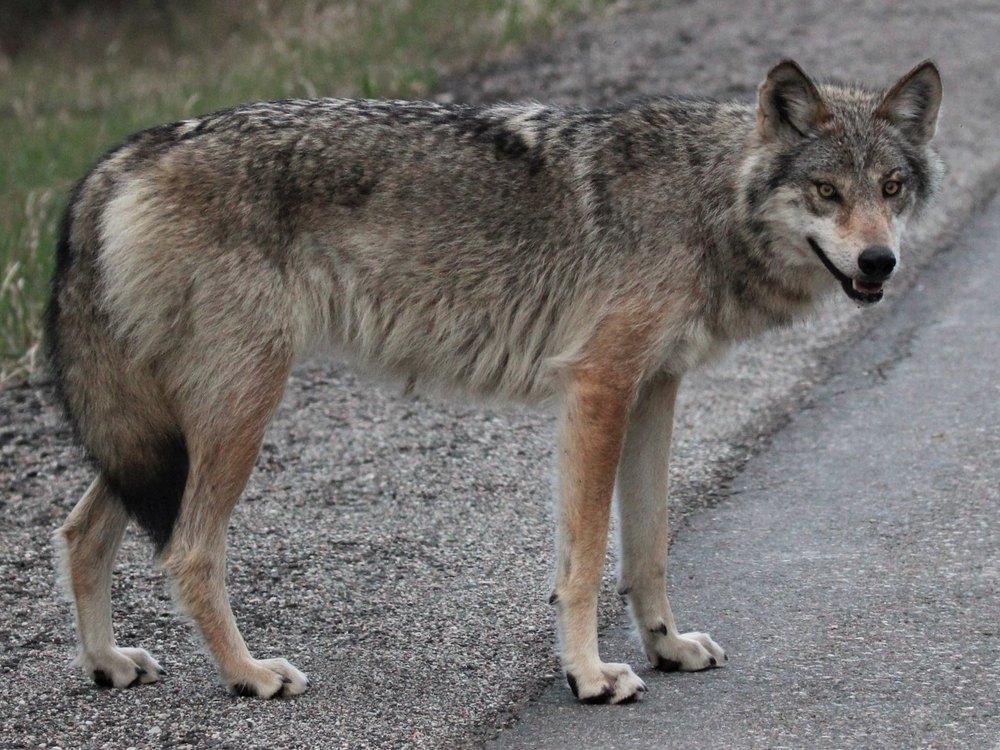
Canis lupus nubilus is the plains wolf, named for the Great Plains of the United States, where it is gone; today wolves of this name live in the western Great Lakes, coastal western Canada and northern and eastern Canada.[1][2]
Names and classification
Thomas Say named it in 1823.[3][4][5] He described it from wolves he saw in the central United States.[1] It is called the plains wolf, and Goldman called it the buffalo wolf in 1937.[6][2]
The Integrated Taxonomic Information System lists it as valid and folds ten older names into it, among them fuscus, ligoni and crassodon of the Pacific coast, mogollonensis, monstrabilis and youngi of the south-west, and labradorius.[3] The Catalogue of Life and GBIF also accept it as a subspecies of the Grey Wolf.[5][4] The US Fish and Wildlife Service follows the 2012 monograph on North American wolves, which recognises this subspecies and the northwestern wolf and says wolves of the coasts of south-east Alaska and British Columbia belong here.[1][6]
The name is disputed. A 2023 study of 21 skull measurements from 12 North American populations found a single pool of shapes that could count as one taxonomic unit, but it did not include wolves from the southern United States.[7] A 2011 genetic study, quoted by the Fish and Wildlife Service, found little separation from the northwestern wolf.[1] The authors of a 2009 study, as summarised by the Raincoast Conservation Foundation, found that wolves of coastal British Columbia differ more from other North American wolves than the named subspecies differ from each other, so they would keep the coastal name fuscus.[8] The monograph authors reply that the earlier DNA results exaggerated the gap and that the commonest coastal haplotype also occurs in the central Great Plains.[1]
Description
The wolves of the Minnesota study area have been counted in winter since 1988–89. In 2020–21 the marked packs averaged 3.79 wolves each, with a range of 2 to 7.[9] The average territory covered 119.1 km², within a range of 22 to 280 km².[9]

Range
Where it lived and lives
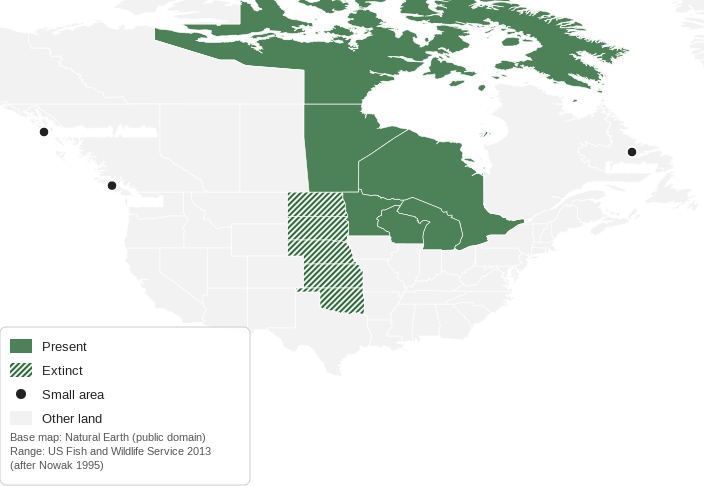
The US Fish and Wildlife Service gives its historical range as the coast of south-east Alaska, western Canada, the contiguous United States from the Pacific to the Great Lakes, eastern Canada except the far south-east, and occasionally west-central Greenland.[1] Goldman described it as the wolf of the Great Plains, from south-central Canada south to south-central United States.[1]
It has lost most of that range in the United States. Wolves were wiped out of the central United States, the southern Rocky Mountains and the Colorado Plateau soon after farming and livestock keeping spread, and the Service calls the loss permanent there.[1] Today the Service places it in the western Great Lakes, south-east Alaska, and a small number of wolves in the Pacific Northwest that look like a mix with the northwestern wolf.[1]
In Canada it lives in coastal and western British Columbia, including Vancouver Island, in most of mainland Nunavut, in northern Manitoba, in the north of Ontario with about 5,000 wolves in 2005, and in most of Quebec north of the St Lawrence, with about 7,000 wolves of all kinds in the province.[1] Labrador held about 1,500 wolves in 2001, and wolves are gone from the island of Newfoundland.[1]
Life in the range
In Minnesota, the winter of 2020–21 gave an estimate of 2,770 wolves (90% confidence interval 2,319 to 3,223) in 621 packs, over an occupied range of 73,972 km², or 3.7 wolves per 100 km².[9] The estimate assumes that 15% of wolves live alone.[9] Wolf numbers there follow the deer the spring before: over nine years they rose and fell with deer density, which averaged about 10.7 deer per square mile in marked wolf territories.[9] White-tailed deer are the main prey in Minnesota, and in south-east Alaska the wolves of the region hunt Sitka black-tailed deer.[9][10] The land they occupy in Minnesota is mostly wetland and forest: woody wetlands cover 37.6%, deciduous forest 16.6% and mixed forest 11.3%.[9]
Classification evidence
The Great Lakes wolves are the largest living group assigned to this subspecies, and their identity is the point most argued over. Researchers continue to debate it, and the Fish and Wildlife Service lists the studies of that debate while still assigning the wolves to nubilus.[1]
The Canadian assessment body, COSEWIC, called the wolves of eastern Canada the northwestern wolf, while the Service calls them the plains wolf, so the border between the two subspecies is drawn in different places.[1] The monograph authors say the two meet in Canada.[6] A genome study of North American wolves did not use subspecies names, and found separate Central and Great Lakes groups instead.[11]
History
The plains wolf followed the settlers’ frontier out of existence. Wolves of the central United States, the southern Rocky Mountains, the Colorado Plateau and the Pacific Northwest were killed after European-style farming and livestock keeping began.[1] The Pacific Northwest is being recolonised, with packs reported in Washington in 2008, 2011 and 2013, from wolves out of coastal British Columbia and from the northwestern wolf.[1]
In the western Great Lakes the wolves grew back and were taken off the federal list in 2011.[1] Minnesota counted about 2,200 to 2,400 wolves in the first three winters after that, and in December 2014 a court ruling put Minnesota wolves back on the list of threatened species.[9]
Status
Canada rated this subspecies and the northwestern wolf as Not at Risk in 2001, citing large, stable populations with no sign of decline in the last 10 years despite liberal hunting.[1] A 2008 finding by Environment Canada said hunting was not harming it.[1]
In its 2013 proposal the US Fish and Wildlife Service found that listing the subspecies was not warranted and judged that the range loss of the past would not repeat, because the range is now stable or growing.[1]
Sources
- US Fish and Wildlife Service (2013), Endangered and Threatened Wildlife and Plants; Removal of the Gray Wolf (Canis lupus) from the List of Endangered and Threatened Wildlife and Maintaining Protections for the Mexican Wolf; proposed rule. Federal Register 78(114): 35664 ff., 13 June 2013
- National Academies of Sciences, Engineering, and Medicine (2019), Evaluating the Taxonomic Status of the Mexican Gray Wolf and the Red Wolf, chapter 4. National Academies Press
- Integrated Taxonomic Information System, Canis lupus nubilus Say, 1823, TSN 726836
- GBIF Secretariat, GBIF Backbone Taxonomy, Canis lupus nubilus Say, 1823
- Catalogue of Life, checklist of 11 November 2026, Canis lupus nubilus Say, 1823
- Chambers, S. M., Fain, S. R., Fazio, B. and Amaral, M. (2012), An account of the taxonomy of North American wolves from morphological and genetic analyses. North American Fauna 77: 1–67
- Khidas, K. (2023), Morphological relationships among populations support a single taxonomic unit for the North American Gray Wolf. Journal of Mammalogy 104(3): 562–577
- Raincoast Conservation Foundation (2026), Ecological differences between grey wolves (backgrounder, summarising Muñoz-Fuentes et al. 2009)
- Erb, J. and Humpal, C. (2021), Minnesota Wolf Population Update 2021. Minnesota Department of Natural Resources
- Alaska Department of Fish and Game, Wolf (Canis lupus), species profile
- Sinding, M.-H. S. et al. (2018), Population genomics of grey wolves and wolf-like canids in North America. PLOS Genetics 14(11): e1007745