Canis lupus occidentalis is the wolf of Alaska, interior western Canada and the northern Rocky Mountains of the United States, also called the northern timber wolf.[1][2]
Names and classification
Richardson named it in 1829.[3][4][5] The type material came from the Northwest Territories.[1] The authors of the 2012 monograph on North American wolves call it the northern timber wolf.[2]
The Integrated Taxonomic Information System lists it as valid, with the old names alces, griseoalbus, hudsonicus, mackenzii, pambasileus and tundrarum folded into it.[3] The Catalogue of Life and GBIF also accept it as a subspecies of the Grey Wolf.[5][4] The US Fish and Wildlife Service follows the 2012 monograph and recognises three subspecies in North America, this one, the plains wolf and the Mexican wolf.[1] The monograph says the two northern subspecies are supported by skull measurements and by DNA studies where they meet in Canada.[2]
Not everyone agrees. A study of 21 skull measurements from 12 North American wolf populations found a single pool of shapes that could count as one taxonomic unit.[6] The Fish and Wildlife Service also quotes a 2011 genetic study that found little separation between this subspecies and the plains wolf.[1]
Description
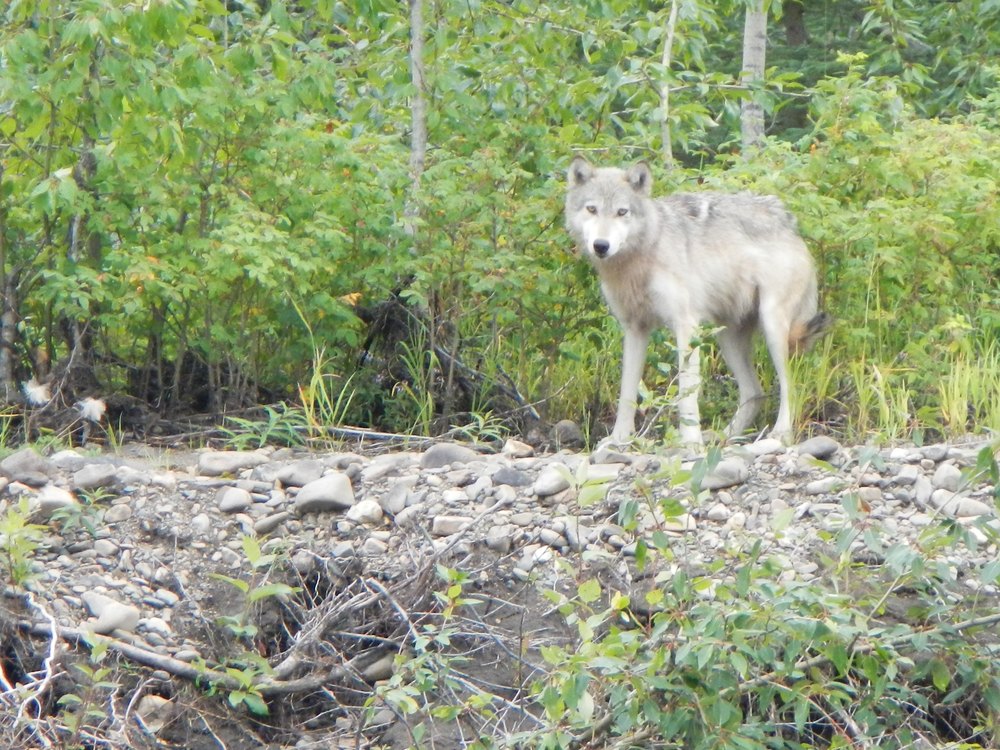
Wild wolves of interior Alaska are grey or black most often, and the fur ranges from black to nearly white, with shades of grey and tan.[7] In Yellowstone National Park, grey and black wolves are about equally common and white ones are rare.[8]
Adult males in interior Alaska usually weigh 38.6 to 52.3 kg, and a few reach 65.3 kg; females rarely weigh more than 45 kg.[7] Among 179 wolves caught in and near Yukon-Charley Rivers National Preserve, Alaska, from 1993 to 2011, the average adult male weighed 50 kg (111 pounds) and the average adult female 44 kg (97 pounds).[9] In Wyoming outside Yellowstone, monitoring from 2012 to about 2024 gave an average of 48 kg (106.5 pounds) for adult males and 41 kg (90.5 pounds) for adult females.[9] In Yellowstone the average adult male weighs 50 kg (110 pounds) and the average adult female 41 kg (90 pounds), and the heaviest recorded wolf weighed 67 kg (148 pounds).[8]

Range
Where it lives
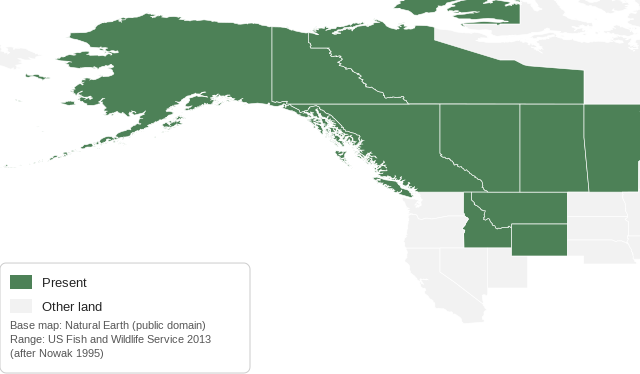
The US Fish and Wildlife Service gives its historical range as all of Alaska except the coastal south-east, the interior of western Canada, and the northern Rocky Mountains of the United States.[1] It meets the plains wolf on its eastern and western sides.[1] The Canadian assessment body, COSEWIC, used a wider range that also took in Manitoba, Ontario, Quebec and Labrador, which the Service gives to the plains wolf.[1]
In Alaska wolves live over about 85% of the state and are missing from Admiralty, Baranof and Chichagof islands.[7] The state estimated 7,000 to 11,000 wolves in 2007, a figure that includes a small number of plains wolves in the south-east.[1] Agency estimates quoted by the Service put about 4,500 wolves in the Yukon in 2001 and about 5,000 in Alberta in 1997.[1] In the contiguous United States the subspecies lives in the northern Rocky Mountains of Idaho, Montana and Wyoming.[1]
Life in the range
Its habitats run from the rain forest of south-east Alaska to the Arctic tundra by the Beaufort Sea.[7] Moose and caribou are the main food across most of Alaska, with voles, lemmings, ground squirrels, snowshoe hares and beavers eaten in summer.[7] In Yellowstone elk dominate the diet in every season; in winter they make up 96% or more of the diet.[8]
Alaskan packs usually hold 2 to 12 wolves and can reach 30, and territories may cover 500 to 2,600 km² (200 to 1,000 square miles).[7] In Yellowstone the average pack has 9.8 wolves and the average territory covers 428 km².[8] In Yukon-Charley Rivers National Preserve the average fall pack held 7.9 wolves in 2011 and 2012.[10] Alaskan females dig the den up to 3 m (10 feet) into well-drained soil.[7]
Classification evidence
The name rests on skull shape and on DNA from wolves where the two northern subspecies touch in Canada, but the boundary between them is not sharp.[2] The Fish and Wildlife Service notes that zones where subspecies blend have long been recognised and that their limits are in constant flux.[1]
A genome study of North American wolves did not use subspecies names. It found separate Alaskan groups, with gene flow to wolves of eastern Siberia, and a separate Yellowstone group, which do not map onto the old names one to one.[11] The skull study of 2023 found the same single pool of shapes across its 12 populations, although it did not include wolves from the southern United States.[6]
History
Settlement and farming removed wolves from the southern edge of the range. The prairie wolves of Alberta and Saskatchewan were wiped out in the early 1900s.[1] In the northern Rocky Mountains of the United States wolves were also exterminated, and wolves were reintroduced to Yellowstone and central Idaho in 1995.[8][1] The Service later removed protection from the northern Rocky Mountain population, in rules of 2011 and 2012.[1]
Wolves of the Yukon-Charley Rivers National Preserve have been counted every year since March 1993. In fall 2011 there were 71 wolves in at least 9 packs; in the winter of 2010 the count had fallen by 41%, from 52 to 31 wolves, while the Fortymile caribou herd wintering along the Charley River gave the packs enough food.[10]
Status
Canada rated this subspecies and the plains wolf as Not at Risk in 2001, citing large, stable populations with no sign of decline in the last 10 years despite liberal hunting.[1] A 2008 finding by Environment Canada described stable to increasing populations and a lack of threats.[1]
In its 2013 proposal the US Fish and Wildlife Service found that listing the subspecies was not warranted.[1] It names loss of habitat in the south, hunting and trapping rules and conflicts with livestock as the main pressures.[1]
Sources
- US Fish and Wildlife Service (2013), Endangered and Threatened Wildlife and Plants; Removal of the Gray Wolf (Canis lupus) from the List of Endangered and Threatened Wildlife and Maintaining Protections for the Mexican Wolf; proposed rule. Federal Register 78(114): 35664 ff., 13 June 2013
- Chambers, S. M., Fain, S. R., Fazio, B. and Amaral, M. (2012), An account of the taxonomy of North American wolves from morphological and genetic analyses. North American Fauna 77: 1–67
- Integrated Taxonomic Information System, Canis lupus occidentalis Richardson, 1829, TSN 726837
- GBIF Secretariat, GBIF Backbone Taxonomy, Canis lupus occidentalis Richardson, 1829
- Catalogue of Life, checklist of 11 November 2026, Canis lupus occidentalis Richardson, 1829
- Khidas, K. (2023), Morphological relationships among populations support a single taxonomic unit for the North American Gray Wolf. Journal of Mammalogy 104(3): 562–577
- Alaska Department of Fish and Game, Wolf (Canis lupus), species profile
- National Park Service, Yellowstone Wolf Facts, Yellowstone National Park
- Outdoor Life, Why are Wyoming wolves so big (quoting Wyoming Game and Fish Department monitoring and National Park Service biologist John Burch)
- National Park Service, Wolf annual reports, Yukon-Charley Rivers National Preserve
- Sinding, M.-H. S. et al. (2018), Population genomics of grey wolves and wolf-like canids in North America. PLOS Genetics 14(11): e1007745