Canis lupus pallipes is the Indian wolf, the wolf of the semi-arid grasslands and scrub of India and Pakistan.[1][2]
Names and classification
William Henry Sykes named it Canis pallipes in 1831, from the “Dukhun” (the Deccan plateau of India).[3] It is also called the Indian grey wolf.[2]
Lists disagree on its rank. ITIS lists it as the subspecies Canis lupus pallipes.[4] The 2018 IUCN text for the Grey Wolf gives pallipes a very wide range, “from Israel to China”, and press reports say the IUCN assessed it separately in October 2025.[5][6] The Mammal Diversity Database lists pallipes only as a synonym of Canis lupus.[3] The IUCN/SSC Canid Specialist Group recommended no split for the Indian wolf.[7] Aggarwal and colleagues proposed the species Canis indica in 2007 from mitochondrial DNA,[8] and a 2024 study of 77 peninsular Indian wolves supports separate species rank, as Canis pallipes.[9] Hennelly and colleagues call the Indian wolf an evolutionarily significant unit (a lineage with its own long history) and ask for a revision that separates it from West Asian wolves.[1]
Description
Twelve adult skulls measured 188 to 221 mm in length, with an average of 202.64 mm.[10] Eleven adults, measured from skins and live animals, had an average body length of 79.95 cm (range 72 to 94.5 cm), a head length of 26.12 cm on average and ears about 11.2 cm high.[10] The Indian wolf is smaller than the Himalayan wolf, which has a longer and broader skull.[2] Its howl does not differ from that of the Himalayan wolf in the parameters measured.[2]
Range
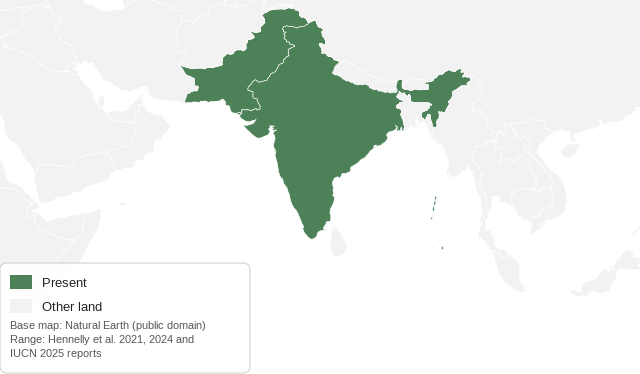
Where it lives
It lives mainly in the semi-arid grasslands, scrub and farmed grazing land of India, across 13 states, with wolves named in Rajasthan, Andhra Pradesh, Maharashtra and Telangana.[2] In Jharkhand, a study in the Mahuadanr Wolf Sanctuary found 18 active dens in 64 km² between 2022 and 2024, mostly in sal forest on steep slopes with shrub cover.[11] In Pakistan, wolves of the Indian lineage live in Sindh and southern Punjab.[12] The IUCN country list for the Grey Wolf shows Bangladesh as native, possibly extinct.[5] Hennelly and colleagues find that wolves from Syria and Iran belong with the Holarctic wolves, so the true range of the Indian lineage is much smaller than “Israel to China” and may be limited to the lowland peninsular Indian subcontinent.[1]
Food, packs and home range
The diet has 17 food types, mostly medium-sized mammals such as blackbuck, chinkara and livestock, with some fruit. Domestic prey made up 40.34% in a review of studies.[2] In Velavadar Blackbuck Sanctuary wild prey made up 91.8% of the diet, while in the human-dominated landscape of Maharashtra domestic prey made up 47.8%.[2] Pack size averages 1.5 to 4.7 animals, depending on the season.[2] Ten GPS-collared wolves in Maharashtra had an average 95% home range of 212.26 km², with a range of 4.92 to 981.48 km², and they moved much more at night than by day.[2]
Classification evidence
Whole genomes put the common ancestor of the Indian lineage and the Holarctic wolves at about 200,000 years ago (95% range 175,000 to 307,000), from four Indian wolves.[1] A genome of one wolf from peninsular India gives about 110,000 years, and the authors find low genetic variety and a lineage that has kept declining.[13] Khan and colleagues quote about 400,000 years from earlier work.[2] The Indian and Himalayan wolves are distinct with no gene flow between them, and the Indian wolf has declined over the last 25 to 50 generations.[9] In Pakistan, ancestry changes gradually from Indian in the east to Holarctic in the west.[12]
Status
Press reports on the IUCN update of 10 October 2025 give Vulnerable and a population of 3,093 (2,877 to 3,310) wolves in India and Pakistan, with only 12.4% of the range inside protected areas.[6][14] An older estimate from 2003 gave 2,000 to 3,000 in India.[1] It is Schedule 1 of the Indian Wildlife (Protection) Act 1972 and regionally endangered in India.[10] CITES lists the wolf populations of Bhutan, India, Nepal and Pakistan in Appendix I.[5] In most of its range it lives mainly on livestock and is severely persecuted for it.[2] Other threats are poisoning, roads and other linear works that cut up its land, and free-ranging dogs, which spread disease and can interbreed with it.[10]
Sources
- Hennelly, L.M. et al. 2021. A new species or a distinct lineage? Genomic diversity and divergence of the Tibetan and Indian wolves. Molecular Ecology 30: 6687.
- Khan, W. et al. 2022. Woolly wolf and Indian wolf compared: home range, diet, skull and howl. Frontiers in Ecology and Evolution 10: 775612.
- Mammal Diversity Database, Canis lupus Linnaeus, 1758, taxon page and synonym list. American Society of Mammalogists.
- Integrated Taxonomic Information System (ITIS), Canis lupus, list of subspecies.
- Boitani, L., Phillips, M. & Jhala, Y. 2018. Canis lupus. The IUCN Red List of Threatened Species 2018.
- Asianet Newsable, 13 October 2025. IUCN may declare Indian wolf distinct species, sparks urgent conservation call.
- Alvares, F. et al. 2019. Old World Canis spp. with taxonomic ambiguity: workshop conclusions and recommendations. IUCN/SSC Canid Specialist Group.
- Aggarwal, R.K. et al. 2007. Mitochondrial DNA coding region sequences support the phylogenetic distinction of two Indian wolf species. Journal of Zoological Systematics and Evolutionary Research 45: 163.
- Srinivas, Y. & Jhala, Y.V. 2024. Genetic distinctness of the Himalayan and Indian peninsular wolves. Conservation Genetics 25: 33.
- Srinivas, Y. & Jhala, Y.V. 2021. Morphological identification of the wolves, jackals and dhole of India. Biodiversity Data Journal 9: e67677.
- Iqbal, K. et al. 2025. Den sites of the Indian gray wolf in Mahuadanr Wolf Sanctuary, Jharkhand. Scientific Reports 15: 10060.
- Hennelly, L.M. et al. 2024. Genomic and mitochondrial diversity of wolves in Pakistan. Journal of Heredity 115: 339.
- Wang, M.-S. et al. 2022. Genome of the Indian wolf, a distinct and declining lineage. Genome Biology and Evolution 14: evac012.
- Dunya News, 27 October 2025 (APP report from Peshawar). Study finds Indian wolf sliding towards extinction.